

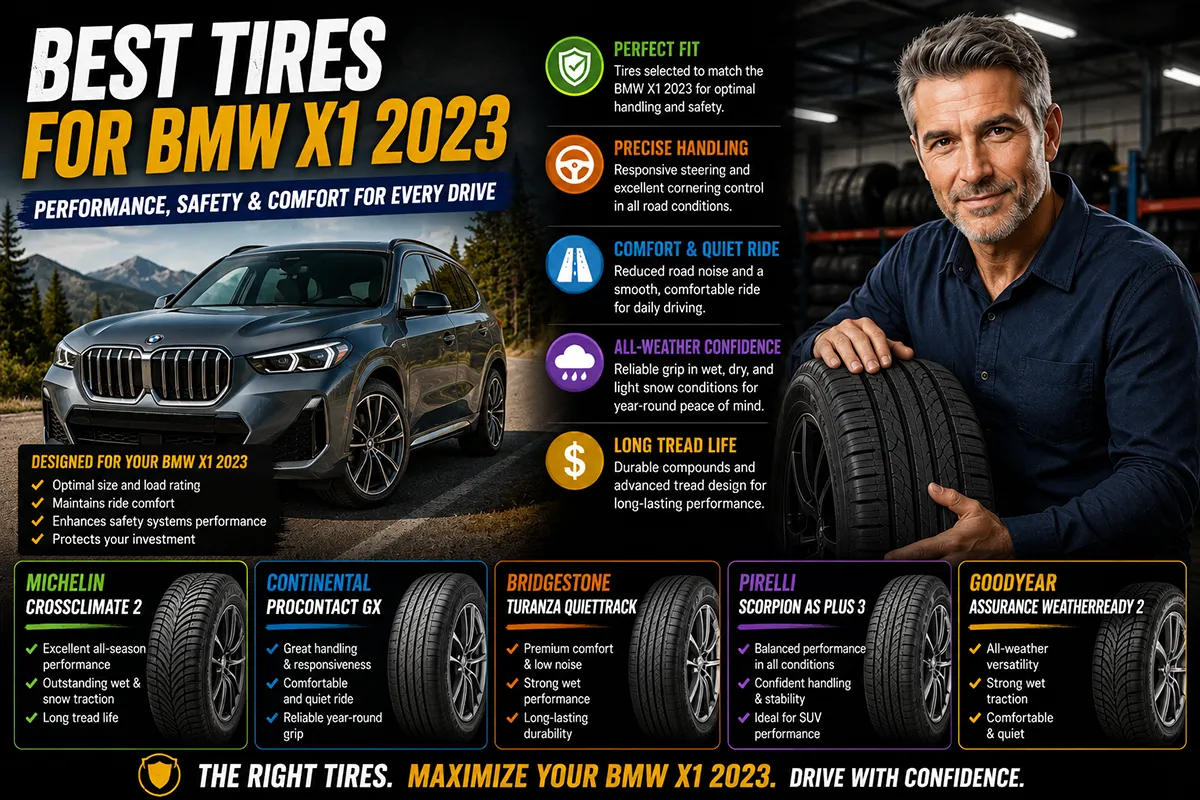
The 2023 BMW X1 (U11 generation) is a genuine sport-tuned compact luxury SUV, and tire choice has a real, felt impact on how it rides, handles, and sounds.
This generation remains in production through the current model year, so the guidance here applies whether you own a 2023, 2024, 2025, or current model.
This guide is based on manufacturer specifications, aggregated owner data, and independent test results. Here’s what actually holds up, by priority.
- Best overall: Michelin Pilot Sport 4 SUV.
- Best all-season: Continental CrossContact RX.
- Best value: Vredestein Quatrac Pro.
- Best for winter: Bridgestone Blizzak WS90.
- Best for comfort: Pirelli Scorpion AS Plus 3.
- Best ultra-high performance: Goodyear Eagle F1 Asymmetric 5.
- Best all-weather, no swap: Michelin CrossClimate2.
- The X1 (U11) uses 225/55R18 standard, 245/45R19 optional, or 245/40R20 on the M35i — full sizing and an honest run-flat discussion are below.
Liked this article?
Add TireAdvise as a preferred source so you see more of our tire reviews and guides on Google.
A Genuinely Important Sizing Correction
This is worth addressing directly, since getting tire size wrong is a real, common, and entirely avoidable mistake. The current U11-generation X1 (2023–present) uses 225/55R18 as the standard factory fitment across sDrive28i, xDrive28i, and M Sport trims.
A 245/45R19 size is available as an upgrade on M Sport and X Line packages, and the M35i performance trim steps up to 245/40R20. These three sizes cover essentially every U11 X1 on the road, and they’re consistently confirmed across manufacturer fitment data, independent wheel-fitment databases, and owner forum reports.
It’s worth knowing this generation replaced the previous F48 X1, which used genuinely different sizing — commonly 225/50R17 or 225/45R18 depending on trim and year. If you’re shopping for an older X1, don’t assume current U11 sizing applies; confirm your specific generation first.
Always confirm the exact size on the driver’s door jamb sticker before ordering, since minor trim and wheel-package variations exist.
Worth knowing separately: BMW also sells a fully electric iX1 on the same U11 platform. It shares chassis dimensions with the gas X1, but confirm your specific model and trim before assuming identical sizing.
How These Were Evaluated
This comparison draws on manufacturer specifications, aggregated owner reports, UTQG ratings, and independent traction, braking, and noise testing for each tire.
Particular weight went to how each tire’s real-world character matches how X1 owners actually drive. This is a genuinely sport-tuned compact SUV, so handling and steering feel carry real weight alongside comfort and daily usability.
Where specific figures or comparisons are cited, the source is noted rather than presented as a personal measurement.
Quick Comparison: 11 Best Tires for the BMW X1 2023
| Tire | Best For | Approx. Price/Tire | 3PMSF Rated | Warranty |
|---|---|---|---|---|
| Michelin Pilot Sport 4 SUV | Best overall | $190–$220 | No | Not specified |
| Continental CrossContact RX | Best all-season | $170–$210 | No | Not specified |
| Vredestein Quatrac Pro | Best value | $140–$170 | Yes | Not specified |
| Bridgestone Blizzak WS90 | Best winter | $160–$190 | Yes | Seasonal (no summer warranty) |
| Pirelli Scorpion AS Plus 3 | Best for comfort | $175–$205 | No | 70,000 mi |
| Goodyear Eagle F1 Asymmetric 5 | Best UHP | $180–$215 | No | Not specified |
| Michelin CrossClimate2 | All-weather, no swap | $180–$230 | Yes | 60,000–85,000 mi (size dependent) |
| Continental ExtremeContact DWS06 Plus | Performance all-season | $170–$230 | Yes | Not specified |
| Bridgestone Turanza QuietTrack | Quiet touring | $160–$200 | No | 80,000 mi |
| Michelin X-Ice Snow | Extreme cold | $150–$210 | Yes | 40,000 mi |
| Kumho Crugen HP71 | Budget option | $110–$150 | No | 60,000 mi |
Prices are street prices at major online retailers for common X1 sizes (225/55R18) as of mid-2026. Expect regional and seasonal swings, and the 19- and 20-inch fitments run above these ranges.
BMW X1 (U11) OEM Tire Info
Most 2023-and-later X1 models ship from the factory with Bridgestone Turanza T005 run-flat tires, marked with BMW’s star (★) designation indicating a vehicle-specific tune.
The X1 doesn’t come with a spare tire, relying instead on run-flat technology and a tire mobility kit. If switching to conventional tires, carrying a compact spare or a quality plug kit and portable inflator is a genuinely sensible precaution.
Should You Even Replace Your Factory Tires?
If your factory run-flat tires are wearing evenly and the ride still feels acceptable, replacing like-for-like is a reasonable, low-risk approach.
That said, many X1 owners find switching to non-run-flat options delivers a genuinely noticeable ride-quality and noise improvement — more on that trade-off below.
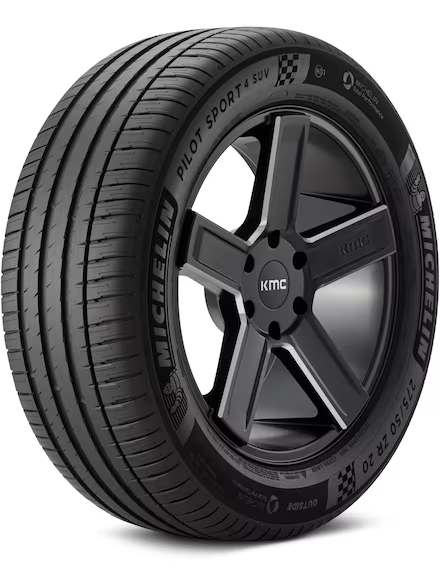
1. Michelin Pilot Sport 4 SUV: Best Overall
Price Check
Check the price of this tire at the following retailers:
This tire genuinely unlocks the X1’s sport-tuned chassis, and it’s a strong pick for owners who want the car to feel the way BMW engineered it.
An asymmetric tread pattern with a rigid outer shoulder delivers exceptional cornering stability, and turn-in response is genuinely immediate — real, felt steering feedback that can feel vague on lesser tires.
Wet performance is a real strength. Independently reported testing places this tire among the strongest performers for hydroplaning resistance, with meaningfully shorter wet braking distances compared to typical OEM run-flat tires.
Pros: Genuine dry and wet grip, sharp and connected steering feel, respectable comfort for a performance tire.
Cons: Summer-only, shorter tread life than touring all-season options.
2. Continental CrossContact RX: Best All-Season
Price Check
Check the price of this tire at the following retailers:
For X1 owners who need one tire to handle everything the US climate offers, this tire delivers genuinely strong year-round performance.
Independently reported noise testing places this tire among the quieter options in its category, with a real, noticeable comfort improvement over factory run-flat tires. Wet grip is a genuine strength, with confident performance even on standing water.
Dry handling is competent and predictable, without quite matching the razor-sharp edge of the Pilot Sport 4 SUV — an honest, reasonable trade-off for the comfort gained.
Pros: Genuine wet-weather strength, real comfort improvement over factory run-flats, confident dry handling.
Cons: Not as sporty as summer tires, limited in heavy snow.
3. Vredestein Quatrac Pro: Best Value

Price Check
Check the price of this tire at the following retailers:
This Dutch-engineered tire delivers genuinely strong performance for the price, with a surprisingly sporty character for an all-season option.
Real owner reports describe composed handling through winding roads without the mushy, disconnected feeling common in value-oriented tires. Wet performance is solid — not quite matching the Continental’s level, but genuinely safe and predictable.
The value proposition is real: typically $30–$50 less per tire than premium brands, adding up to meaningful savings across a full set, with genuine 3PMSF certification adding real all-weather versatility.
Pros: Genuine value with real all-weather capability, surprisingly sporty handling, even wear characteristics.
Cons: More road noise than the Continental, limited US dealer availability.
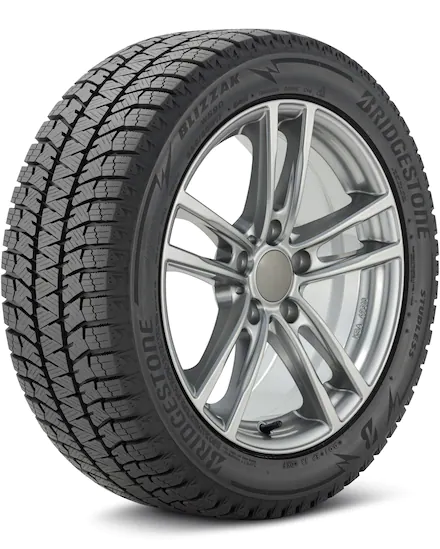
4. Bridgestone Blizzak WS90: Best for Winter
Price Check
Check the price of this tire at the following retailers:
For X1 owners in genuinely snowy regions, this is the benchmark winter tire, and no all-season option in this comparison matches it once conditions turn severe.
Bridgestone’s MultiCell compound technology actively draws water away from ice, delivering real, documented traction improvements. Paired with the X1’s xDrive system, the confidence this tire provides on packed snow is genuinely transformative.
Independently reported ice-braking testing shows dramatically shorter stopping distances than all-season tires — a real, safety-relevant margin. This is a seasonal tire that must come off once temperatures consistently climb above 45°F.
Pros: Best-in-comparison ice and snow traction, genuine cold-weather compound flexibility, surprisingly smooth ride on cold pavement.
Cons: Seasonal use only, not available in 19-inch for the X1.
5. Pirelli Scorpion AS Plus 3: Best for Comfort
Price Check
Check the price of this tire at the following retailers:
For X1 owners who prioritize a smoother ride over apex-chasing, this tire delivers genuine cushioning that suits the X1’s naturally firm suspension well.
Real owner reports describe road expansion joints and coarse pavement transmitting noticeably less harshness through the cabin. Noise levels are genuinely among the lowest in this comparison, with the tire fading into the background at highway speed.
Handling is good but not sharp — a real, honest trade-off, with somewhat more body roll and less turn-in precision than the Michelin or Continental. Backed by a strong 70,000-mile treadwear warranty.
Pros: Genuinely quiet, plush ride, strong 70,000-mile warranty, confident wet traction.
Cons: Less sporty feel, not ideal for aggressive cornering.
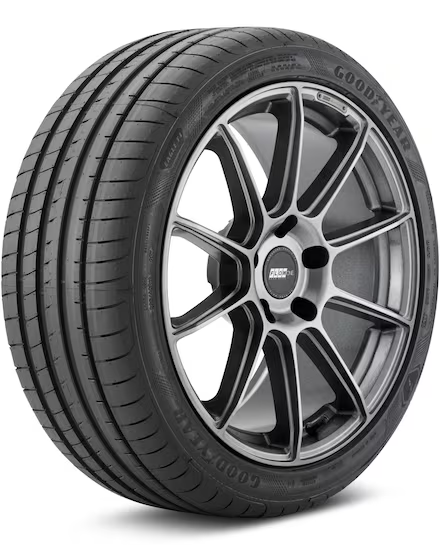
6. Goodyear Eagle F1 Asymmetric 5: Best Ultra-High Performance
Price Check
Check the price of this tire at the following retailers:
For X1 owners who treat their compact SUV like a hot hatch, this tire delivers genuinely phenomenal dry grip.
During hard cornering, the tire holds on with real tenacity, and breakaway is progressive and predictable when pushed past the limit. Wet performance is equally strong, with Goodyear’s asymmetric tread design channeling water efficiently for confident braking in both conditions.
The trade-offs are real and worth knowing: road noise is genuinely higher than any other tire in this comparison, and ride comfort is firm, bordering on harsh over rough pavement. This is a summer-only tire with no cold-weather capability.
Pros: Genuine maximum dry and wet grip, real steering feedback, some of the shortest braking distances in this comparison.
Cons: Noisiest tire in this comparison, firm ride, no winter capability.
7. Michelin CrossClimate2: Best All-Weather, No Seasonal Swap

Price Check
Check the price of this tire at the following retailers:
For X1 owners who don’t want a dedicated winter tire but face real winter weather often enough that a standard all-season tire feels risky, this offers a genuine middle path.
It carries real 3PMSF certification and delivers significantly better cold-weather performance than a typical all-season tire, without requiring the seasonal changeover a dedicated winter tire demands.
A V-shaped tread with dense biting edges maintains solid traction in light to moderate snow, and dry-weather handling and tread life remain respectable — genuinely useful for owners in variable-climate regions who want one set of tires year-round.
Pros: Genuine 3PMSF-rated winter capability without seasonal swapping, respectable dry handling, wide size availability.
Cons: Doesn’t match a dedicated winter tire on ice, premium price.
8. Continental ExtremeContact DWS06 Plus: Best Performance All-Season

Price Check
Check the price of this tire at the following retailers:
The “DWS” name — Dry, Wet, Snow — reflects genuine three-season capability, with sidewall markings that visibly wear away to indicate remaining condition-specific performance.
Dry handling is impressively sharp for an all-season tire, genuinely close to summer-tire steering response, and wet grip is outstanding, with confident, predictable braking in standing water. This tire carries real 3PMSF certification.
For X1 owners who want a sportier all-season alternative to the Continental CrossContact RX, this delivers a real step up in dry-condition sharpness.
Pros: Genuine dry/wet/snow versatility, sharp handling for an all-season tire, real 3PMSF winter certification.
Cons: Premium price, not a substitute for dedicated winter tires in severe conditions.
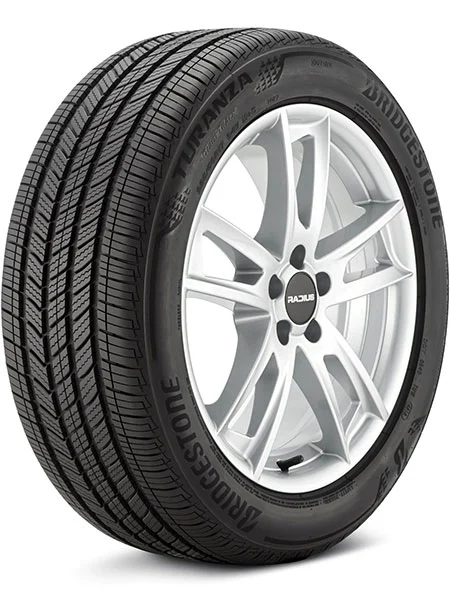
9. Bridgestone Turanza QuietTrack: Best Quiet Touring
Price Check
Check the price of this tire at the following retailers:
This tire is purpose-built around a genuinely serene cabin experience, using in-groove quiet tracks specifically engineered to break up the noise patterns that cause tire hum.
Comfort extends beyond noise. A rounded contact-patch design absorbs road imperfections effectively, and non-uniform pitch sequencing prevents the harmonics that plague lesser touring tires.
Backed by an 80,000-mile warranty — among the strongest in this comparison — with real, dependable wet traction from wide circumferential grooves.
Pros: Genuinely class-leading noise reduction, strong 80,000-mile warranty, confident wet-weather grip.
Cons: Premium price, not built for aggressive driving.
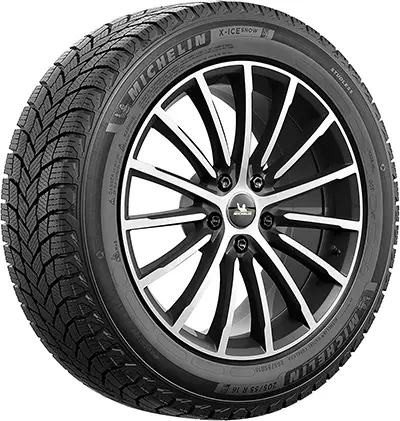
10. Michelin X-Ice Snow: Best for Extreme Cold
Price Check
Check the price of this tire at the following retailers:
For X1 owners facing genuinely severe winter conditions, this tire delivers real, documented ice performance through Michelin’s FleX-Ice compound, which stays flexible in extreme cold.
Cross Z Sipes create micro-pumps that actively absorb water from icy surfaces, genuinely improving contact and traction, and the tire’s tread block design provides real stability during cornering and braking.
Backed by a notable 40,000-mile warranty — genuinely strong for a dedicated winter tire, where many competitors offer no summer-style coverage at all.
Pros: Genuine ice-specific traction, real winter-specific cornering stability, notable 40,000-mile warranty for a winter tire.
Cons: Premium price, seasonal use only.
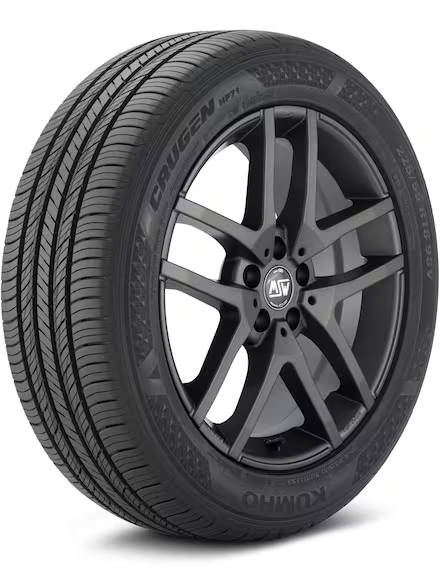
11. Kumho Crugen HP71: Best Budget Option
Price Check
Check the price of this tire at the following retailers:
This tire delivers genuinely dependable all-season performance at a price well below most competitors in this comparison.
A silica-enhanced compound provides real grip in both wet and dry conditions, and a design tuned for crossovers delivers respectable ride comfort for the price point.
Backed by a 60,000-mile warranty, with real owner reports describing solid, predictable performance for daily driving without significant compromises for the price.
Pros: Genuine value with a strong 60,000-mile warranty, respectable comfort for the price.
Cons: Not 3PMSF rated, doesn’t match premium tires in extreme conditions.
Run-Flat vs. Standard Tires on the X1: What to Consider
This is one of the most common questions X1 owners face, and the honest answer depends on priorities rather than a single universal recommendation.
The OEM Bridgestone Turanza T005 run-flats let you keep driving after a puncture to reach a shop safely — genuinely useful peace of mind, especially in remote areas or on rural roads with limited shoulder space. But the ride-quality trade-off is real: run-flat tires have reinforced, stiffer sidewalls that transmit more road harshness into the cabin, particularly noticeable on the X1’s sport-tuned suspension.
Switching to standard construction — the Continental CrossContact RX, for example — delivers a genuinely noticeable comfort improvement that many owners describe as feeling like the car was re-sprung. Road noise typically drops as well, since conventional tire construction doesn’t carry the same stiffness penalty.
If switching to conventional tires, carrying a portable tire inflator, a tire plug kit, and confirming roadside assistance coverage through BMW or an auto club are all genuinely sensible precautions given the X1 doesn’t include a spare tire from the factory.
Tire Buying Tips Specific to the X1
Consider your wheel size carefully. Owners running 19-inch wheels who are due for replacement tires might consider whether they actually need that size — many X1 owners who’ve downsized to 18-inch wheels with a taller sidewall report a genuine ride-comfort improvement and more tire options in 225/55R18.
Don’t overlook TPMS considerations. The X1 uses a direct TPMS system. A second set of wheels for winter tires needs additional TPMS sensors, typically $30–$50 each, programmed to the vehicle by a dealer or equipped independent shop.
Get an alignment after installation. The X1’s suspension geometry is precise, and even minor misalignment can cause premature, uneven wear on premium tires. Budget $100–$150 for a quality alignment.
How to Get the Best Price on X1 Tires
Compare across retailers. Tire Rack, Discount Tire, Costco, and SimpleTire all offer competitive pricing, and comparing the total cost including installation, balancing, and rebates is genuinely worth the few minutes it takes.
Watch for manufacturer rebates. Seasonal rebate programs, typically $50–$100 back on a set of four, are common in spring and fall.
Maintaining X1 Tires
Check pressure at least monthly, and always when tires are cold. Confirm the correct PSI on the door jamb sticker, not the tire’s sidewall.
Rotate every 5,000 to 7,500 miles, and note that staggered fitments (if applicable to your trim) can’t be rotated front-to-rear.
Watch for genuine replacement signs: tread depth below 4/32″, uneven wear patterns, sidewall cracks or bulges, or decreased wet-weather performance.
Choosing the Right Tire for a BMW X1
Match tire category to how the car is actually driven. Daily commuters get real, felt value from the Continental CrossContact RX’s balance of comfort and capability. Enthusiast drivers in warm climates get the fullest expression of the X1’s character from the Michelin Pilot Sport 4 SUV.
Don’t skip winter tires facing real cold. The Bridgestone Blizzak WS90 or Michelin X-Ice Snow deliver a genuine, safety-relevant traction advantage no all-season tire in this comparison fully replicates.
Budget doesn’t have to mean giving up real performance. The Vredestein Quatrac Pro and Kumho Crugen HP71 both deliver genuine value without sacrificing core safety.
Frequently Asked Questions
What size tires does a 2023 BMW X1 need?
The U11-generation X1 (2023–present) uses 225/55R18 as the standard factory fitment, with 245/45R19 available as an upgrade on M Sport and X Line packages, and 245/40R20 on the M35i performance trim. Always confirm the exact size on the driver’s door jamb sticker.
What are the best all-season tires for a 2023 BMW X1?
The Continental CrossContact RX, Michelin CrossClimate2, and Continental ExtremeContact DWS06 Plus all deliver strong wet and dry traction, low road noise, and dependable tread life for daily commuting and highway driving.
Does the 2023 BMW X1 need run-flat tires?
The X1 ships with run-flat tires from the factory and doesn’t include a spare, so many owners stick with run-flat replacements for convenience. Switching to standard tires delivers a genuinely noticeable comfort improvement, but requires carrying a portable inflator and repair kit as a precaution.
What are the best winter tires for a 2023 BMW X1 in snow and ice?
The Bridgestone Blizzak WS90 and Michelin X-Ice Snow are the strongest winter picks, dramatically improving braking and cornering grip on snow and ice compared to all-season tires, even on xDrive models.
How long do tires last on a 2023 BMW X1?
Most quality all-season tires last 40,000 to 60,000 miles with proper maintenance, though aggressive driving and misalignment can reduce that significantly. Run-flat tires tend to wear somewhat faster, averaging 35,000 to 50,000 miles.
Are performance tires worth it for the 2023 BMW X1?
If spirited driving matters, high-performance options like the Michelin Pilot Sport 4 SUV or Continental ExtremeContact DWS06 Plus deliver genuinely sharper cornering grip and steering response, though generally at some cost to tread life and comfort compared to touring all-season options.
How much does a full set of replacement tires cost for a 2023 BMW X1?
A full set typically costs $600 to $1,000 installed, depending on brand and tire type. Budget-friendly options like the Kumho Crugen HP71 start around $110–$150 per tire, while premium choices like the Michelin CrossClimate2 run closer to $180–$230 each.
