

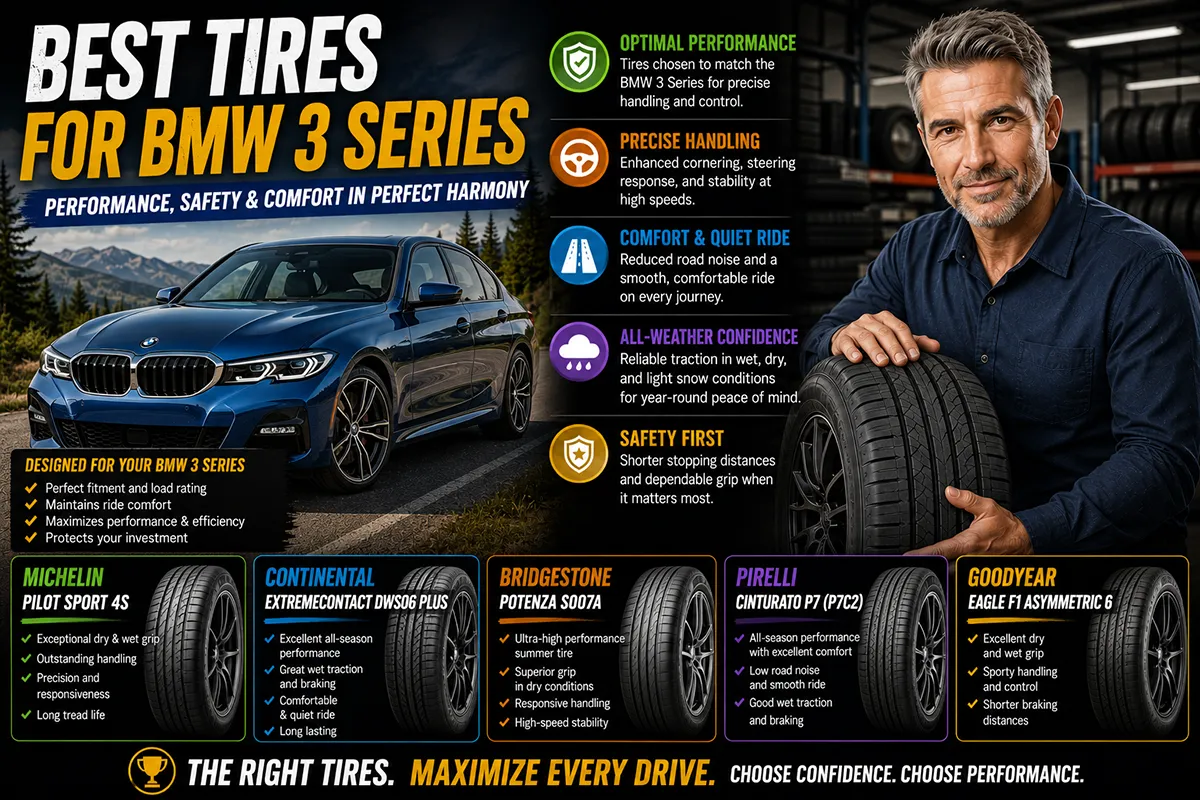
The BMW 3 Series was engineered with near-perfect weight distribution, sharp steering, and a suspension tuned for sport-luxury balance — all of which depends on the right tires to deliver the driving experience BMW intended.
Most 3 Series models also run staggered setups and factory run-flat tires, which means real choices about ride quality, noise, and whether to stick with run-flats at all.
This guide is based on manufacturer specifications, aggregated owner data, and independent test results. Here’s what actually holds up, by priority.
- Best overall: Michelin Pilot Sport 4S.
- Best all-season: Continental ExtremeContact DWS06 Plus.
- Best value: General G-MAX RS.
- Best for comfort: Pirelli Cinturato P7 All Season Plus 3.
- Best winter: Bridgestone Blizzak WS90.
- Best ultra-high performance: Goodyear Eagle F1 Asymmetric 6.
- Best budget performance: Falken Azenis FK510.
- Full sizing by generation and a note on the incoming G50 redesign are below.
Liked this article?
Add TireAdvise as a preferred source so you see more of our tire reviews and guides on Google.
A New Generation Is Arriving — Here’s What’s Changing
This is worth knowing before shopping by an outdated assumption. The current G20-generation 3 Series received an LCI2 mid-cycle facelift for 2025, with a new multi-spoke bicolor wheel design and minor styling updates, but the fundamental sizing and mechanical layout carried over.
The bigger news: BMW’s all-new, eighth-generation 3 Series (internally the G50) is entering production in 2026 for the 2027 model year. It brings BMW’s new “Vision Neue Klasse” design language — a genuinely radical styling departure from the current car — and for the first time in the 3 Series’ history, an electric variant will be offered alongside the traditional gas model, though the two ride on completely different platforms.
Also genuinely notable: the G50 will be the first 3 Series ever sold without a manual transmission option, closing out a chapter for enthusiasts who’ve valued that choice.
None of this changes tire shopping for the millions of G20-generation cars already on the road — this guide is built around that current, widely owned generation. But it’s worth knowing the landscape is about to shift.
How These Were Evaluated
This comparison draws on manufacturer specifications, aggregated owner reports, UTQG ratings, and independent traction, braking, and noise testing for each tire.
Particular weight went to how each tire’s real-world character matches how 3 Series owners actually drive. The car’s near-50/50 weight distribution and sharp steering reward tires that preserve real feedback and grip, while comfort and noise still matter for daily driving.
Where specific figures or comparisons are cited, the source is noted rather than presented as a personal measurement.
Quick Comparison: 11 Best Tires for the BMW 3 Series
| Tire | Best For | Approx. Price/Tire | 3PMSF Rated | Warranty |
|---|---|---|---|---|
| Michelin Pilot Sport 4S | Best overall | $180–$260 | No | Not specified |
| Continental ExtremeContact DWS06 Plus | Best all-season | $160–$220 | Yes | Not specified |
| General G-MAX RS | Best value | $120–$170 | No | Not specified |
| Pirelli Cinturato P7 All Season Plus 3 | Best for comfort | $150–$200 | No | Not specified |
| Bridgestone Blizzak WS90 | Best winter | $140–$190 | Yes | Seasonal (no summer warranty) |
| Goodyear Eagle F1 Asymmetric 6 | Best UHP | $170–$240 | No | Not specified |
| Falken Azenis FK510 | Best budget performance | $110–$160 | No | Not specified |
| Michelin Pilot Sport All Season 4 | Best all-season performance | $190–$260 | No | 45,000 mi |
| Michelin X-Ice Snow | Best extreme cold | $150–$210 | Yes | 40,000 mi |
| Bridgestone Potenza Sport A/S | Sportier all-season alternative | $170–$230 | No | Not specified |
| Bridgestone DriveGuard Plus | Best run-flat replacement | $160–$220 | No | Not specified |
Prices are street prices at major online retailers for common G20 sizes (225/45R18 front, 255/40R18 rear, or the 19-inch equivalents) as of mid-2026. Expect regional and seasonal swings.
BMW 3 Series Tire Sizes: Know What You Need
Confirm the exact size on the driver’s door jamb sticker before ordering — the 3 Series comes in several configurations depending on generation, trim, and wheel package.
Standard (non-staggered) fitments include 225/50R17 on base 17-inch wheels (F30 generation), 225/45R18 on standard 18-inch wheels (F30 and G20), and 225/40R19 on 19-inch M Sport wheels.
Staggered fitments commonly run 225/45R18 front / 255/40R18 rear, or 225/40R19 front / 255/35R19 rear on M Sport packages. M340i models typically run a staggered 19×8 front / 19×8.5 rear setup on 225/40R19 and 255/35R19, with an 18-inch 225/45R18 / 255/40R18 winter wheel option.
If you’re running a staggered setup, tires can’t be rotated front-to-rear, which makes even wear and regular alignment more important than on a square setup.
What About the M340i and M3?
The M340i’s 386 horsepower and the M3’s 473–503 horsepower demand tires built to handle real additional torque and lateral load.
For the M340i, the Michelin Pilot Sport 4S or Goodyear Eagle F1 Asymmetric 6 are the strongest picks without compromise. The Continental ExtremeContact DWS06 Plus is a reasonable choice if all-season capability matters more than outright performance, with an honest trade-off in ultimate grip.
For M3 owners who track the car regularly, a genuine semi-slick option like the Michelin Pilot Sport Cup 2 delivers real, extraordinary grip but wears faster and offers minimal wet-weather capability. For street-focused M3 driving, the Pilot Sport 4S remains the strongest all-around recommendation.
Run-Flat vs. Standard Tires: What to Consider
This is one of the most common questions 3 Series owners face, and it deserves a direct answer.
Most 3 Series models ship from the factory with run-flat tires — typically Bridgestone Turanza or Pirelli Cinturato run-flat variants — since BMW doesn’t include a spare tire. Run-flats have reinforced sidewalls that let you drive a limited distance on a flat to reach a service center.
Switching to conventional tires is genuinely one of the more noticeable ride-quality upgrades available for a 3 Series. Run-flats’ stiffer sidewalls transmit real, felt road harshness into the cabin, and every conventional tire in this comparison is quieter than its run-flat equivalent.
The case for keeping run-flats is real too: in areas with rough roads, potholes, and limited shoulder space, the peace of mind of driving on a flat rather than being stranded roadside has genuine value. If switching to conventional tires, carrying a quality tire repair kit and portable inflator — roughly $40–$60 — is cheap, sensible insurance.
1. Michelin Pilot Sport 4S: Best Overall

Price Check
Check the price of this tire at the following retailers:
This is Michelin’s flagship ultra-high-performance tire, and it’s widely regarded as the tire that lets a 3 Series feel like it was truly designed to feel.
An asymmetric tread pattern with a rigid outer shoulder delivers exceptional cornering stability, and the steering response is genuinely sharper and more connected than most alternatives in this comparison. Dry grip is extraordinary, with real headroom before the tire approaches its limits on winding roads.
Wet performance is where this tire truly separates itself. Independently reported testing consistently places it among the strongest performers for hydroplaning resistance and wet braking in the max-performance summer category.
Pros: Genuine wet and dry grip balance, sharp and connected steering feel, respectable tread life for the category.
Cons: Summer-only — becomes unsafe below roughly 40°F, premium price.
2. Continental ExtremeContact DWS06 Plus: Best All-Season

Price Check
Check the price of this tire at the following retailers:
For 3 Series owners who don’t want seasonal tire swaps, this tire delivers genuine year-round confidence without a major performance compromise.
The “DWS” name — Dry, Wet, Snow — reflects real three-season capability, with sidewall markings that visibly wear away to indicate remaining condition-specific performance. Dry handling is impressively sharp for an all-season tire, genuinely close to summer-tire steering response and cornering grip.
Wet grip is outstanding, arguably class-leading in the ultra-high-performance all-season category, with confident, predictable braking in standing water. This tire carries real 3PMSF certification, providing adequate light-snow traction, though a dedicated winter tire remains the better choice for persistent heavy snow.
Pros: Genuine dry/wet/snow versatility, sharp handling for an all-season tire, real 3PMSF winter certification.
Cons: Not a substitute for dedicated winter tires in severe conditions, premium price.
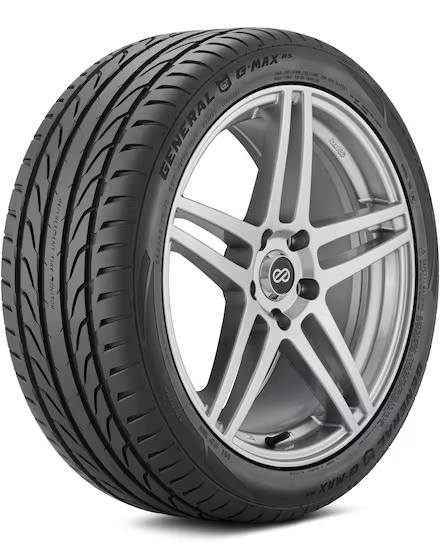
3. General G-MAX RS: Best Value
Price Check
Check the price of this tire at the following retailers:
This tire delivers genuinely competitive sport performance at a price that undercuts most premium alternatives significantly.
General shares underlying technology with Continental, and in dry conditions, lateral grip is genuinely competitive with tires costing 40% more. Steering doesn’t feel quite as razor-sharp as the Michelin or Continental options, but it remains communicative and confidence-inspiring.
The honest trade-off shows up in wet conditions, where braking distances run slightly longer and steering feedback is a touch less precise in heavy rain. Ride comfort is surprisingly good for the price, and moderate road noise stays well short of intrusive.
Pros: Genuine near-premium dry grip at a meaningfully lower price, respectable comfort for the category.
Cons: Wet performance trails premium options, not built for winter conditions.
4. Pirelli Cinturato P7 All Season Plus 3: Best for Comfort
Price Check
Check the price of this tire at the following retailers:
For 3 Series owners who prioritize highway comfort over apex-chasing, this tire delivers a genuinely quiet, smooth ride.
Independently reported noise testing places this tire among the quietest in the touring category, and real owner reports describe a noticeably calmer cabin compared to OEM run-flat tires at highway speeds. Ride comfort is exceptional, with road imperfections absorbed in a cushioned, composed way that suits the 3 Series’ luxury side.
The trade-off is honest: steering feel is more relaxed and ultimate cornering grip trails the sportier options in this comparison. Treadwear projections look strong, with a generous warranty backing real-world longevity.
Pros: Genuinely quiet, comfortable ride, strong treadwear performance, confident wet-weather grip.
Cons: Less dynamic sharpness than performance-focused options, not built for winter conditions.
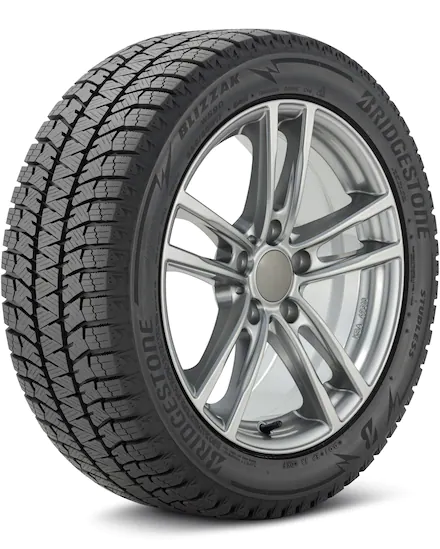
5. Bridgestone Blizzak WS90: Best Winter
Price Check
Check the price of this tire at the following retailers:
For 3 Series owners in genuine Snow Belt conditions, this is the benchmark winter tire, and no all-season option in this comparison comes close in true winter conditions.
Bridgestone’s MultiCell compound technology actively absorbs the thin water layer that forms on ice, creating real, documented friction improvements. Grip on packed snow is genuinely transformative, particularly valuable for RWD 3 Series models without xDrive.
Independently reported ice-braking testing shows dramatically shorter stopping distances compared to all-season tires — a real, safety-relevant margin. This is a seasonal tire that must come off once temperatures consistently climb above 45°F, and mounting a dedicated second set of wheels makes seasonal swaps meaningfully easier.
Pros: Best-in-comparison ice and snow traction, genuinely important for RWD models without AWD.
Cons: Seasonal use only, wears quickly if run in warm weather.
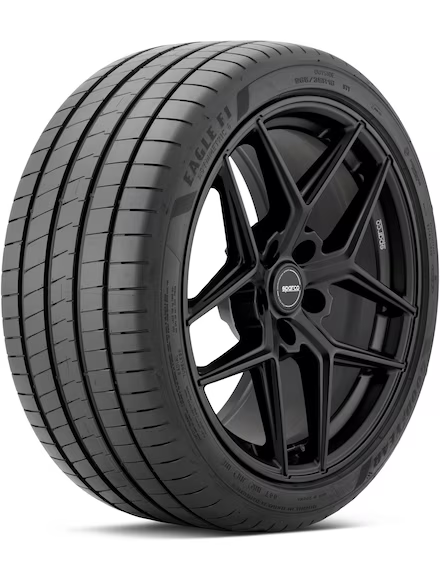
6. Goodyear Eagle F1 Asymmetric 6: Best Ultra-High Performance
Price Check
Check the price of this tire at the following retailers:
For 3 Series owners who track the car, run autocross events, or genuinely push canyon roads, this tire competes directly with the Pilot Sport 4S at the flagship level.
Dry grip is immense, with the tire communicating progressively through the steering as it approaches its limit, and turn-in response is genuinely razor-sharp — the car feels nimble and eager rather than compromised.
In back-to-back independently reported comparisons, this tire matches the Michelin closely in dry grip and comes close in wet conditions, with a genuine edge in tread-wear longevity. Pricing is competitive too, often coming in $10–$20 less per tire than the Pilot Sport 4S.
Pros: Genuine flagship-level dry grip and steering feedback, respectable tread life, competitive pricing versus the Michelin.
Cons: Summer-only, not built for winter conditions.
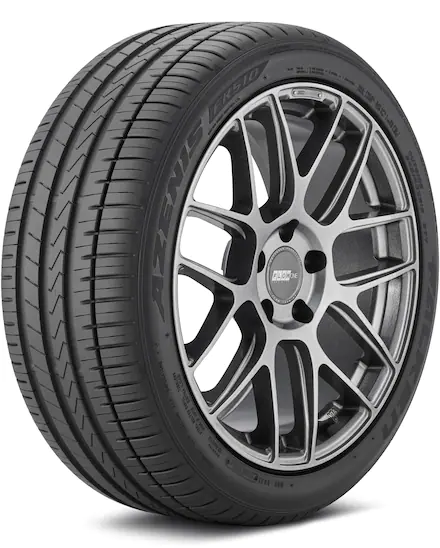
7. Falken Azenis FK510: Best Budget Performance
Price Check
Check the price of this tire at the following retailers:
This tire delivers approximately 85–90% of the performance of premium-tier options at roughly 70% of the price — a genuinely compelling value proposition for 3 Series owners.
A hybrid asymmetric tread pattern with wide shoulder blocks maximizes road contact during aggressive cornering, and Falken’s 4D Nano Design technology genuinely enhances wet grip while improving wear resistance at the molecular level.
Real owner reports describe grip and handling that rivals pricier brands in everyday spirited driving, with well-controlled road noise even at highway speeds.
Pros: Genuine near-premium performance at a meaningfully lower price, confident wet-weather grip, well-controlled road noise.
Cons: Not built for winter conditions, doesn’t quite match flagship tires at the absolute limit.
8. Michelin Pilot Sport All Season 4: Best All-Season Performance

Price Check
Check the price of this tire at the following retailers:
For 3 Series owners who want dry performance approaching a dedicated summer tire without giving up year-round usability, this tire offers a genuine middle path.
Michelin’s Helio+ technology, using sunflower oil and extreme silica, keeps the compound flexible as temperatures drop without sacrificing warm-weather grip — real, meaningful capability beyond what a pure summer tire offers once fall arrives.
Cold-weather capability genuinely separates this tire from the rest of this comparison, continuing to deliver confident grip below 45°F where dedicated summer tires become unsafe. Backed by a 45,000-mile warranty, with real steering precision that closely tracks the sportier all-season options here.
Pros: Genuine near-summer-tire dry performance, real cold-weather and light-snow capability, strong 45,000-mile warranty.
Cons: Doesn’t replace a dedicated winter tire in severe conditions, premium price.
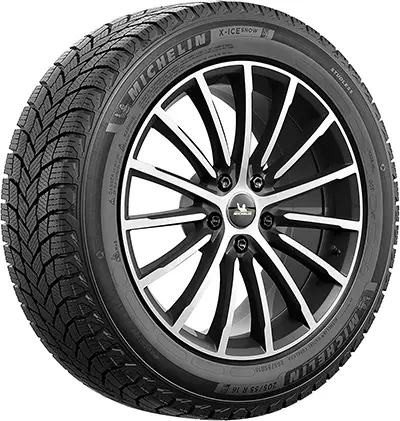
9. Michelin X-Ice Snow: Best for Extreme Cold
Price Check
Check the price of this tire at the following retailers:
For 3 Series owners facing genuinely severe winter conditions, this tire delivers real, documented ice performance through Michelin’s FleX-Ice compound, which stays flexible in extreme cold where lesser compounds stiffen and lose grip.
Cross Z Sipes create micro-pumps that actively absorb water from icy surfaces, genuinely improving contact and traction, and the tire’s tread block design provides real stability during cornering and braking — important for maintaining the 3 Series’ handling character in winter.
Backed by a notable 40,000-mile warranty — genuinely strong for a dedicated winter tire, where many competitors offer no summer-style coverage at all.
Pros: Genuine ice-specific traction, real winter-specific cornering stability, notable 40,000-mile warranty for a winter tire.
Cons: Premium price, seasonal use only.
10. Bridgestone Potenza Sport A/S: Sportier All-Season Alternative
Price Check
Check the price of this tire at the following retailers:
For 3 Series owners who want a sportier all-season alternative to the Continental DWS06 Plus, this tire delivers genuinely direct steering response.
A specialized compound and optimized contact patch translate steering inputs to immediate action, and real owner reports describe confident traction on both dry and wet surfaces above 45°F, with genuinely short braking distances.
Cornering stability is a real strength, with rigid sidewall construction minimizing flex during aggressive maneuvers, letting drivers fully exploit the 3 Series’ handling capabilities with real, confidence-inspiring lateral grip.
Pros: Genuine track-derived grip and responsiveness, strong cornering stability, reasonable comfort for a performance-leaning all-season tire.
Cons: Premium price, not built for winter conditions.
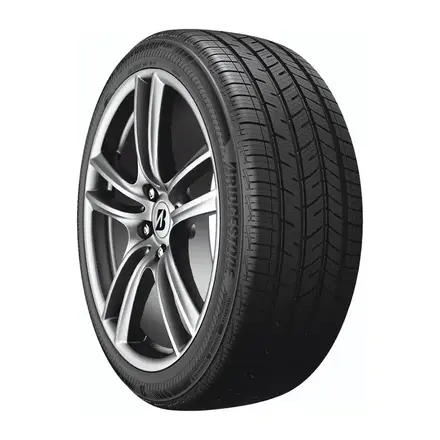
11. Bridgestone DriveGuard Plus: Best Run-Flat Replacement
Price Check
Check the price of this tire at the following retailers:
For 3 Series owners who want to stay with run-flat technology but move beyond the factory-fitted option, this tire delivers a genuinely improved experience.
Reinforced sidewall construction maintains the ability to drive a limited distance after a puncture, and Bridgestone’s updated compound and tread design deliver real, meaningful comfort improvements over older-generation run-flat tires — a common owner complaint with factory-fitted OE run-flats.
Real owner reports describe a noticeably smoother ride than typical run-flat construction, without giving up the genuine peace-of-mind benefit of continued drivability after a flat.
Pros: Genuine comfort improvement over typical run-flat construction, real continued-drivability after a puncture, no spare tire required.
Cons: Doesn’t match the ride quality of non-run-flat alternatives, premium price.
How to Get the Best Price on BMW 3 Series Tires
Compare across major retailers. Tire Rack, Discount Tire, and SimpleTire prices can vary by $15–$30 per tire for the same product, making a quick comparison genuinely worthwhile.
Watch for manufacturer rebates. Michelin, Continental, and Goodyear all run seasonal rebate programs, typically $70–$100 back on a set of four, with timing around these promotions saving real money.
Buy the full set at once. Mixing tire brands or ages on a 3 Series can genuinely degrade handling balance. Replace in complete sets, or at minimum in pairs (both fronts or both rears).
Factor in installation costs. Ordering online and shipping to a local installer often saves $20–$40 per tire versus buying directly from a dealership.
Maintenance Tips to Maximize Tire Life
Check pressure at least biweekly. BMW’s TPMS alerts to significant pressure drops but won’t catch slow leaks or gradual seasonal changes. Confirm the correct PSI (typically 32–36) on the door jamb placard.
Get an alignment after installation. This is genuinely non-negotiable — the 3 Series’ suspension geometry is sensitive to alignment specs, and even small deviations can cause rapid edge wear on premium tires. Budget $100–$150 for a quality alignment.
Rotate when possible. Square setups can rotate every oil change or few months of driving. Staggered setups can’t rotate front-to-rear, but swapping left-to-right helps equalize wear patterns.
Watch for genuine replacement signs: tread depth below 4/32″, uneven wear patterns, sidewall cracks or bulges, or decreased wet-weather performance.
Choosing the Right Tire for a BMW 3 Series
Match tire category to how the car is actually driven. Daily commuters in mild climates get real, felt value from the Continental ExtremeContact DWS06 Plus’s all-season versatility. Warm-climate enthusiasts get the fullest expression of the car’s capability from the Michelin Pilot Sport 4S.
Don’t skip winter tires facing real cold. The Bridgestone Blizzak WS90 or Michelin X-Ice Snow deliver a genuine, safety-relevant traction advantage no all-season tire in this comparison fully replicates — especially important on RWD models without xDrive.
Budget doesn’t have to mean giving up real performance. The General G-MAX RS and Falken Azenis FK510 both deliver genuine capability at meaningfully lower prices.
Confirm which generation you own before shopping. With the all-new G50 entering production in 2026, don’t assume specs for the outgoing G20 apply to a future model, or vice versa.
Frequently Asked Questions
What are the best all-season tires for a BMW 3 Series?
The Continental ExtremeContact DWS06 Plus and Michelin Pilot Sport All Season 4 are widely regarded as the strongest all-season options, balancing year-round traction with the sporty handling 3 Series owners expect. The Bridgestone Potenza Sport A/S is a strong alternative if dry performance matters more than all-season versatility.
What tire size does a BMW 3 Series use?
It depends on generation and trim. Most models run 225/45R18 or 225/50R17 up front, with staggered setups pairing that with a wider rear size like 255/40R18. M Sport and M340i trims commonly step up to 225/40R19 front / 255/35R19 rear. Always check the door jamb placard for your exact specification.
Are run-flat tires worth it for a BMW 3 Series?
It depends on priorities. Run-flats let you drive a limited distance on a flat since the 3 Series doesn’t include a spare, offering real peace of mind, especially on rough roads with limited shoulder space. Switching to conventional tires delivers a genuinely smoother, quieter ride and can save $30–$60 per tire, but requires carrying a repair kit and portable inflator.
What are the best winter tires for a BMW 3 Series in snow?
The Bridgestone Blizzak WS90 and Michelin X-Ice Snow are the top winter choices, providing outstanding cold-weather grip even on rear-wheel-drive models without xDrive. Mounting winter tires on a dedicated set of wheels makes seasonal swaps easier and protects factory rims from road salt.
How long do tires last on a BMW 3 Series?
Most all-season tires last 30,000 to 50,000 miles, while high-performance summer tires may wear out in 20,000 to 25,000 miles due to softer compounds. The sport-tuned suspension puts real additional stress on tread edges, so regular rotation and annual alignment checks genuinely extend tread life.
Can I put cheaper tires on my BMW 3 Series?
Yes, and options like the General G-MAX RS or Falken Azenis FK510 deliver solid performance without sacrificing core safety. Ultra-cheap, no-name tires are worth avoiding, since the 3 Series relies heavily on tire quality for handling, braking, and stability control effectiveness.
Is there a new BMW 3 Series coming?
Yes. BMW’s all-new eighth-generation 3 Series (G50) enters production in 2026 for the 2027 model year, bringing a radical new design language and, for the first time in the nameplate’s history, an electric variant alongside the gas model — though the two ride on different platforms. It will also be the first 3 Series never offered with a manual transmission.
