

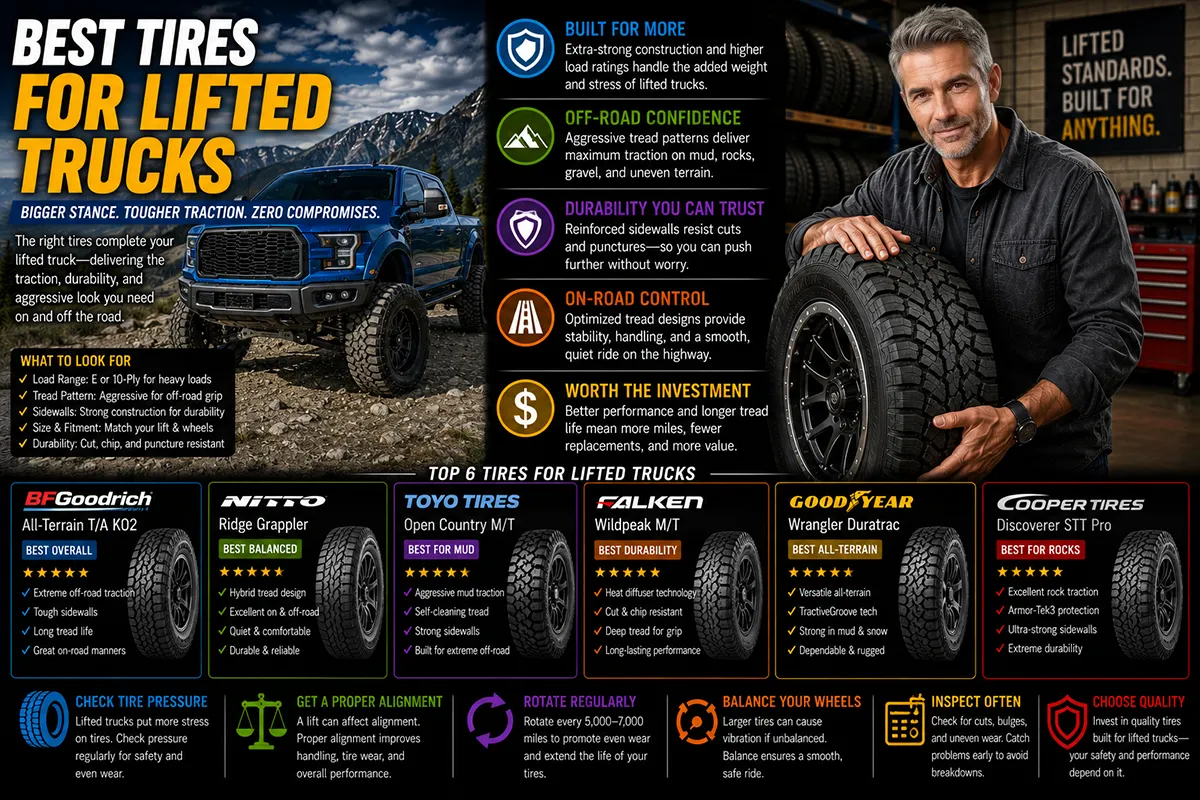
Finding the right tires for a lifted truck is one of the more frustrating shopping experiences in the automotive world. Real money already went into the suspension, and the rubber needs to match both the look and the actual capability of the rig.
The wrong choice means highway noise that ruins a daily commute, premature wear that wastes hundreds of dollars, or tires that look aggressive but turn into hockey pucks the moment they hit a wet trail.
This guide is based on manufacturer specifications, aggregated owner data, and independent traction and durability testing across all-terrain, mud-terrain, and hybrid categories. Here’s what actually holds up, by priority.
- Best overall: BFGoodrich All-Terrain T/A KO3 — the improved successor to the long-standing KO2, with real gains in snow traction and durability.
- Best mud-terrain: Nitto Trail Grappler M/T.
- Best budget pick: Falken Wildpeak AT3W.
- Best for daily driving: Toyo Open Country AT III.
- Best aggressive look: Mickey Thompson Baja Boss A/T.
- Lifted trucks need tires rated for higher load capacities — always check the load index before buying.
- 33-inch to 37-inch tires are the sweet spot for most lifted trucks; going bigger requires regearing.
Liked this article?
Add TireAdvise as a preferred source so you see more of our tire reviews and guides on Google.
What to Know Before Buying Tires for a Lifted Truck
A few fundamentals matter more here than on a stock truck, and getting them wrong costs real money.
Tire size scales with lift height. A 2- to 3-inch lift typically accommodates 33-inch tires without rubbing. A 4- to 6-inch lift opens the door to 35-inch tires, and anything beyond usually requires 37s or larger with more significant modification.
Running the largest tire that fits comfortably without trimming or wheel spacers is generally the right approach — bigger isn’t automatically better, since oversized tires on an under-lifted truck create clearance problems and accelerate wear on steering components.
Load rating is non-negotiable. Lifted trucks are heavier than stock, between the lift kit, heavier wheels, skid plates, and bumpers — often an extra 300 to 500 pounds over factory weight. LT (Light Truck) rated tires with a load range of at least C, and preferably D or E for heavier rigs, are the right call. Passenger-rated tires on a heavily modified three-quarter-ton truck are a genuine, avoidable safety risk.
All-terrain versus mud-terrain is mostly a math problem. Roughly 80% of lifted truck owners are genuinely best served by a quality all-terrain tire. Mud-terrains look dramatic, but unless deep mud, rock crawling, or serious overlanding happens regularly, the noise and reduced highway tread life become a real, ongoing frustration. All-terrain tires have improved enough in recent years that many rival mud-terrains in off-road grip while staying civilized on the highway.
How These Were Evaluated
This comparison draws on manufacturer specifications, aggregated owner reports, and independently reported on-road noise and comfort testing, off-road traction across gravel, dirt, sand, mud, and rock, and long-term durability data for each tire.
Where specific figures or comparisons are cited, the source is noted rather than presented as a personal measurement.
Quick Comparison: 10 Best Tires for Lifted Trucks
| Tire | Type | Starting Price | Max Size | Snow Rated | Best For |
|---|---|---|---|---|---|
| BFGoodrich All-Terrain T/A KO3 | A/T | ~$240 | 35″ | Yes | Overall best |
| Nitto Trail Grappler M/T | M/T | ~$280 | 40″ | No | Mud performance |
| Falken Wildpeak AT3W | A/T | ~$170 | 35″ | Yes | Budget pick |
| Toyo Open Country AT III | A/T | ~$215 | 35″ | Yes | Daily driving |
| Mickey Thompson Baja Boss A/T | A/T | ~$250 | 37″ | No | Aggressive look |
| Cooper Discoverer Rugged Trek | Hybrid | ~$200 | 35″ | Yes | Value hybrid |
| Nitto Ridge Grappler | Hybrid | ~$260 | 38″ | No | Best hybrid overall |
| Goodyear Wrangler DuraTrac | A/T (aggressive) | ~$220 | 35″ | Yes | Snow and ice |
| Toyo Open Country M/T | M/T | ~$300 | 40″ | No | Heavy-duty M/T |
| General Grabber A/TX | A/T | ~$175 | 33″ | Yes | Under-the-radar value |
Prices are street prices for common LT265/70R17 sizing as of mid-2026. Expect variation by size.
1. BFGoodrich All-Terrain T/A KO3: Best Overall

Price Check
Check the price of this tire at the following retailers:
BFGoodrich retired the long-standing KO2 in favor of the KO3, and for lifted truck owners who want one tire that does everything well, the successor genuinely earns the top spot.
CoreGard Max sidewall technology adds reinforced rubber that resists splitting and bruising — real, meaningful protection given how much stress a lifted, aired-down truck puts on sidewalls over sharp rock and debris. The KO3 improves on the KO2’s gravel-road durability, snow traction, and tread wear, and unlike the KO2, it carries the 3PMSF severe-snow rating out of the box.
Independently reported testing describes confidence-inspiring grip across loose desert sand, slushy winter roads, and everything between, with an interlocking tread design that bites into surfaces without feeling excessively aggressive on pavement.
On the highway, road noise is noticeable but not overwhelming, and real owner reports describe genuinely even wear across extended testing — a strong sign the compound is well-engineered for the added weight lifted trucks carry.
Pros: Genuine all-around capability, real durability and snow-traction improvement over the KO2, 3PMSF-rated winter traction out of the box.
Cons: Premium price, not the quietest all-terrain available.
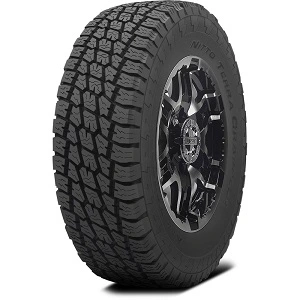
2. Nitto Trail Grappler M/T: Best Mud-Terrain
Price Check
Check the price of this tire at the following retailers:
For owners who want a mud-terrain tire without a genuinely miserable daily commute, this is the strongest pick in that category.
Most mud-terrains sound like a freight train above 50 mph; independently reported testing describes the Trail Grappler keeping cabin noise at a genuinely more reasonable level than most direct competitors. The self-cleaning tread pattern works as advertised in mud, with material packing into the voids and flinging clear within a rotation or two.
On rock, sidewall lugs provide real additional bite when aired down. The honest trade-off: tread wears faster than an all-terrain, a fair cost for genuinely superior off-road grip.
Pros: Genuine exceptional mud and rock traction, quieter than most mud-terrain competitors, available in very large sizes.
Cons: Shorter tread life than all-terrains, reduced fuel economy, premium pricing in larger sizes.
3. Falken Wildpeak AT3W: Best Budget Pick

Price Check
Check the price of this tire at the following retailers:
This tire delivers a genuinely compelling value proposition, typically $50–$80 less per tire than the KO3 while coming close to matching it in most categories.
Independently reported testing describes outstanding wet-weather traction, with a silica tread compound that stays pliable in cold temperatures — the 3PMSF winter rating isn’t marketing dressing, it reflects genuine snow grip. Heat diffuser technology in the lower sidewall protects internal components during demanding towing or extended highway drives.
Real owner reports describe surprisingly composed on-road comfort, with a slightly softer sidewall than pricier competitors — a genuinely welcome trade-off on a lifted truck that already rides firm.
Pros: Genuine near-premium performance at a meaningfully lower price, real wet and winter traction, comfortable ride for the category.
Cons: Sidewall not as rugged as the KO3, tread can look worn sooner than it actually is.
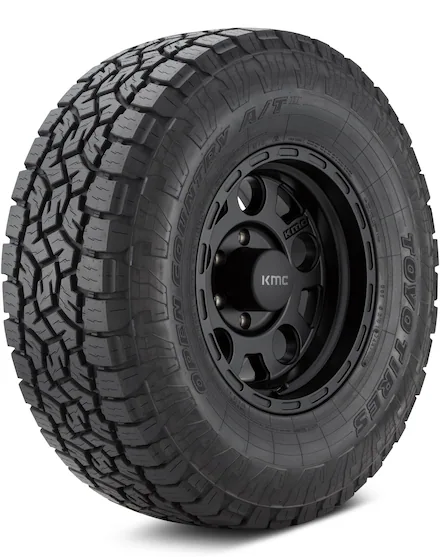
4. Toyo Open Country AT III: Best for Daily Driving
Price Check
Check the price of this tire at the following retailers:
For lifted trucks that are primarily daily drivers with occasional off-road excursions, this is the quietest all-terrain in this comparison.
Independently reported noise testing places this tire closer to a highway tire than a typical all-terrain, with real owner reports describing genuinely forgettable road noise during daily commuting. Off-road, it handles loose gravel, packed dirt, and moderate rock sections competently, if not as aggressively as the KO3 in deep mud specifically.
Tread life is a real strength, with independently reported wear data describing consistent, even results even on trucks with altered suspension geometry.
Pros: Genuinely class-leading quiet for an all-terrain, strong tread life, excellent wet braking, 3PMSF rated.
Cons: Less aggressive-looking than competitors, off-road traction trails the KO3 in deep mud.
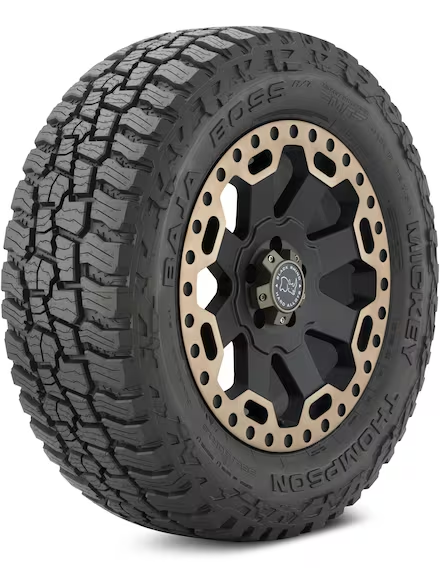
5. Mickey Thompson Baja Boss A/T: Best Aggressive Look
Price Check
Check the price of this tire at the following retailers:
This tire draws on decades of off-road racing heritage, and the asymmetric tread pattern and distinctive sidewall design genuinely stand apart visually.
It’s not just looks. Independently reported testing describes the silica-reinforced compound gripping sandstone and loose rock with real confidence, and PowerPly XD construction provides genuine reassurance on sharp terrain that would concern lesser tires.
On-road manners are surprisingly civilized — real testing places road noise between the quieter Toyo AT III and the louder KO3, with sharp steering response that’s a real, felt benefit on a lifted vehicle that can otherwise feel vague.
Pros: Genuinely distinctive visual design, real rock and sand traction, strong sidewall construction.
Cons: Premium price for an all-terrain, average mud traction, moderate fuel-economy penalty from added weight.
6. Cooper Discoverer Rugged Trek: Best Value Hybrid

Price Check
Check the price of this tire at the following retailers:
Cooper has quietly built strong truck tires for years, and this hybrid sits between a traditional all-terrain and a mud-terrain, delivering more aggressive traction without the typical mud-terrain penalties.
Independently reported testing describes stone ejector ribs in the tread genuinely preventing rock embedment — a real, practical benefit on crushed-gravel roads. Off-road traction runs noticeably better than standard all-terrains, especially in loose soil and shallow mud.
Tread life is a real strength, with Cooper’s warranty backing consistent with independently reported wear data showing slow, even results even under the added stress of a lifted suspension.
Pros: Genuine bridge between A/T and M/T categories, real stone and chip resistance, respectable tread life for a hybrid.
Cons: Less widely available than some competitors, noticeable highway noise at speed.
7. Nitto Ridge Grappler: Best Hybrid Overall

Price Check
Check the price of this tire at the following retailers:
This is one of the most popular tires in the lifted truck community, and independently reported testing explains why: it looks like a mud-terrain, performs like a capable all-terrain, and wears better than the aggressive tread suggests.
The E-load rating handles heavier lifted trucks confidently, and variable pitch tread design genuinely reduces noise relative to how aggressive the tread pattern looks. Independently reported off-road testing describes strong performance across rocky creek crossings, clay mud, and rutted forest roads, with the tighter tread spacing falling short only in genuinely deep, soupy mud where material can’t evacuate quickly enough.
Pros: Genuine balance of looks, performance, and daily livability, available in large sizes, real noise reduction from variable pitch design.
Cons: Not ideal for deep mud specifically, premium price, can be prone to cupping without careful alignment.
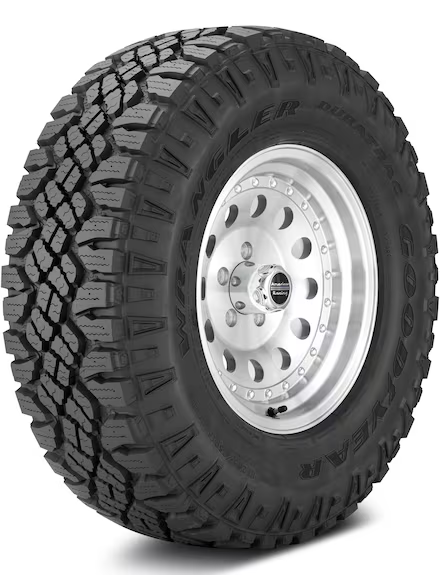
8. Goodyear Wrangler DuraTrac: Best for Snow and Ice
Price Check
Check the price of this tire at the following retailers:
For lifted truck owners in genuine winter climates, this tire’s TractiveGroove Technology in the shoulder area delivers traction that independently reported testing describes as rivaling dedicated winter tires.
The distinctive jagged shoulder blocks and open tread design work both aesthetically on a lifted truck and functionally in loose terrain. Braking distances in snow are consistently shorter than other all-terrains in aggregated testing, with siping that holds its effectiveness even as the tire wears.
Pros: Genuine best-in-comparison snow and ice performance for an A/T, studdable for extreme conditions, rim protector ridge guards against curb damage.
Cons: Above-average road noise, shorter tread life than less aggressive all-terrains.
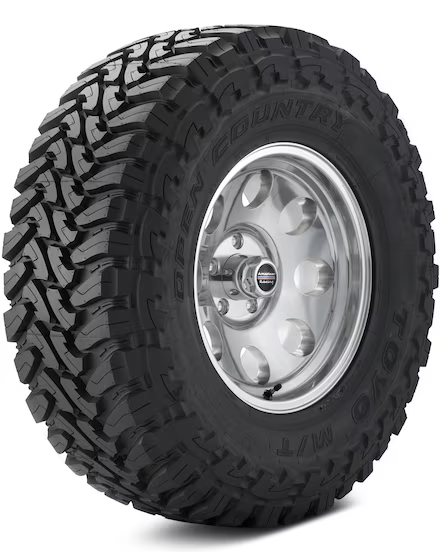
9. Toyo Open Country M/T: Best Heavy-Duty Mud-Terrain
Price Check
Check the price of this tire at the following retailers:
For three-quarter-ton and one-ton lifted trucks that need a tire built to take real punishment, this is genuinely built like a tank.
A 3-ply polyester casing with twin steel belts creates a sidewall that shrugs off impacts that would destroy lighter tires. Independently reported testing describes hook-shaped tread blocks biting into deep mud and pulling heavy trucks through sections where lesser tires get stuck.
On-road manners are what you’d expect from a full mud-terrain — genuinely loud, no way around it — though independently reported testing describes the noise as lower-pitched and less fatiguing than many mud-terrain competitors over long drives.
Pros: Genuine extreme durability for heavy trucks, outstanding deep-mud performance, available up to 40″.
Cons: Loud on the highway, expensive in larger sizes, poor fuel economy from high rolling resistance.
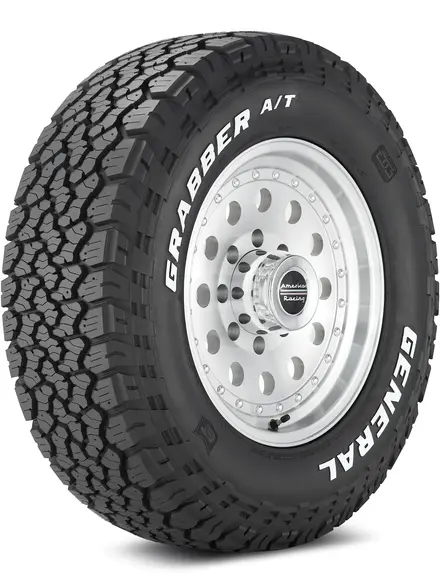
10. General Grabber A/TX: Best Under-the-Radar Pick
Price Check
Check the price of this tire at the following retailers:
General Tire doesn’t get the hype of BFGoodrich or Nitto, but this tire deserves more attention, benefiting from shared engineering with parent company Continental.
Independently reported testing describes DuraGen Technology delivering genuinely even wear that keeps the tire looking fresh well into its service life. Wet traction stands out specifically, with multiple sipe patterns channeling water away effectively.
Off-road, this tire is competent rather than exceptional — handling gravel roads, dirt trails, and light mud without drama, though not a replacement for a dedicated off-road tire on serious trail work. For a lifted truck used primarily as a daily driver, it’s a genuinely strong value.
Pros: Genuine exceptional value, very good wet-weather traction, even and long-lasting wear, 3PMSF rated.
Cons: Limited size options for heavily lifted trucks, less aggressive-looking than competitors, middle-of-the-pack off-road performance.
Common Mistakes When Buying Tires for Lifted Trucks
Ignoring speedometer calibration. Going from stock 31-inch tires to 35-inch tires throws the speedometer off by roughly 12% — a truck reading 70 mph is actually closer to 78 mph. Recalibrating through the truck’s computer or an aftermarket programmer is a genuine, worthwhile correction.
Skipping the alignment. Every time new tires go on a lifted truck, a four-wheel alignment is genuinely non-negotiable. Lifted suspension geometry shifts alignment angles from factory spec, and running out of spec chews through tire edges dramatically faster than expected — brand-new 35s with 8,000 miles can look like they’ve done 40,000 purely from a skipped alignment. Budgeting $100–$150 for alignment every time tires change is real, cheap insurance for the investment.
Understanding Load Ratings and Ply Construction
Load range letters (C, D, E) correspond to increasing ply ratings and maximum load capacity. Load Range C tires handle lighter half-ton trucks with modest lifts; Load Range D suits most mid-weight lifted three-quarter-ton applications; Load Range E is genuinely necessary for heavy-duty trucks or those regularly towing near capacity.
Running a lower load range than the truck’s actual weight demands is a real, avoidable risk — premature sidewall failure, poor handling under load, and reduced puncture resistance are all documented consequences of undersizing load capacity on a heavier-than-stock rig.
Tire Pressure for Lifted Trucks: On-Road and Off-Road
On-road, follow the manufacturer’s recommended PSI for the specific tire and load, typically higher than a stock passenger tire given the LT rating — often 50–65 PSI depending on load range.
Off-road, airing down genuinely transforms traction. Dropping from highway pressure to roughly 15–20 PSI significantly increases the tire’s contact patch, improving grip on sand, rock, and loose dirt. A portable air compressor for re-inflating before returning to pavement is a practical, worthwhile investment — running low pressure at highway speed generates dangerous heat buildup.
Maintenance Tips for Lifted Truck Tires
Rotate every 5,000–7,000 miles. Lifted trucks put uneven stress on tires depending on suspension geometry, making consistent rotation genuinely more important than on a stock truck.
Inspect sidewalls regularly, particularly after off-road use. Watch for cuts, bulges, or embedded debris — catching damage early prevents a small issue from becoming a highway failure.
Balance after significant off-road sessions. Rock crawling and washboard roads can knock tires out of balance, and vibration afterward is worth addressing before it accelerates wear on steering components.
Choosing the Right Tire for Your Lifted Truck
Most lifted truck owners: the BFGoodrich KO3 remains the tire to beat, earning its reputation through genuine, well-documented performance rather than marketing alone.
Budget-conscious: the Falken Wildpeak AT3W delivers roughly 90% of the KO3 experience at a meaningfully lower price, with genuinely surprising wet and winter capability.
Want an aggressive look without highway misery: the Nitto Ridge Grappler is the strongest hybrid available, and the Mickey Thompson Baja Boss A/T turns heads without ruining a daily commute.
Serious mud work on heavier rigs: the Nitto Trail Grappler or Toyo Open Country M/T are purpose-built for conditions where all-terrains give up — highway noise is simply part of that trade-off.
Frequently Asked Questions
What size tires should I put on my lifted truck?
The right size depends on lift height and wheel well clearance. A 2–3 inch lift typically accommodates 33-inch tires, while a 4–6 inch lift can fit 35-inch or even 37-inch tires. Check your specific truck’s fitment guide and confirm no rubbing at full steering lock before buying — going too large without proper trimming can damage fender liners and suspension components.
Are mud-terrain or all-terrain tires better for lifted trucks?
It depends on how the truck is used. All-terrain tires like the BFGoodrich KO3 or Toyo Open Country AT III are the best all-around choice for trucks that daily-drive on highways with occasional off-road use. Mud-terrain tires like the Nitto Trail Grappler or Mickey Thompson provide superior traction in deep mud and rocks but run noisier on pavement and wear faster. For most US drivers, a quality all-terrain strikes the best balance.
How much do good tires for a lifted truck cost?
Expect $250 to $450 per tire for quality 33- to 35-inch options from trusted brands, or $1,000 to $1,800 for a full set before mounting and balancing (typically another $80–$120 total). Premium 37-inch mud-terrain tires can push past $500 each. Spending more upfront on a reputable tire generally saves money long-term through better tread life and warranty coverage.
Do lifted trucks need special wheels to run larger tires?
In most cases, yes. Larger tires often need wheels with the right offset and backspacing to clear the frame and suspension components properly. Many owners upgrade to wheels with a zero or negative offset for the right stance and clearance. Consulting a wheel fitment specialist or an online fitment calculator specific to the truck model before purchasing is genuinely worthwhile.
How long do tires last on a lifted truck compared to a stock truck?
Tires on lifted trucks generally wear 10–20% faster than on stock trucks due to altered suspension geometry and increased weight. Quality all-terrain tires in the 35-inch range typically last 40,000–60,000 miles with proper maintenance, while mud-terrains often manage only 25,000–40,000 miles. Keeping alignment dialed in after the lift and rotating every 5,000–7,000 miles makes a real, measurable difference.
Will bigger tires on a lifted truck hurt my gas mileage?
Yes. Larger and heavier tires increase rolling resistance and rotational mass, typically reducing fuel economy by 1–3 MPG compared to stock tires, with mud-terrain tread patterns having an even bigger impact than all-terrains. Choosing a lighter-weight tire option and keeping pressure properly inflated helps minimize the hit, and regearing the differential to match the larger tire diameter restores lost power and efficiency.
What are the best tire brands for lifted trucks?
BFGoodrich, Nitto, Toyo, Mickey Thompson, Falken, and Cooper are the top brands for lifted trucks in the US market. BFGoodrich leads the all-terrain category with the KO3, Nitto’s Ridge Grappler and Trail Grappler are favorites for hybrid and mud-terrain use, and Toyo Open Country tires offer strong value for daily-driven lifted trucks. All of these brands maintain solid treadwear warranties and wide availability at US tire shops and online retailers.
