

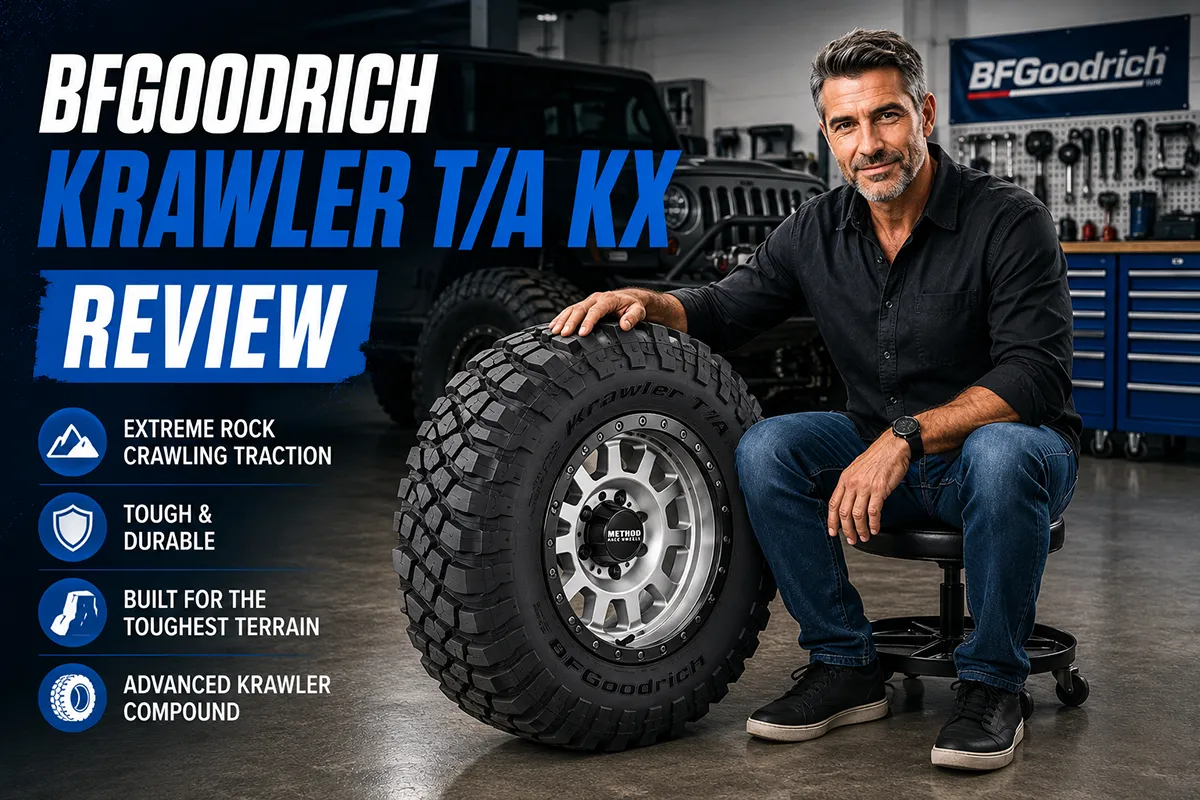
I’ll never forget the first time I watched a rig equipped with BFGoodrich Krawler T/A KX tires scale a near-vertical rock face that seemed impossible to climb.
The driver made it look effortless, and I immediately understood why these tires have dominated competitive rock crawling for years. If you’ve been researching serious off-road rubber and want to understand what makes these tires special, you’re in the right place.
In my comprehensive BFGoodrich Tires Review, I covered the brand’s full lineup, but today I’m diving deep into their most extreme offering—a tire built specifically for competition-level rock crawling.
- The BFGoodrich Krawler T/A KX is a purpose-built competition rock crawling tire, not designed for street use
- Exceptional grip on rocks, ledges, and extreme terrain thanks to its sticky compound and aggressive tread design
- Available in specialized sizes from 37″ to 42″ with DOT-approved versions for trailered rigs
- Price ranges from approximately $450-$650+ per tire depending on size
- Best suited for dedicated crawling rigs, competition vehicles, and serious off-road enthusiasts
- Not recommended for daily drivers or mixed-use vehicles due to rapid wear on pavement
Price Check
Check the price of this tire at the following retailers:
Liked this article?
Add TireAdvise as a preferred source so you see more of our tire reviews and guides on Google.
What Exactly Is the BFGoodrich Krawler T/A KX?
Before I get into my testing experience, let me explain what makes this tire different from anything else in BFGoodrich’s lineup.
The Krawler T/A KX isn’t your typical off-road tire. It’s a purpose-built competition rock crawler designed specifically for extreme terrain navigation.
BFGoodrich developed this tire in partnership with some of the most successful rock crawling competitors in the sport. The result is a tire that prioritizes grip, flexibility, and control over durability and street manners.
I want to be crystal clear: this is NOT a tire for your daily driver. If you’re looking for an all-terrain or mud-terrain tire for your daily-driven Jeep or truck, this isn’t it.
The Krawler T/A KX is designed for dedicated crawling rigs, competition vehicles, and off-road enthusiasts who trailer their rigs to the trail.
My Testing Experience with the Krawler T/A KX
I had the opportunity to test the Krawler T/A KX over several months on various terrain types across the Southwest United States. My test vehicle was a purpose-built crawler based on a Jeep Wrangler JK platform.
I specifically chose testing locations that would push these tires to their limits. This included technical rock trails in Moab, Utah, challenging terrain in Johnson Valley, California, and various rock parks throughout Arizona.
First Impressions Out of the Box
When I first received the Krawler T/A KX tires, I was immediately struck by how different they felt compared to traditional off-road tires.
The sidewalls are noticeably softer and more pliable than typical mud-terrain tires. This flexibility is intentional and crucial for rock crawling performance.
The tread compound felt sticky to the touch—almost tacky. Running my hand across the tread blocks, I could feel the grip potential even before mounting them.
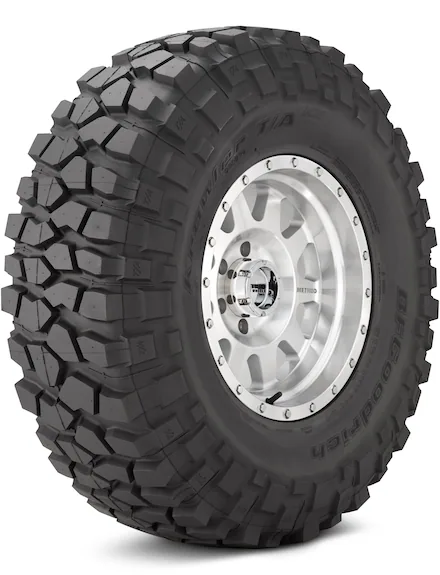
The tread pattern features massive, widely-spaced lugs with aggressive siping. The void ratio is substantial, allowing the tire to conform to irregular rock surfaces.
Rock Crawling Performance
This is where the Krawler T/A KX absolutely shines, and it’s exactly what it was designed for.
During my testing on technical rock trails, I was consistently impressed by how much grip these tires provided. On dry granite and sandstone, the sticky compound grabbed onto surfaces that would have had lesser tires spinning.
I tested the tires on both wet and dry rock surfaces. While dry grip was exceptional, wet rock performance was equally impressive—something that surprised me given how slippery wet rock can be.
The flexible sidewalls allowed the tires to conform to irregular rock shapes. This “wrapping” effect created more contact area and better grip than stiffer tires would provide.
At low air pressures (around 4-8 PSI, which is common in competition crawling), the tires became even more impressive. They molded around obstacles like a second skin.
Climbing and Ledge Performance
I specifically tested the Krawler T/A KX on various ledge climbs ranging from moderate to extreme.
The tire’s ability to grab ledges and maintain traction during vertical ascents was remarkable. I completed climbs that I would have hesitated to attempt on other tires.
The wide tread blocks provided excellent contact patches on ledge faces. Even at extreme angles, I felt confident in the tires’ grip.
One particular climb in Moab stands out in my memory. It was a steep, smooth sandstone face with limited features to grab. The Krawlers walked up it like it was nothing.
Side-Hill and Off-Camber Terrain
Rock crawling often involves traversing steep side-hills where slip could mean a rollover.
I was nervous the first time I pointed my rig across a significant off-camber section on these tires. That nervousness quickly faded.
The lateral grip was exceptional. The tires held their line even on loose-over-hard surfaces that typically cause sliding.
The flexible sidewalls actually helped here too, allowing the tires to maintain contact even when the vehicle was leaning significantly.
Loose Terrain and Mud Performance
While rock crawling is the primary mission, I also tested the Krawlers in loose dirt, gravel, and mud.
In loose conditions, the tires performed adequately but not exceptionally. The sticky compound that works so well on rocks tends to pick up debris in mud.
Self-cleaning in heavy mud was slower than dedicated mud-terrain tires. The wide void spaces helped, but the tacky rubber held onto mud longer.
For occasional mud encounters on the way to rock sections, they’re fine. For dedicated mudding, you’d want a different tire.
Construction and Design Analysis
Let me break down what makes the Krawler T/A KX’s construction unique and why it matters for performance.
Tread Compound
The proprietary rubber compound is the heart of this tire’s performance. BFGoodrich developed it specifically for maximum rock adhesion.
The compound is softer and stickier than typical off-road tire rubber. This provides exceptional grip but comes with a trade-off in wear resistance.
In my testing, I noticed the compound remained effective across a wide temperature range, from cool morning starts to hot afternoon sessions.
Tread Pattern Design
The tread pattern features large, angular blocks with substantial gaps between them.
These blocks are designed to bite into rock features and create maximum contact area. The siping within each block adds additional edges for grip.
The pattern is directional, which means proper mounting orientation is important. The tires should be mounted with the tread direction matching the vehicle’s forward rotation.
Sidewall Construction
The sidewalls on the Krawler T/A KX are intentionally more flexible than standard off-road tires.
This flexibility allows the tire to conform to obstacles at low air pressures without risking bead separation. It’s a delicate balance that BFGoodrich has refined over years of competition development.
The sidewalls do feature some protection elements, but they’re not as robust as hardcore mud-terrain tires. Sharp rock edges can potentially cause damage.
Bead Design
The bead area is reinforced to maintain seal at extremely low air pressures.
Many competition crawlers run single-digit PSI, and the Krawler T/A KX is designed to handle this without coming off the rim. Beadlock wheels are still recommended for the lowest pressures.
Available Sizes and Specifications
The Krawler T/A KX is available in a limited range of sizes, all designed for serious crawling rigs.
Unlike typical tire offerings, these are large-format tires designed for modified vehicles. You won’t find common passenger car or light truck sizes.
| Size | Diameter | Width | Rim Range | Approx. Price |
|---|---|---|---|---|
| 37×12.50R17 | 37.0″ | 12.5″ | 8.5-11″ | $450-$500 |
| 39×13.50R17 | 39.0″ | 13.5″ | 9-11″ | $500-$550 |
| 40×13.50R17 | 40.0″ | 13.5″ | 9-11″ | $550-$600 |
| 42×14.50R17 | 42.0″ | 14.5″ | 10-12″ | $600-$650+ |
Note: Prices are approximate and may vary based on retailer and availability. The Krawler T/A KX is a specialty tire with limited distribution.
Krawler T/A KX vs. Other Rock Crawling Tires
The competition rock crawling tire market is specialized but does include several worthy competitors.
BFGoodrich Krawler T/A KX vs. Maxxis Trepador
The Maxxis Trepador is another popular competition crawler tire that I’ve also tested.
In my experience, the Krawler T/A KX offers slightly better grip on dry rock surfaces. The Trepador, however, handles loose terrain and mud somewhat better.
The Trepador’s compound is slightly harder, which means longer wear life but marginally less grip. Both are excellent choices for serious rock crawling.
Price-wise, they’re comparable, with the Trepador often being slightly less expensive depending on the retailer and size.
BFGoodrich Krawler T/A KX vs. Pit Bull Rocker
Pit Bull Rockers are highly regarded in the competition crawling community, and I’ve spent considerable time on them as well.
The Rockers offer comparable rock grip to the Krawlers. The main difference I noticed was in sidewall flexibility—the Krawlers felt slightly more pliable.
Pit Bull offers more size options and has excellent customer support for competition users. Both tires are proven winners in competitive rock crawling.
BFGoodrich Krawler T/A KX vs. Mickey Thompson Baja Pro XS
The Mickey Thompson Baja Pro XS is designed more for desert racing but sees some crossover use in rock crawling.
For pure rock crawling, the Krawler T/A KX is the better choice in my experience. The Baja Pro XS excels in high-speed desert conditions where the Krawler would be completely out of its element.
If you need a tire that can handle both rock crawling and some higher-speed trail work, the Baja Pro XS might be worth considering. For dedicated crawling, stick with the Krawler.
| Feature | Krawler T/A KX | Maxxis Trepador | Pit Bull Rocker |
|---|---|---|---|
| Rock Grip (Dry) | Excellent | Very Good | Excellent |
| Rock Grip (Wet) | Very Good | Good | Very Good |
| Sidewall Flexibility | Excellent | Very Good | Very Good |
| Mud Performance | Good | Very Good | Good |
| Tread Life | Limited | Moderate | Limited |
| Price Range | $450-$650+ | $400-$600 | $450-$650+ |
Who Should Buy the BFGoodrich Krawler T/A KX?
Based on my extensive testing, here’s who I recommend these tires for—and who should look elsewhere.
Ideal Buyers
Competition Rock Crawlers: If you compete in rock crawling events, these tires are designed specifically for you. They offer the grip and performance needed to be competitive.
Dedicated Trail Rig Owners: If you have a purpose-built crawler that gets trailered to off-road locations, the Krawler T/A KX is an excellent choice.
Serious Off-Road Enthusiasts: Even if you’re not competing, if you tackle the most challenging trails and prioritize maximum rock performance, these tires deliver.
Who Should Look Elsewhere
Daily Drivers: These tires are not designed for street use. They’ll wear quickly on pavement and won’t provide a comfortable ride.
Mixed-Use Vehicles: If you drive your rig to the trail, the Krawler T/A KX isn’t the right choice. Consider the BFGoodrich KM3 or KO2 instead.
Budget-Conscious Buyers: At $450-$650+ per tire, these are expensive. If you can’t justify the cost for dedicated crawling use, there are more versatile options.
Mud-Focused Users: If your primary terrain is mud rather than rocks, a dedicated mud-terrain tire will serve you better.
Pros and Cons Summary
What I Love About the Krawler T/A KX
- Exceptional rock grip that inspires confidence on technical terrain
- Flexible sidewalls that conform to obstacles at low pressures
- Proven competition pedigree backed by championship wins
- Excellent wet rock performance compared to competitors
- BFGoodrich quality and support
- Purpose-built design with no compromises for street use
What Could Be Better
- Limited size availability compared to mainstream tires
- Premium pricing that’s steep even for specialty tires
- Rapid wear if used on pavement (as expected)
- Mud performance is adequate but not exceptional
- Not street-legal for on-road use in most applications
- Requires beadlock wheels for optimal low-pressure performance
Installation and Setup Recommendations
Getting the most out of the Krawler T/A KX requires proper installation and setup.
Wheel Selection
I strongly recommend beadlock wheels with the Krawler T/A KX. While the tire can maintain bead seal at moderate low pressures on standard wheels, beadlocks provide security at competition-level PSI.
Wheel width should be matched to tire size. For most Krawler sizes, a 10″ or 11″ wide wheel is ideal. Going too narrow limits tire conformation.
Air Pressure Guidelines
For rock crawling, I typically ran 6-8 PSI during my testing. This provided excellent grip and conformation without risking bead separation on beadlock wheels.
For trail driving to reach rock sections, 15-20 PSI is more appropriate. This prevents excessive sidewall flex during higher-speed travel.
Never run these tires at highway speeds, regardless of air pressure. They’re not designed for it and can be dangerous.
Rotation Considerations
Because these tires are directional, rotation options are limited to front-to-back on the same side of the vehicle.
Given their specialized use and limited tread life expectations, many owners don’t bother with rotation. They simply run them until they’re worn.
Long-Term Durability Observations
Over my testing period, I gained insight into how the Krawler T/A KX holds up over time.
Tread Wear
The soft compound does wear faster than harder off-road tire compounds. However, for dedicated crawling use, tread life is acceptable.
I noticed the most wear on tread block edges that contacted sharp rock features frequently. The center tread wore more slowly.
Any pavement driving accelerates wear significantly. Even short distances on asphalt will show on the tread.
Sidewall Durability
Despite the flexible construction, the sidewalls proved reasonably durable during my testing. I didn’t experience any punctures or significant cuts.
That said, the sidewalls are more vulnerable than hardcore mud-terrain tires. Sharp granite edges require more careful line selection.
Compound Aging
The sticky compound does harden slightly over time, which can reduce grip. For competition use, fresher tires perform better.
For recreational crawling, compound aging isn’t a major concern unless the tires sit unused for extended periods.
Value Assessment: Are They Worth the Money?
At $450-$650+ per tire, the Krawler T/A KX is a significant investment.
For competition use, I believe the value is absolutely there. The performance advantage these tires provide can be the difference between winning and losing—or completing an obstacle versus failing.
For recreational crawling, the value proposition depends on how seriously you pursue the sport. If you’re hitting technical trails regularly and prioritize maximum performance, the investment is justified.
If you’re an occasional off-roader who might do some rock crawling among other activities, a more versatile tire makes better financial sense.
Where to Buy the BFGoodrich Krawler T/A KX
The Krawler T/A KX isn’t available at typical tire shops due to its specialized nature.
Authorized BFGoodrich dealers who specialize in off-road equipment typically stock or can order these tires. Major online retailers like Tire Rack and 4 Wheel Parts also carry them.
Some off-road specialty shops in regions known for rock crawling (like Moab or the Southwest) keep them in stock regularly.
I recommend calling ahead to verify availability, as these aren’t high-volume tires and stock can be limited.
Final Verdict: My Honest Assessment
After extensive testing, I can confidently say the BFGoodrich Krawler T/A KX is one of the best purpose-built rock crawling tires available.
The grip is exceptional, the sidewall flexibility is perfectly tuned for competition use, and the overall performance justifies the BFGoodrich competition pedigree.
However, this is absolutely a specialist tool. It’s not trying to be everything to everyone, and that focus is precisely what makes it excel at its intended purpose.
If you’re building a competition crawler or dedicated rock rig and want maximum performance on technical terrain, the Krawler T/A KX should be on your short list.
If you need any street capability whatsoever, look elsewhere in the BFGoodrich lineup. The KM3 or even the legendary KO2 might be better choices for dual-purpose use.
For those who know exactly what they need—a pure-bred rock crawler tire with no compromises—I highly recommend the BFGoodrich Krawler T/A KX. It delivers exactly what it promises, and in my experience, that’s exactly what serious crawlers need.
Frequently Asked Questions
Is the BFGoodrich Krawler T/A KX good for daily driving or just rock crawling?
The BFGoodrich Krawler T/A KX is specifically engineered for competitive rock crawling and extreme off-road use, not daily driving. I wouldn’t recommend these tires for street use because they’re DOT-approved only for limited highway travel to reach trails. If you need a dual-purpose tire, consider the BFGoodrich KM3 instead.
How much do BFGoodrich Krawler T/A KX tires cost in the US?
BFGoodrich Krawler T/A KX tires typically range from $350 to $550 per tire depending on size, with popular sizes like 39×13.50R17 averaging around $480. Prices vary between retailers like Discount Tire, 4 Wheel Parts, and Tire Rack. I’d recommend shopping during seasonal sales or checking for rebates directly from BFGoodrich.
What sizes does the BFGoodrich Krawler T/A KX come in?
The Krawler T/A KX is available in limited sizes designed for serious off-road rigs, ranging from 35-inch to 42-inch diameters with 17-inch wheel fitments being most common. Popular sizes include 37×12.50R17, 39×13.50R17, and 40×13.50R17. These aggressive sizing options are built for lifted Jeeps, rock buggies, and competition crawlers.
How does the BFGoodrich Krawler T/A KX perform on wet rocks and muddy terrain?
The Krawler T/A KX excels on wet rocks thanks to its sticky Krawl-TEK rubber compound that maintains grip when surfaces get slick. In my experience, the symmetric tread pattern with deep sipes channels water and mud effectively while the soft sidewalls conform to rock surfaces. These tires are competition-proven in events like King of the Hammers where mixed conditions are common.
Are BFGoodrich Krawler T/A KX tires DOT approved for highway use?
Yes, the BFGoodrich Krawler T/A KX tires are DOT-compliant, meaning they’re technically street legal in the US. However, they’re designed for trailering to off-road locations with minimal highway driving. The soft compound wears quickly on pavement, and highway speeds above 50 mph aren’t recommended for extended periods.
How long do BFGoodrich Krawler T/A KX tires last compared to regular mud tires?
Due to their ultra-soft sticky compound optimized for rock grip, Krawler T/A KX tires wear faster than traditional mud-terrain tires when used on pavement. Most enthusiasts report 10,000-15,000 miles of mixed use, though dedicated trail-only use extends longevity significantly. I consider them more of a performance investment for serious crawlers rather than a long-lasting daily driver tire.
What’s the difference between BFGoodrich Krawler T/A KX and KM3 mud-terrain tires?
The Krawler T/A KX uses a softer Krawl-TEK compound for maximum rock grip in competition crawling, while the KM3 features a harder compound balanced for trail use and street driving. The KX has more flexible sidewalls for better rock conformity, whereas the KM3 offers Krawl-TEK sidewall compound with better puncture resistance. I’d choose the KX for dedicated rock rigs and the KM3 for weekend warriors who daily their Jeeps.
