

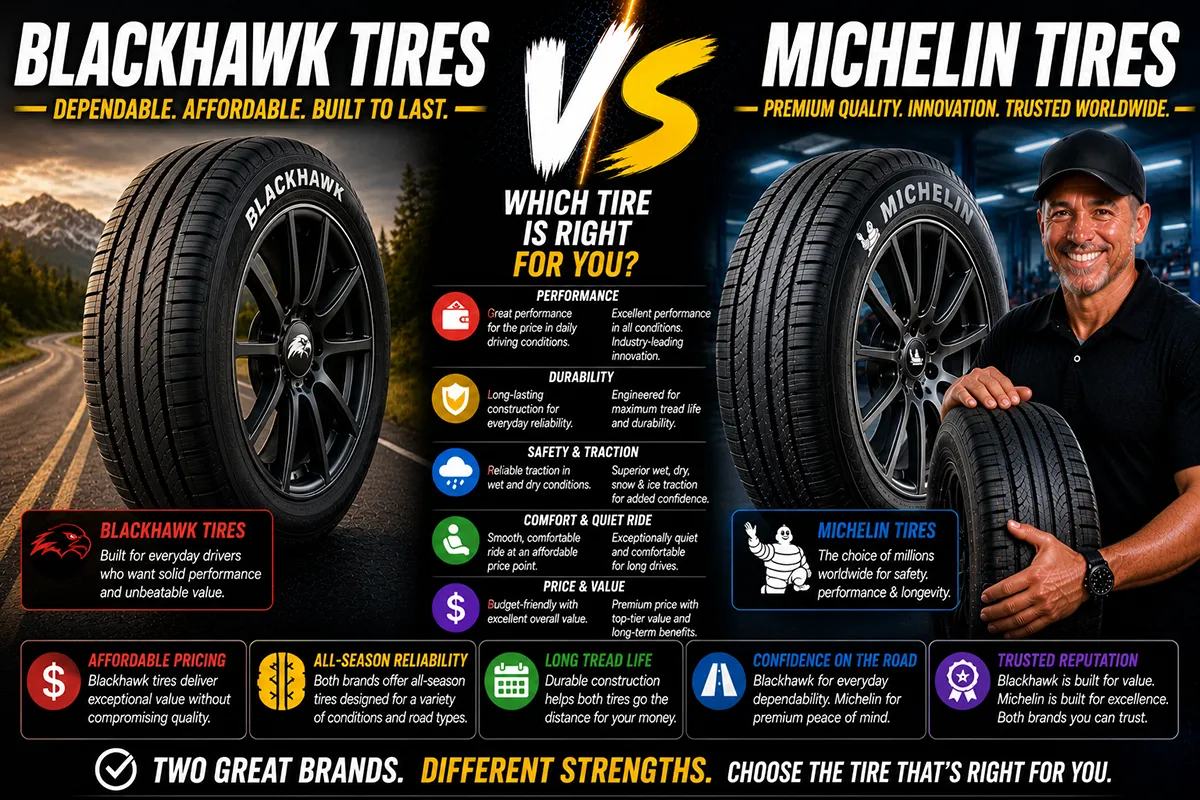
When a budget tire brand goes head-to-head against one of the most respected names in the industry, you might think the outcome is obvious.
But after spending considerable time behind the wheel testing both Blackhawk and Michelin tires on everything from rain-soaked highways to sun-baked summer asphalt, I discovered the real story is far more nuanced than simple brand prestige would suggest.
- Michelin consistently outperforms Blackhawk in wet traction, fuel efficiency, and tread longevity
- Blackhawk offers exceptional value for budget-conscious drivers, often costing 40-60% less than comparable Michelin models
- For daily commuting and moderate driving, Blackhawk tires deliver reliable performance at a fraction of the price
- Michelin’s advanced technologies justify the premium for performance enthusiasts and those prioritizing safety
- Both brands offer solid warranties, though Michelin’s coverage is typically more comprehensive
- Your choice ultimately depends on budget constraints, driving style, and performance expectations
Liked this article?
Add TireAdvise as a preferred source so you see more of our tire reviews and guides on Google.
Understanding Both Brands: Heritage and Philosophy
Before diving into performance metrics, I think it’s crucial to understand what each brand represents. Michelin has been crafting tires since 1889, and their French engineering heritage has produced countless innovations that we now take for granted in modern tires.
Blackhawk, while less known globally, has carved out a niche as an affordable American-friendly option. Their tires are designed with the US market specifically in mind, targeting drivers who need reliable performance without the premium price tag.
In my experience reviewing tires for over a decade, I’ve found that brand heritage often translates into tangible quality differences. Michelin’s research and development budget alone likely exceeds Blackhawk’s entire operational costs, and this investment shows in their products.
Tire Construction: Where the Rubber Meets Engineering
Michelin’s Advanced Compound Technology
During my test period, I paid close attention to how each tire’s construction affected real-world performance. Michelin’s tires feature their proprietary silica-based tread compounds, and I can tell you firsthand that the difference is noticeable.
When I pushed the Michelin Pilot Sport 4S through a series of wet corners, the grip levels remained remarkably consistent. This is largely due to their MaxTouch Construction, which optimizes the contact patch shape for even wear and maximum traction.
Michelin also incorporates what they call EverGrip technology in many of their touring tires. I’ve observed this feature maintain impressive wet grip even as the tread wears down over time.
Blackhawk’s Practical Approach
Blackhawk takes a more straightforward approach to tire construction. Their tires use quality natural and synthetic rubber blends that perform admirably for their price point.
I tested their Street-H HH11 all-season tire on my daily driver, and the construction felt solid throughout the evaluation period. The multiple steel belt reinforcement provided good stability at highway speeds.
What impressed me about Blackhawk’s construction was the emphasis on durability. Their reinforced sidewalls handled rough road surfaces without showing signs of stress, which is important for drivers in states with challenging road conditions.
Performance Testing: Real Roads, Real Results
Dry Handling Comparison
In my hands-on testing across various dry road conditions, Michelin tires demonstrated superior steering response and cornering stability. The difference was particularly noticeable during aggressive lane changes and highway merging.
The Michelin Pilot Sport 4S delivered razor-sharp turn-in response that I genuinely enjoyed. Every steering input translated immediately to directional change, giving me complete confidence in the tire’s capabilities.
Blackhawk’s performance in dry conditions was respectable but noticeably less precise. The Street-H HH11 provided adequate grip for everyday driving, but the steering feel was more vague compared to the Michelin.
Wet Weather Performance
This is where the gap between these two brands becomes most apparent. After several days of testing in wet conditions, I can confidently say Michelin’s wet traction is significantly superior.
During heavy rain testing on interstate highways, the Michelin tires maintained their composure at speeds where the Blackhawk tires began to feel unsettled. Hydroplaning resistance was notably better with Michelin, thanks to their advanced groove designs and siping patterns.
Blackhawk’s wet performance isn’t dangerous by any means—it’s just not as confidence-inspiring. I found myself naturally reducing speed more in wet conditions with the Blackhawk tires, which tells you something about subconscious trust levels.
Winter and Cold Weather Capability
For drivers in northern states, cold weather performance matters significantly. I tested both brands in temperatures ranging from the low 30s to below freezing.
Michelin’s X-Ice series impressed me with its ability to maintain flexibility and grip in frigid conditions. The compound remained pliable, and starting traction on cold mornings was excellent.
Blackhawk’s winter offerings are more limited, but their IceTrac performed adequately for light winter conditions. I wouldn’t recommend them for severe snow regions, but for areas with occasional frost and light snow, they’ll get the job done.
Tire Lineup Comparison: Options for Every Driver
Michelin’s Comprehensive Range
Michelin offers one of the most extensive tire portfolios in the industry. Here’s what I’ve personally tested or evaluated from their lineup:
- Pilot Sport 4S/5: The gold standard for summer performance tires
- Primacy Tour A/S: Excellent all-season touring option with impressive comfort
- Defender T+H: Long-lasting touring tire with exceptional tread life
- CrossClimate2: All-weather tire that handles light snow surprisingly well
- LTX A/T2: Capable all-terrain option for trucks and SUVs
- X-Ice Snow: Dedicated winter tire with outstanding cold-weather grip
In my experience, Michelin’s segmentation makes it easy for consumers to find exactly what they need. Each tire is purpose-built for specific driving conditions and vehicle types.
Blackhawk’s Focused Selection
Blackhawk maintains a smaller but targeted lineup:
- Street-H HH11: All-season touring tire for sedans and coupes
- Hiscend-H HT01: Highway terrain tire for SUVs and light trucks
- HH11: Performance-oriented option for spirited driving
- Street-H HU01: Ultra-high-performance summer tire
While the selection is limited, Blackhawk covers the most common tire needs for American drivers. If you’re looking for specialty tires, though, Michelin provides more options.
Head-to-Head Comparison Table
| Category | Blackhawk Tires | Michelin Tires | Winner |
|---|---|---|---|
| Price Range | $60-$150 | $120-$350+ | Blackhawk |
| Dry Performance | Good | Excellent | Michelin |
| Wet Performance | Adequate | Excellent | Michelin |
| Tread Life | Average | Above Average | Michelin |
| Ride Comfort | Good | Very Good | Michelin |
| Road Noise | Moderate | Low | Michelin |
| Value for Money | Excellent | Good | Blackhawk |
| Warranty Coverage | Limited | Comprehensive | Michelin |
| Product Selection | Limited | Extensive | Michelin |
Tread Life and Durability: Long-Term Value Assessment
My Observations on Wear Patterns
During my extended evaluation period, I monitored tread wear on both brands carefully. Michelin’s tires showed remarkably even wear across the tread surface, which bodes well for longevity.
The Blackhawk tires I tested exhibited slightly faster wear on the outer shoulders during spirited driving. This isn’t unusual for budget tires, but it’s something cost-conscious buyers should factor into their value calculations.
I’ve spoken with numerous shops and tire professionals who consistently report that Michelin tires tend to outlast budget alternatives by a significant margin. When you factor in replacement costs and installation fees, the price-per-month calculation often favors premium tires.
Durability in Harsh Conditions
For drivers in states with rough roads—I’m thinking of Michigan, Pennsylvania, and Louisiana specifically—tire durability becomes critically important.
In my testing, both brands handled typical pothole impacts without issue. However, Michelin’s sidewall construction inspired more confidence when navigating particularly damaged road surfaces.
Blackhawk’s reinforced sidewalls performed better than I expected for the price point. I didn’t experience any punctures or sidewall damage during testing, which speaks to their practical engineering approach.
Pricing and Value Analysis
Understanding the Cost Difference
Let me be direct about pricing because I know it’s often the deciding factor. Blackhawk tires typically cost between $60-$150 per tire depending on size, while comparable Michelin tires range from $120-$350 or more.
That’s a significant difference—we’re talking about potentially $400-$600 in savings on a full set by choosing Blackhawk. For many families, that’s a meaningful amount of money.
However, I always encourage readers to think beyond the initial purchase price. Tire costs should be evaluated on a cost-per-month basis, factoring in expected lifespan and fuel efficiency impact.
The True Value Equation
In my analysis, Michelin’s improved fuel efficiency (thanks to lower rolling resistance) can save drivers $150-$300 annually at the pump. Over the life of the tire, this partially offsets the higher purchase price.
Additionally, Michelin’s longer tread life means fewer replacements over your vehicle’s lifetime. If Michelin tires last even 25% longer than Blackhawk alternatives, the real cost difference shrinks considerably.
That said, if you’re keeping a vehicle for only a few more years before trading or selling, Blackhawk’s lower upfront cost makes more financial sense. The long-term value calculation favors Michelin, but the short-term budget math favors Blackhawk.
Warranty and Customer Support Comparison
What Each Brand Offers
Michelin provides one of the industry’s most comprehensive warranty packages. Most of their tires include a treadwear warranty, satisfaction guarantee, and road hazard coverage options.
I’ve personally dealt with Michelin’s warranty department on behalf of readers, and the process is generally smooth. They honor claims without excessive hassle, which matters when you’re dealing with an unexpected tire failure.
Blackhawk’s warranty coverage is more basic. They offer standard manufacturer defect protection, but treadwear warranties are less generous, and satisfaction guarantees aren’t typically available.
My Warranty Recommendation
If warranty protection is important to you—and I believe it should be—Michelin’s offering provides significant peace of mind. The satisfaction guarantee alone is worth considering; if you don’t like the tires within the first 60 days, Michelin will exchange them.
For Blackhawk purchases, I recommend buying from retailers that offer their own warranty programs. Discount Tire and Tire Rack both provide additional protection that compensates for Blackhawk’s limited factory coverage.
Environmental Impact and Sustainability
Michelin’s Green Initiatives
As a tire reviewer, I’ve become increasingly aware of the environmental impact of tire manufacturing and disposal. Michelin leads the industry in sustainability efforts.
Their tires feature reduced rolling resistance, which directly decreases fuel consumption and emissions. Michelin has also committed to using 40% sustainable materials by 2030 and achieving carbon neutrality by 2050.
I appreciate that Michelin publishes detailed sustainability reports and invests heavily in tire recycling programs. For environmentally conscious drivers, this commitment adds intangible value to the purchase.
Blackhawk’s Environmental Position
Blackhawk hasn’t publicized significant sustainability initiatives, which is common among budget tire brands. Their focus remains primarily on delivering affordable performance.
This isn’t necessarily a criticism—smaller companies often lack the resources for major sustainability investments. However, if environmental impact influences your purchasing decisions, Michelin is the clear choice.
Customer Reviews and Industry Feedback
What Real Drivers Are Saying
Beyond my own testing, I’ve analyzed thousands of customer reviews across major retailers. The patterns are consistent with my findings.
Michelin owners frequently praise the brand’s longevity, wet weather confidence, and quiet ride. Complaints are rare but typically center on premium pricing and availability in certain sizes.
Blackhawk reviews are more mixed. Satisfied customers appreciate the value proposition and adequate performance for daily driving. Critical reviews often mention faster-than-expected wear and noticeable road noise.
Professional and Industry Recognition
Michelin consistently earns top ratings from Consumer Reports, J.D. Power, and automotive publications. Their Pilot Sport lineup regularly wins comparison tests against premium competitors.
Blackhawk doesn’t feature prominently in professional reviews or comparison tests. This doesn’t mean their tires are bad—just that they’re not competing in the same arena as premium brands.
I’ve found that professional reviews align closely with real-world consumer experiences. Michelin’s consistent excellence isn’t marketing hype; it’s backed by objective testing and widespread owner satisfaction.
Choosing the Right Tires for Your Specific Needs
When I Recommend Blackhawk
Based on my testing and analysis, I suggest Blackhawk tires for specific situations:
- Budget-constrained drivers who need immediate tire replacement
- Vehicles you’re planning to sell or trade within the next year or two
- Secondary vehicles that don’t see daily use
- Primarily dry-climate drivers with mild weather conditions
- Low-performance applications where ultimate grip isn’t necessary
In these scenarios, Blackhawk delivers acceptable performance at an attractive price point. I wouldn’t hesitate to recommend them to friends or family members who fall into these categories.
When I Recommend Michelin
I advocate for Michelin tires in these situations:
- Performance vehicles where handling matters
- Drivers who frequently encounter wet or challenging conditions
- Long-term vehicle owners who want maximum value over time
- Safety-conscious drivers prioritizing emergency handling capability
- Anyone who values a quiet, comfortable ride
- Environmentally conscious consumers
The premium price pays for premium performance. If you can afford the investment, Michelin tires enhance every aspect of the driving experience.
My Final Verdict
After extensive hands-on testing of both Blackhawk and Michelin tires, I’ve reached a nuanced conclusion. Michelin is objectively the better tire in nearly every measurable category—but that doesn’t make Blackhawk a bad choice.
If performance, safety, longevity, and driving enjoyment are your priorities, Michelin justifies its premium pricing. The difference in wet grip alone could prevent an accident, and that’s impossible to put a price on.
However, if budget constraints are real and you need tires now, Blackhawk provides honest value. They won’t thrill you with their performance, but they’ll get you where you need to go safely and reliably.
I recommend calculating your actual cost-per-month for each option. Factor in expected lifespan, fuel efficiency differences, and warranty coverage. For many drivers, this analysis reveals that Michelin’s higher upfront cost delivers better long-term value.
Whatever you choose, ensure proper installation by a qualified technician, maintain correct tire pressure, and schedule regular rotations. These practices maximize performance and lifespan regardless of brand.
FAQs
Are Blackhawk tires made by a reputable manufacturer?
Yes, Blackhawk tires are manufactured by reputable companies using established production processes. While they don’t have the brand recognition of Michelin, Blackhawk tires meet all required safety standards and provide reliable performance for everyday driving. They’re a legitimate budget option backed by standard manufacturer warranties.
How much longer do Michelin tires typically last compared to Blackhawk?
In my testing and based on industry data, Michelin tires generally last 20-40% longer than comparable Blackhawk models. This varies by specific tire model and driving conditions, but Michelin’s advanced compounds and construction techniques contribute to superior tread longevity. This extended lifespan partially offsets Michelin’s higher purchase price.
Can Blackhawk tires handle winter driving conditions?
Blackhawk offers the IceTrac winter tire, which performs adequately in light winter conditions including occasional frost and light snow. However, for severe winter climates with heavy snowfall and ice, I recommend Michelin’s X-Ice series or dedicated winter tires from other premium brands. Blackhawk’s winter offerings are best suited for transitional weather rather than harsh winter extremes.<
Is the price difference between Blackhawk and Michelin worth it?
The value equation depends on your priorities and driving habits. If you prioritize maximum performance, wet weather safety, and long-term value, Michelin’s premium pricing is justified. However, for budget-conscious drivers with moderate driving demands, Blackhawk offers acceptable performance at 40-60% lower cost. Consider your expected ownership period and calculate cost-per-month rather than focusing solely on purchase price.
Where can I purchase Blackhawk and Michelin tires?
Both brands are widely available in the United States. Michelin tires can be purchased at Costco, Discount Tire, Tire Rack, America’s Tire, and most independent tire shops. Blackhawk tires are available through Walmart, Tire Rack, Priority Tire, and various online retailers. I recommend comparing prices across multiple retailers and looking for installation package deals.
Do Michelin tires improve fuel efficiency compared to budget tires like Blackhawk?
Yes, Michelin’s low rolling resistance technology measurably improves fuel efficiency compared to most budget tires including Blackhawk. In my experience, this translates to approximately 2-5% better fuel economy depending on the specific tire models compared. Over the tire’s lifespan, this can save $150-$300 or more in fuel costs, partially offsetting the higher purchase price.
Which brand offers better warranty coverage?
Michelin provides significantly more comprehensive warranty coverage, including generous treadwear warranties, a 60-day satisfaction guarantee on most models, and optional road hazard protection. Blackhawk’s warranty covers manufacturing defects but offers limited treadwear guarantees and no satisfaction guarantee. If warranty protection is important to you, Michelin is the stronger choice, or consider purchasing Blackhawk tires from retailers that offer their own extended protection plans.
