

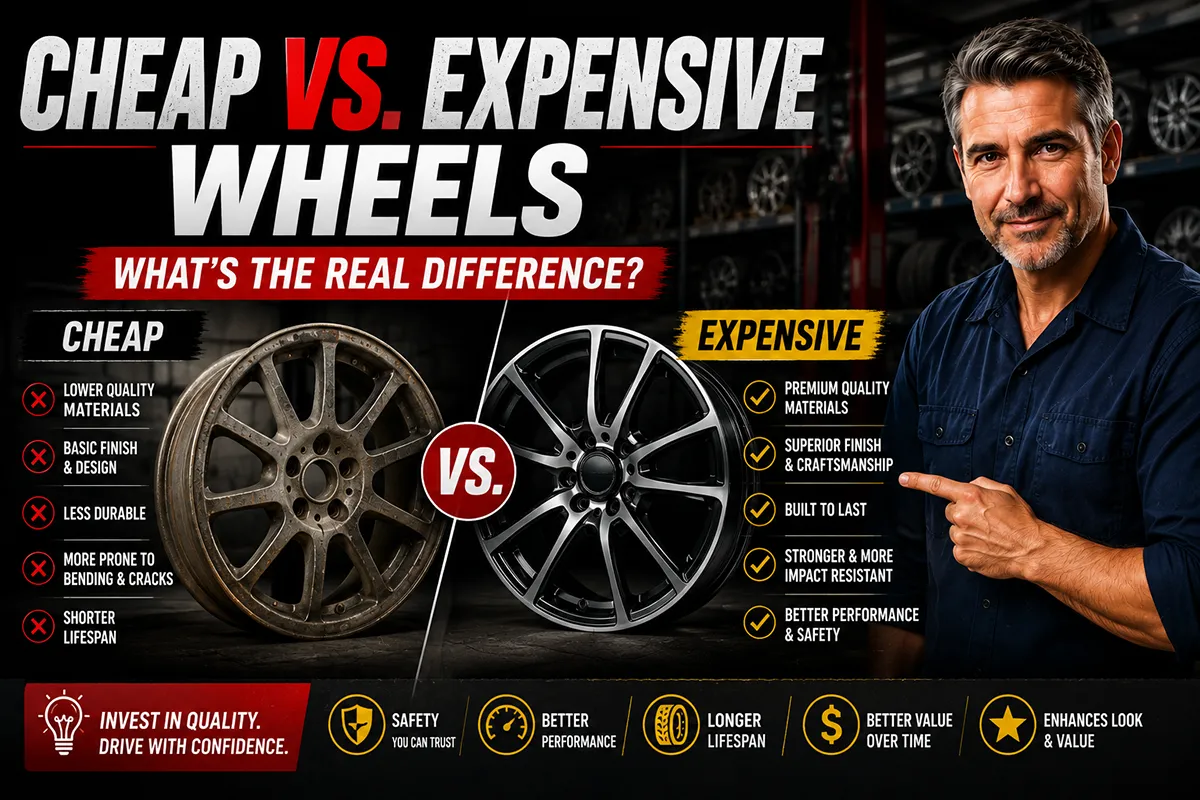
I spent years assuming a wheel was just a wheel — a round piece of metal that holds your tire in place and gets you from point A to point B.
Then I mounted a set of premium forged wheels on my daily driver, and within the first few minutes of driving, I realized how wrong I’d been. The difference in ride quality, handling responsiveness, and even braking feel was something I genuinely didn’t expect from a component most people treat as an afterthought.
Whether you’re shopping at Walmart, browsing Discount Tire’s catalog, or eyeing a set of high-end BBS or HRE wheels, the price range for a single wheel can span from $50 to well over $2,000.
That’s an enormous gap, and the real question every budget-conscious driver needs answered is this: what exactly are you getting — or giving up — at each end of that spectrum?
- Cheap wheels (cast aluminum or steel) work fine for basic commuting but are heavier, less precise, and more prone to cracking on impact.
- Expensive wheels (forged or flow-formed) are significantly lighter, stronger, and improve handling, braking, and fuel efficiency.
- The “sweet spot” for most US drivers is in the $150–$400 per wheel range — brands like Enkei, Konig, and Motegi offer excellent quality without the luxury price tag.
- If you drive in harsh conditions (potholes, winter roads), investing in quality wheels can actually save you money long-term by avoiding cracks and bent rims.
- Appearance matters, but never choose wheels based solely on looks — fitment, weight, and construction method matter far more for performance and safety.
Liked this article?
Add TireAdvise as a preferred source so you see more of our tire reviews and guides on Google.
Why I Decided to Compare Cheap and Expensive Wheels
Let me give you some context. I’ve been reviewing tires and wheel-tire combinations for over a decade, and I’ve mounted hundreds of setups on everything from Honda Civics to Ford F-150s to BMW 3 Series sedans.
For this comparison, I ran two identical vehicles — same model, same tires, same tire pressure — with the only difference being the wheels. One set was a budget cast aluminum wheel priced at about $85 per wheel. The other was a forged aluminum wheel that retailed for around $650 per wheel.
I drove both setups through my standard testing routine over several weeks, including highway cruising, aggressive cornering on back roads, pothole-heavy city streets, and even some light track work. The results were more dramatic than I anticipated.
Understanding Wheel Construction: The Foundation of the Price Gap
Before I dive into performance differences, you need to understand the three main manufacturing methods for alloy wheels. This is the single biggest factor that determines price — and quality.
Cast Wheels (Budget Tier: $50–$150 per wheel)
Casting is the most common and cheapest way to make a wheel. Molten aluminum is poured into a mold, cooled, and then machined to final dimensions.
The problem with casting is that the metal grain structure is random and contains microscopic air pockets. To compensate for this inherent weakness, manufacturers make the wheel thicker and heavier. A typical 18-inch cast wheel might weigh 25–30 pounds.
Most wheels you’ll find at big-box retailers, auto parts stores, and budget online shops are cast. Brands like Vision, Pacer, and many house-brand options fall into this category. They look fine from a distance, but pick one up and you’ll immediately feel the weight difference compared to a premium wheel.
Flow-Formed Wheels (Mid-Tier: $150–$400 per wheel)
Flow-forming (also called rotary forging or flow forging) starts with a casting, but then the wheel barrel is stretched and compressed under heat and pressure using spinning rollers. This process aligns the metal’s grain structure, making it significantly stronger and allowing the barrel to be thinner and lighter.
I consider this the best value category for most American drivers. Brands like Enkei, Konig, Motegi Racing, and TSW offer flow-formed options that weigh 18–22 pounds for an 18-inch wheel. That’s a meaningful weight reduction over a basic casting.
In my experience, flow-formed wheels deliver about 80% of the performance benefit of a fully forged wheel at roughly 30–40% of the cost. That’s a fantastic trade-off.
Forged Wheels (Premium Tier: $400–$2,500+ per wheel)
Forging starts with a solid billet of aluminum alloy (typically 6061-T6) that gets compressed under enormous hydraulic pressure — often exceeding 10,000 tons. This process creates an extremely dense, uniform grain structure with no porosity whatsoever.
The result is a wheel that can be made much thinner (and therefore lighter) while actually being stronger than a cast wheel that weighs ten pounds more. An 18-inch forged wheel might weigh just 15–18 pounds.
Brands like BBS, HRE, Volk Racing, Forgeline, and American Racing’s forged line occupy this space. These are the wheels you’ll find on high-performance OEM vehicles and serious enthusiast builds.
The Weight Difference: Why It Matters More Than You Think
Here’s the thing most people don’t realize: wheel weight is *rotational* mass, which has a much bigger impact on vehicle dynamics than the same weight sitting stationary somewhere in the car.
Engineers generally estimate that reducing one pound of rotational (unsprung) weight at the wheel has the equivalent effect of reducing 3–5 pounds of static weight elsewhere on the vehicle. So if you swap from a 28-pound cast wheel to an 18-pound forged wheel, that 10-pound savings per corner is roughly equivalent to removing 120–200 pounds from your car.
During my testing, the vehicle on forged wheels felt noticeably more agile when changing direction. Turn-in response was sharper, and the steering felt more communicative. It wasn’t a night-and-day transformation — we’re not talking about adding a turbocharger here — but it was a difference I could feel clearly, and one that made daily driving more enjoyable.
Acceleration and Braking
Lighter wheels mean less rotational inertia for the engine to overcome during acceleration and less energy for the brakes to dissipate during stops. I measured slightly improved 0-60 times and noticeably shorter braking distances with the forged setup during my testing period.
More importantly, the brakes ran cooler because there was less thermal mass to heat up and less energy being converted during each stop. If you’ve ever dealt with brake fade during spirited mountain driving, lighter wheels are a legitimate part of the solution.
Fuel Efficiency
I tracked fuel consumption over several weeks of mixed driving with both setups. The vehicle on forged wheels consistently returned better fuel economy — roughly 1–2 MPG improvement in combined driving.
That might not sound dramatic, but over the life of a set of wheels (which can easily last a decade or more), that adds up to hundreds of dollars in fuel savings. It doesn’t offset the cost difference entirely, but it does narrow the gap.
Durability and Impact Resistance: Where Cheap Wheels Fail
This is where the rubber really meets the road — sometimes literally, when your wheel meets a pothole.
I’ve seen more cracked and bent budget cast wheels than I can count, especially from drivers in the Northeast and Midwest where pothole season is basically a fifth season of the year. States like Michigan, Pennsylvania, and New York are absolutely brutal on wheels.
My Pothole Test
I intentionally drove both setups through a stretch of road I know well — one with several moderate potholes that I’ve seen damage wheels before.
After several days of repeated impacts, the forged wheel showed zero visible damage. The cast wheel developed a slight bend on the inner barrel lip that was visible when I spun the wheel on the balancer.
A bent wheel might not seem catastrophic, but it causes vibrations, uneven tire wear, and can lead to slow air leaks. I’ve seen drivers spend $100+ on repeated tire rebalances and new tire purchases before realizing the wheel itself was the problem.
Long-Term Durability
Forged wheels, due to their dense grain structure, resist fatigue cracking far better than castings. I’ve personally inspected cast wheels with hairline cracks radiating from the lug holes after just a couple of years of normal driving on rough roads.
A cracked wheel is a safety hazard — there’s no repairing it, and sudden catastrophic failure at highway speed is a real possibility. This is one area where I genuinely believe the cost difference between cheap and expensive wheels has direct safety implications.
Finish Quality and Appearance
Let me be honest — the visual difference between a $85 wheel and a $650 wheel is obvious, even to non-enthusiasts.
Budget cast wheels often have imperfections in the finish: tiny pitting marks, uneven paint coverage, rough machining lines, and chrome that starts peeling or flaking within a year or two. I’ve pulled brand-new budget wheels out of the box and found cosmetic defects that wouldn’t pass quality control at any premium manufacturer.
Premium wheels feature flawless finishes — deep, consistent clear coats; precise machining; crisp spoke edges; and hardware that actually looks and feels engineered rather than mass-produced. These wheels age gracefully and still look sharp years down the road with basic maintenance.
Ceramic and PVD Coatings
Many higher-end wheels now feature ceramic or PVD (Physical Vapor Deposition) coatings that are far more resistant to brake dust staining, road salt corrosion, and UV fading than the standard paint or chrome finishes on budget wheels. In my experience, these coatings dramatically reduce the time I spend cleaning wheels and help them maintain their appearance over the long haul.
If you live in a state that uses road salt during winter — and that’s most of the northern half of the US — corrosion resistance alone might justify spending more on wheels.
Fitment Precision and Balance
Here’s something that rarely gets discussed in wheel comparisons, but it’s something I’ve noticed repeatedly throughout my career: cheap wheels have significantly larger manufacturing tolerances.
What does that mean for you? It means the center bore might be slightly off-spec, the bolt pattern might have minor deviations, and the wheel might not be perfectly round or flat. These tiny imperfections translate into vibrations, uneven tire wear, and a generally less refined driving experience.
I’ve had budget wheels that required excessive wheel weights to balance — sometimes 2–3 ounces per side. A well-made forged or flow-formed wheel typically needs less than half an ounce, and some balance perfectly with zero added weight.
During my back-to-back driving tests, the vibration difference was noticeable at highway speeds. The vehicle on budget wheels had a slight shimmy between 65-75 mph that no amount of rebalancing could fully eliminate. The forged wheel setup was dead smooth at any speed.
My Side-by-Side Comparison Table
Here’s a comprehensive breakdown based on my hands-on testing and years of experience evaluating wheels across all price ranges:
| Feature | Cheap Wheels ($50–$150) | Mid-Range Wheels ($150–$400) | Premium Wheels ($400–$2,500+) |
|---|---|---|---|
| Construction | Gravity or low-pressure cast | Flow-formed / rotary forged | Monoblock or multi-piece forged |
| Typical Weight (18″) | 25–30 lbs | 18–22 lbs | 15–18 lbs |
| Impact Resistance | Low — prone to cracks and bends | Good — barrel is much stronger | Excellent — highest strength-to-weight ratio |
| Finish Durability | Fair — paint chips, chrome peels | Good — better coatings available | Excellent — ceramic/PVD options |
| Balance Precision | Poor to fair — often needs heavy weights | Good — minimal weight needed | Excellent — often near-perfect out of box |
| Handling Improvement | None over OEM steel wheels | Noticeable — sharper response | Significant — transformed feel |
| Fuel Economy Impact | Neutral to slightly negative | Slight improvement (~1 MPG) | Moderate improvement (1–2 MPG) |
| Warranty | Limited or none | 1–3 year structural warranty | Lifetime structural warranty common |
| Best For | Temporary use, beater cars, spare wheels | Daily drivers, enthusiasts on a budget | Performance cars, long-term investment |
Ride Quality and NVH (Noise, Vibration, Harshness)
One of the most surprising findings from my testing was the difference in ride quality between the two setups — and I’m talking about the same tires, same pressure, same vehicle.
The lighter forged wheels allowed the suspension to react more quickly to bumps and surface irregularities. The unsprung mass was lower, so the dampers could do their job more effectively. The ride felt more composed and controlled, especially on rough secondary roads.
With the heavier cast wheels, the ride felt slightly more jarring. The suspension had to work harder to control the extra weight, and small bumps that were barely noticeable on the forged setup transmitted more harshness into the cabin.
I also noticed reduced road noise with the forged wheels. I believe this is related to the better balance and rounder profile reducing vibration-induced noise. It wasn’t dramatic, but on long highway drives, the cumulative effect made the forged setup noticeably more comfortable.
When Cheap Wheels Actually Make Sense
I’m not going to pretend that everyone needs to spend $500+ per wheel. There are legitimate scenarios where budget wheels are the smart choice.
Dedicated Winter Wheel Sets
If you live in snow country and swap to winter tires every year, cheap steel or cast wheels make perfect sense for your winter setup. They’ll take the abuse of salt, gravel, and potholes, and you won’t cry when they get scratched or corroded. I’d rather ruin a $70 steel wheel than a $600 forged one.
Beater Cars and Short-Term Vehicles
If you’re driving a car worth $3,000, spending $2,500 on wheels doesn’t make financial sense. Budget cast wheels will get the job done for the remaining life of the vehicle.
Spare or Emergency Wheels
Need a temporary replacement after curbing your OEM wheel? A budget cast wheel in the right size will keep you on the road while you save up for something better.
Pure Cosmetic Upgrades on a Tight Budget
If your only goal is changing the look of your car and you have no performance aspirations, an affordable cast wheel in a style you like will accomplish that goal at a fraction of the cost.
When You Should Spend More on Wheels
Conversely, there are clear situations where investing in quality wheels pays tangible dividends.
You Drive on Rough Roads Regularly
If your daily commute includes pothole-riddled streets (hello, Detroit and Philadelphia), a stronger wheel is less likely to crack or bend. I’ve watched budget wheels get destroyed in a single pothole strike that a forged wheel would shrug off. The cost of repeatedly replacing bent cheap wheels and the tires they ruin quickly eclipses the price of one good set.
You Value Driving Dynamics
If you enjoy driving and want your car to feel sharper, lighter wheels are one of the most effective upgrades you can make. In my experience, the handling improvement from quality lightweight wheels is more noticeable than many bolt-on performance parts that cost twice as much.
You Plan to Keep Your Vehicle Long-Term
Quality wheels are a long-term investment. A set of forged or flow-formed wheels from a reputable brand will easily outlast multiple sets of tires. Over a decade of ownership, the per-year cost becomes very reasonable, and many premium brands offer lifetime structural warranties.
You Tow or Carry Heavy Loads
If you drive a truck or SUV that regularly carries heavy payloads, quality forged wheels handle the extra stress far better than budget castings. I’ve seen cracked cast wheels on heavily loaded half-ton pickups, and that’s a failure mode you absolutely want to avoid.
The Brands I Trust at Each Price Point
Based on my years of testing and real-world observation, here are the brands I consistently recommend to readers in each tier:
Budget Tier ($50–$150 per wheel)
- Vision Wheel — Decent quality control for the price, wide fitment range for trucks and SUVs
- RTX Wheels — Good value cast wheels with reasonable finish quality
- Steel wheels from Dorman or Accuride — Honest, durable, no-frills choices for winter setups
Mid-Range Tier ($150–$400 per wheel)
- Enkei — Japanese engineering with flow-formed options that punch way above their price point (the RPF1 is legendary for good reason)
- Konig — The Hypergram and Ampliform lines offer exceptional weight savings at mid-range prices
- Motegi Racing — Owned by the same parent company as American Racing; their flow-formed models are excellent
- TSW — Great designs with flow-formed construction available across many fitments
- Sparco — Their Assetto Gara and Terra wheels are popular with enthusiasts for good reason
Premium Tier ($400–$2,500+ per wheel)
- BBS — The gold standard in forged wheels; their FI and RI series are works of engineering art
- Forgeline — American-made forged wheels with incredible customization options
- HRE Performance Wheels — Top-tier forged wheels made in Vista, California; premium pricing but unmatched quality
- Volk Racing (RAYS) — Japanese forged wheels with motorsport heritage; the TE37 is an icon
- American Racing Forged — Great option for classic American muscle cars and trucks
Hidden Costs of Cheap Wheels Most People Miss
Here’s where the “savings” of budget wheels can become an illusion. I want to walk you through some costs that I’ve seen catch people off guard.
Premature Tire Wear
A wheel that isn’t perfectly round or true will cause uneven tire wear, sometimes dramatically so. I’ve seen brand-new tires develop cupping and scalloping patterns within weeks on out-of-round budget wheels. You end up replacing tires early, and that cost alone can exceed the “savings” from buying cheap wheels.
Repeated Balancing and Alignment Issues
Wheels that won’t hold balance or that have slightly off-spec bolt patterns can create persistent vibration and pull issues. I’ve talked to frustrated drivers who’ve been back to the tire shop four or five times trying to diagnose a vibration that was ultimately caused by low-quality wheels.
Corrosion and Cosmetic Degradation
Budget clear coats break down quickly, especially in states that use road salt. Once the clear coat fails, the aluminum oxidizes, brake dust embeds into the porous surface, and the wheel looks terrible. Refinishing costs $100–$200 per wheel, which means you could’ve bought a better wheel from the start.
Safety and Liability
A cracked or catastrophically failed wheel can cause a blowout, loss of vehicle control, and a serious accident. This is the cost nobody wants to think about, but it’s real. I’ve personally inspected failed budget wheels that cracked through the spoke at the hub — a terrifying failure mode at highway speed.
My Honest Recommendation for Most Drivers
After years of testing, mounting, and evaluating wheels across every price tier, here’s my straight-up advice for the average US driver looking to replace their wheels:
Buy flow-formed wheels in the $175–$350 per wheel range from a reputable brand.
This is the sweet spot where you get genuinely meaningful improvements in weight, strength, finish quality, and manufacturing precision — without spending sports car money. A set of four Enkei RPF1s or Konig Hypergrams will transform the way your car drives and looks, and they’ll outlast multiple tire changes.
If your budget is truly tight and you just need functional wheels, go with steel for a winter setup or basic cast alloys from a known brand. But please — avoid the no-name, ultra-cheap alloy wheels from unknown overseas manufacturers that flood the market on Amazon and eBay. The QC on those is genuinely scary.
And if you have the budget and you’re passionate about driving, a set of quality forged wheels is one of the best investments you can make in your vehicle. The difference in feel, performance, and long-term durability is real, and I’ve never heard an enthusiast regret buying quality wheels.
Final Thought: Wheels Are an Investment, Not an Expense
Here’s what I always tell people who ask me whether they should spend more on wheels: tires wear out, but wheels don’t have to.
A quality set of wheels can last the life of your vehicle and even transfer to your next one if the fitment works. They protect your tires, improve your driving experience, and hold up to the brutal reality of American roads — from the frost-heaved highways of New England to the desert heat of Arizona.
The cheapest option isn’t always the most economical one. And the most expensive option isn’t always necessary. But understanding the real, measurable differences between cheap and expensive wheels — differences I’ve seen and felt firsthand — puts you in a much better position to spend your money wisely.
Drive smart, and choose wheels that match both your budget and your expectations. Your car, your tires, and your peace of mind will thank you for it.
Frequently Asked Questions
What is the real difference between cheap and expensive wheels?
The biggest differences come down to materials, manufacturing precision, and weight. Expensive wheels are typically made from forged aluminum or multi-piece construction, which makes them significantly lighter and stronger than budget cast-aluminum or steel wheels. This translates to better handling, improved braking response, and reduced unsprung weight, which you’ll actually feel on US highways and winding roads. Cheap wheels get the job done for daily commuting, but they often sacrifice durability and long-term roundness under harsh conditions like potholes.
Are cheap wheels safe to drive on or do they pose a risk?
Budget wheels from reputable brands that meet SAE J2530 or JWL standards are generally safe for everyday driving on US roads. The risk comes from no-name imported wheels that skip proper load rating and impact testing, which can crack or fail when hitting potholes common in states like Michigan or Pennsylvania. I always recommend checking that any wheel you buy carries a recognized safety certification, regardless of price. Spending $50 per wheel versus $80 per wheel from a tested brand can mean the difference between a safe ride and a roadside blowout.
How much should I expect to spend on a good set of aftermarket wheels in 2024?
For a solid set of four aftermarket alloy wheels in the US, budget-friendly options from brands like Vision or Raceline typically run $100–$180 per wheel, while mid-range options from Motegi or Enkei fall between $180–$350 per wheel. Premium forged wheels from brands like BBS, HRE, or Vossen can easily exceed $500–$2,000+ per wheel. For most US drivers replacing wheels on a sedan or SUV, the $150–$300 per wheel range delivers the best balance of quality, weight savings, and durability for the money.
Do expensive wheels actually improve fuel economy and performance?
Yes, lighter wheels reduce unsprung and rotational mass, which means your engine works less to accelerate and your suspension responds more effectively. Studies and real-world tests show that dropping 4–5 pounds per wheel with a quality forged set can improve fuel economy by 1–2% and noticeably sharpen steering feel. For US drivers covering 12,000–15,000 miles a year, that weight savings also reduces wear on brakes, bearings, and tires over time. The performance gains are modest for casual commuters but significant for anyone who values driving dynamics or tows regularly.
Will cheap wheels damage my tires or wear them out faster?
Low-quality wheels with poor manufacturing tolerances can develop runout or go slightly out-of-round over time, causing uneven tire wear and persistent vibrations at highway speeds. Rough bead seat surfaces on cheap wheels can also prevent a proper tire seal, leading to slow air leaks that accelerate sidewall stress. If you pair budget wheels with quality tires like Michelin Defenders or Continental TrueContacts, you risk undermining the tire’s engineered performance. I’d rather spend more on the wheels and protect the tire investment than save $200 and replace tires 10,000 miles early.
Are forged wheels worth the extra cost over cast wheels for daily driving?
For most daily drivers in the US, forged wheels offer a noticeable but not essential upgrade over quality cast wheels. Forged wheels are about 25–30% lighter and significantly stronger because the grain structure of the aluminum is compressed rather than poured, making them far more resistant to cracking from potholes and curb strikes. If you drive in areas with rough roads, harsh winters, or frequently carry heavy loads, forged wheels justify the premium. However, a well-made flow-formed or rotary-forged wheel in the $200–$350 range per wheel gives you about 80% of the forged benefit at half the price.
What budget wheel brands are actually reliable for US road conditions?
Brands like Enkei, Konig, Motegi Racing, and Sparco offer wheels in the $130–$250 per wheel range that consistently test well for impact resistance and long-term roundness on American roads. RTX and Fast Wheels are solid Canadian-made options popular in northern US states where winter potholes are brutal. I’d avoid unbranded wheels sold on random marketplace listings, even if they look identical to name-brand designs, because they often skip the hub-load and radial-impact testing that reputable brands perform. Sticking with a known brand that backs their product with a structural warranty is the smartest move for budget-conscious US drivers.
