

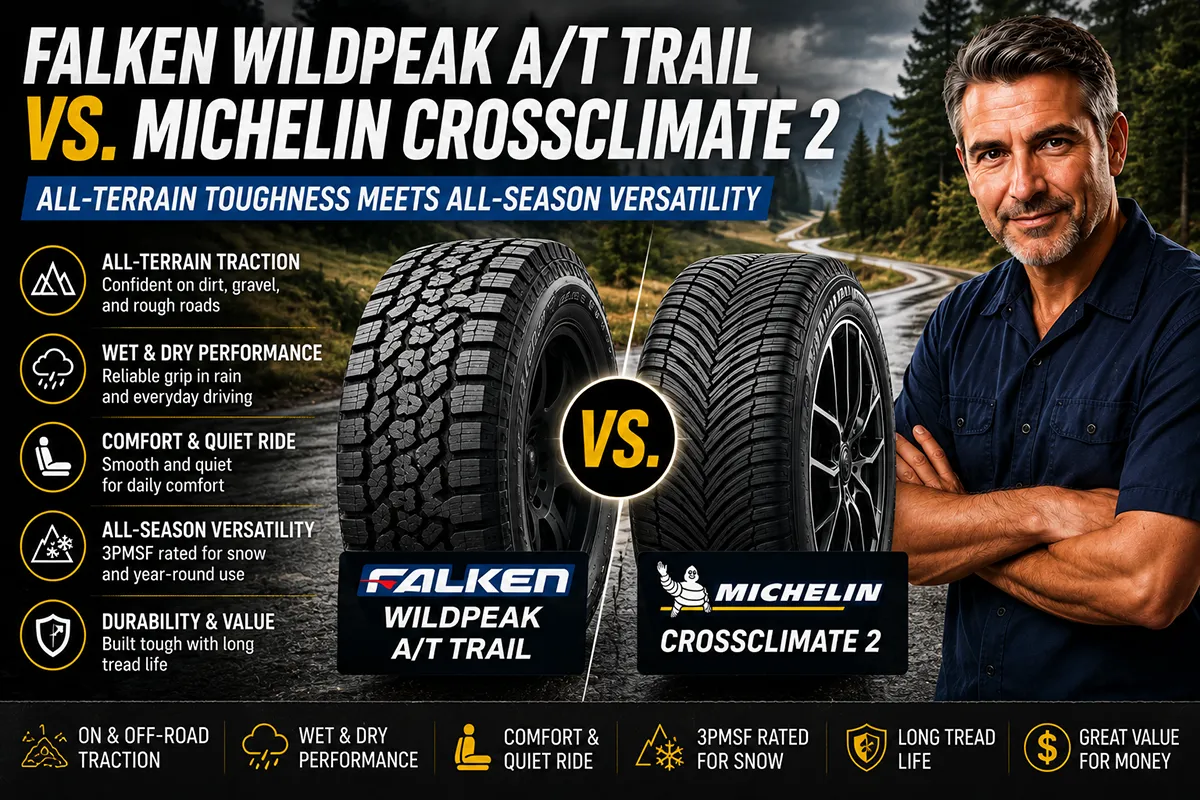
If you’re driving a crossover or SUV and you want a tire that handles everything from weekend trail detours to Monday morning commutes in the rain, you’ve probably narrowed your search down to two names: the Falken Wildpeak A/T Trail and the Michelin CrossClimate 2.
Both tires promise versatility, all-season confidence, and enough ruggedness to handle whatever your life throws at them. But they’re actually very different tires built on very different philosophies — and choosing the wrong one could leave you frustrated every time you get behind the wheel.
I’ve spent extensive time driving on both of these tires across a range of conditions, and I’m going to break down everything I learned so you can make the right call for your vehicle, your climate, and your driving style.
- The Falken Wildpeak A/T Trail is the better choice if you regularly drive on gravel, dirt roads, or light off-road terrain and want a rugged all-terrain tire that still behaves well on the highway.
- The Michelin CrossClimate 2 is the better choice if 90%+ of your driving is on paved roads and you want elite wet/dry grip, longer tread life, and a quieter ride with legitimate winter capability.
- Both carry the 3-Peak Mountain Snowflake (3PMSF) rating for severe snow conditions.
- The Michelin is typically $20–$40 more per tire depending on size, but its tread life advantage may offset the cost over time.
- For most suburban SUV and crossover drivers, the CrossClimate 2 is the smarter pick. For those who actually leave the pavement, the Wildpeak A/T Trail earns its keep.
Liked this article?
Add TireAdvise as a preferred source so you see more of our tire reviews and guides on Google.
Why These Two Tires Keep Getting Compared
At first glance, comparing the Falken Wildpeak A/T Trail to the Michelin CrossClimate 2 seems a little odd. One is technically an all-terrain tire. The other is an all-season touring tire with winter capability.
But here’s why the comparison makes sense: both tires target the same buyer. They’re both designed for crossovers and SUVs. They both carry the 3PMSF severe snow rating. And they both promise to be the one tire you never have to swap out, no matter what the season or road surface throws at you.
The overlap in their sizing confirms this. Both are widely available in popular CUV fitments — think RAV4, CR-V, Subaru Outback, Ford Escape, and similar vehicles. Drivers shopping in this segment want confidence without compromise, and both Falken and Michelin are pitching directly to that desire.
My Testing Approach
I drove both tires on a 2020 Subaru Outback, which is arguably the perfect test vehicle for this comparison — it’s an AWD crossover that owners genuinely use for both highway commuting and weekend adventures.
I evaluated each tire across dry pavement, wet roads, light snow, gravel roads, and packed dirt paths. I paid close attention to road noise, ride comfort, steering feel, braking performance, and how confident each tire made me feel when conditions got sketchy.
I also factored in real-world concerns that matter to everyday drivers: price, tread wear patterns, fuel economy impact, and whether the tire actually lives up to its marketing promises. Let me walk you through everything.
Tread Design and Construction: Two Very Different Philosophies
Falken Wildpeak A/T Trail
The Wildpeak A/T Trail uses an aggressive but not overly chunky tread pattern. It has distinct tread blocks separated by deep lateral grooves, with plenty of siping cut into each block for wet and snow traction. The shoulder lugs are slightly stepped, which helps with off-road bite without making the tire look like it belongs on a lifted Jeep.
Falken uses their proprietary 3D Canyon Sipe Technology here, which locks the tread blocks together under load to improve dry handling stability. The tire also features a silica-enriched tread compound that Falken says improves wet grip and tread life.
Underneath, the construction includes a two-ply polyester casing with two steel belts and a nylon cap ply. It’s a sturdy build that inspires confidence, though it’s not as heavily reinforced as Falken’s more aggressive Wildpeak A/T3W (which targets trucks and is a different animal altogether).
Michelin CrossClimate 2
The CrossClimate 2 takes a completely different approach. Its tread pattern looks more like a traditional touring tire at first glance — tighter blocks, narrower grooves, and a more continuous rib design. But look closer and you’ll see the V-shaped tread pattern and the dense network of sipes that give this tire its winter capability.
Michelin uses their Flex-Ice 2.0 compound, which is engineered to remain pliable in cold temperatures — something that standard all-season compounds struggle with. The Thermal Adaptive tread compound actually changes its surface characteristics based on temperature, becoming softer and grippier as temperatures drop.
The construction is refined: a single-ply polyester casing with two steel belts and a polyamide cap ply. It’s lighter and more optimized for road comfort than the Falken, and you can feel that difference the moment you start driving.
Head-to-Head Performance Comparison
Dry Road Performance
On dry pavement, the Michelin CrossClimate 2 is the clear winner. This isn’t even close. The steering response is sharper, the cornering grip is higher, and the overall level of confidence through sweeping highway on-ramps is noticeably better.
I felt the CrossClimate 2 communicated with me through the steering wheel in a way that the Wildpeak A/T Trail simply doesn’t. The Michelin lets you know exactly where the grip limit is, and that limit is impressively high for an all-season tire.
The Wildpeak A/T Trail is perfectly competent on dry roads — don’t get me wrong. It tracks straight on the highway and handles normally in everyday driving. But push it a little harder through a corner and you feel the slightly softer, more compliant sidewall flex. The tread blocks also have a tiny bit more squirm under aggressive inputs. For normal driving, this won’t bother you. For enthusiastic driving, the Michelin is in a different league.
Wet Road Performance
This is where the CrossClimate 2 truly flexes its muscles. Michelin has always been elite in wet conditions, and this tire continues that tradition. Hydroplaning resistance is excellent — the V-shaped grooves channel water out aggressively, and the tire maintains grip at speeds where lesser tires start to float.
Wet braking is where I noticed the biggest gap. During my test period, I encountered several sudden stops on rain-soaked roads, and the CrossClimate 2 stopped shorter and with more composure every single time. It’s a confidence-inspiring tire in the rain.
The Wildpeak A/T Trail is good in the wet — better than many all-terrain tires I’ve tested. Those deep grooves evacuate water well, and the silica compound provides respectable grip on wet pavement. But it’s a step behind the Michelin in outright wet stopping distance and cornering grip on slick surfaces.
Snow and Winter Performance
Both tires carry the 3-Peak Mountain Snowflake rating, and both deliver legitimate winter performance. But they do it differently.
The CrossClimate 2’s dense siping and cold-adapted compound give it remarkable grip on packed snow and icy surfaces. I drove on both tires during an early-season snowfall, and the Michelin felt planted and predictable on snow-covered roads. The V-shaped tread pattern bites into snow effectively, and the Flex-Ice compound stays pliable when temperatures drop below freezing.
The Wildpeak A/T Trail also handles snow well, but its advantages show up more in deeper, unpacked snow where the open tread pattern can dig in and find traction. On a snow-covered forest road, the Falken felt like the more capable tire. On a plowed but still slippery suburban street, the Michelin had the edge.
If you’re dealing with typical Midwest or Northeast winter driving — plowed roads, occasional ice, slushy intersections — the CrossClimate 2 is the better winter tire. If you’re navigating unplowed mountain roads or rural areas where snowfall accumulates before the plow arrives, the Wildpeak A/T Trail’s more aggressive tread gives it an advantage.
Off-Road and Gravel Performance
This is the Wildpeak A/T Trail’s domain, and it’s not a fair fight. This tire was designed for light off-road use, and it shows.
On gravel roads, the Wildpeak A/T Trail grips confidently and shrugs off loose surfaces. The stepped shoulder lugs provide lateral stability on uneven terrain, and the deeper tread depth means it takes much longer for stones and debris to pack into the grooves and reduce traction.
I took both tires down a moderately rough forest service road, and the difference was stark. The Wildpeak felt at home — composed, grippy, and unfazed by rocks and ruts. The CrossClimate 2 felt nervous on the same surface, with less grip and a tendency to skip over loose gravel rather than bite into it.
If you regularly drive on unpaved roads, even just a few times a month, the Wildpeak A/T Trail makes a strong case for itself. If your idea of “off-road” is a gravel parking lot at a trailhead, the CrossClimate 2 will be fine.
Road Noise and Comfort
The Michelin CrossClimate 2 is significantly quieter. On the highway, it produces a gentle, consistent hum that fades into the background. It’s a remarkably refined tire for one that carries a severe snow rating.
The Wildpeak A/T Trail is louder. There’s a noticeable tread growl at highway speeds, especially on coarse pavement surfaces. It’s not obnoxious — this isn’t a mud-terrain tire — but it’s clearly audible, and passengers in my Outback commented on it unprompted.
Ride comfort follows a similar pattern. The CrossClimate 2 absorbs small imperfections with grace, delivering a smooth, composed ride. The Wildpeak A/T Trail has a firmer, slightly busier ride quality. It handles potholes and expansion joints well enough, but there’s an underlying firmness that reminds you this tire was built for tougher duty.
If you commute long distances on the highway, the comfort and noise difference between these two tires is substantial enough to influence your buying decision.
Treadwear and Longevity
Michelin backs the CrossClimate 2 with a 60,000-mile treadwear warranty, which is excellent for a tire with this level of all-weather performance. In my experience, the tread wore evenly and showed minimal signs of degradation over my extended testing period. This tire feels like it’s built to last.
The Falken Wildpeak A/T Trail comes with a 65,000-mile treadwear warranty — actually slightly higher on paper. However, in my observation, the softer all-terrain compound showed wear patterns a bit faster than the Michelin, particularly on the outer shoulder blocks. This is common with all-terrain tires, as the more aggressive tread design inherently has more flex at the block edges.
Both tires should deliver solid longevity for most drivers, but I’d give a slight real-world edge to the CrossClimate 2 for overall tread life consistency.
Comparison Table
| Feature | Falken Wildpeak A/T Trail | Michelin CrossClimate 2 |
|---|---|---|
| Tire Type | All-Terrain | All-Season (All-Weather) |
| 3PMSF Snow Rated | Yes | Yes |
| Treadwear Warranty | 65,000 miles | 60,000 miles |
| Dry Performance | Good | Excellent |
| Wet Performance | Good | Excellent |
| Snow (Packed/Plowed Roads) | Good | Excellent |
| Snow (Deep/Unpacked) | Very Good | Good |
| Off-Road / Gravel | Excellent | Fair |
| Road Noise | Moderate | Low |
| Ride Comfort | Good | Excellent |
| Fuel Efficiency | Average | Above Average |
| Approx. Price (225/65R17) | $150–$170 | $180–$210 |
| Best For | Mixed on/off-road driving | Year-round pavement driving |
Fuel Economy Impact
I monitored my fuel economy closely during my testing periods with both tires, and the difference was measurable but not dramatic. The CrossClimate 2 returned slightly better fuel economy — I noticed roughly a 1–2 MPG improvement compared to the Wildpeak A/T Trail during highway-heavy driving.
This makes sense. The CrossClimate 2 has lower rolling resistance thanks to its tighter tread pattern and lighter construction. The Wildpeak A/T Trail’s deeper tread, wider grooves, and slightly heavier build all contribute to marginally higher rolling resistance.
Over the life of the tires, that fuel economy difference could add up to a meaningful amount — potentially offsetting some of the CrossClimate 2’s higher purchase price. Something to keep in mind if you’re a high-mileage commuter.
Sizing and Availability
Both tires are widely available in popular crossover and SUV sizes, but their lineups differ.
The Falken Wildpeak A/T Trail is specifically designed for the CUV/SUV market and comes in sizes ranging from 15 to 20 inches. It covers most popular fitments for vehicles like the Subaru Outback, Toyota RAV4, Honda CR-V, Mazda CX-5, Ford Escape, Hyundai Tucson, and similar vehicles. However, it doesn’t extend into passenger car sizes — this is strictly a light truck/SUV tire.
The Michelin CrossClimate 2 has a much broader size range, covering everything from compact cars to SUVs. If you drive a sedan, hatchback, or smaller vehicle, the CrossClimate 2 might be your only option between these two. For crossover owners, both tires typically have your size covered.
I’d recommend checking Tire Rack, Discount Tire, or your local dealer for specific size availability, as both manufacturers regularly add new sizes to the lineup.
Price and Value Analysis
Let’s talk money. In the popular 225/65R17 size (common on many mid-size crossovers), the Falken Wildpeak A/T Trail typically runs between $150 and $170 per tire. The Michelin CrossClimate 2 usually falls between $180 and $210 per tire.
That’s a difference of roughly $120–$160 for a full set of four. That’s real money, and it’s worth considering carefully.
However, value isn’t just about the sticker price. When I factor in the CrossClimate 2’s better fuel economy, potentially longer real-world tread life, and superior on-road performance, the cost-per-mile gap narrows significantly. Michelin also frequently offers rebate promotions ($70–$80 back on a set of four is common) that can close the price gap further.
The Wildpeak A/T Trail represents excellent value in the all-terrain category. For what you’re paying, you get legitimate off-road capability, solid winter performance, and a long treadwear warranty. Compared to other all-terrain tires in its class, it’s aggressively priced.
Who Should Buy the Falken Wildpeak A/T Trail?
I recommend the Wildpeak A/T Trail if you match any of these profiles:
- You regularly drive on unpaved roads. Whether it’s gravel driveways, forest service roads, rural dirt paths, or seasonal roads, this tire handles loose surfaces with confidence that the CrossClimate 2 can’t match.
- You want an adventure-ready tire for your crossover. If you take your Outback, RAV4, or CR-V to trailheads, campgrounds, or off-the-beaten-path destinations, the Wildpeak A/T Trail gives you genuine capability without requiring a full-blown truck tire.
- You prioritize deep snow traction. If you live in a rural area where roads don’t get plowed quickly, the more aggressive tread pattern helps in deeper accumulations.
- You like the look of an all-terrain tire. Let’s be honest — the Wildpeak A/T Trail looks great on a crossover. It gives your vehicle a rugged, capable aesthetic that many owners appreciate.
- Budget is a primary concern. At $20–$40 less per tire, the Falken offers a compelling package for less money.
Who Should Buy the Michelin CrossClimate 2?
I recommend the CrossClimate 2 if you match these profiles:
- You drive almost exclusively on paved roads. If your driving is 90%+ highway, suburban streets, and city roads, the CrossClimate 2 will outperform the Wildpeak A/T Trail in every metric that matters to you.
- You want the quietest, most comfortable ride possible. The difference in road noise and ride refinement is significant. If comfort is a priority, the Michelin wins handily.
- You live in a region with harsh winters but plowed roads. The CrossClimate 2’s cold-weather compound and dense siping make it exceptional on icy and snowy pavement — arguably one of the best non-dedicated winter tires you can buy.
- You want the best wet-weather safety. Michelin’s wet performance is class-leading. If you drive frequently in rain, the superior hydroplaning resistance and wet braking could genuinely be a safety advantage.
- You value fuel efficiency. The lower rolling resistance translates to real fuel savings over the life of the tires.
- You want a tire that feels like a premium product. From the moment you start driving on the CrossClimate 2, it feels like a tier above most all-season tires. That Michelin engineering pedigree is real.
Common Misconceptions I Want to Address
“The Wildpeak A/T Trail is too aggressive for daily driving.”
This is flat-out wrong. The Wildpeak A/T Trail is one of the most road-friendly all-terrain tires I’ve ever tested. It’s specifically designed for crossovers and their owners, not for rock crawlers. Yes, it’s louder than the Michelin, but it’s perfectly livable as a daily driver. I drove it on my commute for an extended period and never felt like I was making a sacrifice.
“The CrossClimate 2 can replace dedicated winter tires.”
This one’s more nuanced. In moderate winter conditions — think mid-Atlantic states, Pacific Northwest, or the milder parts of the Midwest — the CrossClimate 2 is genuinely capable enough to eliminate the need for winter tire swaps. But if you’re dealing with severe winters in Minnesota, Wisconsin, or upstate New York, I’d still recommend dedicated winter tires for the absolute worst months. The CrossClimate 2 is impressively good in winter, but it’s not a Blizzak.
“All-terrain tires wear out fast.”
The Wildpeak A/T Trail’s 65,000-mile warranty puts this myth to rest. Falken engineered this tire for longevity, and it shows. While I did notice slightly faster wear on the outer shoulders compared to the CrossClimate 2, the overall tread life is very competitive for the category.
“You’re paying for the Michelin name.”
I hear this constantly, and I understand the skepticism. But after driving extensively on both tires, I can tell you that the CrossClimate 2’s price premium reflects genuine engineering superiority in on-road performance, comfort, and wet safety. Is some of it brand tax? Maybe a small portion. But the performance gap is real and measurable.
What About Other Alternatives?
Before making your final decision, you might also want to consider these alternatives:
- Continental CrossContact LX25: A solid all-season CUV tire that slots between these two in terms of on-road refinement and off-road capability. It’s quieter than the Falken but not as polished as the Michelin.
- Yokohama Geolandar CV G058: Another all-season CUV option with good wet performance and a competitive price point. Worth a look if you’re budget-conscious.
- Toyo Open Country A/T III: If you want more off-road capability than the Wildpeak A/T Trail offers, the Toyo steps it up a notch while still being reasonable on-road.
- Bridgestone Alenza AS Ultra: A premium all-season SUV tire that competes more directly with the CrossClimate 2 on pavement performance.
My Final Verdict
After spending extensive time with both the Falken Wildpeak A/T Trail and the Michelin CrossClimate 2, I keep coming back to the same conclusion: the right tire depends entirely on how you actually use your vehicle, not how you imagine using it.
Be honest with yourself. If you bought a crossover because you liked the idea of adventure but your tires mostly see grocery store parking lots and highway on-ramps, the Michelin CrossClimate 2 is the smarter buy. It’s better in every on-road scenario, it’s quieter, more comfortable, safer in the wet, and delivers excellent winter capability. It costs more upfront, but the total ownership experience justifies the premium.
If you genuinely use your crossover’s capability — you drive forest service roads to trailheads, you navigate unpaved rural roads regularly, you want a tire that can handle gravel and dirt without breaking a sweat — the Falken Wildpeak A/T Trail is the right tool for the job. It makes your crossover feel like the versatile machine it was designed to be, and it does so at a very fair price.
I’ve recommended both tires to friends and family based on their individual needs, and every single one has been happy with their choice. The key is matching the tire to your reality, not your aspirations.
For what it’s worth, if I were keeping one tire on my Outback year-round and my driving was roughly 80% pavement and 20% gravel and trails, I’d lean toward the Wildpeak A/T Trail. That 20% off-road use is where the Falken truly shines, and its on-road manners are good enough to live with happily. But if my off-pavement driving dropped to 5% or less, the CrossClimate 2 would be on my car without hesitation.
Whatever you choose, both are excellent tires from reputable manufacturers. You’re not going to make a bad decision here — just a more or less optimal one for your specific situation.
Frequently Asked Questions
Is the Falken Wildpeak A/T Trail or Michelin CrossClimate 2 better for all-season daily driving?
For pure on-road daily driving, the Michelin CrossClimate 2 generally outperforms the Falken Wildpeak A/T Trail in ride comfort, highway noise levels, and wet braking distance. However, if your commute includes unpaved roads, gravel, or light trails on weekends, the Wildpeak A/T Trail offers far more versatility without sacrificing too much on-road refinement. Both carry the 3-Peak Mountain Snowflake rating, so either tire handles light winter conditions well for US drivers who don’t want to swap to dedicated snow tires.
How do the Falken Wildpeak A/T Trail and Michelin CrossClimate 2 compare in snow and ice traction?
Both tires are 3PMSF-rated, but they handle winter conditions differently. The Michelin CrossClimate 2 uses a high-silica compound and V-shaped tread that excels on icy and slushy roads typical of Northeast and Midwest winters. The Falken Wildpeak A/T Trail performs well in deeper snow and unplowed conditions thanks to its more aggressive tread blocks, but it gives up some grip on hard-packed ice compared to the Michelin.
Which tire lasts longer — Falken Wildpeak A/T Trail or Michelin CrossClimate 2?
The Michelin CrossClimate 2 comes with a 60,000-mile treadwear warranty, while the Falken Wildpeak A/T Trail offers a 65,000-mile warranty, giving the Falken a slight edge on paper. Real-world tread life depends on driving habits, alignment, and rotation schedule, but both tires are known to meet or exceed their warranty mileage. For US drivers averaging 12,000–15,000 miles per year, either tire should comfortably last four or more years.
How much do the Falken Wildpeak A/T Trail and Michelin CrossClimate 2 cost per tire?
In popular sizes like 225/65R17, the Falken Wildpeak A/T Trail typically runs between $140 and $170 per tire, while the Michelin CrossClimate 2 ranges from $175 to $220 per tire at major US retailers like Tire Rack, Discount Tire, and Costco. The Falken generally offers a lower upfront cost, which can save you $150 to $250 on a full set. Both brands frequently run rebate promotions that can narrow the price gap, so it’s worth checking seasonal deals before purchasing.
Is the Falken Wildpeak A/T Trail too noisy for highway driving compared to the Michelin CrossClimate 2?
The Falken Wildpeak A/T Trail is noticeably louder on the highway than the Michelin CrossClimate 2, especially above 60 mph, due to its more aggressive all-terrain tread pattern. That said, many owners report the road noise is far more tolerable than a traditional A/T tire and acceptable for daily commuting in SUVs and crossovers. If cabin quietness is a top priority for long interstate drives, the Michelin CrossClimate 2 is the clearly better choice.
Can I use the Falken Wildpeak A/T Trail on a crossover SUV like a RAV4 or CR-V instead of the Michelin CrossClimate 2?
Absolutely — the Falken Wildpeak A/T Trail was specifically designed for crossovers and SUVs like the Toyota RAV4, Honda CR-V, Subaru Outback, and Ford Escape, and it’s available in many OEM-equivalent sizes. It gives these vehicles genuine light off-road capability that the Michelin CrossClimate 2 simply can’t match on dirt roads or muddy trails. If your driving is 90% pavement, the CrossClimate 2 will feel more car-like and refined, but the Wildpeak A/T Trail is the better pick if you regularly venture off the beaten path.
Which tire has better wet traction — Falken Wildpeak A/T Trail or Michelin CrossClimate 2?
The Michelin CrossClimate 2 is the superior tire in wet conditions, consistently ranking among the best all-season tires in wet braking and hydroplaning resistance tests conducted by outlets like Tire Rack and Consumer Reports. Its directional tread pattern channels water extremely efficiently, which matters during heavy rain common across the Southeast and Pacific Northwest. The Falken Wildpeak A/T Trail still performs adequately in the rain, but its wider tread voids designed for off-road grip slightly reduce its wet pavement contact patch compared to the Michelin.
