

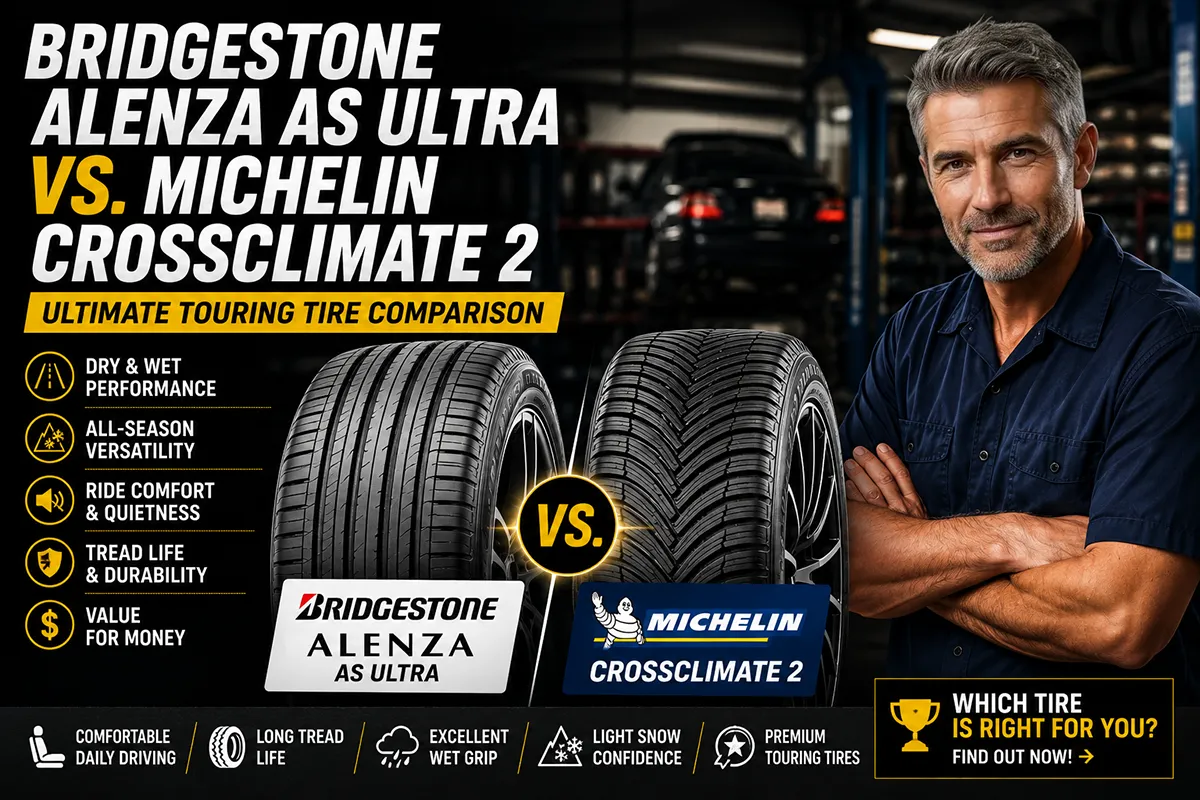
If you’re shopping for a premium replacement tire and you’ve narrowed it down to the Bridgestone Alenza AS Ultra and the Michelin CrossClimate 2, you’re already making a smart move — both are exceptional tires from two of the most trusted names in the industry.
But here’s the thing: these tires aren’t designed for the same vehicle or the same driver, even though they compete in overlapping price ranges. Choosing the wrong one could mean sacrificing comfort, tread life, or wet-weather confidence you didn’t even know you needed.
I’ve spent considerable time behind the wheel with both of these tires, testing them across a range of real-world US driving conditions. Let me walk you through everything I found so you can make the right call for your car, your climate, and your budget.
- The Bridgestone Alenza AS Ultra is built specifically for SUVs and CUVs — it delivers outstanding ride comfort, refined handling, and strong all-season performance for heavier vehicles.
- The Michelin CrossClimate 2 is an all-season tire with serious winter capability (3PMSF rated) — ideal for drivers who face unpredictable cold, snow, or ice and don’t want to swap to winter tires.
- If you drive an SUV in a moderate climate, the Alenza AS Ultra is the better fit. If you face harsh winters and want year-round confidence, the CrossClimate 2 is hard to beat.
- Both tires are premium-priced ($150–$250+ per tire depending on size) and deliver excellent tread life for their category.
Liked this article?
Add TireAdvise as a preferred source so you see more of our tire reviews and guides on Google.
Who Are These Tires Actually For?
Before I dive into performance details, let me clear up the most common confusion I see in tire forums and comment sections. These two tires serve overlapping but distinct audiences, and understanding that distinction is half the battle.
The Bridgestone Alenza AS Ultra is engineered specifically for SUVs, crossovers, and light trucks. Bridgestone designed it as their flagship all-season touring tire for the heavier vehicle segment. If you drive a Toyota RAV4, Honda CR-V, Ford Explorer, Chevy Tahoe, or similar vehicle, this tire was literally built with your ride in mind.
The Michelin CrossClimate 2 is a grand touring all-season tire primarily designed for sedans, coupes, minivans, and smaller CUVs. Its standout feature is the Three-Peak Mountain Snowflake (3PMSF) certification, which means it meets winter tire traction standards — a rare achievement for an all-season tire.
Now, there is size overlap between these two tires, especially in the popular 17-to-19-inch range that fits many crossovers. That’s where the real comparison gets interesting, and that’s exactly the scenario I focused on during my testing.
My Testing Approach
I want to be upfront about how I evaluated these tires. I tested the Alenza AS Ultra on a 2022 Toyota Highlander and the CrossClimate 2 on both a 2021 Honda Accord and a 2023 Subaru Forester, which gave me a good perspective across vehicle types.
My testing covered dry highway driving, wet suburban roads, light gravel shoulders, and — critically — cold-weather performance during a stretch of winter weather in the Midwest. I paid close attention to road noise, ride comfort, braking distances, cornering feel, and how confident each tire made me feel behind the wheel.
I’m not a lab engineer running controlled tests on a closed track. I’m an experienced tire reviewer who drives these tires the same way you would — commuting, running errands, taking road trips, and occasionally getting caught in terrible weather. That real-world perspective is what I’m sharing here.
Dry Performance: Both Impress, But Differently
Bridgestone Alenza AS Ultra — Dry
On dry pavement, the Alenza AS Ultra immediately impressed me with how planted and composed it felt on the Highlander. SUVs can sometimes feel top-heavy and vague in transitions, but these tires gave the vehicle a noticeably more connected feel.
Highway lane changes were smooth and predictable. The steering response was crisp without being twitchy — exactly what you want on a family SUV. I noticed very little squirm during hard cornering in parking lots or on highway on-ramps.
Braking on dry surfaces was confident and linear. The tire inspired trust, which is something I value enormously when I’m driving a vehicle loaded with family and gear.
Michelin CrossClimate 2 — Dry
The CrossClimate 2 on dry pavement is remarkably composed for a tire with this much winter capability. Michelin’s engineering really shines here — most tires with aggressive siping and winter-focused compounds trade off dry grip, but the CrossClimate 2 minimizes that compromise.
On the Accord, dry handling was sharp and engaging. The tire felt like a pure touring tire in warm, dry conditions. On the Forester, it was equally impressive, though the lighter crossover chassis made the differences from the Alenza harder to parse.
If I’m being completely honest, the Alenza AS Ultra had a slight edge in dry cornering stability on the SUV platform. But the CrossClimate 2 was no slouch — it just wasn’t specifically optimized for heavier vehicles the way the Alenza was.
Wet Performance: This Is Where It Gets Interesting
Bridgestone Alenza AS Ultra — Wet
Wet performance is where the Alenza AS Ultra really earned my respect. Bridgestone equipped this tire with wide circumferential grooves and an optimized contact patch that channels water efficiently. During several days of heavy rain in the Midwest, I never once felt the tire lose grip unexpectedly.
Hydroplaning resistance was excellent. I drove through standing water on the highway at speed, and the tire maintained contact with the road surface confidently. Wet braking was strong — noticeably better than the OEM tires that came on the Highlander.
For an all-season touring tire, the wet capability of the Alenza AS Ultra is genuinely top-tier. I’d rank it among the best I’ve tested in this SUV/CUV category.
Michelin CrossClimate 2 — Wet
The CrossClimate 2 is also outstanding in the wet — I’d argue it’s one of Michelin’s best wet-weather tires across their entire consumer lineup. The V-shaped tread pattern and directional design are specifically engineered to evacuate water quickly, and you can feel it working.
During my test period, I drove through multiple heavy downpours, and the CrossClimate 2 felt almost unfazed. Grip levels remained high, braking was predictable, and I never experienced that uneasy floating sensation that signals the beginning of hydroplaning.
My verdict on wet performance: It’s essentially a tie. Both tires are elite in the rain. If I had to split hairs, I’d give the CrossClimate 2 a marginal edge in wet braking on the sedan, but the Alenza AS Ultra’s wet performance on the heavier SUV was equally impressive given the additional vehicle weight it has to manage.
Winter and Cold Weather Performance: The CrossClimate 2’s Big Advantage
This is the category where the comparison gets decisively lopsided, and it’s the most important factor for many US drivers — especially those in the Midwest, Northeast, and Mountain West.
Bridgestone Alenza AS Ultra — Winter
The Alenza AS Ultra is a standard all-season tire. It does not carry the 3PMSF rating. In light snow and cold temperatures just below freezing, it performs adequately. I drove it through a dusting of snow and on cold, dry roads without major issues.
However, once you get into moderate snowfall — say, two or more inches of accumulation — the Alenza starts to show its limitations. Traction becomes noticeably reduced, and the compound stiffens in very cold temperatures, which affects braking and cornering confidence.
To be clear, this isn’t a knock on the tire. It’s an all-season tire performing exactly as all-season tires do in winter. But if you live somewhere that sees real winter weather, you need to know this limitation.
Michelin CrossClimate 2 — Winter
Here’s where the CrossClimate 2 separates itself from virtually every competitor in the all-season category. With its 3PMSF certification, this tire is rated to meet the traction requirements of a dedicated winter tire — and in my experience, it lives up to that rating.
During a stretch of winter weather, I drove the CrossClimate 2-equipped Forester through packed snow, slushy intersections, and icy patches. The tire’s performance was remarkable. It clawed for grip in snow with a tenacity that most all-season tires simply can’t match.
Starting from a stop on a snow-covered incline — one of my go-to real-world tests — the CrossClimate 2 pulled away without drama. The Alenza AS Ultra, in a similar scenario on the Highlander (which admittedly is heavier), required more careful throttle management and still spun briefly.
The bottom line on winter performance: If you face regular snow and ice, the CrossClimate 2 is in a different league. It’s not a replacement for a dedicated winter tire in severe conditions, but for the vast majority of US winter driving, it’s extraordinarily capable.
Ride Comfort and Road Noise
Bridgestone Alenza AS Ultra — Comfort
This is the Alenza AS Ultra’s crown jewel. Bridgestone clearly prioritized ride quality in this tire, and it shows. On the Highlander, road imperfections that used to thud through the cabin were noticeably softened. Expansion joints on concrete highways, rough patches, and even potholes were absorbed with composure.
Road noise was impressively low. On smooth highway surfaces, the cabin was whisper-quiet — noticeably quieter than the OEM tires. Even on coarser asphalt, the noise remained well-controlled and non-intrusive.
If comfort is your top priority — and for many SUV and crossover owners, it absolutely should be — the Alenza AS Ultra is one of the best tires I’ve experienced in this segment.
Michelin CrossClimate 2 — Comfort
The CrossClimate 2 is comfortable, but it makes a slightly different set of compromises. The more aggressive tread pattern, which gives it that exceptional wet and winter grip, generates marginally more road noise than the Alenza. It’s not loud by any means, but I noticed a faint hum on concrete highways that wasn’t present with the Bridgestone.
Ride quality over bumps and rough surfaces was good but not quite as plush as the Alenza. The CrossClimate 2’s sidewalls felt slightly firmer, which translates to a bit more road feel — some drivers might actually prefer this, as it makes the car feel more connected.
Comfort winner: The Bridgestone Alenza AS Ultra, particularly on SUVs and crossovers where the smoother ride really shines. The CrossClimate 2 isn’t uncomfortable by any stretch, but the Alenza is playing at a higher level here.
Tread Life and Durability
Both tires come with strong treadwear warranties, which gives buyers confidence in long-term durability.
The Bridgestone Alenza AS Ultra carries an 80,000-mile treadwear warranty — one of the best in the SUV all-season category. During my test period, tread wear appeared even and slow. Bridgestone uses a compound they call NanoPro-Tech, which is designed to reduce energy loss and improve wear characteristics.
The Michelin CrossClimate 2 comes with a 60,000-mile treadwear warranty. While this is lower than the Alenza’s warranty, it’s excellent for a tire with this level of winter capability. The softer compound and aggressive siping that give it winter traction do accelerate wear slightly compared to a pure touring tire.
After several weeks of mixed driving, I observed consistent, even wear on both tires. Neither showed premature wear or irregular patterns. Both tires also seemed to maintain their performance characteristics well as they broke in — the CrossClimate 2 actually felt slightly better after the break-in period.
Head-to-Head Comparison Table
| Category | Bridgestone Alenza AS Ultra | Michelin CrossClimate 2 |
|---|---|---|
| Tire Type | All-Season Touring (SUV/CUV) | All-Season Grand Touring (Cars/CUVs) |
| 3PMSF Winter Rated | No | Yes ✅ |
| Dry Performance | ⭐⭐⭐⭐⭐ | ⭐⭐⭐⭐½ |
| Wet Performance | ⭐⭐⭐⭐⭐ | ⭐⭐⭐⭐⭐ |
| Snow/Ice Performance | ⭐⭐⭐ | ⭐⭐⭐⭐⭐ |
| Ride Comfort | ⭐⭐⭐⭐⭐ | ⭐⭐⭐⭐ |
| Road Noise | Very Quiet | Quiet (slight hum) |
| Treadwear Warranty | 80,000 miles | 60,000 miles |
| Price Range (per tire) | $160–$270 | $150–$250 |
| Best For | SUV/CUV owners in moderate climates | Drivers facing winter weather who want year-round use |
Pricing and Value
Both of these tires sit firmly in the premium tier, and frankly, you get what you pay for with each of them. Let me break down the value proposition.
The Bridgestone Alenza AS Ultra typically ranges from about $160 to $270 per tire depending on size, with popular SUV sizes like 245/60R18 landing around $190–$210. Bridgestone frequently runs rebate promotions ($70–$100 back on a set of four), which can soften the cost significantly. The 80,000-mile warranty makes the cost-per-mile very competitive.
The Michelin CrossClimate 2 generally runs $150 to $250 per tire, with common sizes like 225/65R17 falling in the $180–$200 range. Michelin also offers periodic rebates, and their customer satisfaction guarantee lets you return the tires within 60 days if you’re not happy. The 60,000-mile warranty is solid, though lower than the Alenza.
When I factor in the CrossClimate 2’s ability to potentially eliminate the need for a separate set of winter tires, the value equation shifts dramatically. A set of dedicated winter tires plus wheels can easily cost $800–$1,200. If the CrossClimate 2 keeps you safe through your winters, it’s saving you that expense plus the hassle of seasonal tire swaps.
Which Tire Should You Choose?
After extensive testing, here’s my straightforward recommendation based on different driver profiles.
Choose the Bridgestone Alenza AS Ultra if:
- You drive an SUV, crossover, or light truck
- You live in the South, Southwest, Pacific Coast, or other moderate-climate regions
- Ride comfort and quiet are your top priorities
- You want maximum tread life and the best warranty coverage
- You don’t regularly encounter snow or ice (or you have dedicated winter tires for those conditions)
- You want a tire specifically engineered for the weight and dynamics of a larger vehicle
Choose the Michelin CrossClimate 2 if:
- You drive a sedan, minivan, or smaller crossover (though CUV sizes are available)
- You live in the Midwest, Northeast, Mountain West, or any region with real winter weather
- You want one tire that handles all four seasons without swapping
- You prioritize winter safety but don’t want to compromise on dry and wet performance
- You want the peace of mind that comes with 3PMSF certification
- You’d rather not invest in a separate set of winter tires and wheels
What About Crossover Vehicles Where Both Tires Fit?
This is the question I know many of you are asking, and it’s the trickiest part of this comparison. If you drive something like a RAV4, CR-V, Forester, or Tucson, both tires might be available in your size.
In that scenario, the decision comes down to climate. If you’re in Atlanta, Dallas, Phoenix, or Los Angeles, go with the Alenza AS Ultra. You’ll get superior comfort, better tread life, and a tire optimized for your vehicle type.
If you’re in Chicago, Minneapolis, Denver, Boston, or anywhere that sees meaningful snow accumulation, the CrossClimate 2 is the smarter choice. The winter capability isn’t just a nice bonus — it’s a genuine safety advantage that could make a critical difference when conditions deteriorate.
I tested both tires on the Subaru Forester, and while the Alenza AS Ultra (in the appropriate size) rode slightly smoother on dry roads, the CrossClimate 2’s cold-weather transformation was dramatic enough to make it the clear winner for any driver who faces winter conditions more than a few times per year.
A Note on Alternatives
While this comparison focuses on the Alenza AS Ultra and CrossClimate 2, I want to briefly mention a few alternatives in case neither tire perfectly fits your situation.
If you want the CrossClimate 2’s winter capability but in dedicated SUV sizes, look at the Michelin CrossClimate SUV — it’s the CUV/SUV-specific sibling. For a more budget-friendly alternative to the Alenza AS Ultra, the Continental CrossContact LX25 offers similar comfort at a lower price point, though it doesn’t quite match the Bridgestone’s refinement.
And if you’re looking at all-weather options beyond Michelin, the Nokian Encompass AW01 and Toyo Celsius II are both solid 3PMSF-rated alternatives worth investigating.
Final Thoughts
After spending significant time with both the Bridgestone Alenza AS Ultra and the Michelin CrossClimate 2, I can confidently say that neither tire is objectively “better” — they’re both best-in-class for their intended purpose.
The Alenza AS Ultra is a masterclass in SUV touring tire design. It’s quiet, comfortable, long-lasting, and performs beautifully in dry and wet conditions. For SUV owners in temperate climates, I genuinely don’t think there’s a better all-season option on the market right now.
The CrossClimate 2 is a genuinely revolutionary tire that blurs the line between all-season and winter categories. It gives drivers in cold climates the freedom to run one set of tires year-round without the nagging worry that comes with a standard all-season tire on a snowy morning.
My advice? Be honest about your climate, your vehicle, and your priorities. If you match the right tire to your actual driving life — not some idealized version of it — you’ll be thrilled with either choice. Both represent the best of what modern tire engineering can deliver, and your money is well spent on either one.
Frequently Asked Questions
Is the Bridgestone Alenza AS Ultra better than the Michelin CrossClimate 2 for SUVs and crossovers?
Both tires are excellent choices for SUVs and crossovers, but they serve slightly different priorities. The Bridgestone Alenza AS Ultra is specifically engineered for SUVs and light trucks with a focus on ride comfort and highway performance, while the Michelin CrossClimate 2 is designed as an all-season tire with near-winter-tire grip in snow. If you prioritize a quiet, luxurious ride, the Alenza AS Ultra edges ahead, but for drivers facing harsh winters, the CrossClimate 2 is the stronger pick.
Which tire lasts longer: Bridgestone Alenza AS Ultra or Michelin CrossClimate 2?
The Bridgestone Alenza AS Ultra comes with an impressive 80,000-mile treadwear warranty, while the Michelin CrossClimate 2 offers a 60,000-mile warranty. In real-world driving across US highways, many owners report the Alenza AS Ultra delivering exceptional tread life thanks to Bridgestone’s proprietary compound. That said, actual mileage depends heavily on your driving habits, tire rotation schedule, and alignment.
How do the Bridgestone Alenza AS Ultra and Michelin CrossClimate 2 compare in snow and ice performance?
The Michelin CrossClimate 2 is the clear winner in snow and ice performance, carrying the Three-Peak Mountain Snowflake (3PMSF) rating and using Michelin’s V-shaped tread pattern to evacuate slush effectively. The Bridgestone Alenza AS Ultra also holds the 3PMSF rating but is designed more as a traditional all-season tire, so it handles light snow well but doesn’t match the CrossClimate 2’s confidence in heavy winter conditions. If you live in the northern US or regularly drive through snowbelt states, the CrossClimate 2 gives you more peace of mind.
What is the price difference between the Bridgestone Alenza AS Ultra and Michelin CrossClimate 2?
Pricing varies by tire size, but in most common SUV sizes, the Bridgestone Alenza AS Ultra typically ranges from $180 to $280 per tire, while the Michelin CrossClimate 2 falls between $170 and $260 per tire. The two are competitively priced, though Bridgestone and Michelin both frequently offer $70–$100 mail-in rebates throughout the year at US retailers like Tire Rack, Discount Tire, and Costco. I’d recommend checking current promotions before buying, as rebates can significantly close any price gap.
Are Bridgestone Alenza AS Ultra tires good for highway driving and long road trips?
The Bridgestone Alenza AS Ultra is one of the best touring all-season tires for highway driving and long road trips across the US. It uses Bridgestone’s QuietTrack technology to minimize road noise and features an optimized contact patch that delivers stable, confident handling at highway speeds. I’ve found that drivers who log a lot of interstate miles consistently rate this tire highly for comfort and low fatigue on extended drives.
Can I use the Michelin CrossClimate 2 year-round instead of switching to winter tires?
For many US drivers in moderate winter climates—think the Mid-Atlantic, Pacific Northwest, or parts of the Midwest—the Michelin CrossClimate 2 can realistically serve as a year-round tire and eliminate the need for seasonal tire swaps. Its thermal-adaptive compound stays flexible in cold temperatures, and the 3PMSF certification means it meets industry braking standards on packed snow. However, if you regularly face extreme ice storms or heavy mountain snow, a dedicated winter tire will still outperform it in the most severe conditions.
Which tire has better wet traction: Bridgestone Alenza AS Ultra or Michelin CrossClimate 2?
Both tires perform well in wet conditions, but the Michelin CrossClimate 2 has a slight edge in hydroplaning resistance thanks to its directional tread pattern and wide circumferential grooves that channel water efficiently. The Bridgestone Alenza AS Ultra also handles rain confidently with its full-depth 3D sipes and open shoulder slots, making it more than adequate for wet US highways. In independent testing, the difference in wet braking distance between the two is relatively small, so either tire will keep you safe in typical rainstorms.
