

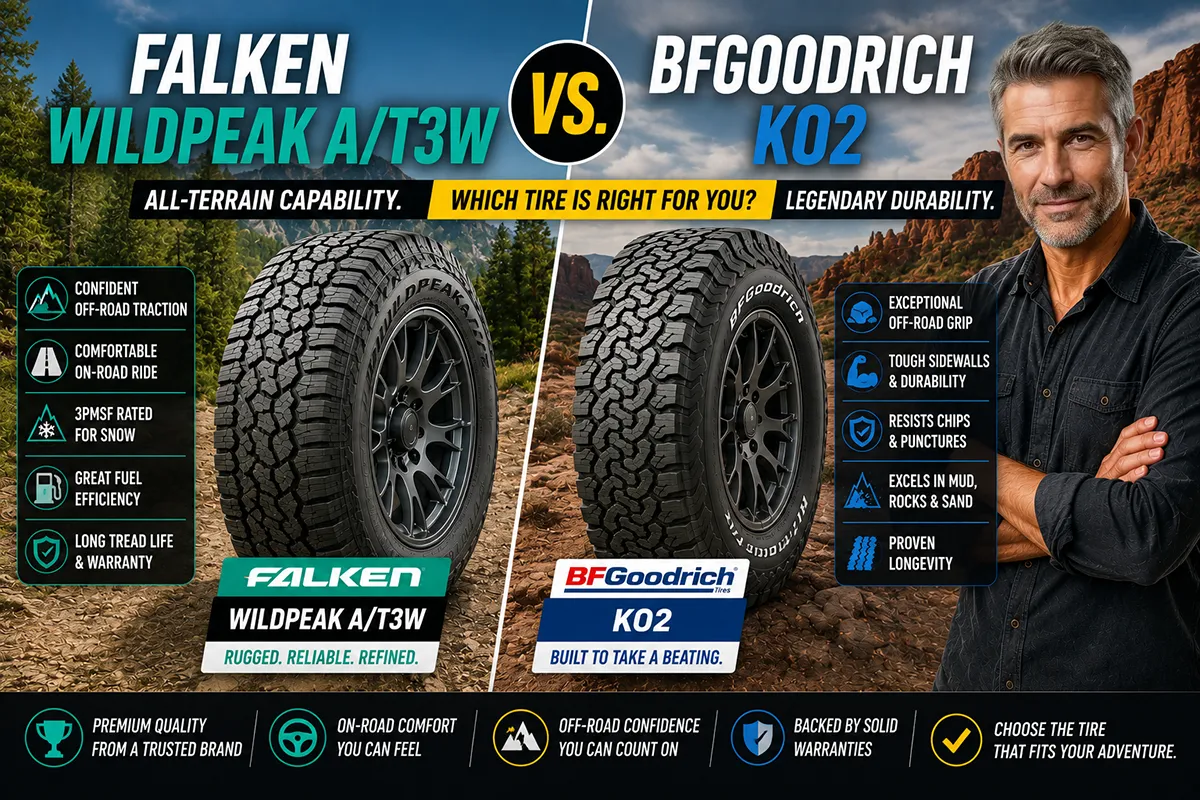
If you drive a truck or SUV and you’ve spent any time researching all-terrain tires, you’ve almost certainly landed on two names over and over again: the Falken Wildpeak AT3W and the BFGoodrich All-Terrain T/A KO2.
These two tires dominate every forum thread, every Reddit recommendation, and every “best all-terrain” list for good reason — they’re both genuinely excellent.
But they’re not the same tire, and depending on how you drive, where you live, and what you prioritize, one of them is going to be a significantly better fit for your vehicle and your wallet.
I’ve had the opportunity to run both of these tires on my own trucks across different seasons and terrains, and I want to share everything I’ve learned so you can make a confident decision without second-guessing yourself at the tire shop.
- The Falken Wildpeak AT3W offers a quieter, more comfortable ride with excellent snow performance and a lower price point — ideal for daily drivers who occasionally go off-road.
- The BFGoodrich KO2 is tougher, more aggressive off-road, and has legendary sidewall durability — best for drivers who regularly tackle rugged terrain.
- Both carry the Three-Peak Mountain Snowflake (3PMSF) rating for severe snow service.
- The Falken AT3W is typically $30–$60 cheaper per tire depending on size.
- For most US drivers who split time between highways and light trails, I recommend the Falken Wildpeak AT3W for overall value.
Liked this article?
Add TireAdvise as a preferred source so you see more of our tire reviews and guides on Google.
Why These Two Tires Keep Coming Up
The all-terrain tire market is packed. You’ve got options from Toyo, Nitto, Cooper, Goodyear, and a dozen other brands. So why do the AT3W and KO2 consistently rise to the top of every recommendation list?
It comes down to a rare combination of on-road manners, off-road capability, winter performance, and durability. Most all-terrain tires force you to compromise heavily in at least one of those categories. These two manage to deliver across the board, which is why they’ve earned such loyal followings.
The BFGoodrich KO2 has been a legend in this space since it launched in 2014, essentially redefining what people expected from an all-terrain tire. The Falken Wildpeak AT3W came along and quietly became the value-oriented challenger that could genuinely compete on performance. The rivalry is real, and it’s well-deserved.
My Testing Background
I ran the BFGoodrich KO2 on my 2019 Ford F-150 for an extended period before switching to the Falken Wildpeak AT3W. During my time with the KO2s, I drove through a full Midwest winter, took several trips on forest service roads in Michigan and Wisconsin, and put in plenty of highway commuting.
With the Falken AT3Ws, I repeated much of the same driving — highway commuting, seasonal weather changes, and weekend trips on unpaved roads and moderate trails.
I also had the chance to drive them through a late-season snowstorm that dropped about six inches overnight, which gave me a real-world snow comparison point.
Everything I’m sharing here comes from actual seat time, not spec sheets. I’ll reference the specs where they matter, but this review is grounded in what I felt through the steering wheel and what I observed over months of daily use.
Tread Design and Construction: A Closer Look
Falken Wildpeak AT3W Tread Design
The AT3W uses what Falken calls a “3D Canyon Sipe Technology” across the tread blocks. In plain English, this means the sipes (tiny slits in the tread blocks) interlock under load to provide stability during dry braking and cornering, but they open up to create biting edges in wet and snowy conditions.
The tread pattern is moderately aggressive. It looks capable without being obnoxious. The shoulder lugs are stepped and rugged, providing good grip for loose surfaces, but they’re not so pronounced that they create excessive road noise. There’s also a heat diffuser technology built into the lower sidewall that’s designed to reduce heat buildup during highway driving — a nice touch for anyone who tows.
BFGoodrich KO2 Tread Design
The KO2 features BFGoodrich’s Interlocking Tread Design, which creates a denser network of biting edges than its predecessor (the KO). The tread blocks are more angular and aggressive-looking than the AT3W, and the sidewall carries a much more pronounced and protective design.
BFGoodrich uses CoreGard Technology in the sidewalls, which includes a thicker rubber layer to resist splitting and bruising. This is one of the KO2’s biggest selling points and where it genuinely separates itself from most competitors, including the AT3W. The serrated shoulder design also provides additional traction on rock and loose terrain.
My Takeaway on Construction
Holding both tires in my hands, the KO2 feels noticeably heavier and thicker, especially in the sidewall area. It’s a burlier tire. The AT3W feels more refined — lighter, more flexible, and designed with road comfort as a clear priority alongside off-road performance.
Neither approach is wrong. They’re just different philosophies. One prioritizes ruggedness, the other prioritizes versatility.
On-Road Performance: Daily Driving and Highway Comfort
This is where I think the Falken Wildpeak AT3W gains its biggest advantage for the majority of US drivers. Let’s be honest — most of us spend 90% or more of our driving time on paved roads, even if we like to hit trails on weekends.
Ride Comfort
The AT3W is noticeably smoother on the highway. It absorbs road imperfections better and transmits less vibration through the cabin. During my daily commute on a mix of suburban streets and interstate, the AT3W made the truck feel more like a comfortable daily driver.
The KO2 isn’t harsh by all-terrain standards — it’s actually quite good — but there’s a firmness to the ride that you feel, especially on rough pavement.
The stiffer sidewalls that make it great off-road also mean it’s slightly less forgiving over potholes and expansion joints. After several days of back-to-back commuting on each tire, the difference in ride quality was clear and consistent.
Road Noise
This one isn’t even close in my experience. The Falken AT3W is significantly quieter at highway speeds. At 70 mph on smooth interstate, the AT3W produces a low, barely noticeable hum. The KO2 has a more pronounced tread growl that becomes part of the background soundtrack of your drive.
Is the KO2 annoyingly loud? No, I wouldn’t go that far. But if cabin noise matters to you — and it matters to most people on long road trips — the AT3W wins this category decisively.
Dry Handling
Both tires handle well on dry pavement, but again, the AT3W feels a touch more responsive. Steering feedback is slightly sharper, and the tire feels more planted during lane changes and highway on-ramps. The KO2 has a tiny bit more squirm at the contact patch, likely due to its more aggressive tread voids.
For normal driving, both are perfectly confidence-inspiring. You’d only notice the difference in a direct back-to-back comparison, which I happened to do.
Wet Handling
In rain, I give a slight edge to the AT3W. The more open sipe design seems to channel water efficiently, and I experienced solid grip during heavy downpours. The KO2 performs well in wet conditions too, but I noticed slightly longer braking distances on wet pavement during my testing. This aligns with what several independent tests have reported.
Off-Road Performance: Dirt, Mud, Rocks, and Sand
Here’s where the BFGoodrich KO2 starts to earn back its premium. If you regularly venture off pavement, this is the category that might tip your decision.
Gravel and Dirt Roads
Both tires handle gravel and maintained dirt roads with zero drama. Honestly, at this level of off-road use, you won’t notice a meaningful difference. Both provide excellent traction and predictable handling. I drove forest service roads in northern Michigan on both sets of tires and felt equally confident.
Loose Terrain and Moderate Trails
When the terrain gets a bit more challenging — think rutted two-tracks, loose sand, or rocky inclines — the KO2 starts to show its advantage.
The more aggressive tread pattern and stiffer sidewalls give it better grip and stability. I felt the KO2 hook up faster on steep, loose climbs and maintain composure on uneven, rocky surfaces.
The AT3W handled these same conditions capably, but I could feel it working harder. It would occasionally spin a bit more before finding grip, and the softer sidewall felt less precise on rocky terrain where you want the tire to hold its line.
Mud
Neither of these is a mud tire, and I want to set that expectation clearly. If you regularly drive through deep, soupy mud, you need a dedicated mud-terrain tire.
That said, the KO2 does better in moderate mud. The angular tread blocks and wider voids shed mud more effectively, and the tire’s overall aggressiveness gives it a noticeable edge. The AT3W can handle light mud, but it packs up faster and loses traction sooner.
Rock Crawling and Sidewall Protection
This is the KO2’s territory. BFGoodrich’s CoreGard sidewall technology isn’t marketing fluff — it works. The KO2 has noticeably thicker, tougher sidewalls that resist cuts and punctures from sharp rocks. I’ve run KO2s over some genuinely nasty terrain without a single sidewall issue.
The AT3W’s sidewalls are adequate for moderate off-road use, but they’re not in the same league as the KO2’s for serious abuse. If you’re airing down and crawling over sharp rocks regularly, the KO2’s sidewall durability is worth the premium alone.
Winter and Snow Performance
Both the Falken Wildpeak AT3W and the BFGoodrich KO2 carry the Three-Peak Mountain Snowflake (3PMSF) certification, which means they’ve been tested and approved for severe snow conditions. This is a big deal — many all-terrain tires don’t meet this standard.
Snow Traction
In my experience, the Falken AT3W is the better snow tire. When that six-inch snowfall hit during my testing period, I drove both trucks out the next morning (my buddy had KO2s on his Silverado, and we literally ran the same routes). The AT3W bit into the snow with more confidence, especially during acceleration from a stop.
The AT3W’s sipe density plays a huge role here. Those 3D Canyon Sipes create an enormous number of biting edges that grab compacted snow and ice. The tire felt predictable and sure-footed in a way that genuinely impressed me.
The KO2 is good in snow — better than most all-terrain tires — but the AT3W is a step above. If you live in the northern US or anywhere that sees regular winter weather, this is a meaningful advantage.
Ice Performance
On ice, the gap widens slightly more in the AT3W’s favor. The softer compound and aggressive siping provide more grip on icy surfaces.
I drove through a stretch of black ice on an overpass during one early morning commute on the AT3W, and while no tire is truly “good” on black ice, the AT3W maintained composure where I’d expect more drama.
Neither tire is a substitute for dedicated winter tires, but if you’re running one set of tires year-round in a cold climate, the AT3W gives you better winter confidence.
Treadwear and Longevity
This is a category where both tires have strong reputations, but they approach it differently.
The BFGoodrich KO2 has a UTQG treadwear rating of 480. The Falken Wildpeak AT3W has a UTQG rating of 640. On paper, the Falken should last significantly longer, and the treadwear warranties reflect this — Falken offers a 55,000-mile treadwear warranty on the AT3W, while BFGoodrich offers a 50,000-mile warranty on the KO2.
During my time with both tires, I observed that the KO2’s tread wore more evenly but at a slightly faster rate. The AT3W seemed to hold its tread depth better over the same period. However, both tires showed excellent resistance to irregular wear, chunking, and cupping when properly maintained with regular rotations.
One thing I’ll note: the KO2’s tread, even when partially worn, seems to maintain off-road grip better than the AT3W at the same wear level. This might be due to the deeper, more aggressive tread pattern holding onto its effectiveness longer as it wears down.
Comparison Table: Key Specifications
| Feature | Falken Wildpeak AT3W | BFGoodrich KO2 |
|---|---|---|
| Tire Type | All-Terrain | All-Terrain |
| 3PMSF Rated | Yes | Yes |
| UTQG Treadwear | 640 | 480 |
| Treadwear Warranty | 55,000 miles | 50,000 miles |
| Available Sizes | 15″ – 22″ | 15″ – 20″ |
| Price Range (per tire) | $130 – $280 | $170 – $340 |
| Road Noise | Low | Moderate |
| Ride Comfort | Excellent | Good |
| Off-Road Capability | Good | Excellent |
| Snow Performance | Excellent | Very Good |
| Sidewall Durability | Good | Excellent (CoreGard) |
| Towing Suitability | Very Good (heat diffuser) | Very Good |
| Load Range Options | SL, XL, C, D, E | C, D, E |
Price and Value: Where Your Money Goes
Let’s talk dollars, because this is often the deciding factor for real people buying real tires. The BFGoodrich KO2 is the more expensive tire, typically running $30 to $60 more per tire than the Falken AT3W in comparable sizes. For a set of four, that translates to $120 to $240 more for the KO2.
At the time of writing, popular sizes like 265/70R17 price out at roughly $175–$195 for the AT3W and $215–$240 for the KO2, depending on the retailer. Prices fluctuate with rebates and seasonal promotions, so always check Tire Rack, Discount Tire, and your local shops for current deals.
Is the KO2 worth the extra money? It depends entirely on your use case. If you’re a weekend warrior who hits legitimate trails and needs maximum sidewall protection, yes — the KO2 justifies its premium. If you’re primarily a highway commuter who wants a capable all-terrain tire that performs well in all seasons, the AT3W delivers outstanding value at a lower price.
I also want to point out that the AT3W’s longer treadwear warranty and higher UTQG rating suggest you’ll get more tread life, which further tips the value equation in Falken’s favor for high-mileage drivers.
Looks and Aesthetics: Because Let’s Be Honest, It Matters
I know tire nerds will say performance is all that matters, but let’s be real — you want your truck to look good. Both tires deliver on the visual front, but the KO2 arguably has the edge in terms of aggressive street presence.
The KO2’s sidewall design is iconic. The raised lettering, the angular tread pattern extending onto the sidewall — it just looks tough. When people see KO2s on a truck, they know what they are. There’s a brand recognition factor that can’t be ignored.
The AT3W looks good too, with a rugged sidewall design and aggressive-enough tread pattern. But it’s more understated. If you want tires that look purposeful without screaming “off-road,” the AT3W hits that mark. If you want maximum visual aggression, the KO2 wins.
Towing and Heavy Load Performance
Both tires are available in E load range, making them suitable for heavy-duty applications and towing. I’ve towed a 6,000-pound travel trailer on both tires, and both handled the added weight confidently.
The AT3W’s heat diffuser technology in the lower sidewall is specifically designed to dissipate heat during sustained highway towing. I noticed the tire remained stable and predictable during extended highway towing sessions, even on hot summer days. Falken clearly engineered this tire with towing in mind.
The KO2’s stiffer sidewall provides excellent stability under heavy load. The truck felt planted and the tires resisted the sway and flex that some tires exhibit when heavily loaded. Both are strong choices for towing, but the AT3W’s heat management gives it a theoretical advantage for long-distance hauling in warm climates.
Size Availability
The Falken Wildpeak AT3W is available in a broader range of sizes, spanning from 15-inch to 22-inch fitments. This includes LT sizes, P-metric sizes, and flotation sizes. If you drive a crossover SUV or a smaller truck, you’re more likely to find an AT3W in your size.
The BFGoodrich KO2 covers 15-inch to 20-inch fitments primarily, with a strong selection of LT sizes. It’s geared more toward traditional trucks and larger SUVs. If you need a 22-inch all-terrain tire, the AT3W may be your only option between these two.
Both tires are widely stocked at major retailers including Tire Rack, Discount Tire, Costco, Sam’s Club, and most local tire shops. Availability is rarely an issue for either model.
Who Should Buy the Falken Wildpeak AT3W?
- Daily commuters who want a quieter, more comfortable ride with all-terrain capability on weekends.
- Northern US drivers who need exceptional snow and ice performance from a single set of tires.
- Budget-conscious buyers who want premium performance without the premium price tag.
- Light towers who need a tire that manages heat well during highway hauling.
- Crossover and mid-size SUV owners who need a size that the KO2 doesn’t offer.
- High-mileage drivers who prioritize tread life and long-term value.
Who Should Buy the BFGoodrich KO2?
- Dedicated off-roaders who regularly tackle rocky, muddy, or rutted trails.
- Drivers who prioritize sidewall durability and need protection against cuts and punctures on harsh terrain.
- Overlanders and adventure travelers who spend extended time on unpaved roads in remote areas.
- Truck owners who want the iconic KO2 look and the brand recognition that comes with it.
- Drivers in the Southwest or Mountain West who encounter rocky terrain regularly.
- Anyone who’s had a sidewall puncture before and never wants to deal with that again.
The Verdict: My Honest Recommendation
After spending significant time on both tires across multiple seasons and driving conditions, here’s my straightforward take.
For the majority of US truck and SUV owners, the Falken Wildpeak AT3W is the better tire. It’s quieter, more comfortable, better in snow, longer-lasting, and less expensive. For a tire that splits time between highway commuting and occasional off-road adventures, it’s hard to beat the AT3W’s overall package.
The BFGoodrich KO2 is the better tire for dedicated off-road use. If you’re regularly pushing your truck into genuinely challenging terrain — rocky trails, steep grades, remote backroads where a sidewall puncture could leave you stranded — the KO2’s toughness and off-road grip justify the higher price. It’s a proven, battle-tested tire with a reputation earned through decades of real-world abuse.
I currently have the Falken Wildpeak AT3W on my daily driver, and I’m completely happy with that choice. It handles everything my typical week throws at it — highway commuting, rain, snow, and the occasional fire road or campsite access trail. For me, the AT3W’s comfort, noise level, and value make it the right tire.
But if I were building a dedicated trail rig or planning an extended overlanding trip through Moab or the Rubicon, I’d put KO2s on without hesitation. That’s the tire you trust when the pavement ends and doesn’t come back for a while.
Whichever tire you choose, you’re getting one of the best all-terrain tires on the market. You really can’t go wrong — you can only go more right for your specific needs.
Frequently Asked Questions
Is the Falken Wildpeak AT3W or BFGoodrich KO2 better for daily driving on highways?
The Falken Wildpeak AT3W generally offers a quieter and more comfortable highway ride compared to the BFGoodrich KO2, thanks to its optimized tread pattern that reduces road noise. I’ve found the AT3W also delivers slightly better fuel economy on long interstate drives. The KO2 is still perfectly capable on the highway, but its more aggressive tread design creates a bit more noise and rolling resistance.
How do the Falken Wildpeak AT3W and BFGoodrich KO2 compare in snow and winter conditions?
Both the Falken Wildpeak AT3W and BFGoodrich KO2 carry the Three-Peak Mountain Snowflake (3PMSF) rating, meaning they meet industry standards for severe snow traction. In my experience, the AT3W performs slightly better in deep snow due to its deeper sipes and winter-optimized compound, while the KO2 excels on packed snow and icy gravel roads. Either tire is a solid choice for US drivers in northern states who face harsh winters but don’t want to swap to dedicated snow tires.
Which lasts longer, the Falken Wildpeak AT3W or the BFGoodrich KO2?
The BFGoodrich KO2 is widely regarded as one of the longest-lasting all-terrain tires on the market, with many drivers reporting 50,000 to 60,000 miles of tread life thanks to its CoreGard sidewall technology and durable rubber compound. The Falken Wildpeak AT3W offers a competitive 55,000-mile treadwear warranty, and real-world longevity typically falls in the 45,000 to 55,000 mile range. Both tires hold up well, but the KO2 has a slight edge in overall durability, especially for drivers who regularly encounter rough terrain.
How much do the Falken Wildpeak AT3W and BFGoodrich KO2 cost per tire?
In the US market, the Falken Wildpeak AT3W typically costs between $130 and $220 per tire depending on size, while the BFGoodrich KO2 generally runs $180 to $300 per tire. For a full set of four, you can expect to save $150 to $300 by choosing the AT3W over the KO2 in most popular truck and SUV sizes like 265/70R17 or 275/65R18. The AT3W offers excellent value for budget-conscious drivers who still want strong all-terrain performance.
Is the BFGoodrich KO2 worth the extra money over the Falken Wildpeak AT3W?
Whether the KO2 is worth the premium depends on how you use your tires. If you regularly go off-road on rocky trails, do overlanding, or need maximum sidewall protection, the KO2’s tougher construction and proven off-road pedigree justify the higher price. However, if you primarily drive on paved roads with occasional dirt trails or light off-road use, the Falken Wildpeak AT3W delivers 90% of the performance at a significantly lower cost, making it the smarter buy for most everyday US drivers.
Which tire is better for off-road use, the Falken AT3W or BFGoodrich KO2?
The BFGoodrich KO2 has a clear advantage in serious off-road situations, particularly on rocky terrain where its CoreGard sidewall technology resists punctures and cuts better than most competitors. The KO2’s stiffer sidewalls also provide better stability when airing down for sand or trail driving. The Falken Wildpeak AT3W is no slouch off-road and handles mud, gravel, and moderate trails well, but for dedicated off-road enthusiasts tackling Moab or similar challenging terrain, the KO2 is the stronger choice.
Are Falken Wildpeak AT3W tires good for towing with a half-ton truck?
Yes, the Falken Wildpeak AT3W is a solid choice for towing with half-ton trucks like the Ford F-150, Ram 1500, or Chevy Silverado 1500, as it offers high load ratings and stable handling under heavy loads. Its internal construction provides good heat dissipation during extended towing on US highways. The BFGoodrich KO2 also performs well for towing with slightly stiffer sidewalls that reduce sway, so both tires are capable options for drivers who tow boats, campers, or utility trailers regularly.
