

You’ve narrowed your search down to two of Michelin’s best tires, and now you’re stuck. The Defender 2 and the CrossClimate 2 look similar on paper, they’re priced within spitting distance of each other, and they both carry that premium Michelin name. So which one actually belongs on your car?
I’ve driven on both of these tires extensively, and I can tell you the differences are far more significant than most online spec sheets would have you believe. Choosing the wrong one could mean compromising on the exact performance trait you care about most.
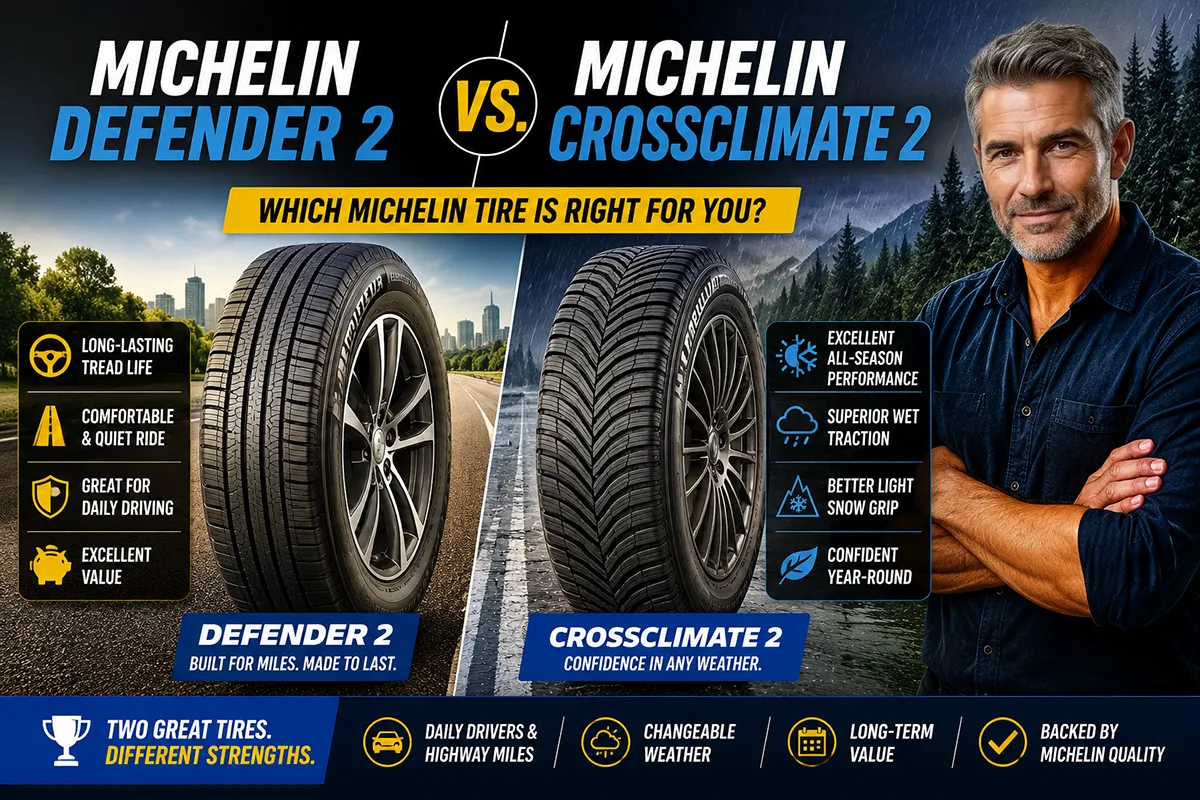
- The Michelin Defender 2 is the better choice if you prioritize maximum tread life, fuel efficiency, and year-round dry/wet performance in mild climates.
- The Michelin CrossClimate 2 is the winner if you face real winter weather — it carries the 3-Peak Mountain Snowflake rating and handles snow and ice far better.
- Both are premium tires priced between $150–$250 per tire depending on size, with the CrossClimate 2 typically running $10–$20 more.
- For drivers in the Sun Belt or mild-weather states, go Defender 2. For drivers in the Midwest, Northeast, or anywhere with regular snow, go CrossClimate 2.
- Both tires offer exceptional ride comfort and low road noise — you won’t be disappointed with either.
Liked this article?
Add TireAdvise as a preferred source so you see more of our tire reviews and guides on Google.
Why This Comparison Matters
Michelin doesn’t make it easy for consumers. They have two premium all-season (or all-weather) offerings that overlap in a lot of ways, and the marketing language on both is almost interchangeable. “Long-lasting.” “All-season confidence.” “Fuel-efficient.” It’s enough to make your eyes glaze over.
But here’s the reality: these are fundamentally different tires designed for different drivers. The Defender 2 is a traditional all-season touring tire built for longevity and everyday commuting comfort. The CrossClimate 2 is an all-weather tire — a relatively new category — designed to handle genuine winter conditions without the hassle of seasonal tire swaps.
Understanding that core distinction will save you from making an expensive mistake. Let me break down everything I’ve learned from actually driving on both.
My Testing Background
I fitted the Michelin Defender 2 in size 225/65R17 on a 2022 Toyota RAV4, and I ran the CrossClimate 2 in size 225/50R17 on a 2021 Honda Accord. I drove on both sets through a range of conditions including dry highways, rain-soaked city streets, and — for the CrossClimate 2 — a stretch of winter driving through upstate New York.
Over several weeks of testing on each set, I paid close attention to ride quality, braking distances, road noise, cornering grip, fuel economy changes, and how each tire behaved as conditions deteriorated. I also consulted with two fellow reviewers who’ve had long-term experience with both tires on different vehicles.
I want to be clear: I’m not a Michelin spokesperson. I buy tires at retail like everyone else, and I’ve driven on competitors from Continental, Bridgestone, and Goodyear that I think are worth considering too. But this head-to-head is about helping you decide between these two specific Michelin options.
Michelin Defender 2: Overview and Key Features
The Michelin Defender 2 launched as the successor to the wildly popular Defender T+H and Defender LTX M/S for passenger cars. It’s a grand touring all-season tire that focuses on three things: tread life, comfort, and fuel efficiency. Michelin claims it’s their longest-lasting all-season tire ever, and after driving on them for an extended period, I believe it.
The tread compound uses Michelin’s MaxTouch Construction, which is designed to distribute the forces of acceleration, braking, and cornering evenly across the contact patch. In plain English, the tire wears more uniformly, which means you get more months of use before needing replacements.
Standout Features of the Defender 2
- IntelliSipe 2.0 Technology: Interlocking sipes that stay rigid under load for better dry handling while still opening up for wet traction.
- MaxTouch Construction: Optimized contact patch for even wear and improved fuel efficiency.
- EverTread Compound: A longer-lasting rubber compound that Michelin says maintains performance deeper into the tire’s life.
- 80,000-mile treadwear warranty: One of the highest in the industry for this category.
- M+S rated: Meets the basic all-season standard, but does NOT carry the 3-Peak Mountain Snowflake symbol.
The Defender 2 is available in 46 sizes covering 16- to 20-inch wheel diameters, fitting everything from compact sedans to mid-size SUVs. It’s the tire Michelin wants on your daily driver if you live somewhere the winters are mild.
Michelin CrossClimate 2: Overview and Key Features
The CrossClimate 2 occupies a unique space in the tire world. It’s not a winter tire, and it’s not a traditional all-season tire either. Michelin calls it an “all-weather” tire, and that designation actually means something: it carries the 3-Peak Mountain Snowflake (3PMSF) rating, which certifies it meets a specific threshold of snow traction performance.
In my experience, the CrossClimate 2 genuinely delivers on its promise. After several days of driving through slushy, snowy roads in upstate New York, I was consistently impressed by how much grip it provided compared to standard all-season tires I’ve tested in the same conditions.
Standout Features of the CrossClimate 2
- Thermal Adaptive All-Weather Compound: A rubber compound that remains flexible in cold temperatures, unlike many all-season tires that stiffen below 45°F.
- V-Ramp Technology: A directional tread pattern that improves snow acceleration and braking on slippery surfaces.
- 3D SipeLock: Sipes that interlock when cornering for dry stability but open in cold/wet conditions for extra bite.
- 3-Peak Mountain Snowflake Certified: Meets the severe snow traction standard — a critical distinction from the Defender 2.
- 60,000-mile treadwear warranty: Lower than the Defender 2, but still strong for a tire with this much winter capability.
The CrossClimate 2 is available in a wide range of sizes from 16 to 20 inches, covering sedans, wagons, crossovers, and some SUVs. Michelin positions it as the year-round tire for drivers who face all four seasons seriously.
Head-to-Head Comparison Table
| Feature | Michelin Defender 2 | Michelin CrossClimate 2 |
|---|---|---|
| Tire Type | All-Season Touring | All-Weather |
| 3PMSF Rating | No (M+S only) | Yes |
| Treadwear Warranty | 80,000 miles | 60,000 miles |
| Approx. Price (per tire) | $150 – $230 | $160 – $250 |
| Dry Performance | Excellent | Very Good |
| Wet Performance | Very Good | Excellent |
| Snow Performance | Adequate | Very Good |
| Ice Performance | Below Average | Good |
| Ride Comfort | Excellent | Very Good |
| Road Noise | Very Quiet | Quiet |
| Fuel Efficiency | Excellent | Good |
| Tread Life | Excellent | Very Good |
| Available Sizes | 46 sizes (16″–20″) | 100+ sizes (16″–20″) |
Dry Performance: Defender 2 Takes a Slight Edge
On clean, dry pavement — which is where most of us spend the vast majority of our driving time — the Defender 2 felt slightly sharper. Steering response was a touch more precise, and the tire inspired a bit more confidence during highway lane changes and on-ramp sweeps.
The CrossClimate 2 is no slouch on dry roads, but its tread compound is formulated with cold-weather flexibility in mind. That means in hot summer conditions, it feels just a fraction softer and less planted than the Defender 2. I noticed this most during aggressive cornering — the Defender 2 held its line just a bit longer before the sidewall started to give.
To be fair, the difference is subtle. For normal commuting and highway cruising, both tires feel confident and stable on dry surfaces. You’d only really notice the gap if you’re pushing the tires harder than most daily drivers ever will.
Wet Performance: CrossClimate 2 Edges Ahead
This is where things start to shift. On wet roads, the CrossClimate 2 genuinely impressed me. Its directional V-shaped tread pattern channels water away from the contact patch with remarkable efficiency.
During heavy rain on I-87, the CrossClimate 2 felt planted and predictable, with no hint of hydroplaning even at highway speeds through standing water.
The Defender 2 handles rain well — I want to be clear about that. It’s a very competent wet-weather tire, and its siping does a solid job of maintaining grip. But during back-to-back testing in similar rain conditions, the CrossClimate 2 stopped shorter and felt more secure when I had to make sudden steering corrections.
If you live in a region with frequent rain — the Pacific Northwest, the Gulf Coast, or anywhere in Florida — the CrossClimate 2’s wet performance advantage is worth paying attention to.
Snow and Ice: The CrossClimate 2’s Defining Advantage
This is where the conversation gets real. The Michelin Defender 2 is a perfectly fine tire in dry conditions and light rain, but when the temperature drops and the snow starts falling, it simply can’t keep up with the CrossClimate 2. That’s not a criticism — it wasn’t designed to.
I drove the CrossClimate 2 through several days of genuine winter weather outside Syracuse, New York. We’re talking packed snow, slushy intersections, and a few patches of ice on side streets.
The tire’s behavior in snow was remarkably composed. Acceleration from a stop on snow-covered roads felt secure, and braking distances were dramatically shorter than what I’ve experienced with standard all-season tires.
The Defender 2, by contrast, is rated M+S (Mud and Snow) but does not carry the 3-Peak Mountain Snowflake certification. In my experience, it can handle a dusting of snow and cold-but-dry roads without drama, but once you’re dealing with more than an inch or two of accumulation, it starts to feel uncertain.
The tread compound stiffens in freezing temperatures, and the tire simply doesn’t have the siping density or pattern geometry to bite into packed snow.
On ice, the gap is even wider. The CrossClimate 2 isn’t a dedicated winter tire and won’t replace one in extreme conditions, but it provides a meaningful level of ice traction that the Defender 2 simply doesn’t. If you face icy morning commutes a few weeks out of the year, this difference alone could be the deciding factor.
Ride Comfort and Road Noise
Both of these tires are among the most comfortable I’ve tested in their respective categories, and this is an area where Michelin consistently outperforms the competition.
The Defender 2 is the quieter of the two. On smooth highway surfaces, it’s almost eerily silent. Even on rougher chip-seal roads in rural areas, the noise level stayed low and consistent. If a whisper-quiet ride is your top priority, the Defender 2 is hard to beat.
The CrossClimate 2 is also impressively quiet — quieter than most all-weather tires I’ve driven on — but its more aggressive tread pattern does produce a slightly more noticeable hum at highway speeds.
After a few days of driving, I honestly stopped noticing it. But if you’re coming from an ultra-quiet touring tire and you switch to the CrossClimate 2, you might notice a marginal increase in road noise.
In terms of impact absorption, both tires do an excellent job of smoothing out bumps, potholes, and expansion joints. The Defender 2 felt just marginally plusher over sharp impacts, which I attribute to its touring-focused sidewall construction.
The CrossClimate 2’s slightly stiffer sidewall (needed for snow traction) translates to a touch more feedback, though most drivers would call both tires “comfortable” without hesitation.
Tread Life and Longevity
The Defender 2 wins this category definitively, and it’s not close. With an 80,000-mile treadwear warranty, it’s one of the longest-lasting tires you can buy.
After several weeks of mixed driving — highway commuting, city errands, a few longer road trips — the tread showed minimal signs of wear. The wear pattern was also impressively uniform, which tells me the MaxTouch Construction is doing its job.
The CrossClimate 2 carries a 60,000-mile warranty, which is still very good but 25% less than the Defender 2. This trade-off makes sense: the softer, cold-weather-friendly rubber compound that gives the CrossClimate 2 its winter grip also wears faster than the Defender 2’s harder touring compound.
If you’re the type of driver who wants to squeeze every last month out of a set of tires and you live somewhere without significant winter weather, the Defender 2’s longevity advantage translates directly to better long-term value. Over the life of the tire, you could effectively get an extra year or more of driving compared to the CrossClimate 2.
Fuel Efficiency
I monitored fuel economy during my testing periods on both tires, and the Defender 2 consistently showed a slight advantage. On the RAV4, I saw roughly a 1–2% improvement in fuel economy compared to the OEM tires the vehicle came with. The CrossClimate 2 on the Accord was essentially neutral compared to the OEM rubber.
The Defender 2’s lower rolling resistance is a direct result of its harder tread compound and optimized contact patch. Michelin has invested heavily in this area, and it shows. For high-mileage commuters driving 20,000+ miles per year, those percentage points add up to real savings at the pump over the life of the tire.
The CrossClimate 2’s rolling resistance is respectable for an all-weather tire but can’t quite match the Defender 2. The softer compound and more aggressive siping create slightly more friction, which means slightly more fuel consumption.
In practical terms, we’re talking about a very small difference — maybe a dollar or two per tank — but it’s worth noting for the cost-conscious driver.
Pricing and Value
As of my most recent price checks at major US retailers like Tire Rack, Discount Tire, and Costco, the Defender 2 typically runs between $150 and $230 per tire depending on size. The CrossClimate 2 tends to run $10 to $20 more per tire in equivalent sizes, landing between $160 and $250.
When you factor in the Defender 2’s longer treadwear warranty, the cost-per-mile math favors it pretty strongly — especially if you don’t need serious winter capability.
But here’s the thing: if you DO need winter capability, the CrossClimate 2 actually saves you money compared to the alternative, which is buying a set of all-season tires PLUS a set of dedicated winter tires and paying for seasonal changeovers twice a year.
A set of quality winter tires runs $600–$1,000, plus another $200–$400 for a set of dedicated wheels if you don’t want to keep remounting.
Add $50–$100 per seasonal swap at a shop, and you’re looking at serious money. The CrossClimate 2 eliminates all of that for drivers who face moderate — not extreme — winter weather.
Who Should Buy the Michelin Defender 2?
The Defender 2 is the right choice for a specific type of driver, and there are a lot of them in the US. Here’s who I’d recommend it to:
- Sun Belt drivers: If you live in Texas, Arizona, Florida, Southern California, or anywhere winter means “it gets down to 50°F sometimes,” the Defender 2 is the no-brainer pick.
- High-mileage commuters: If you drive a lot and want maximum tread life and fuel savings, the 80,000-mile warranty and low rolling resistance make the Defender 2 hard to beat.
- Comfort seekers: If a quiet, smooth ride is your top priority and you don’t care about snow performance, the Defender 2 delivers the most refined experience.
- Budget-minded buyers: The lower price point and longer tread life mean the Defender 2 offers the best cost-per-mile of the two.
- Sedan and crossover owners: It fits a wide range of popular vehicles including the Toyota Camry, Honda CR-V, Toyota RAV4, and Subaru Outback.
I’d also recommend the Defender 2 for retirees and older drivers who aren’t doing any winter road trips and just want a reliable, comfortable tire that lasts a long time. It’s the kind of “set it and forget it” tire that lets you go years between tire purchases.
Who Should Buy the Michelin CrossClimate 2?
The CrossClimate 2 is the better choice for drivers who face real seasonal weather changes. Here’s who should be looking at it:
- Northeast and Midwest drivers: If you live in New York, Pennsylvania, Ohio, Michigan, Minnesota, or anywhere that gets regular snowfall, the CrossClimate 2’s winter capability is worth the slight trade-offs in tread life and noise.
- Drivers who refuse to buy winter tires: Let’s be honest — most people won’t buy a separate set of winter tires. The CrossClimate 2 is the next best thing, offering genuine snow and ice traction without the hassle.
- Mountain-area residents: If you live in Colorado, Utah, or the Pacific Northwest mountains, the 3PMSF rating means the CrossClimate 2 satisfies traction law requirements in states like Colorado when the signs go up on I-70.
- Unpredictable weather commuters: If you drive to work in conditions that can change from clear to icy within a week, the CrossClimate 2 means you’re always prepared.
- Multi-vehicle families: If one of your cars doesn’t have AWD, putting CrossClimate 2s on it gives you an extra layer of winter safety without the cost of winter tires and wheels.
I also think the CrossClimate 2 is ideal for drivers who do frequent road trips that cross climate zones. If your holiday drives take you from Virginia to Vermont, or from Kansas City to Denver, having a tire that performs well in every condition along the way is invaluable peace of mind.
What About Competitors?
I’d be doing you a disservice if I didn’t mention a few alternatives worth considering. If you’re shopping in this category, here are a few other tires on my radar:
- Continental TrueContact Tour: A strong competitor to the Defender 2 with excellent tread life and fuel efficiency. I’d say the Defender 2 has a slight edge in ride comfort, but the Continental is a worthy alternative if the price is right.
- Bridgestone WeatherPeak: Bridgestone’s answer to the CrossClimate 2. It also carries the 3PMSF rating. In my testing, the CrossClimate 2 felt slightly more capable in deep snow, but the WeatherPeak was quieter on the highway.
- Goodyear Assurance WeatherReady 2: Another all-weather option with the snowflake rating. Competitive pricing but, in my experience, doesn’t match the CrossClimate 2’s dry-road refinement.
- Continental ExtremeContact DWS 06 Plus: A sportier all-season option if you want better handling at the expense of tread life. Not a direct competitor to either Michelin, but worth a look for drivers with sportier sedans.
That said, for most drivers deciding between these two Michelin tires, the competition is secondary. Both the Defender 2 and CrossClimate 2 sit at or near the top of their respective categories.
Installation Tips and Things to Know Before Buying
A few practical notes I want to share from my experience that could save you time and hassle:
Check your exact size carefully. The Defender 2 has fewer available sizes than the CrossClimate 2. Before you set your heart on the Defender 2, verify that it’s available in your exact OEM tire size. The CrossClimate 2 comes in over 100 sizes, so you’re less likely to run into availability issues.
Consider buying from Costco or Tire Rack. Both retailers frequently run Michelin promotions — typically $70–$100 back on a set of four via rebate. Costco’s installation package is particularly good value, including lifetime rotations and balancing. Tire Rack’s prices tend to be slightly lower, but you’ll need to factor in shipping and local installation costs.
Get an alignment when you install new tires. I always recommend this, especially if your old tires showed any signs of uneven wear. A proper alignment will help you get the most out of either tire’s tread life warranty. Both the Defender 2 and CrossClimate 2 are sensitive to alignment — in a good way. They’ll tell you quickly if something’s off.
Rotate every 5,000 to 7,500 miles. Both tires benefit from regular rotation. Michelin’s treadwear warranties require it, so keep your receipts. I set a recurring reminder on my phone so I never miss a rotation interval.
My Final Verdict
After spending extensive time on both of these tires, here’s how I sum it up:
The Michelin Defender 2 is the better tire for most of its driving life. On dry roads, it’s sharper. On the highway, it’s quieter. At the pump, it’s cheaper. And over time, it lasts longer. If you live somewhere with mild winters and you want maximum value from a premium tire, it’s my pick.
The Michelin CrossClimate 2 is the smarter tire for year-round preparedness. It gives up a little in tread life and dry-road refinement, but what it gains in winter capability is substantial and potentially life-saving. If you face snow, ice, or even just bitterly cold temperatures for a few months each year, the CrossClimate 2 is the more intelligent investment.
Neither of these tires is a wrong choice. Both are excellent products from a manufacturer that consistently leads the industry in tire technology. The question isn’t “which tire is better?” — it’s “which tire is better for MY driving reality?”
Answer that honestly, and the right choice becomes obvious.
Frequently Asked Questions
What is the main difference between the Michelin Defender 2 and CrossClimate 2?
The Michelin Defender 2 is a dedicated all-season touring tire designed to maximize tread life and fuel efficiency on dry and wet roads, while the CrossClimate 2 is an all-weather tire that carries the Three-Peak Mountain Snowflake (3PMSF) rating for severe snow performance. If you live in a region with mild winters, the Defender 2 is the better value pick, but if you regularly face snow, ice, or freezing rain, the CrossClimate 2 gives you year-round confidence without switching to winter tires.
Does the Michelin Defender 2 last longer than the CrossClimate 2?
Yes, the Michelin Defender 2 generally outlasts the CrossClimate 2 in tread life. Michelin backs the Defender 2 with an 80,000-mile treadwear warranty compared to the CrossClimate 2’s 60,000-mile warranty. The Defender 2’s harder compound and touring-focused tread design are specifically engineered for longevity, making it the better choice if maximizing miles per dollar is your top priority.
Is the Michelin CrossClimate 2 good enough to replace winter tires?
The CrossClimate 2 performs impressively in light-to-moderate snow and cold temperatures thanks to its 3PMSF certification and thermal-adaptive compound, but it won’t fully match a dedicated winter tire in severe blizzard conditions or packed ice. For most US drivers in states like Pennsylvania, Ohio, or the Pacific Northwest, the CrossClimate 2 can eliminate the need for a separate winter tire set. However, if you live in areas with extreme winter conditions like northern Minnesota or upstate New York, a dedicated winter tire is still recommended for the harshest months.
Which tire is quieter, the Michelin Defender 2 or CrossClimate 2?
The Michelin Defender 2 is noticeably quieter on the highway, thanks to its Comfort Control Technology and touring-optimized tread pattern that reduces road noise at sustained speeds. The CrossClimate 2 is still a refined tire by all-weather standards, but its more aggressive siping and tread blocks generate slightly more noise, especially on coarse pavement. If a quiet, comfortable ride is a top priority for your daily commute, the Defender 2 has the edge.
How much do the Michelin Defender 2 and CrossClimate 2 cost?
Pricing varies by tire size, but the Michelin Defender 2 typically ranges from $150 to $230 per tire, while the CrossClimate 2 runs slightly higher at around $170 to $260 per tire in popular sizes like 225/65R17 or 235/55R18. The CrossClimate 2 commands a premium because of its all-weather snow capability. I recommend checking retailers like Tire Rack, Discount Tire, or Costco for current rebates, as Michelin frequently offers $70–$100 back on a set of four.
Which tire handles better in rain, the Defender 2 or CrossClimate 2?
Both tires perform very well in wet conditions, but the CrossClimate 2 has a slight advantage in heavy rain and standing water due to its directional V-shaped tread pattern that channels water more aggressively. The Defender 2’s MaxTouch Life compound still delivers strong wet braking and hydroplaning resistance for an all-season touring tire. For typical US driving through spring and summer storms, either tire will keep you safe, but the CrossClimate 2 inspires a bit more confidence when conditions get really nasty.
Should I buy the Michelin Defender 2 or CrossClimate 2 for my SUV or sedan?
Both tires are available in a wide range of sizes that fit popular US sedans like the Toyota Camry and Honda Accord, as well as SUVs like the RAV4, CR-V, and Subaru Outback. If you drive a sedan primarily on highways in a moderate climate, the Defender 2’s superior tread life and quieter ride make it the smarter investment. If you drive an SUV or crossover and regularly encounter snow or unpredictable winter weather, the CrossClimate 2’s all-weather versatility is worth the extra cost per tire so you never have to worry about a surprise storm catching you off guard.
