

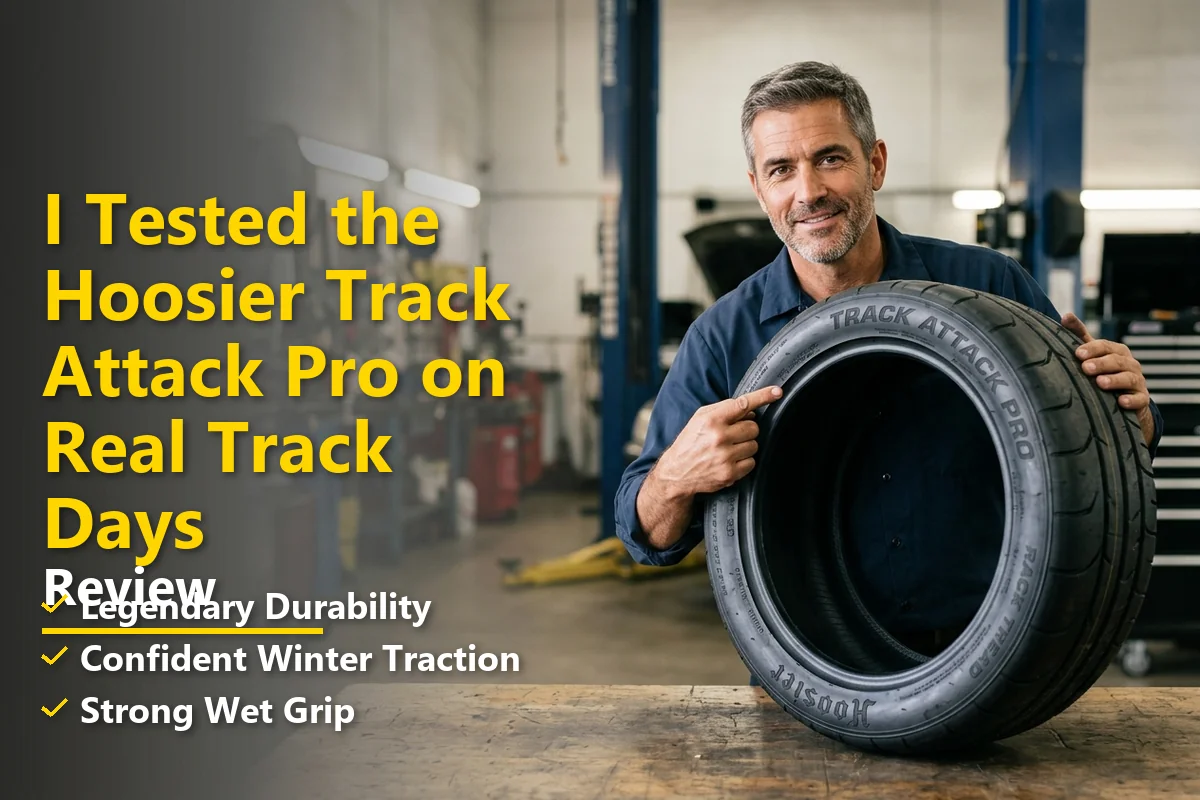
If you’ve ever white-knuckled your way through a high-speed corner on a set of all-season tires, you already know the sinking feeling — the tires are the bottleneck, not you.
The moment I bolted on a set of Hoosier Track Attack Pro tires and rolled onto the circuit, that bottleneck vanished. But are they the right choice for *your* track days?
Let me break down everything I learned after pushing these tires hard on multiple track weekends, autocross events, and even a few spirited back-road sessions.
- The Hoosier Track Attack Pro is a DOT-legal R-compound track tire designed for serious enthusiasts who want race-level grip without going full slick.
- Grip levels are extraordinary — I shaved seconds off my lap times immediately compared to my previous 200-TW sport tires.
- Heat cycling is manageable if you follow best practices, but these tires do have a finite performance window.
- Not intended for daily driving, rain, or cold weather — this is a dedicated track tire that happens to be street-legal.
- Pricing ranges from roughly $200–$380+ per tire depending on size, which is competitive for the R-compound category.
- Best suited for HPDE, time attack, autocross, and dedicated track day warriors.
Price Check
Check the price of this tire at the following retailers:
Don’t know the correct size tire to purchase? Start here!
Liked this article?
Add TireAdvise as a preferred source so you see more of our tire reviews and guides on Google.
What Exactly Is the Hoosier Track Attack Pro?
Hoosier Racing Tire has been a name synonymous with American motorsport for decades. Based out of Lakeville, Indiana, they’ve been manufacturing competition tires since 1957 — and unlike many tire brands, racing is literally all they do.
The Track Attack Pro sits in an interesting niche. It’s a DOT-approved R-compound tire, meaning it carries the Department of Transportation stamp that makes it technically street-legal, but its DNA is pure competition.
Think of it as a race tire wearing a thin disguise. The treadwear rating comes in at around 100, placing it firmly in the “competition” category alongside rivals like the Toyo Proxes R888R, Nankang AR-1, and BFGoodrich g-Force R1 S.
Why I Decided to Test the Track Attack Pro
I’d been running a set of well-known 200-treadwear sport tires on my track car for several events. They were good — genuinely good — but I kept feeling like I was leaving time on the table, especially in high-speed sweepers where confidence in the front end is everything.
A few friends at my local HPDE group had switched to R-compound rubber and wouldn’t stop raving about the difference. One of them specifically recommended the Hoosier Track Attack Pro, citing its predictability and the fact that Hoosier’s customer support is US-based and genuinely helpful.
So I ordered a set, mounted them on my dedicated track wheels, and set out to see what the hype was about.
First Impressions Out of the Box
The first thing I noticed was the compound itself. If you’ve never handled an R-compound tire, it feels noticeably different from a standard performance tire. The rubber is softer, stickier — you can almost press your thumbnail into the tread surface and feel it give.
The tread pattern is minimal but purposeful. There are circumferential grooves for basic water evacuation, but this is clearly not a tire designed for monsoon conditions. The contact patch is maximized, with large tread blocks that prioritize mechanical grip.
Sidewall construction felt stiff and confidence-inspiring. The “Track Attack Pro” branding is clean and visible, and the overall build quality is exactly what I’d expect from a company that builds tires for professional racing series.
Mounting and Setup Notes
I want to mention something practical here, because it tripped me up initially. Not every tire shop is comfortable mounting R-compound tires. The softer sidewalls and beads can require a more careful touch.
I ended up going to a shop that regularly services track cars, and they had no issues. If you’re in a similar situation, I’d recommend calling ahead and asking if they have experience with competition rubber.
I ran the tires at pressures recommended by Hoosier’s own setup guides — starting around 30-32 psi cold and adjusting based on tire temperatures after sessions. Getting your pressures right is absolutely critical with these tires, and I’ll talk more about that below.
Wheel Fitment and Sizes Available
Hoosier offers the Track Attack Pro in a decent range of sizes, though it’s not as extensive as what you’d find from a major consumer brand. Common fitments cover 15-inch through 18-inch wheels, with widths ranging from 205 to 315.
If you’re running a Miata, BMW 3-Series, Mustang, Corvette, or similar popular track platforms, you’ll likely find a size that works. I’d recommend checking Hoosier’s official fitment guide or calling them directly — their team has been remarkably responsive in my experience.
On-Track Performance: The Heart of This Review
Let me be blunt: the first time I pushed the Track Attack Pro through a series of hard corners, I understood why people become R-compound converts.
Dry Grip
The grip is astonishing. I’m not exaggerating when I say the car felt like it was on rails compared to my previous 200-TW tires. Corner entry speeds that used to make me nervous became totally manageable. The car rotated with precision, and I could feel every nuance of the contact patch through the steering wheel.
During my first full track day on these tires, I dropped over two seconds from my previous best lap time at the same circuit — and I wasn’t even fully comfortable with the new grip level yet. By the end of the day, I’d found another half-second as my confidence grew.
The mechanical grip in slower, tighter corners was equally impressive. Under hard braking, the tires inspired so much confidence that I found myself braking later and harder, which further contributed to the time improvement.
Progressiveness and Predictability
This is where the Hoosier Track Attack Pro truly shines, and it’s the quality that separates a great track tire from a merely fast one.
When you approach the limit of grip, these tires don’t suddenly let go. The breakaway is progressive and communicative. I could feel the rear end begin to rotate gently, giving me ample time to make corrections. The front tires would push gradually rather than washing out without warning.
For intermediate and even advanced HPDE drivers, this predictability is invaluable. It lets you explore the limit safely and build confidence over time. I’ve driven on some R-compound tires that felt like they were either gripping or sliding with nothing in between — the Track Attack Pro is not one of those tires.
Heat Management and Optimal Temperature Window
R-compound tires are designed to work within a specific temperature window, and the Track Attack Pro is no exception. In my testing, the tires needed about one to two warm-up laps before they reached their optimal operating temperature.
I used a pyrometer to check temps after sessions, aiming for surface temperatures in the 180°F–220°F range. When the tires were in this window, the grip was phenomenal. When they were below it — like on an out-lap on a cool morning — they felt noticeably less confident.
On hotter days with ambient temperatures above 85°F, I did notice some degradation toward the end of longer sessions (20+ minutes). The tires would get greasy as they overheated, and lap times would climb. Shortening session length or taking a cool-down lap helped manage this.
Heat Cycles: The Elephant in the Room
If there’s one topic that generates the most debate around R-compound tires, it’s heat cycles. Every time an R-compound tire heats up to operating temperature and then cools down, the rubber undergoes a chemical change that gradually reduces grip.
The Hoosier Track Attack Pro is subject to this reality like every other R-compound tire. In my experience, the tires delivered their absolute peak performance during the first few track days. After several events, I could feel a subtle but measurable reduction in peak grip.
That said, the degradation was gradual — not a cliff. Even after multiple track weekends, the tires were still significantly grippier than any 200-TW tire I’ve used. They just weren’t at their absolute peak anymore.
Tips to Maximize Heat Cycle Life
- Store tires in tire bags — keeping them away from UV light and ozone when not in use slows chemical degradation.
- Keep tires in a climate-controlled space — extreme heat or cold during storage accelerates aging.
- Avoid unnecessary heat cycles — don’t drive to the track on these tires if you can avoid it. Trailer your car or swap wheels in the paddock.
- Use tire warmers if regulations allow — starting at a higher temperature means less thermal shock.
- Don’t over-session — excessively long stints that overheat the tires count as especially harsh heat cycles.
Wet Performance: Proceed with Extreme Caution
I want to be completely transparent here: I did encounter light rain during one of my test sessions, and the Track Attack Pro’s wet grip is, to put it kindly, limited.
The minimal tread pattern does evacuate some water, and at moderate speeds on a damp surface, the tires maintained acceptable grip. But in standing water or heavy rain, hydroplaning risk is very real. I backed off significantly and came into the pits early.
If your track day gets rained out, these tires can get you safely back to the paddock at reduced speed. But I would never willingly run a wet session on them. If you regularly encounter rain at your events, consider having a set of 200-TW wet-weather tires ready to swap on.
Treadwear and Longevity
Let’s address the practical lifespan question. R-compound tires wear faster than street tires — that’s the trade-off for their extraordinary grip. In my experience with the Track Attack Pro, the wear rate was reasonable for the category.
After several track weekends of aggressive driving, the tires showed noticeable but not alarming wear. The tread depth decreased evenly across the surface, which tells me my alignment and tire pressures were in the right ballpark.
I’d estimate that a dedicated track enthusiast running one or two events per month could get a solid season of use from a set, assuming proper care and storage. Your mileage — literally — will vary based on your car’s weight, power, alignment settings, driving style, and the abrasiveness of the track surfaces you frequent.
Compared to competitors like the Toyo R888R, I found the Hoosier’s wear rate to be similar. It’s not the longest-lasting R-compound out there, but it’s not the fastest-wearing either. Hoosier has found a reasonable balance between grip and durability.
How Does It Compare to the Competition?
No tire review is complete without context. Here’s how the Track Attack Pro stacks up against the tires I’ve personally used or have extensive knowledge of:
| Feature | Hoosier Track Attack Pro | Toyo Proxes R888R | Nankang AR-1 | BFG g-Force R1 S |
|---|---|---|---|---|
| Treadwear Rating | ~100 | 100 | 80 | 40 |
| Dry Grip | ★★★★★ | ★★★★☆ | ★★★★☆ | ★★★★★ |
| Wet Grip | ★★☆☆☆ | ★★★☆☆ | ★★☆☆☆ | ★★☆☆☆ |
| Predictability at Limit | ★★★★★ | ★★★★☆ | ★★★☆☆ | ★★★★☆ |
| Tread Life | ★★★☆☆ | ★★★☆☆ | ★★★★☆ | ★★☆☆☆ |
| Approx. Price (per tire) | $200–$380 | $180–$350 | $140–$280 | $220–$400 |
| Size Range | Good | Excellent | Good | Limited |
| Made in USA | ✅ Yes | ❌ No | ❌ No | ❌ No |
My Take on the Competition
The Toyo R888R is probably the most popular tire in this space, and for good reason — it offers excellent grip with slightly better wet-weather capability and wider size availability. If you want a more versatile R-compound, the R888R is a strong choice.
The Nankang AR-1 is the budget king. It doesn’t grip quite as hard as the Hoosier, but it’s significantly cheaper and wears a bit slower. For someone just getting into track days, it’s a fantastic entry point.
The BFGoodrich g-Force R1 S is arguably the grippiest option in the group but wears the fastest and costs the most. It’s the choice for time attack competitors chasing every tenth of a second.
The Hoosier Track Attack Pro occupies a sweet spot: it delivers grip that’s very close to the BFG at a more reasonable price point, with better tread life and — in my opinion — the most predictable handling characteristics of the group.
And there’s the “Made in USA” factor. For some buyers, supporting an American manufacturer that builds tires right here in Indiana matters. Hoosier is one of the few remaining US-based tire makers focused on performance, and their heritage is hard to argue with.
Street Driving: Can You Daily Drive These?
Technically? Yes. The DOT stamp means you can legally drive on public roads with the Track Attack Pro.
Practically? I’d strongly advise against it.
During my test period, I drove the tires on a brief street section between the paddock and the track entrance. Even at low speeds, the road noise was significantly louder than a standard performance tire. The ride quality was noticeably harsher due to the stiff sidewalls and hard compound.
More importantly, these tires wear rapidly on the street. Cold compound on rough asphalt chews through tread at an accelerated rate. Every time you drive them to the gas station, you’re burning through grip you could be using on track.
My recommendation: treat these as dedicated track tires. Mount them on a separate set of wheels, swap them in the paddock, and keep a set of proper street tires for the drive home.
Who Should Buy the Hoosier Track Attack Pro?
Based on my testing, here’s who I think this tire is ideal for:
- HPDE enthusiasts who have outgrown 200-TW tires and want to step up to R-compound grip for the first time.
- Time attack competitors in classes that allow DOT-legal R-compound tires.
- Autocross drivers looking for maximum grip within SCCA or similar sanctioning body rules.
- Dedicated track day warriors who value predictability and progressive handling at the limit.
- Drivers who want to support American manufacturing — Hoosier is one of the few options in this category made right here in the US.
And here’s who should probably look elsewhere:
- Casual enthusiasts who do one or two track days per year — the cost-per-event ratio doesn’t make sense when a good 200-TW tire would suffice.
- Anyone who needs to drive in rain regularly — even on track, these tires aren’t designed for wet conditions.
- Daily drivers — the noise, ride quality, and rapid street wear make these impractical for commuting.
- Budget-conscious beginners — the Nankang AR-1 offers a much cheaper entry point into R-compound territory.
Pricing and Where to Buy
Pricing for the Hoosier Track Attack Pro varies by size, but as of my most recent research, you can expect to pay roughly $200 to $380 per tire for most common fitments. A full set of four will typically run between $800 and $1,500.
You can purchase them directly from Hoosier Racing Tire, through authorized dealers, or from online retailers like Tire Rack. I’ve also seen them available at some specialty motorsport shops and performance parts retailers.
One tip: Hoosier occasionally runs promotions through their dealer network, especially before the start of track season in spring. It’s worth keeping an eye out for bundle deals.
I’d also recommend buying all four tires at the same time from the same production batch. Consistent rubber compound across all four corners matters for predictable handling, and mixing old and new R-compound tires can lead to inconsistent grip balance.
My Final Verdict on the Hoosier Track Attack Pro
After pushing these tires hard over multiple track weekends and autocross events, I can confidently say the Hoosier Track Attack Pro is one of the best R-compound tires available to American enthusiasts today.
The dry grip is extraordinary. The predictability at the limit is best-in-class. The progressive breakaway characteristics make it a confidence-inspiring tire that rewards smooth driving while still being forgiving when you make mistakes.
Is it perfect? No. The wet grip is poor, the noise is significant on the street, and the heat cycle degradation is a reality you’ll need to manage. But those are inherent trade-offs of any R-compound tire — they’re not unique to the Hoosier.
What sets the Track Attack Pro apart is the combination of grip, predictability, and the backing of a genuinely American company with decades of racing heritage. When I bolt these tires on, I feel like I’m running equipment that was designed by people who actually understand what happens at turn-in, at the apex, and at track-out.
If you’re serious about shaving seconds off your lap times and you’re ready to step up from 200-TW rubber, the Hoosier Track Attack Pro deserves a spot at the very top of your shortlist. I’ll be buying another set for next season — and in my world, that’s the strongest endorsement I can give.
Frequently Asked Questions
How does the Hoosier Track Attack Pro perform on track days compared to other DOT-approved track tires?
The Hoosier Track Attack Pro delivers exceptional grip and consistent lap times that rival many full-slick race tires while still carrying DOT approval. In my experience, it outperforms popular competitors like the Toyo Proxes RR and Nitto NT01 in raw cornering grip, especially in the 180–220 treadwear range. The compound heats up quickly and maintains a predictable feel throughout extended track sessions, making it a top choice for dedicated HPDE and time attack drivers in the US.
Is the Hoosier Track Attack Pro street legal and safe to drive on public roads?
Yes, the Hoosier Track Attack Pro carries a DOT certification, which means it is technically street legal in all US states. However, it is designed primarily for track use and has minimal tread depth and virtually no rain channeling, so driving on wet public roads is risky and not recommended. Most enthusiasts trailer their cars to the track or limit street driving to short distances in dry conditions only.
How long do Hoosier Track Attack Pro tires last for regular track day use?
Tire life depends heavily on your driving style, vehicle weight, and track surface, but most drivers report getting between 3 to 6 full track days out of a set of Hoosier Track Attack Pro tires. Aggressive drivers in heavier cars like C6 Corvettes or BMW M3s may see faster wear, while lighter Miata and BRZ owners tend to stretch them further. Rotating tires between sessions and managing tire pressures carefully can help maximize their lifespan.
How much does a set of Hoosier Track Attack Pro tires cost in the US?
Prices for the Hoosier Track Attack Pro typically range from $250 to $380 per tire depending on the size, with popular fitments like 275/35R18 and 245/40R17 usually falling in the $280–$340 range. A full set of four will generally cost between $1,000 and $1,500 before mounting and balancing. You can purchase them from authorized Hoosier dealers, Tire Rack, or directly from specialty motorsport retailers across the US.
What tire sizes are available for the Hoosier Track Attack Pro?
Hoosier offers the Track Attack Pro in a focused range of sizes popular with track day cars, primarily spanning 15-inch to 18-inch wheel diameters. Common sizes include 205/50R15, 225/45R17, 245/40R17, 275/35R18, and 315/30R18, which cover most popular platforms like the Mazda Miata, Subaru BRZ, BMW 3 Series, and Chevrolet Corvette. I recommend checking Hoosier’s official fitment guide since availability can vary and new sizes are occasionally added.
What is the ideal tire pressure for the Hoosier Track Attack Pro on a track day?
Most drivers find the sweet spot for hot tire pressures on the Hoosier Track Attack Pro is between 28 and 34 PSI, depending on vehicle weight and suspension setup. I typically start with cold pressures around 26–28 PSI and check temperatures and pressures after a few laps, adjusting until the tire wears evenly across the tread surface. Running too low can cause excessive shoulder wear and sidewall damage, while running too high reduces the contact patch and hurts grip.
How does the Hoosier Track Attack Pro compare to the Hoosier R7 for time attack and HPDE events?
The Hoosier R7 is the softer, grippier option designed for maximum single-lap performance and competitive time attack, while the Track Attack Pro offers a slightly harder compound that provides better durability and more consistent performance over longer stints. If you are doing regular HPDE days and want a tire that balances strong grip with reasonable tire life, the Track Attack Pro is the better value. For all-out competition where every tenth of a second counts and tire cost per session is less of a concern, the R7 is the faster choice.
