

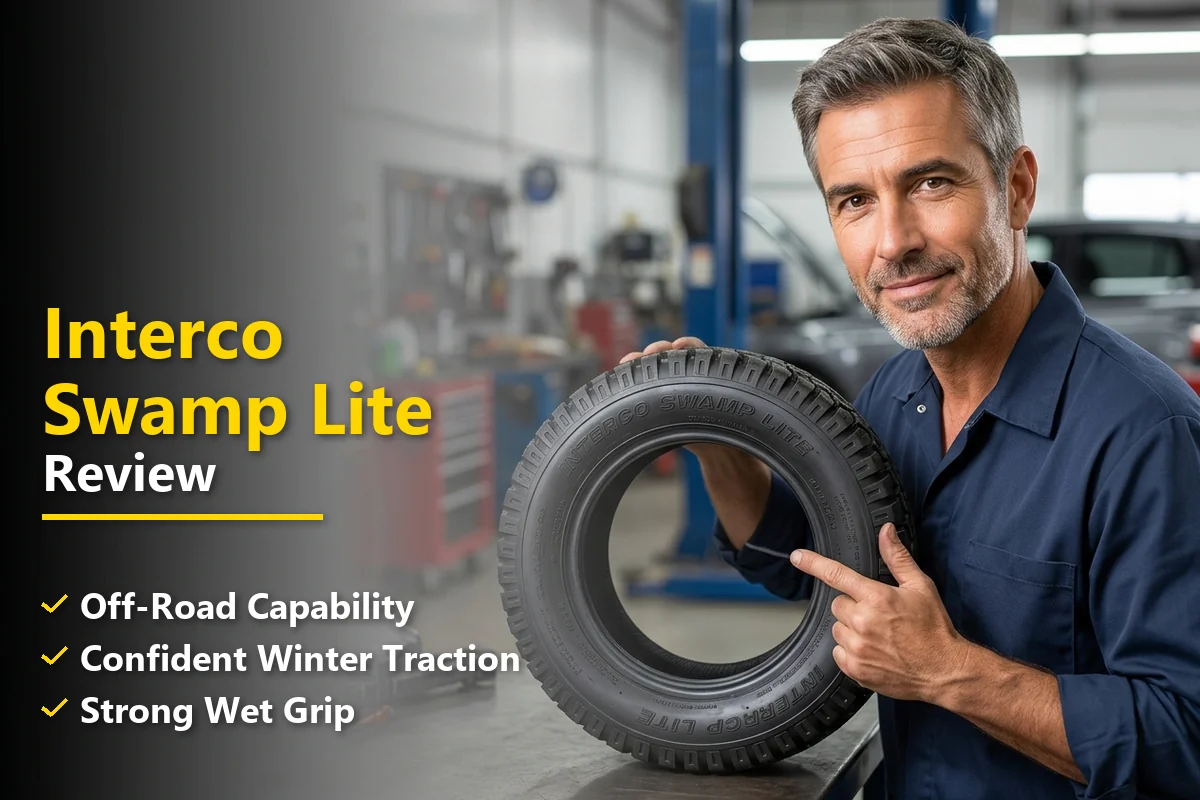
If you’ve ever buried your ATV or side-by-side up to the axles in thick Louisiana-style mud, you know the sinking feeling — literally. You sit there, wheels spinning, mud spraying everywhere, wondering if you bought the wrong tires.
That’s exactly where I was before I mounted a set of Interco Swamp Lites. I’d been running a set of stock tires on my utility ATV that were fine on hard-packed trails but absolutely useless in anything deeper than a puddle.
After spending serious seat time on the Swamp Lites across multiple terrain types over several weeks, I’m ready to share everything I learned — the good, the bad, and the muddy.
- The Interco Swamp Lite is a budget-friendly mud tire for ATVs and UTVs that punches above its price point in soft terrain.
- Excellent self-cleaning tread design that sheds mud quickly and consistently.
- Surprisingly light compared to other mud tires — less strain on your drivetrain and belt.
- Not ideal for high-speed trail riding or rocky terrain — the rubber compound is softer and the lugs can wear faster on hard surfaces.
- Best suited for riders who spend 60%+ of their time in mud, swamp, snow, or loose soil.
- Prices typically range from $55 to $110 per tire depending on size — outstanding value for a purpose-built mud tire.
Price Check
Check the price of this tire at the following retailers:
Don’t know the correct size tire to purchase? Start here!
Liked this article?
Add TireAdvise as a preferred source so you see more of our tire reviews and guides on Google.
What Exactly Is the Interco Swamp Lite?
Before I get into my hands-on experience, let me give you some quick background. Interco Tire Corporation is a US-based manufacturer out of Rayne, Louisiana. They’ve been making tires since 1965, and if you’ve spent any time in the off-road world, you’ve probably heard of their flagship Super Swamper line for trucks and Jeeps.
The Swamp Lite is their entry-level mud tire designed specifically for ATVs and UTVs. It sits below the more aggressive (and more expensive) Interco Snorkl and Black Mamba lines, but it borrows a lot of the same design DNA.
What makes the Swamp Lite stand out from the crowd is its combination of lightweight construction and aggressive lug spacing. Interco designed this tire to be a true mud tire that doesn’t destroy your machine’s belt, CV joints, or engine in the process. That’s a bigger deal than most people realize.
Available Sizes and Fitment
The Swamp Lite comes in a solid range of sizes that fit most popular ATVs and side-by-sides on the US market. Here’s a breakdown of what’s currently available:
- 25×8-12 (front)
- 25×10-12 (rear)
- 25×11-10 (rear)
- 26×9-12 (front)
- 26×10-12 (rear)
- 26×12-12 (rear)
- 27×9-12 (front)
- 27×10-12 (rear)
- 27×11-12 (rear)
- 27×12-12 (rear)
- 28×9-14 (front)
- 28×10-14 (rear)
- 28×11-14 (rear)
- 29.5×10⁻¹²
This covers most of the popular Honda Rancher, Polaris Sportsman, Can-Am Outlander, Yamaha Grizzly, and Kawasaki Brute Force models. The 14-inch options also work well for many side-by-side applications like the Polaris Ranger and Can-Am Defender.
I tested the 27×10-12 rear and 27×9-12 front combination on my machine, which gave me a nice balance between ground clearance and stability.
First Impressions Out of the Box
When I first pulled the Swamp Lites out of the shipping box, two things immediately stood out. First, the weight — or rather, the lack of it. I’ve handled plenty of mud tires in my time, and these felt noticeably lighter than competitors like the Sedona Mud Rebel or the ITP Mud Lite II in comparable sizes.
The second thing I noticed was the tread design. The lugs are tall, angled, and spaced generously apart. You can immediately see that Interco prioritized self-cleaning capability. There’s plenty of void space between the lugs for mud to escape as the tire rotates, and the lug edges are sharp and defined.
The rubber compound felt medium-soft to the touch — definitely softer than an all-terrain tire but not as gummy as some premium competition tires. The 6-ply rating gave me confidence that the sidewalls would hold up to moderate trail abuse, though I wouldn’t call them puncture-proof.
Mounting and Setup
I mounted the Swamp Lites on a set of standard steel wheels using a manual tire changer. The beads seated without any drama — I didn’t need a ratchet strap or starter fluid, which isn’t always the case with budget ATV tires. A standard air compressor at about 25 PSI popped them into place on the first try.
I initially set my air pressure at 7 PSI for trail riding and planned to drop to 4-5 PSI for deep mud. Getting the pressure right is critical with these tires, and I’ll explain why in the performance sections below.
My Testing Conditions
I believe a tire review is only as good as the testing behind it, so let me lay out exactly what I put these tires through. I’m based in the southeastern United States, and my riding area includes a mix of terrain types that are common across the region.
Over several weeks of riding, I took the Swamp Lites through:
- Thick, bottomless clay mud (the kind that swallows boots whole)
- Shallow standing water and flooded trails
- Soft, sandy creek beds
- Hard-packed dirt and gravel fire roads
- Root-covered forest trails
- Moderate rocky terrain with loose shale
- Wet grass and hillside climbs
I also rode in temperatures ranging from the mid-40s to the upper 80s (Fahrenheit), so I got a sense of how the rubber behaves across a reasonable temperature range. I didn’t test these in snow, but I’ll share what I know about their cold-weather performance based on the compound characteristics.
Performance in Deep Mud — Where These Tires Shine
Let’s cut to the chase: the Interco Swamp Lite was born for mud, and it absolutely delivers. This is where I was most impressed during my entire test period.
The first time I hit a serious mud hole — we’re talking knee-deep, thick, soupy clay — the Swamp Lites bit in and pulled through with a confidence that genuinely surprised me. The tall lugs dug down to find traction, and the wide spacing between them meant the tread cleaned itself almost instantly as the tire rotated.
I dropped pressure to about 5 PSI for the deep stuff, which allowed the tire to spread out and float better across the surface. At this pressure, the contact patch grows significantly, and the tire transitions from a digger to more of a paddle-style action. It was remarkably effective.
Where some cheaper mud tires pack up with clay and essentially become slicks after a few passes, the Swamp Lites kept their bite. After several days of hitting the same mud pits repeatedly, I never experienced a situation where the tread packed up and refused to clean out. That self-cleaning capability is the single biggest selling point of this tire, and Interco nailed it.
Performance on Hard-Packed Trails
Here’s where I need to be honest — the Swamp Lite is not a trail tire, and it doesn’t pretend to be. On hard-packed dirt and gravel roads, the ride quality is noticeably rougher than an all-terrain tire. You can feel each lug making contact with the ground, creating a mild vibration and a distinct hum at speeds above 20 mph.
Steering feel on hard surfaces is also less precise than I’d like. The tall, flexible lugs create a slightly vague feeling in the handlebars, especially during cornering. The tire wants to roll onto the edges of the lugs rather than sitting flat, which reduces your contact patch on hard ground.
That said, I never felt unsafe on trails. The Swamp Lites handled fire roads and packed dirt adequately — they just weren’t in their element. If you split your riding 50/50 between mud and trail, you might want to look at a more versatile option like the ITP Mud Lite II or the Maxxis Zilla.
Performance in Rocks and Rough Terrain
Rocky terrain is arguably the Swamp Lite’s weakest area. The softer rubber compound that makes these tires so effective in mud also makes them more vulnerable to cuts and abrasion on sharp rocks. During my test period, I picked up a few minor cuts on the lugs after riding through a shale-covered creek bed.
None of the cuts were deep enough to cause concern, but I could see how extended use on rocky terrain would accelerate wear significantly. The 6-ply sidewall offers decent protection against punctures, but I wouldn’t push my luck on seriously rocky trails.
If your riding area includes a lot of rock, I’d honestly steer you toward something with a harder compound and more sidewall protection, like the Sedona Mud Rebel RT or the CST Wild Thang.
Performance in Snow and Cold Conditions
While I didn’t do extensive cold-weather testing, I did take the Swamp Lites out on a couple of chilly mornings in the mid-40s. The rubber remained reasonably pliable, which makes sense given the softer compound. I’ve spoken with several riders in northern states who use these tires for winter utility work and snow plowing on their ATVs, and the consensus is that the Swamp Lite performs well in snow.
The aggressive lug pattern acts almost like a paddle in snow, digging down to the ground beneath. The self-cleaning action also prevents snow from packing into the tread. I’d feel comfortable recommending these for light to moderate snow use, but not for ice — no ATV tire handles ice well without studs.
Weight Comparison — A Major Advantage
One of the most significant advantages of the Interco Swamp Lite is its weight. Lighter tires mean less unsprung weight, less rotational mass, and less stress on your machine’s belt, transmission, and CV joints. This is especially critical for belt-driven machines like Polaris and Can-Am ATVs.
Here’s how the Swamp Lite compares to some popular competitors in the 27×10-12 size:
| Tire Model | Size | Approx. Weight | Ply Rating | Approx. Price | Mud Performance |
|---|---|---|---|---|---|
| Interco Swamp Lite | 27×10-12 | ~22 lbs | 6-ply | $85–$100 | Excellent |
| ITP Mud Lite II | 27×9-12 | ~28 lbs | 6-ply | $95–$120 | Very Good |
| Sedona Mud Rebel RT | 27×10-12 | ~30 lbs | 6-ply | $100–$130 | Good |
| Maxxis Zilla | 27×10-12 | ~26 lbs | 6-ply | $90–$115 | Good |
| CST Wild Thang | 27×10-12 | ~32 lbs | 6-ply | $85–$105 | Very Good |
As you can see, the Swamp Lite is the lightest tire in this group by a meaningful margin. That 6-10 pound difference per tire adds up to 24-40 pounds across all four corners. Your machine will accelerate faster, steer easier, and put less strain on the drivetrain. For smaller displacement ATVs in the 400-500cc range, this weight savings can be the difference between a tire that works with your machine and one that kills your belt.
Ride Quality and Comfort
Let me be real — if ride comfort is your top priority, a dedicated mud tire probably isn’t for you. That said, the Swamp Lite is more comfortable than I expected, primarily because of its lighter weight and relatively flexible sidewall.
At 7 PSI on packed trails, the ride was firm but not punishing. The tire absorbs small bumps reasonably well, though larger impacts can feel harsh. Dropping to 5 PSI improved comfort significantly but introduced a bit of sidewall roll in turns.
Noise levels are moderate. On hard surfaces, there’s a definite hum from the aggressive tread, but it’s not as loud as some deep-lug tires I’ve tested. On soft ground, the noise virtually disappears.
Durability and Wear
During my test period, I was closely monitoring the Swamp Lites for signs of premature wear, and here’s what I found. On mud and soft terrain, wear was minimal — the lugs showed very little degradation even after several hard days of riding.
On hard-packed surfaces, wear was more noticeable. The lug edges started to round slightly after extended fire road riding, which is typical for soft-compound mud tires. I expect these tires to last a long time if used primarily in their intended environment, but they’ll wear faster than average if you spend a lot of time on hard ground.
The sidewalls held up well. I didn’t experience any punctures, cuts, or bulging during my testing, though I was careful to avoid the gnarliest rock sections. The 6-ply construction seems adequate for normal off-road use, but hardcore rock crawlers should look elsewhere.
Tread Design Deep Dive
I want to spend a moment analyzing the tread design because it’s really the heart of what makes the Swamp Lite work. The tire features a directional tread pattern with angled lugs that radiate outward from the center line.
Each lug is relatively tall — approximately 1 inch of tread depth in the larger sizes — with squared-off edges that create aggressive biting surfaces. The angle of the lugs is designed to channel mud and debris outward as the tire spins, which is what gives the Swamp Lite its excellent self-cleaning ability.
The center lugs are slightly more tightly spaced than the shoulder lugs, which provides a bit more stability on hard surfaces while maintaining maximum mud evacuation on the outer edges. The shoulder lugs wrap slightly down the sidewall, adding traction when the tire is running at lower pressures and spreading into ruts.
It’s a simple design compared to some of the more complex tread patterns on the market, but simplicity works in mud tires. Fewer voids to pack up, cleaner channels for mud evacuation, and predictable behavior across different conditions.
Who Should Buy the Interco Swamp Lite?
After spending extensive time on these tires, I’ve got a clear picture of who they’re best suited for. Here’s my honest assessment:
The Swamp Lite Is Perfect For:
- Budget-conscious mud riders: If you want legitimate mud performance without spending $150+ per tire, the Swamp Lite delivers exceptional value.
- Riders with smaller displacement machines: The lightweight construction makes these ideal for 400-700cc ATVs where every pound matters.
- Southeastern US riders: If you ride in Louisiana, Mississippi, Alabama, Florida, Georgia, or the Carolinas where mud and swamp dominate, these are a natural fit.
- Utility riders in soft terrain: Farmers, hunters, and property owners who need reliable traction in fields, food plots, and wetlands.
- Beginners looking to upgrade from stock tires: The Swamp Lite is a massive step up from any stock tire in mud, and the price makes it a low-risk investment.
The Swamp Lite Is NOT Ideal For:
- Trail-only riders: If you rarely encounter mud and mostly ride hard-packed trails, you’ll be sacrificing ride quality and tread life for capability you don’t need.
- Rocky terrain riders: The softer compound and exposed lugs won’t hold up well to sharp, abrasive rock.
- High-speed riders: These tires aren’t designed for aggressive trail speed. The tall lugs create instability at higher speeds on hard ground.
- Extreme mud racers: If you’re racing in organized mud events, you’ll probably want something more aggressive like the Interco Black Mamba or SuperATV Assassinator.
Price and Value Assessment
The Interco Swamp Lite is one of the best values in the ATV mud tire market. At the time of writing, prices typically range from about $55 for the smaller front sizes to around $110 for the largest rear sizes. A full set of four tires can usually be had for $300–$400, depending on the sizes you need.
For context, a set of four ITP Mud Lite II tires in comparable sizes will run you $380–$480, and a set of SuperATV Assassinators will cost $500+. The Swamp Lite undercuts most name-brand competitors while delivering comparable — and in some cases superior — mud performance.
I purchased my set from an online retailer that ships from within the US, and they arrived within a few days. You can also find them at most ATV dealerships and some Tractor Supply stores. Interco’s Louisiana manufacturing base means parts and warranty support are domestic, which is a plus.
How the Swamp Lite Compares to the ITP Mud Lite II
This is the comparison everyone asks about, so let me address it directly. The ITP Mud Lite II is probably the most popular ATV mud tire in America, and for good reason — it’s a well-rounded tire that handles both mud and trail reasonably well.
However, in a head-to-head mud comparison, the Interco Swamp Lite wins. The Swamp Lite has deeper lugs, wider spacing, and better self-cleaning ability. It digs harder and recovers faster in thick clay and swamp conditions.
Where the Mud Lite II pulls ahead is on the trail. It’s a smoother, quieter tire on hard surfaces with more predictable handling. If I had to pick one tire for a 50/50 mud-and-trail rider, I’d pick the Mud Lite II. For a rider who’s 70%+ in mud, the Swamp Lite is the better choice — and it costs less.
How the Swamp Lite Compares to the Maxxis Zilla
The Maxxis Zilla is another popular mid-range ATV tire that gets cross-shopped with the Swamp Lite. The Zilla is more of a 60/40 mud-to-trail tire with a unique tread pattern that does a decent job in both environments.
In pure mud, the Swamp Lite outperforms the Zilla. The Zilla’s tread tends to pack up faster in heavy clay, and its lugs aren’t as aggressive. On the flip side, the Zilla rides better on trails, lasts longer on hard surfaces, and handles mixed terrain with more versatility.
Price-wise, they’re close, with the Swamp Lite usually coming in $10–$20 cheaper per tire. If mud is your primary concern, choose the Swamp Lite. If you want a more versatile tire, the Zilla is worth the slight premium.
Installation Tips and Air Pressure Recommendations
Based on my experience, here are my recommended air pressure settings for the Interco Swamp Lite:
- Trail riding (hard-packed): 7–8 PSI — provides the best stability and wear characteristics on firm ground.
- Mixed terrain: 5–6 PSI — a good compromise between flotation and handling.
- Deep mud / swamp: 4–5 PSI — maximizes the contact patch and flotation for soft conditions.
- Snow: 4–5 PSI — similar to mud settings, allows the tire to spread and paddle through snow.
I strongly recommend using a quality low-pressure tire gauge (not a standard automotive gauge) to get accurate readings at these pressures. A couple PSI makes a significant difference in how these tires perform.
When mounting, make sure the directional arrow on the sidewall is pointing in the correct direction of rotation. Installing a directional mud tire backward will significantly reduce its self-cleaning ability and traction.
Potential Drawbacks to Consider
No tire is perfect, and I want to be transparent about the Swamp Lite’s shortcomings. Here are the things that gave me pause during testing:
- Tread life on hard surfaces: The soft compound wears faster than average on pavement and hard-packed ground. Avoid extended road riding if possible.
- Ride harshness: The aggressive tread pattern creates noticeable vibration on smooth surfaces. Not a comfort tire by any means.
- Limited sidewall protection: The 6-ply rating is adequate but not exceptional. Riders in rocky areas may experience sidewall damage.
- Handling at speed: Above 25-30 mph on hard ground, the tall lugs create a slightly unpredictable feeling. Keep speeds moderate.
- Not DOT rated: These are off-road-only tires. Do not use them on public roads (not that most ATV tires are road-rated, but it’s worth mentioning).
Long-Term Ownership Outlook
While I haven’t had these tires for years yet, I can make some informed projections based on what I observed during my test period combined with feedback from other Swamp Lite owners I’ve spoken with.
Riders who use these primarily in mud and soft terrain report getting excellent longevity out of them — the soft ground simply doesn’t wear the lugs the way hard surfaces do. Several owners I talked to have been running their Swamp Lites for multiple seasons without any significant issues.
The most common complaint I’ve heard from long-term owners is lug chunking — small pieces of rubber breaking off the lug edges after extended use on abrasive terrain. This seems to happen more in rocky or gravelly conditions and is consistent with what I’d expect from the softer rubber compound.
My Final Verdict on the Interco Swamp Lite
After putting these tires through their paces over several weeks of varied riding, I’m genuinely impressed with what Interco has accomplished at this price point. The Swamp Lite isn’t trying to be everything to everyone — it’s a dedicated mud tire that does its primary job exceptionally well.
The self-cleaning tread design is the star of the show. In thick, soupy, boot-sucking mud, these tires simply work. They dig, they clean, they pull, and they do it all while weighing less than virtually any competitor. For riders on smaller machines or those worried about belt wear, the weight advantage alone might justify the purchase.
Are there better mud tires out there? Sure — but they cost twice as much. Are there more versatile tires? Absolutely — but they won’t match the Swamp Lite in deep mud. The Interco Swamp Lite lives in a sweet spot of performance, weight, and value that very few competitors can touch.
If you ride in the kinds of conditions this tire was designed for, I recommend it without hesitation. It’s one of the best bang-for-your-buck ATV tires I’ve tested, and it carries the confidence of a US-made product from a company with nearly 60 years of off-road tire experience.
My rating: 4.3 out of 5 stars. Excellent mud performance and value, held back slightly by limited versatility on hard surfaces and moderate durability concerns on rocks.
Frequently Asked Questions
Are Interco Swamp Lite tires good for muddy trails and swampy terrain?
Interco Swamp Lite tires are specifically engineered for soft, muddy, and swampy conditions, and they deliver excellent traction in those environments. The aggressive paddle-style tread design channels mud and debris away from the contact patch, giving you consistent grip even in deep muck. I’ve found them to be one of the best budget-friendly options for riders who regularly encounter standing water and soupy trail conditions across the southern US.
How long do Interco Swamp Lite tires last compared to other ATV mud tires?
Interco Swamp Lite tires offer decent durability for a mud-focused tire, but they tend to wear faster on hard-packed surfaces like gravel roads or pavement. Most riders report getting 1,500 to 3,000 miles depending on terrain mix and riding style. If you primarily ride in soft terrain like mud, swamps, and loose dirt, the tread life will be significantly longer than if you frequently ride on abrasive hard surfaces.
What is the price range for Interco Swamp Lite tires in the US?
Interco Swamp Lite tires generally cost between $55 and $110 per tire in the US market, depending on the size you need for your ATV or UTV. This makes them one of the more affordable mud tire options compared to premium brands like ITP or Maxxis. You can find competitive pricing at online retailers like Rocky Mountain ATV/MC, Amazon, and local powersports dealers, and buying a full set of four can sometimes unlock bundle discounts.
Do Interco Swamp Lite tires perform well on hard-packed trails and roads?
Interco Swamp Lite tires are not designed for hard-packed surfaces, and you’ll notice increased road noise, a rougher ride, and faster tread wear on firm terrain. The widely spaced lugs that make them exceptional in mud create a bumpy feel on gravel and hardpack. If your riding involves a mix of mud and hard trails, you may want to consider a more versatile all-terrain tire or accept the trade-off for superior mud performance.
What ATV and UTV sizes are available for the Interco Swamp Lite?
Interco offers the Swamp Lite in a wide range of popular ATV and UTV sizes, typically from 25-inch to 29.5-inch diameters with various widths to fit most common bolt patterns. Common sizes include 25×8-12 for the front and 25×10-12 for the rear, which fit machines like the Polaris Sportsman, Honda Rancher, and Can-Am Outlander. I recommend checking Interco’s fitment guide or your owner’s manual to confirm the correct size for your specific machine.
How do Interco Swamp Lite tires compare to the Interco Swamp Lite Bias?
The standard Interco Swamp Lite features a 6-ply bias construction that balances flexibility and puncture resistance, while the overall Swamp Lite lineup stays consistent in its bias-ply design rather than offering a radial option. Some riders confuse the Swamp Lite with Interco’s other mud lines like the Super Swamper or Black Mamba, which offer different tread patterns and construction ratings. The Swamp Lite remains the entry-level mud tire in Interco’s lineup, making it ideal for recreational riders who want proven mud performance without paying premium prices.
Are Interco Swamp Lite tires worth it for hunting and utility riding in the US?
For hunters and utility riders who frequently navigate flooded fields, creek crossings, and swampy woodlands across states like Louisiana, Texas, Georgia, and Florida, the Interco Swamp Lite is absolutely worth the investment. The self-cleaning tread keeps you moving through soft ground that would bog down standard tires, and the affordable price point means you’re not breaking the bank to get reliable off-road traction. I’d recommend them for anyone whose primary use involves soft-terrain riding where mud clearance is more important than on-trail comfort.
