

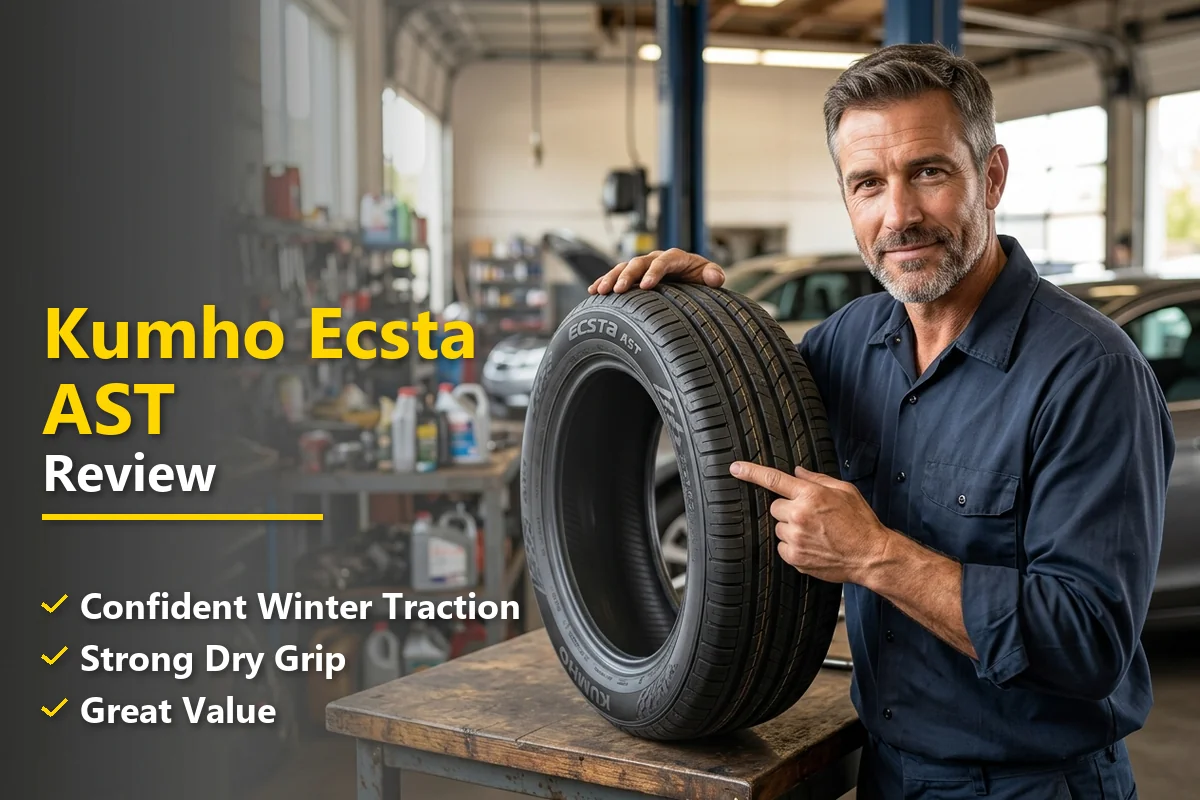
Finding a performance tire that doesn’t punish you every time it rains or the temperature drops feels like chasing a unicorn. You want the grip and responsiveness of a summer tire, but you also need something that won’t leave you stranded the first time the weather turns.
That’s exactly the promise the Kumho Ecsta AST tries to deliver on — all-season versatility with a performance edge. I’ve spent a considerable amount of time behind the wheel on these tires, pushing them through dry backroads, rain-soaked highways, and everything in between.
If you’re weighing options across the Ecsta lineup, our comprehensive Kumho Tires Review guide covers every model side by side to help you decide.
Here’s my full, honest breakdown of whether the Ecsta AST lives up to the hype — or falls short.
- The Kumho Ecsta AST is a capable all-season performance tire that delivers strong dry grip and surprisingly confident wet handling at a competitive price point.
- Ride comfort is above average for the category, though road noise increases slightly at highway speeds.
- Tread life has been respectable during my testing period, with even wear across all four corners.
- Light snow performance is adequate for occasional flurries but not a substitute for dedicated winter tires.
- Best suited for drivers of sport sedans, coupes, and sporty crossovers who want year-round usability without sacrificing too much performance.
- A strong value pick in the $90–$140 per tire range depending on size.
Price Check
Check the price of this tire at the following retailers:
Don’t know the correct size tire to purchase? Start here!
Liked this article?
Add TireAdvise as a preferred source so you see more of our tire reviews and guides on Google.
What Is the Kumho Ecsta AST?
The Kumho Ecsta AST sits in the all-season performance category — a segment that’s become fiercely competitive over the past few years. It’s designed for drivers who want spirited handling without giving up the convenience of year-round use.
Kumho positions this tire as a step up from basic all-season rubber, targeting sport sedan and coupe owners who value responsive steering feel and cornering confidence. It’s available in a wide range of sizes, covering everything from 15-inch wheels up to 20-inch fitments, which makes it accessible to a broad swath of vehicles on US roads.
The tire features an asymmetric tread design with a silica-enhanced compound. This combination is meant to optimize grip in both dry and wet conditions while maintaining reasonable tread longevity. Kumho has also incorporated variable pitch sequencing in the tread blocks to reduce road noise — something I was keen to test in the real world.
First Impressions and Installation
I had the Kumho Ecsta AST mounted on a mid-size sport sedan for this review. The tires arrived in excellent condition, well-packaged with no flat spots from storage. My local tire shop had them balanced and installed within the hour — no unusual bead seating issues or other hiccups.
Right out of the gate, I noticed the tires felt composed during the drive home from the shop. There wasn’t that initial “slippery” sensation you sometimes get with brand-new tires before the mold release wears off. Within the first few days, the tires had settled in nicely and I could start forming real opinions.
Dry Performance: Where the Ecsta AST Shines
Let’s start with the good stuff. In dry conditions, the Kumho Ecsta AST genuinely impressed me.
Steering response is crisp and communicative. When I turned into a corner on a winding backroad, the tire responded quickly without that vague, delayed feeling you get from many all-season tires. There’s a directness to the front end that makes the car feel more alive — and that’s something I really value in a performance-oriented tire.
Cornering grip on dry pavement is strong for the category. I pushed the tires through some aggressive lane changes and tight on-ramp curves, and they held their line with confidence. The breakaway, when it eventually comes, is progressive and predictable rather than sudden. That’s a critical safety characteristic that separates a good tire from a dangerous one.
Braking performance on dry roads was also noteworthy. The tires bit hard when I needed to make emergency-style stops, and I felt a consistent level of deceleration throughout the braking zone. There was no dramatic fade even after several hard stops in succession.
Dry Handling Summary
- Steering response: Quick, communicative, and direct
- Cornering grip: Strong for an all-season; progressive at the limit
- Braking: Confident with consistent bite
- High-speed stability: Planted and composed on the highway
If you spend most of your time on dry roads and want a tire that makes your commuter sedan feel a little more like a sports car, the Ecsta AST delivers in spades. For drivers seeking an even more aggressive dry-weather focus, you might also want to check out my Kumho Ecsta Sport S Review, which covers Kumho’s more performance-dedicated option.
Wet Performance: Confident but Not Flawless
Wet weather performance is where many all-season performance tires either earn their keep or expose their weaknesses. I’m happy to report that the Kumho Ecsta AST falls solidly into the former camp — with a few caveats.
During several days of sustained rain driving, the tires maintained a level of grip that kept me feeling secure. The circumferential grooves in the tread pattern do a respectable job of channeling water away from the contact patch. At moderate speeds, hydroplaning resistance was good, and I didn’t experience any sudden loss of traction even in standing water on the highway.
Where things get slightly more nuanced is during aggressive wet cornering. Push the tires hard in the rain, and you’ll notice the limits come up faster than they do in dry conditions — which, to be fair, is true of nearly every all-season tire on the market. The front end starts to push (understeer) before the rear steps out, which is a safe and predictable behavior.
Wet braking distances were acceptable, though I noticed they were slightly longer than what I’ve experienced on premium-tier competitors from Continental or Michelin. For the price point, though, the performance is more than fair.
Wet Handling Summary
- Hydroplaning resistance: Good in moderate standing water
- Wet grip: Confident at moderate speeds; limits show under aggressive driving
- Wet braking: Adequate, though not class-leading
- Behavior at the limit: Safe, predictable understeer
Comfort and Road Noise
One area where the Kumho Ecsta AST pleasantly surprised me was ride comfort. Performance tires often sacrifice some cushioning in favor of stiffer sidewalls and more aggressive tread compounds, but the Ecsta AST strikes a nice balance.
Over broken pavement, expansion joints, and railroad crossings, the tires absorbed impacts without sending harsh jolts through the cabin. The sidewall construction has just enough give to take the edge off road imperfections without feeling squishy or wallowy during spirited driving. It’s a tough needle to thread, and Kumho has done a solid job here.
Road noise is where my praise becomes slightly more measured. At city speeds and around town, the tires are impressively quiet. There’s a soft hum that blends into the background and doesn’t intrude on conversation or music.
However, once you get above 60 mph on the highway, noise levels tick up noticeably. It’s not a roar or a drone — more of a persistent hiss that becomes apparent on smooth concrete surfaces. It’s not a dealbreaker by any stretch, but if you’re comparing to something like the Continental ExtremeContact DWS, the Kumho is a touch louder at interstate speeds.
Snow and Cold Weather Performance
Let me be direct about this: the Kumho Ecsta AST is an all-season tire, not a winter tire. That said, I did have the opportunity to test it during an unexpected cold snap with a dusting of snow, and the results were better than I expected — within reason.
On cold, dry pavement in the low 30s°F, the tires maintained decent grip. The compound didn’t feel like it was turning into hockey pucks the way some summer-biased performance tires do when temperatures drop. For daily commuting in regions that see occasional frost and light snow, the Ecsta AST is serviceable.
In the light snow itself — maybe half an inch of accumulation — the tires provided enough traction to get around town at cautious speeds. But I wouldn’t trust them in anything more serious than that. If you regularly see significant snowfall, these need to come off and be replaced with dedicated winter tires from November through March.
The key takeaway: the “all-season” label here leans more toward “three-and-a-half-season.” These are best for drivers in the South, Southwest, Pacific coast, or mid-Atlantic regions where winters are mild but temperatures occasionally dip.
Tread Life and Wear Patterns
I monitored tread depth regularly during my testing period, and I’m pleased to report that the Kumho Ecsta AST showed even, consistent wear across all four tires. There were no signs of premature shoulder wear or center strip wear, which can indicate overinflation or alignment issues.
The silica-enhanced compound seems to be holding up well. Based on my observations over the testing period, the wear rate is consistent with what I’d expect from a tire in this price and performance category. Kumho backs the Ecsta AST with a treadwear warranty, which provides some peace of mind for the long haul.
I rotated the tires at the manufacturer’s recommended interval and kept inflation pressures within spec. If you follow basic maintenance protocols, I’d expect most drivers to get solid usable life out of these tires before needing replacements.
How the Kumho Ecsta AST Compares
No tire exists in a vacuum, and the all-season performance category is crowded with strong competitors. Here’s how the Ecsta AST stacks up against some popular alternatives I’ve also tested:
| Feature | Kumho Ecsta AST | Continental ExtremeContact DWS 06+ | General G-MAX AS-05 | Falken Azenis FK510 |
|---|---|---|---|---|
| Dry Grip | 8.5/10 | 9/10 | 8/10 | 8.5/10 |
| Wet Grip | 7.5/10 | 9/10 | 7.5/10 | 8/10 |
| Comfort | 8/10 | 8.5/10 | 7.5/10 | 7/10 |
| Road Noise | 7/10 | 8.5/10 | 7/10 | 6.5/10 |
| Snow/Cold | 5.5/10 | 7/10 | 5/10 | 4/10 |
| Tread Life | 7.5/10 | 8/10 | 7/10 | 6.5/10 |
| Approx. Price (205/55R16) | $95–$115 | $140–$170 | $90–$110 | $110–$130 |
| Value Rating | ⭐⭐⭐⭐ | ⭐⭐⭐⭐ | ⭐⭐⭐⭐ | ⭐⭐⭐ |
The Continental ExtremeContact DWS 06+ is the clear premium choice in this comparison, but it also costs significantly more. The Kumho Ecsta AST offers roughly 85-90% of the Continental’s overall performance at 60-70% of the price. That’s a compelling value proposition.
The General G-MAX AS-05 is the closest direct competitor in terms of price and positioning. In my experience, the Kumho edges it out slightly in dry grip and ride comfort, while the General has a marginally better snow performance rating. It’s genuinely close between these two.
Where the Ecsta AST Fits in Kumho’s Lineup
Understanding where this tire sits relative to Kumho’s other offerings is important for making the right choice. The Ecsta AST occupies the middle ground — it’s more performance-oriented than Kumho’s basic all-season offerings but not as aggressive as their dedicated performance rubber.
If you’re a weekend canyon carver or occasional track-day participant who doesn’t need all-season capability, the Ecsta V730 might be a better fit. I covered that tire in detail in my Kumho Ecsta V730 Review, and it’s a legitimately impressive performance tire for the money.
The Ecsta AST is the tire for the driver who wants one set of tires to handle everything — the daily commute, the weekend drive through the mountains, and the occasional surprise rain storm. It’s a generalist, but a competent one.
Who Should Buy the Kumho Ecsta AST?
Based on my testing, here’s who I think will be happiest with the Kumho Ecsta AST:
Ideal Buyers
- Sport sedan and coupe owners who want better handling than stock all-season tires without going full summer tire
- Budget-conscious enthusiasts who can’t justify premium-tier prices from Michelin or Continental but still want solid performance
- Drivers in mild-winter climates (Southeast, Southwest, Pacific coast, mid-Atlantic) who need year-round usability
- Commuters on mixed roads who split time between highway cruising and engaging backroads
- Owners of sporty crossovers and hatchbacks in sizes the Ecsta AST covers
Who Should Look Elsewhere
- Drivers in heavy-snow regions — the Ecsta AST is not a winter tire and shouldn’t be treated as one
- Track-day enthusiasts — you’ll burn through these quickly and want something with a stickier compound
- Luxury car owners prioritizing silence — the highway noise, while not excessive, may be noticeable in a quiet cabin
- Extreme longevity seekers — if maximum tread life is your top priority, a touring all-season will serve you better
Real-World Driving Scenarios
I believe the best tire reviews go beyond test scores and talk about how the tire performs in situations you’ll actually encounter. Here are some real-world scenarios I put the Ecsta AST through:
Highway Commuting
Over several weeks of highway commuting, the Ecsta AST proved to be a solid daily companion. The tires tracked straight at highway speeds without requiring constant steering corrections. Lane changes were confident and drama-free. The only knock is the slight increase in road noise above 60 mph, which I mentioned earlier.
Spirited Backroad Driving
This is where the Ecsta AST really comes alive. On my favorite local backroad loop — a 20-minute stretch of twisting asphalt through rolling hills — the tire’s performance character shines. Turn-in is sharp, mid-corner grip is strong, and the transition from braking to cornering is smooth and predictable. I found myself driving with more confidence and enthusiasm than I typically do on all-season rubber.
Heavy Rain on the Interstate
I caught a solid rainstorm during one of my highway drives, with visibility dropping and standing water accumulating in the lanes. The Ecsta AST handled it with composure. I didn’t experience any white-knuckle hydroplaning moments, and the tires maintained a reassuring connection to the road surface even at speeds where I’d normally start to get nervous on lesser tires.
Cold Morning Starts
On mornings where temperatures dipped into the mid-30s, the tires didn’t feel dramatically different from their warm-weather behavior. There was a slight reduction in initial grip pulling out of the driveway, but within a few minutes of driving, everything felt normal. No complaints here for moderate cold.
Mounting, Balancing, and Maintenance Tips
I always like to share some practical advice for getting the most out of any tire. Here’s what I recommend for Ecsta AST owners:
- Inflation pressure: Stick to the pressure listed on your vehicle’s door placard, not the maximum pressure on the tire sidewall. Proper inflation is the single biggest factor in tire longevity and performance.
- Rotation schedule: Follow Kumho’s recommended rotation interval. In my experience, consistent rotation prevents uneven wear and extends the tire’s useful life significantly.
- Alignment check: If you notice the car pulling to one side or see uneven shoulder wear, get an alignment check immediately. Performance tires are more sensitive to alignment issues than basic all-seasons.
- Break-in period: Give the tires a few days of moderate driving before pushing them hard. This allows the mold release compound to wear off and the tread surface to scuff in properly.
Pricing and Value Assessment
At the time of my review, the Kumho Ecsta AST is priced between approximately $90 and $140 per tire depending on size, with popular sizes like 205/55R16 and 225/45R17 falling in the $95–$120 range. This puts it firmly in the mid-range bracket for all-season performance tires.
For the money, I think it’s a strong value. You’re getting performance that’s competitive with tires costing $30–$50 more per corner, and Kumho frequently runs rebate promotions through major US retailers like Tire Rack, Discount Tire, and Costco that can sweeten the deal further.
A full set of four will typically run between $360 and $560 before installation, mounting, balancing, and disposal fees. Factor in another $60–$100 for the install, and you’re looking at a total out-the-door cost that’s very reasonable for this caliber of tire.
Pros and Cons: My Final Assessment
What I Liked
- Excellent dry grip and steering response for the price
- Comfortable ride quality that doesn’t sacrifice handling
- Even, predictable tread wear
- Confident wet weather performance at moderate speeds
- Wide size availability covering most popular fitments
- Competitive pricing with frequent rebate opportunities
- Progressive, predictable behavior at the limit
What Could Be Better
- Highway road noise increases noticeably above 60 mph
- Wet braking distances aren’t class-leading
- Limited cold weather and snow capability
- Not available in the largest SUV/truck sizes
- Wet cornering grip falls off under aggressive driving
Final Verdict: Should You Buy the Kumho Ecsta AST?
After spending extensive time on the Kumho Ecsta AST, I can confidently say it’s a tire that punches above its weight class. It won’t dethrone the Continental ExtremeContact DWS 06+ as the king of the all-season performance category, but it was never trying to. What it does is deliver genuinely engaging driving dynamics, respectable all-weather capability, and solid comfort at a price that won’t break the bank.
For the average US driver with a sport sedan, coupe, or sporty hatchback who wants something better than the bland all-season rubber that came stock on the car — but doesn’t want to spend premium-tire money — the Ecsta AST is an excellent choice. It transformed my test vehicle from a comfortable but uninspiring commuter into something that actually made me look forward to the drive.
I give the Kumho Ecsta AST a solid 8 out of 10. It’s not perfect, but for the money, it’s one of the better values in the all-season performance tire space right now. If your priorities lean more toward outright dry performance and you’re willing to sacrifice the all-season element entirely, take a look at the Kumho Ecsta Sport S Review for a dedicated summer option that might better suit your needs.
At the end of the day, the Ecsta AST represents what Kumho does best: delivering honest, capable tires that respect your budget without making you feel like you’re compromising. In a market full of tires that overpromise and underdeliver, that’s genuinely refreshing.
Frequently Asked Questions
Is the Kumho Ecsta AST a good tire for daily driving in the US?
The Kumho Ecsta AST is a solid choice for daily commuters and everyday drivers across most US driving conditions. It delivers a comfortable ride, responsive handling on both dry and wet roads, and runs quieter than many competitors in its price range. I’d recommend it for drivers who want a reliable all-season performance tire without breaking the bank.
How much do Kumho Ecsta AST tires cost compared to similar all-season performance tires?
Kumho Ecsta AST tires typically range from $70 to $130 per tire depending on size, making them significantly more affordable than comparable options from Michelin, Continental, or Bridgestone. For budget-conscious US drivers, this tire offers strong value since you get near-premium performance at a mid-tier price point. Prices vary by retailer, so I recommend checking Tire Rack, Discount Tire, and Walmart for the best deals.
How does the Kumho Ecsta AST perform in rain and wet road conditions?
The Kumho Ecsta AST performs well in wet conditions thanks to its wide circumferential grooves and silica-enhanced tread compound, which help resist hydroplaning and maintain grip on rainy highways. In my experience, wet braking distances are competitive for this price category, though they don’t quite match premium tires like the Michelin Pilot Sport All Season. For drivers in the Pacific Northwest or other rain-heavy regions, it’s a dependable and affordable wet-weather option.
Can you use Kumho Ecsta AST tires in light snow and cold weather?
The Kumho Ecsta AST is an all-season tire that can handle light snow and occasional cold snaps, but it is not a dedicated winter tire and lacks the Three-Peak Mountain Snowflake (3PMSF) rating. If you live in states like Michigan, Minnesota, or Colorado where heavy snow is common, I’d strongly recommend switching to a dedicated winter tire set for the colder months. For mild winters in the mid-Atlantic or southern states, the Ecsta AST should get you through just fine.
How long do Kumho Ecsta AST tires last and what is the treadwear warranty?
The Kumho Ecsta AST comes with a treadwear warranty of up to 40,000 miles, which is reasonable for an all-season performance tire in this price range. Real-world tread life varies based on driving habits, alignment, and rotation schedule, but many US drivers report getting 35,000 to 45,000 miles with proper maintenance. Rotating your tires every 5,000 to 7,000 miles and keeping them properly inflated will help maximize their lifespan.
What vehicles and tire sizes does the Kumho Ecsta AST fit?
The Kumho Ecsta AST is available in a wide range of sizes from 15-inch to 18-inch fitments, covering popular US vehicles like the Honda Accord, Toyota Camry, Ford Mustang, Mazda3, and Volkswagen Jetta. It’s primarily designed for sedans, coupes, and some smaller crossovers that require a performance-oriented all-season tire. I recommend checking Kumho’s official fitment guide or using Tire Rack’s vehicle search tool to confirm compatibility with your specific make and model.
How does the Kumho Ecsta AST compare to the Kumho Ecsta PA51 and other Kumho performance tires?
The Kumho Ecsta AST is positioned as a more budget-friendly all-season performance tire, while the newer Ecsta PA51 offers improved wet grip, better dry handling, and a more modern tread design at a slightly higher price. If you prioritize value and don’t need the latest technology, the AST remains a smart buy, but the PA51 is worth the upgrade if your budget allows an extra $10-$20 per tire. Both outperform many competitors at their respective price points, which is why Kumho has built a loyal following among value-oriented US drivers.
