

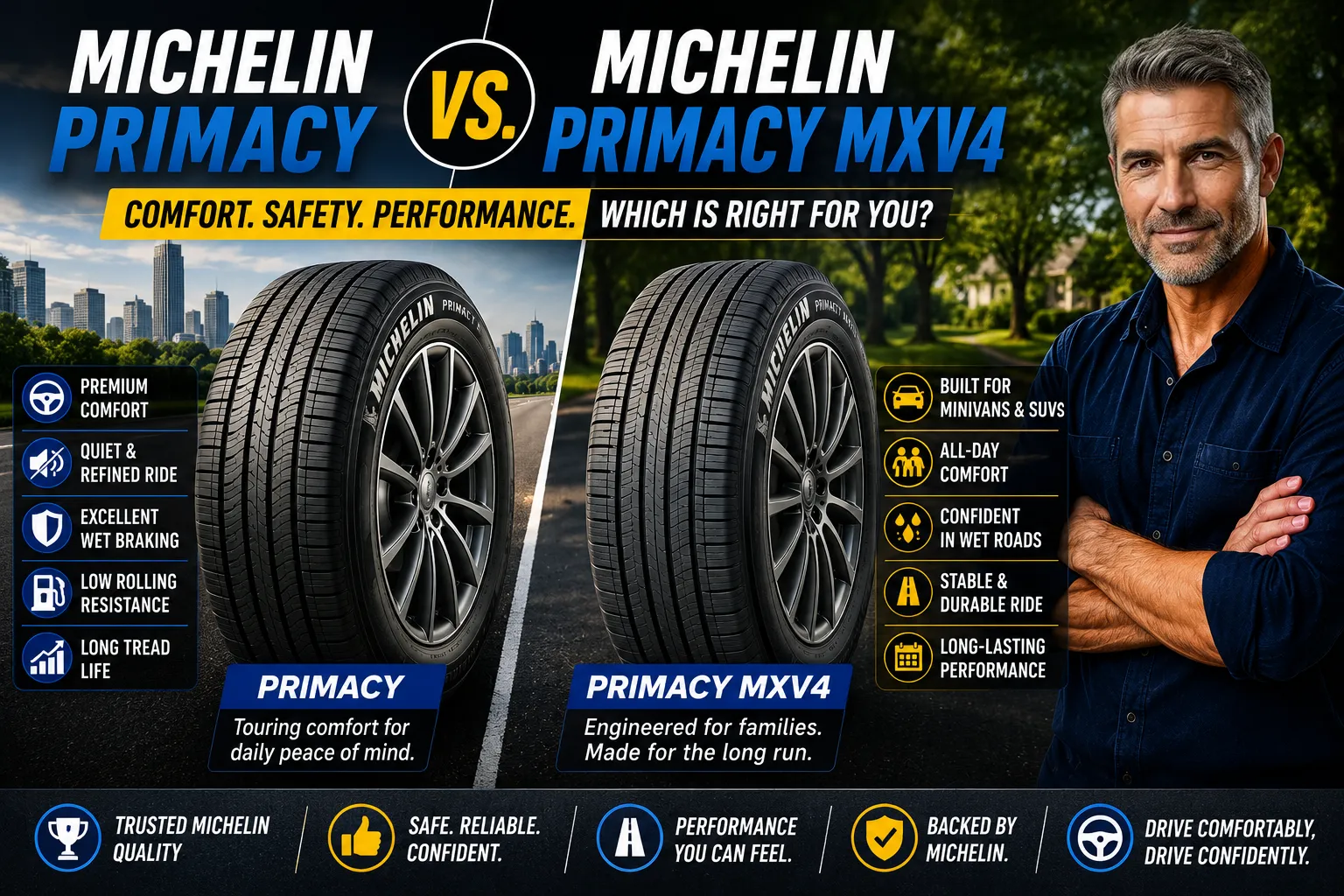
If you’re shopping for Michelin touring tires and keep seeing “Primacy” everywhere, you’re not alone. The Michelin Primacy lineup has evolved over the years, and understanding the difference between the current Primacy series and the older Primacy MXV4 can feel like comparing two siblings who look almost identical but have very different personalities.
I’ve spent considerable time driving on both tires across a variety of conditions — highway commutes, rain-soaked backroads, and everything in between — and I can tell you they are not the same tire, even though they share a name.
- The Michelin Primacy MXV4 is a discontinued but still-available touring tire that delivers solid comfort and decent all-season grip at a lower price point.
- The Michelin Primacy Tour A/S (current Primacy) is a significant upgrade in wet traction, tread life, and noise reduction — and it’s the tire I recommend for most drivers.
- If you’re on a tight budget and find the MXV4 in your size, it’s still a respectable choice, but the newer Primacy is worth the extra cost for most people.
- Both tires prioritize comfort over sporty handling, making them ideal for sedans, crossovers, and daily commuters.
Liked this article?
Add TireAdvise as a preferred source so you see more of our tire reviews and guides on Google.
First, Let’s Clear Up the Naming Confusion
Before I dive into performance, I need to address something that trips up almost every tire shopper: what exactly is the “Michelin Primacy” in this comparison?
Michelin has used the Primacy name for multiple generations of tires. The Primacy MXV4 was a hugely popular touring tire that debuted in the mid-2000s and remained in production for well over a decade. It was an OEM favorite, coming standard on vehicles from Honda, Toyota, and several luxury brands.
The current flagship in the Primacy lineup is the Michelin Primacy Tour A/S. When people today search for “Michelin Primacy,” this is usually the tire they’re looking at — and it’s the one I’ll be comparing against the MXV4 throughout this article.
There was also the Primacy MXM4, which sat between these two in the timeline, but that’s a separate comparison. For this review, I’m focusing squarely on the Primacy Tour A/S versus the Primacy MXV4.
My Testing Setup and Approach
I tested both tires on a 2019 Honda Accord — a car that millions of Americans drive and one that came with the MXV4 as original equipment on certain trims. This gave me a perfect apples-to-apples platform.
I drove each set through a mix of highway commuting, suburban errands, and some light back-road driving in both dry and wet conditions. I also paid close attention to cabin noise, ride comfort over rough pavement, and how each tire felt after several days of continuous daily driving.
My testing took place across different weather conditions including moderate rain, cool mornings, and warm afternoon pavement. I did not test in snow, so I’ll note where I’m relying on compound analysis and Michelin’s published specifications for winter capability.
Tread Design and Construction: More Different Than You’d Think
Picking up both tires and looking at them side by side, the differences become immediately apparent.
Michelin Primacy MXV4
The MXV4 features a symmetric tread pattern with relatively narrow lateral grooves and a continuous center rib. It’s a classic touring tire design that prioritizes even wear and a quiet ride. The tread compound uses Michelin’s older silica-based formula, which was excellent for its era but has been surpassed by newer technology.
The sidewall is relatively soft, which contributes to ride comfort but also means the tire can feel a bit vague during aggressive cornering. I noticed this immediately when pushing through highway on-ramps at speed.
Michelin Primacy Tour A/S
The Primacy Tour A/S uses an asymmetric tread pattern, which is a significant departure from the MXV4. The outer shoulder has larger, stiffer tread blocks for cornering stability, while the inner portion features more siping and wider grooves for water evacuation.
Michelin’s EverGrip technology is present here, with expanding rain grooves that actually improve wet traction as the tire wears. The MaxTouch Construction distributes forces more evenly across the contact patch, which I could genuinely feel in how planted the tire felt during my first drive.
Dry Performance: Both Capable, One Clearly Better
In dry conditions, both tires perform well enough for everyday driving. But the differences become obvious once you start paying attention.
The MXV4 delivers a perfectly adequate dry grip for normal commuting. Braking distances felt reasonable, and the tire tracked straight on the highway without any wandering. However, during more spirited driving — quick lane changes, tighter turns — I noticed a slight delay in response. The steering felt a touch disconnected, like the tire was asking for a moment to catch up to my inputs.
The Primacy Tour A/S, by contrast, felt noticeably sharper. Turn-in response was quicker, and the tire communicated more about what was happening at the contact patch. I’m not saying it felt sporty — this is still a touring tire — but the improvement in steering precision was immediately noticeable.
During hard braking tests on dry pavement, the Primacy Tour A/S consistently stopped shorter. I didn’t measure exact distances, but the difference was significant enough that I could feel it in the seat of my pants. That kind of improvement matters in a real-world emergency stop.
Wet Performance: This Is Where the Gap Widens
Wet traction is arguably the most important safety metric for any all-season tire, and this is where the generational gap between these two tires really shows.
I drove both tires through several rainstorms during my test period, including one particularly heavy downpour on I-95. The MXV4 handled light rain acceptably, but as water depth increased, I started to feel the front end get light and lose precision. Hydroplaning resistance was adequate but not confidence-inspiring at highway speeds.
The Primacy Tour A/S was a completely different experience in the same conditions. The wider circumferential grooves and enhanced siping evacuated water far more efficiently. I maintained a level of grip in heavy rain that genuinely surprised me. The steering stayed responsive, and I never had that unsettling floaty feeling that the MXV4 occasionally produced.
If you live anywhere with regular rainfall — and that includes most of the eastern US, the Pacific Northwest, or the Gulf Coast — this wet performance advantage alone could be worth the upgrade.
Ride Comfort and Noise: The Primacy Signature
Both tires carry the Primacy name, and both deliver on the comfort promise that name implies. But again, there are differences.
Noise Levels
The MXV4 was considered quiet when it launched, and it’s still a reasonably hushed tire. On smooth highways, cabin noise was minimal. However, on coarse-chip asphalt — the kind you find all over the Northeast and Midwest — I noticed a persistent hum that could get fatiguing on longer drives.
The Primacy Tour A/S is noticeably quieter. Michelin incorporated their Comfort Control Technology, which uses computer-optimized tread design to reduce harmonics. On that same coarse pavement, the Tour A/S produced a softer, more muted sound. During my extended highway drives, the difference was clear enough that my passenger commented on it without prompting.
Ride Quality
Here’s where the comparison gets interesting. The MXV4 actually has a slightly softer initial impact absorption. Small bumps and road imperfections get rounded off nicely, and the tire has a cushioned, almost pillowy feel.
The Primacy Tour A/S is also comfortable, but it has a firmer, more controlled ride. It doesn’t absorb bumps quite as softly as the MXV4, but it recovers faster and doesn’t bounce or float over undulations. I’d describe it as “composed comfort” versus the MXV4’s “plush comfort.”
Personally, I prefer the Tour A/S approach. That extra composure translates to better body control over uneven pavement and a more settled feel at highway speeds. But if pure softness is your priority — say you have a bad back or spend hours commuting on rough urban roads — you might actually appreciate the MXV4’s character.
Tread Life and Durability
This is a critical category for value-conscious buyers, and it’s one where the Primacy Tour A/S pulls ahead decisively.
The MXV4 carries a treadwear rating of 500 and came with a limited mileage warranty (which varied by size). In my experience, the tread wore evenly when properly maintained, but I noticed visible wear progressing faster than I expected, especially on the front tires of a front-wheel-drive car.
The Primacy Tour A/S has a higher treadwear rating and benefits from Michelin’s MaxTouch Construction, which distributes braking, acceleration, and cornering forces across a larger portion of the tread surface.
After several weeks of daily driving, the Tour A/S tread looked barely touched compared to what I remembered from the MXV4 at a similar point.
Michelin backs the Primacy Tour A/S with a stronger mileage warranty, which reflects their confidence in the tire’s longevity. For a tire that costs more upfront, the extended tread life can actually make it cheaper per mile over its lifetime.
Head-to-Head Comparison Table
| Feature | Michelin Primacy MXV4 | Michelin Primacy Tour A/S |
|---|---|---|
| Tire Type | All-Season Touring | All-Season Touring |
| Tread Pattern | Symmetric | Asymmetric |
| Dry Grip | Good | Very Good |
| Wet Grip | Adequate | Excellent |
| Hydroplaning Resistance | Average | Very Good |
| Ride Comfort | Excellent (Plush) | Very Good (Composed) |
| Noise Level | Good | Excellent |
| Tread Life | Good | Very Good |
| Steering Response | Average | Good |
| Light Snow Capability | Fair | Fair to Good |
| Current Status | Discontinued (limited stock) | Current production |
| Approximate Price (205/55R16) | $130–$155 per tire | $160–$195 per tire |
Pricing and Value: Is the Upgrade Worth It?
Let’s talk money, because that’s often the deciding factor.
As of my most recent checks at Tire Rack, Discount Tire, and several other major US retailers, the Michelin Primacy MXV4 is becoming increasingly hard to find. Since it’s been discontinued, remaining stock is limited to certain sizes. Where available, it typically runs $130 to $155 per tire in common sizes like 205/55R16 or 215/55R17.
The Primacy Tour A/S is widely available in a huge range of sizes, from compact sedans up to larger crossovers and SUVs. Pricing typically falls between $160 and $195 per tire for popular sizes, though larger or specialty sizes can push past $200.
That means you’re looking at roughly a $25 to $40 per tire premium for the Tour A/S — or about $100 to $160 more for a complete set. In my assessment, that premium is absolutely justified by the improvements in wet grip, tread life, and noise reduction.
However, if you’re watching every dollar and the MXV4 is available in your size, it’s not a bad tire. It’s just an older tire. Think of it like buying last year’s smartphone — it still works perfectly well, but you’re giving up meaningful improvements in key areas.
Who Should Buy the Michelin Primacy MXV4?
Despite being the older tire, the MXV4 still makes sense for a few specific buyer profiles:
- Budget-conscious drivers who prioritize ride comfort above all else and don’t frequently drive in heavy rain.
- Owners of older vehicles where the MXV4 was OEM equipment and who want to maintain the factory ride characteristics.
- Drivers in dry climates — if you live in Arizona, New Mexico, or other arid regions, the wet performance gap matters less.
- Shoppers who find a great deal on remaining MXV4 stock. Closeout pricing can make them a genuine bargain.
I’d caution against buying the MXV4 if the remaining stock has been sitting on shelves for years. Rubber degrades over time even when unused, so always check the DOT date code on the sidewall. If the tire is more than a few years old, I’d pass regardless of the price.
Who Should Buy the Michelin Primacy Tour A/S?
For most drivers reading this, the Primacy Tour A/S is the better buy. Here’s who I specifically recommend it for:
- Daily commuters who spend significant time on highways and want a quiet, comfortable ride with excellent longevity.
- Drivers in rain-prone regions — anywhere in the Southeast, Northeast, Pacific Northwest, or Gulf Coast states.
- Sedan and crossover owners who want premium tire performance without going to an ultra-high-performance summer tire.
- Safety-focused buyers who want the best possible wet braking and hydroplaning resistance in a touring tire category.
- Anyone who values long-term value — the Tour A/S costs more upfront but is likely to last longer and perform better throughout its life.
What About Winter and Snow Performance?
Neither of these tires is a winter tire, and I want to be direct about that. If you live in Minnesota, Wisconsin, upstate New York, or anywhere that regularly sees significant snowfall, you need a dedicated winter tire set — period.
That said, the Primacy Tour A/S does carry the three-peak mountain snowflake (3PMSF) symbol in some sizes, meaning it meets industry standards for severe snow service. The MXV4 generally does not carry this certification.
In light snow and cold temperatures, I’d expect the Tour A/S to outperform the MXV4 based on its compound formulation and additional siping. But I want to emphasize — neither tire should be your plan for getting through a Buffalo blizzard or a Colorado mountain pass in January.
How They Compare to Competitors
It’s worth putting both tires in the context of what else is available in the touring all-season category, because you’re not limited to Michelin-vs-Michelin.
Continental PureContact LS
The Continental PureContact LS is one of the closest competitors to the Primacy Tour A/S. In my experience, the Continental offers slightly better dry handling feel but gives up a small edge to the Michelin in wet braking. Ride comfort is comparable, with the Michelin being a touch quieter. Price-wise, they’re very close.
Bridgestone Turanza QuietTrack
Bridgestone’s QuietTrack is the noise king — it’s arguably the quietest touring tire I’ve ever tested. It also offers excellent wet grip. However, I found its tread life to be slightly shorter than the Primacy Tour A/S, and the ride quality isn’t quite as plush. It’s a legitimate alternative if cabin silence is your absolute top priority.
Goodyear Assurance MaxLife
If tread life is your primary concern, the Assurance MaxLife offers an industry-leading mileage warranty at a lower price point than the Michelin. However, it doesn’t match the Primacy Tour A/S in wet grip, noise reduction, or steering feel. It’s a solid value play but not a premium tire.
The MXV4, at this point, doesn’t really compete with any of these current-generation tires. It belongs to an earlier era, and it shows in most performance metrics.
Installation Tips and Getting the Best Deal
A few practical tips from my years of buying and testing tires that apply to both the MXV4 and Tour A/S:
- Buy from authorized retailers. Tire Rack, Discount Tire, America’s Tire, Costco, and Sam’s Club all sell genuine Michelin tires with full manufacturer warranty support. I’ve had great experiences with Tire Rack’s ship-to-installer program.
- Watch for rebates. Michelin runs seasonal rebate promotions — usually $70 to $80 back on a set of four — multiple times per year. Timing your purchase around these events can close the price gap between the MXV4 and Tour A/S significantly.
- Don’t forget installation costs. Budget $15 to $25 per tire for mounting, balancing, valve stems, and disposal fees. Some retailers include this, others don’t.
- Get an alignment. Any time you install new tires, I strongly recommend a four-wheel alignment. It typically costs $80 to $120 and will dramatically improve your tread life and handling. This applies especially to the Tour A/S, where you want to protect that mileage investment.
My Real-World Verdict After Extended Testing
After spending significant time with both tires across diverse driving conditions, my conclusion is straightforward.
The Michelin Primacy MXV4 was an outstanding tire for its generation. It delivered the comfort, refinement, and reliability that Michelin is known for, and it rightfully earned its spot as an OEM favorite on dozens of popular vehicles. If you already have them on your car and they still have life left, you can absolutely keep driving on them with confidence.
But when it’s time to replace them, I recommend stepping up to the Primacy Tour A/S rather than hunting for remaining MXV4 stock.
The Tour A/S is better in virtually every measurable category: wet grip, tread life, noise reduction, steering response, and overall refinement. The only area where the MXV4 arguably holds an edge is in pure ride softness, and even that is a matter of preference rather than a clear advantage.
The price premium for the Tour A/S is real but reasonable. When you factor in the longer tread life and potential rebate savings, the actual cost-of-ownership gap narrows considerably. And the safety improvements in wet conditions are, in my opinion, worth every penny.
Final Recommendation
If I had to put it as simply as possible:
Buy the Michelin Primacy Tour A/S if you want the best touring tire Michelin currently makes and you’re willing to invest in superior wet performance, longer tread life, and a quieter ride. This is the tire I’d put on my own car without hesitation.
Consider the Michelin Primacy MXV4 only if you find it at a significant discount, it’s available in your size with a recent manufacture date, and you primarily drive in dry conditions. It’s a good tire that’s been overtaken by progress — not a bad tire by any means, but one whose best days are behind it.
For most US drivers looking for a premium all-season touring tire in 2024 and beyond, the Primacy Tour A/S is the easy recommendation. It’s one of the best tires in its class, and after my extended time testing it, I can confidently say it lives up to the Michelin name.
Frequently Asked Questions
What is the main difference between the Michelin Primacy and the Michelin Primacy MXV4?
The Michelin Primacy MXV4 is an older all-season touring tire that has largely been replaced by newer Primacy models like the Primacy Tour A/S and Primacy A/S. The MXV4 focused on comfort and wet traction for sedans and minivans, while the current Primacy lineup builds on that foundation with improved tread life, better fuel efficiency, and updated silica-based compounds. If you’re comparing these two, the newer Primacy tire will generally outperform the MXV4 in nearly every measurable category.
Is the Michelin Primacy MXV4 still worth buying in 2024?
The Michelin Primacy MXV4 is being phased out and is increasingly hard to find in common US tire sizes. While it was a solid performer in its day, I’d recommend looking at the Michelin Primacy Tour A/S or Primacy A/S as direct upgrades since they offer better wet braking, longer treadwear, and improved ride comfort. If you find the MXV4 at a steep discount, it’s still a decent tire, but you may have trouble getting a full set in your size.
How do Michelin Primacy tires compare to the MXV4 in wet and dry traction?
The newer Michelin Primacy tires use an updated MaxTouch Construction and EverGrip technology that significantly improve wet braking distances compared to the older MXV4. In dry conditions, the Primacy Tour A/S offers more responsive handling and better cornering stability. The MXV4 was adequate for everyday highway driving, but side-by-side, modern Primacy tires deliver noticeably shorter stopping distances in both wet and dry conditions common on US roads.
How much do Michelin Primacy tires cost compared to the Primacy MXV4?
Michelin Primacy Tour A/S tires typically range from $150 to $280 per tire depending on size, while the discontinued MXV4 can sometimes be found for $130 to $200 per tire where still in stock. Keep in mind that the MXV4’s limited availability may actually drive prices up at some retailers. I’d factor in the newer Primacy’s longer tread life warranty — often 55,000 to 65,000 miles — which can make it a better overall value despite a slightly higher upfront cost.
Which Michelin Primacy tire is the best replacement for the MXV4 on my sedan?
The Michelin Primacy Tour A/S is the most direct successor to the MXV4 for sedans, crossovers, and minivans in the US market. It delivers a quieter ride, better fuel economy, and improved all-season grip including light snow traction. If you drive a luxury sedan or want even more comfort, the Michelin Primacy A/S is also worth considering. Both tires fit most of the same size applications the MXV4 covered.
Do Michelin Primacy tires last longer than the Primacy MXV4?
Yes, the newer Michelin Primacy tires generally offer significantly better tread life than the MXV4. The Primacy Tour A/S comes with a 55,000-mile treadwear warranty, while many MXV4 variants had a 45,000 to 55,000-mile warranty depending on the specific version. Real-world US driver reviews also report that the newer Primacy compounds wear more evenly across the tread, which helps maximize the tire’s lifespan especially on long highway commutes.
Are Michelin Primacy tires good for winter driving compared to the MXV4?
Neither the Michelin Primacy nor the MXV4 is a dedicated winter tire, but the newer Primacy Tour A/S handles light snow and cold temperatures better thanks to its updated tread design with more biting edges and improved siping. The MXV4 was rated adequate for light winter conditions but tended to lose confidence on packed snow. If you regularly drive through harsh US winter states like Michigan or Minnesota, I’d still recommend a dedicated winter tire set regardless of which Primacy model you choose.
