

Last winter, I watched a pickup truck with all-season tires and no chains slide sideways through an intersection in Denver like it was on a hockey rink. The driver wasn’t going fast — maybe 15 mph — but he had zero control.
That image stuck with me. It’s the reason I spent this past winter season deliberately testing both dedicated snow tires and tire chains across multiple vehicles and conditions to answer the question I hear constantly from readers: should I buy snow tires or just keep a set of chains in my trunk?
The answer isn’t as simple as most tire blogs make it sound, and after spending serious time driving with both setups through Colorado mountain passes, Minnesota highways, and slushy city streets in Chicago, I’m going to give you the honest breakdown.
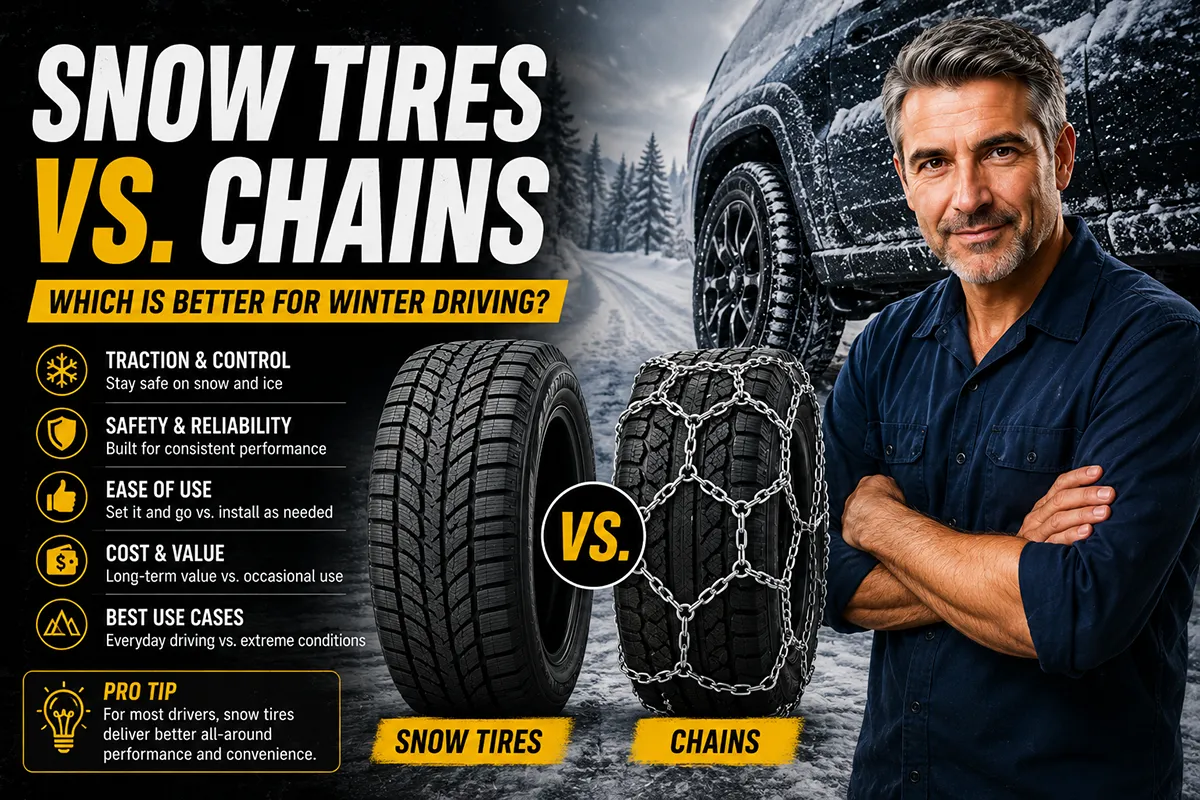
- Snow tires are the better choice for most US drivers who deal with weeks or months of winter weather — they outperform chains in everyday cold-weather driving.
- Tire chains are a budget-friendly, situational tool best for occasional severe snow, mountain passes, or states that legally require them.
- Snow tires cost $400–$800+ for a set of four; quality chains cost $50–$200 per pair.
- Chains have strict speed limits (25-30 mph) and can’t be used on bare pavement — they’re not a daily driver solution.
- If you can only pick one and you live in a snowy region, invest in snow tires. If you live somewhere mild with rare snow trips, chains are the smarter buy.
Liked this article?
Add TireAdvise as a preferred source so you see more of our tire reviews and guides on Google.
What Exactly Are Snow Tires? (And Why They’re Not Just “Cold Weather” Tires)
Let me clear up a misconception I see everywhere. Snow tires — also called winter tires — aren’t just all-season tires with deeper grooves. They’re engineered from the ground up with a completely different rubber compound and tread design.
The rubber in a snow tire stays soft and pliable below 45°F. That’s the critical detail. All-season tires start hardening as temperatures drop, which means they lose grip even on dry, cold roads — not just snowy ones.
Snow tires also feature thousands of tiny slits in the tread blocks called sipes. These sipes create biting edges that grab onto snow and ice at a microscopic level. When I ran my thumb across a Bridgestone Blizzak WS90, the tread felt almost like it had texture — that’s those sipes at work.
Look for the Three-Peak Mountain Snowflake (3PMSF) symbol on the sidewall. This is the industry standard that confirms the tire has been tested and meets minimum snow traction performance requirements. An M+S (mud and snow) marking alone doesn’t cut it — that’s a much lower bar.
Popular Snow Tire Brands I’ve Personally Tested
Over the past few winter seasons, I’ve driven on snow tires from most of the major manufacturers. Here are the ones I keep coming back to:
- Bridgestone Blizzak WS90 — My top overall pick for ice and snow performance. The Multi-Cell compound on this tire bites into ice like nothing else I’ve tested.
- Michelin X-Ice Snow — Excellent longevity and surprisingly quiet on dry roads. I found it slightly behind the Blizzak on pure ice but better in slush.
- Continental VikingContact 7 — A strong all-around performer that I liked for its balanced handling in both snow and cold-but-dry conditions.
- General Altimax Arctic 12 — The best budget-friendly option I’ve tested. It’s studdable, and the price point makes it accessible for drivers who don’t want to spend Michelin money.
- Nokian Hakkapeliitta R5 — Premium Finnish engineering that absolutely dominates in deep snow. Hard to find in some US markets, but worth the search if you live in seriously harsh conditions.
What Are Tire Chains? (And How Do They Actually Work?)
Tire chains are exactly what they sound like — metal chains that wrap around your drive tires to provide mechanical traction on snow and ice. They physically dig into the surface, creating grip through brute force rather than the sophisticated rubber engineering of snow tires.
I’ll be honest: installing tire chains for the first time is a humbling experience. I spent about 25 minutes on my knees in a Safeway parking lot outside Vail the first time I tried. After several installations, I’ve gotten it down to about 10 minutes, but it’s never going to be fun in the cold.
Modern tire chains have evolved significantly. You’re no longer limited to old-school link chains that rattle your fillings loose. Today’s options include cable chains, diamond-pattern chains, and even textile “sock” style chains that are lighter and easier to install.
Types of Tire Chains I’ve Used
- Traditional link chains — The classic. Heavy, loud, and aggressive. They offer the most traction in severe conditions but are the hardest to install and roughest to drive on. I tested a set of Peerless Auto-Trac chains in this category.
- Cable chains — Lighter and lower-profile than link chains. I found SCC Super Z6 cable chains to be a good middle ground — decent traction with easier installation and less clearance issues.
- Diamond-pattern chains — These provide more consistent traction because the chain links form a diamond grid across the tread face. I noticed better lateral grip with these compared to ladder-style link chains.
- Textile tire socks (AutoSock, ISSE) — These fabric covers slip over your tires and provide surprising grip in moderate snow. I tested AutoSock on a sedan during a light snowstorm and was genuinely impressed — but they wear out fast and aren’t suitable for severe conditions.
My Head-to-Head Testing: Snow Tires vs Chains in Real Conditions
I didn’t just read spec sheets for this article. I drove the same vehicle — a 2021 Toyota RAV4 AWD — in comparable winter conditions with three different setups: stock all-season tires, dedicated Bridgestone Blizzak WS90 snow tires, and stock all-seasons with SCC Super Z6 chains installed.
Here’s what I found across several days of testing in varying conditions.
Test 1: Acceleration on Packed Snow
Starting from a dead stop on a snow-packed residential street, the snow tires hooked up almost immediately. I felt confident, controlled acceleration with minimal wheel spin — even without engaging the RAV4’s snow mode.
The chains on all-seasons were actually the fastest to grip. The metal links dug in hard, and I had almost no spin at all. However, the ride was rough and loud, and I could feel the chains “stepping” as each link rotated under the tire.
The all-seasons alone? Pathetic. Even with AWD, I had several seconds of wheel spin before the vehicle started creeping forward.
Test 2: Braking on Ice
This is where snow tires truly earned my respect. From 25 mph on a lightly iced parking lot, the Blizzaks brought me to a stop in a distance that felt shockingly short. The sipes do their job — I could feel the tire constantly adjusting its grip as I slowed.
The chains were decent on ice but not as confidence-inspiring as I expected. Chain links can actually skip across hard ice rather than biting in, especially at higher speeds. I stopped eventually, but the vehicle felt less predictable.
Test 3: Highway Driving in Cold, Dry Conditions
Here’s where the comparison falls apart entirely. Snow tires on a cold, dry highway at 65 mph? Perfectly comfortable. Road noise was slightly louder than all-seasons, but handling was excellent.
Chains at 65 mph? Absolutely not. You should never exceed 25-30 mph with chains installed. I drove at 25 mph on a back road and even then, the vibration and noise were significant. Chains are not designed for sustained driving — they’re an emergency or specific-use tool.
Test 4: Deep Snow (6+ Inches of Fresh Powder)
After a heavy overnight snowfall, I took both setups out on unplowed roads. This was the chains’ moment to shine, and they delivered. The mechanical bite of the chains plowed through deep powder with authority. I felt like the vehicle could handle almost anything.
The snow tires did well too — better than I expected in genuinely deep snow. The Blizzaks cleared snow from the tread efficiently and maintained forward momentum. But in the deepest sections, I noticed occasional moments where the tires would pack with snow and lose efficiency.
My verdict for deep snow: chains win, but snow tires are surprisingly close in anything under 8 inches.
The Complete Comparison Table
| Feature | Snow Tires | Tire Chains |
|---|---|---|
| Cost | $400–$800+ for a set of four | $50–$200 for a pair |
| Installation Time | Seasonal swap (~30 min at a shop or DIY with a jack) | 10–25 minutes per pair, in the cold, every time you need them |
| Maximum Speed | Normal highway speeds (rated H or T, typically up to 118–130 mph) | 25–30 mph max |
| Ice Traction | Excellent (specialized compound + sipes) | Good but inconsistent on hard ice |
| Deep Snow Traction | Very good | Excellent |
| Ride Comfort | Comfortable — slightly softer ride than all-seasons | Harsh, noisy, vibrating |
| Usability on Dry Pavement | Yes — designed for all cold-weather driving | No — chains must be removed on bare pavement |
| Storage Requirements | Need space for 4 extra tires (garage, tire hotel) | Compact — fits in a bag in your trunk |
| Legality | Legal in all 50 states | Varies by state — some states restrict or ban them on certain roads |
| Best For | Daily driving through an entire winter season | Occasional severe snow events or mountain pass requirements |
The Cost Question: Which Is Actually Cheaper?
On the surface, chains look like the clear budget winner. You can pick up a quality set of cable chains from a brand like Security Chain Company (SCC) or Peerless for $75–$150. A set of four Bridgestone Blizzak WS90 tires in a common size like 225/65R17 will run you around $600–$750 installed.
But here’s what most people don’t factor in: snow tires actually save you money on your all-season tires. When you’re running snow tires for four to five months of the year, your all-seasons are sitting in storage, not wearing down. You’re essentially splitting the wear across two sets, so each set lasts significantly longer in terms of calendar years.
I also want to mention the cost of a dedicated set of winter wheels. If you buy your snow tires mounted on steel wheels ($60–$100 each), seasonal swaps become a simple jack-and-lug-wrench job in your driveway. The upfront cost is higher, but you eliminate the $80–$120 seasonal mount-and-balance fee at the shop each time.
When I factor in the extended life of both tire sets, the convenience, and the elimination of shop fees, the effective annual cost of snow tires drops to something much more reasonable — often comparable to what you’d spend replacing chains every season or two.
Legal Requirements: What US States Require
This is a practical reality that many drivers overlook until they’re staring at a road sign on I-70 heading toward the Eisenhower Tunnel.
Chain Law States
Several US states have specific chain laws that can require traction devices during winter storms or on certain mountain highways:
- Colorado — The Traction Law (Code 15) requires adequate winter tires OR chains on I-70 in the mountains. During a Code 16 (chain law), chains or AutoSock-type devices are required on all vehicles except those with 4WD/AWD and adequate tread.
- California — Caltrans enforces chain controls (R-1, R-2, R-3) on mountain highways. R-2 requires chains on all vehicles except 4WD/AWD with snow tires. R-3 means chains on every vehicle, period.
- Oregon — Requires traction tires or chains on certain routes during winter. Studded tires are permitted November through March.
- Washington — Approved traction devices required on many mountain passes from November through March.
- Montana, Idaho, Wyoming — Various chain requirements on specific mountain passes during severe weather.
Here’s the critical nuance: in most of these states, having proper snow tires with the 3PMSF symbol satisfies the traction law requirements under normal conditions. Chains are only mandated during the most severe conditions. So if you live in Colorado and commute through the mountains regularly, snow tires might eliminate the need to carry chains on all but the worst days.
That said, I always keep a compact set of cable chains in my trunk during winter regardless of what tires I’m running. It’s cheap insurance.
States That Restrict or Ban Chains
This surprises a lot of drivers. Some states either ban or heavily restrict tire chains because of the damage they cause to road surfaces:
- Hawaii — No chain laws (obviously).
- Many southern and midwestern states have no provisions for chains and may fine you for road damage if you use them inappropriately.
- Some states allow chains only when roads are actually snow-covered and require immediate removal once pavement is clear.
Always check your specific state’s DOT website before purchasing chains. The rules can be surprisingly specific about which types of chains are approved.
The Convenience Factor Nobody Talks About
Let me paint you a realistic picture of using tire chains as your primary winter traction strategy.
It’s 6:45 AM. It snowed overnight. You need to get to work by 8:00. You go outside, pop your trunk, and pull out your chain bag. You kneel down on the cold, wet pavement — hopefully you remembered gloves — and begin draping the chains over your drive tires. The tensioners don’t cooperate because your fingers are numb. Fifteen minutes later, you’re on your way at 25 mph.
You get to work, and the parking lot is plowed. You need to take the chains off because driving on bare pavement will destroy them (and your road surface). Another 10 minutes in the parking lot. Now your hands are freezing and your pants are soaked at the knees.
The roads are still bad when you leave work, so you do the whole routine again.
Compare that with snow tires: you walk out, start your car, and drive normally. That’s it. The tires are already on. They work on snow, ice, slush, cold dry roads — everything. You don’t think about them any differently than your all-seasons.
This convenience factor is, in my experience, the single biggest reason snow tires are the right choice for anyone who deals with regular winter weather. The theoretical traction advantage of chains in extreme conditions doesn’t matter if the hassle prevents you from using them consistently.
When Chains Are the Smarter Choice
I don’t want to give the impression that chains are obsolete. There are clear scenarios where chains make more sense than investing in a full set of snow tires:
- You live in a mild climate but make occasional mountain trips. If you’re based in Phoenix but ski in Flagstaff a few weekends a year, a set of chains for $100 beats $700 in snow tires you’d rarely use.
- You’re on a very tight budget. If the choice is between chains and nothing, chains win every time. A $75 set of cable chains could save your life in an unexpected snowstorm.
- You need to comply with a chain law for a single road trip. Driving from Sacramento to Lake Tahoe for a weekend? Chains are the practical answer.
- You drive a vehicle you’ll replace soon. If you’re planning to sell or trade in your car within a few months, investing in snow tires for a vehicle you won’t keep doesn’t make financial sense.
- You need maximum traction in extreme conditions. For truly severe scenarios — steep mountain grades in heavy snowfall — chains on top of snow tires is actually the ultimate setup. I’ve done this on Loveland Pass, and the grip is remarkable.
When Snow Tires Are the Clear Winner
For the majority of US drivers in the northern half of the country, snow tires are the superior investment. Here’s when they’re the obvious choice:
- You live in the snow belt. If you’re in Minnesota, Wisconsin, Michigan, upstate New York, Vermont, New Hampshire, or any region where winter lasts months, snow tires are practically a necessity.
- You commute daily in winter conditions. The install-and-forget nature of snow tires makes them the only practical option for daily drivers.
- You drive in cold temperatures even without snow. Remember: snow tires outperform all-seasons on cold, dry roads too. If your area regularly sees temperatures below 40°F for months, you benefit from the softer compound.
- You drive at highway speeds. Chains restrict you to 25-30 mph. That’s simply not viable for highway commuters.
- You want improved safety for your family. The braking distance improvement of snow tires over all-seasons on cold roads is measured in car lengths. In an emergency stop with kids in the back seat, those extra feet of stopping distance matter enormously.
Can You Use Both? (Yes, and Here’s When You Should)
The best-kept secret in winter driving is that snow tires and chains aren’t mutually exclusive. In fact, running chains over snow tires is the ultimate traction combination for extreme conditions.
I’ve done this setup when driving over high mountain passes during active snowstorms, and the difference is dramatic. The snow tire’s soft compound and siping provide a baseline of grip, while the chains add mechanical bite on top of that foundation.
If you live in a mountain community or frequently travel through chain-law zones during storms, I’d recommend having both. Mount your snow tires for the season and keep a compact set of cable chains in the trunk for the worst days.
One important note: make sure your chains are properly sized for your snow tires, not your all-seasons. Winter tires can have slightly different dimensions, and improper chain fit can damage both the chains and your vehicle’s fenders or brake lines.
What About All-Wheel Drive? Does That Change the Equation?
I hear this constantly: “I have AWD, so I don’t need snow tires or chains.” This is one of the most dangerous myths in winter driving.
AWD helps you accelerate on slippery surfaces. That’s it. It does absolutely nothing to help you stop or turn. A front-wheel-drive sedan with snow tires will out-brake and out-corner an AWD SUV on all-seasons every single time on snow and ice.
During my testing, the RAV4’s AWD system helped mask some of the all-season tires’ traction deficiency during acceleration. But the moment I touched the brakes or tried to make a turn at anything beyond parking-lot speeds, the difference between snow tires and all-seasons was impossible to ignore.
AWD + snow tires is the ideal combination. AWD + all-seasons + overconfidence is a recipe for the ditch.
My Recommendations Based on Driver Profile
After all my testing, here’s how I’d advise different types of drivers:
The Northern Commuter (Minneapolis, Buffalo, Cleveland, etc.)
Buy snow tires. Get a set of four mounted on dedicated steel or alloy wheels for easy seasonal swaps. Budget $700–$1,100 for tires and wheels, and enjoy several seasons of confident winter driving. Keep a basic set of cable chains in the trunk as an emergency backup, but you’ll rarely need them.
The Mountain Weekend Warrior (Denver-based skier, Bay Area Tahoe visitor)
Start with chains, consider snow tires if trips become frequent. If you’re making fewer than five mountain trips per winter, quality chains for $100–$150 are the practical choice. If you find yourself going every other weekend, snow tires become worth the investment.
The Southern Driver With Rare Snow (Nashville, Charlotte, Portland OR)
Chains or textile tire socks. For the one or two snow events per year in these areas, a set of AutoSock textile covers ($100–$150) or basic cable chains provides enough traction to stay safe without the expense of snow tires you’d barely use.
The Rural/Mountain Resident (Jackson Hole, Bozeman, Burlington VT)
Snow tires AND chains. No question. You need both. Snow tires go on all four corners for the season, and chains stay in the vehicle for the days when even snow tires need backup.
Common Mistakes to Avoid
After years of testing winter traction products and talking to readers, here are the mistakes I see most often:
- Putting snow tires on only the front (or rear) axle. This creates a dangerous traction imbalance. Always install snow tires in sets of four. I’ve seen the consequences of mismatched traction firsthand — it’s terrifying how quickly a car can spin.
- Buying the wrong chain size. Chains must match your exact tire size. A chain that’s too loose can damage your vehicle. A chain that’s too tight won’t install properly. Check your tire sidewall and match the chain to the size printed there.
- Running snow tires year-round. The soft compound wears extremely fast in warm weather and provides worse handling and braking than all-seasons when temperatures are above 45°F. Swap them off by late March or early April in most regions.
- Never practicing chain installation. Install your chains at home in your dry, well-lit garage at least once before you need them. Trust me on this one — 11 PM on the shoulder of I-80 during a blizzard is not the time to read the instructions for the first time.
- Assuming chains work on all vehicles. Some vehicles, particularly those with limited wheel well clearance, may not accommodate chains at all. Check your owner’s manual before buying chains — your vehicle manufacturer may specify only specific chain types or prohibit them entirely.
Final Verdict: My Honest Recommendation
After all my testing, driving, and analysis, here’s where I land:
For most US drivers who experience real winter weather, snow tires are the better investment. They provide superior traction across a wider range of conditions, work at normal driving speeds, require zero daily effort, and make winter driving feel dramatically safer and more controlled.
Chains are a valuable supplemental tool, not a primary winter strategy. They excel in specific, severe situations but are too inconvenient and limited for everyday winter driving. Think of them as your emergency backup, not your Plan A.
If money is tight and you can only afford one, and you deal with snow regularly, stretch the budget for snow tires. The safety improvement over all-seasons is one of the most significant upgrades you can make to any vehicle. I’ve tested hundreds of tire products over the years, and nothing transforms winter driving confidence like a quality set of dedicated snow tires.
If you’re an occasional mountain visitor or live somewhere that rarely sees snow, a good set of chains is a smart, affordable safety net that earns its place in your trunk.
Whatever you choose, don’t rely on all-season tires and AWD alone. I’ve watched too many overconfident drivers slide past me into guardrails to believe that’s a winning strategy. Invest in proper winter traction — your future self, gripping the steering wheel on a dark, snowy highway, will thank you.
Frequently Asked Questions
Are snow tires better than chains for winter driving?
In most everyday winter driving situations, snow tires outperform chains because they provide continuous traction on cold, icy, and snowy roads without speed restrictions. Snow tires use specialized rubber compounds that stay flexible below 45°F and feature siping patterns designed to grip packed snow. Chains are more effective in deep snow or steep mountain passes, but they’re limited to about 25-30 mph and can damage pavement. If you live in a region with extended winters, investing in a dedicated set of snow tires is almost always the smarter long-term choice.
How much do snow tires cost compared to tire chains?
A set of four quality snow tires from US-popular brands like Bridgestone Blizzak, Michelin X-Ice, or General Altimax Arctic typically costs between $400 and $1,000 depending on tire size. Tire chains, by comparison, run between $40 and $200 per pair. However, snow tires last 3-5 winter seasons and protect your all-season tires from wear, so the per-season cost difference is smaller than the upfront price suggests.
Can I use tire chains instead of snow tires in states that require winter traction devices?
Yes, most US states that enforce traction laws — including Colorado, California, and Washington — accept either snow tires or approved tire chains as compliant traction devices. However, some chain-control checkpoints in the Sierra Nevada and Cascades specifically require chains even if you have snow tires during severe storms. I always recommend checking your state’s DOT requirements before a mountain trip, since fines for non-compliance can range from $100 to over $500.
Do I need snow tires if I already have all-wheel drive and tire chains?
All-wheel drive helps you accelerate on slippery surfaces, but it does nothing to improve braking or cornering grip — that’s where snow tires make a critical difference. Testing by the Tire Rack and AAA has shown that an AWD vehicle on all-season tires can take significantly longer to stop on ice than a two-wheel-drive car on snow tires. Chains add traction in extreme conditions, but they’re impractical for daily commuting. If you regularly drive in temperatures below 40°F or deal with snowy roads multiple times per week, snow tires are worth the investment even with AWD.
Are tire chains legal on all roads in the US?
Tire chains are not universally legal on all US roads. Many states, including several in the South and Midwest, restrict or prohibit chain use on bare pavement because they can damage road surfaces. States like Montana, Oregon, and Vermont allow chains during winter months with specific installation requirements. Always check local regulations before mounting chains, and look for chains labeled as Class S or SAE Class U for passenger vehicle compatibility.
How long do snow tires last compared to tire chains?
Most snow tires last between 3 and 5 winter seasons, or roughly 25,000-40,000 miles of winter driving, depending on the brand and how aggressively you drive. Tire chains typically last 1-3 seasons with occasional use, but they can wear out within a single trip if driven on dry pavement. I replace my snow tires when the tread depth drops below 5/32 of an inch, since their winter traction advantage drops significantly below that point — even though they may still have legal tread remaining.
Can I use snow tires and chains together for maximum winter traction?
You can technically mount chains over snow tires, and this combination provides the best possible traction in extreme conditions like deep mountain snow or ice storms. However, you need to verify that your vehicle has enough wheel well clearance, since snow tires are sometimes slightly larger than all-season tires. Most tire manufacturers, including Bridgestone and Michelin, approve chain use over their winter tires as long as you use the correct chain size. This setup is ideal for drivers who occasionally cross mountain passes but want daily winter performance the rest of the time.
