

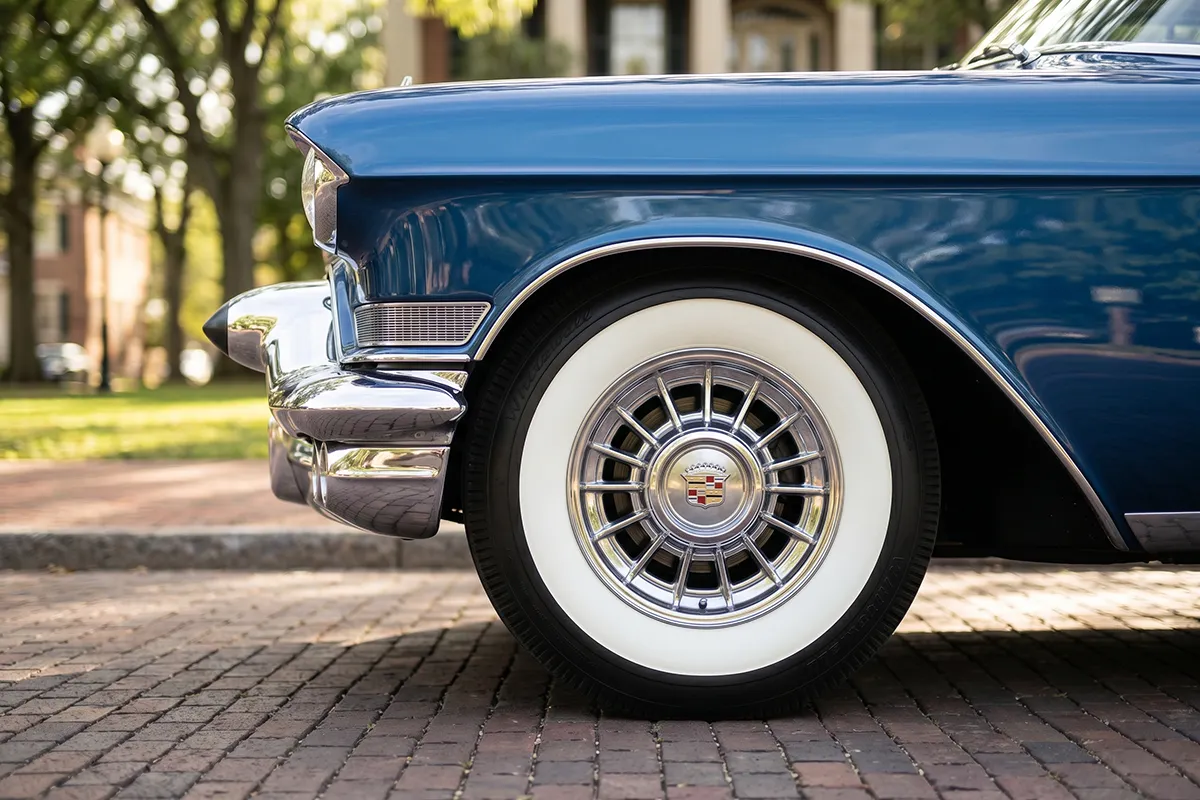
- White wall tires originated in the 1910s and peaked in popularity from the 1940s through the 1960s.
- The ‘white’ is a cosmetic band of white rubber on the sidewall — widths range from a subtle 1-inch stripe to a classic 3-inch band.
- They are available for classic cars (bias-ply and radial) and some modern vehicles via specialty manufacturers.
- Cleaning is the biggest maintenance consideration — white rubber shows dirt fast and needs dedicated whitewallcleaners.
- Top brands include Coker Tire, BFGoodrich, Lucas Classic, and Diamondback Truck covers for modern pickups.
- Not ideal for performance driving — they’re a style choice, not a performance upgrade.
I’ve spent years reviewing tires for everything from daily drivers to show-quality classics, and few questions come up more often than: “Where can I find good white wall tires?”
It makes sense — there’s something about that bright white stripe that instantly signals a certain era of American automotive culture.
But the landscape of white wall tires has changed a lot since your grandfather swapped a set onto his Buick Roadmaster, and getting the right set today takes a bit more research than it used to.
In this guide I’ll walk you through the full picture: the history of white wall tires, the different styles available today, how to size them correctly, the best brands on the market, and how to keep them looking their best.
Whether you’re restoring a 1955 Chevy, building a period-correct hot rod, or just want a subtle retro touch on a modern car, this is the guide you need.
Looking for general tire buying advice first? See our complete Tire Buying Guide.
Liked this article?
Add TireAdvise as a preferred source so you see more of our tire reviews and guides on Google.
1. A Brief History of White Wall Tires
White wall tires weren’t always a style statement — they started out as a manufacturing inevitability. In the early days of tire production, the carbon black compound used to strengthen rubber hadn’t been widely adopted yet.
Natural rubber was a creamy off-white color, and the outer sidewalls were simply left uncolored. The result was a white (or tan) sidewall that was, at the time, purely functional.
By the 1930s, carbon black had become the industry standard for tread rubber because it dramatically improved durability and wear resistance. But manufacturers discovered that customers had grown fond of the white sidewalls.
So they began producing a two-layer construction: black carbon-reinforced rubber for the tread and structural portions, with a layer of white rubber on the outer sidewall for aesthetics.
The postwar boom years — roughly 1945 through 1965 — represented peak white wall popularity. Wide, sweeping 3- to 4-inch white bands were considered premium features on everything from Cadillacs to Fords.
Tire companies marketed them aggressively, and automakers specified them as standard equipment on top trim levels. If you watch any film or TV from this era, you’ll notice white walls on virtually every car.
The 1970s brought a hard turn toward black. Rising performance culture, the influence of racing tires, and shifting aesthetic tastes made white walls seem dated almost overnight.
By the early 1980s, they had largely vanished from new cars — aside from occasional appearances on luxury vehicles and specialty trim packages. Today they live primarily in the classic and custom car world, though a handful of manufacturers have kept the flame alive.
2. Understanding White Wall Tire Styles and Widths
Not all white wall tires look the same, and the differences go well beyond cosmetics. Here’s how to think about the main styles:
Wide White Wall (2″–4″)
This is the classic look — a broad, highly visible band of white rubber that dominates the sidewall. Widths typically range from 2 to 4 inches. These are historically accurate for vehicles from the 1940s through the early 1960s.
If you’re doing a concours-level restoration of a 1953 Buick Super or a 1957 Thunderbird, a wide white wall in the correct width is non-negotiable.
Narrow White Wall / Thin Line (1″–1.5″)
By the mid-to-late 1960s, taste had shifted toward narrower bands. A 1-inch or 1.5-inch white wall reads as more subtle and sporty — still recognizably vintage but not as flashy.
These work well on muscle cars, pony cars, and early imports from that era. Many builders also use them on custom builds where they want a hint of vintage character without a fully period-correct look.
Raised White Letters (RWL)
Technically distinct from white walls, raised white letter tires feature the tire brand and model name embossed in white on the sidewall. They were enormously popular in the 1970s and 1980s on performance cars and trucks.
Brands like BFGoodrich, Goodyear, and Firestone made them iconic. RWL tires are still produced today and remain popular on muscle car restorations and lifted trucks.
Whitewall Covers and Portawall Inserts
If you want the white wall look without buying specialty tires, portawall inserts are rings of white rubber that fit between the tire and the rim to simulate a white sidewall.
They’re an inexpensive option for shows or occasional use, but they don’t hold up to regular driving and can cause balance issues. I generally recommend them only for display purposes — not daily or weekend driving.
3. How to Size White Wall Tires Correctly
Sizing white wall tires correctly is one of the areas where I see the most confusion, especially among first-time classic car owners. Here’s what you need to know:
Bias-Ply vs. Radial
Older vehicles — generally anything pre-1970s — were originally equipped with bias-ply tires, which have a fundamentally different internal construction than modern radial tires. Bias-ply tires have a rounder profile and a distinctly different ride character.
For concours restorations, correct bias-ply white walls are usually required. For drivers who want modern ride quality and safety, radial white walls are available for many classic fitments and are the better functional choice.
Coker Tire is the leading source for both bias-ply and radial white wall tires in period-correct sizes. Their catalog is extensive — if you’re restoring something specific, their fitment guides are an excellent starting point.
Reading the Size
Vintage tire sizes use a different notation than modern tires. A size like 7.50-14 means 7.50 inches of section width on a 14-inch rim.
When cross-referencing to modern metric sizing (like 215/75R14), you need to match both the diameter and section width carefully.
Many specialty suppliers provide conversion charts, and I highly recommend verifying fitment with a specialist before ordering — returns on specialty tires can be expensive and complicated.
White Wall Width Measurement
White wall width is measured from the outer edge of the white portion to where it meets the tread shoulder.
A tire listed as a “3-inch white wall” should have approximately 3 inches of visible white rubber on the sidewall when mounted.
This can vary slightly depending on how the tire seats on your specific rim, so it’s worth checking with the manufacturer if exact width matters for your restoration.
4. Best White Wall Tires: Top Picks by Use Case
After testing and reviewing dozens of specialty tires over the years, here are the brands and products I consistently recommend across different applications.
Note that white wall tires are a specialty product — pricing, availability, and specific models change regularly, so I recommend verifying current stock with the retailer.
Best for Classic Car Restorations: Coker Classic Tires
Coker Tire has been the gold standard for classic car tires since 1958. They manufacture both bias-ply and radial white wall tires in an enormous range of vintage sizes, with historically accurate white band widths.
If you’re restoring a pre-1970 vehicle to original or period-correct spec, start here. Their quality control is excellent, and their customer service team genuinely knows vintage fitments.
Shop Coker Classic Tires: Tire Rack | Coker Tire Direct
Best Budget Option: Lucas Classic Tires
Lucas Classic offers white wall tires at a noticeably lower price point than Coker.
The quality is generally solid for weekend show cars and occasional drivers — I wouldn’t put them on a high-mileage daily driver, but for a car that sees a few hundred miles a year, they represent strong value. Available in both bias-ply and radial constructions.
Shop Lucas Classic: SimpleTire | Amazon
Best for Muscle Cars (Raised White Letters): BFGoodrich Radial T/A
The BFGoodrich Radial T/A is an icon in its own right — this is the tire you see on Trans Ams, Camaros, and Mustangs of the 1970s and ’80s in every movie and poster.
The raised white “T/A” lettering on the sidewall is instantly recognizable. BFGoodrich still makes this tire in a wide range of sizes, and it performs genuinely well as a driving tire — not just a show piece.
Shop BFGoodrich Radial T/A: Tire Rack | SimpleTire
Best for Modern Trucks and SUVs: Diamondback Truck Covers
Diamondback doesn’t make a tire — they make a snap-on white wall accessory designed specifically for modern truck and SUV tires.
They attach to the outside of the sidewall without affecting tire performance or balance (when installed correctly), and they give a convincing white wall look to a modern pickup.
I’ve seen these on everything from F-150s to Silverados, and the effect is impressive. Best used on show trucks rather than daily drivers that see highway speeds regularly.
Shop Diamondback Covers: Amazon
5. How to Clean and Maintain White Wall Tires
This is the question I get more often than any other from white wall tire owners: how do you keep them white? The honest answer is that it takes consistent effort.
White rubber is porous and stains easily from road grime, brake dust, and the carbon black that migrates from the tread and inner sidewall rubber. Here’s my maintenance routine:
Regular Cleaning (After Every Drive or Week)
After every drive — or at minimum every week for cars that see regular use — give the white walls a quick clean with a dedicated white wall tire cleaner. My preferred products are Westley’s Bleche-Wite or Tire Foam from Meguiar’s.
Spray on, let sit for 30–60 seconds, then scrub with a stiff-bristle brush (not a wire brush — that will damage the rubber) and rinse clean.
Deep Cleaning (Monthly or Before Shows)
For tires that have developed yellowing or stubborn stains, a more aggressive approach is needed. A paste of baking soda and dish soap, applied with a brush and left for several minutes before scrubbing, works well for light staining.
For heavy oxidation or old stains, a product like Bleche-Wite at full strength, combined with vigorous scrubbing with a tire brush, usually does the job.
In extreme cases, very fine (400-grit) wet sandpaper can carefully remove surface staining — but do this sparingly and carefully, as it removes material.
What NOT to Do
Avoid silicone-based tire dressings (the shiny black ones) on white walls — they accelerate yellowing and make white areas harder to clean. Never use bleach directly on tires; it degrades rubber over time.
And don’t ignore the issue — the longer you let staining sit, the harder it is to remove. A quick post-drive wipe-down takes 5 minutes and saves you an hour of deep cleaning later.
Storage
If you’re storing a white wall tire vehicle for any extended period, store the car on a flat surface (not jacks if avoidable), away from ozone sources like electric motors and generators. Cover tires with a breathable tire cover.
Some owners apply a light coat of 303 Aerospace Protectant to the white walls before long storage periods to prevent oxidation — this is a practice I’ve found genuinely helpful.
6. White Wall Tires on Modern Vehicles
It’s a reasonable question: can you put white wall tires on a modern car or truck? The honest answer is — sometimes, but it’s complicated.
For modern vehicles with standard metric tire sizes, true white wall tires in modern constructions are extremely limited. A few manufacturers produce narrow white stripe tires in some common sizes, but if you need a 235/55R17 white wall, your options are essentially nil in factory tire form.
This is where Diamondback Covers (mentioned above) or similar snap-on accessories become relevant. They work best on trucks and larger SUVs with substantial sidewall area to accommodate the white band.
On low-profile modern car tires (anything with a 45-series or lower aspect ratio), there simply isn’t enough sidewall to make a white band look right — and the covers won’t fit properly.
Custom builders sometimes source narrow-white-stripe tires from specialty importers or have tires custom-produced, but this is expensive and time-consuming. For most people wanting white walls on a modern vehicle, a classic car or a truck platform is the more practical choice.
7. Are White Wall Tires Safe?
This is a question I take seriously. White wall tires produced by reputable manufacturers today are engineered to the same safety standards as conventional tires. The white rubber compound on the sidewall does not compromise the structural integrity of the tire when it’s properly manufactured.
That said, there are a few things to be aware of:
- Vintage bias-ply tires have inherently different handling characteristics than modern radials — longer stopping distances, less lateral grip, and less resistance to hydroplaning. If you’re driving a classic with bias-ply whites, adjust your driving accordingly.
- White wall inserts and covers are not as safe as full white wall tires for highway driving. They can shift at high speeds and potentially cause balance or interference issues. If you use covers, follow the manufacturer’s speed rating guidance strictly.
- Old or cracked white wall tires — regardless of appearance — should be replaced. Sidewall cracking is a sign of rubber degradation that affects all aspects of tire performance. A tire that looks fine but has cracks near the white band may be unsafe. When in doubt, consult a tire professional.
- Always size white wall tires correctly for your vehicle. Running the wrong size can create clearance issues, handling changes, and speedometer errors. This applies to all tires but bears repeating for specialty fitments.
8. Where to Buy White Wall Tires
White wall tires are a specialty product, and not every tire shop will stock them. Here’s where I recommend sourcing them:
- Tire Rack (tirerack.com):
Has a curated selection of classic and white wall tires with strong fitment tools. Browse at Tire Rack
- SimpleTire (simpletire.com):
Good selection at competitive prices, with home delivery. Browse at SimpleTire
- Coker Tire (cokertire.com):
The specialist of specialists for vintage fitments. If Tire Rack doesn’t have your size, Coker likely does. Their phone support is excellent for tricky fitments.
- Amazon:
Good for whitewall accessories, cleaning products, and Diamondback Covers. Less reliable for full white wall tire selection — verify seller reputation carefully. Search Amazon
Local tire shops rarely stock white wall specialty tires but may be able to order them. For installation, any competent tire shop can mount white wall tires — just make sure to specify which side faces outward before they mount them (some shops mount tires without asking, and putting a white wall tire backwards is a frustrating mistake).
White Wall Tires: Frequently Asked Questions
Do white wall tires cost more than regular tires?
Yes, typically significantly more. White wall tires in vintage sizes from specialty manufacturers like Coker can cost $150–$300+ per tire, compared to $80–$150 for a standard modern tire in common sizes. The specialty manufacturing, smaller production runs, and more complex construction all contribute to the premium.
Can I paint white wall tires at home?
You can, and some people do use white tire paint to create a white wall effect on standard tires. Products like Plasti-Dip in white or specialty tire paint can work for shows. However, the results are not as durable as actual white wall rubber, and paint can peel, crack, or look uneven, especially after cleaning. For anything beyond a one-time display, I recommend real white wall tires.
How wide should my white walls be?
This is primarily a question of historical accuracy and personal taste. As a rough guide: 3″–4″ bands are correct for 1940s–early 1960s vehicles; 1.5″–2″ bands suit mid-to-late 1960s cars; 1″ or narrow stripe works for late-1960s through early 1970s. For custom builds, there are no rules — go with what looks proportionate to your vehicle’s wheel and tire size.
Will white wall tires yellow over time?
Yes, all white rubber oxidizes and yellows with age and UV exposure. Regular cleaning and the use of UV-protectant products (like 303 Aerospace Protectant) significantly slow the process. But some yellowing is a natural characteristic of white rubber, and completely preventing it long-term is not realistic without diligent maintenance.
Are white wall tires available for motorcycles?
Yes — white wall and white stripe tires are available for motorcycles, particularly cruisers and choppers in the classic styling tradition. Coker and Metzeler both offer motorcycle white wall options. Harley-Davidson and Indian choppers, in particular, commonly get white wall treatment for custom builds.
Final Thoughts
White wall tires occupy a unique space in automotive culture. They’re not the fastest, not the grippiest, and definitely not the lowest-maintenance option. But when they’re right for a vehicle, there’s nothing else that gives that same sense of era and personality.
The keys to getting white walls right are: source from reputable specialty manufacturers, size carefully for your specific vehicle and era, maintain them consistently, and use them in the right context.
Put a 3-inch white wall on a correct 1955 Chevrolet Bel Air, and it looks like it just rolled off a showroom floor. Put a cheap white wall insert on a modern sports sedan, and it’ll look exactly like what it is.
For more on how to choose tires for your specific vehicle — including rim sizing, load ratings, and seasonal considerations — take a look at our complete Tire Buying Guide. And if you have questions about a specific fitment, drop them in the comments below.
Related reading: Complete Tire Buying Guide | Best Tires for Classic Cars | How to Read Tire Size
Affiliate Disclosure: Some links in this article are affiliate links. If you purchase through them, we may earn a small commission at no additional cost to you. This helps support our independent testing and content creation. We only recommend products we have genuinely reviewed or would consider for our own vehicles.
