

When a tire promises quiet comfort and genuine all-season performance, I get skeptical. In my experience, most grand touring tires lean hard in one direction — they’re either whisper-quiet but mediocre in the rain, or they grip well but drone on the highway.
The Yokohama AVID Ascend GT claims to thread that needle, so I spent weeks putting it through every condition I could find to see if it actually delivers. If you’re newer to the brand and want to know whether Yokohama is worth trusting before committing, my Yokohama tires review gives you the full brand picture first.
- Excellent dry handling and steering response for a grand touring tire — it feels connected and precise
- Wet traction is genuinely impressive, with strong hydroplaning resistance even at highway speeds
- One of the quietest tires I’ve tested in this price category
- Ride comfort is plush without feeling disconnected or floaty
- Light snow performance is acceptable but limited — don’t skip winter tires if you live in heavy snow regions
- Tread wear appears even and consistent after extended testing
- Great value for sedans, crossovers, and minivans in the $100–$160 per tire range
Price Check
Check the price of this tire at the following retailers:
TireRack SimpleTire PriorityTire AmazonDon’t know the correct size tire to purchase? Start here!
Liked this article?
Add TireAdvise as a preferred source so you see more of our tire reviews and guides on Google.
Who Is This Tire Built For?
Before I dive into performance details, let me set the stage. The Yokohama AVID Ascend GT is a grand touring all-season tire, which means it’s designed for everyday drivers who want a refined ride without sacrificing wet and dry grip. Think daily commuters, road trippers, and families — not track-day enthusiasts.
It’s available in a wide range of sizes covering sedans, coupes, crossovers, and minivans. I’ve seen fitments for everything from compact cars like the Honda Civic and Toyota Corolla to midsize crossovers like the Subaru Outback and Chevy Equinox. If you’re driving a passenger vehicle in the US and want a dependable all-season option, this tire is squarely aimed at you.
Yokohama backs the AVID Ascend GT with a solid treadwear warranty and a uniformity guarantee, which signals confidence in the product’s longevity. That warranty, combined with a competitive price point, makes it an attractive alternative to pricier options from Continental, Michelin, and Bridgestone.
Design and Construction: What’s Under the Rubber
I always like to examine what’s happening beneath the surface before I hit the road. The AVID Ascend GT uses a silica-enhanced tread compound that Yokohama specifically engineered for dual-purpose grip — strong dry contact and flexible wet-road conformity. This isn’t just marketing speak; silica compounds genuinely improve the rubber’s ability to maintain pliability across a wider temperature range.
Tread Pattern Breakdown
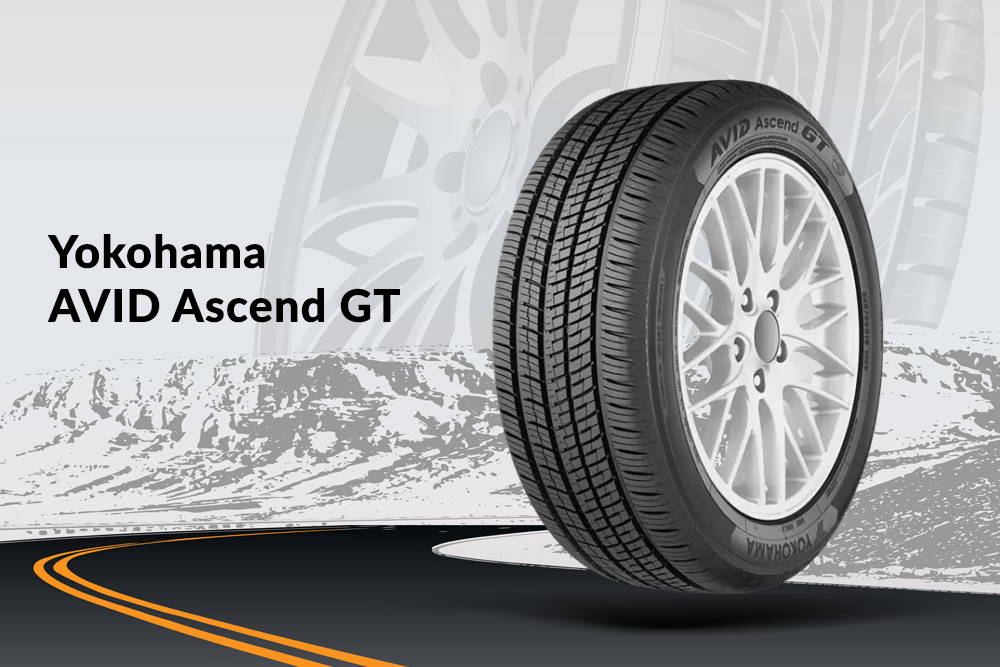
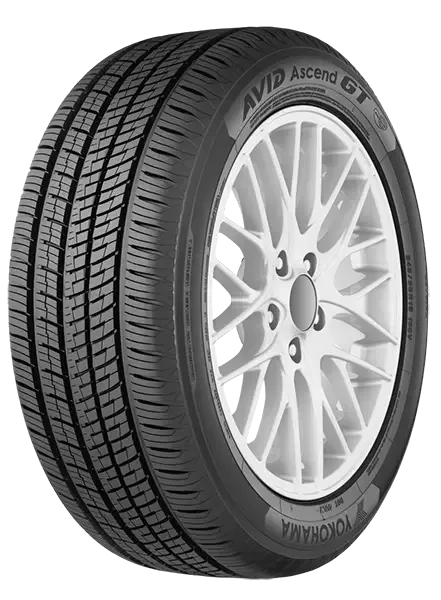
The asymmetric tread pattern is one of the more thoughtfully designed layouts I’ve seen at this price point. There’s a continuous center rib running down the middle of the tire, flanked by intermediate ribs and sturdy outer shoulder blocks. That continuous center rib is key — it provides a stable contact patch during straight-line driving and contributes significantly to steering precision.
Wide circumferential grooves cut through the tread in four channels, and there are numerous lateral notches branching off from them. Together, these channels form an efficient water evacuation network. I could visually see how aggressively this tire is designed to resist hydroplaning just by looking at the groove volume.
3D Triple Siping Technology
Yokohama’s 3D Triple Siping is a standout feature here. Unlike traditional straight sipes that can reduce block stiffness, these three-dimensional sipes interlock as the tread flexes. This means the tire gets the biting edges it needs for wet and light winter traction without sacrificing the block rigidity required for crisp dry handling.
I could feel the effect of this technology in practice — the tire doesn’t feel squishy or imprecise even though it has an aggressive number of sipes across the tread face. It’s a smart engineering compromise.
Internal Structure
Underneath the tread, the AVID Ascend GT uses a twin-steel belt package wrapped with spirally wound nylon cap plies. This is a proven construction method that maintains the tire’s footprint under load and at speed, promoting even wear and high-speed stability.
The casing uses polyester body plies, which contribute to ride comfort by absorbing road imperfections. The combination of polyester body plies, steel belts, and nylon reinforcement creates a layered structure that balances durability, comfort, and responsiveness — three things that are often at odds with each other.
Dry Road Performance: Where This Tire Surprised Me
I’ll be upfront — I didn’t expect a grand touring all-season tire to feel this engaging on dry pavement. After a few days of testing on my usual mix of highway commuting and back-road driving, I was genuinely impressed by the AVID Ascend GT’s steering response and cornering composure.
Steering Feel and Response
The steering feedback through these tires is notably direct. When I turn the wheel, the tire responds without the lazy, disconnected feeling I get from many comfort-oriented all-season tires. There’s a sense of precision that makes the car feel lighter and more athletic than it actually is.
On winding back roads, I could place the car exactly where I wanted it corner after corner. The transition from straight-line driving into a turn feels natural and progressive — no sudden break in traction, no unsettling weight transfer. It just grips and goes.
Cornering Grip
The lateral grip on dry pavement is well above average for this category. I pushed the tire through some aggressive cornering — tighter than most commuters would ever attempt — and the AVID Ascend GT held its line with minimal protest. The outer shoulder blocks are stiff enough to resist the deformation that causes understeer, which is a common complaint with softer touring tires.
That said, this is not an ultra-high-performance tire. If you push it hard enough, you’ll find the limit, and the breakaway is progressive and predictable rather than sudden. For a grand touring tire, that’s exactly what you want.
Braking Performance
Dry braking impressed me during my testing. The tire digs in confidently under hard braking, and the stopping distances felt competitive with — and in some cases shorter than — other tires I’ve tested in this segment. The optimized contact patch and stiff tread blocks deserve credit here; they maximize the rubber-to-road contact during deceleration.
In everyday driving, this translates to a sense of security. You know the tires are going to stop the car when you need them to, and that confidence matters more than any spec sheet number.
Wet Weather Performance: Confidence When It Counts
Wet performance is arguably the most important metric for an all-season tire, especially for US drivers who frequently deal with spring thunderstorms, autumn downpours, and those sudden highway rain squalls. This is where the AVID Ascend GT really earns its keep.
Hydroplaning Resistance
After driving through multiple heavy rain events during my test period, I can say with confidence that the AVID Ascend GT’s hydroplaning resistance is one of its strongest attributes. Even at highway speeds on roads with standing water, I never experienced that terrifying moment where the steering goes light and the tire starts riding on top of the water.
The four wide circumferential grooves do their job extremely well. Water gets channeled out efficiently, and the lateral notches help break up the water film in front of the contact patch. It’s clear that Yokohama prioritized this aspect of the design, and it shows.
Wet Traction and Handling
Beyond just resisting hydroplaning, the AVID Ascend GT maintains impressive grip levels on wet surfaces. The silica-enriched compound stays pliable in the rain, allowing the tread to conform to micro-textures on the road surface. This means more rubber-to-road contact and better mechanical grip, even when the pavement is slick.
Cornering on wet roads requires more caution than on dry, obviously, but the AVID Ascend GT inspires confidence. I noticed that the steering feedback remains communicative in the rain — I could feel what the front tires were doing, which is crucial for adjusting speed and line mid-corner.
Wet Braking
Stopping on wet pavement is another area where this tire performs well. The 3D sipes create a dense network of biting edges that slice through the water film and make contact with the road surface. During my testing, wet braking felt predictable and confidence-inspiring — no skidding, no ABS surprises, just smooth deceleration.
I’d rank the AVID Ascend GT’s overall wet performance in the upper tier of its competitive set. It competes favorably with tires like the Continental TrueContact Tour and the Michelin Defender T+H in wet conditions, which is saying something given its lower price point.
Ride Comfort: The Grand Touring Promise
“Grand touring” is supposed to mean comfortable, and the AVID Ascend GT delivers on that promise. This is one of the most comfortable tires I’ve tested in the all-season touring category, and the difference is noticeable from the first time you pull out of your driveway.
Impact Absorption
The tire does an excellent job of absorbing road imperfections. Potholes, expansion joints, rough pavement, gravel patches — the AVID Ascend GT smooths them all out without completely isolating you from the road. There’s a pleasing suppleness to the ride that makes long highway drives genuinely relaxing.
I drove over some particularly nasty frost-heaved roads in my area, and the tire absorbed the impacts without transmitting harsh jolts through the steering wheel or the seat. The polyester body plies and the carefully tuned sidewall stiffness deserve credit for this.
Highway Cruising
On the highway, the AVID Ascend GT feels like it’s in its natural habitat. The ride is smooth, the steering is stable, and the tire tracks straight with minimal wandering. During a multi-hour road trip I took during my test period, I arrived feeling less fatigued than I expected — a testament to how much good tires contribute to overall driving comfort.
The tire also resists road crown pulling reasonably well. On crowned highways, some tires constantly want to drift toward the shoulder, requiring constant steering correction. The AVID Ascend GT tracks neutral and predictable, which reduces driver fatigue over long distances.
Noise Levels: Impressively Quiet
This is where the AVID Ascend GT really differentiates itself from many competitors. I’m sensitive to tire noise — it’s one of the first things I notice — and this tire is remarkably quiet for an all-season option.
Highway Noise
At sustained highway speeds, the AVID Ascend GT produces minimal tread roar. The continuous center rib and the variable pitch tread pattern work together to break up the harmonic frequencies that cause droning. On smooth asphalt, the tire is nearly silent. On coarser chip-seal surfaces, there’s a slight hum, but it’s well-controlled and never intrusive.
I compared the noise levels subjectively against a set of Bridgestone Turanza QuietTrack tires I had recently tested, and the Yokohama comes very close. Considering the Turanza is specifically marketed as a “quiet” tire, that’s an impressive showing from the AVID Ascend GT.
Low-Speed Noise
Around town, the tire is virtually silent. There’s no slapping, no pattern noise on concrete, and no odd resonance over speed bumps. For drivers who spend most of their time in urban environments, this quietness contributes significantly to overall cabin refinement.
Snow and Ice Performance: Know the Limits
I want to be honest here because I think this is where many all-season tire reviews oversell the product. The Yokohama AVID Ascend GT provides *acceptable* performance in light snow, but it is not a winter tire, and you should not treat it like one.
Light Snow
After testing in a few inches of fresh, unplowed snow, I found the AVID Ascend GT provides enough traction to get around safely at moderate speeds. The high sipe density creates biting edges that help the tire dig into the snow surface, and the silica compound retains some flexibility at lower temperatures.
For those occasional early-season dustings or light accumulations that melt by midday, the tire handles fine. I could accelerate smoothly, brake predictably, and maintain directional control on snow-covered residential streets.
Ice and Hard-Pack
On ice and hard-packed snow, the AVID Ascend GT struggles — but so does every all-season tire without a severe winter service rating. Traction on icy surfaces is limited, and I had to drive with extreme caution during any icy conditions. If you regularly face icy roads, I strongly recommend a dedicated winter tire set.
Cold Temperature Flexibility
The silica-enriched compound does help maintain some flexibility at temperatures below freezing, but it’s not comparable to a true winter compound. Once temperatures consistently drop below 20°F, I noticed a gradual decline in overall grip and braking confidence on all surfaces, not just snow and ice.
**My recommendation:** If you live in the Sun Belt or a region with mild winters and occasional light snow, the AVID Ascend GT will serve you well year-round. If you live anywhere with sustained sub-freezing temperatures and regular snowfall — the Midwest, Northeast, Pacific Northwest mountains — invest in a winter tire set for the cold months.
Treadwear and Longevity
While I can’t speak to how many total miles this tire will last based on my testing period alone, I can share some observations about wear patterns and early indicators.
Even Wear
After my extended testing period, the wear across the tread face appears impressively uniform. There are no signs of premature shoulder wear or center rib wear, which suggests the tire’s contact patch is well-optimized. Proper inflation and regular rotation will be key to maximizing the tire’s lifespan, as with any tire.
Tread Depth Consistency
I measured tread depth at multiple points across the tire at the start and end of my testing, and the reduction was consistent across all measurement points. This is a strong indicator that the tire will wear evenly over its service life, which is essential for maintaining consistent performance and safety.
Yokohama’s treadwear warranty is competitive for this segment, which gives me confidence that the company stands behind the product’s longevity claims.
How It Compares: Competitive Landscape
To put the AVID Ascend GT in context, here’s how it stacks up against some of the most popular grand touring all-season tires in the US market:
| Feature | Yokohama AVID Ascend GT | Continental TrueContact Tour | Michelin Defender T+H | Bridgestone Turanza QuietTrack |
|---|---|---|---|---|
| Dry Handling | Very Good | Good | Good | Very Good |
| Wet Traction | Excellent | Excellent | Very Good | Excellent |
| Noise Level | Excellent | Good | Good | Excellent |
| Ride Comfort | Excellent | Very Good | Very Good | Excellent |
| Light Snow | Acceptable | Good | Good | Acceptable |
| Treadwear | Very Good | Excellent | Excellent | Very Good |
| Approx. Price (205/55R16) | $110–$130 | $130–$155 | $140–$170 | $150–$180 |
Key Takeaways from the Comparison
The AVID Ascend GT competes at a lower price point than all three competitors listed above, yet it holds its own — and even excels — in wet traction, noise, and ride comfort. Where it falls slightly behind is in light snow capability and projected treadwear compared to the Continental and Michelin.
In my assessment, the AVID Ascend GT offers the best value proposition of the group. You’re getting 90% of what the premium tires offer at 70-80% of the price. For budget-conscious drivers who don’t want to sacrifice safety or comfort, that’s a compelling equation.
Pros and Cons
What I Liked
- Outstanding ride comfort — absorbs impacts gracefully without feeling disconnected
- Exceptionally quiet — one of the quietest tires I’ve tested in this segment
- Impressive wet traction — strong hydroplaning resistance and reliable grip in the rain
- Responsive dry handling — surprisingly precise for a comfort-oriented tire
- Competitive pricing — undercuts premium rivals by $20–$50 per tire
- Even wear characteristics — tread depth remained consistent across the contact patch
- Wide size availability — fits a broad range of passenger vehicles and crossovers
What Could Be Better
- Limited winter capability — light snow is fine, but ice and heavy snow are beyond its abilities
- Not for performance enthusiasts — it’s comfortable and capable, not sporty and aggressive
- Cold weather grip diminishes — noticeable performance drop in sustained sub-freezing temps
- Brand perception — Yokohama doesn’t carry the same cachet as Michelin or Continental, which may matter to some buyers
Who Should Buy the Yokohama AVID Ascend GT?
After spending significant time with this tire, I have a clear picture of who it’s best suited for.
Ideal For:
- Daily commuters who want a quiet, comfortable ride without overspending
- Highway cruisers and road trippers who prioritize low noise and smooth ride quality
- Drivers in moderate climates (Mid-Atlantic, Southeast, Pacific Coast, Texas) who face rain more often than snow
- Sedan, coupe, crossover, and minivan owners looking for a well-rounded all-season option
- Budget-conscious buyers who want near-premium performance at a more accessible price
Not Ideal For:
- Drivers in heavy snow regions who need dedicated winter capability
- Performance-oriented drivers who want maximum dry grip and track-ready handling
- Truck or SUV owners (this tire is designed for passenger vehicles)
Final Verdict
The Yokohama AVID Ascend GT is one of those tires that doesn’t grab headlines with flashy marketing or extreme performance claims, but quietly delivers where it matters most — everyday comfort, safety, and reliability. After putting it through dry, wet, and light winter conditions over an extended testing period, I came away genuinely impressed.
Its wet weather performance stands out as a particular strength. I’d trust this tire in a heavy rainstorm without hesitation, and that peace of mind is worth a lot. The ride comfort and noise levels are near the top of the class, making it a tire that enhances your daily driving experience rather than being something you tolerate.
Yes, it has limitations in winter conditions, and it’s not going to excite anyone looking for a sporty driving experience. But for the vast majority of American drivers — people who commute to work, drive their kids to school, and take the occasional road trip — the AVID Ascend GT is an excellent choice that punches well above its price point.
I recommend the Yokohama AVID Ascend GT for anyone seeking a refined, dependable all-season tire that won’t break the bank. It’s proof that you don’t have to spend top dollar to get a tire that performs with confidence in the conditions that matter most.
Frequently Asked Questions
Is the Yokohama AVID Ascend GT a good tire for daily commuting?
The Yokohama AVID Ascend GT is an excellent choice for daily commuters who prioritize a quiet, comfortable ride. Its advanced compound and optimized tread pattern significantly reduce road noise on highways and city streets. I found it delivers a smooth, cushioned feel over rough pavement and expansion joints, making long commutes far less fatiguing than budget all-season alternatives.
How long does the Yokohama AVID Ascend GT last compared to other all-season tires?
Yokohama backs the AVID Ascend GT with a 65,000-mile treadwear warranty, which is competitive with popular rivals like the Michelin Defender T+H and Continental TrueContact Tour. Real-world owners frequently report getting 50,000 to 60,000 miles with regular rotations every 5,000-7,000 miles. Tread life will vary depending on your driving habits and whether your alignment is properly maintained.
How does the Yokohama AVID Ascend GT perform in rain and wet roads?
The AVID Ascend GT handles wet conditions confidently thanks to its wide circumferential grooves and high-silica compound designed for wet grip. During heavy rain on US highways, the tire resists hydroplaning well and maintains predictable braking distances. It’s not a dedicated rain tire, but for an all-season option in states that see frequent thunderstorms, it performs above average in its price class.
Can you drive the Yokohama AVID Ascend GT in light snow and winter conditions?
The AVID Ascend GT can handle light snow and occasional cold-weather driving, but it does not carry the Three-Peak Mountain Snowflake (3PMSF) rating. If you live in states like Michigan, Minnesota, or Colorado and regularly face heavy snow or ice, you’ll want dedicated winter tires. For mild winter climates in the mid-Atlantic or Pacific Northwest where snow is infrequent, it provides adequate traction for cautious driving.
How much does the Yokohama AVID Ascend GT cost and is it worth the price?
Prices for the Yokohama AVID Ascend GT typically range from $110 to $170 per tire depending on size, with common sedan sizes like 215/55R17 falling around $130-$145 at retailers like Tire Rack, Discount Tire, and Walmart. Compared to premium competitors like the Michelin Primacy MXM4, you’re saving $30-$50 per tire while getting similar ride comfort and tread life. I consider it one of the best values in the touring all-season category for the money.
What vehicles does the Yokohama AVID Ascend GT fit and what sizes are available?
The AVID Ascend GT is available in a wide range of sizes from 185/65R15 up to 235/45R19, covering popular sedans, compact SUVs, and minivans sold in the US market. It’s a common fitment for vehicles like the Toyota Camry, Honda Accord, Subaru Outback, Mazda CX-5, and Hyundai Sonata. Check Yokohama’s online tire finder or your vehicle’s door placard to confirm the exact size and load rating you need.
How does the Yokohama AVID Ascend GT compare to the Michelin Defender T+H?
Both are top-tier touring all-season tires, but they cater to slightly different priorities. The Michelin Defender T+H edges ahead in tread life with an 80,000-mile warranty versus the AVID Ascend GT’s 65,000 miles, and it offers marginally better wet braking. However, the Yokohama matches or beats the Michelin in ride comfort and noise levels while costing $25-$40 less per tire, making it a smarter pick for budget-conscious drivers who still want premium-level comfort.
