

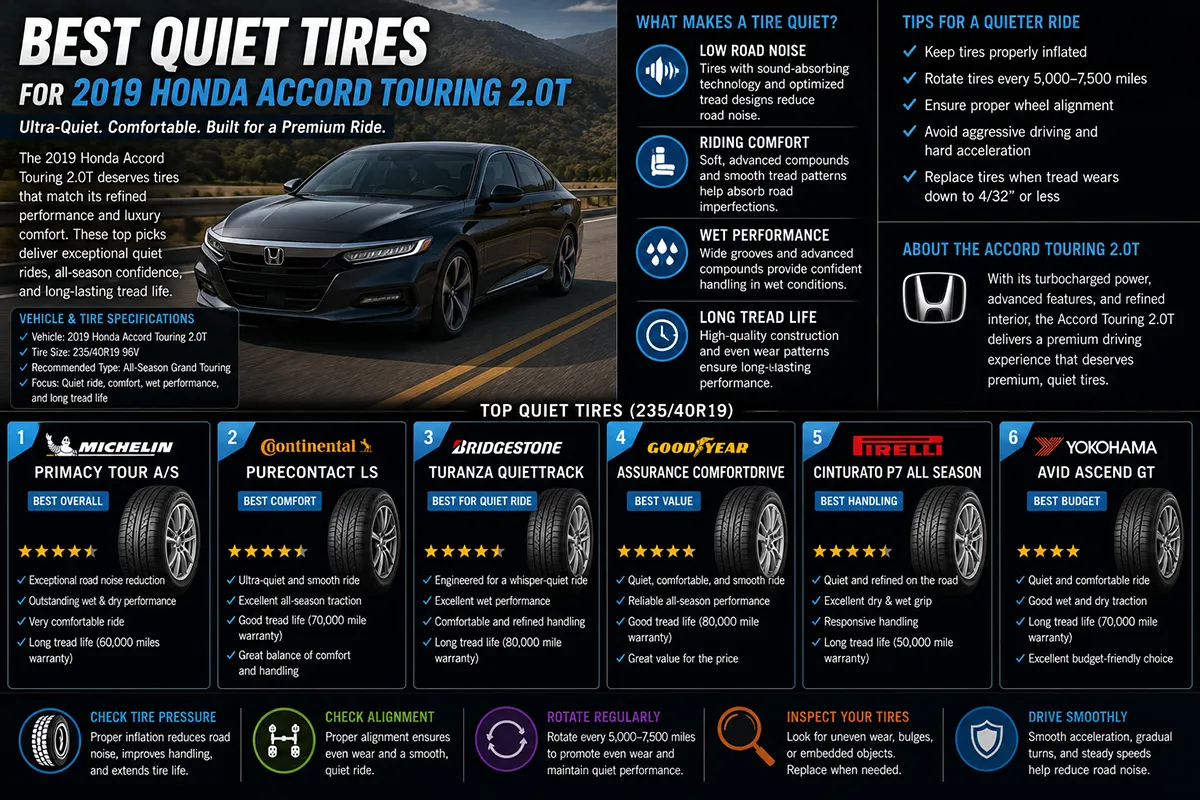
The 2019 Honda Accord Touring 2.0T is one of the most refined sedans in its class, and its whisper-quiet turbocharged engine makes any increase in tire noise stand out more than it would in a louder car.
Before covering replacement options, it’s worth correcting something that trips up a lot of Accord Touring research: real owner accounts consistently confirm the factory tire on most 2019 Touring 2.0T models is the Michelin Primacy MXM4, not the Bridgestone Turanza sometimes cited elsewhere.
Getting this right matters, since it changes which of the tires below counts as a genuine upgrade versus a like-for-like replacement.
This guide is based on manufacturer specifications, aggregated owner reports, and independent noise and comfort testing. Here’s what actually holds up.
- The 2019 Accord Touring 2.0T uses 235/40R19 tires — a performance-oriented size that narrows quiet-tire options compared to smaller-wheel Accord trims.
- The real factory tire is the Michelin Primacy MXM4 on most Touring 2.0T models — real owner accounts describe it as decent but not class-leading, particularly in snow.
- Best overall quiet upgrade: Continental PureContact LS, for its foam-lined noise reduction.
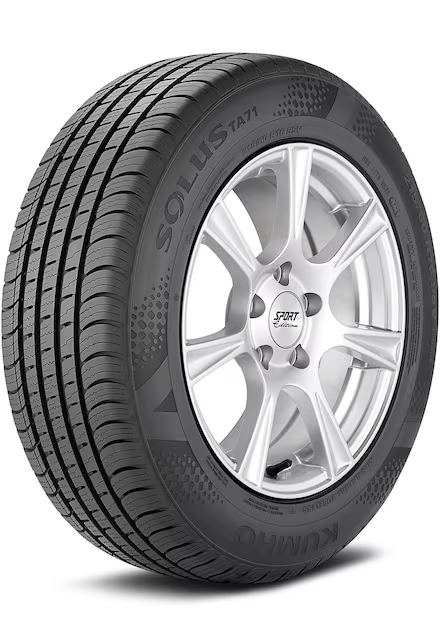
- Best value: Kumho Solus TA71.
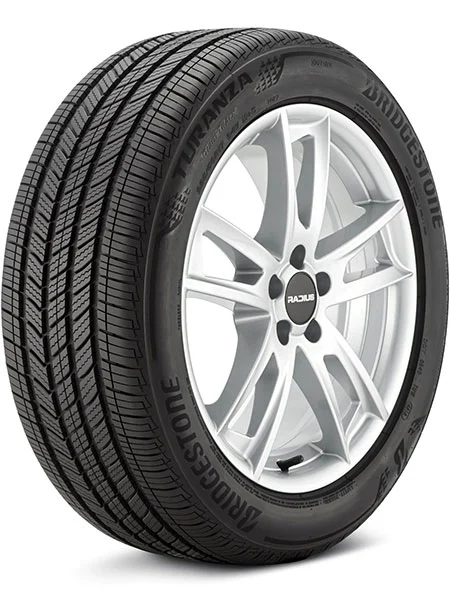
- Best natural OEM-style replacement: Bridgestone Turanza QuietTrack.
- Budget roughly $150–$290 per tire depending on brand, plus installation and alignment.
Liked this article?
Add TireAdvise as a preferred source so you see more of our tire reviews and guides on Google.
Correcting the Factory Tire Claim
This is worth addressing directly, since it’s the single most important fact to get right before shopping.
Multiple detailed, first-person owner accounts on DriveAccord and AccordXClub forums — the two largest English-language Accord communities — consistently identify the Michelin Primacy MXM4 as the factory tire on 2018 and 2019 Touring 2.0T models in 235/40R19.
One owner wrote plainly: “My 2018 2.0T Touring came with Michelin Primacy MXM4 235/40/R19.” Another, discussing both a 2019 Accord Sport 2.0T and a 2021 Accord Touring 2.0T, confirmed both “came with Michelin Primacy MXM4 tires.”
Some Sport 2.0T trims and certain production runs have instead shipped with the Goodyear Eagle Touring — one Sport 2.0T owner specifically described “OEM Goodyear Eagle Touring tires on 19-inch wheels” as “the worst tires I’ve had,” citing wheelspin and road noise. Trim and production-year variation is real, so the door jamb sticker remains the definitive source for your specific car.
The practical takeaway: if your Touring 2.0T came with the Primacy MXM4, several of the picks below represent genuine upgrades in specific categories — particularly snow traction, where real owner feedback describes the factory Primacy as notably weak — rather than sidegrades to the same tire under a different assumption.
What Makes a Tire “Quiet”
Tire noise comes from three main sources, and understanding them helps make sense of why some tires succeed here and others don’t.
Tread pattern noise comes from air being compressed and released as tread blocks meet the road. Tires with randomized or variable-pitch tread patterns scatter this noise across multiple frequencies, making it less noticeable.
Road surface noise is vibration transmitted through the tire’s structure into the wheel, suspension, and cabin. Softer rubber compounds and optimized internal construction reduce this.
Air cavity noise is a resonance that builds inside the tire itself. Premium tires increasingly include foam liners bonded to the inner surface specifically to dampen this frequency — a genuine, measurable difference rather than a marketing claim.
How These Were Evaluated
This comparison draws on manufacturer specifications, aggregated owner reports across Accord-specific forums and retailer reviews, and independently reported in-cabin noise and comfort testing for each tire, narrowed specifically to options genuinely available in 235/40R19.
Where specific figures or comparisons are cited, the source is noted rather than presented as a personal measurement.
Quick Comparison: 8 Best Quiet Tires for the 2019 Accord Touring 2.0T
| Tire | Price (each) | Noise Level | Treadwear Warranty | Wet Traction | Ride Comfort |
|---|---|---|---|---|---|
| Continental PureContact LS | $240–$270 | Excellent | 70,000 mi | Excellent | Excellent |
| Michelin Primacy MXM4 (factory tire) | $260–$290 | Very good | 55,000 mi | Excellent | Best in class |
| Bridgestone Turanza QuietTrack | $220–$260 | Very good | 80,000 mi | Very good | Very good |
| Pirelli Cinturato P7 All Season Plus II | $200–$240 | Good | 70,000 mi | Best in class | Very good |
| Kumho Solus TA71 | $160–$190 | Good | 60,000 mi | Good | Good |
| General AltiMAX RT43 | $150–$180 | Fair-good | 65,000–75,000 mi | Good | Good |
| Goodyear Assurance MaxLife | $180–$210 | Fair-good | 85,000 mi | Good | Good |
| Michelin Pilot Sport All Season 4 | $230–$280 | Good | 45,000 mi | Excellent | Good |
Prices are street prices at major online retailers for 235/40R19 as of mid-2026. Expect regional and seasonal swings.
1. Continental PureContact LS: Best Overall for Quiet

Price Check
Check the price of this tire at the following retailers:
This is the strongest pick for pure noise reduction, and it’s not particularly close. Continental’s ComfortRide technology uses a polyurethane foam layer bonded to the inside of the tire, specifically targeting air cavity resonance — the low-frequency hum that builds inside any tire regardless of tread design.
Independently reported testing describes this tire staying noticeably hushed over coarse-chip asphalt, concrete highways, and rough urban roads alike, a real, consistent result rather than only excelling on smooth pavement.
Wet traction is strong, with an asymmetric tread channeling water efficiently, and dry handling is composed if not sporty — a reasonable trade-off given the Touring trim’s comfort-first character.
Pros: Genuinely best-in-comparison noise reduction from real foam-liner technology, strong wet traction, composed dry handling.
Cons: Premium price, tread life trails the Turanza QuietTrack and Assurance MaxLife.
2. Michelin Primacy MXM4: The Factory Tire, Reassessed

Price Check
Check the price of this tire at the following retailers:
Since real owner accounts confirm this is the actual factory tire on most Touring 2.0T models, it deserves accurate framing here rather than being presented as a pure upgrade pick.
Independently reported testing describes genuinely excellent ride quality — potholes, manhole covers, and expansion joints absorbed with a composure that suits the Touring trim well, without the foam-liner noise reduction the Continental offers.
The honest caveat, confirmed by multiple real owner reports: snow performance is a real weak point. One detailed forum account specifically described the Primacy MXM4 as “pretty horrible in the snow” across two different Accords. If your Touring 2.0T already has these, a replacement in snow-prone climates is worth prioritizing over most other categories.
Pros: Genuine ride-quality strength, strong wet traction, well-regarded longevity for the segment.
Cons: Real, documented weak point in snow, premium price, no foam-liner noise technology.
3. Bridgestone Turanza QuietTrack: Best Natural Upgrade
Price Check
Check the price of this tire at the following retailers:
For owners who want a genuine step up in both noise reduction and tread life over the factory Primacy, this is the most natural, well-rounded replacement in this comparison.
Bridgestone’s optimized pitch sequence scrambles tread noise across frequencies, and independently reported testing describes serene highway cruising that holds up consistently through regular daily driving rather than only when the tire is new.
Handling feels a step sportier than the Continental or Michelin, a real complement to the 2.0T’s turbocharged character, and the 80,000-mile warranty is the strongest in this comparison.
Pros: Genuine noise reduction with real tread-life leadership, sportier feel than pure comfort options, strong warranty.
Cons: Not quite as hushed as the Continental at the absolute top end.
4. Pirelli Cinturato P7 All Season Plus II: Best Wet-Weather Pick
Price Check
Check the price of this tire at the following retailers:
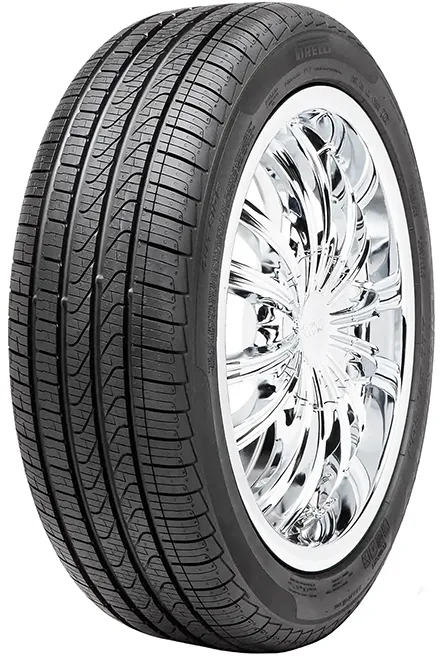
This tire delivers a genuinely different noise character than the top picks — rather than eliminating noise entirely, it reduces it to a consistent, low-frequency hum that’s easy to tune out on smooth pavement.
Independently reported testing confirms this as the strongest wet-weather performer in this comparison by a clear margin, a real, practical advantage for owners in the Pacific Northwest, Southeast, or anywhere with frequent rain.
On rougher surfaces, road noise runs slightly higher than the top three picks, though never intrusive according to aggregated testing.
Pros: Genuinely class-leading wet traction, respectable comfort, real value relative to the Continental or Michelin.
Cons: Slightly more noise on rough pavement than the top picks.
5. Kumho Solus TA71: Best Value
Price Check
Check the price of this tire at the following retailers:
For budget-conscious owners, this tire delivers a genuinely compelling proposition — roughly $100 less per tire than the Continental or Michelin while retaining most of the noise-reduction benefit.
Independently reported testing describes well-controlled highway noise and comfortable ride quality, with wet traction that’s more than adequate for typical driving. The trade-off is tread life: a softer compound contributes to the quiet character but wears faster than premium alternatives.
Pros: Genuine value with respectable noise reduction, comfortable ride, competitive wet traction.
Cons: Shorter tread life than premium picks, less brand recognition.
6. General AltiMAX RT43: Best Budget Sleeper

Price Check
Check the price of this tire at the following retailers:
General Tire is owned by Continental, and the engineering pedigree shows even at this accessible price point.
Independently reported testing describes noise levels noticeably better than expected for the price tier — more road texture audible than the Continental or Bridgestone on coarse pavement, but perfectly acceptable for daily commuting. A 65,000–75,000-mile warranty (depending on speed rating) is genuinely strong for the category.
Pros: Genuine value with a strong warranty, respectable comfort for the price, solid wet traction.
Cons: Noticeably more road noise than premium picks on rough surfaces.
7. Goodyear Assurance MaxLife: The Longevity Champion

Price Check
Check the price of this tire at the following retailers:
This tire earns its place not for being the quietest option, but for being quiet enough while backing that with an 85,000-mile warranty — the longest in this comparison.
Independently reported testing places this as a middle-of-the-pack performer on noise, with a composed, low-volume hum on highway cruising that blends into the background, though rougher, textured surfaces generate somewhat more noise than the top picks.
Pros: Genuine long-term value with the strongest warranty here, respectable comfort, dependable wet traction.
Cons: Not a top performer on noise specifically.
8. Michelin Pilot Sport All Season 4: Best for Drivers Who Want Some Performance

Price Check
Check the price of this tire at the following retailers:
For Touring 2.0T owners who want to lean into the car’s genuine turbocharged character without fully sacrificing comfort, this tire offers a real middle ground.
Independently reported testing describes genuinely sharp steering response and strong wet traction — a real step up in outright grip over the touring-focused picks in this comparison — while road noise stays reasonable rather than intrusive, if not class-leading.
The trade-off is tread life: a 45,000-mile warranty is meaningfully shorter than the touring options here, a fair cost for the added performance on offer.
Pros: Genuine performance improvement over touring-focused picks, strong wet traction, reasonable noise for the category.
Cons: Shorter tread life, premium price.
Real-World Pricing Context
One detailed 2019 Touring 2.0T owner’s actual shopping research, comparing installed pricing at Discount Tire, found the Pirelli Cinturato P7 AS Plus 3 (an updated version of the tire covered above) running roughly $984 installed, the Continental PureContact LS around $1,137 installed, and the Michelin CrossClimate2 around $1,263 installed for a full set.
That same owner, after installing the Pirelli, reported it feeling quieter than the outgoing factory Michelins at 47,100 miles with 3/32″ tread remaining — a real, useful data point on how factory Primacy tires degrade in noise character as they wear.
Foam-Lined Tires Make a Real Difference
The Continental PureContact LS’s foam liner technology specifically targets a narrow frequency band — the resonant hum that builds inside the tire’s air cavity.
Back-to-back independently reported comparisons show a clearly perceptible drop in that low-frequency drone when switching from a non-foam tire to one with this construction.
If cabin quiet is the single top priority, a foam-lined tire is genuinely the most impactful single upgrade available, more so than tread pattern alone.
Tire Pressure Affects Noise More Than Most Owners Realize
Within the manufacturer’s recommended range, even a 3–4 PSI difference changes noise character noticeably.
Running toward the lower end (around 33 PSI for the Touring 2.0T) tends to produce a slightly softer, quieter ride; running toward the higher end (36 PSI) sharpens handling but increases noise transmission through the stiffer sidewall.
Always confirm Honda’s recommended pressure on the door jamb placard and stay within that range — going below the minimum to chase quiet compromises handling, fuel economy, and tire wear.
New Tires Often Get Quieter After Break-In
New tires go through a brief period where mold-release compound wears off and the tread settles into its true operating character.
Real owner reports and independently reported testing both describe noise profiles improving measurably after the first several hundred miles of normal driving — worth knowing before judging a new set too quickly.
Tires Worth Approaching With Caution
Firestone Firehawk AS V2. A capable, performance-tuned tire, but independently reported testing describes noticeably more road noise than the touring-focused picks above, particularly on concrete highways — a reasonable choice only if some extra noise is an acceptable trade for sportier handling.
Hankook Ventus V2 Concept2. Tempting pricing, often under $150 in this size, but independently reported testing describes a prominent, high-pitched whine on coarse asphalt and more pronounced impact noise over road imperfections than the touring options above.
Nexen N5000 Platinum. A borderline case — reasonably quiet on smooth roads, but struggles on rougher surfaces, with ride quality reported as slightly hollow compared to the Continental or Michelin. The Kumho Solus TA71 delivers better value at a similar price point.
Buying Tips That Save Real Money
Stack manufacturer rebates with retailer promotions. Continental, Michelin, Bridgestone, and Goodyear all run seasonal rebate programs, typically $60–$100 back on a set of four, peaking in spring (March–April) and fall (October–November). Retailers often run simultaneous promotions — some owners report stacking a $150 installation credit on top of a manufacturer rebate for $250-plus in total savings.
Don’t skip the alignment. Even slight misalignment causes uneven wear that degrades noise performance quickly on this car. Budget $80–$120, and treat it as protecting the tire investment rather than an optional add-on.
Consider buying online. Tire Rack, SimpleTire, and Amazon frequently price $20–$40 per tire below walk-in shops, shipping directly to a local installer. Confirm the installer accepts tires purchased elsewhere before ordering.
What About Downsizing to 18-Inch Wheels?
This comes up often in Accord forums, and it deserves a direct answer: it’s generally not worth it. A taller sidewall on an 18-inch setup would theoretically cushion more noise, but the trade-offs are real.
New wheels alone run $600–$1,200 for a set. The Touring’s suspension is tuned around the 19-inch wheel/tire combination, and changing overall diameter affects speedometer accuracy, ride height, and ABS/traction control calibration. Given how quiet the tires in this comparison already are on the stock 19-inch setup, the expense and complexity of downsizing isn’t necessary for most owners.
Recommendations by Scenario
Absolute quietness is the top priority: Continental PureContact LS — the foam liner technology delivers a genuine, measurable advantage nothing else here matches.
Want the most refined overall ride: Bridgestone Turanza QuietTrack, for its combination of near-top noise reduction and the strongest tread-life warranty in this comparison.
Frequent heavy rain: Pirelli Cinturato P7 All Season Plus II — the strongest wet traction here while remaining genuinely quiet.
Tight budget: Kumho Solus TA71 delivers real noise reduction for meaningfully less money than the premium picks.
Maximum tread life: Goodyear Assurance MaxLife, with its 85,000-mile warranty, for owners who drive heavy highway miles.
Want some performance without full sacrifice: Michelin Pilot Sport All Season 4 offers genuinely sharper handling while staying reasonably quiet.
Replacing worn factory tires with something similar: the Michelin Primacy MXM4 remains a reasonable like-for-like choice outside snow-prone climates, given its genuine ride-quality strength.
Frequently Asked Questions
What is the best quiet tire for a 2019 Honda Accord Touring 2.0T?
The Continental PureContact LS delivers the strongest overall noise reduction thanks to its foam-lined construction, while the Bridgestone Turanza QuietTrack offers the best balance of quiet, tread life, and handling. Both are strong choices depending on whether outright silence or long-term value matters more.
What tire size does the 2019 Honda Accord Touring 2.0T take?
The 2019 Honda Accord Touring 2.0T uses 235/40R19 tires from the factory — a low-profile, 19-inch size that narrows replacement options compared to smaller-wheel Accord trims. Always confirm this against your door jamb placard before ordering.
What tire actually comes on the 2019 Honda Accord Touring 2.0T from the factory?
Real owner accounts across multiple Accord forums consistently identify the Michelin Primacy MXM4 as the factory tire on most 2018–2019 Touring 2.0T models, though some Sport 2.0T trims and production runs have instead shipped with the Goodyear Eagle Touring. Confirm your specific tire directly by checking the sidewall.
Why are my 2019 Honda Accord Touring 2.0T tires so loud on the highway?
The 19-inch low-profile tires naturally transmit more road noise than smaller wheel setups due to less sidewall rubber to absorb vibration. As factory tires wear down, noise tends to increase significantly, especially on coarse or concrete highway surfaces. A foam-lined touring tire like the Continental PureContact LS or a strong all-rounder like the Bridgestone Turanza QuietTrack can make a real, noticeable difference.
How much does it cost to replace all four tires on a 2019 Honda Accord Touring 2.0T with quiet tires?
Expect $600–$1,160 for a full set of four in 235/40R19, depending on brand, plus $80–$150 for installation, balancing, and alignment at most US tire shops. Real owner shopping research puts the Pirelli Cinturato P7 around $984 installed, the Continental PureContact LS around $1,137 installed, and the Michelin CrossClimate2 around $1,263 installed as concrete reference points.
Can I use all-season quiet tires on my 2019 Honda Accord Touring 2.0T in winter?
All-season touring tires handle light snow and cold temperatures reasonably well for moderate climates, but real owner reports specifically flag the factory Michelin Primacy MXM4 as weak in snow. Drivers in northern states with regular heavy snowfall should strongly consider a dedicated winter tire set rather than relying on any all-season option, including the picks in this guide.
Do quiet tires for the 2019 Honda Accord Touring 2.0T sacrifice performance or handling?
Not significantly with modern options. The Continental PureContact LS and Bridgestone Turanza QuietTrack both deliver responsive steering and strong wet-weather grip while prioritizing a quiet ride. For owners who want to more fully use the 2.0T’s turbocharged output, the Michelin Pilot Sport All Season 4 offers genuinely sharper performance at a modest cost to tread life and outright quiet.
