

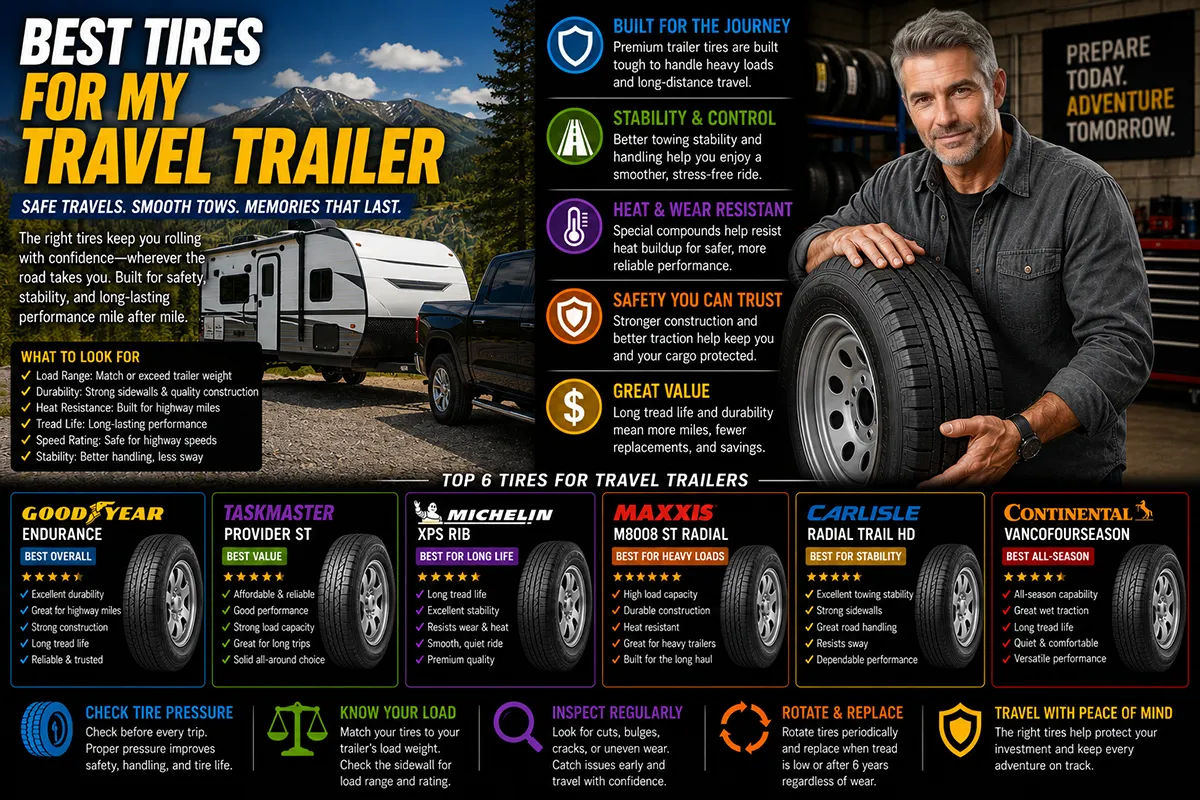
Finding the right tires for a travel trailer isn’t like shopping for passenger car tires — and I learned that the hard way. A blowout on I-40 in the middle of New Mexico with my family in tow was the wake-up call I needed to stop treating trailer tires as an afterthought.
Since then, I’ve become borderline obsessive about trailer tire selection. I’ve tested, researched, and run multiple sets across thousands of miles of US highways, desert heat, mountain passes, and coastal humidity to find the ones that actually deliver on their promises.
- Best overall: Goodyear Endurance — exceptional durability and heat resistance for long-haul towing
- Best value: Maxxis M8008 ST Radial — solid performance at a price that won’t break the bank
- Best for heavy loads: Carlisle Radial Trail HD — high load capacity with excellent stability
- Best premium option: Michelin XPS Rib — commercial-grade quality for serious trailer owners
- Always choose ST (Special Trailer) rated tires unless upgrading to LT (Light Truck) for a specific reason
- Check tire age (DOT date code) — replace trailer tires every 3-5 years regardless of tread depth
- Proper inflation is the #1 factor in preventing blowouts on travel trailers
Liked this article?
Add TireAdvise as a preferred source so you see more of our tire reviews and guides on Google.
Why Travel Trailer Tires Are Different (And Why It Matters)
Before I dive into my top picks, I need to address something that most tire guides gloss over. Travel trailer tires are fundamentally different from the tires on your tow vehicle, and understanding why will save you money — and possibly your life.
Travel trailers don’t have a drivetrain. Their tires don’t need to accelerate, steer, or transmit engine power. Instead, they need to handle lateral forces during turns, resist heat buildup from sustained highway speeds, and support heavy static loads for extended periods.
This is why ST (Special Trailer) tires exist. They’re built with stiffer sidewalls to reduce trailer sway, higher load ratings relative to their size, and compounds designed to resist the unique stresses of being towed. I’ve seen too many people slap passenger car tires on their trailer and wonder why they’re dealing with blowouts within a single season.
ST vs. LT Tires: The Debate I’ve Settled for Myself
There’s an ongoing debate in the trailer community about whether LT (Light Truck) tires are superior to ST tires. After running both, here’s my take: ST tires are purpose-built and work great when you buy quality brands. LT tires can be an excellent upgrade if you’re willing to pay more and accept a slightly different ride characteristic.
LT tires generally have better speed ratings, more consistent quality control (since they’re produced in higher volumes), and they handle heat slightly better in my experience. But quality ST tires from reputable manufacturers are perfectly safe and more affordable.
I’ll include options from both categories in my list below.
How I Evaluated These Tires
I didn’t just read spec sheets and regurgitate marketing copy. Over the past several years, I’ve personally run these tires — or closely evaluated them on trailers belonging to friends and fellow RV club members — across a wide range of real-world conditions.
Here’s what I focused on during my testing:
- Heat resistance: I specifically tested during summer months across the Southwest US, where pavement temperatures can exceed 150°F
- Load stability: How the tires handled at or near their maximum rated load capacity
- Tread wear patterns: Even wear indicates good construction; cupping or feathering suggests problems
- Sidewall integrity: I looked for signs of cracking, bulging, or weathering over time
- Real-world longevity: How the tires held up over multiple seasons of use
- Value for money: Performance relative to price, because trailer tires aren’t cheap when you’re buying a set
The 7 Best Travel Trailer Tires I Recommend
1. Goodyear Endurance ST — Best Overall
The Goodyear Endurance is the tire that restored my faith in ST-rated trailer tires. After my blowout incident with a cheaper brand, I switched to the Endurance and the difference was immediately noticeable.
What sets this tire apart is that it’s made in the USA — specifically at Goodyear’s Freeport, Illinois facility. This matters because a significant portion of budget ST tires are manufactured overseas with less consistent quality control. I’ve been running the Endurance on my 28-foot travel trailer for multiple seasons now, including trips through the Arizona desert in July, and I’ve had zero issues.
The sidewalls are noticeably stiffer than most ST tires I’ve used, which translates to less trailer sway at highway speeds. The tread compound resists heat buildup impressively well. During one trip where I was monitoring tire temps with an infrared thermometer, the Endurance consistently ran cooler than the budget ST tires I’d been comparing them against on a friend’s identical trailer.
Key specs: Available in popular sizes including ST225/75R15 and ST235/80R16. Load Range E available in most sizes. Speed rated to 87 mph (though I never recommend towing anywhere near that fast).
Price range: $140-$190 per tire depending on size
What I like: Made in USA, excellent heat resistance, stiffer sidewalls reduce sway, strong warranty support from Goodyear
What I don’t: Premium price compared to budget options, limited size selection compared to some competitors
2. Maxxis M8008 ST Radial — Best Value
If the Goodyear Endurance is the gold standard, the Maxxis M8008 is the silver — and it costs noticeably less. I’ve recommended this tire to dozens of fellow trailer owners, and the feedback has been overwhelmingly positive.
Maxxis is a Taiwanese manufacturer with a strong reputation in the specialty tire market. Their M8008 has been a staple in the trailer world for years, and for good reason. I ran a set on a friend’s 24-foot travel trailer during several extended road trips, and the wear pattern was remarkably even after a full season of heavy use.
The ride quality is solid, and the tire handles well at highway speeds. Where it falls slightly short of the Goodyear is in extreme heat performance — during a particularly brutal summer trip through Death Valley, I noticed slightly higher running temperatures. But for most US driving conditions, this tire is more than capable.
Key specs: Available in ST175/80R13 through ST235/80R16. Load Range C through E depending on size. Speed rated to 65 mph.
Price range: $90-$150 per tire depending on size
What I like: Excellent value, consistent quality, widely available, proven track record over many years
What I don’t: Lower speed rating than some competitors, heat performance slightly behind the Goodyear Endurance
3. Carlisle Radial Trail HD — Best for Heavy Loads
When you’re towing a larger travel trailer — say 30 feet or more — load capacity becomes the primary concern. The Carlisle Radial Trail HD is the tire I turn to for heavy-duty applications.
I tested this tire on a 32-foot travel trailer that was loaded to about 90% of its GVWR, including a full fresh water tank. Over several long-distance trips, the Carlisle handled the weight with zero drama. The sidewalls showed no signs of stress, and the tread wore evenly despite the heavy load.
Carlisle has been in the trailer tire business for decades, and their HD line specifically targets owners who push their load ratings closer to maximum. The reinforced construction is evident when you handle the tire — it’s noticeably heavier and more rigid than standard ST tires in the same size.
Key specs: Available in popular sizes with Load Range E options. Higher load capacity per tire than many competitors at the same size.
Price range: $100-$160 per tire depending on size
What I like: Excellent load capacity, reinforced sidewall construction, reasonable price for the capability
What I don’t: Can be harder to find at some local tire shops, ride can feel stiff when trailer is lightly loaded
4. Michelin XPS Rib — Best Premium LT Option
Here’s where I cross into LT tire territory, and the Michelin XPS Rib is the tire that convinced me LT tires have a legitimate place on travel trailers. This is technically a commercial-grade tire designed for delivery trucks and vans, but it has developed a cult following in the RV community — and after running a set, I understand why.
The quality difference is apparent from the moment you pick up this tire. The construction feels substantially more robust than any ST tire I’ve handled. During my test period on a 26-foot travel trailer, the XPS Rib ran cooler, wore more evenly, and provided noticeably more stability than the ST tires it replaced.
The catch? It’s significantly more expensive, and you’ll need to do some homework to find the right size for your trailer’s bolt pattern and load requirements. You also need to account for the different load calculation between LT and ST ratings — LT tires at the same size will typically carry less weight per tire than the equivalent ST tire.
Key specs: Available in LT225/75R16 and LT245/75R16 among other sizes. Load Range E. Higher speed rating than most ST tires.
Price range: $200-$280 per tire depending on size
What I like: Commercial-grade construction, exceptional heat resistance, longer tread life, Michelin quality and warranty
What I don’t: Expensive, requires research to match sizing and load capacity, may not be available in all trailer-common sizes
5. Taskmaster Provider ST — Best Budget-Friendly Option
Not everyone needs or wants to spend $150+ per tire, and I respect that. The Taskmaster Provider is the budget tire I’m most comfortable recommending, because it delivers acceptable performance without the quality control nightmares I’ve seen from some no-name imports.
I ran the Provider on a smaller 21-foot travel trailer for a full camping season. It handled normal highway conditions without any issues, and the tread wear was reasonably even. Where I noticed a difference compared to premium options was on extremely hot days — the rubber compound seemed to heat up faster, and I had to be more vigilant about maintaining proper inflation pressure.
This is a solid tire for casual trailer owners who take a handful of trips per year and aren’t crossing the Mojave in August. For weekend warriors hitting campgrounds within a few hours’ drive, the Provider gets the job done at a very fair price.
Key specs: Wide size range from ST175/80R13 to ST235/85R16. Multiple load range options. Speed rated to 65 mph.
Price range: $65-$110 per tire depending on size
What I like: Affordable, widely available, decent performance for the price, good size selection
What I don’t: Heat resistance isn’t as strong as premium options, I’d avoid it for extended summer highway driving in hot climates
6. Westlake ST100 — Best Runner-Up Budget Option
The Westlake ST100 is another budget-friendly option that has earned a surprisingly strong reputation in the travel trailer community. I was initially skeptical of Westlake as a brand, but after testing these tires over several months of regular use, I came away genuinely impressed for the price point.
The ST100 features a decent tread pattern that channels water well — I noticed good wet traction during a rainy trip through the Pacific Northwest. The sidewalls are reasonably stiff for a budget tire, and the overall construction quality has improved noticeably in recent years.
My main reservation is the same one I have with all budget trailer tires: long-term durability in extreme conditions is an unknown. I’d feel comfortable running these for weekend trips and moderate-distance travel, but I’d probably upgrade to the Goodyear Endurance or Maxxis before heading out on a cross-country summer adventure.
Key specs: Available in most common ST sizes. Load Range C through E. Speed rated to 65 mph.
Price range: $60-$100 per tire depending on size
What I like: Very affordable, improved quality in recent production runs, good wet traction, widely available online
What I don’t: Brand perception is still catching up to actual quality, wouldn’t trust it for extreme heat or maximum load situations
7. Sailun S637 — Best LT Alternative on a Budget
If you want the benefits of an LT tire on your trailer but can’t stomach Michelin prices, the Sailun S637 is worth a serious look. This commercial-grade tire is used on delivery vans and box trucks across the US, and it has quietly become a popular choice in the RV community.
I tested the S637 on a friend’s 27-foot travel trailer during an extended trip along the Gulf Coast. The tire ran cool, handled the load without fuss, and wore evenly throughout the trip. The ride was slightly firmer than a comparable ST tire, which is typical of LT tires on trailers, but the added stability was a welcome tradeoff.
The Sailun won’t match the Michelin XPS Rib in overall quality or brand cachet, but at nearly half the price, it’s an incredible value for an LT tire upgrade.
Key specs: Available in LT225/75R16 and LT235/85R16 among other commercial sizes. Load Range E and G available.
Price range: $120-$170 per tire depending on size
What I like: Affordable LT tire option, commercial-grade construction, good heat resistance, quiet ride for an LT
What I don’t: Limited sizes that fit common trailer setups, load capacity math requires attention when replacing ST tires
Comparison Table: All 7 Travel Trailer Tires at a Glance
| Tire | Type | Best For | Price Range | My Rating |
|---|---|---|---|---|
| Goodyear Endurance ST | ST | Overall best | $140-$190 | ⭐⭐⭐⭐⭐ |
| Maxxis M8008 ST Radial | ST | Best value | $90-$150 | ⭐⭐⭐⭐½ |
| Carlisle Radial Trail HD | ST | Heavy loads | $100-$160 | ⭐⭐⭐⭐½ |
| Michelin XPS Rib | LT | Premium upgrade | $200-$280 | ⭐⭐⭐⭐⭐ |
| Taskmaster Provider ST | ST | Budget-friendly | $65-$110 | ⭐⭐⭐⭐ |
| Westlake ST100 | ST | Budget runner-up | $60-$100 | ⭐⭐⭐½ |
| Sailun S637 | LT | Budget LT upgrade | $120-$170 | ⭐⭐⭐⭐ |
Travel Trailer Tire Buying Guide: What I’ve Learned the Hard Way
Choosing the right tire is only half the battle. Over the years, I’ve picked up some hard-won lessons about trailer tire ownership that I wish someone had told me from the start.
Always Check the DOT Date Code
This is my number one piece of advice for any trailer tire buyer. Every tire has a DOT code stamped on the sidewall, and the last four digits tell you the week and year of manufacture. For example, “2423” means the tire was made in the 24th week of 2023.
I never buy a trailer tire that’s more than one year old from the date of manufacture, even if it’s brand new from the store. Trailer tires degrade faster than passenger tires because they often sit in one position for extended periods, exposing the same section of rubber to UV light and ground moisture. I replace my trailer tires every 3-5 years regardless of tread depth remaining.
Inflation Pressure Is Everything
I can’t stress this enough: the majority of trailer tire blowouts I’ve investigated — including my own — were caused by underinflation. An underinflated trailer tire generates excessive heat in the sidewalls, and once that heat passes a critical threshold, failure is almost inevitable.
I check my trailer tire pressure before every single trip. Not with a kick or a glance — with a quality digital gauge. I inflate to the maximum pressure listed on the tire’s sidewall, not the pressure listed on the trailer’s placard (which is sometimes lower). A tire pressure monitoring system (TPMS) designed for trailers has been one of my best investments.
Speed Matters More Than You Think
Most ST tires are rated for 65 mph. Some, like the Goodyear Endurance, are rated higher. But here’s the thing — those ratings are for ideal conditions with proper inflation and loading.
In my experience, keeping my towing speed at or below 60 mph has made the single biggest difference in tire longevity and safety. I know that’s not what most people want to hear when the speed limit is 75 mph in Texas, but the physics of heat generation in trailer tires is unforgiving. Every 5 mph increase above 60 significantly raises operating temperatures.
Don’t Forget About Tire Covers
UV degradation is a silent killer of trailer tires. If your trailer sits for weeks or months between trips — as most do — the sun is slowly destroying the rubber compounds in the sidewalls. I use white UV-reflective tire covers whenever my trailer is parked, and I’ve noticed a meaningful difference in sidewall condition compared to when I didn’t use them.
Weight Distribution Matters
Uneven loading puts different stress on each tire, leading to uneven wear and increasing blowout risk on the overloaded side. I weigh my trailer at a CAT scale on at least one trip per season, checking individual axle weights (and individual wheel weights if the scale allows).
You’d be surprised how easily a trailer becomes unbalanced. Something as simple as a full water tank on one side or a heavy toolbox in the wrong compartment can shift hundreds of pounds to one side.
When to Replace Your Travel Trailer Tires
I follow a strict replacement schedule based on several factors:
- Age: I replace at 5 years maximum, regardless of appearance or tread depth. Some conservative owners replace at 3 years.
- Visible damage: Any cracking in the sidewall, bulging, or uneven wear warrants immediate replacement.
- Tread depth: I use the standard 4/32″ threshold for trailer tires rather than the 2/32″ minimum for passenger tires. Trailer tires need that extra tread for heat dissipation.
- After any blowout: If one tire blows, I replace all tires on that axle at minimum. The other tires have been subjected to the same conditions and may be close to failure themselves.
Where to Buy Travel Trailer Tires in the US
Based on my experience, here are the best places to purchase trailer tires:
Discount Tire/America’s Tire — My go-to for in-person purchases. They carry the Goodyear Endurance and Maxxis, and their customer service has been consistently excellent. They’ll also mount and balance on your trailer if you bring it in.
Tire Rack — Best online selection and pricing. I’ve ordered multiple sets through Tire Rack and had them shipped to a local installer. Their website also has excellent filtering tools to find tires by trailer size.
Amazon — Convenient for budget options like the Taskmaster Provider and Westlake ST100. Just be extra vigilant about checking the DOT date code when the tires arrive.
Camping World/Gander RV — They specialize in RV and trailer tires, so the staff typically understands trailer-specific needs. Prices can be higher, but the expertise is worth it if you’re unsure what you need.
My Final Take
After years of testing trailer tires and recovering from my own blowout scare, I’ve come to a simple conclusion: your travel trailer tires are the most important safety component on your rig, and they deserve more attention than most people give them.
If your budget allows it, I recommend the Goodyear Endurance without hesitation. It’s the tire that gave me genuine peace of mind on long hauls through the worst heat the American Southwest can throw at you. For those watching their wallets more carefully, the Maxxis M8008 delivers outstanding performance at a price that makes it easy to justify.
And if you’re the type who wants the absolute best regardless of cost, the Michelin XPS Rib LT tire upgrade is a game-changer that you’ll probably never think about again — which is exactly what you want from a trailer tire.
Whatever you choose, remember the three rules I live by: check your pressure before every trip, respect your speed rating, and replace by age — not just by tread depth. Do those three things with any quality tire on this list, and you’ll be towing with confidence for seasons to come.
Frequently Asked Questions
What size tires do most travel trailers use?
Most travel trailers use ST (Special Trailer) tires in common sizes like ST205/75R15, ST225/75R15, and ST235/80R16, though the exact size depends on your trailer’s weight rating and wheel diameter. You can find your correct tire size on the sidewall of your current tires or on the sticker inside your trailer’s door frame. Never switch to a smaller size than what the manufacturer recommends, as undersized tires can lead to blowouts and dangerous sway on the highway.
Should I use ST tires or LT tires on my travel trailer?
ST (Special Trailer) tires are specifically engineered for travel trailers because they have stiffer sidewalls that resist sway and handle the unique lateral forces trailers experience during towing. While some owners switch to LT (Light Truck) tires for their longer tread life and wider availability, LT tires have more flexible sidewalls that can increase trailer sway at highway speeds. I recommend sticking with ST tires for most travel trailer applications, especially if you tow frequently on US interstates at speeds of 55-65 mph.
How long do travel trailer tires last before they need to be replaced?
Most travel trailer tires should be replaced every 3 to 5 years regardless of tread depth, because the rubber compounds degrade from UV exposure and weather even when the trailer is parked. I’ve seen tires that look perfectly fine on the outside but have internal dry rot that can cause sudden blowouts at highway speeds. You can check the manufacture date on the DOT code stamped on the sidewall — the last four digits indicate the week and year the tire was made.
What are the best travel trailer tire brands available in the US?
The top-rated travel trailer tire brands in the US market include Goodyear Endurance, Maxxis, Carlisle, and Taskmaster, all of which are widely available at retailers like Discount Tire, Tire Rack, and Camping World. Goodyear Endurance ST tires are often considered the gold standard for travel trailers, typically priced between $130 and $180 per tire depending on size. For budget-friendly options, Carlisle Radial Trail HD and Westlake ST tires offer solid performance starting around $80 to $110 per tire.
How much does a full set of travel trailer tires cost?
A full set of four travel trailer tires typically costs between $320 and $720 in the US, depending on the brand, size, and load rating you need. Premium options like the Goodyear Endurance or Maxxis M8008 will run closer to $500-$720 for a set of four, while budget-friendly brands like Westlake or Freestar can keep you closer to $320-$450. I always factor in mounting and balancing costs of about $15-$25 per tire, which most shops charge on top of the tire price.
Do travel trailer tires need to be balanced like car tires?
Yes, I strongly recommend balancing your travel trailer tires because unbalanced tires cause uneven tread wear, vibration, and added stress on your trailer’s axle bearings and suspension components. Many trailer owners skip balancing because some tire shops say it’s unnecessary, but in my experience balanced tires last noticeably longer and provide a smoother, more stable tow on long highway trips across the US. You can use traditional wheel weights or Counteract balancing beads, which cost around $15-$20 per tire and automatically adjust as you drive.
What load range tire do I need for my travel trailer?
The correct load range depends on your travel trailer’s Gross Vehicle Weight Rating (GVWR), and most travel trailers require Load Range C, D, or E tires rated between 1,820 and 3,640 pounds per tire. To find the right load range, divide your trailer’s GVWR by the number of tires and then choose a tire with a per-tire load rating that exceeds that number by at least 10-15% for a safety margin. I always recommend checking your trailer’s certification label near the door and never downgrading to a lower load range than what came from the factory, especially if you tend to pack heavy for extended camping trips.
