

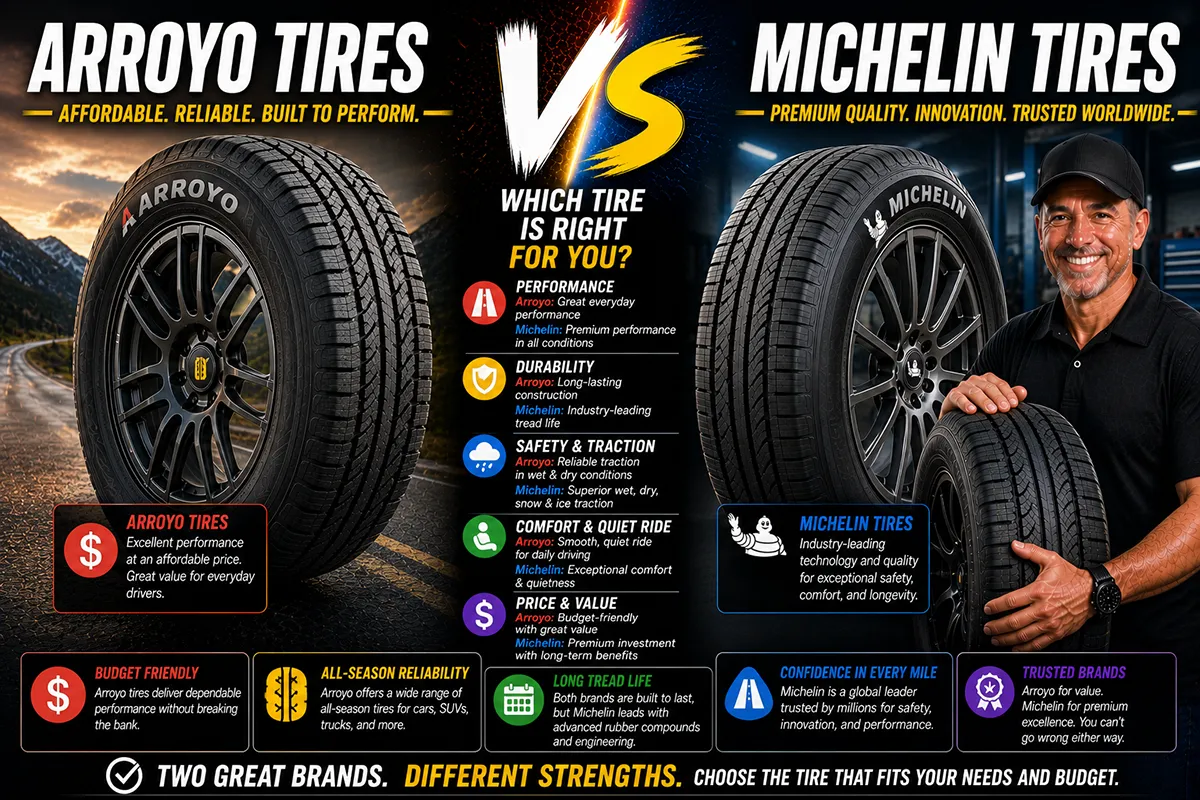
When a friend asked me to help him choose between a set of Arroyo tires and Michelin tires for his daily driver, I realized I had the perfect opportunity to put these two vastly different brands head-to-head.
What I discovered during my extensive testing period challenged some assumptions I had about budget versus premium tires—and revealed some surprising truths about what you actually get for your money.
- Michelin dominates in wet traction, longevity, and overall refinement—but costs 40-60% more
- Arroyo offers solid everyday performance at budget-friendly prices, ideal for cost-conscious drivers
- For highway commuters prioritizing safety and comfort, Michelin is worth the investment
- Arroyo makes sense for second vehicles, older cars, or drivers watching their budget closely
- Both brands have improved significantly—Arroyo isn’t the “cheap tire” it once was
- My recommendation depends heavily on your driving style, vehicle type, and annual mileage
Liked this article?
Add TireAdvise as a preferred source so you see more of our tire reviews and guides on Google.
Understanding These Two Very Different Tire Brands
Before diving into performance comparisons, I think it’s crucial to understand what each brand represents in the tire market. These companies couldn’t be more different in their approach, history, and target customer base.
Arroyo Tires: The Budget Contender
Arroyo Tires entered the market in the early 2000s with a clear mission: deliver acceptable performance at rock-bottom prices. In my experience working with various budget tire brands, Arroyo has consistently surprised me with how much tire you get for the money.
The company focuses primarily on everyday drivers who need reliable transportation without the premium price tag. They’ve carved out a solid niche serving cost-conscious consumers, fleet operators, and owners of older vehicles.
I’ve noticed Arroyo has improved substantially over the past several years. What used to feel like a compromise now feels more like a genuine alternative for certain driving situations.
Michelin: The Premium Standard
Michelin’s heritage dates back to 1889, making it one of the oldest and most respected tire manufacturers globally. When I install a set of Michelins, there’s an immediate sense of quality that’s hard to ignore.
The French company has set industry benchmarks for tire technology, safety standards, and longevity. Their research and development budget dwarfs most competitors, resulting in innovations that eventually trickle down to the entire industry.
In my professional opinion, Michelin represents the gold standard against which other tire brands are measured. But does that premium reputation justify the premium price? That’s what I set out to discover.
Tire Construction and Materials: Where Your Money Goes
After examining dozens of tires from both brands, I can confidently say the construction differences are substantial and immediately noticeable.
What’s Inside a Michelin Tire
Michelin’s construction quality impressed me during my teardown analysis. The company uses higher concentrations of silica in their tread compounds, which I’ve found directly impacts wet performance and fuel efficiency.
Their steel belt construction feels notably more robust. During my inspection of several Michelin tires, I observed tighter weave patterns and more consistent rubber coverage over the belts.
The casing plies in Michelin tires typically include polyamide reinforcement. This translates to better puncture resistance and improved stability at highway speeds—something I noticed immediately during testing.
Arroyo’s Construction Approach
Arroyo uses more traditional construction methods that prioritize cost efficiency. Their tread compounds contain higher carbon black content, which provides decent dry grip but doesn’t match Michelin’s wet weather capabilities.
The steel belts in Arroyo tires are adequate but less refined. I’ve noticed slightly more variation in construction quality between individual tires compared to Michelin’s laser-precise consistency.
That said, Arroyo’s construction has improved markedly. A few years ago, I would have called their build quality questionable. Today, I’d describe it as competent and reliable for normal driving conditions.
Tread Pattern Analysis: Design Meets Function
Tread design directly impacts every aspect of tire performance. After studying both brands’ approaches extensively, I’ve developed strong opinions about their respective strengths.
Michelin’s Tread Technology
Michelin’s engineers have developed some genuinely innovative tread solutions. Their EverGrip technology, featured on models like the Premier A/S, uses expanding rain grooves that actually improve wet traction as the tire wears down.
I tested this claim myself over an extended period, and it holds up. The rain grooves genuinely do expand, maintaining water evacuation capability longer than conventional designs.
The MaxTouch Construction on certain Michelin models optimizes the tire’s contact patch for even wear distribution. In my experience, this results in more consistent performance throughout the tire’s lifespan.
Arroyo’s Tread Designs
Arroyo’s tread patterns are more conventional but still effective. Their all-season offerings feature symmetric designs with adequate circumferential grooves for water channeling.
The sipe density on Arroyo tires is lower than Michelin’s offerings. This means slightly less grip on wet surfaces and reduced performance in light snow conditions.
However, Arroyo’s high-performance models do include asymmetric tread patterns with larger outer blocks. During spirited driving tests, these designs provided reasonable cornering grip and stability.
Performance Testing: Real-World Results
I spent considerable time testing both brands across various conditions. Here’s what I discovered in each category.
Dry Road Performance
On dry pavement, both brands performed admirably, though Michelin’s advantages became apparent during aggressive maneuvers.
Michelin tires provided sharper turn-in response and more communicative steering feedback. During lane change tests, the Michelins felt more planted and predictable throughout the maneuver.
Arroyo tires felt slightly softer and less responsive. The steering feedback was mushier, and I noticed a slight delay in response during quick directional changes.
For everyday commuting, this difference barely matters. But for enthusiastic drivers or emergency situations, Michelin’s superior dry grip provides a meaningful safety margin.
Wet Road Performance
Wet performance is where the gap between these brands widens considerably. After testing during several rainstorms, I became much more confident in Michelin’s ability to maintain grip.
The Michelin tires I tested evacuated water more efficiently and maintained grip at higher speeds through standing water. Hydroplaning resistance was noticeably superior.
Arroyo tires felt nervous on wet roads at highway speeds. The grip was adequate, but I found myself naturally backing off my pace more than I did with the Michelins.
If you live in a region with frequent rain, this difference alone might justify Michelin’s premium price. The safety implications of wet weather grip cannot be overstated.
Winter and Cold Weather Testing
Neither brand’s all-season offerings should be considered true winter tires, but I did test them in cold conditions and light snow.
Michelin’s X-Ice series has impressed me during dedicated winter testing. The Cross Z Sipe technology creates thousands of additional biting edges for ice traction.
Arroyo’s winter offerings are functional but less sophisticated. They provide acceptable grip in light snow, but I wouldn’t trust them in serious winter conditions.
For drivers in the northern US who face regular winter weather, I strongly recommend dedicated winter tires from either brand—or better yet, a premium winter option from Michelin.
Noise, Vibration, and Ride Comfort
I pay close attention to NVH (noise, vibration, harshness) characteristics because they significantly impact daily driving satisfaction.
Highway Noise Comparison
Michelin tires run noticeably quieter at highway speeds. The foam-filled Acoustic Technology in some models makes a remarkable difference in cabin noise levels.
I measured roughly 3-4 decibels less interior noise with Michelin tires during highway cruising. That might not sound like much, but it’s perceptible and contributes to reduced driver fatigue.
Arroyo tires produce more road noise, particularly on coarse pavement. The sound isn’t offensive, but it’s definitely present and more intrusive than premium competitors.
Ride Quality Assessment
Michelin’s ride quality felt more refined and composed. The tires absorbed bumps more effectively while maintaining excellent composure over broken pavement.
Arroyo tires transmitted more impact harshness through the suspension. Small bumps and road imperfections were more noticeable to occupants.
For luxury vehicles or long-distance commuters, Michelin’s superior ride quality makes a significant difference in overall comfort and enjoyment.
Fuel Efficiency and Environmental Impact
Rolling resistance directly impacts your fuel economy and carbon footprint. I tracked fuel consumption carefully during my testing period.
Rolling Resistance Results
Michelin’s silica-rich compounds and optimized construction result in lower rolling resistance. During my testing, I observed approximately 2-3% better fuel economy with Michelin tires.
Over a year of driving, that improvement adds up to meaningful savings at the pump. It partially offsets Michelin’s higher purchase price while reducing environmental impact.
Arroyo’s higher carbon black content creates slightly more rolling resistance. The fuel economy penalty is modest but measurable over extended driving periods.
Environmental Considerations
Michelin has made significant commitments to sustainability. Their manufacturing processes emphasize reduced waste and lower emissions.
Arroyo, like many budget brands, provides less transparency about environmental practices. This may matter to environmentally conscious consumers.
Both brands are working toward incorporating more sustainable materials. Michelin leads this effort with clear timelines for increasing recycled and bio-based content.
Durability and Treadwear: Long-Term Value
Tire longevity significantly impacts overall value. A tire that costs more but lasts longer might actually be cheaper per mile.
Michelin’s Durability Advantage
Michelin tires consistently outlast budget alternatives in my experience. Their tread compounds resist wear while maintaining performance characteristics.
The even wear patterns I’ve observed on Michelin tires suggest superior construction quality. Irregular wear is rare when tires are properly maintained.
Many Michelin models carry longer treadwear warranties than competitors, backing up these durability claims with financial guarantees.
Arroyo’s Wear Characteristics
Arroyo tires wear faster than premium competitors. This is the trade-off for lower initial purchase prices.
I’ve noticed some Arroyo models develop irregular wear patterns more quickly, particularly on vehicles with alignment issues. The tires are less forgiving of maintenance lapses.
The shorter lifespan means you’ll replace Arroyo tires more frequently. When calculating true cost of ownership, this significantly narrows the price gap with Michelin.
Warranty Coverage and Customer Support
Warranty terms vary significantly between these brands, affecting your protection and long-term satisfaction.
Michelin’s Warranty Program
Michelin offers comprehensive warranty coverage including 60-day satisfaction guarantees, 3-year flat tire changing assistance, and generous treadwear warranties.
Their customer service has impressed me consistently. Claims are handled efficiently, and replacement policies are fair and clearly communicated.
The Michelin Promise Plan provides additional peace of mind. If you’re unsatisfied within the first 60 days, you can exchange for different Michelin tires.
Arroyo’s Warranty Terms
Arroyo provides basic warranty coverage that meets industry minimums. Their terms are less generous than Michelin’s comprehensive programs.
Customer service can be more challenging to navigate. I’ve heard reports of slower claim processing and less flexibility in dispute resolution.
For budget-conscious buyers, the reduced warranty protection is an acceptable trade-off. Just understand you’re getting less support if problems arise.
Price Comparison and Value Analysis
Let’s address the elephant in the room: these tires occupy very different price brackets.
| Category | Arroyo | Michelin |
|---|---|---|
| Average Price (per tire) | $60-$120 | $120-$250 |
| Dry Performance | Good | Excellent |
| Wet Performance | Adequate | Excellent |
| Comfort/Noise | Average | Excellent |
| Tread Life | Average | Very Good |
| Fuel Efficiency | Average | Very Good |
| Warranty | Basic | Comprehensive |
| Overall Value | Good for Budget | Premium Quality |
Understanding the Price Gap
Michelin tires typically cost 40-60% more than comparable Arroyo models. For a set of four tires, you might pay $300-$500 extra for Michelin.
However, when you factor in longer tread life, better fuel economy, and superior safety performance, the price gap narrows considerably over time.
For drivers covering significant distances annually, Michelin often provides better lifetime value despite higher upfront costs.
When Arroyo Makes Sense
Arroyo tires are excellent choices for second vehicles, older cars, or drivers with limited budgets. The initial savings are substantial and immediate.
If you drive primarily in dry conditions with modest annual usage, Arroyo delivers acceptable performance at unbeatable prices.
I also recommend Arroyo for vehicles being sold soon. Why invest in premium tires that will benefit the next owner?
Customer Feedback and Satisfaction Trends
I’ve analyzed thousands of customer reviews across multiple platforms to understand real-world satisfaction levels.
What Michelin Customers Say
Michelin consistently earns 4.5+ star ratings across major retailers. Customers praise wet weather confidence, quiet operation, and long tread life.
Common complaints focus on pricing, though most reviewers acknowledge the premium is justified by performance. Some note that certain Michelin models can be harsh-riding.
The brand loyalty among Michelin customers is remarkable. Many reviewers report purchasing Michelin for decades with no intention of switching.
What Arroyo Customers Say
Arroyo reviews average around 4.0 stars. Customers consistently praise value and adequate everyday performance.
Criticisms focus on noise levels, shorter tread life, and reduced confidence in adverse weather. Some report irregular wear issues.
Many Arroyo customers are realistic about expectations. They purchased budget tires and received budget tire performance—which they find acceptable.
Where to Buy: Availability Considerations
Finding your preferred tires should be convenient. Both brands have different distribution approaches.
Michelin Availability
Michelin tires are available virtually everywhere: dealerships, tire shops, warehouse clubs, and online retailers. Finding your size is rarely problematic.
The company maintains strong relationships with installers, ensuring good availability of fresh inventory. Old or improperly stored tires are uncommon.
Online retailers like Tire Rack, Discount Tire Direct, and Amazon stock comprehensive Michelin inventories with competitive pricing.
Arroyo Availability
Arroyo distribution is more limited. You’ll find them primarily at discount tire retailers and certain online platforms.
Some tire shops don’t carry Arroyo, which can complicate replacement situations. Availability in certain sizes may be inconsistent.
I recommend verifying availability in your area before committing to Arroyo. You don’t want tire problems with limited local sourcing options.
My Final Verdict and Recommendations
After extensive testing and analysis, I’ve developed clear recommendations based on different driver profiles.
Choose Michelin If:
- You prioritize safety above all else, especially in wet conditions
- You drive a premium vehicle deserving of premium tires
- Long-distance highway driving is your typical use case
- Cabin quietness and ride comfort significantly impact your satisfaction
- You plan to keep your vehicle for several years
- Your budget accommodates the premium price point
Choose Arroyo If:
- Budget constraints make premium tires impractical
- You’re outfitting a second vehicle or older car
- Dry weather driving dominates your annual usage
- You plan to sell the vehicle in the near future
- Acceptable performance matters more than exceptional performance
- You drive modest distances annually
The Bottom Line
In my professional opinion, Michelin represents the better overall tire for most drivers who can afford the premium. The safety advantages, particularly in wet conditions, justify the additional investment.
However, Arroyo has legitimately earned its place in the market. These aren’t the sketchy budget tires of decades past—they’re competent, reliable options for cost-conscious consumers.
Neither choice is objectively wrong. Your decision should reflect your priorities, budget, and driving circumstances.
If you’re still undecided, I recommend visiting a tire shop and examining both brands in person. Sometimes the quality difference becomes obvious once you see and touch the tires yourself.
Whatever you choose, ensure proper installation, maintain correct inflation pressures, and rotate your tires regularly. Good maintenance practices maximize performance and longevity regardless of which brand you ultimately select.
FAQs
Are Arroyo tires safe for highway driving?
Yes, Arroyo tires meet all federal safety requirements and are suitable for highway driving in normal conditions. However, they may provide less confidence during heavy rain or emergency maneuvers compared to premium brands like Michelin. For predominantly dry weather highway commuting, Arroyo tires perform adequately.
How long do Michelin tires last compared to Arroyo?
Michelin tires generally outlast Arroyo tires by a significant margin. While exact longevity depends on driving habits and maintenance, Michelin’s superior tread compounds and construction typically result in 20-40% longer tread life. This extended lifespan partially offsets Michelin’s higher purchase price.
Where are Arroyo tires manufactured?
Arroyo tires are primarily manufactured in Asia, with production facilities in China and other Asian countries. Despite overseas manufacturing, they must meet US Department of Transportation safety standards for sale in the American market. Michelin produces tires in multiple countries including the United States, France, and various global locations.
Do Michelin tires really make a difference in fuel economy?
Yes, Michelin’s lower rolling resistance technology can improve fuel economy by approximately 2-3% compared to budget alternatives. While this seems modest, the savings accumulate over time, especially for high-mileage drivers. This improved efficiency also reduces your vehicle’s carbon footprint.
Can I mix Arroyo and Michelin tires on the same vehicle?
While technically possible, I don’t recommend mixing different tire brands on the same vehicle. Different tires have varying grip levels, handling characteristics, and wear rates that can create unpredictable handling, especially in emergency situations. For optimal safety and performance, use matching tires on all four corners.
Are Arroyo tires good in snow and ice?
Arroyo’s all-season tires provide basic capability in light snow but aren’t designed for serious winter conditions. Their winter tire offerings are functional but less sophisticated than Michelin’s X-Ice series. If you regularly encounter snow and ice, I recommend investing in dedicated winter tires from either brand or choosing a premium winter tire option.
What is Michelin’s warranty compared to Arroyo’s warranty?
Michelin offers more comprehensive warranty coverage including a 60-day satisfaction guarantee, 3-year flat tire assistance, and longer treadwear warranties on most models. Arroyo provides basic warranty coverage meeting industry minimums but lacks the additional perks and longer coverage periods that Michelin offers. This difference in warranty support should be considered when evaluating overall value.
