


If you’ve ever felt like your car lost a step after swapping from the original equipment tires to a cheaper replacement set, you’re not alone. That disconnect — the vague steering, the slightly longer braking distance, the confidence that quietly vanished — is something I’ve experienced more times than I’d like to admit.
That’s exactly why tires like the Yokohama Advan Sport V107 exist: to restore (and sometimes exceed) the performance your car delivered on day one.
I recently spent an extended test period with the Advan Sport V107 mounted on a BMW 5 Series, putting them through everything from scorching Texas highway driving to surprise thunderstorms and spirited backroad sessions.
What I found genuinely surprised me — in both good ways and a couple of areas where I think buyers need realistic expectations. If you want the full brand context before diving into this specific model, my Yokohama tires review is a good place to start.
- The Yokohama Advan Sport V107 is a true ultra-high performance summer tire that competes head-to-head with the Michelin Pilot Sport 4S and Continental ExtremeContact Sport 02.
- Dry grip and steering precision are outstanding — among the best I’ve tested in this class.
- Wet performance is genuinely confidence-inspiring, though not quite at Michelin PS4S levels in standing water.
- Ride comfort is a pleasant surprise for a UHP tire; road noise is well-controlled at highway speeds.
- This is a summer-only tire — do NOT use it below ~40°F or in snow.
- Pricing is competitive, typically $20-$40 less per tire than the Pilot Sport 4S in comparable sizes.
Price Check
Check the price of this tire at the following retailers:
TireRack SimpleTire PriorityTire DiscountedWheelWarehouse AmazonDon’t know the correct size tire to purchase? Start here!
Liked this article?
Add TireAdvise as a preferred source so you see more of our tire reviews and guides on Google.
What Exactly Is the Yokohama Advan Sport V107?
The Advan Sport V107 is Yokohama’s flagship ultra-high performance (UHP) summer tire, designed for sport sedans, coupes, and performance SUVs.
It replaced the well-regarded Advan Sport V105 and was developed in partnership with several European automakers, earning OE fitments on vehicles from Porsche, Mercedes-AMG, BMW, and Audi.
That OE pedigree matters more than most people realize. When a tire manufacturer co-develops a tire with engineers at Porsche or AMG, the performance standards are brutally high. It means this tire had to meet strict targets for grip, stability, noise, and rolling resistance before it ever reached a retail shelf.
In the US market, the V107 is available in a wide range of sizes from 18 inches to 23 inches, covering everything from a BMW 3 Series to a Porsche Cayenne.
Prices typically range from around $180 to $380 per tire depending on size, which positions it as a premium option but not the most expensive in its class.
My Testing Setup and Conditions
I tested the Yokohama Advan Sport V107 in size 245/40R19 (front) and 275/35R19 (rear) on a 2022 BMW 540i. This is a staggered setup, which is common for performance sedans and gives me a good sense of how the tire communicates through both the steering and the rear end during spirited driving.
Over my test period, I drove through a range of conditions: sustained highway cruising at 75-80 mph across central Texas, aggressive backroad driving on Hill Country two-lanes, city stop-and-go in Austin traffic, and multiple heavy rain events that turned roads into temporary rivers.
I also paid close attention to everyday livability — things like road noise on coarse chip-seal pavement, ride comfort over expansion joints, and whether the tires introduced any vibration or harshness that would bother a daily driver.
Dry Performance: This Is Where the V107 Shines Brightest
Let me be direct: the dry grip on the Yokohama Advan Sport V107 is phenomenal. It’s the kind of grip that makes you trust the front end implicitly when you turn into a corner at speed, and that trust only grows the more you push.
Steering Feel and Response
The first thing I noticed — literally within the first few minutes of driving — was how much more communicative the steering felt compared to the all-season tires I’d been running.
The V107 transmits road texture to your hands without being harsh. You feel the surface change from smooth asphalt to rougher chip-seal, and that feedback tells you exactly how much grip is available.
Turn-in response is razor sharp. When you rotate the steering wheel, the car responds immediately. There’s no delay, no mushiness, no sense that the tire is flexing and deforming before the car changes direction. This is exactly what performance drivers want.
Cornering Grip and Stability
On my favorite Hill Country roads — tight, technical, with elevation changes that load and unload the suspension constantly — the V107 felt utterly planted. I could carry significantly more speed through corners than I expected, and the tire’s breakaway characteristics were progressive and predictable.
What impressed me most was the lateral stability during quick lane changes and highway merges. The tire doesn’t squirm or wander. It goes where you point it with a mechanical directness that makes the car feel smaller and lighter than it is.
I’d put the dry grip performance right alongside the Continental ExtremeContact Sport 02 and very close to the Michelin Pilot Sport 4S — which is the highest compliment I can give a tire in this category.
Wet Performance: Confident, With One Caveat
I’ll admit I was slightly nervous the first time I hit heavy rain on these tires. Ultra-high performance summer tires can be a mixed bag in the wet — some are genuinely dangerous, while others handle rain almost as well as dedicated all-season tires.
The V107 falls solidly in the “confident and capable” camp.
Wet Grip and Braking
On wet roads, the V107 maintains a surprisingly high level of grip. Braking from highway speeds on soaked pavement felt controlled and linear — the ABS didn’t intervene prematurely, which tells me the tires were finding traction effectively before the electronics needed to step in.
Cornering in the rain required a bit more respect, as you’d expect, but the tire gave me clear, progressive feedback about where the limit was. There was never a moment where grip disappeared suddenly. That’s critical for safety on public roads.
Hydroplaning Resistance
Here’s my one caveat: in standing water — the kind that pools in highway ruts during a Texas downpour — I did feel the front end lighten slightly at speeds above 65 mph. It wasn’t alarming, but it was noticeable.
The V107’s four circumferential grooves do a good job evacuating water, but in extreme standing water situations, the Michelin Pilot Sport 4S feels slightly more planted. For typical wet road driving, though, the V107 is more than adequate. I’d rate it about 8.5 out of 10 in the wet, compared to the PS4S’s 9.5.
Comfort and Noise: Surprisingly Refined for a UHP Tire
This is where the Yokohama Advan Sport V107 quietly exceeds expectations. Most buyers shopping for ultra-high performance summer tires expect to make a comfort sacrifice. With the V107, that sacrifice is much smaller than you’d think.
Ride Quality
The V107 absorbs small impacts — expansion joints, patchy road repairs, manhole covers — better than several competing UHP tires I’ve tested. There’s a suppleness to the sidewall that takes the sharp edge off impacts without introducing any unwanted flex during cornering.
On long highway drives, this translated to noticeably less fatigue. I did a sustained drive of several hours on Interstate 35, and the ride never felt punishing. For a tire with this level of performance capability, that’s impressive.
Road Noise
Noise levels are very well controlled. At highway speeds, the V107 produces a low-frequency hum that’s easy to tune out. It’s not whisper-quiet like a touring tire, but it’s significantly quieter than aggressive UHP options like the Bridgestone Potenza Sport or the Firestone Firehawk Indy 500.
On coarse-textured pavement — the kind of chip-seal that Texas loves to use — there’s a noticeable increase in tire roar, but it never becomes intrusive enough to make conversation difficult.
I’d put the noise levels roughly on par with the Continental ExtremeContact Sport 02 and slightly louder than the Michelin Pilot Sport 4S.
Treadwear and Longevity: My Early Observations
I want to be transparent here: I haven’t run these tires to the end of their tread life, so I can’t give you a definitive treadwear verdict. But I can share what I’ve observed during my test period.
After several weeks of mixed driving — including some genuinely aggressive backroad sessions — the tread shows remarkably even wear patterns. The outer shoulder blocks, which typically take the most abuse on UHP tires, show no signs of excessive wear or feathering.
The V107 carries a UTQG treadwear rating of 300, which is typical for this class. For reference, the Michelin Pilot Sport 4S is rated at 300 as well, while the Continental ExtremeContact Sport 02 comes in at 340.
Based on my early observations, I’d expect the V107 to deliver reasonable longevity for a UHP summer tire, though “reasonable” in this category still means you’ll be replacing them faster than an all-season tire.
If you’re buying UHP summer tires, you’re accepting that tradeoff. These tires are about performance, not penny-per-mile economics.
How Does the V107 Compare to Key Competitors?
The ultra-high performance summer tire segment is fiercely competitive in the US market. Here’s how the Yokohama Advan Sport V107 stacks up against the tires it’s most likely to be cross-shopped with:
| Feature | Yokohama Advan Sport V107 | Michelin Pilot Sport 4S | Continental ExtremeContact Sport 02 | Bridgestone Potenza Sport |
|---|---|---|---|---|
| Dry Grip | 9.5/10 | 9.5/10 | 9.5/10 | 9/10 |
| Wet Grip | 8.5/10 | 9.5/10 | 9/10 | 8.5/10 |
| Comfort | 8.5/10 | 9/10 | 8/10 | 7.5/10 |
| Noise Level | 8/10 | 8.5/10 | 8/10 | 7/10 |
| Steering Feel | 9.5/10 | 9/10 | 9/10 | 8.5/10 |
| UTQG Treadwear | 300 | 300 | 340 | 300 |
| Approx. Price (245/40R19) | $220-$250 | $260-$290 | $210-$240 | $230-$260 |
V107 vs. Michelin Pilot Sport 4S
This is the comparison everyone wants to know about. The Michelin Pilot Sport 4S has been the benchmark in this category for years, and rightfully so.
In my experience, the PS4S edges ahead in wet performance and overall refinement. The Michelin also has a slightly more luxurious feel on the highway.
However, the V107 matches (and I’d argue slightly beats) the PS4S in steering feel and dry turn-in response. It’s also meaningfully less expensive — often $30-$40 per tire cheaper in popular sizes.
If you value dry performance above all else and want to save some money, the V107 is a compelling alternative.
V107 vs. Continental ExtremeContact Sport 02
The Continental is the V107’s closest competitor in terms of both performance and pricing. In my testing, the two tires are remarkably similar in dry grip, with the Continental offering a slight edge in wet conditions and the V107 winning on ride comfort and steering precision.
It’s genuinely a toss-up between these two. I’d recommend test-driving both if your local shop can accommodate it, but you won’t be disappointed with either choice.
V107 vs. Bridgestone Potenza Sport
The Potenza Sport is a solid tire, but in my experience, it falls short of the V107 in both comfort and feedback. The Bridgestone feels harsher over rough surfaces and generates more road noise.
Dry grip is competitive, but the V107 inspires more confidence at the limit due to its more progressive breakaway characteristics.
The Technology Behind the Performance
I generally don’t geek out too hard on marketing-speak, but the V107 does incorporate some genuinely interesting engineering that I think explains its real-world behavior.
Asymmetric Tread Design
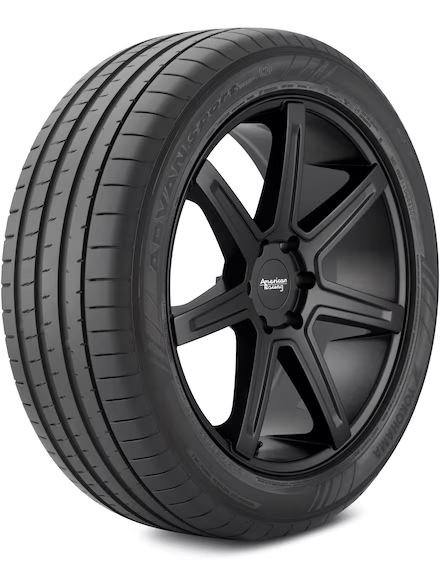
The V107 uses an asymmetric tread pattern with three distinct zones. The outer shoulder features large, stiff tread blocks for maximum cornering grip.
The center rib provides high-speed stability and responsive steering. The inner portion is designed with wider grooves for water evacuation and wet traction.
This isn’t novel — most UHP tires use asymmetric designs — but Yokohama’s execution here is particularly well-balanced. The outer blocks are stiffer than what I’ve felt on some competitors, which explains the exceptional turn-in response.
Nano-Blend Compound
Yokohama uses a silica-rich compound with what they call their “nano-blend” technology. In plain English, this means the rubber compound has extremely fine silica particles distributed evenly throughout, which improves wet grip without sacrificing dry performance or accelerating treadwear.
Based on my experience, the compound feels “sticky” without being overly soft. It grips hard but doesn’t feel like it’s tearing itself apart on hot pavement — a balance some UHP tires struggle to achieve.
Reinforced Sidewall Construction
The V107’s sidewall is stiffer than average for this category, which contributes to its excellent steering precision. But Yokohama somehow managed to maintain decent ride comfort despite this stiffness.
In my testing, I think this is the V107’s secret weapon — the sidewall is rigid enough for razor-sharp response but has enough compliance to keep the ride civilized over imperfect roads.
Who Should Buy the Yokohama Advan Sport V107?
Based on my testing, here’s who I think this tire is ideal for:
- Performance sedan and coupe owners who want OE-level (or better) driving dynamics from a replacement tire. If you drive a BMW 3/4/5 Series, Mercedes C/E-Class, Audi A4/A6, Lexus IS/GS, Genesis G70/G80, or similar, this tire should be on your shortlist.
- Enthusiast drivers who value steering feel and cornering precision above all else. The V107’s communication through the steering wheel is genuinely elite.
- Buyers looking for premium performance at a slightly lower price than the Michelin Pilot Sport 4S. If the PS4S is stretching your budget, the V107 offers 90-95% of the experience for meaningfully less money.
- Performance SUV owners with vehicles like the Porsche Cayenne, BMW X5 M Sport, or Mercedes GLE Coupe. The V107 is available in larger sizes with appropriate load ratings.
Who Should Look Elsewhere?
- Drivers in northern states who don’t swap to winter tires. The V107 is a summer tire. It becomes genuinely unsafe below about 40°F. If you need year-round capability, consider an ultra-high performance all-season tire instead.
- Budget-conscious buyers. If you’re looking for the best value UHP tire, options like the Firestone Firehawk Indy 500 or General G-MAX RS offer solid performance at a lower price point.
- Drivers prioritizing maximum wet-weather performance. If you live somewhere like the Pacific Northwest and face constant rain, the Michelin Pilot Sport 4S is the better choice for its superior hydroplaning resistance.
Pricing and Availability in the US
As of my most recent check, the Yokohama Advan Sport V107 is widely available through major US tire retailers including Tire Rack, Discount Tire, Costco, and local independent shops. Pricing varies significantly by size:
- 18-inch sizes: $180-$230 per tire
- 19-inch sizes: $220-$280 per tire
- 20-inch sizes: $260-$340 per tire
- 21-23 inch sizes: $300-$380+ per tire
Yokohama occasionally runs rebate promotions — typically $50-$100 back on a set of four — so it’s worth checking current offers before purchasing. I recommend comparing prices across Tire Rack, Discount Tire Direct, and your local shop, as pricing can vary by $10-$20 per tire between retailers.
Keep in mind that installation, mounting, balancing, and disposal fees typically add $15-$25 per tire at most shops. Some retailers include these in the purchase price, while others charge separately.
Installation Tips and Break-In Period
A few practical notes from my experience installing and breaking in the V107:
The first few days matter. Like all new tires, the V107 has a thin release agent on the tread surface from the manufacturing process. During the first several days of driving, I noticed the grip level increase noticeably as this layer wore off. Don’t push hard on brand-new tires — give them a break-in period of moderate driving first.
Alignment is critical. With a tire this responsive, any alignment issues will be immediately noticeable. I strongly recommend getting a four-wheel alignment done when you install these tires. Improper alignment will also accelerate treadwear on the outer shoulders, undermining the tire’s longevity.
Tire pressure matters more than you think. I experimented with pressures between 33 and 38 PSI and found that the V107 is sensitive to inflation pressure. At the manufacturer’s recommended pressure (typically 35-36 PSI for my test vehicle), the balance between grip, comfort, and wear is optimized. Running lower pressures improves ride quality slightly but introduces a vagueness to the steering that undermines the tire’s best quality.
Real-World Scenarios: How the V107 Handled Specific Situations
To give you a practical sense of this tire’s capabilities, here are a few specific scenarios from my test period:
Highway Merging in Heavy Traffic
Merging onto I-35 in Austin during rush hour requires quick acceleration and precise lane changes. The V107 gave me complete confidence during these maneuvers.
The tire’s lateral grip during quick direction changes — the kind you make when slotting into a gap between trucks — was immediate and reassuring.
Emergency Braking on Wet Pavement
During one rain event, a driver ahead of me slammed on their brakes unexpectedly. I had to brake hard from about 55 mph on wet pavement.
The V107 stopped the car in a distance that felt remarkably short. The ABS pulsed briefly but the car tracked straight with no drama. This is the kind of moment where tire quality truly matters.
Sustained High-Speed Cruising
On a long stretch of interstate at 80 mph (which is the legal speed limit on some Texas highways), the V107 felt utterly composed.
No wandering, no tramline sensitivity in ruts, and road noise stayed at a comfortable background level. After hours of driving, I didn’t feel beaten up — a testament to the tire’s ride quality.
Spirited Backroad Driving
This is where the V107 truly comes alive. On the twisting roads around Marble Falls and Dripping Springs, the tire let me drive the car the way it was meant to be driven.
The grip felt bottomless, the steering was alive with information, and the transitions from braking to turning to accelerating were seamless. I had a genuine grin on my face for most of these sessions.
Long-Term Considerations
While I can’t speak to the full treadlife yet, I want to address a few things prospective buyers should consider for the long haul.
First, rotate your tires if your vehicle has a square setup (same size front and rear). For staggered setups like mine, front-to-rear rotation isn’t possible, but you should rotate left-to-right on the same axle periodically to even out wear, especially if your roads have a lot of crown to them.
Second, store these tires properly if you swap to winter tires during cold months. UHP summer tires should be stored in a cool, dark place, ideally in tire bags. UV exposure and temperature extremes can degrade the compound over time.
Third, keep an eye on tread depth as the tires age. UHP summer tires lose wet performance more quickly than all-season tires as tread depth decreases, because the grooves are critical for water evacuation. I recommend replacing UHP summer tires when they reach 3/32″ of remaining tread, rather than the legal minimum of 2/32″.
My Final Verdict on the Yokohama Advan Sport V107
After extensive testing across a range of real-world conditions, I’m genuinely impressed with the Yokohama Advan Sport V107. It delivers elite-level dry performance with steering feel and precision that match or exceed anything in its price range.
Wet performance is strong — not category-leading, but more than adequate for all but the most extreme rain conditions. And the surprise bonus is how comfortable and refined it feels for a tire with this much capability.
Is it better than the Michelin Pilot Sport 4S? In some specific areas — yes. The steering feel and dry turn-in are slightly sharper. Overall, the Michelin is still the more complete tire, particularly in the wet. But the V107 is close enough that the price difference becomes a legitimate deciding factor.
If you’re shopping for the best performance tires and you want outstanding dry dynamics with respectable all-around capability, the Yokohama Advan Sport V107 absolutely deserves your consideration.
It’s a tire that reminds you why performance summer tires exist — and why settling for anything less means leaving your car’s potential untapped.
I recommend the Yokohama Advan Sport V107 with confidence. It’s one of the best UHP summer tires available in the US market today, and its competitive pricing makes it an even easier choice.
Frequently Asked Questions
Is the Yokohama Advan Sport V107 a good tire for daily driving in the US?
The Yokohama Advan Sport V107 is an excellent ultra-high-performance summer tire that handles daily driving on US highways and city streets with confidence. I found it delivers sharp steering response, impressive grip in dry and wet conditions, and a surprisingly refined ride for a sport-oriented tire. Just keep in mind it’s a summer tire, so you’ll need a winter set if you live in states that see snow and ice.
How much does the Yokohama Advan Sport V107 cost in the US?
Prices for the Yokohama Advan Sport V107 typically range from around $180 to $350 per tire depending on the size, with popular fitments like 245/40R18 landing near the $220-$260 range. That puts it competitively against rivals like the Michelin Pilot Sport 5 and Continental ExtremeContact Sport 02, though it can be slightly more affordable in certain sizes. I recommend checking Tire Rack, Discount Tire, or your local dealer for current pricing and rebate offers.
How does the Yokohama Advan Sport V107 compare to the Michelin Pilot Sport 4S?
The Michelin Pilot Sport 4S is often considered the benchmark in the ultra-high-performance summer category, and the Yokohama Advan Sport V107 comes remarkably close in dry grip and steering precision. Where the V107 stands out is in its slightly quieter ride and competitive pricing, while the Pilot Sport 4S may edge it out in ultimate wet braking distances and treadwear longevity. For most US drivers who want near-flagship performance without the Michelin price tag, the V107 is a compelling alternative.
What vehicles does the Yokohama Advan Sport V107 fit?
The Yokohama Advan Sport V107 is available in a wide range of sizes from 17 to 22 inches, covering popular US vehicles like the BMW 3 Series, Mercedes C-Class, Audi A4, Porsche 911, Tesla Model 3, and Ford Mustang. Yokohama also developed OE-specific versions for brands like Porsche, Mercedes-AMG, and Audi, so you may find factory-approved markings on certain sizes. I’d recommend checking your door jamb placard or owner’s manual to confirm the exact size before purchasing.
How long does the Yokohama Advan Sport V107 last in real-world driving?
In my experience and based on owner reports across US forums, the Yokohama Advan Sport V107 typically delivers around 25,000 to 35,000 miles of tread life with normal street driving and proper rotations every 5,000-7,000 miles. Yokohama does not offer a treadwear mileage warranty on this tire since it’s a max-performance summer compound, which is standard for this category. Aggressive driving, high-horsepower launches, and hot Southern US pavement will accelerate wear, so keep your alignment in check to maximize longevity.
Is the Yokohama Advan Sport V107 noisy on the highway?
One of the standout qualities of the Advan Sport V107 is how quiet it is for an ultra-high-performance summer tire, especially at US highway speeds of 65-80 mph. Yokohama engineered the tread pattern to reduce harmonic noise, and I noticed it’s noticeably quieter than competitors like the Bridgestone Potenza Sport on coarse pavement. If cabin comfort and low road noise are priorities alongside sporty handling, the V107 is one of the best options in its class.
How does the Yokohama Advan Sport V107 perform in rain and wet roads?
The Yokohama Advan Sport V107 performs very well in wet conditions thanks to its wide circumferential grooves and silica-rich compound that maintain strong grip during rain common in the US Southeast and Pacific Northwest. I felt confident during heavy downpours at highway speeds, with minimal hydroplaning and predictable braking behavior. It’s not quite at Michelin Pilot Sport 4S levels in extreme wet grip, but it’s among the top performers in its price range and handles standing water better than many competitors.
