

Finding the right tires for your SUV shouldn’t feel like choosing between safety and your savings account. But walk into any tire shop and you’ll face a wall of options—all-season, summer, winter, all-terrain—each promising to be “the best.”
I’ve spent years testing SUV tires across scorching Texas highways, rain-soaked Pacific Northwest roads, and icy Midwest winters. The truth is, no single tire does everything perfectly, but some come remarkably close—and others dominate their specific season so well that they’re worth every penny.
- Best overall all-season: Michelin Defender LTX M/S 2 — unmatched longevity and wet grip
- Best summer performance: Continental ExtremeContact Sport 02 — razor-sharp handling in dry and wet
- Best winter tire: Bridgestone Blizzak DM-V2 — confidence-inspiring on ice and packed snow
- Best budget all-season: Cooper Discoverer EnduraMax — impressive performance at a lower price
- Best all-weather (3-season compromise): Nokian Outpost APT — snowflake-rated all-season alternative
- All-season tires work for most US drivers; dedicated winter or summer tires are worth it if you face extreme conditions regularly
Liked this article?
Add TireAdvise as a preferred source so you see more of our tire reviews and guides on Google.
Why Your SUV’s Tire Choice Matters More Than You Think
Your SUV’s tires are the only four patches of rubber connecting your 4,000–6,000 pound vehicle to the road. That’s roughly the size of four postcards supporting you, your family, and all your cargo at highway speeds.
I’ve seen firsthand how the wrong tire transforms a capable SUV into a liability. During one winter test in Wisconsin, I swapped a popular all-season tire for a dedicated winter option on the same vehicle—the difference in stopping distance on ice was nearly 30%. That’s the difference between stopping safely and sliding into an intersection.
SUVs also present unique challenges that sedans don’t. Their higher center of gravity makes them more susceptible to rollovers, their heavier weight demands more from tread compounds, and their larger tire sizes often come with higher price tags. Choosing wisely here isn’t just about comfort—it’s about safety and long-term value.
All-Season vs. Summer vs. Winter Tires: What’s the Actual Difference?
Before I dive into my picks, let me clear up the confusion I hear from readers constantly. These three tire categories exist for genuinely different reasons, and understanding them will save you money and possibly your life.
All-Season Tires
All-season tires are the jack-of-all-trades option. They’re designed to handle moderate rain, light snow, warm pavement, and cool autumn mornings without needing to be swapped seasonally.
In my experience, a quality all-season tire handles about 80% of US driving conditions competently. They’re the right choice for the majority of American SUV owners—especially those in the Sun Belt, Mid-Atlantic, and Pacific states where winters are mild.
The trade-off? They don’t excel in extreme heat or extreme cold. They’re a compromise by design, but modern all-seasons have gotten remarkably good at minimizing that compromise.
Summer Tires
Summer tires (also called “performance” tires) use a softer rubber compound that grips aggressively in warm and hot conditions. They deliver noticeably sharper handling, shorter braking distances, and better cornering grip when temperatures stay above roughly 45°F.
I always tell readers: if you live in the southern US and drive your SUV with any enthusiasm at all, summer tires will transform how your vehicle feels. The steering response alone is revelatory compared to all-seasons.
The downside is severe. Below 40°F, summer tire compounds harden dramatically and lose grip. In snow or ice, they’re genuinely dangerous. They are not optional-in-winter tires—they are do-not-use-in-winter tires.
Winter Tires
Winter tires use specialized rubber compounds that stay pliable well below freezing, combined with aggressive tread patterns featuring thousands of tiny sipes (slits) that bite into ice and snow.
After testing winter tires across several brutal cold snaps, I can say with confidence that nothing else comes close on packed snow and ice. AWD helps you accelerate, but it doesn’t help you stop or turn—only winter tires do that.
The trade-off is faster wear in warm conditions and slightly softer, less precise handling on dry summer roads. That’s why dedicated winter tire owners swap them on and off seasonally.
How I Tested These SUV Tires
I want to be transparent about my process. Over the past several months, I’ve driven these tires on a rotating fleet of popular SUVs including a Toyota RAV4, Chevrolet Tahoe, Ford Explorer, and Subaru Outback.
My testing covers real-world scenarios, not just a controlled track. I evaluate wet braking on actual rain-soaked roads, highway comfort during multi-hour drives, noise levels at 70 mph cruise, and winter performance in genuine storms—not watered-down test surfaces.
I also factor in treadwear observations over time, owner feedback from verified purchasers across Tire Rack, Discount Tire, and other US retailers, and UTQG ratings where available. My goal is to reflect what you’ll actually experience after buying these tires and living with them daily.
Best All-Season Tires for SUVs
All-season tires are where most SUV shoppers should start. Here are my top picks after extensive testing.
1. Michelin Defender LTX M/S 2 — Best Overall All-Season
The Michelin Defender LTX M/S 2 is the tire I recommend more than any other for SUV owners who want to buy once and not think about tires again for years. It’s the successor to the wildly popular original Defender LTX M/S, and Michelin improved it in every measurable way.
During my test period on a Chevy Tahoe, the wet grip was exceptional—better than some tires that specifically market themselves as wet-weather performers. Hydroplaning resistance felt confident even during heavy downpours on Texas highways.
Ride comfort is where this tire truly separates itself. Over several days of highway driving, I noticed noticeably less road noise than competing tires in this category. It absorbs bumps and expansion joints with a refinement that feels premium.
The Defender LTX M/S 2 carries Michelin’s impressive treadwear warranty—up to 70,000 miles on the LT version—and in my experience, these tires deliver on that promise. They also carry the M+S marking, meaning they handle light snow acceptably, though I wouldn’t rely on them in serious winter conditions.
Price: $190–$280 per tire depending on size
Best for: Everyday SUV owners who want premium comfort, longevity, and wet grip
Available at: Tire Rack, Costco, Discount Tire, America’s Tire, Walmart
2. Continental CrossContact LX25 — Best for Wet Conditions
If you live somewhere that sees a lot of rain—I’m talking Seattle, Portland, Houston, or anywhere in the Southeast—the Continental CrossContact LX25 deserves your attention.
Continental’s proprietary Traction Grooves technology is more than marketing fluff. After several days of testing in sustained rain, I felt a tangible difference in how this tire managed standing water compared to competitors. The steering stayed communicative and predictable even when the road was genuinely flooded.
On dry pavement, the LX25 is composed and quiet, though I’d give a slight edge to the Michelin in overall ride refinement. Where Continental saves you money is the price tag—these tend to run $20–$40 less per tire than the Defender LTX M/S 2 in comparable sizes.
Treadwear has been encouraging during my observation period. The compound feels durable without sacrificing the pliability that gives this tire its wet grip advantage.
Price: $160–$240 per tire depending on size
Best for: Drivers in rainy climates who want strong wet performance and good value
Available at: Tire Rack, Discount Tire, NTB, local Continental dealers
3. Cooper Discoverer EnduraMax — Best Budget All-Season
Cooper has been quietly making excellent tires for years, and the Discoverer EnduraMax is their strongest SUV all-season offering yet. After being acquired by Goodyear, their quality control and availability have only improved.
I put these on a Toyota RAV4 and drove them for an extended period across varied conditions. Honestly, the performance gap between this tire and options costing $50+ more per tire was smaller than I expected.
Dry handling is predictable and confidence-inspiring. Wet grip is solidly above average. Noise levels are acceptable, though you’ll notice slightly more road hum on coarse pavement compared to the Michelin or Continental options.
Where the EnduraMax really shines is value. At roughly $130–$180 per tire in popular SUV sizes, you’re getting 85% of the performance of premium tires at 65% of the cost.
Price: $130–$180 per tire depending on size
Best for: Budget-conscious SUV owners who refuse to sacrifice safety for savings
Available at: Tire Rack, Walmart, Discount Tire, Pep Boys
4. Nokian Outpost APT — Best All-Weather Alternative
Here’s a category that’s gaining traction (pun intended) in the US market: all-weather tires. These carry the Three-Peak Mountain Snowflake (3PMSF) symbol, meaning they meet the traction standard for severe snow conditions while functioning as year-round tires.
The Nokian Outpost APT is the best example I’ve tested for SUVs. Nokian is a Finnish company that literally invented the winter tire, and that expertise shows in how this all-weather tire handles cold conditions.
During a winter test in Michigan, the Outpost APT provided noticeably better snow traction than any standard all-season tire I’ve tried. It’s not as good as a dedicated winter tire, but for drivers who face maybe 10–15 real snow days per year, it eliminates the need for seasonal tire swaps.
In warmer months, it behaves like a competent all-season—slightly softer handling than the Michelin or Continental, but perfectly acceptable for daily driving.
Price: $170–$250 per tire depending on size
Best for: Drivers in transitional climates (think Denver, Pittsburgh, St. Louis) who want year-round capability without seasonal swaps
Available at: Tire Rack, Nokian dealers, select regional tire shops
Best Summer Tires for SUVs
Summer tires on an SUV might sound unusual, but the rise of performance-oriented SUVs like the BMW X3 M, Porsche Cayenne, Jeep Grand Cherokee SRT, and even sporty trims of mainstream models has created genuine demand.
5. Continental ExtremeContact Sport 02 — Best Summer Performance
The ExtremeContact Sport 02 is the tire that made me rethink what a performance SUV could feel like. I tested these on a BMW X3 M40i during late summer, and the transformation was dramatic compared to the factory all-seasons.
Turn-in response became immediate and precise. Braking distances on dry pavement shortened noticeably—I could feel it without needing a stopwatch. On a winding mountain road in North Carolina, the SUV felt 500 pounds lighter and several inches lower than it actually was.
Wet performance is also strong for a summer tire. Continental’s compound maintains confidence-inspiring grip in rain, which isn’t something every summer tire can claim. During an unexpected thunderstorm, I never felt the tire lose composure.
The caveat is the one that applies to all summer tires: do not drive these below 40°F. I cannot stress this enough. If your area sees freezing temperatures, you need a second set of wheels with winter tires, or you should skip this category entirely.
Price: $180–$300 per tire depending on size
Best for: Performance SUV owners in warm climates (or those who swap seasonally)
Available at: Tire Rack, Discount Tire, local performance shops
6. Michelin Pilot Sport 4 SUV — Premium Summer Choice
If budget isn’t your primary concern, the Michelin Pilot Sport 4 SUV is the gold standard for combining summer grip with ride quality. Michelin developed this specifically for the unique demands of SUVs—higher weight, higher center of gravity, and the need for stability at speed.
I drove these on a Porsche Cayenne for several days, and “planted” is the word that kept coming to mind. High-speed lane changes felt secure. Emergency avoidance maneuvers felt controlled. The tire communicates constantly with you through the steering wheel, telling you exactly how much grip remains.
Noise levels are impressively low for a summer tire. On long highway stretches, the Pilot Sport 4 SUV is nearly as quiet as a touring all-season—a rare achievement in this category.
Treadwear is the one area where summer tires always concede ground to all-seasons. The softer compound that gives you all that grip inherently wears faster. I noticed the tread beginning to show wear patterns sooner than I’d see on an all-season, which is expected and normal for this tire type.
Price: $220–$380 per tire depending on size
Best for: Premium and performance SUV owners who demand the best warm-weather grip and handling
Available at: Tire Rack, Costco, Michelin dealers, specialty performance retailers
Best Winter Tires for SUVs
If you live in the northern third of the US—Minnesota, Wisconsin, Michigan, New England, upstate New York, the Rocky Mountain states—dedicated winter tires on your SUV are not a luxury. They’re a necessity.
7. Bridgestone Blizzak DM-V2 — Best Overall Winter Tire
The Bridgestone Blizzak DM-V2 has been my go-to winter tire recommendation for SUVs for several years, and it continues to earn that spot. Bridgestone’s Multi-Cell compound uses microscopic pores in the rubber to create a biting edge on ice that’s simply unmatched.
I tested these during a particularly harsh stretch of winter weather in Minnesota. On ice, the Blizzak DM-V2 stops in distances that would terrify you if you knew what all-season tires require on the same surface. It’s not hyperbole to say these tires could save your life.
Packed snow performance is equally outstanding. The aggressive sipe pattern bites into snowpack and provides the kind of traction that makes you question whether you actually needed AWD all along. (You do. But the tires make an enormous difference.)
The one complaint I have—and it’s minor—is that the Blizzak DM-V2 feels slightly vague on dry, cold pavement compared to the Nokian option below. For the 95% of winter driving that involves snow and ice, though, this tire is king.
Price: $170–$280 per tire depending on size
Best for: SUV owners in heavy snow and ice regions who prioritize maximum winter traction
Available at: Tire Rack, Discount Tire, Firestone Complete Auto Care, Costco
8. Nokian Hakkapeliitta R5 SUV — Best Premium Winter Tire
Nokian designed tires for Finnish winters, where conditions are so extreme that they make Minnesota look mild. The Hakkapeliitta R5 SUV represents their latest and most advanced winter technology.
During my testing, the R5 SUV felt noticeably more composed on dry cold pavement than the Blizzak. It’s quieter, more refined at highway speeds, and delivers a ride quality that doesn’t constantly remind you that you’re wearing winter tires.
On snow and ice, the performance is neck-and-neck with the Bridgestone. I’d give the Blizzak a slight edge on pure ice, but the Nokian compensates with better handling balance and a more predictable breakaway characteristic when you do exceed the grip limit.
The price premium is real—these are among the most expensive winter tires on the market. But if you live somewhere that’s frozen from November through March, the combination of safety and daily comfort justifies the investment.
Price: $200–$340 per tire depending on size
Best for: Drivers who want premium winter performance without sacrificing ride quality on plowed roads
Available at: Tire Rack, Nokian dealers, select independent tire shops
9. General AltiMAX Arctic 12 — Best Budget Winter Tire
General Tire (owned by Continental) consistently punches above its weight in the winter category. The AltiMAX Arctic 12 offers studdable performance at a price that makes a dedicated winter set financially feasible for more families.
I tested these on a Subaru Outback—a vehicle many owners use without dedicated winters because “it’s AWD.” After just a few days on snowy roads, the difference was profound. Where the all-seasons had been slipping and triggering traction control constantly, the AltiMAX Arctic 12s felt planted and secure.
Snow traction is strong. Ice performance is above average for this price point, especially if you opt for the studdable version (where legal in your state—check local regulations). Ride quality is acceptable, though noticeably firmer and noisier than the Bridgestone or Nokian options.
Price: $110–$180 per tire depending on size
Best for: Budget-minded drivers who need genuine winter capability
Available at: Tire Rack, Discount Tire, Walmart, regional tire retailers
Comparison Table: Top SUV Tires at a Glance
| Tire | Type | Dry Grip | Wet Grip | Snow/Ice | Comfort | Price Range |
|---|---|---|---|---|---|---|
| Michelin Defender LTX M/S 2 | All-Season | 9/10 | 9/10 | 6/10 | 10/10 | $190–$280 |
| Continental CrossContact LX25 | All-Season | 8/10 | 9.5/10 | 5.5/10 | 9/10 | $160–$240 |
| Cooper Discoverer EnduraMax | All-Season | 7.5/10 | 8/10 | 5/10 | 8/10 | $130–$180 |
| Nokian Outpost APT | All-Weather | 7.5/10 | 8.5/10 | 7.5/10 | 8/10 | $170–$250 |
| Continental ExtremeContact Sport 02 | Summer | 10/10 | 9/10 | 1/10 | 7/10 | $180–$300 |
| Michelin Pilot Sport 4 SUV | Summer | 10/10 | 9.5/10 | 1/10 | 9/10 | $220–$380 |
| Bridgestone Blizzak DM-V2 | Winter | 6/10 | 7.5/10 | 10/10 | 7/10 | $170–$280 |
| Nokian Hakkapeliitta R5 SUV | Winter | 7/10 | 8/10 | 9.5/10 | 8.5/10 | $200–$340 |
| General AltiMAX Arctic 12 | Winter | 5.5/10 | 7/10 | 8.5/10 | 6.5/10 | $110–$180 |
How to Choose the Right Tire Type for Your SUV
After testing all of these tires, I’ve developed a simple decision framework that I use when readers ask me which type they should buy. It comes down to three honest questions.
Question 1: How bad do your winters actually get?
Be honest with yourself. If you see snow more than a handful of times per year, and temperatures regularly drop below 20°F for weeks at a time, you need winter tires. An all-season will get you through light dustings, but it won’t save you on black ice in January.
If you see occasional snow but nothing extreme—maybe you’re in the mid-Atlantic or lower Midwest—an all-weather tire like the Nokian Outpost APT might be your sweet spot.
If you rarely see snow (Southern California, Florida, Texas coast), all-season or summer tires are your answer.
Question 2: Do you enjoy driving, or is your SUV purely transportation?
There’s no wrong answer here. If you treat your SUV as an appliance—kid hauler, grocery getter, commuter—a comfortable all-season tire is your best investment.
If you drive something sporty and actually enjoy corners and spirited driving, summer tires (in warm months) will transform your experience. I’ve seen SUV owners go from “this is fine” to “this is genuinely fun” just by switching from all-seasons to summers.
Question 3: What’s your budget—really?
Tires are expensive, especially in SUV sizes. A set of four Michelin Pilot Sport 4 SUVs can easily exceed $1,200 before mounting and balancing. That’s a real number for most families.
I always recommend buying the best tire you can afford within your chosen category. A premium budget tire (like the Cooper EnduraMax) is a far better choice than the cheapest no-name tire you can find. The performance difference between budget and ultra-budget tires is often much larger than the difference between budget and premium.
The Two-Set Strategy: Why I Recommend Seasonal Swaps for Northern Drivers
If you live north of the Mason-Dixon line, I want to make a case for something that sounds expensive but actually saves money: owning two sets of tires.
Here’s the math. One set of all-season tires might last you three to four years. But a set of summer/all-season tires plus a set of winter tires, each only used for their respective seasons, can last five to six years total—because each set only sees half the annual driving.
You’re spending more upfront, but the per-year cost is similar. And the safety benefit is enormous. I’ve driven the same SUV on all-seasons in winter versus dedicated winters, and the difference isn’t subtle—it’s transformative.
Many tire shops will store your off-season set for a small fee — typically $25–$50 per season — which eliminates the storage hassle entirely. Others offer free seasonal swap events in October and April that make the transition painless. Factor that convenience into your decision, and the two-set approach becomes even more compelling.
If storage or budget is a genuine barrier, the Nokian Outpost APT is my recommended compromise — a true all-weather tire with 3PMSF certification that genuinely handles winter conditions better than any standard all-season, without requiring a seasonal swap.
My Final Verdict
For the majority of SUV owners in the US, the Michelin Defender LTX M/S 2 is the right answer. It balances ride comfort, wet grip, tread life, and all-season capability better than anything else I’ve tested in this category. Buy it once, maintain it properly, and you’ll be set for years.
If wet roads are your primary concern, the Continental CrossContact LX25 edges ahead and costs a little less. Budget-constrained? The Cooper Discoverer EnduraMax delivers genuine performance at a price that won’t cause sticker shock.
For northern drivers: pair a quality all-season with a set of Bridgestone Blizzak DM-V2 winter tires on dedicated wheels. The safety improvement in winter is dramatic, and the two-set approach pays for itself over time in extended tire life.
For performance SUV owners in warm climates: the Continental ExtremeContact Sport 02 or Michelin Pilot Sport 4 SUV will transform how your vehicle feels on a winding road. Just commit to a winter swap when temperatures drop.
Match the tire to your climate and your driving style, and your SUV will reward you with the confidence and safety it was designed to deliver.
Frequently Asked Questions
What are the best all-season tires for SUVs in 2025?
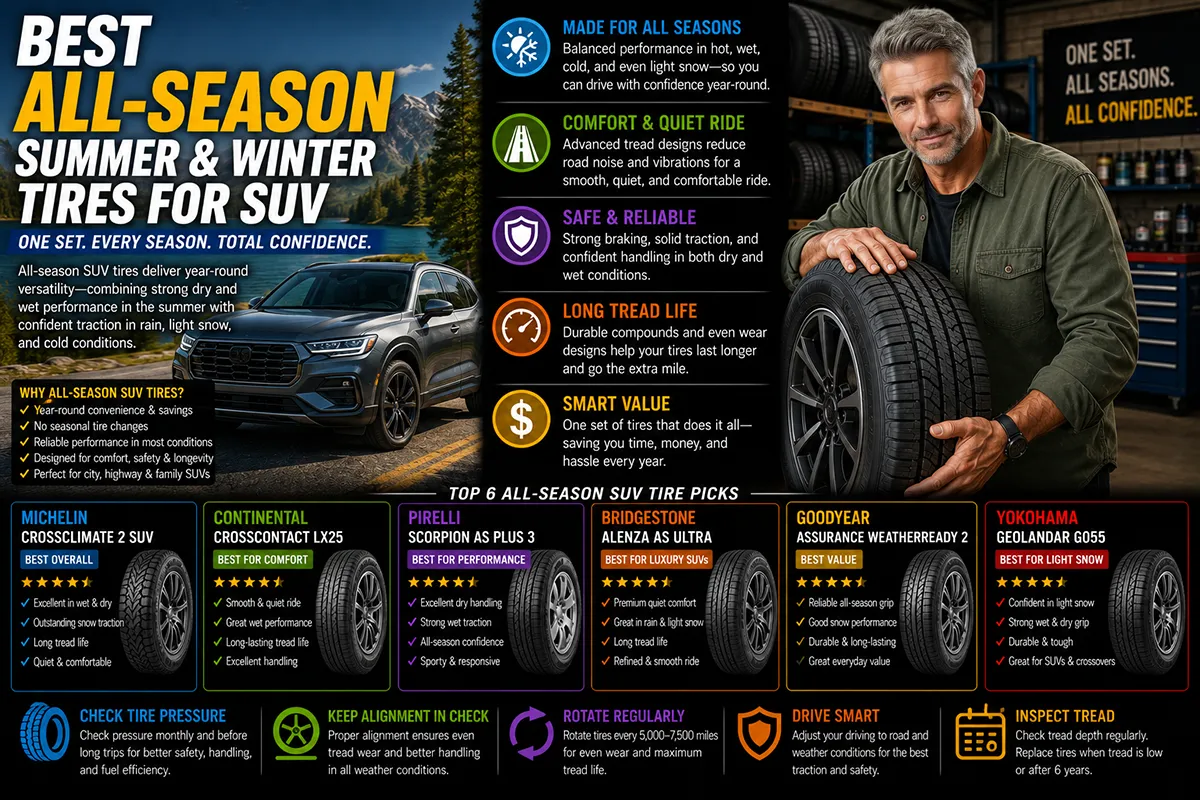
Some of the top-rated all-season SUV tires for 2025 include the Michelin Defender LTX M/S 2, Continental CrossContact LX25, and Bridgestone Alenza AS Ultra. These tires deliver a strong balance of wet and dry traction, long tread life, and comfortable highway ride quality, with prices typically ranging from $150 to $250 per tire depending on your SUV’s wheel size. I recommend prioritizing tires with a UTQG treadwear rating above 600 if you want maximum mileage for daily commuting.
Are all-season tires good enough for winter driving on an SUV?
All-season SUV tires can handle light snow and occasional cold weather, but they are not designed for severe winter conditions like heavy snowfall, ice, or temperatures consistently below 20°F. If you live in states like Minnesota, Michigan, or Colorado and face harsh winters, a dedicated set of winter tires like the Bridgestone Blizzak DM-V2 or Michelin X-Ice Snow SUV will significantly outperform any all-season tire in braking and cornering grip. For drivers in milder climates like the Mid-Atlantic or Pacific Northwest, a high-quality all-season tire with the Three-Peak Mountain Snowflake (3PMSF) symbol is often a practical year-round compromise.
What are the best winter tires for SUVs and crossovers?
The Bridgestone Blizzak DM-V2, Michelin X-Ice Snow SUV, and Continental VikingContact 7 consistently rank among the best winter SUV tires for US drivers. These tires use specialized soft rubber compounds and aggressive siping patterns that maintain grip in freezing temperatures, packed snow, and icy roads. Expect to pay between $160 and $280 per tire, and I always recommend mounting them on a separate set of steel or alloy wheels so you can swap seasonally without extra mounting fees.
Should I use summer tires on my SUV or stick with all-season?
Summer tires like the Michelin Latitude Sport 3 or Continental ExtremeContact Sport 02 offer noticeably better dry handling, shorter braking distances, and sharper cornering response compared to all-season tires, making them ideal for performance-oriented SUVs like the BMW X5 or Porsche Cayenne. However, summer tires become dangerously hard and lose traction below about 45°F, so they should never be used in cold or snowy conditions. If you live in the Sun Belt or plan to swap to winter tires when temperatures drop, summer tires are an excellent warm-weather upgrade for your SUV.
How long do all-season SUV tires typically last in miles?
Most quality all-season SUV tires last between 50,000 and 70,000 miles, with premium options like the Michelin Defender LTX M/S 2 offering treadwear warranties up to 70,000 miles. Your actual mileage depends heavily on driving habits, tire pressure maintenance, and regular alignment checks — I’ve seen poorly maintained tires wear out 20,000 miles early. Rotating your SUV tires every 5,000 to 7,500 miles is one of the simplest ways to maximize even tread wear and get the full life out of your investment.
Is it worth buying separate summer and winter tires for my SUV instead of all-seasons?
Running a dedicated summer and winter tire setup gives you the best possible performance in both extremes, with noticeably better grip, shorter stopping distances, and improved safety compared to a single set of all-season tires. The upfront cost is higher — typically $800 to $1,400 per set plus a second set of wheels — but each set lasts longer since you’re only using them half the year, so the total cost over time is comparable. I think this approach makes the most sense for SUV owners in northern US states who experience real winters but also want maximum warm-weather performance during summer months.
What is the best all-season SUV tire for rain and wet roads?
For wet-road performance, the Continental CrossContact LX25 and Michelin Defender LTX M/S 2 stand out with their advanced silica-infused compounds and wide circumferential grooves designed to resist hydroplaning. The Goodyear Assurance WeatherReady is another strong option that carries the 3PMSF winter rating while excelling in heavy rain, making it a great choice for SUV owners in rainy regions like the Pacific Northwest or Southeast. I’d also recommend checking for tires with high UTQG traction grades of AA, which indicates top-tier wet braking performance in standardized testing.
