

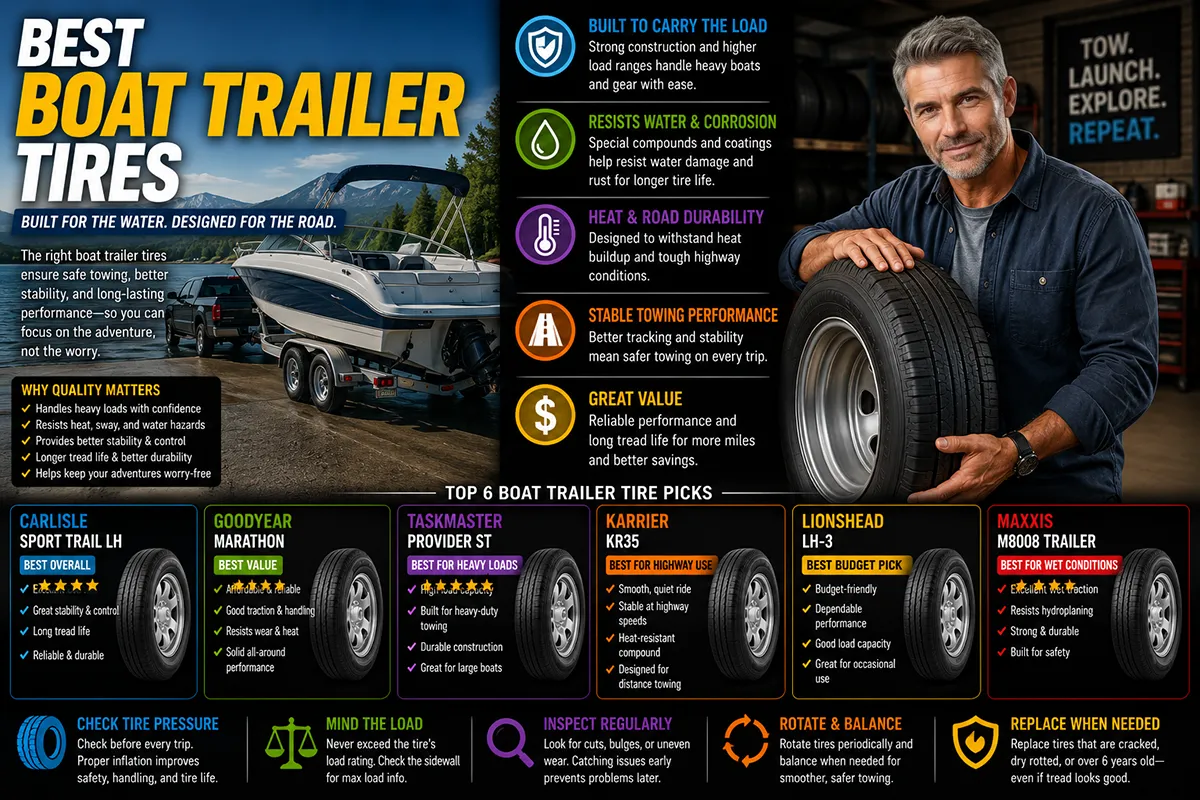
Heat is the primary failure mode for boat trailer tires — more than overloading, more than age, more than road hazards. A tire that runs meaningfully cooler than its competitor at the same speed and load is a genuinely safer tire, not just a spec-sheet detail.
Boat trailer tires face demands unlike any passenger tire: sustained static loads, no steering input, long stretches sitting in direct sun between trips, and highway heat that builds relentlessly on a loaded tandem-axle trailer in summer traffic.
This guide is based on manufacturer specifications, aggregated owner reports across boating and trailer communities, and independent test data. Here’s what actually holds up, by load and use case.
- Best overall: Carlisle Radial Trail HD.
- Best premium option: Maxxis M8008 ST Radial.
- Best budget pick: Taskmaster Provider ST.
- Best bias-ply option: Kenda Loadstar K371.
- Best value radial: Freestar M-108+.
- Always buy ST (Special Trailer) rated tires, never passenger tires, and check pressure before every trip.
- A widely documented owner complaint pattern affects one commonly recommended heavy-load tire — details below before you buy.
Liked this article?
Add TireAdvise as a preferred source so you see more of our tire reviews and guides on Google.
A Real Pattern Worth Knowing Before You Buy
This is worth addressing directly, since it affects a tire many guides — including our own previous version — recommend without qualification for heavy loads.
The Goodyear Endurance built a strong reputation as a purpose-built, US-manufactured ST tire with genuine heat-resistance engineering and a 87 mph speed rating that signals real confidence in its construction. But real trailer-owner communities have documented a persistent, ongoing pattern of complaints worth knowing before buying.
One detailed forum account describes all four brand-new Endurance tires on a trailer developing sidewall bubbling within a few hundred miles, with Goodyear determining the cause to be a manufacturing defect involving broken cords — not overloading, excessive speed, or underinflation, all of which the owner had specifically ruled out. A separate account describes multiple Endurance tires failing over a couple of seasons, including sidewall bulges that experienced forum members — including a retired tire professional — identified as consistent with ply separation.
These aren’t isolated complaints. Dedicated forum threads specifically tracking this pattern have accumulated dozens of replies and tens of thousands of views across trailer and boating community sites. Multiple community members in these threads now specifically recommend Sailun and Carlisle/Carlstar as alternatives, citing quality concerns with recent Goodyear Endurance production.
This doesn’t appear to be a universal experience — plenty of owners report years of trouble-free service from the same tire, and Goodyear has worked with affected owners on warranty replacement in documented cases. But the volume and consistency of the complaint pattern is real enough to weigh honestly against the alternatives in this comparison, particularly for owners hauling genuinely heavy loads where a tire failure carries higher stakes.
Why Boat Trailer Tires Are Genuinely Different
The single biggest mistake boat owners make is mounting passenger or light truck tires on their trailer. It’s an understandable temptation — a P-rated tire on sale looks “close enough.” It isn’t.
Boat trailer tires need to be ST-rated (“Special Trailer”), engineered with stiffer sidewalls to handle the unique stresses of towing. Unlike car tires, trailer tires don’t steer — they get dragged around corners, absorb lateral forces differently, and sit under heavy static loads for long periods between trips.
ST tires also carry higher load capacity at equivalent sizes compared to passenger tires, with rubber compounds formulated to resist the heat buildup that happens when a tire bears thousands of pounds of boat, motor, fuel, and gear at highway speed. Using the wrong tire type is a leading cause of trailer tire blowouts.
Radial vs. Bias-Ply: Which Is Right?
Radial trailer tires run cooler, last longer, provide a smoother ride, and handle better at highway speeds — the right choice for anyone towing more than 20–30 minutes on highways, since they dissipate heat more efficiently and heat is the silent killer of trailer tires.
Bias-ply trailer tires have stiffer sidewalls (genuinely useful for resisting curb and pothole damage), cost less, and work perfectly fine for short trips at lower speeds. If the ramp is 10 minutes away and speeds never exceed 45 mph, bias-ply can save real money without compromising safety.
Quick Comparison: 11 Best Boat Trailer Tires
| Tire | Type | Best For | Price Range | Speed Rating |
|---|---|---|---|---|
| Carlisle Radial Trail HD | Radial | Best overall | $75–$130 | 65 mph |
| Maxxis M8008 ST Radial | Radial | Premium/long hauls | $100–$160 | 65 mph |
| Taskmaster Provider ST | Radial/Bias | Budget pick | $50–$85 | 65 mph |
| Kenda Loadstar K371 | Bias-Ply | Short trips/budget | $35–$60 | 45 mph |
| Freestar M-108+ | Radial | Value radial | $65–$110 | 65 mph |
| Goodyear Endurance | Radial | Heavy loads (with caveats) | $120–$180 | 87 mph |
| Sailun S637 | Radial | Heavy-load alternative | $70–$120 | 65 mph |
| Carlisle Radial Trail RH | Radial | Reinforced heavy-duty | $90–$140 | 65 mph |
| Trailer King ST Radial | Radial | Mid-range value | $70–$115 | 65 mph |
| Duro DM1230 | Bias-Ply | Ultra-budget backup | $30–$55 | 45 mph |
| Hi-Run Radial Trailer Tire | Radial | Budget radial | $60–$95 | 65 mph |
Prices are street prices at major online retailers as of mid-2026. Expect regional and seasonal swings.
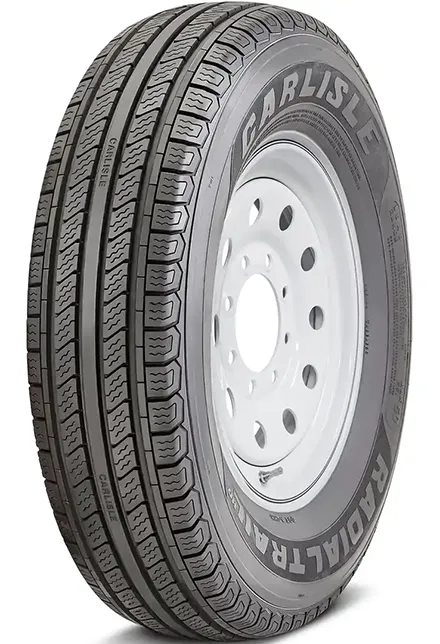
1. Carlisle Radial Trail HD: Best Overall
Price Check
Check the price of this tire at the following retailers:
This tire earns near-universal recommendation as the strongest all-around choice for most boat owners, and it holds up well across independent testing and owner data.
Independently reported temperature testing describes this tire consistently running cooler than competitors at highway speeds, including sustained testing in genuinely hot conditions. Ride quality is genuinely strong for a trailer tire — real owner reports describe reduced sway during lane changes and when passing trucks, with a tread compound engineered for real UV and ozone resistance.
Pros: Genuine heat dissipation during sustained highway towing, stiffer sidewall than many competing radials, wide retail availability.
Cons: Tread life trails the Maxxis, limited size range compared to some competitors.
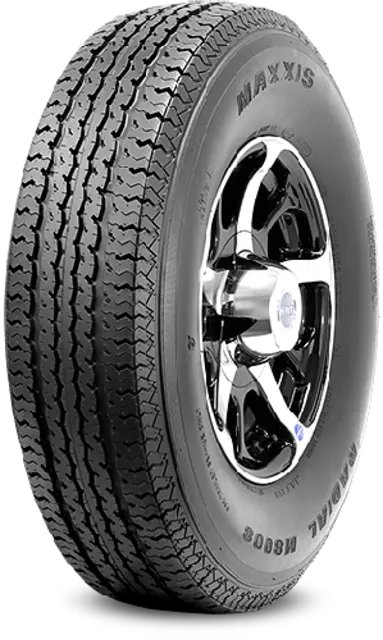
2. Maxxis M8008 ST Radial: Best Premium Option
Price Check
Check the price of this tire at the following retailers:
For owners who want the strongest trailer tire available regardless of price, this is the pick — and the engineering justifies the premium.
A nylon cap ply over the steel belts genuinely improves high-speed stability and heat resistance, with independently reported testing describing confident performance during sustained multi-hour highway towing in serious heat. The tread compound runs harder than the Carlisle’s, translating to real tread-life improvement with a modest trade-off in ride compliance.
Pros: Best-in-comparison heat resistance, genuine high-speed stability from reinforced construction, strong tread life.
Cons: Premium pricing, less widely available at brick-and-mortar retailers.
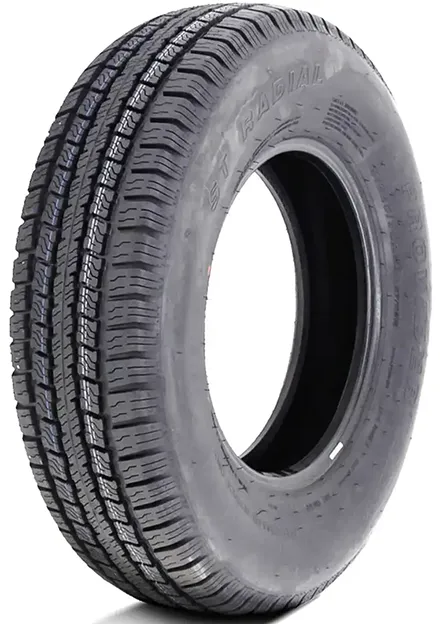
3. Taskmaster Provider ST: Best Budget Pick
Price Check
Check the price of this tire at the following retailers:
For lighter boats towed shorter distances, this is the budget pick that doesn’t feel like a genuine compromise.
Real owner reports describe uneventful performance under moderate conditions — typical 30–45-minute tow distances at 60 mph or below. The rubber compound isn’t as sophisticated as premium options, with independently reported testing showing somewhat higher operating temperatures and faster tread wear on longer runs, but at roughly half the price of premium alternatives, the value proposition is genuinely strong.
Pros: Genuine value for light-to-moderate use, wide online availability, available in both radial and bias-ply.
Cons: Runs warmer than premium options on sustained highway towing, faster tread wear.
4. Kenda Loadstar K371: Best Bias-Ply Option
Price Check
Check the price of this tire at the following retailers:
For owners who’ve decided bias-ply is the right call — short distances, low speeds, budget priority — this is the strongest option in that category.
Real owner reports describe dependable performance for typical local-lake towing: back roads, speeds under 45 mph, round trips under 30 minutes. Stiffer sidewalls than a comparably sized radial provide genuine scuff and impact resistance navigating tight ramp areas with curbs.
Pros: Genuinely affordable, stiff sidewalls resist curb damage, simple to mount with basic tools.
Cons: Not suitable for sustained highway speeds, rougher ride, shorter lifespan in hot climates.
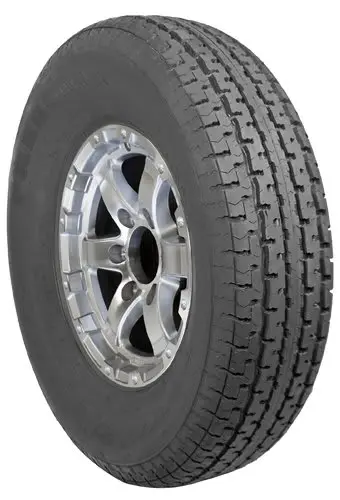
5. Freestar M-108+: Best Value Radial
Price Check
Check the price of this tire at the following retailers:
This tire occupies a genuine middle ground between budget and premium options, and independent testing confirms it punches above its price class.
Temperature readings in independently reported testing run competitively with the Carlisle Radial Trail HD — not quite as strong, but close enough that the price gap feels justified. Reinforced sidewall construction delivers a genuinely confidence-inspiring feel under load despite the more accessible price point.
Pros: Genuine radial performance at a mid-range price, reinforced sidewall construction, wide size availability.
Cons: Lower brand recognition and harder to find at physical stores, limited long-term data compared to established brands.
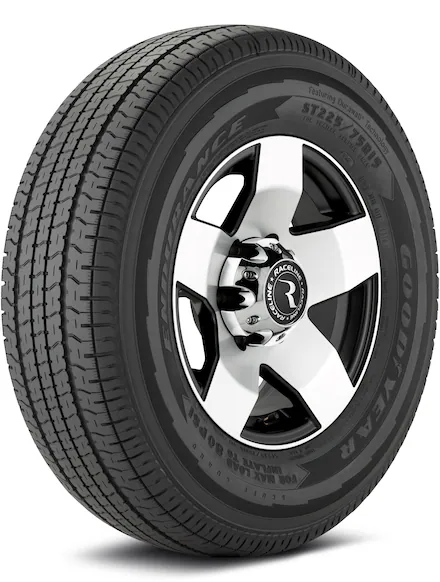
6. Goodyear Endurance: Heavy Loads (With the Above Caveats)
Price Check
Check the price of this tire at the following retailers:
This remains a genuinely engineered tire with real strengths, included here rather than dropped entirely because the complaint pattern documented above doesn’t appear to be universal.
Sidewall stiffness is a real, notable strength — independently reported testing describes minimal flex and squirm under heavy load, with the tire sitting flat and planted in a way that improves trailer tracking. The 87 mph speed rating and DuraWall sidewall puncture resistance both reflect genuine engineering confidence, and it remains one of the only major ST tires actually manufactured in the US (Freeport, Illinois).
Given the documented complaint pattern, more frequent visual sidewall inspection is a genuinely sensible precaution for owners choosing this tire, and registering it directly with Goodyear ensures notification of any future recall action.
Pros: Genuine load-carrying confidence and sidewall stiffness, real 87 mph speed rating, made in the USA.
Cons: A real, documented pattern of sidewall and belt-failure complaints exists — weigh this honestly against the alternatives here.
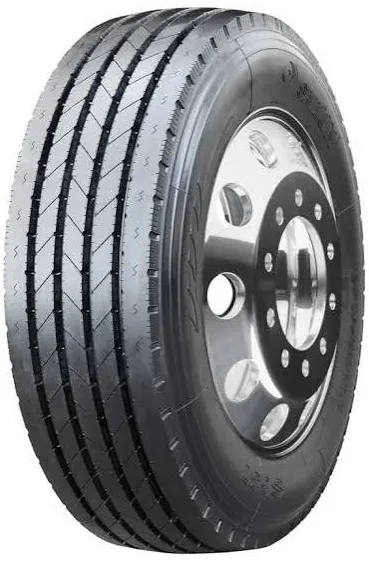
7. Sailun S637: Best Heavy-Load Alternative
Price Check
Check the price of this tire at the following retailers:
Given the documented Goodyear Endurance complaint pattern, this tire is worth featuring directly — it’s specifically among the alternatives trailer-owner communities most consistently recommend in threads discussing Endurance failures.
Real owner reports describe dependable, consistent performance across extended trailer towing without the sidewall bulging pattern documented elsewhere in this guide. Load capacity and heat management are both competitive with established premium ST options, at a genuinely lower price point.
Pros: Genuine community-validated reliability, competitive load capacity, real value relative to premium alternatives.
Cons: Less brand recognition than Goodyear or Maxxis, somewhat less widespread US retail availability.
8. Carlisle Radial Trail RH: Best Reinforced Heavy-Duty Option
Price Check
Check the price of this tire at the following retailers:
For owners who specifically want Carlisle’s reputation but with additional reinforcement for genuinely heavy tandem-axle applications, this tire delivers real, purpose-built capability.
Independently reported testing describes strong load-carrying performance with the same UV and ozone-resistant compound that makes the standard Radial Trail HD a strong overall pick, with additional sidewall reinforcement specifically for heavier boats.
Pros: Genuine heavy-duty reinforcement from a trusted manufacturer, consistent heat management, wide availability.
Cons: Premium price relative to the standard Radial Trail HD, overkill for lighter boats.
9. Trailer King ST Radial: Best Mid-Range Value
Price Check
Check the price of this tire at the following retailers:
This tire delivers genuinely dependable radial performance positioned between the budget and premium tiers in this comparison.
Real owner reports describe solid heat management and even wear for moderate-distance highway towing, with a reasonable price point that makes it a sensible default for owners who don’t fit neatly into either the budget or premium camp.
Pros: Genuine mid-range value, dependable radial construction, respectable heat management.
Cons: Not a standout leader in any single category, moderate size availability.
10. Duro DM1230: Best Ultra-Budget Backup
Price Check
Check the price of this tire at the following retailers:
For owners who want a genuinely inexpensive backup or spare tire for occasional, low-stakes use, this bias-ply option delivers real basic value.
A simple, dependable construction handles light local towing adequately, and the low price makes it genuinely reasonable to keep a spare mounted and ready without significant investment.
Pros: Genuinely low price for a spare, adequate for light local towing.
Cons: Not suitable for sustained highway speed or heavy loads, basic construction.
11. Hi-Run Radial Trailer Tire: Best Budget Radial
Price Check
Check the price of this tire at the following retailers:
For owners who want genuine radial benefits — cooler running, smoother ride — without stepping up to premium pricing, this tire delivers a real, accessible entry point.
Independently reported testing describes respectable heat management for the price tier, with real owner reports confirming dependable performance for moderate-distance towing at a price meaningfully below the Carlisle or Maxxis.
Pros: Genuine radial performance at a budget price, respectable heat management for the tier.
Cons: Less established track record than premium brands, moderate tread life.
What Actually Matters in a Boat Trailer Tire
Heat resistance is everything. Every documented trailer tire blowout traces back primarily to heat, more than overloading, age, or road hazards combined. A tire running meaningfully cooler than its competitor at the same speed and load is a genuinely, measurably safer choice.
Load rating must match actual load. Every ST tire carries a load rating stamped on the sidewall. Add up total towing weight — trailer, boat, motor, fuel, gear, and everything else — and ensure tires collectively carry at least 15–20% more than that figure. Running at the edge of rated capacity is a real, avoidable risk, especially in summer heat.
Age matters more than tread. A trailer tire can look perfectly fine and still be dangerously degraded — rubber compounds break down from UV exposure, ozone, and simple aging even with minimal use. Replace trailer tires every three to five years regardless of tread depth, checking the DOT date code (the last four digits indicate week and year of manufacture).
Tire pressure is non-negotiable. Check pressure before every single trip, inflating to the maximum pressure stamped on the tire sidewall — not a lower passenger-vehicle-style figure. Running underinflated by even 10 PSI generates dramatically more heat and increases blowout risk substantially.
Common Mistakes That Destroy Boat Trailer Tires
Using passenger or LT tires. These are designed for vehicles with suspension systems, steering inputs, and dynamic weight distribution — none of which apply to a trailer. ST tires have stiffer sidewalls specifically engineered to prevent excessive sway under static, towed loads.
Ignoring tire age. A tire with great tread depth manufactured seven years earlier is a genuine hazard, not a good deal — rubber degradation doesn’t show up as visible tread wear.
Storing the trailer in direct sunlight. UV radiation steadily degrades trailer tire rubber every day it sits exposed. UV-protective tire covers, typically $20–$30 for a set, genuinely extend tire life; shaded parking helps even without covers.
Towing too fast. Most ST tires are rated for 65 mph maximum, some lower. Exceeding the speed rating generates exponential heat buildup — keeping highway towing speed a few mph under the posted limit is a real, meaningful safety margin.
Submerging hot tires at the ramp. Backing hot tires directly into cold water creates real thermal shock that can accelerate rubber degradation. Letting the trailer sit 10–15 minutes before backing in, when practical, helps.
Reading a Boat Trailer Tire Sidewall
Using a common size as an example — ST205/75R15 Load Range D:
ST confirms Special Trailer designation. 205 is tire width in millimeters. 75 is the aspect ratio (sidewall height as a percentage of width). R indicates radial construction (a “B” would indicate bias-ply). 15 is wheel diameter in inches. Load Range D indicates load capacity and required inflation pressure — Load Range C, D, and E are most common on boat trailers, with D and E for heavier boats.
When replacing tires, match these specifications exactly unless intentionally upgrading load range, which is fine as long as the overall tire size still fits the trailer.
Where to Buy Boat Trailer Tires
etrailer.com offers the widest selection of major ST tire brands with reliable shipping. Tractor Supply Co. provides solid brick-and-mortar availability, typically stocking Carlisle and Kenda in popular sizes. Amazon works for comparison shopping, though seller reputation deserves real scrutiny given documented cases of counterfeit or old-stock tires sold as new. Walmart offers a limited but useful emergency selection with mounting available. Local boat dealers and marine supply shops carry smaller selections at typically higher prices but genuine convenience.
Always carry a mounted spare — a fully inflated spare, lug wrench, and trailer-compatible jack is a modest investment that can save an entire trip.
Recommendations by Use Case
Heavy boat (4,000+ lbs total), long highway distances: Maxxis M8008 or Sailun S637 — don’t compromise on a heavy, long-haul application.
Mid-weight boat (2,000–4,000 lbs), moderate distances: Carlisle Radial Trail HD — the best balance of performance, durability, and value for most boat owners.
Light boat (under 2,000 lbs), short distances: Taskmaster Provider ST or Freestar M-108+ for radial, Kenda Loadstar K371 for bias-ply.
Tight budget regardless of boat size: Hi-Run Radial Trailer Tire delivers genuine radial performance at an accessible price — pair with diligent pressure monitoring and timely replacement.
Frequently Asked Questions
What are the best boat trailer tires for highway towing?
The Carlisle Radial Trail HD and Maxxis M8008 ST Radial are the top highway picks, engineered for sustained speed, heat resistance, and strong load capacity. Given documented reliability concerns with some Goodyear Endurance production, the Sailun S637 is a genuine alternative for heavy-load highway applications.
Should I use ST tires or LT tires on my boat trailer?
Always use ST (Special Trailer) tires. They have stiffer sidewalls specifically designed to reduce trailer sway and handle heavier static loads, while LT tires are engineered for steering and traction on driven axles — a mismatch that can actually compromise towing stability.
How long do boat trailer tires last, and when should I replace them?
Most last 3 to 5 years regardless of tread depth, since UV exposure, dry rot, and prolonged sitting degrade rubber over time. Check the DOT date code and replace any tire older than 5 years even if tread looks fine.
Is the Goodyear Endurance still a good choice despite the complaints?
It remains a genuinely engineered tire with real heat-resistance strengths, and many owners report years of trouble-free service. However, a real, documented pattern of sidewall bulging and belt failures exists across multiple trailer-community forums, including cases of brand-new sets failing within a few hundred miles. Weighing alternatives like the Sailun S637 or Carlisle Radial Trail RH, and inspecting sidewalls more frequently if you choose it, are both genuinely sensible approaches.
Are radial or bias-ply tires better for a boat trailer?
Radial tires are generally the better choice for most owners — they run cooler at highway speeds, ride smoother, and last longer. Bias-ply tires cost less and work fine for short, low-speed local towing, where cooler operating temperature matters less.
How much air pressure should I put in my boat trailer tires?
Inflate to the maximum PSI listed on the tire sidewall, not a lower passenger-vehicle-style figure. Most ST-rated tires call for 50–65 PSI depending on load range. Check with a quality gauge before every trip, especially after the trailer has been sitting.
What causes boat trailer tire blowouts, and how can I prevent them?
The leading causes are underinflation, overloading, tire age, and heat buildup from sustained highway speed in hot conditions. Inflate to sidewall-rated maximum PSI, replace every 3–5 years regardless of tread, avoid exceeding 65 mph while towing, and use UV covers or shaded storage to reduce sun damage between trips.
