

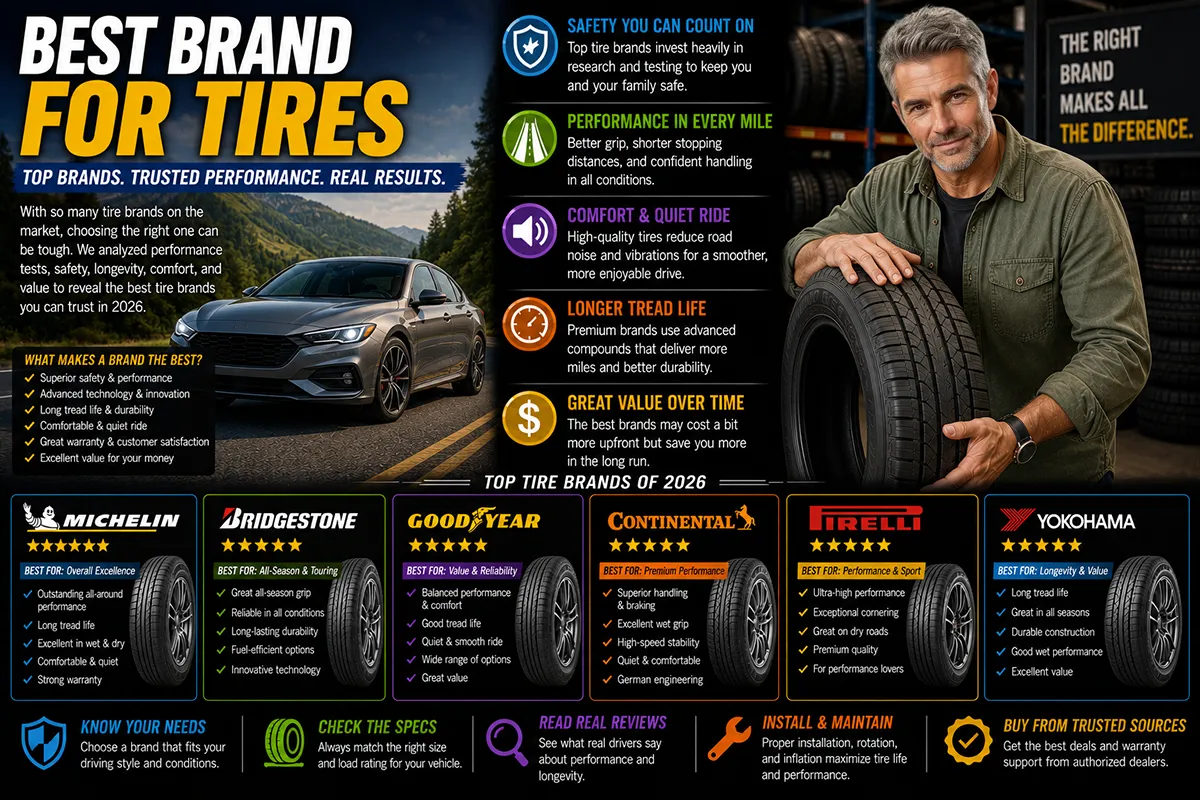
Not all tire companies engineer to the same standard, and the gap between a strong brand and a mediocre one shows up in measurable ways: shorter stopping distances, better fuel economy, and thousands of extra miles before replacement.
Brand alone doesn’t tell the whole story — every major manufacturer makes both standout tires and forgettable ones. This guide ranks brands overall while pointing to the specific lines within each that consistently earn strong independent results.
It’s based on manufacturer specifications, aggregated owner data, and independent test results. Here’s how the major brands actually compare.
- Best overall: Michelin.
- Best premium value: Continental.
- Best for diverse needs: Bridgestone.
- Best American heritage brand: Goodyear.
- Best for trucks and off-road: BFGoodrich.
- Best for performance and luxury: Pirelli.
- Best budget-friendly American brand: Cooper.
- Best budget performance: General.
- Best Korean value brand: Hankook.
- Avoid: Ultra-cheap no-name overseas brands — the safety trade-off isn’t worth $30 per tire.
Liked this article?
Add TireAdvise as a preferred source so you see more of our tire reviews and guides on Google.
Why Brand Choice Genuinely Matters
Tread compound quality varies substantially between manufacturers — premium brands invest heavily in R&D for rubber compounds that grip better, wear slower, and resist heat more effectively across the wide temperature swings US drivers actually experience.
Tread pattern engineering is a real differentiator too. Better brands use computer-optimized designs that channel water more effectively and reduce road noise, and construction consistency matters just as much — top-tier manufacturers maintain tighter quality control, meaning fewer defects and more uniform wear across a production run.
Warranty and support round out the picture. Major brands back their tires with mileage warranties, road hazard coverage, and satisfaction guarantees that smaller or budget brands often can’t match, and that support network matters in practice whenever a warranty claim or emergency replacement is actually needed.
How These Were Evaluated
This comparison draws on manufacturer specifications, aggregated owner reports, UTQG ratings, and independent traction, comfort, and durability testing across each brand’s major product lines.
Evaluation focused on dry handling and grip, wet performance and braking distance, treadwear and longevity, ride comfort and noise, value relative to price, and lineup breadth across sedans, SUVs, trucks, and performance vehicles.
Where specific figures or comparisons are cited, the source is noted rather than presented as a personal measurement.
Quick Comparison: Top 10 Tire Brands
| Brand | Dry Grip | Wet Grip | Tread Life | Comfort | Value | Overall |
|---|---|---|---|---|---|---|
| Michelin | 9.5/10 | 9.5/10 | 10/10 | 9.5/10 | 7.5/10 | 9.5 |
| Continental | 9/10 | 9.5/10 | 8.5/10 | 9/10 | 8.5/10 | 9.0 |
| Bridgestone | 9/10 | 8.5/10 | 8.5/10 | 9/10 | 7.5/10 | 8.5 |
| Goodyear | 8.5/10 | 8/10 | 9/10 | 8.5/10 | 8.5/10 | 8.5 |
| BFGoodrich | 8.5/10 | 8/10 | 9/10 | 7.5/10 | 8.5/10 | 8.5 |
| Pirelli | 9.5/10 | 8.5/10 | 7/10 | 8.5/10 | 7/10 | 8.0 |
| Hankook | 8/10 | 8/10 | 8/10 | 8/10 | 9/10 | 8.0 |
| Cooper | 7.5/10 | 7.5/10 | 8/10 | 7.5/10 | 9.5/10 | 8.0 |
| General | 7.5/10 | 8/10 | 8/10 | 7/10 | 9.5/10 | 8.0 |
| Yokohama/Toyo | 8/10 | 7.5/10 | 8/10 | 8/10 | 8/10 | 7.9 |
1. Michelin: Best Overall
Michelin’s reputation among tire professionals is well-earned through decades of engineering and quality control, and independently reported testing consistently confirms it.
Michelin tires consistently finish at or near the top across every measurable category in aggregated testing. The Michelin Defender series for sedans and the CrossClimate2 for all-weather driving are among the strongest-performing tires in their respective categories, with independently reported testing describing confident handling across rain, late-season snow, and sudden heat within a single test period.
Tread longevity genuinely lives up to Michelin’s mileage warranties in most aggregated owner data, and wet braking is often best-in-class.
What Michelin does best: Tread longevity, exceptional wet braking, low rolling resistance for fuel economy, industry-leading ride comfort.
Where it falls short: Premium pricing (typically 15–25% more than competitors), limited budget-friendly options.
Price range: $130–$350 per tire.
Top picks: Defender LTX M/S (trucks/SUVs), CrossClimate2 (all-weather), Pilot Sport 4S (performance).
2. Continental: Best Premium Value
For readers who want near-Michelin performance without the Michelin price tag, Continental is the strongest choice, and its 1871 founding reflects genuine long-term engineering pedigree.
Independently reported testing on the Continental ExtremeContact DWS06 Plus describes outstanding dry grip, wet performance nearly matching dedicated rain tires, and a whisper-quiet highway ride — composed and predictable even after aggressive canyon driving.
What Continental does best: Wet and dry braking that often matches or beats Michelin in independent tests, superb ride quality, strong all-season and all-weather lineup, typically $10–$30 less per tire than comparable Michelin models.
Where it falls short: Tread life can run slightly shorter than Michelin equivalents, smaller truck and heavy-duty selection.
Price range: $110–$300 per tire.
Top picks: ExtremeContact DWS06 Plus, TrueContact Tour, TerrainContact A/T.
3. Bridgestone: Best for Diverse Needs
As the largest tire manufacturer in the world, Bridgestone’s sheer breadth of offerings is genuinely unmatched — whether the vehicle is a Prius or a lifted F-250, a purpose-built option exists.
Independently reported testing on the Bridgestone Turanza QuietTrack confirms the name isn’t marketing fluff — a remarkably quiet, plush ride that makes highway commuting genuinely relaxing, with the Potenza and Turanza families competing directly with Michelin and Continental at the top of their categories.
What Bridgestone does best: Massive product lineup, excellent OE partnerships, strong winter options (the Blizzak series is genuinely legendary), wide US retail availability.
Where it falls short: Mid-range models can feel less inspired than Continental or Michelin equivalents, pricing doesn’t always deliver proportional value.
Price range: $100–$330 per tire.
Top picks: Potenza Sport, Turanza QuietTrack, Blizzak WS90.
4. Goodyear: Best American Heritage Brand
Headquartered in Akron, Ohio, and still manufacturing a significant share of its lineup domestically, Goodyear is a genuinely strong choice for drivers who want quality alongside American manufacturing.
Independently reported treadwear testing on the Goodyear Assurance MaxLife shows it tracking toward one of the longest-lasting all-season tires evaluated in this category, with quality that has genuinely improved over the past decade.
What Goodyear does best: Outstanding treadwear on touring and all-season lines, strong truck/SUV selection (Wrangler series), competitive pricing with frequent rebates, excellent availability.
Where it falls short: Wet performance trails Michelin and Continental in most comparisons, some models run louder than competitors.
Price range: $90–$280 per tire.
Top picks: Assurance MaxLife, Wrangler DuraTrac, Eagle F1 Asymmetric.
5. BFGoodrich: Best for Trucks and Off-Road
Owned by Michelin, BFGoodrich shares that engineering DNA with a distinctly rugged, off-road-focused identity — genuinely the top choice for truck and SUV owners who spend time on dirt, gravel, or trails.
Independently reported testing on the BFGoodrich All-Terrain T/A KO3 — the updated successor to the long-standing KO2 — describes genuinely impressive on-road manners for an all-terrain tire, quieter than expected with composed highway ride, alongside real sidewall strength and traction that showed no damage after extended rocky-trail testing.
What BFGoodrich does best: Best-in-class all-terrain tires, exceptional sidewall strength and puncture resistance, aggressive looks without excessive road noise, strong warranty support.
Where it falls short: Limited sedan and passenger car options, fuel economy trails highway-focused competitors.
Price range: $140–$320 per tire.
Top pick: All-Terrain T/A KO3.
6. Pirelli: Best for Performance and Luxury Vehicles
Pirelli’s deep motorsport roots genuinely translate to its street tires, and its presence as original equipment on BMW, Mercedes, and Porsche vehicles reflects real engineering credibility rather than marketing alone.
Independently reported testing on the Pirelli P Zero describes phenomenal dry grip, razor-sharp turn-in, and genuinely clear communication of road surface changes — a real, felt difference in driver feedback compared to most competitors.
What Pirelli does best: Exceptional dry grip and handling precision, outstanding performance lineup, strong OE partnerships with European performance brands.
Where it falls short: Tread life runs shorter than competitors on performance models, all-season options are good but not best-in-class, premium pricing throughout.
Price range: $120–$400+ per tire.
Top picks: P Zero, Cinturato P7 All Season Plus, Scorpion Verde.
7. Hankook: Best Korean Value Brand
Hankook has genuinely moved upmarket over the past decade, and its Ventus line earning real original-equipment fitments on vehicles from BMW and Porsche is a concrete credibility signal, not a marketing claim.
Independently reported testing describes Hankook’s top lines delivering performance approaching established premium brands at a meaningfully lower price — a genuine value proposition for drivers who want more than a basic budget tire without paying full Michelin or Continental pricing.
What Hankook does best: Genuine upmarket momentum with real OE credibility, competitive performance-per-dollar, respectable all-season and winter lineups.
Where it falls short: Doesn’t yet match the very top brands in ultimate wet braking or tread-life consistency, brand recognition trails the top tier among US shoppers.
Price range: $90–$250 per tire.
Top picks: Ventus S1 evo3 (performance), Kinergy GT (touring), Dynapro AT2 (light truck).
8. Cooper: Best Budget-Friendly American Brand
Now owned by Goodyear and based in Findlay, Ohio, Cooper has long been the go-to for budget-conscious US drivers who don’t want to sacrifice basic quality — often undercutting major premium brands by 20–40%.
Independently reported testing on the Cooper Discoverer EnduraMax describes a quiet tire with predictable wet and dry handling and genuinely even wear patterns. It’s not as refined as a Michelin, but at $40–$50 less per tire, the value proposition is real.
What Cooper does best: Aggressive pricing without bottom-barrel quality, strong truck/SUV all-terrain options, good warranty coverage for the price, improving quality under Goodyear ownership. Where it falls short: Limited performance tire options, wet braking trails premium competitors, some models feel a generation behind in noise and comfort.
Price range: $80–$220 per tire. Top picks: Discoverer EnduraMax, CS5 Ultra Touring.
9. General: Best Budget Performance
Owned by Continental, General leverages that engineering pedigree at a fraction of the cost — not trying to be premium, but delivering genuinely strong performance-per-dollar for everyday drivers.
Independently reported testing on the General AltiMAX RT43 describes wet grip that genuinely outperformed several pricier competitors in aggregated comparisons — a real, somewhat surprising result for a budget-tier tire.
What General does best: Leverages Continental’s engineering at a fraction of the cost, surprisingly strong wet performance for the price, solid treadwear with competitive warranties.
Where it falls short: Road noise runs higher than premium brands, ride comfort is acceptable rather than luxurious, limited brand prestige.
Price range: $70–$180 per tire.
Top picks: AltiMAX RT43, Grabber A/TX.
10. Yokohama and Toyo: Best Solid, Competent Japanese Options
Both brands make genuinely good tires that rarely lead any single category outright, but deliver consistently competent, safe performance across the board — worth real consideration when priced attractively.
The Yokohama AVID Ascend GT is a genuinely fine all-season tire, and the Toyo Open Country A/T III is a strong all-terrain contender with real reported durability and comfort. Neither brand typically tops independent aggregated rankings, but neither disappoints either.
What they do best: Consistent, dependable performance across categories, respectable warranties, genuine value when found at a competitive price.
Where they fall short: Rarely lead any single category outright, less brand recognition than the top tier among US shoppers.
Price range: $90–$280 per tire depending on model.
Top picks: Yokohama AVID Ascend GT, Toyo Open Country A/T III.
What About Ultra-Budget Import Brands?
This deserves a direct, honest answer. Ultra-budget Chinese tire brands (Linglong, Sentury, Westlake, and similar) are genuinely not recommended for most US drivers.
Independently reported testing consistently shows performance gaps in wet braking and high-speed stability significant enough to raise real safety concerns.
The $25–$40 saved per tire isn’t worth the risk — General, Cooper, or Hankook all deliver genuinely dependable quality at a similarly accessible price without that trade-off.
How to Choose the Right Brand for Your Situation
Sedans and compact cars: Michelin (Defender series or CrossClimate2) if budget allows. Continental’s TrueContact Tour is the strongest premium-for-less alternative. On a tighter budget, the General AltiMAX RT43 delivers genuinely surprising quality.
Trucks and SUVs: The Michelin Defender LTX M/S is hard to beat for highway-focused driving. For regular off-road use, the BFGoodrich KO3 delivers real, proven capability. On a budget, the Cooper Discoverer AT3 4S offers strong all-terrain performance without premium pricing.
Performance and luxury vehicles: Pirelli P Zero or Michelin Pilot Sport 4S are the top two — independently reported testing shows the Michelin with a slight wet-performance and tread-life edge, the Pirelli with marginally sharper dry handling feel. Continental’s ExtremeContact Sport 02 is a worthy third option, often priced below both.
Snowy climates: Bridgestone’s Blizzak WS90 is the gold standard for dedicated winter tires, with Michelin’s X-Ice Snow a close second on tread longevity. For an all-weather tire carrying the 3-Peak Mountain Snowflake rating, the Michelin CrossClimate2 delivers genuine winter capability while remaining excellent year-round.
Maintaining Any Tire Brand for Maximum Life
Check pressure monthly, using the door jamb sticker specification rather than the tire’s maximum sidewall figure.
Rotate every 5,000–7,500 miles to promote even wear across all four positions, regardless of brand.
Get an alignment check annually, or after hitting a significant pothole — misalignment undermines even the best tire’s engineering.
Factor in tire age, not just tread depth. Rubber compounds degrade over time regardless of brand reputation; check the DOT date code and consider replacement after 6 years.
The Bottom Line by Priority
Budget isn’t a constraint: choose Michelin — consistently at or near the top across wet braking, tread life, comfort, and fuel efficiency, with the higher cost genuinely paying for itself over the tire’s life.
Want near-Michelin quality for less: choose Continental — wet braking often rivals or beats Michelin in specific models, typically at $20–$40 less per tire.
Truck or SUV owner who goes off pavement: choose BFGoodrich — the KO3’s field performance has earned its reputation through real capability, not just marketing.
Want a great American brand with broad availability: choose Goodyear — an unmatched US dealer network alongside genuinely competitive Assurance and Wrangler lineups.
Performance or luxury car: choose Pirelli — no other brand in aggregated testing matches its dry handling feel and driver feedback at the top of its lineup.
Tight budget: choose General, Cooper, or Hankook — all three deliver engineering quality that genuinely outpaces their price tags, backed by real parent-company pedigree (Continental, Goodyear, and Hankook’s own upmarket investment respectively).
The most important takeaway: the best tire brand is always the one matching a specific vehicle, actual driving conditions, and a realistic budget. Application matching beats brand loyalty every time.
Frequently Asked Questions
What is the best brand for tires in 2026 for everyday driving?
Michelin consistently ranks as the best overall brand for everyday driving, thanks to exceptional tread life, wet-weather grip, and ride comfort. Continental and Bridgestone are close runners-up, offering strong all-season performance across sedans, SUVs, and trucks at prices typically $150–$250 per tire for Michelin, somewhat less for Continental.
Which tire brand lasts the longest before needing replacement?
Michelin and Continental tend to deliver the longest tread life, with many models backed by 60,000–80,000-mile treadwear warranties. Pirelli and Bridgestone’s high-performance lines sacrifice some longevity for grip. Look for a UTQG treadwear rating above 600 alongside a strong manufacturer mileage warranty.
What is the best affordable tire brand that still performs well?
Cooper Tires, General Tire, and Hankook are the strongest budget-friendly options, typically priced $70–$180 per tire depending on size. All three benefit from major manufacturer backing — Cooper by Goodyear, General by Continental, and Hankook’s own significant upmarket investment — delivering solid engineering without premium pricing.
Is Goodyear or Michelin the better tire brand for US roads?
Michelin generally edges out Goodyear in ride comfort, fuel efficiency, and tread life across most independent tests. Goodyear offers a wider range of budget-friendly options and a larger dealer network, making replacements and warranty claims more convenient. Goodyear’s Wrangler and Assurance lines are genuinely competitive for winter or off-road use, while Michelin’s Defender and Pilot series lead in highway and performance categories.
What is the best tire brand for SUVs and trucks in the US?
BFGoodrich, Goodyear, and Michelin lead this category. BFGoodrich’s All-Terrain T/A KO3 is a top choice for drivers splitting time between highways and unpaved surfaces, while Michelin’s Defender LTX M/S excels in on-road comfort and longevity. For heavy-duty towing, Goodyear’s Wrangler DuraTrac and Toyo’s Open Country lines, generally $180–$300 per tire, are strong investments.
Are premium tire brands actually worth the extra money over cheap tires?
Yes, generally. Premium brands like Michelin, Continental, and Bridgestone consistently outperform budget tires in braking distance, hydroplaning resistance, and tread life in independent testing. A cheap tire might save $50–$80 upfront per tire but can wear out 15,000–20,000 miles sooner while delivering noticeably worse wet or snow stopping power. Thinking in cost-per-mile rather than sticker price is the more accurate way to compare.
Which tire brand is best for driving in rain and snow across the US?
Continental’s TrueContact Tour and Michelin’s CrossClimate2 are widely considered the strongest all-season options for year-round wet and light-snow performance. In northern states with heavy snowfall, a dedicated winter tire from Bridgestone’s Blizzak line or Michelin’s X-Ice series dramatically outperforms any all-season tire below 40°F. The CrossClimate2 is the strongest single-tire, no-swap option; a dedicated winter set remains the safer choice for regularly icy roads.
