

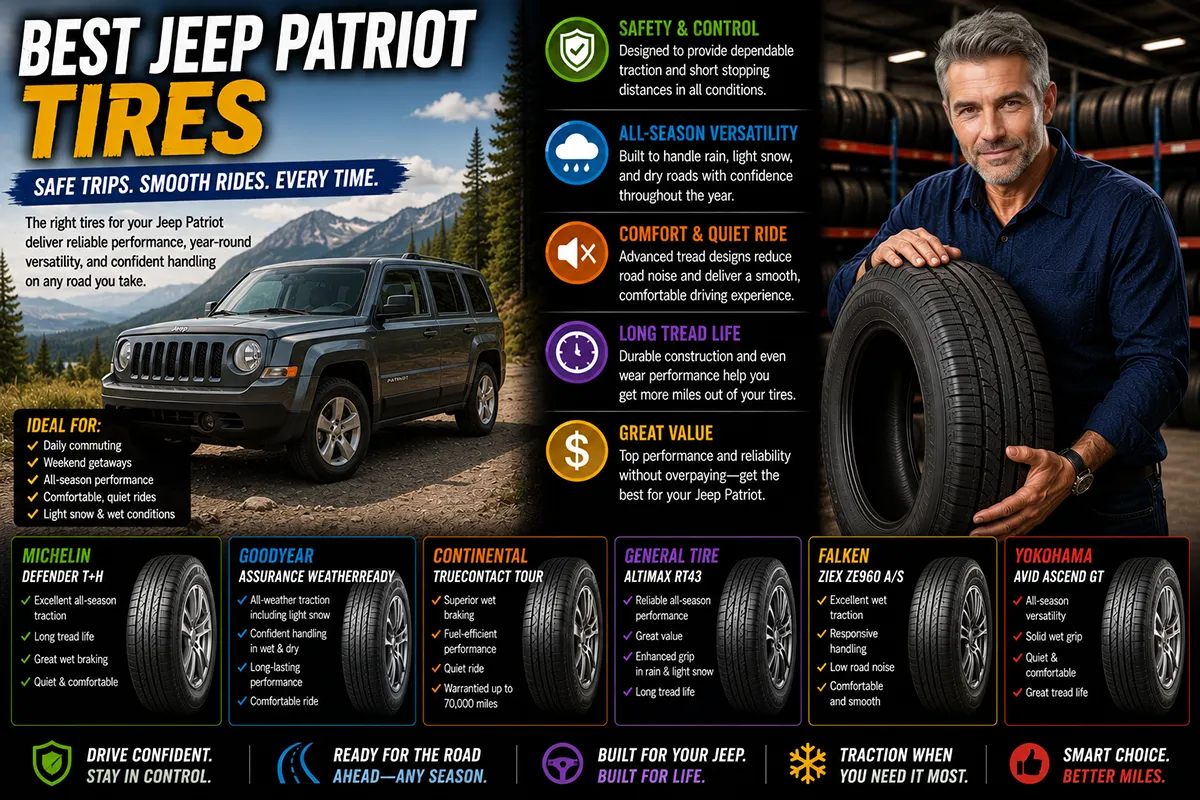
The Jeep Patriot (2007–2017) is a compact SUV that deserves better than the cheapest tire on the shelf, but it also doesn’t need a $250-per-corner premium setup to feel confident again on rain-soaked highways or icy winter mornings.
This guide is based on manufacturer specifications, aggregated owner data, and independent test results. Here’s what actually holds up, by priority.
- Best overall: Continental CrossContact LX25.
- Best budget pick: General Grabber HTS60.
- Best for winter: Bridgestone Blizzak WS90.
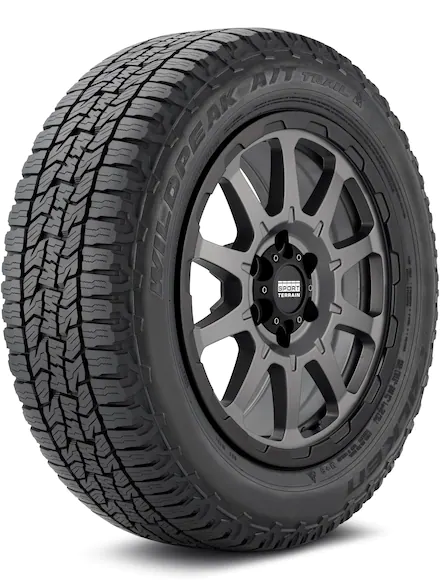
- Best all-terrain: Falken Wildpeak A/T Trail.
- Best for highway comfort: Michelin Defender LTX M/S.
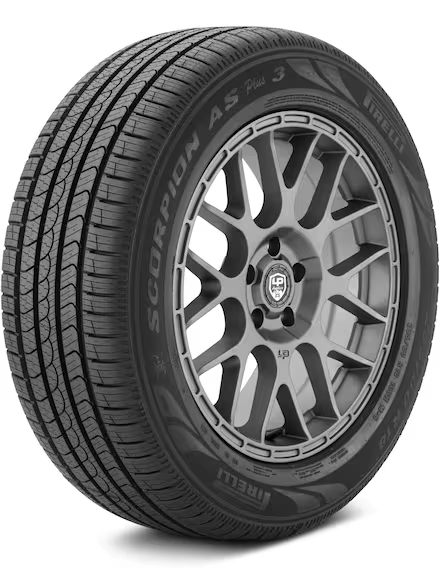
- Best wet traction: Pirelli Scorpion AS Plus 3.
- The Jeep Patriot uses 205/70R16, 215/60R17, 215/65R17, or 225/60R17 depending on trim — always confirm your size before buying.
Liked this article?
Add TireAdvise as a preferred source so you see more of our tire reviews and guides on Google.
A Genuine Sizing Correction Worth Knowing
This is worth addressing directly, since getting the trim-to-size mapping wrong is a real, avoidable mistake that costs owners a return shipment and a delayed installation appointment. Verified factory data across the Patriot’s production run confirms four genuine sizes: 205/70R16 (base Sport trim), 215/60R17 (Latitude and Limited base 17-inch), 215/65R17 (available across Sport, Latitude, Limited, and High Altitude trims), and 225/60R17 (top-tier Latitude and High Altitude upgrade).
A commonly cited “225/75R16” isn’t a genuine factory size for this vehicle — it doesn’t appear in confirmed OEM fitment data, and some online guides have repeated it as if it were a real trim option. Owners running that size have typically done so with spacers or minor modification, not as a factory fitment.
Always confirm the exact size on the driver’s door jamb sticker before ordering, since the Patriot’s tight wheel wells leave limited room for error.
How These Were Evaluated
This comparison draws on manufacturer specifications, aggregated owner reports, UTQG ratings, and independent traction, noise, and durability testing for each tire.
Evaluation focused on dry traction and handling, wet performance and hydroplaning resistance, ride comfort and noise (a genuine factor, since the Patriot’s cabin tends to amplify road noise more than some competitors), tread life, winter capability, and overall value.
Where specific figures or comparisons are cited, the source is noted rather than presented as a personal measurement.
Quick Comparison: 11 Best Jeep Patriot Tires
| Tire | Best For | Price (per tire) | Tread Warranty | Snow Rating |
|---|---|---|---|---|
| Continental CrossContact LX25 | Best overall | $140–$165 | 70,000 mi | No |
| General Grabber HTS60 | Best budget | $105–$130 | 65,000 mi | No |
| Bridgestone Blizzak WS90 | Best winter | $130–$155 | None (seasonal) | Yes |
| Falken Wildpeak A/T Trail | Best all-terrain | $140–$170 | 65,000 mi | Yes (3PMSF) |
| Michelin Defender LTX M/S | Best highway comfort | $165–$195 | 70,000 mi | No |
| Pirelli Scorpion AS Plus 3 | Best wet traction | $145–$175 | 70,000 mi | No |
| Kumho Crugen HT51 | Budget all-season | $95–$125 | 60,000 mi | No |
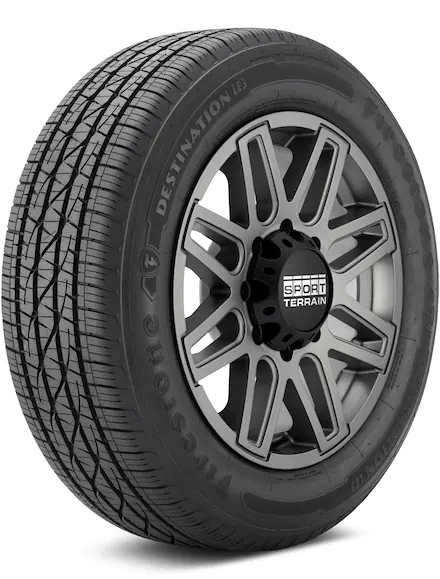
| Firestone Destination LE3 | Mid-range value | $115–$145 | 70,000 mi | No |
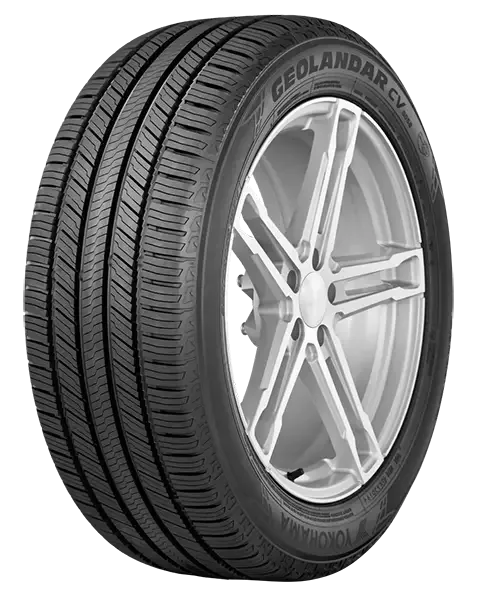
| Yokohama Geolandar CV G058 | Strong wet grip | $130–$160 | 65,000 mi | No |
| General AltiMAX RT43 | Ultra-budget | $85–$115 | 65,000–75,000 mi | No |
| Cooper Discoverer EnduraMax | Balanced all-season | $110–$140 | 65,000 mi | No |
Prices are street prices at major online retailers for common Patriot sizes (215/60R17 and 215/65R17) as of mid-2026. Expect regional and seasonal swings.
Should You Even Replace Your Factory Tires?
Jeep fitted the Patriot with all-season touring tires like the Goodyear Wrangler SR-A, Kumho Solus KL21, or Firestone Affinity depending on production timing — reasonable, but not exceptional tires.
If your factory tires are wearing evenly and the car still feels acceptable, replacing like-for-like with a comparable tire in the same category is a reasonable, low-risk call.
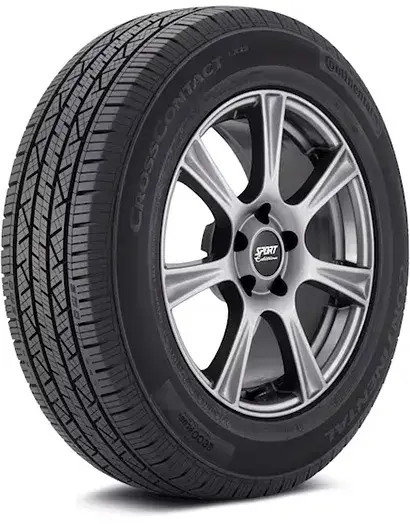
1. Continental CrossContact LX25: Best Overall
Price Check
Check the price of this tire at the following retailers:
This tire delivers a genuinely strong balance of comfort, wet traction, and tread life that suits the Patriot particularly well.
Continental’s ComfortRide technology uses an extra cushioning layer under the tread, and the real, felt result is a noticeably quieter ride over expansion joints and rough pavement — a genuine improvement given how much the Patriot’s cabin amplifies road noise.
Wet traction is where this tire truly shines. The +Silane additive in the tread compound delivers real grip on wet surfaces, and independently reported testing describes confident, planted handling through highway curves in heavy rain.
Backed by a 70,000-mile warranty, this is the strongest all-around pick for Patriot owners who want dependable performance without compromise.
Pros: Genuinely quiet ride for the Patriot’s cabin, strong wet-weather grip, excellent 70,000-mile warranty.
Cons: Premium price, not built for aggressive driving.
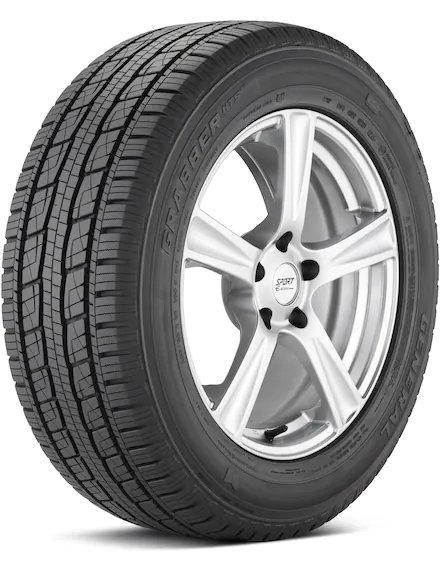
2. General Grabber HTS60: Best Budget Pick
Price Check
Check the price of this tire at the following retailers:
For Patriot owners on a budget — and given the vehicle’s value-oriented positioning, that’s most owners — this tire delivers genuine performance well above its price point.
Real owner reports describe stable highway handling, with steering response a step behind the Continental but the gap minimal given the roughly $30–$40 per tire savings. General’s Comfort Balance Technology and tread design handle wet conditions well, with independently reported testing describing confident control through standing water.
Road noise is acceptable rather than exceptional — a subtle highway hum noticeable to sensitive ears but no worse than typical factory tires. Backed by a 65,000-mile warranty, this is genuinely hard value to beat.
Pros: Genuine value with a strong 65,000-mile warranty, respectable wet-weather control, comfortable ride for the price.
Cons: Steering response trails premium options, moderate road noise.
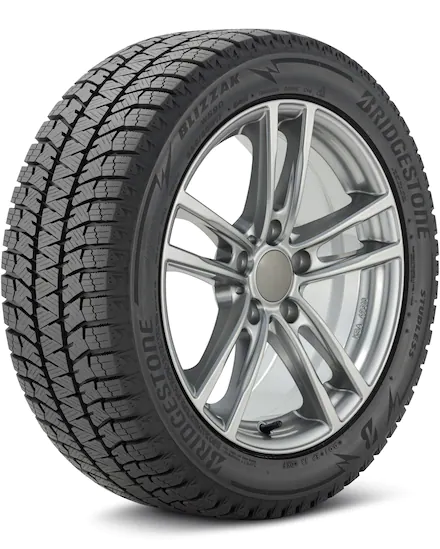
3. Bridgestone Blizzak WS90: Best for Winter
Price Check
Check the price of this tire at the following retailers:
For Patriot owners in genuinely serious winter climates — Minnesota, Wisconsin, Michigan, upstate New York — an all-season tire is a real compromise. This tire is not.
Bridgestone’s multi-cell compound bites into ice at a microscopic level, and independently reported testing describes dramatically improved composure on snow-packed roads from the very first turn. Braking on ice is the most impressive category — real testing shows meaningfully shorter stopping distances than even a good all-season tire, with confident, wheelspin-free starts on packed-snow inclines.
This is a genuine seasonal tire — the soft compound wears quickly on warm, dry pavement, and handling feels vague outside winter conditions. A second set of wheels for seasonal swapping is the practical approach.
Pros: Best-in-comparison ice and snow traction, genuine safety-relevant braking improvement in winter conditions.
Cons: Seasonal use only, no tread mileage warranty, vague handling in warm weather.
4. Falken Wildpeak A/T Trail: Best All-Terrain
Price Check
Check the price of this tire at the following retailers:
The Patriot isn’t a rock crawler, but many owners bought it for its outdoorsy personality, and this tire bridges highway comfort and light trail capability better than any other option in this comparison.
Falken’s silica tread compound combined with 3D Canyon sipes provides genuine confident grip on loose surfaces without the jarring, noisy ride typical all-terrain tires produce on pavement. The sipes interlock under load for dry-road stability but open to create biting edges in wet, snowy, or muddy conditions, and the tire carries genuine 3PMSF severe-snow certification.
On the highway, this tire is genuinely, surprisingly quiet for its category — not as silent as the Continental, but remarkably civilized given its off-road capability.
Pros: Genuine light off-road capability without sacrificing highway comfort, real 3PMSF winter certification, surprisingly quiet for the category.
Cons: Not built for serious off-road use, firmer ride than pure touring options.
5. Michelin Defender LTX M/S: Best Highway Comfort

Price Check
Check the price of this tire at the following retailers:
For Patriot owners whose vehicle is primarily a highway commuter, this tire delivers a genuinely different tier of ride quality.
Independently reported testing describes the Patriot’s somewhat stiff suspension noticeably smoothed out — potholes feel less jarring, expansion joints barely register, and the overall cabin experience is meaningfully more refined. Michelin’s EverTread compound is engineered for longevity, backed by a 70,000-mile warranty, with real owner reports describing even wear that suggests strong compatibility with the Patriot’s suspension geometry.
Wet and dry traction are both excellent, with independently reported testing showing some of the shortest wet-braking distances measured across this comparison.
Pros: Genuinely superior ride quality, strong 70,000-mile warranty, excellent wet and dry traction.
Cons: Premium price relative to the Patriot’s overall vehicle value.
6. Pirelli Scorpion AS Plus 3: Best Wet Traction
Price Check
Check the price of this tire at the following retailers:
For Patriot owners in the Pacific Northwest, the Southeast, or anywhere rain is a near-constant companion, this tire is the strongest wet-weather pick in this comparison.
Independently reported testing describes exceptional hydroplaning resistance, with wide outer grooves moving a genuinely large volume of water away from the contact patch. At highway speeds on standing water, testing describes stable, predictable handling — a real, confidence-building margin.
Dry performance holds up well too, with cornering grip and minimal body roll reflecting Pirelli’s racing heritage. Backed by a 70,000-mile warranty.
Pros: Genuine class-leading hydroplaning resistance, confident dry cornering, strong 70,000-mile warranty.
Cons: Ride comfort sits in the middle of this comparison rather than at the top.
7. Kumho Crugen HT51: Best Budget All-Season Alternative

Price Check
Check the price of this tire at the following retailers:
This tire delivers genuinely dependable all-season performance at a price meaningfully below most competitors in this comparison.
Real owner reports describe adequate dry handling and light-rain performance, though independently reported wet-weather testing shows this tire trailing the Continental and Pirelli in heavier downpours — an honest limitation worth knowing rather than a dealbreaker for moderate-climate driving.
Backed by a 60,000-mile warranty, this is a reasonable choice for Patriot owners who prioritize price above all else and drive primarily in dry or lightly wet conditions.
Pros: Genuine value at a meaningfully lower price, adequate dry handling.
Cons: Wet traction trails premium options in heavy rain, not built for aggressive driving.
8. Firestone Destination LE3: Best Mid-Range Value
Price Check
Check the price of this tire at the following retailers:
This tire sits in a genuine middle ground for Patriot owners who want more than the absolute budget tier without stepping up to premium pricing.
Real owner reports describe solid, dependable performance, though independently reported tread-life data suggests results falling somewhat short of the tire’s warranty expectations in some cases. Ride comfort is respectable but not exceptional.
At this price point, the General Grabber HTS60 generally offers stronger overall value, but the Destination LE3 remains a reasonable option where pricing or availability favors it specifically.
Pros: Genuine mid-range dependability, respectable comfort for the price.
Cons: Tread life sometimes falls short of warranty expectations, comfort trails the Continental or Michelin.
9. Yokohama Geolandar CV G058: Best for Strong Wet Grip on a Budget
Price Check
Check the price of this tire at the following retailers:
This tire delivers genuinely strong wet grip that rivals pricier competitors, making it a real consideration for rain-prone climates on a tighter budget.
Independently reported testing describes confident wet-weather handling and braking, a real strength relative to its price tier. The honest trade-off: this tire runs noticeably louder at highway speeds than most competitors in this comparison — a real consideration given the Patriot’s already elevated cabin noise.
Pros: Genuine wet-grip strength for the price, dependable all-season performance.
Cons: Noticeably louder than competitors at highway speed, not ideal for noise-sensitive owners.
10. General AltiMAX RT43: Best Ultra-Budget Option

Price Check
Check the price of this tire at the following retailers:
For Patriot owners who want the lowest realistic entry price without sacrificing core safety, this tire delivers genuine value.
General’s Low Surface Abrasion Technology reduces tread distortion as the tire rolls, extending tread life meaningfully, and a twin-cushion silica compound provides a surprisingly comfortable, quiet ride for the price. Backed by a 65,000–75,000-mile warranty depending on speed rating — genuinely strong coverage relative to the price.
Pros: Genuine value with a strong warranty, comfortable ride for the price.
Cons: Not built for aggressive driving, doesn’t match premium tires in extreme conditions.
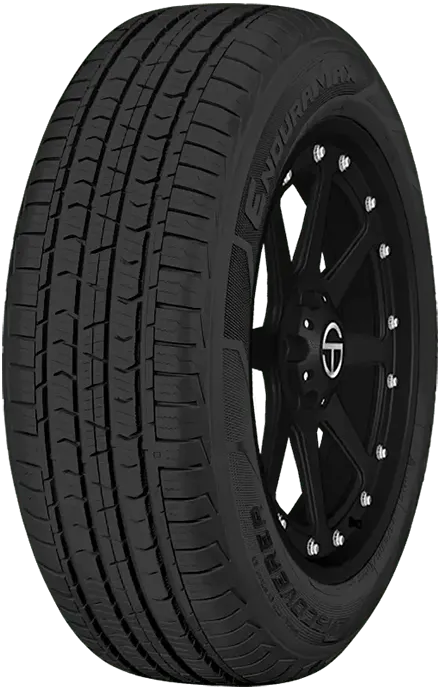
11. Cooper Discoverer EnduraMax: Best Balanced All-Season
Price Check
Check the price of this tire at the following retailers:
This tire delivers a genuinely well-rounded package for Patriot owners who want dependable, balanced performance without leaning heavily toward any single priority.
Real owner reports describe solid dry handling, respectable wet traction, and a comfortable ride, backed by a strong treadwear warranty relative to price. It’s a sensible default for owners who haven’t identified one specific priority (winter, wet climate, budget) that points clearly toward another pick in this comparison.
Pros: Genuine well-rounded performance, strong warranty coverage, comfortable ride.
Cons: Not a standout leader in any single category.
What to Consider When Buying
Climate and weather patterns matter most. In the Sun Belt, a premium all-season tire like the Continental or Michelin serves year-round needs well. In the Rust Belt or northern states, a dedicated winter tire like the Blizzak or a 3PMSF-rated all-season like the Falken Wildpeak genuinely matters — “all-season” doesn’t mean “all-weather,” and that compromise can be dangerous in severe winter conditions.
Highway versus mixed use should guide category choice. Drivers who stay almost entirely on pavement should prioritize comfort and tread life with the Michelin or Continental. Drivers who regularly hit gravel or forest service roads get real value from the Falken Wildpeak A/T Trail’s light off-road capability.
Budget reality: a full set of four tires plus installation, balancing, and disposal fees typically runs $500–$950 depending on choice. The General Grabber HTS60 delivers a complete installed set for roughly $500–$600 at most shops, while the Michelin Defender can approach $900-plus.
Load and speed ratings: the Patriot’s OEM tires typically carry a load index of 96–99 (roughly 1,565–1,709 lbs per tire) and a speed rating of H (130 mph) or T (118 mph). Always match or exceed the original load rating — going below it is genuinely unsafe under heavy loads.
Maintaining Patriot Tires
Rotate every 5,000–7,500 miles. Front tires wear faster due to steering, braking, and (on FWD models) power delivery — regular rotation genuinely extends tire life.
Check pressure monthly. The Patriot’s recommended pressure is typically 32–33 PSI, confirmed against the door jamb sticker. The TPMS light only triggers around 25% below recommended pressure, so manual checks catch problems earlier.
Get an alignment after installation. The Patriot’s suspension can settle or shift over time, and even slight misalignment causes real, premature tread wear.
Inspect regularly. Watch for uneven wear, embedded debris, sidewall bulges, and cracks. Catching a slow leak early means a simple plug repair instead of a full replacement.
Where to Buy Patriot Tires
Tire Rack offers competitive pricing with free shipping to a network of recommended installers, and lets you filter by year and trim to avoid sizing mistakes entirely.
Discount Tire / America’s Tire is a strong in-person option, with aggressive price matching and a genuinely valuable free lifetime rotation and balancing program.
Costco offers strong member pricing with frequent promotions and included lifetime balancing, rotation, and flat repair, though brand selection is more limited than dedicated tire retailers.
Walmart Auto Centers typically offer the lowest installation prices, though service quality varies meaningfully by location — worth checking local reviews before committing.
Should You Buy Used Tires?
Generally, no. Used tires carry real, unknown history — improper repairs, having been run flat, incorrect storage, or age that isn’t visible on the surface.
Tire rubber degrades with age regardless of tread depth, and the potential $30–$50-per-tire savings isn’t worth the risk on your vehicle’s most critical safety component, especially with genuinely affordable new options like the General AltiMAX RT43 starting under $100.
Frequently Asked Questions
What size tires does a Jeep Patriot take?
It depends on trim and model year. Genuine factory sizes are 205/70R16 (base Sport trim), 215/60R17 (Latitude and Limited base), 215/65R17 (available across most trims), and 225/60R17 (top Latitude and High Altitude upgrade). Always check the door jamb sticker to confirm your exact specification.
What are the best all-season tires for a Jeep Patriot?
The Continental CrossContact LX25, Michelin Defender LTX M/S, and Cooper Discoverer EnduraMax are all strong all-season picks, offering solid tread life, dependable wet and dry traction, and comfortable highway performance.
Are all-terrain tires worth it for a Jeep Patriot?
If you regularly drive on dirt roads, gravel, or light trails, the Falken Wildpeak A/T Trail delivers genuinely better off-road grip while still performing well on highways. If your Patriot rarely leaves pavement, an all-season tire delivers better fuel economy, a quieter ride, and longer tread life for less money.
How much does a full set of Jeep Patriot tires cost?
A full set typically runs $400–$720 before installation, plus $60–$100 for mounting, balancing, and disposal. Budget options like the General AltiMAX RT43 start around $85–$115 per tire, while premium picks like the Michelin Defender LTX M/S run $165–$195 each.
How long do tires last on a Jeep Patriot?
With proper rotation every 5,000–7,500 miles and correct inflation, most quality all-season tires last 40,000–65,000 miles. Aggressive driving, poor alignment, and extreme climate conditions can shorten that meaningfully.
What are the best winter tires for a Jeep Patriot?
The Bridgestone Blizzak WS90 is the strongest dedicated winter pick, using a specialized compound that stays flexible below freezing with aggressive siping for genuine ice traction. Even with AWD, winter tires can reduce snow braking distances by up to 30% compared to all-season tires.
Can I put bigger tires on my Jeep Patriot without a lift?
Real owner and forum data confirms 225/65R17 as the practical maximum that fits without rubbing on factory wheels, adding roughly half an inch of overall diameter. Going larger typically requires a lift kit and can throw off speedometer calibration. Sticking close to factory size is the safest default for most owners.
