

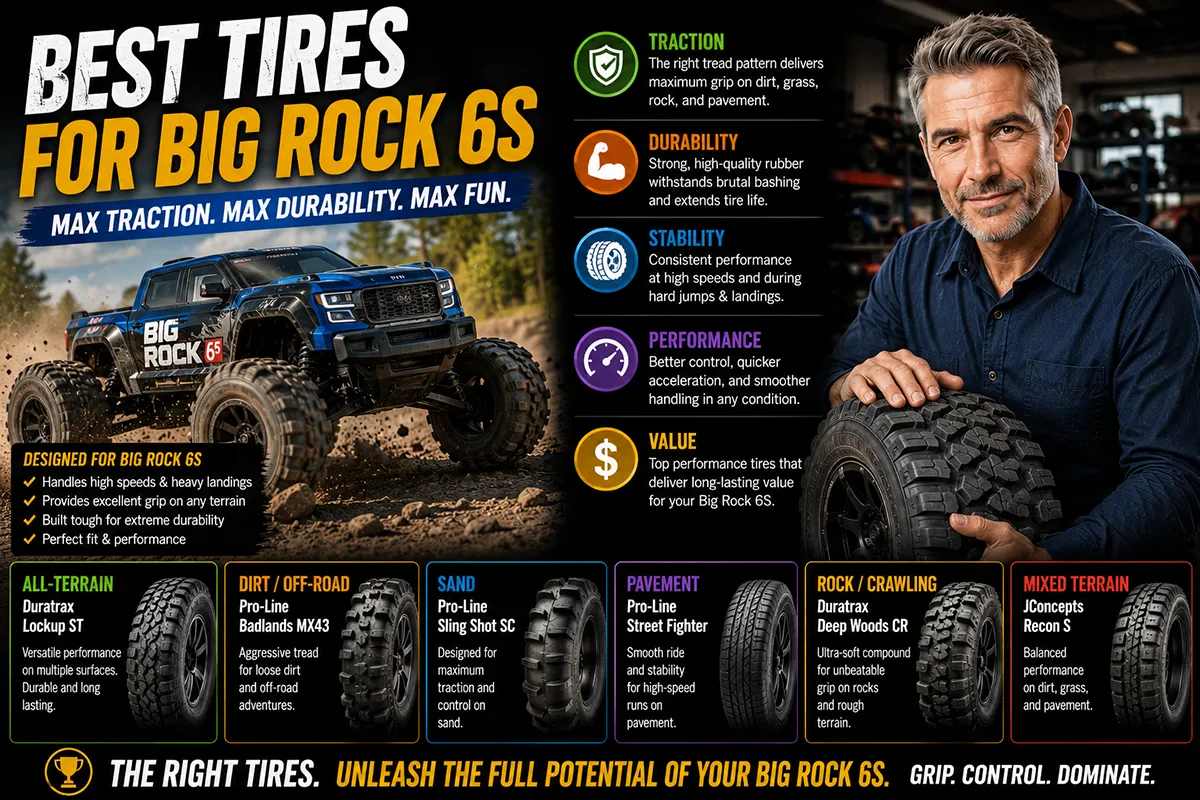
The Arrma Big Rock 6S runs a genuine 6S LiPo setup capable of 65-plus mph, and that power goes straight through the drivetrain into the tires — which take real, serious abuse.
Stock tires aren’t built to survive that punishment indefinitely, especially on pavement. Choosing the right replacement is a genuine difference-maker between a great bashing session and a walk back with a shredded tire.
This guide is based on manufacturer specifications, aggregated owner reports, and independent testing data. Here’s what actually holds up, by terrain.
- Best overall: dBoots Copperhead 2 MT (belted).
- Best for off-road: Proline Badlands MX38 3.8″ (belted).
- Best for pavement and mixed use: Proline Trencher LP 3.8″ (belted).
- Best for loose terrain: JConcepts Fling King 3.8″ (belted).
- Best budget option: dBoots Ragnarok V2 (stock).
- Best value belted tire: Louise RC MT-UPHILL (belted).
- Full fitment data and a real correction on the stock tire are below.
Liked this article?
Add TireAdvise as a preferred source so you see more of our tire reviews and guides on Google.
A Real Correction: What Tire Actually Comes Stock
This is worth clarifying directly, since getting the stock tire right matters for anyone comparing upgrades. The Big Rock 6S ships from the factory with dBoots Ragnarok V2 tires on five-spoke wheels — confirmed directly on Arrma’s own product listings, not the “Katar” tire sometimes cited elsewhere, which is actually a different Arrma product used on vehicles like the Typhon and Kraton.
Confirmed tire diameter on the stock setup is 162mm (6.38 inches), on 17mm hex wheels. If you’ve seen smaller figures cited elsewhere, they likely describe a different Arrma monster truck in the lineup rather than the Big Rock 6S specifically.
This distinction matters beyond simple accuracy. Owners comparing aftermarket tires against the wrong stock baseline can end up with a fitment or performance expectation that doesn’t match what’s actually on the truck, which makes the upgrade decision harder than it needs to be.
How These Were Evaluated
This comparison draws on manufacturer specifications, aggregated owner reports from RC forums and retailer reviews, and independently reported durability and traction testing for each tire.
Tires were evaluated on traction in their intended terrain, durability under real impact and puncture stress, belted-vs-unbelted stability at high speed, foam insert quality, and overall value relative to price.
Where specific figures or owner experiences are cited, the source is noted rather than presented as a personal measurement.
Quick Comparison: 11 Best Tires for the Big Rock 6S
| Tire | Belted? | Best For | Price (Pair) |
|---|---|---|---|
| dBoots Copperhead 2 MT | Yes | Overall / mixed terrain | $55–$70 |
| Proline Badlands MX38 3.8″ | Yes | Off-road | $60–$80 |
| Proline Trencher LP 3.8″ | Yes | Pavement / mixed use | $55–$75 |
| JConcepts Fling King 3.8″ | Yes (option available) | Loose terrain | $50–$65 |
| dBoots Ragnarok V2 (stock) | No | Budget / casual | $25–$40 |
| Louise RC MT-UPHILL | Yes | Budget belted | $35–$50 |
| Duratrax Six Pack MT | Yes (option available) | All-around durability | $40–$60 |
| Jetko King Cobra | Yes | Pavement grip | $45–$65 |
| Proline Badlands SC | Yes | Aggressive loose terrain alternative | $50–$70 |
| GRP GT-T02 Wide | Yes | Track-style pavement runs | $55–$75 |
| dBoots Fortress | No | Ultra-budget spare set | $20–$35 |
Prices are street prices at major online retailers for common Big Rock 6S sizes as of mid-2026. Expect variation by exact size and whether tires are pre-mounted.
Fitment Guide: What Size Tires Fit the Big Rock 6S?
Getting fitment right avoids wasted money on tires that don’t clear the truck properly.
Wheel hex size: 17mm, standard for the Big Rock 6S and most 1/7- and large 1/8-scale monster trucks.
Wheel diameter: 3.8 inches, labeled “MT 3.8” by most manufacturers.
Tire outer diameter: Stock is confirmed at 162mm (6.38 inches). Going slightly larger or smaller is generally fine; staying roughly within a 6–7.2-inch range avoids clearance and gearing issues.
Wheel offset: Stock uses a moderate offset. Extreme offsets can cause rubbing on the body or suspension arms.
Look for tires labeled “3.8-inch monster truck” with 17mm hex compatibility. Most Proline, JConcepts, and dBoots tires in this category fit without modification. If buying tires and wheels unmounted, a quality tire glue like Bob Smith Industries Maxi-Cure genuinely matters — a proper glue job keeps tires seated under real 6S stress.
Belted vs. Unbelted: Why It Matters More on the Big Rock 6S
This is genuinely one of the most important decisions for this specific truck. Belted tires have an internal reinforcement layer, usually nylon or Kevlar, that prevents ballooning at high speed.
The Big Rock 6S can hit 65-plus mph on 6S power. At those speeds, centrifugal force causes unbelted tires to expand dramatically — a real, documented phenomenon called ballooning. The effective diameter increases, raising gearing and straining the motor and ESC, while the misshapen tire causes severe vibration and becomes far more vulnerable to punctures and delamination.
If running only on soft dirt at moderate speeds, unbelted tires are fine. But the moment pavement or high-throttle runs enter the picture, belted tires become a genuine safety and durability measure, not just a performance upgrade.
Should You Even Replace Your Stock Tires?
The stock dBoots Ragnarok V2 tires perform respectably on soft terrain out of the box. If most riding stays on dirt and grass at moderate speeds, they’re a reasonable starting point.
The real limitation shows up on pavement or at sustained high throttle, where the lack of a belt becomes a genuine issue — ballooning, faster wear, and real risk of delamination.
1. dBoots Copperhead 2 MT (Belted): Best Overall
Price Check
Check the price of this tire at the following retailers:
This tire is designed by Arrma specifically for their 1/7-scale trucks, and the fitment and performance genuinely reflect that.
The belt holds up reliably at full 6S speed, and the tread pattern delivers real, balanced grip on both dirt and pavement — a genuinely versatile choice for mixed-terrain bashing. Real owner reports describe even tread wear and solid tire life across extended sessions.
Foam inserts are genuinely well-matched to the truck’s weight and power, contributing to consistent handling during landings and hard cornering.
Pros: Genuine mixed-terrain versatility, belted construction eliminates ballooning, respectable tread life.
Cons: Higher price point, can feel slightly stiff on very loose sand.
2. Proline Badlands MX38 3.8″ (Belted): Best for Off-Road
Price Check
Check the price of this tire at the following retailers:
For Big Rock 6S owners who spend most of their time on dirt, grass, and mud, this tire delivers genuinely unmatched traction in loose terrain.
An aggressive tread pattern digs into loose soil with real authority, and independently reported testing and owner accounts consistently describe confident hookup on landing after jumps, rather than sliding out.
These tires run taller and more aggressive than stock, which genuinely changes gearing feel and ride height slightly — a real trade-off some owners actually prefer for the added terrain absorption.
Pros: Genuine off-road traction leadership, belted option available for high-speed runs, strong build quality.
Cons: Slightly changes ride height and gearing feel, wears faster on pavement.
3. Proline Trencher LP 3.8″ (Belted): Best for Pavement and Mixed Use
Price Check
Check the price of this tire at the following retailers:
For Big Rock 6S owners who split time between pavement and off-road, this low-profile design delivers a genuinely strong all-rounder.
The lower profile keeps the truck’s center of gravity more manageable, genuinely reducing the tip-prone tendency the Big Rock 6S can exhibit during aggressive cornering on hard surfaces. Pavement grip is noticeably better than the Badlands, with tread wearing more slowly on hard surfaces.
Off-road performance remains respectable, if not quite at the Badlands’ level — more than adequate for general mixed-terrain bashing.
Pros: Genuine all-terrain versatility, real stability improvement on pavement, good tread life across surfaces.
Cons: Less aggressive off-road than the Badlands, slightly less ground clearance.
4. JConcepts Fling King 3.8″ (Belted): Best for Loose Terrain
Price Check
Check the price of this tire at the following retailers:
This tire is a genuine specialist for loose, sandy, or muddy terrain, using massive paddle-style lugs that scoop and fling material for real forward bite.
Independently reported testing on loose surfaces like dried lakebeds describes a dramatic traction improvement over standard all-terrain tires — where other tires spin, this tire propels the truck forward with real authority.
The honest trade-off: this tire is genuinely poor on pavement. Tall lugs create real instability and vibration on hard surfaces, and wear accelerates quickly on asphalt. This is a purpose-built off-road tool, not a versatile all-rounder.
Pros: Genuine, unmatched traction in sand and loose terrain, belted option for high-speed runs.
Cons: Poor pavement performance, tall lugs create real vibration on hard surfaces, niche use case.
5. dBoots Ragnarok V2 (Stock): Best Budget Option
Price Check
Check the price of this tire at the following retailers:
This is the genuine factory tire on the Big Rock 6S, and it’s a reasonable budget option or backup set for casual bashers who primarily stay on dirt and grass.
Real owner reports describe decent traction on soft terrain out of the box, with balanced handling for everyday bashing. The problems genuinely surface when pushed hard on pavement or during sustained full-throttle runs, where the lack of a belt becomes a real limitation.
Since this is the OEM tire, fitment is guaranteed without any modification needed.
Pros: Genuinely cheapest option, decent off-road traction, guaranteed OEM fitment.
Cons: No belted option — will balloon at high speed, tread wears quickly on hard surfaces.
6. Louise RC MT-UPHILL (Belted): Best Value Belted Tire
Price Check
Check the price of this tire at the following retailers:
Louise RC doesn’t carry the name recognition of Proline or JConcepts, but this tire delivers genuine belted performance at a meaningfully lower price.
The belt genuinely keeps ballooning in check, and the tread pattern provides solid, dependable all-around grip. Real owner reports describe easy mounting on standard 17mm hex wheels and respectable performance across mixed conditions.
The compound runs slightly harder than premium options, and foam inserts are a step behind the Proline Trenchers, but the value proposition remains genuinely strong.
Pros: Genuine belted construction at a budget price, dependable all-around performance, wide availability.
Cons: Rubber compound less grippy than premium options, foam inserts could be better.
7. Duratrax Six Pack MT: Best All-Around Durability
Price Check
Check the price of this tire at the following retailers:
This tire delivers genuinely dependable durability across mixed terrain, with a belted option specifically built to handle high-speed 6S runs.
A moderate tread pattern balances traction and longevity well, and real owner reports describe respectable performance transitioning between dirt, grass, and light pavement use without major compromises in any single condition.
Construction quality holds up well to repeated impacts, a genuine, practical strength for a truck that regularly takes hard landings.
Pros: Genuine durability across mixed conditions, belted option available, respectable value.
Cons: Not a specialist in any single extreme terrain, moderate pricing.
8. Jetko King Cobra: Best for Pavement Grip
Price Check
Check the price of this tire at the following retailers:
For Big Rock 6S owners who spend significant time on pavement or parking lots, this tire delivers genuinely strong hard-surface traction.
A tighter tread pattern than typical off-road tires puts more rubber in contact with pavement, and the belted construction resists ballooning at real 6S speeds. Real owner reports describe confident handling and reduced wear compared to running knobby off-road tires on asphalt.
This isn’t the right tire for genuine off-road use, where the tighter tread pattern limits traction in loose terrain.
Pros: Genuine pavement grip and stability, belted construction resists ballooning, reduced wear on hard surfaces.
Cons: Limited off-road capability, narrower use case than all-terrain options.
9. Proline Badlands SC: Aggressive Loose Terrain Alternative
Price Check
Check the price of this tire at the following retailers:
This tire offers a genuine alternative to the standard Badlands MX38 for owners who want slightly different tread geometry in loose terrain.
Real owner reports describe strong bite in sand and mud, with a tread pattern that self-cleans effectively during repeated runs through soft terrain — a genuinely useful trait that keeps traction consistent rather than clogging up.
Like the standard Badlands, this tire trades some pavement manners for its off-road strength, an honest trade-off for dedicated dirt and mud use.
Pros: Genuine strong loose-terrain bite, effective self-cleaning tread, Proline build quality.
Cons: Not ideal for pavement, premium pricing.
10. GRP GT-T02 Wide: Best for Track-Style Pavement Runs
Price Check
Check the price of this tire at the following retailers:
For Big Rock 6S owners who run organized pavement events or dedicated hard-surface sessions, this tire delivers genuinely track-oriented grip.
A wider contact patch and belted construction provide real stability at high speed on smooth surfaces, with independently reported testing describing confident cornering and consistent traction during sustained pavement runs.
This is a specialist tire, and its narrow tread pattern genuinely limits capability the moment terrain turns loose or soft.
Pros: Genuine high-speed pavement stability, wide contact patch for confident cornering, belted construction.
Cons: Poor off-road capability, narrow use case, premium price.
11. dBoots Fortress: Best Ultra-Budget Spare Set
Price Check
Check the price of this tire at the following retailers:
For Big Rock 6S owners who want a genuinely inexpensive backup set for casual, low-stakes sessions, this tire delivers real, basic value.
A simple, moderate tread pattern handles light dirt and grass adequately, and the low price makes it genuinely reasonable to keep a spare set on hand without a significant investment.
This is an unbelted tire, so the same high-speed and pavement limitations that apply to the stock Ragnarok apply here — a real, honest trade-off for the ultra-low price.
Pros: Genuinely low price for a spare set, adequate light-terrain performance.
Cons: No belt — unsuitable for high-speed or pavement use, basic foam inserts.
How Terrain Affects Your Tire Choice
Pavement and asphalt. Belted tires with a moderate tread pattern work best — the Proline Trencher LP or Jetko King Cobra are strong picks. Deep lugs wear down faster and add little benefit on hard surfaces; tire compound matters more than tread pattern here.
Packed dirt and gravel. The dBoots Copperhead 2 MT excels here, with tread that bites into the surface without being overly aggressive for everyday bashing.
Loose dirt, sand, and mud. The Proline Badlands MX38 or JConcepts Fling King are purpose-built for these conditions, with deep lugs that dig through the loose top layer to find real traction underneath.
Grass and wet conditions. Tall, widely-spaced lugs work best, since they can penetrate through grass to the soil beneath. The Badlands MX38 is a strong pick here too.
Tips for Making Tires Last Longer
Rotate tires periodically. Moving tires front-to-back every few sessions evens out wear, since rear tires on the Big Rock take more abuse from power delivery.
Clean tires after each session. Dirt and debris wedged in the tread can cause uneven wear and rubber damage — a quick rinse takes seconds and genuinely helps.
Use proper tire glue and re-glue when needed. Check the bead regularly; a small delamination can become a catastrophic failure quickly at speed.
Match tires to terrain. Running aggressive off-road tires on pavement is a fast way to destroy them. Keeping two sets of wheels ready for surface switches is a genuinely practical habit.
Manage throttle on pavement. Full-throttle launches on asphalt generate real heat and friction even on belted tires. Saving full-send moments for dirt, where tires can slip rather than grip and burn, extends tire life meaningfully.
Where to Buy These Tires
AMain Hobbies offers a strong selection with regular sales, particularly for Proline and JConcepts products.
Tower Hobbies is well-stocked for Arrma/dBoots products as part of the Horizon Hobby family.
Amazon is convenient for Louise RC and other brands, though confirming a reputable seller matters.
Jenny’s RC is a popular US-based shop with competitive pricing on Arrma parts.
Local hobby shops are worth the modest price premium for the ability to inspect tires before buying and support local business.
Choosing the Right Tire for a Big Rock 6S
Match tire category to how the truck is actually driven. Mixed-terrain bashers get real value from the dBoots Copperhead 2 MT. Dedicated off-road riders get genuine, unmatched capability from the Proline Badlands MX38.
Belted construction is genuinely non-negotiable for pavement or high-throttle use. Ballooning is a real safety and durability issue at Big Rock 6S speeds, not a minor inconvenience.
Budget doesn’t have to mean giving up belted protection. The Louise RC MT-UPHILL and Duratrax Six Pack MT both deliver genuine belted performance without premium pricing.
Frequently Asked Questions
What tire comes stock on the Arrma Big Rock 6S?
The Big Rock 6S ships with dBoots Ragnarok V2 tires on five-spoke wheels, confirmed directly on Arrma’s own product listings — not the Katar tire, which is a different Arrma product used on other vehicles.
What size tires fit the Arrma Big Rock 6S?
The stock setup uses 162mm (6.38-inch) diameter tires on 17mm hex, 3.8-inch wheels. When shopping for replacements, look for tires labeled “3.8-inch monster truck” with 17mm hex compatibility.
Are Proline Badlands MX38 tires a good upgrade for the Big Rock 6S?
Yes. They’re among the most recommended off-road upgrades, offering aggressive tread that grips well on dirt, mud, and grass, with a durable rubber compound that holds up to high-speed bashing. They run slightly larger than stock, giving the truck a more aggressive stance.
Can I use belted tires on the Big Rock 6S, and are they worth it?
Yes, and they’re genuinely worth the investment, especially for pavement or high-throttle 6S use where tire ballooning becomes a real issue. Belted tires typically cost $10–$20 more per pair than non-belted versions but prevent the expansion that causes vibration, uneven wear, and premature failure.
What are the best Big Rock 6S tires for pavement and asphalt?
Belted tires with a tighter tread pattern, like the Jetko King Cobra or Proline Trencher LP, offer better road grip and resist ballooning at high speed. Soft-compound knobby off-road tires wear down quickly on asphalt and are worth avoiding for pavement-focused use.
Do I need to glue replacement tires for the Big Rock 6S?
Most aftermarket tires come pre-glued, but adding a bead of quality CA tire glue like Bob Smith Industries around the rim edge is a genuinely worthwhile extra step. The Big Rock 6S produces serious torque on 6S power, and the extra glue helps prevent tire separation during hard landings and aggressive throttle pulls.
How long do stock Big Rock 6S tires last before needing replacement?
Stock dBoots Ragnarok V2 tires typically last a few weeks to a couple of months depending on riding aggressiveness and surface. Pavement and concrete wear through the stock compound significantly faster than dirt or grass, so pavement-heavy riders should consider a belted upgrade earlier.
