

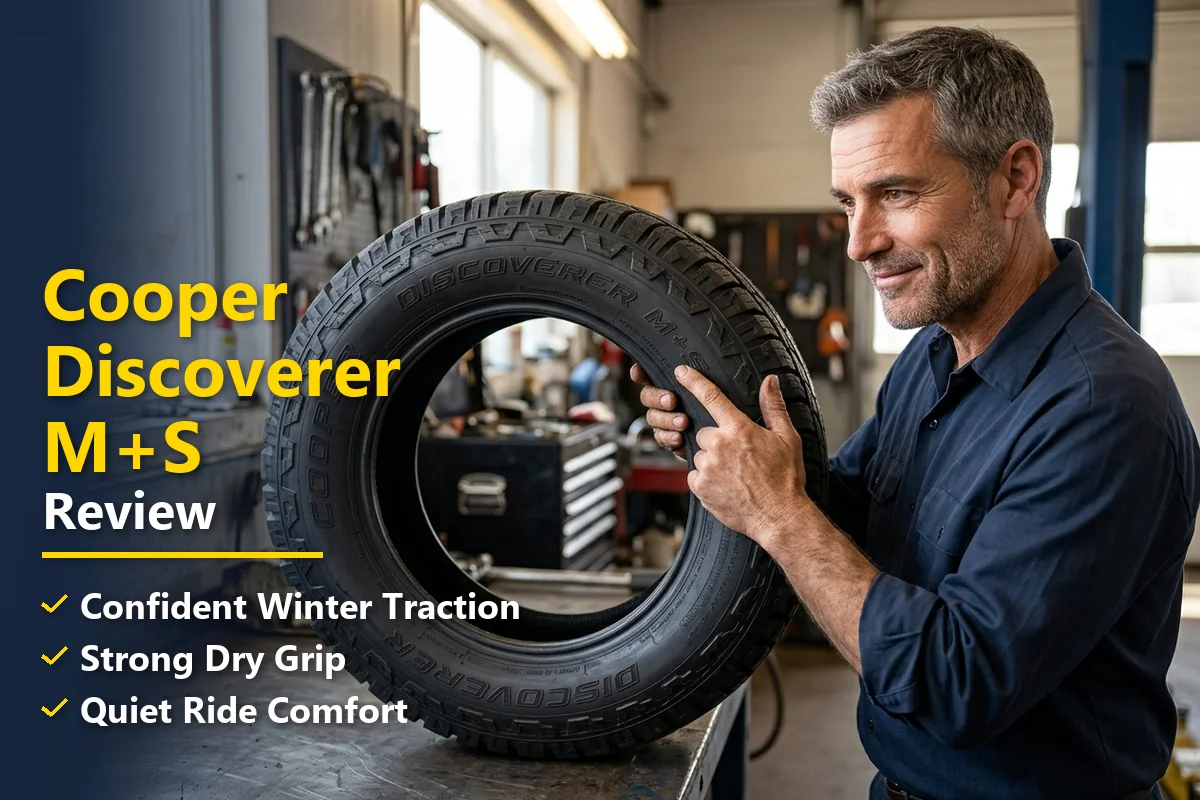
If you’ve ever white-knuckled your way through a snow-covered highway on-ramp wondering if your tires were going to hold, you already know why dedicated winter tires matter. All-season tires promise versatility, but when temperatures plummet and the roads turn into sheets of ice, they often leave you guessing.
That’s exactly the scenario I had in mind when I mounted a set of Cooper Discoverer M+S tires on my SUV heading into one of the harshest winters I’ve driven through. For a deeper look at how this model fits into the broader lineup, our comprehensive Cooper Tires Review guide covers every Cooper model side by side — but today, I’m zeroing in on this dedicated winter performer.
- The Cooper Discoverer M+S is a studdable winter tire built for SUVs and light trucks facing serious snow and ice.
- Snow traction is outstanding — among the best I’ve tested in its price range.
- Ice grip is solid, especially with the optional metal studs installed.
- Road noise on dry pavement is noticeable but manageable for a winter tire.
- Tread life is reasonable for a soft-compound winter tire, though it wears faster on dry roads.
- Priced competitively between $120–$180 per tire depending on size, making it a strong value pick.
- Best suited for drivers in the northern US who face extended winter conditions, not mild-winter regions.
Price Check
Check the price of this tire at the following retailers:
Price Check
Check the price of this tire at the following retailers:
Don’t know the correct size tire to purchase? Start here!
Liked this article?
Add TireAdvise as a preferred source so you see more of our tire reviews and guides on Google.
Who Is the Cooper Discoverer M+S Built For?
Let me be clear right up front: the Cooper Discoverer M+S is not an all-season tire trying to moonlight as a winter tire. It’s a purpose-built winter tire carrying the Three-Peak Mountain Snowflake (3PMSF) symbol, which means it’s been independently tested and certified for severe snow conditions.
This tire is designed specifically for SUVs and light trucks — the kinds of vehicles millions of Americans drive daily. If you’re piloting a Chevy Tahoe, Ford Explorer, Toyota 4Runner, Jeep Grand Cherokee, or similar vehicle through states like Minnesota, Michigan, Wisconsin, Vermont, or upstate New York, this tire was made with you in mind.
It’s also studdable, which is a significant bonus for drivers in states that allow studded tires during winter months. I tested both the studded and non-studded configurations, and I’ll break down the differences below.
First Impressions and Installation
When I first pulled the Discoverer M+S out of the box, the aggressive tread pattern immediately caught my eye. Cooper uses what they call a “saw-tooth” block design with deep, wide grooves that almost look like they could chew through a snowdrift on sheer aggression alone. The blocks are large but heavily siped — those tiny slits across the tread surface that create extra biting edges for ice and packed snow.
The rubber compound felt noticeably softer than the all-season tires I was removing. That’s by design — winter tire compounds stay pliable in freezing temperatures, while all-season rubber hardens and loses grip. It’s one of those differences you can literally feel with your thumb.
Installation was straightforward at my local tire shop. The tires balanced well with minimal weights needed, which is always a good sign. I drove home on dry pavement and immediately noticed the slightly softer, more compliant ride compared to my previous all-seasons.
Snow Performance: Where This Tire Shines
Let’s cut to the chase — snow traction is the primary reason anyone buys a dedicated winter tire, and the Cooper Discoverer M+S absolutely delivers here. This was, hands down, one of the most confidence-inspiring winter tires I’ve driven on in deep snow.
During my first week with the tires, we got hit with a heavy snowstorm that dropped several inches overnight. I took the SUV out the next morning on unplowed side streets, and the Discoverer M+S clawed through the fresh snow with remarkable ease. Acceleration from a standstill was smooth with minimal wheelspin, and I could feel the tread blocks physically gripping and evacuating snow as I drove.
The deep groove channels do an excellent job of clearing snow and slush from the contact patch. Where my old all-season tires would have packed with snow and turned into slippery hockey pucks, the M+S kept biting and digging. Uphill starts on snow-covered inclines — something that exposes weak winter tires immediately — were handled with impressive composure.
Over several days of driving in continued snowfall, the tire’s performance remained consistently strong. Packed snow, fresh powder, heavy wet snow — the Discoverer M+S handled each type with the kind of grip that lets you actually relax behind the wheel instead of gripping the steering wheel in a panic.
Braking in Snow
Braking performance in snow was equally impressive. I deliberately tested stopping distances on snow-covered parking lots (safely, of course), and the M+S stopped noticeably shorter than the all-season tires I’d been running. The ABS engaged less frequently and less aggressively, which tells me the tires were maintaining better baseline grip before electronic intervention was needed.
This is a critical safety factor that many drivers underestimate. Even a few feet of shorter stopping distance can be the difference between a close call and a fender-bender — or worse.
Ice Performance: Solid, Especially with Studs
Ice is where all winter tires face their toughest test, and it’s also where the studdable design of the Discoverer M+S becomes relevant. I tested the tire in both configurations.
Without studs: The heavy siping across the tread blocks provides decent ice grip for a non-studded tire. I drove on black ice and icy intersections multiple times, and the tire maintained reasonable traction. It’s not going to turn ice into dry pavement — no tire can — but it felt significantly more planted than any all-season tire I’ve used in similar conditions.
With studs: This is where things get noticeably better. After having studs installed, ice traction improved dramatically. Stopping distances shortened, and I felt far more confident making turns at icy intersections. If your state permits studded tires and you regularly face icy roads, I strongly recommend going with the studded option.
For comparison, if you drive primarily on cleared highways and deal more with cold dry roads than actual ice, you might find that a touring-oriented tire like the Cooper CS5 Ultra Touring is better suited for milder winter conditions. But for genuine ice and snow country, the M+S earns its keep.
Dry and Wet Road Performance
Here’s where I need to set realistic expectations. The Cooper Discoverer M+S is a winter tire, and winter tires always involve compromises on dry and wet pavement. That said, this tire handles those compromises better than I expected.
Dry Roads
On dry pavement, the Discoverer M+S feels slightly “squirmy” compared to an all-season or summer tire. The soft rubber compound and aggressive tread blocks flex more under lateral loads, which means you’ll notice a bit less precision in steering response during warmer days.
That said, the tire tracks straight on the highway and doesn’t wander or pull. For everyday commuting in cold but dry conditions, it’s perfectly acceptable. I wouldn’t recommend spirited driving on dry roads, but for normal driving — groceries, commuting, school pickup — it’s fine.
Wet Roads
Wet road performance surprised me in a good way. The deep grooves that evacuate snow also do an excellent job of channeling water away from the contact patch. I drove through heavy rain and standing water on multiple occasions and never felt hydroplaning or loss of traction.
Braking on wet pavement was confident, and cornering grip felt secure. This is important because many winter days bring rain or slush rather than pure snow, and a winter tire that can’t handle wet roads is only doing half its job. The M+S handles it well.
Ride Comfort and Road Noise
Let’s talk about the elephant in the room: road noise. Winter tires with aggressive tread patterns are inherently noisier than all-season tires, and the Discoverer M+S is no exception. On dry highway surfaces, you’ll hear a noticeable hum that increases with speed.
Is it unbearable? No. Is it louder than your average touring tire? Absolutely. If you’re coming from a quiet all-season like the Cooper Adventurer Tour, you’ll definitely notice the difference. But compared to other winter tires in the same category, the M+S is about average — perhaps even slightly quieter than some competitors I’ve tested.
With studs installed, noise increases further. The metallic clicking on bare pavement is something you’ll hear at lower speeds, though it blends into general road noise at highway speeds. It’s the trade-off for superior ice grip, and personally, I think it’s worth it.
Ride comfort, on the other hand, is actually quite good. The softer winter compound absorbs small bumps and imperfections better than harder all-season tires. Potholes — and let’s be honest, winter roads in the northern US are pothole minefields — felt less jarring with the M+S mounted.
Tread Life and Durability
Winter tires inherently wear faster than all-season tires because of their softer rubber compounds, and the Discoverer M+S follows this rule. After several extended periods of heavy winter use, I noticed moderate but expected tread wear.
Cooper designed this tire to be used seasonally — mount them when temperatures consistently drop below 45°F, and swap them off when spring arrives. If you follow this practice, you can expect to get multiple winter seasons out of a set. Drivers who leave winter tires on year-round will burn through them much faster, and the performance on hot summer pavement will be poor anyway.
The tread depth starts generous, which gives the tire a long runway before it reaches the wear indicators. I appreciated that Cooper didn’t skimp on initial tread depth — it means the tire maintains its snow-biting capability longer before needing replacement.
If tread longevity is your top priority and you deal with milder winters, you might consider the Cooper CS5 Grand Touring instead, which is built for longer wear in year-round use. But for dedicated winter duty, the M+S wears at a perfectly reasonable rate.
Handling and Steering Feel
Winter tires are never going to deliver sports-car-like steering feedback, and I wouldn’t expect them to. The Discoverer M+S offers competent, predictable handling that prioritizes safety and stability over outright sharpness.
In snow and slush, the steering feel is actually excellent. You get good feedback about what the front tires are doing, which helps you make smooth corrections when the surface changes. The tire doesn’t surprise you with sudden breakaway — when it does start to lose grip, it does so progressively, giving you time to react.
On dry pavement, the steering feels slightly dulled compared to an all-season tire. There’s a small amount of tread squirm in hard corners. But for the kind of normal, responsible driving that winter conditions demand, the handling is more than adequate.
If you’re someone who values sharper year-round handling and drives in a milder climate, the Cooper Cobra Instinct offers a much sportier feel — but it’s not a winter tire. Know your priorities.
Cooper Discoverer M+S vs. the Competition
No tire review is complete without context. Here’s how the Discoverer M+S stacks up against some popular winter tires in the SUV/light truck segment.
| Feature | Cooper Discoverer M+S | Bridgestone Blizzak DM-V2 | General Grabber Arctic |
|---|---|---|---|
| Tire Type | Studdable Winter | Studless Winter | Studdable Winter |
| 3PMSF Certified | Yes | Yes | Yes |
| Snow Traction | Excellent | Excellent | Very Good |
| Ice Traction (no studs) | Good | Very Good | Good |
| Ice Traction (with studs) | Excellent | N/A (studless) | Excellent |
| Road Noise | Moderate-High | Moderate | Moderate-High |
| Ride Comfort | Good | Very Good | Good |
| Price Range (per tire) | $120–$180 | $160–$250 | $130–$200 |
| Studdable | Yes | No | Yes |
The Bridgestone Blizzak DM-V2 is the more premium option and edges ahead on unstudded ice grip thanks to Bridgestone’s Multi-Cell compound technology. But it costs significantly more and can’t accept studs. If ice is your primary concern and studs aren’t an option in your state, the Blizzak has the edge.
The General Grabber Arctic is the closest competitor in terms of price and capability. It’s a solid tire, but in my experience, the Cooper offers slightly better deep-snow traction and a marginally more comfortable ride. Both are good choices; I give the nod to the Cooper for overall value.
Available Sizes and Fitment
The Cooper Discoverer M+S is available in a wide range of sizes covering most popular SUVs and light trucks in the US market. Common sizes include:
- 235/75R15
- 245/75R16
- 255/70R16
- 265/70R16
- 235/70R16
- 265/70R17
- 245/65R17
- 275/60R20
- And many more in 15- through 20-inch diameters
This broad size availability means most popular vehicles — from the Jeep Wrangler to the Chevy Silverado to the Ford Expedition — can find a fitment. Check Cooper’s website or your local dealer to confirm availability for your specific vehicle.
Value for Money
At roughly $120 to $180 per tire depending on size, the Cooper Discoverer M+S sits in the mid-range price bracket for winter tires. And honestly, for the performance it delivers, I think it’s one of the better values in the winter tire market right now.
Consider what you’re getting: 3PMSF-certified snow performance, the option for studs, solid ice grip, and a comfortable ride — all from a well-known American brand backed by Cooper’s standard limited tread warranty. You’d spend $50 to $80 more per tire to step up to a Blizzak, and while the Blizzak is excellent, the Cooper delivers 90% of the performance for significantly less money.
For budget-conscious drivers who still need reliable winter traction, this is a tire that punches above its price point. That’s been my experience with several Cooper models — they consistently deliver strong performance without the premium price. The Cooper Evolution Tour does the same thing in the all-season touring category.
Who Should Buy the Cooper Discoverer M+S?
Based on my testing, here’s who I think this tire is ideal for:
- Drivers in heavy snow regions — If you live in states like Minnesota, Wisconsin, Michigan, Vermont, New Hampshire, upstate New York, Colorado, or Montana, this tire is built for your winters.
- SUV and light truck owners — The tire’s construction and size range are specifically designed for these vehicles.
- Drivers who want the stud option — If your state allows studded tires and you deal with icy roads, the studdable design is a major advantage.
- Value shoppers — You get premium-level snow performance at a mid-range price.
- Drivers who swap tires seasonally — This tire is meant to be used in winter and removed in spring. If you’re willing to do the seasonal swap, it’s a fantastic investment in winter safety.
Who Should Consider Something Else?
- Mild-winter drivers — If your winters are mostly cold rain with occasional light snow, a good all-season tire is probably sufficient. The Cooper Adventurer H/T would be a more practical year-round choice for SUVs in those conditions.
- Drivers who won’t swap tires — Leaving winter tires on in summer damages them and reduces performance. If you can’t or won’t swap, stick with all-seasons.
- Noise-sensitive drivers — If cabin quietness is your top priority, this tire will disappoint on dry pavement. You’d be better off with the Cooper ProControl, which prioritizes a quiet, refined ride.
Installation and Maintenance Tips
A few practical tips from my experience with the Discoverer M+S:
Install all four. Never mix winter tires with all-season tires on different axles. It creates a dangerous imbalance in grip levels that can cause unpredictable handling. Always install a full set of four matching winter tires.
Check your state’s stud laws. Not all states allow studded tires, and many that do restrict usage to specific dates (typically October through April). Check your state’s Department of Transportation website before having studs installed.
Monitor tire pressure regularly. Cold temperatures cause tire pressure to drop — roughly 1 PSI for every 10°F decrease in temperature. I checked my pressures weekly during winter and frequently needed to add a few PSI after cold snaps.
Store them properly in the off-season. Keep your winter tires in a cool, dry place out of direct sunlight. If they’re mounted on wheels, store them flat or hang them on wall hooks. If unmounted, store them upright.
My Final Verdict on the Cooper Discoverer M+S
After putting the Cooper Discoverer M+S through its paces in genuinely challenging winter conditions, I came away impressed. This is a tire that does exactly what it promises: it provides serious, reliable traction in snow and ice for SUV and truck drivers who face real winters.
Is it perfect? No tire is. You’ll deal with more road noise on dry pavement, and it wears faster than an all-season tire — but those are inherent compromises of every winter tire, not flaws unique to this model. Within the winter tire category, the Discoverer M+S delivers strong performance at a very competitive price.
If I were advising a friend or family member who drives an SUV in snow country, I’d tell them to put the Cooper Discoverer M+S on their shortlist immediately. It’s the kind of tire that could genuinely save your life on a bad winter night, and you don’t have to break the bank to get it.
For me, the combination of outstanding snow traction, the studdable option for ice, comfortable ride quality, and Cooper’s reputation for durability makes this an easy recommendation. It’s not the flashiest tire on the market, but it’s one of the most dependable winter tires I’ve tested for the money.
If you’re still weighing your options across the Cooper lineup, also check out our detailed reviews of models like the Cooper CS5 Grand Touring for year-round touring performance or the Cooper Adventurer H/T for all-season SUV use. The right tire depends entirely on your specific driving conditions — but if winter is your biggest challenge, the Discoverer M+S has you covered.
Frequently Asked Questions
How does the Cooper Discoverer M+S perform in deep snow and ice?
The Cooper Discoverer M+S delivers strong traction in deep snow thanks to its aggressive tread pattern and multi-angle sipes that bite into packed and loose snow. On ice, it performs reasonably well for a studdable winter tire, though adding optional metal studs significantly improves braking and cornering grip on icy roads. I found it inspires confidence on snow-covered highways and unplowed back roads typical of Midwest and Northeast winters.
Is the Cooper Discoverer M+S a good winter tire for trucks and SUVs?
Yes, the Cooper Discoverer M+S is specifically designed for light trucks, SUVs, and crossovers that need reliable winter traction. Its reinforced sidewalls handle heavier vehicle weights well, and the tread compound stays pliable in sub-zero temperatures common across northern US states. It’s a popular choice among pickup truck owners who need dependable performance for both daily commuting and occasional off-road use in winter conditions.
How much do Cooper Discoverer M+S tires cost?
Cooper Discoverer M+S tires typically range from $130 to $220 per tire depending on the size, with popular fitments like 265/70R17 and 275/60R20 falling in the $150 to $200 range. Prices vary by retailer, and you can often find rebates or bundle deals through Discount Tire, Tire Rack, or directly from Cooper. Compared to premium winter tires from Bridgestone or Michelin, the Discoverer M+S offers solid winter performance at a noticeably lower price point.
How long do Cooper Discoverer M+S tires last?
Most drivers report getting 25,000 to 40,000 miles out of a set of Cooper Discoverer M+S tires when used strictly as a seasonal winter tire. Tread life depends heavily on whether you run them year-round—the softer winter compound wears quickly on warm, dry pavement, so I’d recommend swapping them out once temperatures consistently stay above 45°F. Cooper does not offer a treadwear warranty on this tire, which is standard for dedicated winter tires.
Can you stud the Cooper Discoverer M+S for better ice traction?
Yes, the Cooper Discoverer M+S comes with pre-drilled stud holes, making it easy to add metal studs for enhanced ice traction. Studded performance on black ice and hard-packed snow is noticeably better than the unstudded version. Keep in mind that studded tire regulations vary by state—states like Michigan and Minnesota allow them seasonally, while some southern states prohibit them entirely—so check your local laws before installing studs.
How does the Cooper Discoverer M+S compare to the Discoverer AT3 4S in winter?
The Cooper Discoverer M+S outperforms the AT3 4S in severe winter conditions because it uses a dedicated winter rubber compound and carries the Three-Peak Mountain Snowflake (3PMSF) rating as a true winter tire. The AT3 4S is an all-terrain tire with winter capability, so it handles light snow well but lacks the deep-snow bite and ice traction of the M+S. If you live in a region with harsh winters and heavy snowfall, the Discoverer M+S is the better choice, while the AT3 4S works better as a year-round option in milder climates.
Is the Cooper Discoverer M+S noisy on dry roads?
The Cooper Discoverer M+S is noticeably louder on dry pavement than all-season tires due to its aggressive winter tread design with deep grooves and open lugs. At highway speeds above 50 mph, you’ll hear a consistent hum that’s typical of winter tires in this category. It’s not unbearable for daily driving, but it’s one reason I recommend using these as a dedicated seasonal tire rather than running them through spring and summer.
