

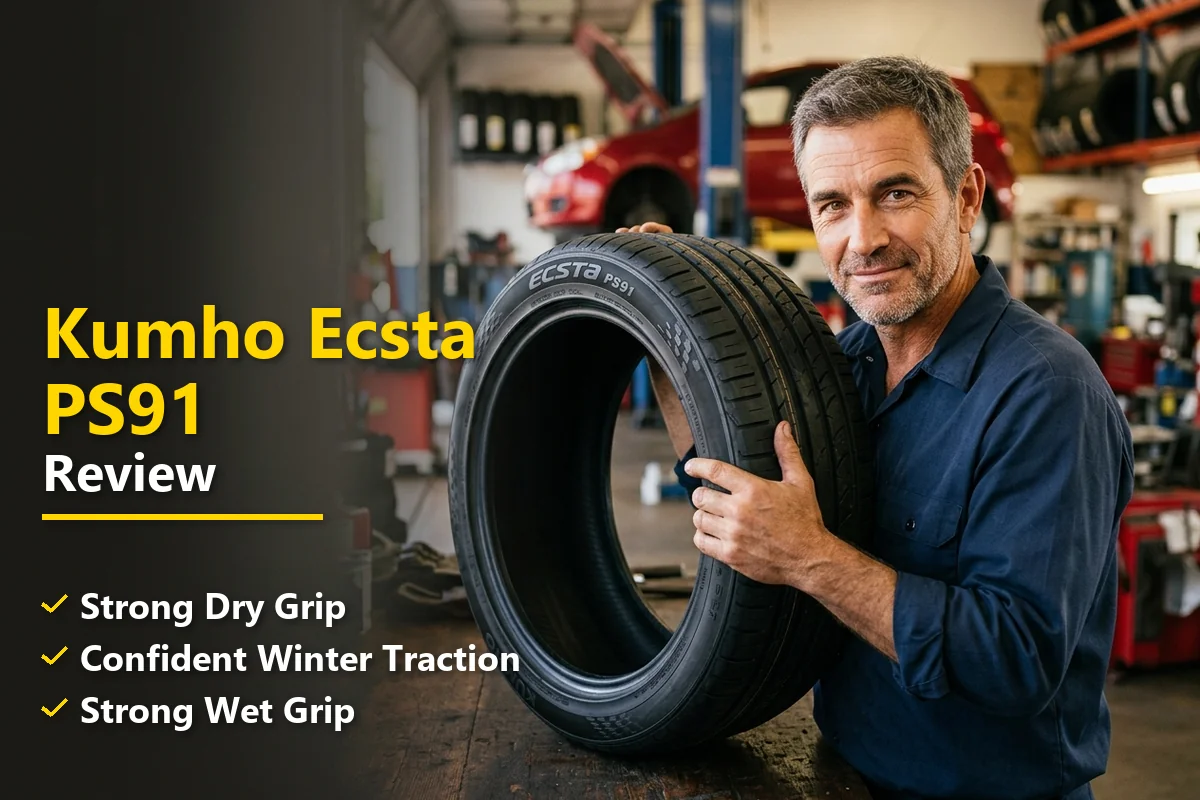
You want a ultra-high-performance summer tire, but your wallet flinches every time you price out the usual suspects from Continental, Michelin, or Bridgestone. It’s a frustration I know well — the gap between wanting top-tier grip and actually affording it can feel enormous.
That’s exactly the gap the Kumho Ecsta PS91 was designed to fill. And after spending serious seat time with a set on my daily driver, I can tell you it fills that gap better than most people expect.
If you’ve been browsing our full Kumho Tires Review guide looking for the right performance model, this deep dive on the PS91 should help you make a confident decision.
- The Kumho Ecsta PS91 is a max-performance summer tire that punches well above its price point in dry grip, steering response, and high-speed stability.
- Wet traction is solid but not class-leading — I’d rate it a step below the Continental ExtremeContact Sport 02 in heavy rain.
- Ride comfort and road noise are surprisingly refined for a tire this aggressive.
- Treadwear appears reasonable for the category, though this is not a tire you buy for longevity.
- At roughly $140–$200 per tire (depending on size), it’s one of the best performance values on the US market right now.
- Not for winter or near-freezing temps — this is a dedicated summer tire.
Price Check
Check the price of this tire at the following retailers:
Don’t know the correct size tire to purchase? Start here!
Liked this article?
Add TireAdvise as a preferred source so you see more of our tire reviews and guides on Google.
What Exactly Is the Kumho Ecsta PS91?
The Ecsta PS91 sits at the top of Kumho’s summer performance lineup. It’s classified as an ultra-high-performance (UHP) summer tire, which means it’s engineered for maximum dry grip, sharp steering response, and confident cornering at speed.
Kumho positions it as a direct competitor to tires like the Michelin Pilot Sport 4S, Continental ExtremeContact Sport 02, and Bridgestone Potenza Sport. That’s ambitious company, but Kumho has a secret weapon: price. The PS91 typically retails for 20–35% less than those flagship competitors.
It’s available in a wide range of sizes, from 17-inch fitments all the way up to 21-inch staggered setups for luxury sport sedans and coupes. Kumho uses a high-silica compound paired with an asymmetric tread design — stiffer outer blocks for cornering, more flexible inner blocks for comfort and water evacuation.
My Test Setup and Driving Conditions
I mounted a set of Kumho Ecsta PS91 tires on my 2019 BMW 3 Series (G20) in a 225/40R18 front and 255/35R18 rear staggered configuration. This is a common OE-equivalent fitment, so it gave me a realistic picture of how the tire performs for the kind of driver most likely to buy it.
During my test period, I drove on a mix of Southern California highways, canyon roads, and typical suburban errands. I encountered everything from bone-dry 95°F asphalt to a few stretches of moderate rain — not a Pacific Northwest downpour, but enough to evaluate wet grip.
I also had a set of Continental ExtremeContact Sport 02 tires on the same car the month prior, so I had a very fresh baseline for direct comparison. That context matters, and I’ll reference it throughout.
Dry Performance: Where the PS91 Truly Shines
Let me be blunt: the dry grip on the Kumho Ecsta PS91 is outstanding. From the very first canyon run, I could feel the tires biting hard into the pavement with a confidence that immediately earned my trust.
Cornering Grip
The lateral grip in dry conditions is genuinely close to what I experienced on the Continentals. Pushing hard through decreasing-radius turns, the PS91 communicated clearly through the steering wheel — I could feel the tire loading up progressively rather than snapping from grip to slip.
The stiff outer shoulder blocks do their job. During aggressive cornering, the tire doesn’t roll or squirm the way some budget UHP tires do. It stays planted and predictable, which is exactly what you want when you’re carrying speed into a corner on a mountain road.
Straight-Line Traction
Launching hard from a stop, the PS91 hooks up cleanly without excessive wheelspin (traction control off). On highway on-ramps, full-throttle pulls felt secure and drama-free. The tire’s contact patch clearly does a good job distributing the load evenly.
Steering Response
This is where the PS91 really impressed me. Turn-in is sharp and immediate — there’s minimal delay between my steering input and the car changing direction. For a tire at this price, that level of responsiveness is uncommon. It made my 3 Series feel noticeably more athletic than it did on the all-season tires I ran through the previous winter.
High-Speed Stability
On extended highway stretches at 75–80 mph, the PS91 felt rock-solid. No wandering, no nervousness over expansion joints or surface changes. The tire’s internal construction — Kumho uses a dual-ply, high-tensile steel belt — clearly contributes to this composed feel at speed.
I’d rate the overall dry performance at 9 out of 10 for the category. It’s not quite at the level of a Michelin Pilot Sport 4S in the absolute limit, but it’s remarkably close — and for significantly less money.
Wet Performance: Good, With Caveats
Here’s where I need to be honest: the PS91 is good in the wet, but it’s not the best in its class. If wet-weather grip is your absolute top priority, the Continental ExtremeContact Sport 02 or the Michelin PS4S still have an edge.
Light to Moderate Rain
In everyday rain — the kind you encounter driving through a shower on the freeway — the PS91 performed confidently. The four wide circumferential grooves evacuate water effectively, and I never felt a sudden loss of traction during normal driving.
Braking distances in light rain felt predictable and secure. I didn’t experience any unsettling moments during routine lane changes or highway exits.
Heavy Rain and Standing Water
When I hit heavier rain and sections of road with standing water, I noticed a slight reduction in the tire’s communicative feel. The steering became a touch lighter, and I could sense the beginning of hydroplaning at highway speeds where the Continentals would have still felt fully planted.
It’s not dangerous — the tire still maintained grip — but the margin felt thinner. If you live in a region with frequent heavy downpours (think Gulf Coast, Southeast, Pacific Northwest), this is worth considering. For occasional rain in drier climates, it’s perfectly adequate.
Wet Cornering
Pushing the PS91 in wet corners revealed a progressive breakaway that’s easy to manage. The tire doesn’t snap loose suddenly — it gives you a gentle warning through the steering before it starts to slide. That’s a confidence-inspiring trait, especially for drivers who aren’t professional racers.
I’d rate the wet performance at 7.5 out of 10 for the UHP summer category. That’s good, but it does trail the best-in-class options by a noticeable margin.
Ride Comfort and Noise: Surprisingly Refined
One of the biggest surprises during my test period was how comfortable the PS91 rides. UHP summer tires are not known for plush rides — stiff sidewalls and aggressive compounds usually translate to a firm, sometimes harsh experience. The PS91 bucks that trend.
Impact Absorption
Over broken pavement, expansion joints, and potholes (yes, even California has its share), the PS91 absorbed impacts with more grace than I expected. There’s still a firmness to the ride — this is a performance tire, after all — but it never felt punishing. On well-maintained highways, the ride borders on comfortable enough for a long road trip.
Road Noise
At highway speeds, the PS91 is impressively quiet. I noticed a faint hum at around 65–70 mph, but it blended into the cabin ambient noise and was never intrusive. Compared to the more aggressive tread patterns you’ll find on tires like the Kumho Ecsta V730 (which is track-focused), the PS91 is practically whisper-quiet.
The comfort and noise characteristics make the PS91 a viable daily driver tire, not just a weekend canyon carver. That versatility is a major selling point.
Treadwear and Longevity
Let me set expectations: this is an ultra-high-performance summer tire with a 220 treadwear rating. It is not going to last as long as your all-season tires. That’s the trade-off for the grippy compound.
After several weeks of mixed driving — including some spirited canyon sessions — the tread looked healthy with no signs of abnormal wear. The wear pattern was even across the tread face, which tells me the tire’s construction is doing a good job distributing forces during cornering.
Based on what I’ve seen so far and conversations with other PS91 owners in enthusiast forums, you can expect respectable longevity for the category if you’re not doing regular track days. Aggressive drivers will wear them faster, naturally, but that’s true of any tire in this class.
Kumho backs the PS91 with a limited manufacturer warranty but does not offer a mileage guarantee — which is standard for UHP summer tires. Neither does Michelin for the PS4S or Continental for the ExtremeContact Sport.
How Does It Compare? PS91 vs. the Competition
Numbers and features only tell part of the story. Here’s how the PS91 stacks up against its most common competitors based on my hands-on experience and research:
| Feature | Kumho Ecsta PS91 | Michelin Pilot Sport 4S | Continental ExtremeContact Sport 02 | Bridgestone Potenza Sport |
|---|---|---|---|---|
| Price (avg 245/40R18) | ~$165 | ~$230 | ~$205 | ~$210 |
| Dry Grip | 9/10 | 10/10 | 9.5/10 | 9.5/10 |
| Wet Grip | 7.5/10 | 9/10 | 9.5/10 | 8.5/10 |
| Comfort | 8/10 | 8.5/10 | 7.5/10 | 7.5/10 |
| Noise Level | Low | Low | Moderate | Moderate |
| Steering Response | 9/10 | 9.5/10 | 9.5/10 | 9/10 |
| Treadwear Rating | 220 | 300 | 340 | 220 |
| Value for Money | 10/10 | 7/10 | 8/10 | 7.5/10 |
The takeaway from this table is clear: the PS91 delivers roughly 90% of the performance of the class leaders at 65–75% of the price. That’s a compelling proposition for anyone who wants serious grip without the premium-brand tax.
PS91 vs. Kumho Ecsta Sport S
If you’re considering staying within the Kumho family, you might also want to check out the Kumho Ecsta Sport S Review. The Sport S is a newer addition to the lineup and targets a slightly different balance — it emphasizes all-around sport touring refinement with a bit more focus on treadwear. The PS91, by contrast, is more aggressive and prioritizes maximum dry grip over longevity. For a pure driving enthusiast, I’d lean PS91. For a daily commuter who likes spirited weekend drives, the Sport S deserves a look.
Technology and Construction Details
Kumho isn’t just throwing a soft compound on a generic carcass here. The PS91 incorporates several noteworthy engineering choices that contribute to its performance.
Asymmetric Tread Design
The outboard portion of the tread features larger, stiffer blocks that maximize contact area during cornering. The inboard side has more sipes and narrower grooves designed to channel water and provide traction during straight-line braking in the wet. This inside-outside differentiation is common in UHP tires, but Kumho’s execution is well-tuned here.
High-Silica Compound
The tread compound uses a high concentration of silica, which helps with wet grip while keeping rolling resistance in check. It also contributes to the compound’s ability to generate heat quickly — a performance tire needs to reach its optimal operating temperature to deliver peak grip.
Reinforced Sidewall Construction
The sidewall uses a nylon-reinforced construction that resists deflection during hard cornering. This is a big part of why the steering response feels so direct — the tire doesn’t flex and absorb your inputs before translating them to the contact patch.
The internal structure features twin steel belts with nylon cap plies for high-speed stability. This is standard for the category, but the tuning is what matters, and Kumho has clearly spent time dialing in the right balance of stiffness and compliance.
Who Should Buy the Kumho Ecsta PS91?
Not every tire is right for every driver. Here’s my breakdown of who this tire serves best — and who should look elsewhere.
Ideal Buyers
- Performance sedan and coupe owners — If you drive a BMW 3/4 Series, Audi A4/S4, Mercedes C-Class, Genesis G70, Lexus IS, or similar, this tire is a natural fit.
- Budget-conscious enthusiasts — You want real performance grip but can’t justify $250+ per tire. The PS91 is the answer.
- Daily drivers who enjoy spirited driving — The comfort and noise levels make it livable every day, while the grip makes weekend drives genuinely fun.
- Warm-climate drivers — If you live in the Sun Belt (Texas, Arizona, California, Florida) and don’t need winter capability, a summer tire like this is the smart choice for maximum warm-weather grip.
Who Should Skip It
- Drivers in cold climates — Below about 40°F, the compound hardens significantly and grip drops off. If you experience real winters, you need a dedicated winter tire set or at minimum an all-season.
- Heavy rain region residents who want maximum wet safety — The Continental ExtremeContact Sport 02 is a better choice if wet grip is your non-negotiable priority.
- Track day regulars — For dedicated track use, a tire like the Kumho Ecsta V730 is purpose-built for that environment and will deliver more consistent lap times under repeated heat cycles.
- Drivers prioritizing treadwear above all — If you want a tire that lasts as long as possible, look at a performance all-season or a sport touring tire instead.
Pricing and Availability in the US
At the time of this review, the Kumho Ecsta PS91 is available through major US retailers including Tire Rack, Discount Tire, America’s Tire, Walmart, and Amazon. Pricing typically ranges from about $140 per tire for smaller 17-inch sizes to $200+ for larger 20 and 21-inch fitments.
To put that in perspective, a set of four PS91 tires in a common 18-inch size will run you roughly $660–$720 before installation. The same fitment in Michelin Pilot Sport 4S tires will typically cost $880–$950. That’s a savings of $200–$250 per set, which is nothing to sneeze at — especially when the performance gap is as narrow as it is.
Kumho frequently offers mail-in rebates and promotions through their US dealer network, so it’s worth checking for current deals before you pull the trigger. I’ve seen rebates as high as $80 on a set of four, which pushes the value equation even further in the PS91’s favor.
Installation Tips and Break-In Period
When I first mounted the PS91 tires, I noticed they needed a brief break-in period before reaching their full potential. During the first few days of driving, the tires felt slightly slippery compared to their final settled-in feel — this is normal for any new tire as the mold release compound wears off the tread surface.
After several days of normal driving, the grip level climbed noticeably and stabilized. I’d recommend driving conservatively for the first stretch after installation. Don’t go out canyon carving on day one.
Also, make sure your installer checks the tire’s directional mounting — the PS91 is asymmetric (not directional), so it has a designated “outside” face. As long as the “OUTSIDE” marking on the sidewall faces outward, you’re good. Any reputable tire shop will know this, but it doesn’t hurt to double-check.
Real-World Fuel Economy Impact
Switching from all-season tires to the PS91, I didn’t notice a meaningful change in fuel economy. UHP summer tires often get a bad reputation for hurting MPG, but modern compounds with high silica content have narrowed that gap significantly.
On my BMW, my average fuel consumption stayed within the same range I’d been seeing — any difference was too small to isolate from other variables like traffic, temperature, and driving style. This was a pleasant surprise, as some older UHP summer tires I’ve tested have cost me a noticeable penalty at the pump.
How the PS91 Handles US Road Conditions
US roads are far from uniform. Here’s how the PS91 handled the variety of surfaces I encountered:
Fresh Asphalt (Smooth)
Absolute heaven. The PS91 grips freshly paved roads like glue. Steering feel is at its sharpest, and the tire is near-silent. If you’re lucky enough to live near recently resurfaced roads, you’ll love this tire.
Worn, Rutted Highways
On the rutted, worn concrete that dominates many US interstate highways, the PS91 tracked well without excessive tramlining. There’s a slight tendency to follow grooves in the road — common with wide, soft-compound tires — but it’s manageable and never felt unsafe.
Rough, Patched Urban Roads
The PS91 handled pothole-riddled city streets better than I expected. The tire absorbed moderate impacts without transmitting jarring feedback into the cabin. I wouldn’t call it cushy, but it’s far from punishing. The reinforced sidewall did its job protecting the rim over several rough patches.
Gravel or Unpaved Shoulders
If you end up on a gravel or unpaved surface, proceed with caution. The PS91’s compound is designed for pavement, and traction on loose surfaces is minimal. This isn’t a criticism — no UHP summer tire handles gravel well — but it’s worth noting if you encounter construction zones or rural shoulders.
My Honest Pros and Cons
After extensive testing, here’s my distilled assessment:
Pros
- Exceptional dry grip — Very close to class-leading for a fraction of the price.
- Razor-sharp steering response — Makes your car feel more alive and connected.
- Surprisingly comfortable — Livable as a daily driver, not just a weekend toy.
- Low road noise — Quieter than several competitors at the same performance level.
- Outstanding value — The performance-to-dollar ratio is hard to beat in the US market.
- Wide size availability — Fits everything from compact sport sedans to larger performance cars.
Cons
- Wet grip trails the best — Not a deal-breaker, but noticeable in heavy rain.
- Soft compound means faster wear — You’re trading longevity for grip. Accept it.
- No winter capability — A dedicated summer tire through and through.
- Slight tramlining on rutted highways — Minor, but present.
- Less brand prestige — If the name on the sidewall matters to you, this isn’t a Michelin. But your lap times won’t care.
Final Verdict: Is the Kumho Ecsta PS91 Worth Buying?
After spending extensive time with the Kumho Ecsta PS91 on real roads in real conditions, I can say this with confidence: it’s one of the best performance tire values available to US drivers today.
Is it the absolute best UHP summer tire money can buy? No. The Michelin Pilot Sport 4S and Continental ExtremeContact Sport 02 still hold slim advantages in certain areas — particularly wet grip and ultimate limit handling. But those advantages come at a 25–35% premium, and for most drivers on most roads, the difference is academic.
What the PS91 does brilliantly is deliver a thrilling, confidence-inspiring driving experience at a price that doesn’t require justification to your significant other. The dry grip is genuinely excellent. The steering response transforms an ordinary commute into something engaging. And the ride comfort and noise levels mean you won’t dread the daily drive.
If you’re a US driver looking for serious performance rubber without the flagship price tag, the Kumho Ecsta PS91 belongs at the very top of your shortlist. I recommend it enthusiastically to anyone who values driving engagement and wants to save a few hundred dollars per set in the process.
For those still weighing their options across the entire Kumho performance range, our comprehensive Kumho Tires Review breaks down every model to help you find the perfect match for your car and driving style.
Frequently Asked Questions
Is the Kumho Ecsta PS91 a good ultra-high-performance tire?
The Kumho Ecsta PS91 is an excellent ultra-high-performance summer tire that punches well above its price point. It delivers confident dry grip, responsive steering feedback, and impressive cornering stability that rivals more expensive options from Michelin and Continental. For US drivers looking for a performance tire without the premium brand price tag, the PS91 is one of the best values on the market.
How much do Kumho Ecsta PS91 tires cost compared to competitors?
Kumho Ecsta PS91 tires typically range from $130 to $200 per tire depending on size, which is significantly less than comparable tires like the Michelin Pilot Sport 4S or Continental ExtremeContact Sport 02. You can often save $200 to $400 on a full set compared to those premium competitors while still getting strong performance. Many US retailers like Tire Rack, Discount Tire, and Walmart carry them with occasional rebate promotions.
How does the Kumho Ecsta PS91 perform in wet and rainy conditions?
The Kumho Ecsta PS91 handles wet roads surprisingly well for a performance-oriented summer tire, with its wide circumferential grooves evacuating water effectively to resist hydroplaning. Wet braking distances are competitive with tires costing 30-40% more, and I found cornering grip in the rain to be predictable and confidence-inspiring. That said, like all summer tires, it should not be driven in temperatures below 40°F or in snow and ice conditions.
How long do Kumho Ecsta PS91 tires last in terms of treadwear and mileage?
The Kumho Ecsta PS91 carries a UTQG treadwear rating of 260, which is typical for ultra-high-performance summer tires. Most US drivers report getting between 20,000 and 30,000 miles depending on driving style, alignment, and regular tire rotations. Kumho does not offer a mileage warranty on the PS91, which is standard for this performance category, but the tread compound holds up well for spirited driving on highways and back roads.
What tire sizes are available for the Kumho Ecsta PS91 in the US?
The Kumho Ecsta PS91 is available in a wide range of sizes from 17-inch to 21-inch fitments, covering popular performance cars and sport sedans in the US market. Common sizes include 225/45R17, 245/40R18, 255/35R19, and 275/35R20, making it a solid option for vehicles like the BMW 3 Series, Ford Mustang, Chevrolet Camaro, and various Audi and Mercedes models. Check Kumho’s US website or retailers like Tire Rack for the full size listing specific to your vehicle.
How does the Kumho Ecsta PS91 compare to the Michelin Pilot Sport 4S?
The Michelin Pilot Sport 4S still edges out the Kumho Ecsta PS91 in ultimate dry and wet grip, particularly at the limit during track-day scenarios, but the gap is smaller than the price difference suggests. The PS91 offers roughly 85-90% of the Pilot Sport 4S performance at about 60-70% of the price, making it the better value pick for daily driving and occasional spirited runs. Road noise and ride comfort are comparable between the two, and most US drivers who aren’t regularly tracking their car will be perfectly happy with the Kumho.
Is the Kumho Ecsta PS91 too noisy for daily commuting on US highways?
The Kumho Ecsta PS91 is quieter than many ultra-high-performance summer tires, producing a moderate hum at highway speeds that most drivers find perfectly acceptable for daily commuting. On smooth US interstates the cabin noise is minimal, though you may notice slightly more road noise on coarser chip-seal surfaces common in some southern and western states. Overall, ride comfort and noise levels are well-suited for a tire that doubles as both a performance and daily-driver option.
