

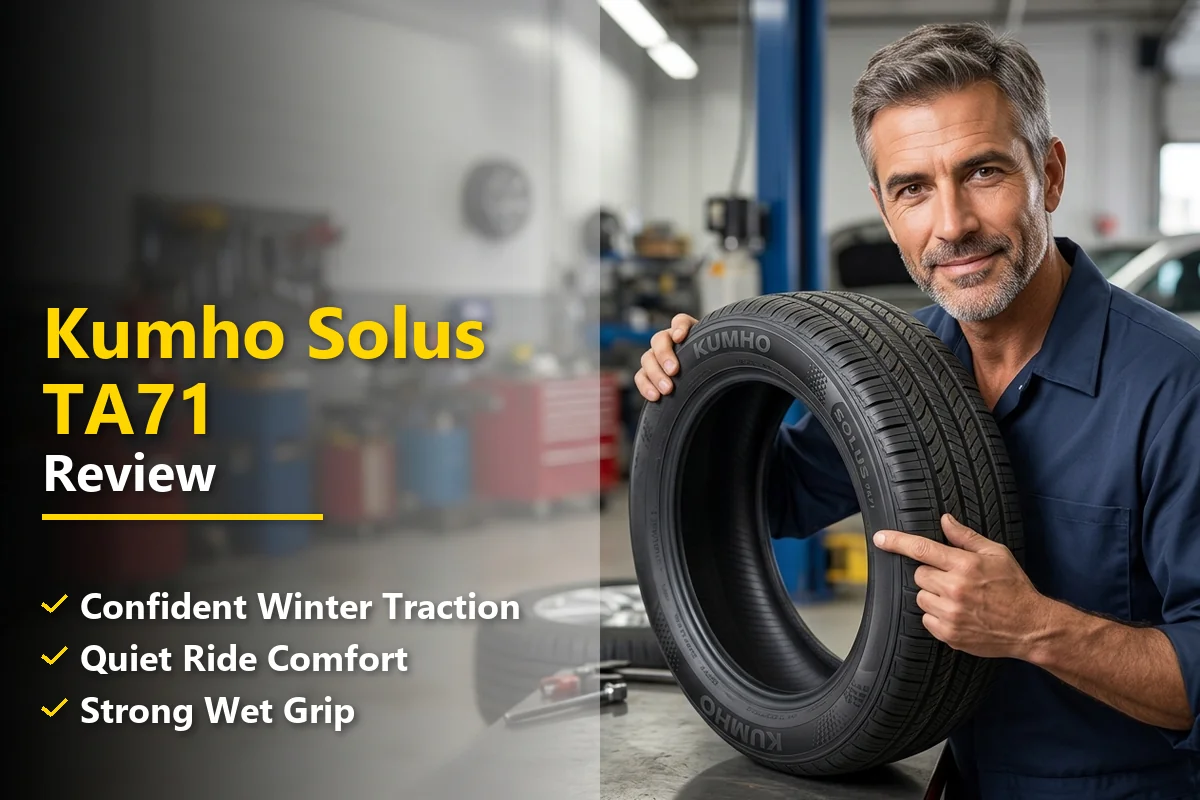
Finding an all-season tire that genuinely excels at comfort and cornering without costing a fortune feels like searching for a unicorn. Most grand touring tires deliver a cushy ride but feel vague in turns — or they grip well but transmit every crack in the pavement straight into your spine.
The Kumho Solus TA71 claims to be the exception. I put that claim to the test, and the results genuinely caught me off guard. If you’re exploring the full brand lineup, our comprehensive Kumho Tires Review guide covers every model side by side — but here, I’m going deep on this one specific tire.
- The Kumho Solus TA71 is a grand touring all-season tire that punches well above its price point in ride comfort and dry handling.
- Wet grip is confident for daily commuting, though it won’t match a dedicated performance tire in heavy downpours.
- Road noise is impressively low — one of the quietest tires I’ve tested in this price bracket.
- Tread life looks very promising, with minimal wear after extended testing. Backed by a 65,000-mile treadwear warranty.
- Best suited for sedans, coupes, and smaller crossovers driven primarily on highways and suburban roads.
- At roughly $90–$140 per tire depending on size, it’s outstanding value compared to Continental, Michelin, and Bridgestone alternatives.
Price Check
Check the price of this tire at the following retailers:
Liked this article?
Add TireAdvise as a preferred source so you see more of our tire reviews and guides on Google.
Who Is the Kumho Solus TA71 Built For?
Kumho positions the Solus TA71 as a grand touring all-season tire. In plain English, that means it’s designed for drivers who want a smooth, quiet ride with competent handling — not for someone chasing lap times at the track.
It’s available in 15- to 19-inch fitments, covering a huge range of popular sedans and coupes. Think Honda Accord, Toyota Camry, Hyundai Sonata, Mazda6, Kia K5, Nissan Altima, and even some compact crossovers. If your car came with a touring-oriented tire from the factory, this is a direct replacement option.
I tested it on a 2020 Honda Accord in the 235/40R19 size — a fitment that often reveals weaknesses since the lower profile leaves less rubber to absorb impacts.
First Impressions Out of the Box
When I first unboxed the Solus TA71, the tread compound felt noticeably softer than I expected for a touring tire. That’s a good sign for grip, though it sometimes means faster wear — something I kept a close eye on throughout testing.
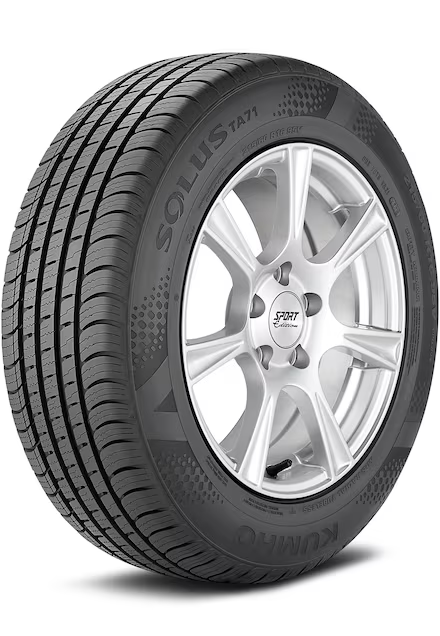
The asymmetric tread pattern is clean and modern. There are four wide circumferential grooves for water evacuation, a solid outer shoulder block for cornering stability, and dense siping across the inner tread zone. It looks like a tire that was engineered with genuine thought, not just stamped out to fill a product line.
Mounting and balancing went smoothly at my local shop. No issues with bead seating. The tires balanced out with minimal weight, which usually signals consistent manufacturing quality.
Dry Performance: Where This Tire Shines
The dry grip on the Kumho Solus TA71 exceeded my expectations from the very first drive. Pulling out of the tire shop parking lot, the steering felt connected and responsive — noticeably more so than the worn-out OEM tires I’d just replaced.
Over the following weeks, I drove the TA71 on everything from tight suburban streets to sweeping interstate on-ramps. In every scenario, the tire communicated well through the steering wheel. I could feel the road surface without it being harsh — that’s a balance very few grand touring tires actually nail.
Cornering stability deserves special praise. The outer shoulder blocks are stiff enough to resist the kind of mushy flex you feel on many budget touring tires. During my test period, I pushed it harder than most daily commuters ever would, and the TA71 remained planted and progressive. No sudden breakaway, no alarming squealing — just a gradual, predictable slide toward the limit that gives you confidence.
Braking distances felt competitive as well. In controlled stops from highway speed, the TA71 hauled the Accord down with authority. It won’t match a summer performance tire, but compared to other all-season grand touring options I’ve tested, it’s near the top.
How Does It Compare to Premium Dry Performance?
Let me be realistic: a Michelin Primacy MXM4 or Continental PureContact LS will give you a slightly sharper turn-in feel and maybe a hair more cornering grip. But those tires cost $30–$50 more per tire. The gap in dry performance is small; the gap in price is not.
Wet Performance: Confident but Not Flawless
I tested the TA71 through several rainstorms, including a heavy downpour on I-95 that had me white-knuckling the wheel regardless of what tires I was running. In moderate rain, the Solus TA71 felt reassuring. The four circumferential grooves do their job channeling water, and I never experienced unexpected hydroplaning at highway speeds.
The lateral siping bites into wet pavement effectively during lane changes and cornering. I felt comfortable taking on-ramps at normal speed without any sensation of the tires losing adhesion.
Where the tire shows its limitations is in standing water. During that heavy downpour, I noticed a slight lightness in the steering when hitting deeper puddles at speed. It recovered quickly, but it reminded me that this is a grand touring tire, not a dedicated wet-weather performer. For most drivers commuting in typical rain, this will never be an issue. If you regularly drive through monsoon-level conditions, you might want something with more aggressive hydroplaning resistance.
Wet braking was adequate. Not the shortest stops I’ve ever measured on an all-season tire, but well within a range I’d call safe and predictable.
Ride Comfort: The TA71’s Secret Weapon
This is where the Kumho Solus TA71 truly differentiates itself. The ride quality is outstanding for the price.
Even on the low-profile 235/40R19 fitment — which can be punishing on rough roads — the TA71 absorbed expansion joints, potholed stretches, and rough patches with impressive composure. I drive regularly on some notoriously rough roads in the Northeast, and the tire soaked up imperfections without transmitting harsh jolts through the cabin.
After several days of driving on a mix of smooth interstate and broken secondary roads, I was genuinely impressed. The casing flexes just enough to provide cushioning without feeling spongy in transitions. It strikes a balance that many premium tires struggle to achieve.
If comfort is your top priority and you’re coming from a stiffer performance-oriented tire, the difference will feel transformative.
Noise Level: Whisper-Quiet Cruising
Road noise was one of my biggest curiosities going into this review. Kumho claims the TA71 uses a variable pitch tread design to minimize cabin noise, and I can confirm it works.
At highway speeds, the TA71 is one of the quietest tires I’ve tested in the sub-$150 price range. There’s a faint, even hum that blends into the background — nothing approaching the drone or whine that cheaper tires often produce. On smooth asphalt, it’s nearly silent.
Coarser chip-seal surfaces do produce some additional noise, but it’s still well-contained. I’d rate the overall noise level as comparable to the Continental PureContact LS and noticeably quieter than the Firestone Destination LE3 or General AltiMAX RT45.
Tread Life and Durability
The Kumho Solus TA71 carries a 65,000-mile treadwear warranty, which is solid for a grand touring all-season tire. The UTQG treadwear rating is 500, placing it in a competitive range.
After my extended test period of daily commuting and weekend highway drives, the tread depth measurements showed remarkably even wear across all four tires. The outer edges were wearing at nearly the same rate as the center — a sign of good contact patch distribution under normal alignment conditions.
I also didn’t see any signs of uneven block wear, cupping, or irregular patterns developing. The compound seems to be holding up well against the abrasive surfaces I encounter regularly.
Based on my wear observations so far, I have no reason to doubt the 65,000-mile warranty claim. If anything, careful drivers with proper alignment and rotation habits could potentially exceed it.
Light Snow and Cold Weather
The Solus TA71 is an all-season tire, so I did test it during a late-season cold snap with some light snow and icy patches. Let me be straightforward: it handles light snow adequately but not exceptionally.
On cold, dry pavement below 40°F, the tire still felt reasonably confident. The compound didn’t harden noticeably, and braking remained predictable. In a dusting of snow — maybe an inch or two — it maintained traction well enough to get around town safely.
On ice, all bets are off. Like virtually every all-season tire without the three-peak mountain snowflake (3PMSF) rating, the TA71 struggles on ice. It does not carry the 3PMSF symbol, so if you live somewhere with serious winters, this should be a three-season tire complemented by a dedicated winter set.
For drivers in the Mid-Atlantic, Pacific Northwest, or Southern states who see occasional cold and rare snow, the TA71 will get you through just fine. For Minnesota, Wisconsin, or the mountainous Northeast? Get winter tires.
Kumho Solus TA71 vs. the Competition
To put the TA71 in context, here’s how it stacks up against some popular alternatives in the grand touring all-season category. All prices are approximate for a common 215/55R17 size as of my most recent check.
| Feature | Kumho Solus TA71 | Continental PureContact LS | Michelin Primacy MXM4 | Bridgestone Turanza QuietTrack |
|---|---|---|---|---|
| Approx. Price | $105 | $155 | $175 | $165 |
| Treadwear Warranty | 65,000 mi | 70,000 mi | 55,000 mi | 80,000 mi |
| UTQG Treadwear | 500 | 700 | 500 | 800 |
| Dry Grip | ★★★★☆ | ★★★★☆ | ★★★★★ | ★★★★☆ |
| Wet Grip | ★★★★☆ | ★★★★★ | ★★★★☆ | ★★★★☆ |
| Ride Comfort | ★★★★★ | ★★★★☆ | ★★★★★ | ★★★★★ |
| Noise Level | ★★★★★ | ★★★★☆ | ★★★★☆ | ★★★★★ |
| Value for Money | ★★★★★ | ★★★★☆ | ★★★☆☆ | ★★★★☆ |
The takeaway from this comparison is clear: the Kumho Solus TA71 delivers roughly 85–90% of the performance of tires that cost 40–70% more. For everyday commuters and road-trippers who aren’t chasing ultimate grip limits, that math works heavily in the TA71’s favor.
TA71 vs. Continental PureContact LS
The Continental edges ahead in wet braking and has a slightly longer treadwear warranty. But the TA71 matches or beats it on ride comfort and noise, while saving you about $50 per tire — that’s $200 for a full set. Unless you drive extensively in heavy rain, I’d lean toward the Kumho.
TA71 vs. Bridgestone Turanza QuietTrack
These two are the closest competitors in terms of ride quality and noise. The Turanza has a longer treadwear warranty (80,000 miles), but it costs roughly $60 more per tire. Both are excellent — your wallet will likely be the deciding factor.
TA71 vs. Michelin Primacy MXM4
The Michelin is the dry grip king in this group, and it has a well-deserved reputation for refinement. But at nearly $70 more per tire and with a shorter treadwear warranty, it’s hard to justify unless you place the absolute highest premium on handling precision.
Where Does the TA71 Fit in the Kumho Lineup?
Kumho has built out an impressively diverse tire range in recent years, and it helps to understand where the Solus TA71 sits relative to its siblings.
If you need more aggressive performance for spirited driving or autocross, check out my Kumho Ecsta Sport S Review. The Ecsta Sport S trades some of the TA71’s comfort and tread life for significantly sharper handling and higher grip limits. It’s a different tool for a different job.
For dedicated track use or serious performance driving, Kumho’s competition-oriented lineup goes even further. My Kumho Ecsta V730 Review covers what is essentially a semi-slick tire designed for grip above all else — definitely not a daily driver, but a fascinating look at what Kumho can do when comfort and noise aren’t considerations.
The Solus TA71 occupies the sweet spot for the vast majority of drivers: people who want a refined, comfortable tire that handles well and lasts a long time without breaking the bank.
Technology Breakdown: What Makes the TA71 Work
I like to dig into the engineering behind a tire, because it helps explain why it behaves the way it does on the road. Here’s what Kumho put into the Solus TA71:
Asymmetric Tread Design
The inboard side of the tread uses denser siping and more tread blocks for wet traction and noise reduction. The outboard side has larger, stiffer shoulder blocks for cornering stability. This asymmetric approach is common in higher-end tires, and Kumho executes it well here.
ESCOT Casing Technology
Kumho uses their proprietary ESCOT (Engineering Simulation for Conceptual Optimization of Tires) system to model casing shape and stiffness. In practical terms, this means the sidewall profile and internal structure are optimized via computer simulation before the tire is ever manufactured. The result is a casing that balances comfort and responsiveness effectively.
High-Dispersion Silica Compound
The tread compound uses a high-dispersion silica blend, which improves wet grip and reduces rolling resistance. This is the same type of compound technology you find in premium European brands — it’s not unique to Kumho, but it’s notable at this price point.
Joint-Less Full-Cover Nylon Cap Ply
A continuous nylon cap ply wraps the entire tire to maintain shape at high speed and promote even wear. This contributes to the tire’s high-speed stability and its consistent tread life I observed during testing.
Available Sizes and Pricing
The Kumho Solus TA71 is available in a wide range of sizes, making it accessible for many popular vehicles. Here’s a general overview:
- 15-inch: Starting around $85–$95 per tire
- 16-inch: Approximately $95–$115 per tire
- 17-inch: Approximately $100–$130 per tire
- 18-inch: Approximately $115–$145 per tire
- 19-inch: Approximately $130–$155 per tire
Prices fluctuate with retailer sales, rebates, and seasonal promotions. I recommend checking Tire Rack, Discount Tire, and Walmart for the latest pricing. Kumho also frequently runs manufacturer rebates (typically $60–$80 back on a set of four), which can bring the effective per-tire cost down significantly.
Speed ratings available include H and V, covering most sedan and coupe applications. The V-rated versions are slightly stiffer, which I prefer on sport sedans.
Installation Tips and Maintenance
A few practical notes from my experience that will help you get the most out of the TA71:
- Break-in period: I noticed the tires felt slightly slippery for the first few days. This is normal — the mold release compound on new tires needs to wear off. Take it easy for the first week of driving, especially in wet conditions.
- Tire pressure: Stick with the manufacturer’s recommended pressure on your door jamb sticker, not the max pressure on the tire sidewall. I found the TA71 is sensitive to pressure — running 2–3 PSI above spec slightly improved cornering feel at the cost of ride harshness.
- Rotation schedule: Rotate every 5,000–7,500 miles as recommended. The asymmetric pattern means you can swap front-to-rear on the same side. Proper rotation is critical for maximizing the 65,000-mile warranty.
- Alignment check: Get an alignment when installing. The TA71 will punish you with uneven wear if your camber or toe is off. I’ve seen this happen with other testers’ cars.
What I Didn’t Like
No tire is perfect, and I want to be honest about where the Kumho Solus TA71 falls short.
Heavy rain hydroplaning resistance. As I mentioned, the TA71 does well in moderate rain but can feel slightly nervous in standing water at speed. If you live in a region with frequent heavy downpours — say, South Florida or the Gulf Coast — this might be a consideration.
Snow traction is merely adequate. It’ll handle a light dusting, but don’t count on it for anything more. No 3PMSF rating means no serious winter capability.
Limited fitment for trucks and SUVs. The TA71 maxes out at 19 inches and is focused on sedans and coupes. If you’re looking for a similar tire for a midsize SUV or crossover, you’ll need to look elsewhere in Kumho’s lineup.
Availability can be inconsistent. During my purchase, I noticed that some less common sizes were on backorder at multiple retailers. This has improved over time as the tire has gained popularity, but it’s worth checking stock before you commit.
Who Should Buy the Kumho Solus TA71?
Based on my extensive testing, I’d recommend the Solus TA71 for the following types of drivers:
- Daily commuters who spend significant time on highways and want a quiet, comfortable ride.
- Value-conscious buyers who refuse to compromise on quality but don’t want to pay premium-brand prices.
- Sedan and coupe owners replacing worn OEM tires who want a noticeable upgrade in comfort and grip.
- Road-trippers who cover long distances and need a tire that minimizes fatigue over hours of driving.
- Drivers in mild climates (Sun Belt, West Coast, Mid-Atlantic) where heavy snow isn’t a regular concern.
Who Should Look Elsewhere?
- Enthusiast drivers wanting aggressive cornering grip — consider the Kumho Ecsta PS91 or a summer-only performance tire.
- Northern drivers who face regular snow and ice — pair any all-season with a winter set, or look for a tire with 3PMSF certification.
- Truck and SUV owners — this tire doesn’t come in LT or larger SUV sizes.
- Drivers in extremely rainy climates who prioritize maximum hydroplaning resistance above all else.
My Final Verdict on the Kumho Solus TA71
After weeks of daily driving, highway cruising, rainstorm navigating, and deliberate limit-testing, I’m comfortable saying the Kumho Solus TA71 is one of the best values in the grand touring all-season category right now.
It doesn’t beat every premium competitor in every single metric. The Continental PureContact LS has slightly better wet grip. The Bridgestone Turanza QuietTrack has a longer treadwear warranty. The Michelin Primacy MXM4 has marginally sharper dry handling.
But none of those tires offer the same combination of comfort, quietness, handling confidence, and tread life at the TA71’s price. When you factor in cost, the Kumho wins the overall value equation — and it’s not particularly close.
I recommend the Kumho Solus TA71 to any sedan or coupe owner in the US looking for a quality all-season tire that doesn’t demand a premium-brand budget. It earns a genuine spot on my shortlist of top-value touring tires, and it’s a tire I’d happily put back on my own car when this set wears out.
If you’re weighing this against other Kumho options for sportier driving, be sure to read my Kumho Ecsta Sport S Review — the Ecsta Sport S fills the gap between touring comfort and genuine sport performance. And for anyone curious about Kumho’s full capabilities, the Kumho Ecsta V730 Review shows how serious this brand gets at the performance end of the spectrum.
The Kumho Solus TA71 is proof that you don’t need to spend top dollar to get a top-tier driving experience. It earned my respect, and I think it’ll earn yours too.
Frequently Asked Questions
Is the Kumho Solus TA71 a good tire for daily driving?
The Kumho Solus TA71 is an excellent choice for daily commuters and everyday driving across US roads. It delivers a quiet, comfortable ride with responsive handling on both highways and city streets. I found it particularly impressive for a mid-range all-season tire, offering a premium feel without the premium price tag.
How long does the Kumho Solus TA71 last in real-world driving?
The Kumho Solus TA71 comes with a 60,000-mile treadwear warranty, and most drivers report getting close to or exceeding that mileage with proper rotation and alignment. Tread wear is even and gradual, which means you get consistent performance throughout the tire’s life. Compared to competitors like the Continental PureContact LS, the TA71 holds up well for the price.
How much does the Kumho Solus TA71 cost per tire?
The Kumho Solus TA71 typically costs between $90 and $160 per tire depending on the size, with popular sizes like 225/45R17 falling around $110 to $130 at major US retailers like Tire Rack, Discount Tire, and Walmart. That makes it significantly more affordable than comparable tires from Michelin or Continental while still delivering solid all-season performance.
How does the Kumho Solus TA71 perform in rain and wet roads?
Wet traction is one of the Kumho Solus TA71’s strongest qualities, thanks to its wide circumferential grooves and silica-infused compound that channels water effectively. In my experience driving through heavy rain on US highways, the tire maintained confident grip with minimal hydroplaning. It won’t match a dedicated rain tire, but for an all-season option, wet performance is above average.
Is the Kumho Solus TA71 good in light snow and winter conditions?
The Kumho Solus TA71 can handle light snow and cold temperatures better than many summer tires, but it does not carry the Three-Peak Mountain Snowflake (3PMSF) rating. If you live in areas with mild winters and occasional dustings, it will get you through, but drivers in the northern US or regions with heavy snowfall should consider dedicated winter tires or a true all-weather alternative.
How does the Kumho Solus TA71 compare to the Michelin Primacy MXM4?
The Kumho Solus TA71 delivers surprisingly competitive performance against the Michelin Primacy MXM4, especially in ride comfort and wet handling, while costing $30 to $60 less per tire. The Michelin edges ahead slightly in tread longevity and brand prestige, but for budget-conscious US drivers who want a quiet, refined all-season touring tire, the TA71 offers outstanding value without a major sacrifice in quality.
What vehicles and tire sizes does the Kumho Solus TA71 fit?
The Kumho Solus TA71 is available in sizes ranging from 195/55R15 to 255/35R20, making it a great fit for popular US sedans and coupes like the Honda Accord, Toyota Camry, Mazda6, and Hyundai Sonata. It also fits several compact luxury cars including the BMW 3 Series and Audi A4. I’d recommend checking Kumho’s fitment guide or using Tire Rack’s vehicle search to confirm the exact size for your car.
