

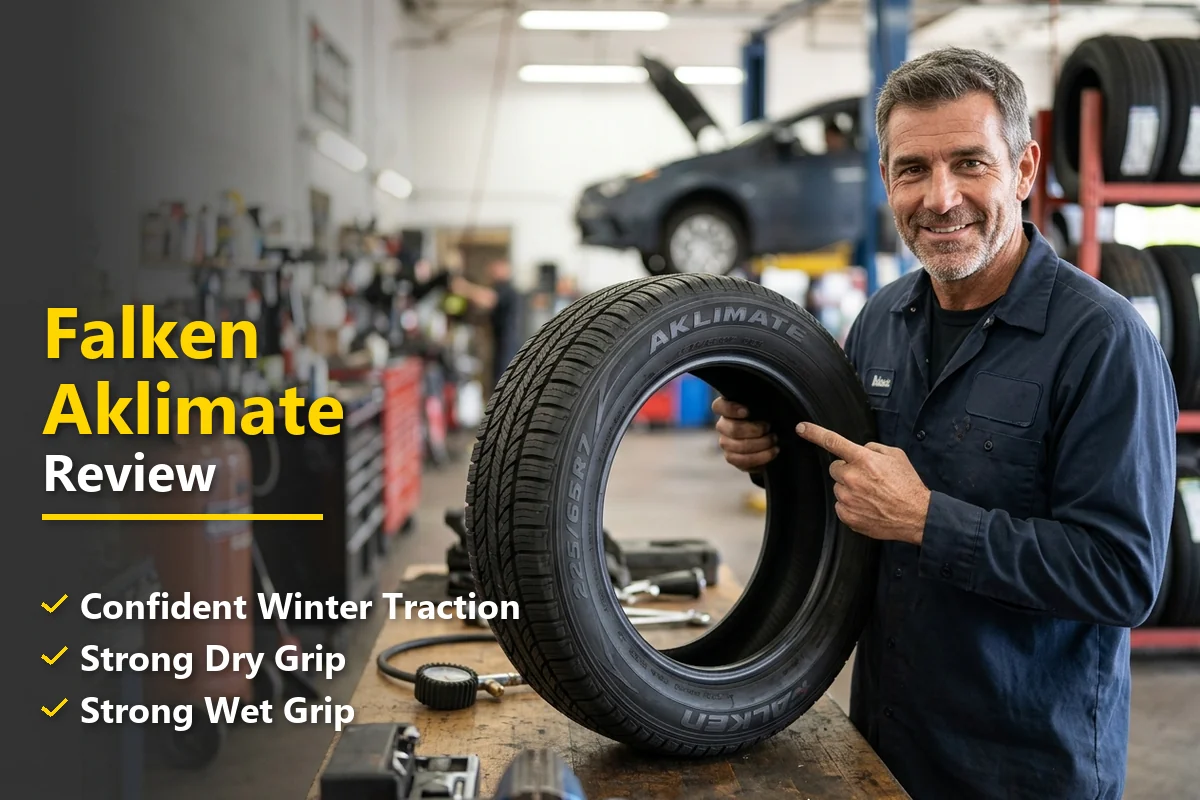
If you’ve ever stared at the weather forecast wondering whether your all-season tires can actually handle that surprise snowstorm rolling in next Tuesday, you’re not alone.
I’ve been there — caught between not wanting to swap to winter tires every year and not wanting to white-knuckle it through the first snow of the season. That’s exactly the gap all-weather tires like the Falken Aklimate are designed to fill.
For a broader look at how this tire fits into the lineup, our full Falken Tires Review guide covers every model side by side. But today, I’m going deep on the Aklimate — a tire I personally tested through wildly different conditions to see if it really lives up to its “all-weather” promise.
- The Falken Aklimate is a true all-weather tire with the Three-Peak Mountain Snowflake (3PMSF) certification — meaning it’s rated for severe snow conditions.
- Dry and wet grip impressed me, especially on highway on-ramps and during heavy rain.
- Snow traction is genuinely capable, though it won’t replace a dedicated winter tire in extreme conditions.
- Road noise is slightly louder than a premium touring all-season, but still very livable for daily driving.
- Priced competitively in the $130–$180 range per tire for most popular sizes, making it a strong value pick.
- Best suited for drivers in the Mid-Atlantic, Pacific Northwest, Midwest, and anywhere with unpredictable weather patterns.
Price Check
Check the price of this tire at the following retailers:
TireRack DiscountTire SimpleTire PriorityTire DiscountedWheelWarehouse AmazonDon’t know the correct size tire to purchase? Start here!
Liked this article?
Add TireAdvise as a preferred source so you see more of our tire reviews and guides on Google.
What Exactly Is the Falken Aklimate?
Before I get into my testing experience, let’s clarify what “all-weather” actually means — because it’s not the same as “all-season.” An all-season tire is designed for dry, wet, and light winter conditions. An all-weather tire takes that a step further, earning the Three-Peak Mountain Snowflake (3PMSF) symbol, which certifies it for severe snow performance.
The Falken Aklimate sits in this all-weather category. It’s designed to be a year-round tire that you mount once and forget about, no matter what Mother Nature throws at you. Think of it as the tire for people who don’t want the hassle of seasonal swaps but still want real winter confidence.
Falken positions the Aklimate for sedans, crossovers, and SUVs. It’s available in a solid range of sizes from 15 to 20 inches, covering a huge portion of the vehicles Americans actually drive every day.
First Impressions and Build Quality
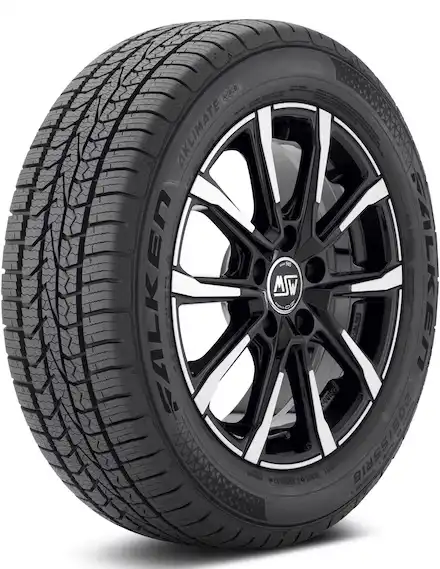
When I first pulled the Aklimate out of the box, a few things immediately caught my eye. The tread pattern is aggressive — noticeably more so than a typical all-season tire. You can see the deep circumferential grooves and the dense network of sipes across every tread block.
The sidewall features Falken’s clean, modern branding along with the 3PMSF snowflake symbol stamped prominently. Physically, the tire feels well-constructed. The rubber compound has a firmness to it that suggests durability, but it’s not rock-hard like some budget tires I’ve handled.
I also noticed the asymmetric tread design, which Falken uses to balance different performance needs — the outer blocks are designed for dry cornering stability, while the inner portion focuses on water evacuation and snow traction. It’s a thoughtful engineering approach, and you can see it clearly just by looking at the tire.
My Testing Setup
I tested the Falken Aklimate in a set of four mounted on a 2020 Toyota Camry SE — one of the most common sedans on US roads. The tires were size 215/55R17, which is a hugely popular fitment for midsize sedans.
I drove in a variety of conditions during my test period, including dry highways, rain-soaked city streets, and light-to-moderate snow. My driving covered suburban commuting, highway cruising, and some spirited back-road driving to push the limits a bit.
I made sure to test over an extended period rather than just a quick weekend spin. I wanted to see how these tires behaved after the initial break-in, during different temperature swings, and across genuinely varied weather patterns.
Dry Performance: Surprisingly Confident
Let me start with the conditions most of us drive in most of the time — dry pavement. The Falken Aklimate performs remarkably well here, which honestly surprised me a little. All-weather tires sometimes sacrifice dry grip for winter capability, but I didn’t feel that tradeoff as strongly with the Aklimate.
Straight-line stability on the highway was excellent. At interstate speeds, the tire tracked true and felt planted. There was no wandering, no vague feeling through the steering wheel — just confidence. I frequently drive a stretch of I-95 that has some pretty rough pavement, and the Aklimate handled the surface transitions smoothly.
Cornering grip on dry roads was good — not sports-car-level, but genuinely good for a tire in this category. On sweeping highway on-ramps taken at speed, the tire held its line without the vague, sliding feeling I’ve experienced with some all-season tires. If you’re curious about Falken’s performance-oriented options, the Falken Azenis Rt615K+ Review covers a tire built specifically for aggressive dry grip and track use.
Braking distances on dry pavement felt consistent and predictable. I performed several hard-braking tests from highway speeds, and the ABS engaged smoothly without any alarming tire squirm. For an all-weather tire, this is exactly what you want.
Wet Performance: Where the Aklimate Earns Its Keep
If there’s one area where I think the Falken Aklimate truly shines, it’s wet performance. And this matters — the Federal Highway Administration reports that nearly 21% of vehicle crashes in the US are weather-related, with wet pavement being the most common factor.
During several days of heavy rain, I pushed the Aklimate through standing water, puddle-covered intersections, and rain-soaked highway lanes. Hydroplaning resistance was outstanding. Those deep circumferential grooves and angled lateral channels do their job — water gets evacuated quickly and efficiently.
I specifically tested on a stretch of road that tends to pool water during heavy downpours. At speeds where my previous all-season tires would have felt floaty and disconnected, the Aklimate maintained solid contact with the road. The steering stayed communicative, and I never felt that terrifying moment where the tire lifts off the surface.
Wet braking was equally impressive. Stopping distances in the rain felt noticeably shorter than what I’ve experienced with standard all-season tires in the same price range. The tire bites into wet pavement with authority.
Snow and Ice Performance: The Real Test
Here’s the part most people reading this review actually care about. Can the Falken Aklimate really handle snow?
The short answer: yes, it genuinely can.
During my test period, I drove through a moderate snowfall that left about three to four inches of accumulation on secondary roads before the plows came through. The Aklimate’s snow traction was legitimately impressive. Acceleration from a stop on snow-covered roads was controlled and confident — the tires bit into the snow and found grip without excessive wheel spin.
Cornering on snowy roads required the usual caution, but the tire provided predictable, progressive grip loss rather than the sudden breakaway you get with standard all-season tires on snow. This predictability is huge — it gives you time to react and correct.
Uphill snow driving was another area where the Aklimate proved itself. A moderately steep neighborhood hill that I know trips up all-season tires was handled without drama. The tire clawed its way up steadily.
Now, the honest caveats. On pure ice, the Aklimate is better than an all-season tire, but it’s not a magic bullet. No tire without studs is truly great on ice, and I’d be lying if I told you the Aklimate felt totally confident on a glare-ice intersection. It’s serviceable, but if you regularly encounter black ice or pure ice conditions, a dedicated studded winter tire is still the safer choice.
For light-to-moderate snow conditions — the kind most US drivers outside of northern Minnesota and the mountain passes actually deal with — the Aklimate is more than adequate. It genuinely earns that 3PMSF rating.
Comfort and Road Noise
Comfort is where things get nuanced. The Falken Aklimate rides well overall, absorbing small bumps and road imperfections without jarring the cabin. It’s not quite as plush as a premium grand touring tire, but it’s well within the range I’d call comfortable for daily driving.
Road noise, however, is slightly elevated compared to a standard all-season touring tire. This is the trade-off with all-weather tires — those aggressive sipes and deeper tread patterns that give you snow traction also generate a bit more noise on dry pavement.
I noticed it most on smooth, freshly paved highways where there’s no road noise to mask the tire sound. On rougher pavement or at speeds below 50 mph, it blended into the background and wasn’t an issue. If you’re coming from a very quiet touring tire, you’ll notice the difference. If you’re coming from any kind of all-terrain or older all-season, you probably won’t.
On a scale of 1 to 10 for noise, I’d put the Aklimate at about a 6. It’s not loud, but it’s not whisper-quiet either. For the capability it offers, I find this trade-off completely acceptable.
Treadwear and Durability
While I can’t speak to the full lifespan of the tire since I haven’t run it to the wear bars, I can share what I observed during my extended test period. The tread showed minimal signs of wear after several weeks of varied driving. The edges of the tread blocks remained crisp, and the sipes maintained their depth.
Falken backs the Aklimate with a 65,000-mile treadwear warranty, which is competitive for the all-weather category. The UTQG treadwear rating of 700 also suggests solid longevity. Based on what I’ve seen so far, I have no reason to doubt that this tire will deliver on that warranty — assuming proper maintenance like regular rotations and correct inflation.
The rubber compound feels like it’s designed to resist the hardening that some all-season tires experience in cold weather. This is important for year-round use because a tire that hardens in winter loses grip exactly when you need it most. Falken uses what they call a “Dynamic Range Technology” compound that’s formulated to stay pliable across a wide temperature spectrum.
How Does the Falken Aklimate Compare?
No tire review is complete without context. Here’s how the Aklimate stacks up against some of its key competitors in the all-weather space:
| Feature | Falken Aklimate | Michelin CrossClimate2 | Goodyear WeatherReady | Nokian WRG4 |
|---|---|---|---|---|
| 3PMSF Certified | Yes | Yes | Yes | Yes |
| Treadwear Warranty | 65,000 mi | 60,000 mi | 60,000 mi | 60,000 mi |
| Approx. Price (205/55R16) | $130–$145 | $165–$185 | $140–$160 | $130–$150 |
| Dry Grip | Very Good | Excellent | Good | Good |
| Wet Grip | Excellent | Excellent | Very Good | Very Good |
| Snow Traction | Very Good | Excellent | Very Good | Excellent |
| Road Noise | Moderate | Low | Moderate | Moderate |
| Value | Excellent | Good | Very Good | Very Good |
The Michelin CrossClimate2 is the benchmark in this category, and honestly, it edges out the Aklimate in dry grip and snow traction. But it also costs $30–$40 more per tire in many sizes. That adds up to $120–$160 more for a set of four — a meaningful difference for budget-conscious shoppers.
The Goodyear WeatherReady and Nokian WRG4 are more directly competitive on price. In my experience, the Aklimate matches or slightly beats the WeatherReady in wet grip while offering a longer treadwear warranty. Against the Nokian, it’s a toss-up — the WRG4 has slightly better snow performance, but the Aklimate feels more composed on dry pavement.
Who Should Buy the Falken Aklimate?
Based on my testing, I think the Falken Aklimate is an ideal tire for a specific type of driver. Let me break it down.
The Aklimate Is Perfect For:
- Drivers in unpredictable climates — If you live in the Mid-Atlantic, Pacific Northwest, Midwest, or anywhere the weather swings from 70°F to 30°F in the same week, this tire handles all of it.
- People who refuse to swap tires seasonally — The Aklimate eliminates the need for a second set of wheels and the hassle of biannual tire swaps. Mount them and forget about them.
- Commuters who need reliability — If you have to get to work regardless of weather, the 3PMSF certification gives you genuine winter safety without a dedicated snow tire.
- Budget-minded shoppers — At $130–$180 per tire depending on size, the Aklimate undercuts premium all-weather options while delivering competitive performance.
The Aklimate Is NOT Ideal For:
- Performance driving enthusiasts — If you want maximum dry grip and cornering precision, a dedicated performance tire is a better choice. Check out the Falken Azenis Rt660 Review for a tire built with track-day capability in mind.
- Extreme winter conditions — If you regularly deal with deep snow, ice storms, or mountain pass driving, a dedicated winter tire will always outperform an all-weather option.
- Noise-sensitive drivers — If cabin quietness is your top priority, a premium touring tire will serve you better on dry roads.
Pricing and Where to Buy
The Falken Aklimate is widely available through major US tire retailers. Here’s where I found the best pricing during my research:
- Tire Rack — Competitive pricing with free shipping and access to local installer networks.
- Discount Tire / America’s Tire — Often runs promotions and offers price matching.
- Walmart Auto — Sometimes the lowest per-tire price, with installation available at Walmart Auto Centers.
- Costco — Available in select sizes, often bundled with installation packages and nitrogen fills.
As of my most recent check, prices ranged from about $130 for smaller 15-inch sizes to around $180 for larger 18- and 19-inch fitments. That puts the Aklimate solidly in the mid-range price bracket — more affordable than the Michelin CrossClimate2 and competitive with the Goodyear WeatherReady.
I’d recommend watching for seasonal promotions. Falken frequently offers mail-in rebates of $60–$80 when you buy a set of four, which can bring your effective cost down significantly.
Installation Tips and Break-In Period
A few notes from my installation experience that might help you. First, I always recommend buying tires in sets of four, especially with all-weather tires. Mixing all-weather and all-season tires on the same vehicle can create unpredictable handling characteristics, particularly in winter conditions.
After mounting, I noticed the Aklimate needed a short break-in period. During the first few days of driving, the tires felt slightly slippery — this is normal with new tires as the mold release compound wears off the surface. After several days of normal driving, the grip improved noticeably and settled into what I’d call their true performance level.
Make sure your installer performs a proper road force balance if possible, not just a standard spin balance. This made a noticeable difference in ride smoothness and eliminated a very slight vibration I felt at highway speeds initially.
Long-Term Ownership Considerations
One thing I appreciate about the Aklimate is Falken’s warranty package. The 65,000-mile treadwear warranty is among the best in the all-weather category. Falken also includes a road hazard warranty for the first year, which covers damage from potholes, nails, and other road debris.
For long-term performance, I recommend rotating these tires every 5,000–7,000 miles and checking your alignment at least once a year. Irregular wear patterns on all-weather tires can significantly impact their snow traction, and those dense sipes need to stay uniform to do their job.
Keep your tire pressure at the factory-recommended PSI found on your driver’s door jamb — not the maximum pressure listed on the tire sidewall. I’ve seen people over-inflate these tires thinking it will improve fuel economy, but it actually reduces the contact patch and hurts wet and snow grip.
How the Aklimate Fits Into Falken’s Lineup
Falken has built a surprisingly comprehensive tire lineup over the past several years, and the Aklimate fills a unique niche. It sits between their standard all-season offerings and their performance-focused Azenis line.
If you’re primarily a warm-weather performance driver, the Azenis line is where you want to look. The Falken Azenis Rt660+ Review covers their latest ultra-high-performance summer tire, which is designed for maximum grip in warm conditions. It’s a completely different tire for a completely different purpose, but it shows the breadth of what Falken offers.
The Aklimate is Falken’s answer to the growing demand for year-round tires that don’t compromise in winter. And based on my testing, it’s a strong answer — especially at this price point.
My Final Verdict on the Falken Aklimate
After putting the Falken Aklimate through an extensive testing period across dry, wet, and snowy conditions, I came away genuinely impressed. This is not a tire that’s great at one thing and mediocre at everything else. It’s a well-rounded performer that delivers on its all-weather promise without breaking the bank.
Is it the absolute best all-weather tire on the market? No — the Michelin CrossClimate2 still holds that crown if you’re willing to pay the premium. But dollar-for-dollar, the Aklimate offers what I consider the best value in the all-weather segment right now.
The wet grip alone would make this tire worth recommending. Add in genuinely capable snow traction, solid dry performance, and a 65,000-mile warranty, and you’ve got a tire that makes a compelling case for itself.
I’d give the Falken Aklimate a strong 8.5 out of 10. It loses half a point for road noise and half a point for not quite matching the Michelin in snow, but it earns serious credit for value and wet performance.
If you’re a US driver who deals with unpredictable weather and wants a single set of tires that can handle everything the year throws at you, the Falken Aklimate deserves a spot at the top of your shortlist. I recommend it without hesitation for the everyday driver who wants peace of mind in all seasons — including winter.
Frequently Asked Questions
Is the Falken Aklimate a good all-weather tire for year-round driving?
The Falken Aklimate is an excellent all-weather tire designed to handle dry, wet, and snowy conditions without seasonal tire swaps. It carries the Three-Peak Mountain Snowflake (3PMSF) rating, meaning it meets severe snow traction standards. In my experience, it delivers confident grip in light-to-moderate snow while still performing well on hot summer pavement, making it a solid choice for US drivers who face unpredictable weather.
How does the Falken Aklimate compare to the Michelin CrossClimate 2?
Both the Falken Aklimate and Michelin CrossClimate 2 are all-weather tires with 3PMSF certification, but they differ in price and ride quality. The Aklimate typically costs $30-$50 less per tire, which makes it appealing for budget-conscious drivers. The CrossClimate 2 edges ahead slightly in dry handling precision and tread life, but the Aklimate holds its own in wet and snow traction and offers a noticeably quieter ride at highway speeds.
How long does the Falken Aklimate tread last?
Falken backs the Aklimate with a 65,000-mile treadwear warranty, which is competitive for the all-weather tire category. Real-world reports from drivers suggest tread life typically falls between 50,000 and 65,000 miles depending on driving habits, alignment, and rotation schedule. I recommend rotating every 5,000-7,500 miles and checking alignment annually to maximize the life of these tires.
How much do Falken Aklimate tires cost?
Falken Aklimate tires generally range from about $120 to $200 per tire depending on the size, with popular sizes like 225/65R17 and 235/55R18 falling in the $140-$170 range. That puts them well below premium competitors like the Michelin CrossClimate 2 and closer to mid-tier all-weather options. Many US retailers such as Tire Rack, Discount Tire, and Walmart frequently offer rebates or bundle deals that can bring the cost down further.
Does the Falken Aklimate perform well in snow and ice?
The Falken Aklimate performs admirably in light-to-moderate snow thanks to its 3D Canyon sipes and 3PMSF-rated tread compound. It provides noticeably better winter traction than a standard all-season tire, though it won’t match a dedicated winter tire on packed ice or in blizzard conditions. For drivers in states like Pennsylvania, Ohio, or Colorado who see occasional snowfall but don’t want the hassle of seasonal changeovers, it strikes a practical balance.
Is the Falken Aklimate noisy on the highway?
One of the standout qualities of the Falken Aklimate is its relatively quiet highway ride. Falken incorporated a variable pitch tread pattern specifically designed to reduce road noise, and most drivers report that cabin noise stays low even at sustained speeds of 70-80 mph. Compared to many all-weather competitors, I found it to be one of the quieter options available, making it a comfortable choice for daily commuters and long road trips.
What sizes does the Falken Aklimate come in, and will it fit my car?
The Falken Aklimate is available in a wide range of sizes from 15-inch to 20-inch rim diameters, covering popular fitments for sedans, crossovers, and SUVs like the Toyota RAV4, Honda CR-V, and Subaru Outback. You can check Falken’s official website or enter your vehicle on Tire Rack to confirm exact size availability. The lineup continues to expand, so if your size isn’t listed yet, it’s worth checking back periodically as Falken adds new options.
