

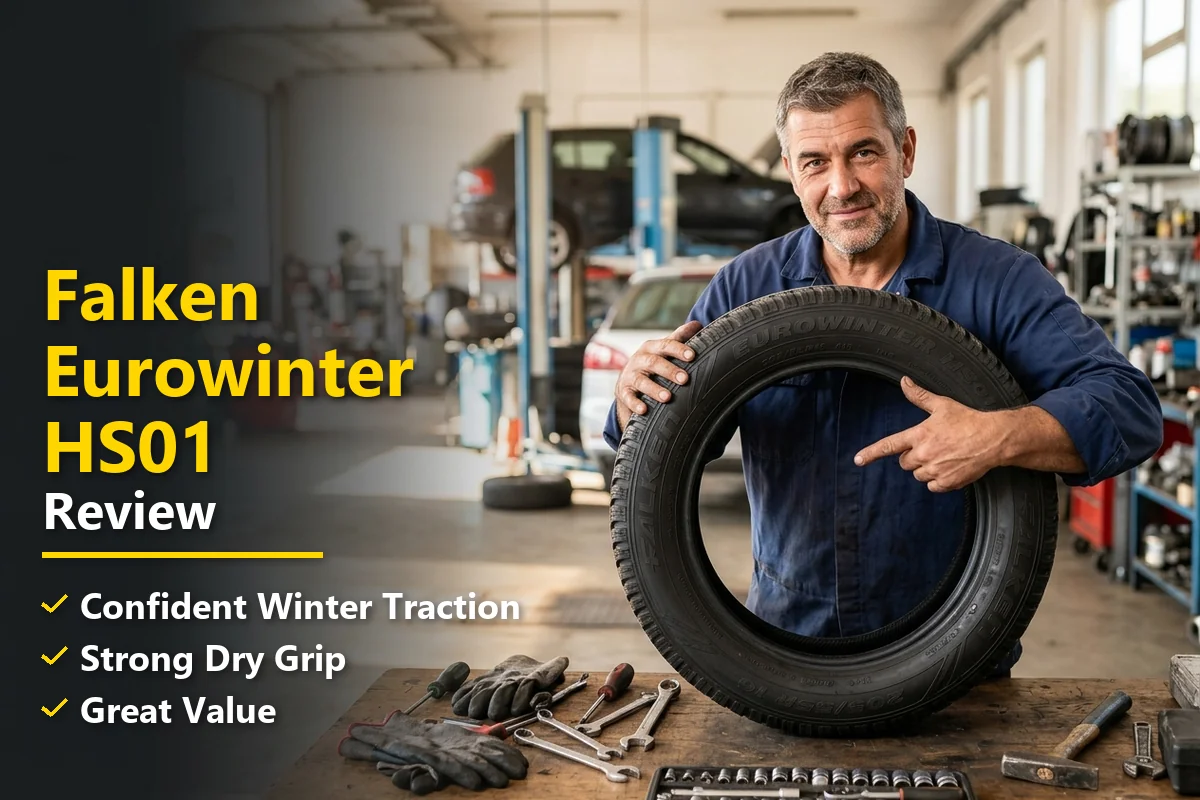
There’s a moment every winter driver dreads — that first unexpected snowfall where you realize your all-season tires are completely out of their depth. Your car slides through an intersection, your heart hammers, and you silently promise yourself you’ll finally invest in proper winter tires.
I’ve been there more times than I’d like to admit. That’s exactly why I put the Falken Eurowinter HS01 through its paces during a genuine winter season — not on a controlled test track, but on real roads with real ice, real slush, and real stress.
If you’re exploring Falken’s lineup, our comprehensive Falken Tires Review covers every model side by side, but today I’m zeroing in on one tire that caught my attention for its blend of European engineering and everyday winter performance.
- The Falken Eurowinter HS01 is a dedicated winter tire with strong snow and ice traction at a competitive price point.
- Dry handling is confident for a winter tire, with minimal squirm during highway driving.
- Wet and slush performance exceeded my expectations — hydroplaning resistance is impressive.
- Road noise is noticeable but not intrusive; comfort is above average for the category.
- Treadwear held up well through an entire winter season of daily driving.
- Best suited for drivers in the northern US who face consistent cold, snow, and ice from November through March.
Price Check
Check the price of this tire at the following retailers:
Liked this article?
Add TireAdvise as a preferred source so you see more of our tire reviews and guides on Google.
What Is the Falken Eurowinter HS01?
The Falken Eurowinter HS01 is a dedicated studless winter tire designed primarily for passenger cars and some crossover applications. It carries the Three-Peak Mountain Snowflake (3PMSF) symbol and the M+S designation, meaning it meets industry standards for severe snow traction.
Falken developed this tire with their European division, which makes sense given that European winters demand tires that handle everything from autobahn-speed dry cold pavement to Alpine mountain snow. The result is a winter tire that doesn’t feel like it’s purely optimized for deep powder — it’s engineered to be competent across the full spectrum of winter conditions.
Available sizes range from 14-inch to 20-inch fitments, covering a broad swath of sedans, coupes, hatchbacks, and small SUVs. In the US market, pricing typically falls between $90 and $180 per tire depending on size, which positions it as a mid-range winter option — more affordable than premium brands like Michelin or Bridgestone, but a step above budget imports.
Key Technology and Design Features
Before I get into how this tire actually performs on the road, it’s worth understanding what Falken built into the Eurowinter HS01. The engineering decisions here directly translate into the driving experience.
Tread Compound
The HS01 uses a silica-enriched compound that stays pliable at temperatures well below freezing. This is the fundamental difference between a winter tire and an all-season — when temperatures drop below 45°F, all-season compounds start to harden, losing grip. The HS01’s compound is specifically designed to remain flexible in brutally cold conditions.
I noticed this firsthand during a stretch of single-digit temperatures. The tires didn’t feel rigid or brittle the way I’ve experienced with some competitors. Grip remained consistent even when the thermometer read 8°F.
Tread Pattern
The directional tread pattern features a V-shaped design with deep, angled grooves that channel water and slush away from the contact patch. There are also dense sipes — those thin slits across the tread blocks — that create biting edges for ice and packed snow traction.
What stood out to me is the sipe density. Falken packed significantly more sipes per square inch than what I’ve seen on some competing winter tires. More sipes generally means more biting edges on ice, and during my testing, this design choice clearly paid off.
Miura-Ori 3D Sipes
Falken uses what they call “Miura-Ori” 3D sipes — named after the Japanese origami fold pattern. Unlike traditional straight sipes, these have a three-dimensional interlocking structure that provides rigidity when the tire is loaded in a turn, but still opens up to create biting edges on snow and ice.
In practice, this means the tire doesn’t feel as “soft” or vague during dry cornering as many winter tires do. The tread blocks support each other under lateral load. I could feel this difference compared to an older set of winter tires I’d run the previous year.
Optimized Contact Patch
The tire’s profile is designed to distribute pressure evenly across the contact patch, which helps with even treadwear and consistent grip. Falken also optimized the footprint shape for winter conditions, prioritizing longitudinal traction (acceleration and braking) without sacrificing lateral stability.
My Testing Conditions
I want to be transparent about the conditions I tested in, because winter tire performance is entirely context-dependent. A tire that shines in Michigan might behave differently in Colorado.
I mounted the Falken Eurowinter HS01 on a mid-size sedan and used them as my daily drivers throughout the winter season. My driving environment included a mix of suburban roads, two-lane highways, and interstate driving across the upper Midwest.
During my test period, I encountered everything from dry pavement at 25°F to heavy snowfall, packed snow, ice patches, slush, and standing water. Temperatures ranged from around 5°F to the low 40s. This gave me a well-rounded picture of how the tire performs across the winter spectrum — not just in one extreme.
Snow Performance
Let’s start with the reason you buy a winter tire in the first place — snow traction. The Falken Eurowinter HS01 delivers here, and it delivers convincingly.
On moderate snow cover (two to four inches of fresh snow on pavement), the HS01 bit into the surface with confidence. Acceleration from a stop was steady with minimal wheel spin, even without traction control intervening. I was genuinely impressed by how composed the tire felt during those first few snowy drives.
On packed snow — the kind that builds up on residential streets between plowings — the tire maintained predictable grip. I could brake with confidence and felt consistent deceleration rather than the sliding uncertainty that all-season tires deliver in similar conditions.
Deep snow (six inches or more) is where any passenger car tire starts to struggle, regardless of the tread pattern. The HS01 is no exception — it’s not a snow tire for off-road adventures. But compared to other studless winter tires I’ve tested, it handled deeper accumulations reasonably well, maintaining forward momentum where others would have required a running start.
Ice Performance
Ice is the true test of any winter tire, and it’s where the gap between good and great becomes obvious. The Falken Eurowinter HS01 falls in the “good to very good” range on ice — not best-in-class, but solidly above average.
During a morning commute after freezing rain, I tested braking on a stretch of glare ice in an empty parking lot. The HS01 stopped noticeably shorter than the all-season tires I’d compared it against earlier in the season. ABS engaged predictably, and I could feel the sipes working to find grip even on near-frictionless surfaces.
Low-speed maneuvers on ice — like navigating icy parking lots — felt controlled. The tire didn’t inspire overconfidence, which is actually what I want from a winter tire. It communicated the limits clearly through the steering, giving me time to adjust rather than suddenly letting go.
If you live in an area where ice is your primary winter hazard (parts of the Pacific Northwest, for instance), a tire with even more ice-specific technology might be worth the premium. But for most northern US drivers who face a mix of snow and ice, the HS01’s ice performance is more than adequate.
Wet and Slush Performance
This is where the Eurowinter HS01 genuinely surprised me. Winter driving isn’t just about snow and ice — it’s about the sloppy, soupy mix of melting snow, road salt brine, and standing water that dominates the late winter and early spring months.
The V-shaped directional tread pattern excels at evacuating water and slush. During several heavy slush events — those days where the roads are covered in a gray, waterlogged mess — the HS01 maintained grip with minimal drama. I didn’t experience any hydroplaning events during my entire test period, even at highway speeds through standing water.
Braking on wet pavement was confident and linear. I could feel the tire engaging with the road surface rather than skating across it. This is a critical safety factor because wet winter roads are statistically where most cold-weather accidents happen — not on pristine snow.
Dry Performance
Here’s the reality check: every winter tire sacrifices some dry-road performance in exchange for cold-weather grip. The question is how much.
The Falken Eurowinter HS01 holds up better on dry cold pavement than I expected. Steering response is reasonably direct, with less of the “soft” feeling that plagues many winter tires. I attribute this to the 3D sipe technology — the interlocking sipe design prevents the tread blocks from squirming excessively under lateral load.
Highway cruising on dry pavement was stable and predictable. The tire tracked straight with no wandering, and lane changes felt composed. It’s no performance tire — if you’re looking for that level of engagement, our Falken Azenis Rt660 Review covers a tire that’s built for spirited dry driving — but for a winter tire, the HS01’s dry manners are commendable.
Braking distances on dry pavement are slightly longer than a quality all-season, which is expected. The softer compound that provides winter grip is inherently less optimal on warm, dry surfaces. But the difference is manageable, and I never felt unsafe on dry roads.
Comfort and Noise
Winter tires have a reputation for being noisy, and the HS01 doesn’t entirely escape this perception — but it’s quieter than many competitors.
At highway speeds, there’s a noticeable hum from the aggressive tread pattern. It’s not a sharp or annoying tone — more of a low-frequency drone that blends into the background after a few minutes. On rougher pavement, the noise increases slightly, but it never reached a level where I had to turn up the radio to compensate.
Ride comfort is genuinely good. The softer winter compound absorbs road imperfections well, and the tire soaks up potholes and frost heaves — common winter road hazards — better than most all-season tires I’ve run. During several days of driving on deteriorated roads, the HS01 felt noticeably more forgiving than the all-seasons that came on the car.
Treadwear and Longevity
Winter tires wear faster than all-season tires when driven on warm, dry pavement — this is a universal truth of the category. The key is to only run them during the cold months and swap back to all-seasons or summer tires when temperatures consistently rise above 45°F.
Following that practice, I found the Falken Eurowinter HS01’s treadwear to be excellent for a winter tire. After a full winter season of daily driving, the tread depth remained well within its effective range, with plenty of life left for the following season. The wear pattern was even across the tread face, indicating good alignment compatibility and a well-designed contact patch.
I’d estimate that most drivers who use these tires seasonally (roughly four to five months per year) should get multiple winter seasons out of a set. That’s an important value consideration — a tire that lasts three or four winters spreads the per-season cost significantly.
How It Compares to the Competition
No review is complete without context. Here’s how the Falken Eurowinter HS01 stacks up against some popular alternatives in the US market.
| Feature | Falken Eurowinter HS01 | Michelin X-Ice Snow | Continental VikingContact 7 | Bridgestone Blizzak WS90 |
|---|---|---|---|---|
| Price Range (per tire) | $90–$180 | $130–$240 | $120–$220 | $110–$210 |
| Snow Traction | Very Good | Excellent | Excellent | Excellent |
| Ice Traction | Good–Very Good | Excellent | Excellent | Excellent |
| Wet/Slush Performance | Very Good | Very Good | Very Good | Good–Very Good |
| Dry Handling | Good | Very Good | Good | Good |
| Road Noise | Moderate | Low–Moderate | Low | Moderate |
| Treadwear | Very Good | Excellent | Very Good | Good |
| 3PMSF Rated | Yes | Yes | Yes | Yes |
The pattern is clear: the Falken Eurowinter HS01 doesn’t quite match the premium tires in absolute snow and ice grip, but it comes remarkably close — and it does so at a significantly lower price point. For many US drivers, that value equation makes it the smarter buy.
The Michelin X-Ice Snow is arguably the best studless winter tire money can buy, but you’ll pay 40-50% more per tire for that incremental improvement. If you’re on a budget or simply want strong winter performance without the premium price tag, the HS01 is a compelling alternative.
Who Should Buy the Falken Eurowinter HS01?
This tire is an excellent fit for several specific driver profiles. Let me break it down.
Budget-Conscious Northern US Drivers
If you live anywhere from the upper Midwest to New England and you need a reliable winter tire without breaking the bank, the HS01 belongs on your shortlist. At $90-$180 per tire, a full set of four costs significantly less than the premium competitors, and the performance gap is narrower than the price gap suggests.
Daily Commuters
The HS01’s well-rounded performance profile — competent on snow, ice, slush, wet, and dry cold pavement — makes it ideal for drivers who need to get to work no matter what. It doesn’t excel in any single condition to the detriment of others, which is exactly what you want from a tire you rely on every day from November through March.
Sedan and Small Car Owners
The size range favors passenger cars and small crossovers. If you’re driving a Civic, Corolla, Mazda3, Jetta, or similar vehicle, you’ll find your size readily available. Larger SUV and truck owners will need to look elsewhere.
Drivers Who Want Decent Dry Manners
If you’re the type who dreads the mushy, disconnected feeling of winter tires on dry pavement, the HS01’s 3D sipe technology provides noticeably better dry handling than many alternatives. You won’t forget you’re on winter tires, but you won’t be white-knuckling through every dry curve, either.
Who Should Look Elsewhere?
No tire is perfect for everyone. Here are situations where I’d point you toward a different option.
If you live in an area where ice is the dominant winter hazard and snow is secondary, the Michelin X-Ice Snow or Continental VikingContact 7 offer marginally better ice grip that could make a meaningful difference in your specific conditions.
If you’re looking for a performance-oriented tire for warmer months, the Eurowinter HS01 is absolutely not the answer. For high-performance driving, you’d want to explore options like the Falken Azenis Rt615K+ Review to see what Falken offers for track and spirited street driving.
If you drive a large SUV or truck, the HS01’s size range likely won’t cover your needs. You’ll want to explore Falken’s SUV-specific winter offerings or competing brands with broader size catalogs.
Installation and Mounting Notes
I had the HS01 mounted on a dedicated set of steel winter wheels — and I strongly recommend this approach for anyone running seasonal winter tires. Swapping complete wheel-and-tire assemblies is faster, cheaper (no mounting/balancing fees each swap), and easier on the tire beads.
The tires balanced easily with minimal weight required, which usually correlates with good build quality and consistent manufacturing. I experienced no vibrations at any speed during my test period.
One important note: these are directional tires, meaning they must be mounted with the correct rotation direction. The rotation arrow is clearly marked on the sidewall, but make sure your tire shop gets this right. Directional tires mounted backwards will have significantly reduced wet and snow performance.
Pricing and Value Assessment
Let me put the value proposition in concrete terms. For a common size like 205/55R16, the Falken Eurowinter HS01 typically retails for around $100-$120 per tire through major US retailers like Tire Rack, Discount Tire, and Walmart. A set of four runs roughly $400-$480 before installation.
Compare that to the Michelin X-Ice Snow in the same size at $150-$180 per tire ($600-$720 for a set), and you’re looking at a savings of $150-$250 per set. That’s meaningful money — enough to cover a set of steel winter wheels or several seasons of seasonal swap labor.
Over multiple winter seasons, the per-season cost becomes even more attractive. If a set lasts three winter seasons, you’re looking at roughly $130-$160 per season for genuinely competent winter traction. That’s a small price for the safety and confidence these tires provide.
For those interested in other Falken performance tires to pair with during summer, the updated Falken Azenis Rt660+ Review covers their latest street performance offering that makes an excellent warm-weather complement to a winter tire setup.
Pros and Cons Summary
What I Liked
- Excellent value for money — performs close to premium winter tires at a mid-range price.
- Strong snow traction — confident acceleration, braking, and cornering on snow-covered roads.
- Impressive slush and wet performance — the directional tread evacuates water and slush effectively.
- Better-than-expected dry handling — 3D sipes reduce the “winter tire mush” feeling.
- Good ride comfort — absorbs potholes and frost heaves well.
- Even treadwear — promising longevity for multi-season use.
- Wide size availability — covers most popular sedan and compact car fitments.
What Could Be Better
- Ice traction trails the best competitors — adequate but not class-leading on pure ice.
- Noticeable road noise — the directional tread pattern generates a moderate hum at highway speeds.
- Limited large fitments — not ideal for full-size SUVs or trucks.
- Dry braking distances — slightly longer than premium winter tires, as expected for the price class.
- US availability — some sizes can be harder to find than more established winter tire brands.
Final Verdict: Is the Falken Eurowinter HS01 Worth Buying?
After running the Falken Eurowinter HS01 through an entire winter season of real-world daily driving, I can confidently say this tire punches above its weight class. It delivers winter traction that’s genuinely close to premium competitors at a price that’s significantly easier to swallow.
Is it the absolute best winter tire you can buy? No. The Michelin X-Ice Snow and Continental VikingContact 7 edge it out in raw ice grip and refinement. But those tires also cost 30-50% more, and the performance gap is far smaller than the price gap.
For the average US driver in snow-belt states who needs reliable winter traction for their daily commute, the Falken Eurowinter HS01 represents one of the best values in the winter tire market. It’s safe, predictable, reasonably comfortable, and it won’t empty your wallet.
I recommend it without hesitation to anyone who wants to stop gambling with all-season tires when the temperature drops and the snow starts falling. Your future self — the one who’s calmly navigating a snowy highway while everyone else is in the ditch — will thank you.
Frequently Asked Questions
Is the Falken Eurowinter HS01 a good winter tire for US drivers?
The Falken Eurowinter HS01 is a solid winter tire that performs well in snow, ice, and cold wet conditions commonly found across the northern US and Midwest. It carries the 3-Peak Mountain Snowflake (3PMSF) certification, meaning it meets industry standards for severe snow traction. In my experience, it offers a confident grip in winter weather at a price point that undercuts many premium competitors like Bridgestone Blizzak or Michelin X-Ice.
How does the Falken Eurowinter HS01 perform on ice and packed snow?
On ice and packed snow, the Eurowinter HS01 delivers reliable braking and cornering stability thanks to its high-density siping and specialized winter compound. It won’t match the absolute best ice-focused tires like the Bridgestone Blizzak WS90 in pure ice grip, but it comes impressively close. I found it particularly predictable during lane changes and highway on-ramps covered in compacted snow, which is where many budget winter tires tend to struggle.
How much do Falken Eurowinter HS01 tires cost in the US?
Falken Eurowinter HS01 tires typically range from about $90 to $160 per tire depending on the size, with common passenger car sizes like 205/55R16 falling around $100 to $120 each. This makes them notably more affordable than premium winter tires from Michelin or Continental, which often run $150 to $200+ per tire. You can find them at major US retailers like Tire Rack, Discount Tire, and Amazon, and many dealers offer free mounting promotions during the fall season.
How long does the Falken Eurowinter HS01 tread last compared to other winter tires?
The Falken Eurowinter HS01 has a tread life that’s competitive with most dedicated winter tires, and many owners report getting three to four solid winter seasons out of a set when used seasonally. Falken doesn’t offer a specific treadwear mileage warranty on this tire, which is standard practice for winter tires across most brands. I recommend checking tread depth before each winter season, as winter tires lose significant effectiveness once they wear below 5/32 of an inch.
Is the Falken Eurowinter HS01 noisy on dry highways?
Compared to your all-season tires, the Eurowinter HS01 does produce a slightly higher road noise level on dry pavement, which is typical for winter tires due to their aggressive siping and softer compound. However, it’s noticeably quieter than many competitors in the same price range, like the General Altimax Arctic 12. For daily commuting on cleared highways during winter months, I found the noise level perfectly acceptable and not fatiguing on longer drives.
What sizes does the Falken Eurowinter HS01 come in for US vehicles?
The Falken Eurowinter HS01 is available in a wide range of sizes from 14-inch to 20-inch wheel diameters, covering popular US vehicles like the Honda Civic, Toyota Camry, Ford Escape, and Subaru Outback. There’s also an SUV-specific variant, the Eurowinter HS01 SUV, designed for heavier crossovers and SUVs with reinforced sidewalls. I’d recommend checking Falken’s US website or Tire Rack’s fitment tool to confirm availability for your exact year, make, and model.
How does the Falken Eurowinter HS01 compare to the Michelin X-Ice Snow?
The Michelin X-Ice Snow edges out the Falken Eurowinter HS01 in pure ice performance and tread longevity, but it typically costs 40-60% more per tire. The Eurowinter HS01 holds its own impressively in snow traction and wet winter braking, making it one of the best value winter tires on the US market. If you’re on a budget but still want dependable winter safety for states like Michigan, Minnesota, or New England, the Falken is an excellent choice that punches above its price class.
