

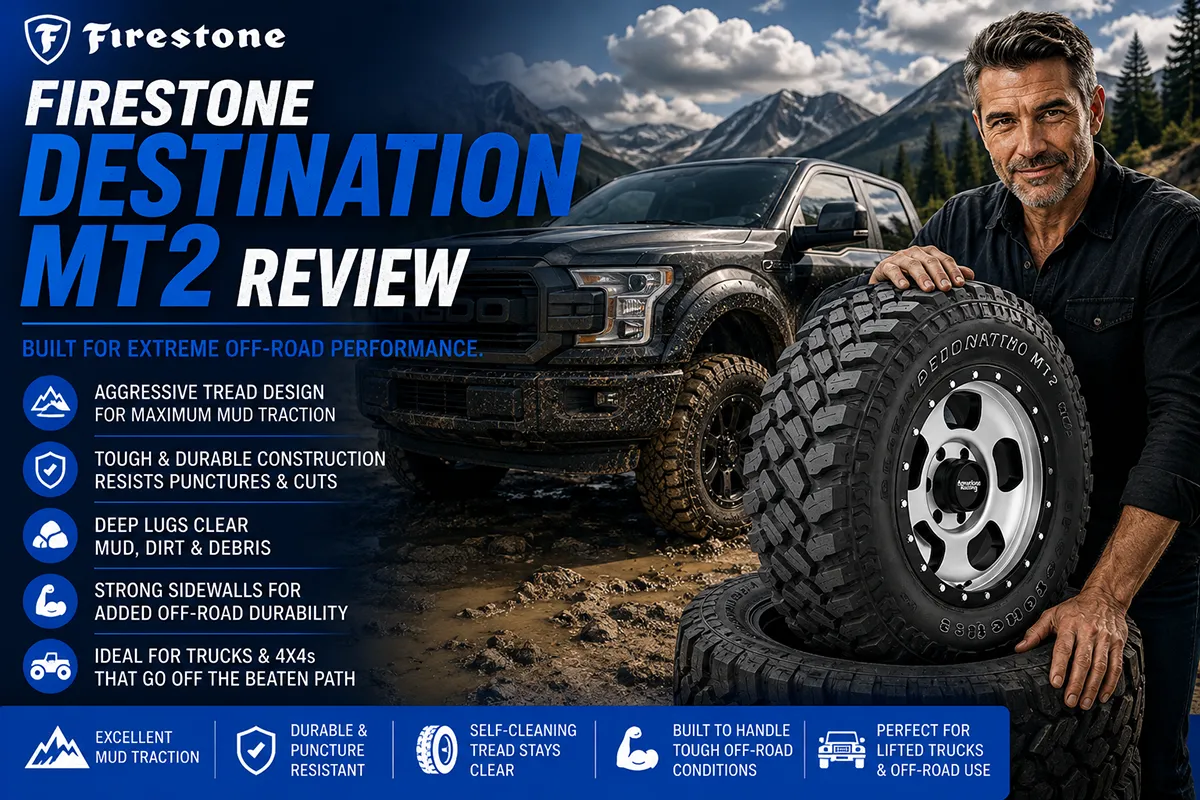
You’ve been staring at your truck’s tires for weeks now, watching the tread wear down and wondering if this is the time you finally commit to a real mud-terrain tire. Maybe you’ve been running an all-terrain that’s fine on the highway but completely useless the moment the trail gets nasty.
I’ve been there. And after spending serious time behind the wheel with the Firestone Destination MT2 mounted on a full-size pickup, I can tell you this tire has some strong opinions about what it wants to do — and “sitting on pavement” isn’t at the top of that list.
If you’ve been browsing our full Firestone Tires Review guide to compare models across the lineup, this deep dive into the MT2 will help you decide if it’s the right mud-terrain choice for your rig.
- The Firestone Destination MT2 is an aggressive mud-terrain tire designed for serious off-road use — mud, rocks, sand, and loose terrain.
- Off-road traction is outstanding, especially in deep mud and over rocky surfaces where the aggressive tread pattern really shines.
- Highway ride quality and noise are the expected trade-offs — this tire hums at speed, and you’ll feel it on long road trips.
- Tread life has been solid for a mud-terrain, and the sidewall construction feels genuinely tough.
- Best suited for trucks and SUVs that see regular off-road duty, not daily commuters who rarely leave asphalt.
- Pricing typically falls in the $220–$380+ range per tire depending on size, which is competitive for this class.
Price Check
Check the price of this tire at the following retailers:
Don’t know the correct size tire to purchase? Start here!
Liked this article?
Add TireAdvise as a preferred source so you see more of our tire reviews and guides on Google.
What Exactly Is the Firestone Destination MT2?
The Firestone Destination MT2 is the second generation of Firestone’s dedicated mud-terrain tire. It’s built for trucks and SUVs that spend meaningful time off pavement — we’re talking trail rigs, ranch trucks, overlanders, and weekend warriors who take their 4x4s into genuinely challenging terrain.
Firestone positioned this as a step up from their all-terrain offerings in terms of off-road capability. If you’ve been considering something like the Firestone Destination Le3 Review for a highway-touring option and realized it won’t cut it for your off-road adventures, the MT2 is on the complete opposite end of that spectrum.
It’s available in popular light truck sizes ranging from 15-inch to 20-inch fitments, covering most full-size pickups like the Ford F-150, Chevy Silverado, Ram 1500, Toyota Tundra, and Tacoma, as well as SUVs like the Jeep Wrangler and Ford Bronco. The LT sizing and load ratings make it suitable for trucks that occasionally haul or tow, though this is primarily an off-road-focused tire.
First Impressions: Out of the Box
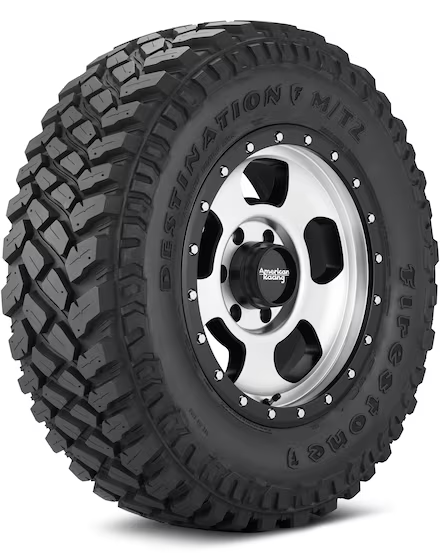
The moment I pulled the MT2 out of the packaging, I knew this tire meant business. The tread blocks are massive, deeply sculpted, and spaced far apart — exactly what you want to see on a mud-terrain tire that needs to self-clean in thick, sticky terrain.
The sidewall design is equally aggressive. Firestone incorporated protruding lugs along the sidewall that aren’t just cosmetic — they serve a real purpose when airing down and crawling over rocks or through deep ruts where the sidewall contacts the ground.
Picking the tire up, the weight felt substantial. This is a beefy, heavy-duty construction that immediately communicates durability. The rubber compound has a firm yet slightly pliable feel, and the overall build quality matched what I’d expect from a major brand like Firestone at this price point.
Tread Design and Technology Breakdown
Let me walk through the specific design features that make the MT2 work the way it does, because there’s more engineering here than meets the eye.
Aggressive Tread Block Pattern
The MT2 uses a staggered shoulder design with alternating tread block heights and positions. This creates biting edges from multiple angles, which matters enormously when you’re trying to claw your way through loose, shifting surfaces. The blocks themselves are large and tall, providing deep channels for mud, clay, and snow to be funneled out as the tire rotates.
Stone Ejector Ribs
Between the main tread blocks, Firestone placed stone ejector ribs at the base of the grooves. During my testing on rocky trails, I noticed these did a genuinely good job of preventing small rocks from lodging in the tread. Packed stones in a mud-terrain tire can cause punctures and dramatically reduce traction, so this is a feature worth appreciating.
Sidewall Armor
The sidewall lugs on the MT2 are more than decoration. They extend the traction surface beyond the main tread face, which becomes critical when you air down to low pressures for rock crawling or deep sand. I ran these at significantly reduced pressures on several occasions, and the sidewall lugs provided noticeable additional grip.
3-Ply Sidewall Construction
Depending on the specific size, many MT2 fitments come with a 3-ply sidewall. This is crucial for off-road durability. Sharp rocks, jagged stumps, and unforgiving trail obstacles are constantly threatening sidewall damage, and the extra ply gives meaningful peace of mind. During my testing over rough terrain, I didn’t experience a single puncture or sidewall issue.
Off-Road Performance: Where the MT2 Thrives
This is why you’re here, so let me be direct: the Firestone Destination MT2 is a legitimately capable off-road tire. It’s not just wearing a costume — it delivers real performance when the going gets tough.
Mud Performance
In deep, thick mud — the kind that swallows all-terrain tires whole — the MT2 performed impressively. The widely spaced tread blocks allowed mud to evacuate quickly as the tire rotated, maintaining fresh biting edges with almost every revolution. I tested these in clay-heavy mud common across the Southeast, and the self-cleaning ability was noticeably better than some competitors I’ve previously run.
Where some mud-terrain tires pack up and become slicks after sustained mud driving, the MT2 continued to find purchase. I could feel the tread working, chewing through the muck rather than just spinning on top of it.
Rock Crawling
On rocky trails, the MT2’s large tread blocks provided excellent surface contact and grip. When aired down, the tire conformed well to uneven rock surfaces, and those sidewall lugs I mentioned earlier added genuine confidence on off-camber sections where the sidewall was doing a lot of the gripping work.
The stiff sidewall construction also meant the tire resisted deformation on sharp rock edges. Over several days of aggressive trail riding on rocky terrain, the MT2 held up without any visible cuts or damage. That’s the kind of durability that matters when you’re miles from the nearest paved road.
Sand Performance
In loose sand, the MT2 was capable but required the right technique and air pressure. Aired down significantly, the tire floated reasonably well on soft sand. The aggressive tread pattern can dig in if you’re heavy on the throttle, so steady momentum and lower pressures are key — but that’s true of virtually every mud-terrain tire on the market.
Loose Gravel and Dirt Roads
On maintained dirt roads and gravel, the MT2 felt planted and confident. The aggressive tread bit into loose surfaces effectively, and steering response was predictable. This is where a lot of MT2 owners will spend the majority of their off-road time, and the tire handles it effortlessly.
On-Road Performance: The Honest Trade-Offs
Here’s where I need to be completely honest, because I think some buyers have unrealistic expectations about what a mud-terrain tire can deliver on pavement. The MT2 is an off-road tire that can handle highway driving — it is not a highway tire that happens to go off-road.
Road Noise
Let’s address the elephant in the room. Yes, the MT2 is noisy on the highway. At speeds above 50 mph, there’s a pronounced hum that you’ll hear inside the cabin. It’s not the loudest mud-terrain I’ve ever driven on, but it’s definitely present and impossible to ignore during long highway stretches.
After several days of mixed driving — including highway commuting — I found that I adjusted to the noise somewhat. A good audio system helps, and if your truck already has decent sound insulation, it’s manageable. But if road noise is a dealbreaker for you, a mud-terrain tire simply isn’t the right choice.
Ride Comfort
The ride quality on pavement is stiffer than an all-terrain or highway tire. You’ll feel more road imperfections, expansion joints, and rough patches transmitted through the steering wheel and seat. It’s not harsh enough to be unpleasant for short to moderate drives, but a cross-country highway trip on the MT2 will remind you constantly that you’re running aggressive off-road rubber.
Dry Pavement Handling
On dry roads, the MT2 handles adequately. Braking distances are slightly longer than what you’d get from an all-terrain tire, and the truck feels a bit more vague during quick lane changes. For normal driving at legal speeds, it’s perfectly acceptable. You just won’t confuse it with a performance tire.
Wet Pavement Performance
In rain, the MT2 actually does better than I expected. The deep, wide grooves channel water efficiently, and I didn’t experience any hydroplaning during moderate rain. Heavy downpours on the highway required a bit more caution, but overall wet grip was reasonable for a mud-terrain tire. That said, I always recommend extra following distance when running aggressive off-road tires on wet pavement.
Tread Life and Durability
Mud-terrain tires historically wear faster than all-terrain or highway tires, and the MT2 is no exception to the general trend. However, I was pleasantly surprised by how the tread held up during my test period.
After several weeks of mixed use — including plenty of off-road abuse — the tread depth showed even wear and minimal chunking. The rubber compound Firestone uses on the MT2 seems to strike a reasonable balance between being soft enough for off-road grip and firm enough to resist rapid wear on pavement.
Rotating these tires on schedule is critical. I’d recommend following a strict rotation interval to maximize tread life, especially if you’re splitting time between highway driving and trail use. Uneven wear is the enemy of any mud-terrain tire, and the MT2 responds well to consistent maintenance.
One thing I want to note: Firestone does not offer a treadwear warranty on the Destination MT2, which is standard practice for mud-terrain tires across all brands. Don’t let that scare you — it’s an industry norm, not a red flag.
Winter and Snow Performance
The MT2 is not a dedicated winter tire and doesn’t carry the Three-Peak Mountain Snowflake (3PMSF) symbol. However, it does carry the M+S (Mud and Snow) designation, and in my experience, it handles light to moderate snow reasonably well.
The aggressive tread blocks bite into fresh snow effectively, and the deep channels prevent snow from packing in as badly as you might expect. On icy surfaces, though, the MT2 struggles like most non-winter tires. If you live in an area with serious winter conditions, you’ll want dedicated winter tires or at minimum, a good set of chains.
Firestone Destination MT2 vs. the Competition
No tire review is complete without context. Here’s how the MT2 stacks up against the most popular mud-terrain alternatives in the US market:
| Feature | Firestone Destination MT2 | BFGoodrich Mud-Terrain T/A KM3 | Nitto Trail Grappler M/T | Toyo Open Country M/T |
|---|---|---|---|---|
| Mud Traction | Excellent | Excellent | Very Good | Excellent |
| Rock Crawling | Very Good | Excellent | Very Good | Very Good |
| Highway Comfort | Fair | Fair | Good | Fair |
| Road Noise | Noticeable | Noticeable | Moderate | Noticeable |
| Tread Life | Good | Good | Very Good | Good |
| Sidewall Durability | Very Good | Excellent | Very Good | Very Good |
| Approx. Price (265/70R17) | $250–$290 | $290–$340 | $300–$350 | $270–$320 |
vs. BFGoodrich KM3
The BFGoodrich Mud-Terrain T/A KM3 is the benchmark in this category, and for good reason. It edges out the MT2 in rock crawling performance and sidewall toughness. However, the MT2 offers very competitive mud traction at a noticeably lower price point. If budget matters — and for most of us, it does — the MT2 delivers roughly 85-90% of the KM3’s capability for meaningfully less money.
vs. Nitto Trail Grappler M/T
The Nitto Trail Grappler is often praised for being one of the quieter mud-terrain tires on the highway, and I’d agree with that assessment. If you split your driving 60/40 between road and trail, the Trail Grappler might be the smarter pick. But in pure off-road mud performance, the MT2’s more aggressive tread pattern gives it an edge.
vs. Toyo Open Country M/T
The Toyo Open Country M/T is a strong all-around mud-terrain tire that competes very closely with the MT2. In my experience, the two are nearly interchangeable in mud and rock performance. The Toyo tends to cost a bit more in most sizes, which gives the MT2 a value advantage. Both are solid choices.
Pricing and Value
In the US market, the Firestone Destination MT2 typically ranges from about $220 to $380+ per tire, depending on the size. Popular sizes like 265/70R17 and 275/65R18 tend to fall in the $250–$310 range, which makes the MT2 one of the more affordable options in the premium mud-terrain segment.
For the money, I think the MT2 represents strong value. You’re getting a tire from a well-established American brand (Firestone has been around since 1900) with solid off-road performance, decent durability, and wide availability at retailers like Discount Tire, Tire Rack, Walmart Auto Centers, and local shops across the country.
Keep an eye out for seasonal promotions. Firestone frequently runs rebate programs — I’ve seen offers of $60 to $100 back on a set of four, which makes an already competitive tire even more attractive.
Who Should Buy the Firestone Destination MT2?
This tire is ideal for a specific type of driver. Let me break down who I think the MT2 is — and isn’t — right for.
The MT2 Is Perfect If You:
- Regularly drive off-road in mud, rocks, dirt, or sand
- Own a truck or SUV that’s primarily used for off-road recreation, ranch work, or trail access
- Want serious off-road capability without spending BFGoodrich KM3 money
- Prioritize durability and sidewall protection on rough terrain
- Don’t mind road noise and a firmer ride on the highway
- Live in a rural area with unpaved roads as your daily reality
The MT2 Is NOT Right If You:
- Primarily drive on the highway and rarely go off-road
- Value a quiet, comfortable ride above all else
- Want maximum fuel efficiency (aggressive tread patterns increase rolling resistance)
- Need a dedicated winter/ice tire
- Drive a crossover SUV or light-duty vehicle that doesn’t need this level of aggression
If you fall into that second category, you’d be much better served by something like the Destination LE3, which I’ve reviewed separately. It’s designed specifically for the on-road experience where the MT2 makes the most compromises.
Installation and Balancing Notes
One practical tip from my experience: mud-terrain tires like the MT2 can be more challenging to balance perfectly than standard tires. I recommend asking your installer to use a road-force balancer if available, and consider having them use bead sealant during mounting to prevent slow leaks — especially if you plan to air down frequently off-road.
I also strongly suggest investing in a quality set of valve stems or switching to metal valve stems if your truck uses rubber ones. When you’re crawling over rocks and through brush, a rubber valve stem is an unnecessarily vulnerable point of failure.
Fuel Economy Impact
I’d be dishonest if I didn’t mention this: switching to the MT2 from a highway or all-terrain tire will impact your fuel economy. The aggressive tread pattern, heavier weight, and increased rolling resistance all contribute to higher fuel consumption.
During my test period, I noticed a measurable drop in fuel efficiency compared to the all-terrain tires that were previously on the test truck. It wasn’t catastrophic, but it was consistent. If you’re buying a mud-terrain tire, this is a cost you need to factor into your ownership equation alongside the tire purchase price itself.
Warranty and Customer Support
Firestone backs the Destination MT2 with their standard limited warranty covering defects in workmanship and materials. As I mentioned earlier, there’s no mileage-based treadwear warranty, which is typical for the mud-terrain category.
Firestone’s dealer network in the US is extensive, which is a genuine advantage. If you have a warranty issue, finding an authorized dealer is rarely a problem, whether you’re in a major metro area or a smaller rural town. That accessibility matters when you’re dealing with tire issues on the road or trail.
My Final Verdict on the Firestone Destination MT2
After putting the Firestone Destination MT2 through its paces across a variety of terrains and driving conditions over my full test period, I came away impressed with what this tire delivers for the price. It’s a legitimate, capable mud-terrain tire that punches above its weight class in off-road traction — particularly in deep mud, where its self-cleaning tread design genuinely excels.
The on-road compromises are real but expected. If you understand what a mud-terrain tire is and what it isn’t, the MT2 won’t disappoint you. It’s noisy on the highway, the ride is firm, and your fuel economy will take a hit. None of that should surprise anyone shopping in this category.
Where the MT2 really earns its recommendation is in the value equation. It undercuts several premium competitors by a meaningful margin per tire while delivering competitive off-road performance. For the truck owner who wants serious trail capability without breaking the bank, the Firestone Destination MT2 is a smart, well-engineered choice that I’d confidently recommend.
If you’re still deciding between Firestone’s various off-road and truck tire options, take a look at our complete Firestone Tires Review to see how the entire lineup compares. And if you decide the MT2 is too aggressive for your needs, the Firestone Destination Le3 offers a comfortable highway-oriented alternative that still carries the Firestone name and quality.
The bottom line: if your truck sees real dirt, real mud, and real trails on a regular basis, the Destination MT2 deserves a spot on your shortlist. It earned my respect out on the trail, and I think it’ll earn yours too.
Frequently Asked Questions
Is the Firestone Destination MT2 a good mud-terrain tire for daily driving?
The Firestone Destination MT2 is primarily designed for serious off-road use, so daily driving on highways will come with more road noise and slightly reduced fuel economy compared to all-terrain tires. That said, Firestone improved the on-road manners over the original Destination M/T, making it more tolerable for drivers who split time between pavement and trails. If your commute is short and you regularly hit muddy or rocky terrain on weekends, the MT2 is a solid dual-purpose choice.
How much does the Firestone Destination MT2 cost per tire?
Prices for the Firestone Destination MT2 typically range from around $200 to $380 per tire depending on the size, with popular truck sizes like LT265/70R17 and LT285/75R16 falling in the $240 to $300 range. You can often find rebates through Firestone promotions or discounts at retailers like Discount Tire, Tire Rack, and Walmart. I’d recommend comparing installed prices since mounting, balancing, and disposal fees can vary significantly between shops.
How does the Firestone Destination MT2 perform in mud and deep off-road conditions?
The Destination MT2 excels in mud, loose dirt, and rocky terrain thanks to its aggressive tread pattern with deep, wide voids that channel mud and debris out quickly. Firestone uses Duraforce technology in the sidewall, which adds puncture resistance and allows for better traction when airing down on trails. In my experience, this tire claws through deep ruts and sloppy conditions where most all-terrain tires would spin helplessly.
How long do Firestone Destination MT2 tires last on pavement?
Firestone does not offer a treadwear mileage warranty on the Destination MT2, which is standard for mud-terrain tires since the softer compound wears faster on asphalt. Most drivers report getting between 30,000 and 50,000 miles depending on driving habits, tire rotation frequency, and how much off-road use the tires see. Regular rotations every 5,000 to 7,000 miles and keeping proper air pressure will help you maximize the tread life.
Is the Firestone Destination MT2 good in snow and winter conditions?
The Destination MT2 performs reasonably well in deep, unpacked snow because the aggressive lugs bite into soft surfaces much like they do in mud. However, it does not carry the three-peak mountain snowflake (3PMSF) rating, so it lacks the ice traction and cold-weather rubber compound found in dedicated winter tires. For US drivers in states like Colorado or Montana who face icy roads regularly, I’d recommend pairing these with a set of winter tires for the coldest months.
How noisy is the Firestone Destination MT2 on the highway compared to other mud-terrain tires?
The MT2 is noticeably louder than an all-terrain tire on the highway, but Firestone incorporated variable pitch tread elements to reduce the constant drone you get with many mud-terrain competitors. Most owners describe the noise level as a steady hum rather than an aggressive roar, and it tends to break in and quiet down slightly after the first 1,000 miles. Compared to tires like the BFGoodrich KM3 or Toyo Open Country MT, the Destination MT2 is competitive in noise levels and arguably quieter at sustained highway speeds.
What truck and SUV sizes does the Firestone Destination MT2 come in?
The Firestone Destination MT2 is available in a wide range of light truck sizes from 15-inch to 20-inch rim diameters, covering popular fitments for the Ford F-150, Chevrolet Silverado, Toyota Tacoma, Jeep Wrangler, and Ram 1500. Common sizes include LT235/75R15, LT265/75R16, LT285/70R17, and LT35x12.50R20 for lifted trucks. I’d suggest checking Firestone’s website or a retailer like Tire Rack to confirm availability for your exact bolt pattern and suspension setup.
