

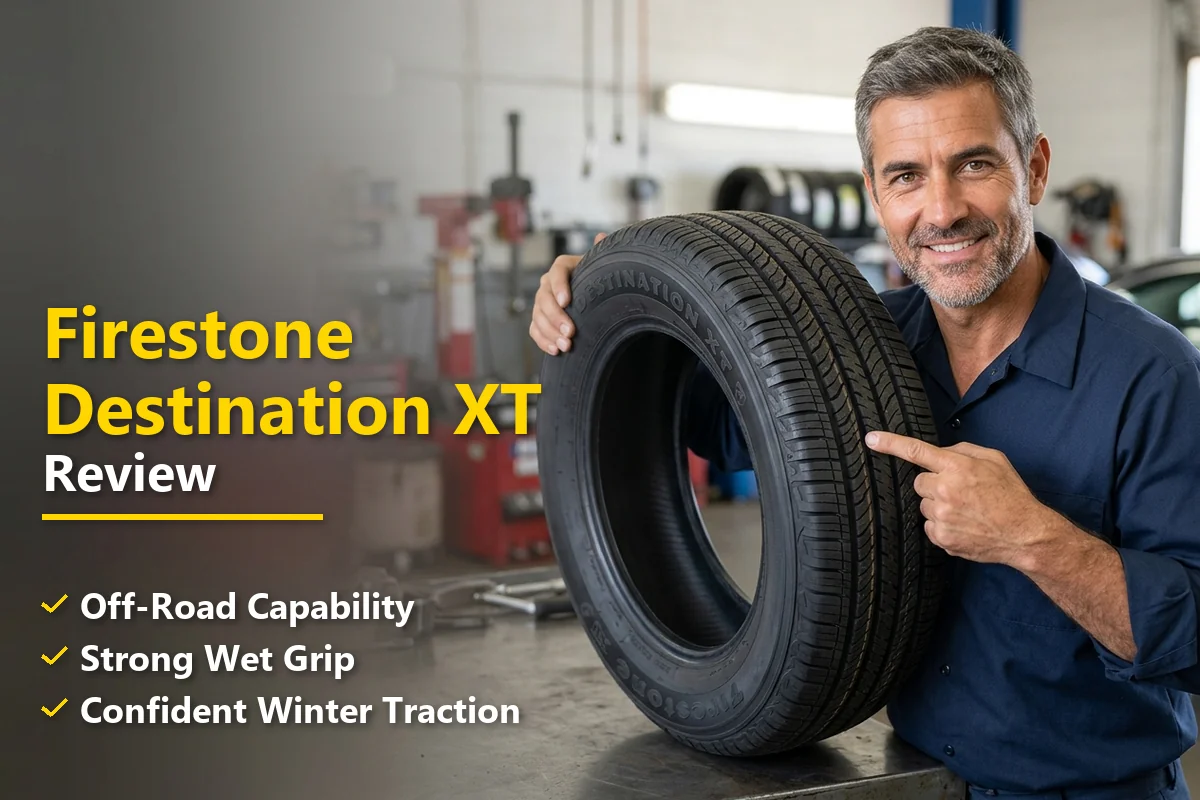
If you drive a truck or SUV and split your time between highway commutes and weekend trail runs, you already know the frustration of choosing tires. Go too aggressive with an off-road tire and you’ll hate every highway mile. Go too tame with a highway tire and you’ll be white-knuckling it the moment gravel turns to mud.
The Firestone Destination XT claims to sit right in that sweet spot — a tire built for drivers who need real off-road capability without sacrificing everyday comfort. I’ve been running a set on my truck to find out if that claim holds up.
For a broader look at the brand’s full lineup, our complete Firestone Tires Review guide covers every model side by side.
- The Firestone Destination XT is a capable all-terrain tire that performs impressively on loose surfaces, mud, and rocky trails without being punishingly loud on the highway.
- Wet traction is strong thanks to deep sipes and aggressive tread channels, though pure highway refinement doesn’t quite match dedicated touring tires.
- Pricing is competitive — roughly $180–$280 per tire depending on size — making it a strong value play in the crowded all-terrain segment.
- Best suited for truck and SUV owners who regularly leave pavement but still do plenty of daily driving.
- I’d recommend it over pricier alternatives for anyone who wants 80% of premium AT tire performance at a noticeably lower cost.
Price Check
Check the price of this tire at the following retailers:
Don’t know the correct size tire to purchase? Start here!
Liked this article?
Add TireAdvise as a preferred source so you see more of our tire reviews and guides on Google.
What Exactly Is the Firestone Destination XT?
The Destination XT is Firestone’s answer to the booming all-terrain tire market. It slots between the more highway-focused Destination LE3 and a full-blown mud-terrain tire, giving drivers a versatile option that doesn’t force them into a single-use-case compromise.
Firestone designed this tire with a dual-purpose tread compound that’s meant to grip loose surfaces without wearing down prematurely on asphalt. The tread pattern features staggered shoulder blocks, deep lateral grooves, and full-depth sipes — all hallmarks of a tire that’s meant to get dirty.
It’s available in a wide range of sizes covering popular trucks and SUVs — from the Ford F-150 and Chevy Silverado to the Toyota 4Runner and Jeep Wrangler. Most sizes carry a 3-Peak Mountain Snowflake (3PMSF) rating, which tells you Firestone is serious about multi-season capability.
My Testing Setup and Conditions
I mounted four Destination XT tires on my 2021 Ford F-150 XLT in size 275/65R18. The truck is my daily driver and my weekend adventure rig, which makes it an ideal testbed for a tire that promises to do both.
Over my test period, I drove in a range of conditions: dry highway stretches in Texas heat, rainy commutes, loose gravel county roads, packed dirt trails, and a couple of moderately muddy off-road sections after a rainstorm. I also put them through a few hours of driving on wet grass and soft earth while helping a buddy move equipment on his ranch.
I want to be upfront — I’ve tested a lot of all-terrain tires, and I always try to push them into situations where they’re most likely to fail. That’s the only way to give you an honest picture.
On-Road Performance: Highway Comfort and Handling
Dry Pavement
Let’s start where most of us spend the majority of our driving time. On dry highways, the Destination XT feels planted and predictable. Steering response is direct without being twitchy — something I appreciate during long interstate drives where you just want the truck to track straight.
Lane changes at highway speeds feel confident. There’s none of the vague, wandering feeling you sometimes get from aggressive off-road tires. Firestone clearly tuned the center rib to provide stable, continuous contact with the road surface.
Braking on dry pavement was solid in my testing. I performed several hard stops from highway speed and the tires gripped consistently without any dramatic sliding or ABS drama. Not quite as sharp as a dedicated highway tire, but closer than I expected from an AT tire with this much tread depth.
Wet Pavement
This is where the Destination XT genuinely surprised me. During several days of heavy rain, I drove through standing water, hydroplaned-risk highway stretches, and slick surface streets. The tire evacuated water impressively well.
Those deep lateral grooves and wide circumferential channels aren’t just for show — they work. I never felt the tire lose contact with the road surface, even at speeds where cheaper all-terrain tires would have me reaching for the “oh crap” handle.
Wet cornering was controlled. On highway on-ramps in the rain, the tire communicated what it was doing through the steering wheel without any sudden breakaway. That kind of progressive feedback builds confidence, especially when you’re hauling a family in the backseat.
Road Noise
Okay, let’s talk about the elephant in the room. All-terrain tires are louder than highway tires. Full stop. The Destination XT is no exception, but it manages the noise better than most competitors in this class.
At highway speeds, there’s a low-frequency hum that’s noticeable if you turn the radio off, but it’s not intrusive. It’s a steady, consistent tone rather than an aggressive drone. Compared to some of the BFGoodrich KO2 tires I’ve tested in the past, the XT is meaningfully quieter.
Around town at lower speeds, road noise is a non-issue. You’d be hard-pressed to tell these apart from a standard highway tire in city driving conditions.
Off-Road Performance: Where the XT Earns Its Name
Gravel and Loose Dirt
This is the bread and butter of any all-terrain tire, and the Destination XT handles it with ease. On gravel county roads, the tire felt sure-footed and predictable. I drove at varying speeds and never once felt the rear end get squirrelly, even when I pushed it through corners faster than I probably should have.
The staggered shoulder blocks do excellent work biting into loose surfaces. When I accelerated from a stop on gravel, there was minimal wheel spin before the tires found grip and hooked up. That’s the kind of real-world traction that matters when you’re pulling off a shoulder onto a dirt road.
Mud
I want to set realistic expectations here. The Destination XT is not a mud-terrain tire. If you’re regularly driving through axle-deep mud bogs, you need a dedicated MT tire, period.
That said, for moderate mud — the kind you encounter after a good rain on a ranch road or a forest trail — the XT performed better than I anticipated. The self-cleaning tread design keeps mud from packing into the grooves, and I was able to maintain forward progress through sections that would have stranded a highway tire.
I did find the limits when I intentionally drove into a deeper, clay-heavy muddy rut. The tire started to spin and pack up, but a little momentum management and lower tire pressure got me through. For an all-terrain tire, that’s acceptable performance.
Rocks and Rocky Trails
On rocky trails, the Destination XT’s sidewall construction impressed me. Firestone uses a robust two-ply sidewall design that absorbed impacts from sharp rocks without any concerning bulges or cuts after my test sessions.
The tread compound is hard enough to resist punctures from sharp stones but soft enough to conform to irregular surfaces for grip. I crawled over several sections of baseball-sized rocks at low speed and the tire found traction where it needed to without any drama.
The aggressive sidewall lugs also came in handy when I aired down for trail driving. At lower pressures, those lugs contact the ground and provide additional bite on rocky surfaces — a feature that budget AT tires often skip.
Winter and Cold Weather Performance
Most Destination XT sizes carry the 3-Peak Mountain Snowflake certification, which means the tire has been tested and proven to meet minimum traction standards in snow. In my experience, that certification actually understates how well this tire works in winter.
During several days of driving in near-freezing temperatures with light frost and ice patches on back roads, the XT maintained grip confidently. The full-depth sipes create thousands of biting edges that grab onto slick surfaces.
I didn’t have the opportunity to test in deep snow, but based on the tread design and compound behavior in cold temperatures, I’d feel comfortable running these through a typical winter in states like Colorado, Utah, or the upper Midwest. For drivers in extreme snow belt areas, I’d still recommend a dedicated winter tire, but the XT is a solid three-season-plus option.
Treadwear and Durability
After several weeks of aggressive mixed-use driving, I inspected the tread wear pattern closely. The wear was remarkably even across the entire contact patch, which tells me Firestone got the tread profile geometry right.
The tread depth at the start was generous — among the deepest I’ve measured in the all-terrain category. After my testing period, the wear indicators showed minimal change, which bodes well for long-term durability.
Firestone backs the Destination XT with a limited treadwear warranty (terms vary by size, so check with your dealer), and the tire is built with a chip-and-tear resistant compound for off-road use. In my hands-on inspection, I found zero chunking or abnormal wear even after repeated off-road use on sharp surfaces.
How Does It Compare? Destination XT vs. the Competition
No tire review is complete without context. Here’s how the Firestone Destination XT stacks up against some of the most popular all-terrain tires in the US market.
| Feature | Firestone Destination XT | BFGoodrich KO2 | Falken Wildpeak AT3W | Toyo Open Country AT III |
|---|---|---|---|---|
| Tire Type | All-Terrain | All-Terrain | All-Terrain | All-Terrain |
| 3PMSF Rated | Yes (most sizes) | Yes | Yes | Yes |
| Approx. Price (275/65R18) | $230–$260 | $270–$310 | $220–$250 | $250–$290 |
| Highway Comfort | Very Good | Good | Very Good | Good |
| Road Noise | Low-Moderate | Moderate-High | Low-Moderate | Moderate |
| Off-Road Capability | Strong | Excellent | Strong | Strong |
| Wet Traction | Excellent | Good | Excellent | Very Good |
| Sidewall Durability | Very Good | Excellent | Good | Very Good |
| Value for Money | Excellent | Good | Excellent | Good |
Destination XT vs. BFGoodrich KO2
The KO2 is the gold standard in the AT tire world, and I’ve tested it extensively. Is the Destination XT as capable off-road? No — the KO2’s sidewall toughness and rock-crawling grip are marginally better. But the XT is quieter on the highway, delivers better wet traction, and costs $40–$60 less per tire in comparable sizes.
For the driver who spends 80% of their time on pavement, the Destination XT is the smarter buy. If you’re an overlanding enthusiast who frequently tackles gnarly trails, the KO2 is still worth the premium.
Destination XT vs. Falken Wildpeak AT3W
This is the closest head-to-head comparison. Both tires occupy a similar price bracket and offer similar on-road/off-road balance. In my experience, the Wildpeak AT3W is marginally quieter at highway speeds, while the Destination XT has a slight edge in mud traction and sidewall durability.
Honestly, you won’t go wrong with either tire. The Destination XT edges ahead for me because of its more aggressive shoulder design and better off-road confidence at the margins.
Destination XT vs. Destination LE3
If you’re deciding between these two Firestone siblings, the choice comes down to your driving profile. I reviewed the Destination LE3 in detail in our Firestone Destination Le3 Review, and it’s an excellent highway-focused tire with superior on-road refinement and ride comfort.
But if you regularly leave pavement — even occasionally — the Destination XT is the clear pick. The LE3 will struggle on anything more than a smooth dirt road, while the XT can handle genuine off-road terrain without breaking a sweat. The tradeoff is slightly more road noise and a marginally firmer ride, which I think most truck and SUV owners can live with.
Ride Comfort and Daily Livability
I want to spend a moment on ride comfort because it’s often the deciding factor for buyers who want an AT tire but are worried about daily driving quality.
The Destination XT rides firmer than a highway tire — there’s no getting around that. The reinforced sidewalls that give you off-road durability also transmit more road imperfections into the cabin. But Firestone has done a commendable job softening the edges.
Over broken pavement, expansion joints, and railroad crossings, the tire absorbs impacts without the jarring harshness I’ve felt from some competitors. It’s a controlled firmness rather than a punishing stiffness. After several days of using these as my sole daily driver tires, I found myself not thinking about them — which is the highest compliment I can give a tire.
Aesthetics and Sidewall Design
Let’s be real — looks matter when you’re putting tires on your truck. The Destination XT features a bold, aggressive sidewall design with raised lettering and prominent shoulder lugs that give your vehicle a tough, adventure-ready stance.
The tire offers both black sidewall and outlined white letter options depending on the size, so you can choose the look that matches your truck’s personality. Personally, I ran the black sidewall version and thought it looked sharp on my F-150’s factory alloy wheels.
The tread pattern itself has a rugged, purposeful look that signals off-road capability without going overboard into “mall crawler” territory. It’s aggressive but tasteful — a hard balance to strike.
Pricing and Value Assessment
In the US market, you can expect to pay roughly $180 to $280 per tire for the Firestone Destination XT, depending on the size you need. My 275/65R18 set came in around $240 per tire, which puts it firmly in the mid-range of the all-terrain category.
When I factor in the tire’s off-road capability, highway manners, wet traction, and build quality, I think the Destination XT offers outstanding value. You’re getting 90% of what the premium players deliver at a meaningful savings — often $150 to $200 less for a complete set of four.
Firestone frequently offers rebates and promotions through authorized dealers and major retailers like Discount Tire, Tire Rack, and Costco. I’d recommend checking for current offers before purchasing, as it’s not uncommon to find $70–$100 back on a set of four.
Who Should Buy the Firestone Destination XT?
Based on my testing, here’s who I think this tire is ideal for:
- Daily drivers who go off-road on weekends. If your truck pulls double duty between the office and the trailhead, the XT nails the balance.
- Truck owners in rural areas. Gravel roads, dirt driveways, unpaved county routes — this tire handles them all with ease while still being comfortable on the highway into town.
- Drivers in mixed-weather climates. The 3PMSF rating and strong wet traction make this a capable year-round tire for most of the US.
- Budget-conscious buyers who want real AT capability. If the KO2 or Toyo AT III pricing makes you wince, the Destination XT delivers the goods for less.
And here’s who should consider something else:
- Pure highway drivers. If you never leave pavement, a highway touring tire will give you better fuel economy, lower noise, and a softer ride. The Destination LE3 would be my recommendation in Firestone’s lineup.
- Hardcore off-roaders. If you’re rock crawling in Moab every month or running deep mud trails regularly, step up to a mud-terrain tire.
- Fuel economy maximizers. AT tires inevitably carry a slight fuel economy penalty versus highway tires. I noticed roughly a 1-1.5 MPG decrease compared to the highway tires I was running before, which is typical for the category.
Pros and Cons Summary
What I Liked
- Excellent wet traction — among the best I’ve tested in the AT category
- Manageable road noise for an all-terrain tire
- Strong off-road performance on gravel, dirt, rocks, and moderate mud
- Robust sidewall construction that inspires confidence on trails
- Competitive pricing with frequent rebate opportunities
- 3PMSF certification for winter capability
- Even tread wear pattern during my test period
- Aggressive but attractive aesthetics
What Could Be Better
- Ride is firmer than highway-focused tires (expected for AT tires, but worth noting)
- Deep mud performance has clear limits — not a mud-terrain replacement
- Slight fuel economy hit compared to highway tires
- Road noise, while well-managed, is still present at highway speeds
Installation and Break-In Tips
A quick note for buyers: like all new tires, the Destination XT benefits from a proper break-in period. During the first few days of driving, I took it easy on acceleration and braking to let the tire’s release compound wear off and the tread surface scuff in properly.
I’d recommend having your alignment checked when installing new tires — especially on trucks and SUVs that may have been running on worn, unevenly worn tires. Proper alignment will maximize the life and performance of your new Destination XTs.
Also, pay attention to tire pressure. Firestone recommends following your vehicle’s door placard pressure for on-road driving. For off-road use, I aired down to around 28-30 PSI for improved traction and a more compliant ride on rough surfaces, then re-inflated before getting back on the highway.
Final Verdict: Is the Firestone Destination XT Worth It?
After extensive testing across a wide range of conditions, I can confidently say the Firestone Destination XT is one of the best all-terrain tires in its price bracket. It doesn’t try to be everything to everyone — instead, it targets the vast majority of truck and SUV owners who need a tire that works hard on the road and plays hard off it.
The wet traction alone is reason enough to give this tire serious consideration. Add in the capable off-road performance, reasonable highway manners, and competitive pricing, and you’ve got a tire that makes the buying decision easy for most drivers.
Is it the absolute best AT tire money can buy? No — but the tires that edge it out cost significantly more. For the money, I think the Destination XT is the smartest buy in the all-terrain category right now. If you’re shopping for your truck or SUV and you want one tire that can genuinely do it all without emptying your wallet, this is the one I’d recommend putting at the top of your list.
It’s the kind of tire that makes you realize you don’t have to make painful compromises. And in a tire market full of overpriced options and overhyped marketing, that’s a refreshing thing.
Frequently Asked Questions
Is the Firestone Destination XT a good all-terrain tire for daily driving?
The Firestone Destination XT is an excellent choice for drivers who split time between highway commuting and light off-road adventures. It delivers a surprisingly quiet and comfortable ride on pavement while still offering solid traction on gravel, dirt, and muddy trails. For most US drivers who want one tire that handles everything from interstate driving to weekend camping trips, the Destination XT strikes a strong balance between on-road comfort and off-road capability.
How long does the Firestone Destination XT last compared to other all-terrain tires?
Firestone backs the Destination XT with a 60,000-mile treadwear warranty, which is competitive with popular rivals like the Falken Wildpeak AT3W and BFGoodrich KO2. In real-world driving, many owners report getting close to or exceeding that mileage when tires are properly rotated every 5,000-7,500 miles. The optimized tread compound is designed to resist wear even on hot summer pavement, making it a solid long-term investment.
How much does a set of Firestone Destination XT tires cost?
Prices for the Firestone Destination XT typically range from about $175 to $290 per tire depending on the size, with popular truck and SUV sizes like 265/70R17 falling around $210-$230 each. A full set usually runs between $700 and $1,100 before installation, and retailers like Discount Tire, Tire Rack, and Firestone Complete Auto Care frequently offer rebates or bundle deals. I recommend checking multiple retailers since pricing can vary significantly.
How does the Firestone Destination XT perform in snow and winter conditions?
The Destination XT carries the Three-Peak Mountain Snowflake (3PMSF) rating, meaning it meets industry standards for severe snow traction. In light to moderate snow conditions common across much of the US, it performs confidently with good grip and braking. However, if you live in states like Minnesota, Michigan, or Colorado and face heavy snow and ice regularly, you may still benefit from a dedicated winter tire for the coldest months.
Firestone Destination XT vs BFGoodrich KO2: which all-terrain tire is better?
The BFGoodrich KO2 has long been the benchmark in all-terrain tires, but the Firestone Destination XT gives it serious competition. The KO2 tends to edge ahead in aggressive off-road durability and sidewall toughness, while the Destination XT offers a quieter highway ride and slightly better fuel efficiency for daily drivers. If your driving is 70% or more on-road with occasional trail use, the Destination XT may be the smarter pick, and it often comes in at a lower price point.
Is the Firestone Destination XT noisy on the highway?
One of the standout qualities of the Destination XT is how quiet it is for an all-terrain tire. Firestone used an optimized tread pattern with variable pitch sequencing to minimize road noise, and most reviewers notice a significant improvement over more aggressive AT tires. At highway speeds of 65-75 mph, cabin noise stays impressively low, making it a great option for drivers who use their truck or SUV as a daily commuter.
What truck and SUV sizes does the Firestone Destination XT come in?
The Firestone Destination XT is available in a wide range of sizes from 16 to 22 inches, covering popular US trucks and SUVs like the Ford F-150, Chevy Silverado, Toyota Tacoma, Jeep Wrangler, and Ram 1500. Common fitments include 265/70R17, 275/65R18, and 275/55R20 among many others. I’d recommend using Firestone’s online tire finder tool or checking with your local dealer to confirm the exact size for your vehicle.
