

If you drive a pickup truck or full-size van for work, you already know the frustration of choosing tires that can handle job-site gravel on Monday and a highway commute on Tuesday.
Most all-terrain tires promise everything but deliver compromises — either they’re loud on pavement or they fall apart under heavy loads. I’ve been putting the Firestone Transforce AT through its paces on my Ford F-250, and I have a lot to say about where this tire shines and where it falls short. For broader context on the brand’s full lineup, our comprehensive Firestone Tires Review guide covers every model side by side.
- The Firestone Transforce AT is a commercial-grade all-terrain tire built for light trucks, vans, and SUVs that carry heavy loads.
- It delivers strong wet and dry traction, impressive load-carrying capability, and surprisingly decent highway comfort for a work tire.
- Off-road performance is respectable but not class-leading — this tire favors on-road durability over rock crawling.
- Tread life is solid, especially given the aggressive use cases this tire is designed for.
- Noise levels are moderate; not whisper-quiet, but far from unbearable on long drives.
- Priced competitively in the $180–$280 range per tire depending on size — strong value for a commercial all-terrain option.
Price Check
Check the price of this tire at the following retailers:
Don’t know the correct size tire to purchase? Start here!
Liked this article?
Add TireAdvise as a preferred source so you see more of our tire reviews and guides on Google.
What Exactly Is the Firestone Transforce AT?
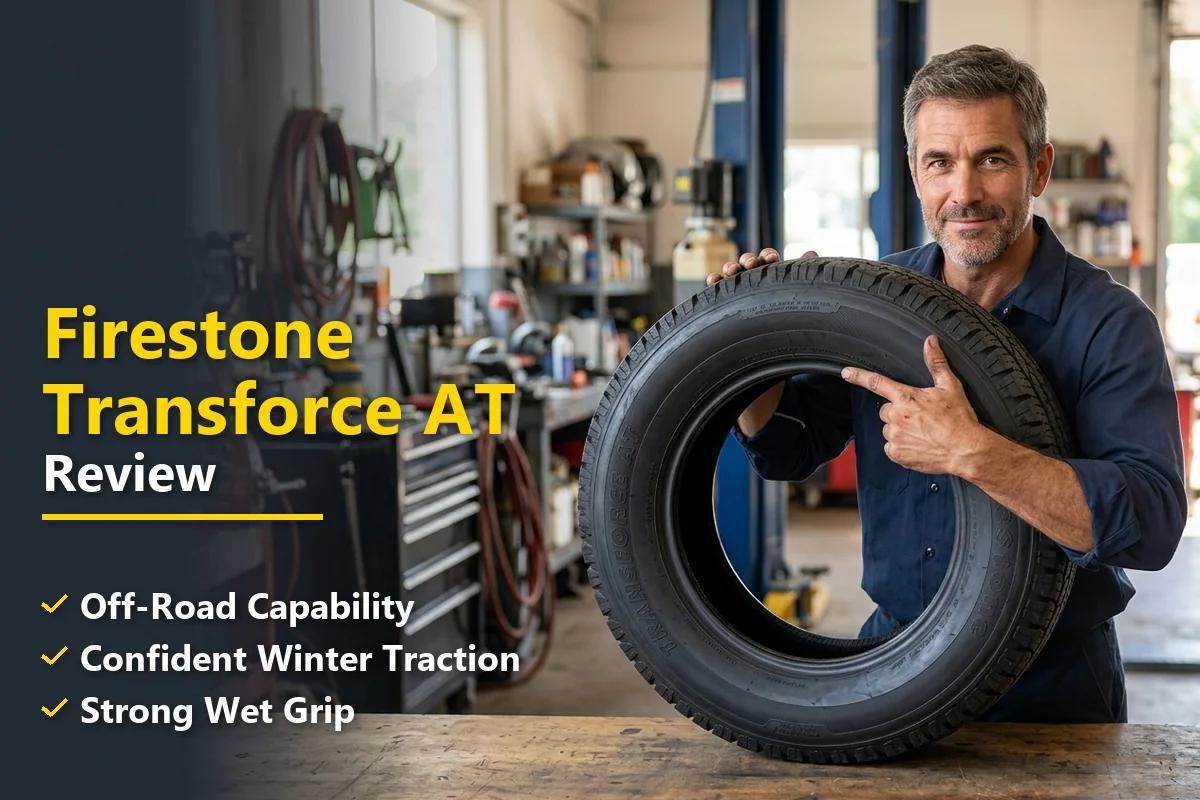
The Firestone Transforce AT is an all-terrain tire specifically engineered for light trucks, commercial vans, and heavy-duty pickups. It sits within Firestone’s Transforce family, which is their commercial and fleet-oriented tire lineup.
What sets it apart from a typical consumer all-terrain tire is its focus on load capacity and durability under work conditions. The Transforce AT comes in Load Range C, D, and E options, meaning it can handle serious weight — think loaded truck beds, towing trailers, and contractor equipment.
I want to be clear about what this tire is and isn’t. It’s not a weekend-warrior off-road tire designed to look aggressive in a mall parking lot. It’s a working tire that happens to have genuine all-terrain capability baked in.
My Testing Setup and Conditions
I mounted a set of LT275/70R18 Firestone Transforce ATs on my 2021 Ford F-250 Super Duty. This truck regularly hauls materials for a small contracting side project and doubles as my daily driver.
During my test period, I drove across a range of conditions that I think reflect what most buyers of this tire actually deal with: suburban highways, unpaved rural roads, wet pavement during spring storms, loose gravel, and loaded highway pulls with a utility trailer.
I also spent several days driving on dirt roads and moderately muddy trails in Virginia’s rural Shenandoah Valley to see how the tire handles off-pavement terrain that isn’t extreme but isn’t tame either.
Tread Design and Construction: Built for the Long Haul
The first thing I noticed when I pulled these tires out of the box was how substantial they feel. The sidewalls are thick and reinforced — Firestone uses a dual-layer, high-turn-up construction that’s designed to resist punctures and sidewall damage.
Tread Pattern Breakdown
The tread design features an aggressive, interlocking block pattern with deep grooves running both laterally and circumferentially. These grooves are wider than what you’d see on a highway tire, which gives the tire its ability to evacuate water, mud, and loose debris.
Each tread block has multiple sipes cut into it. These thin slits are what provide biting edges in wet and light snow conditions. In my experience, the sipe density on the Transforce AT is generous — more than some competitors in the commercial all-terrain space.
The shoulder blocks are noticeably squared-off and extend slightly down the sidewall. This gives the tire additional grip when you air down on loose surfaces, though the sidewall lugs aren’t as pronounced as you’d find on a dedicated off-road tire like a BFGoodrich KO2.
Rubber Compound
Firestone uses what they describe as a “long-link carbon” compound in the Transforce AT. In practice, this means the rubber is formulated for chip and tear resistance — critical if you’re regularly driving on gravel, broken pavement, or construction sites.
After several weeks of driving on mixed surfaces, I noticed virtually no chunking or abnormal wear on the tread blocks. That’s a good early sign for long-term durability.
On-Road Performance: Where This Tire Earns Its Keep
Let me be honest — most buyers putting Transforce ATs on their trucks will spend 80% or more of their time on paved roads. So on-road performance matters a lot, and this is where the tire impressed me the most.
Dry Pavement
On dry highways and suburban roads, the Transforce AT feels planted and confident. Steering response is direct for a tire this heavy-duty, and I never felt any vagueness in the contact patch during lane changes at highway speeds.
Braking performance on dry surfaces was strong. I performed several hard stops from 60 mph, and the truck pulled up straight and predictable every time. There’s no wandering or pulling — the tire tracks true.
Wet Pavement
Wet traction is arguably the Transforce AT’s best party trick. Those wide circumferential grooves and dense siping do exactly what they’re supposed to do — channel water away from the contact patch and maintain grip.
I drove through multiple heavy downpours during my testing period, including some standing water on poorly drained county roads. At no point did I feel the tire lose its composure. Hydroplaning resistance is excellent for a tire in this class.
If you frequently drive in the rain-heavy Southeast or Pacific Northwest, this is a meaningful advantage.
Highway Comfort and Noise
Here’s where expectations need to be calibrated. The Transforce AT is a Load Range E tire (in the size I tested), and it’s built for commercial use. It is not going to ride like a passenger car tire.
That said, it’s more comfortable than I expected. The ride is firm but not punishing. On smooth highway surfaces, I found the tire to be perfectly livable for long commutes. Over rough pavement and expansion joints, you feel more of the road than you would with a softer consumer tire, but it’s never harsh.
Noise is moderate. At highway speeds, there’s a noticeable hum that’s louder than a dedicated highway tire but quieter than most aggressive all-terrain or mud-terrain tires I’ve tested. I’d describe it as a steady, low-frequency drone that’s easy to tune out — especially with the radio on.
Off-Road Performance: Capable but Not Extreme
I want to give a realistic picture of what the Transforce AT can do off-road, because I think some buyers might expect more than this tire is designed to deliver.
Gravel and Loose Dirt
On gravel roads and loose dirt, the Transforce AT is excellent. The squared-off tread blocks dig in and provide confident traction, and the tire’s weight and stiffness actually help it maintain stability on washboard surfaces.
This is the off-road environment where a commercial all-terrain tire truly excels, and the Transforce AT didn’t disappoint. For contractors, farmers, and rural drivers who deal with unpaved roads daily, this tire is a natural fit.
Mud
Mud performance is decent but not outstanding. In light to moderate mud, the tire clears itself reasonably well thanks to those wide grooves. I was able to navigate some sloppy, rain-soaked trails without getting stuck.
However, in deep, clay-heavy mud, the tread pattern does start to pack up. This isn’t a mud-terrain tire, and it doesn’t pretend to be. If you regularly encounter serious mud, you’ll want something more aggressive.
Sand and Soft Surfaces
I didn’t get a chance to test in deep sand, but on soft, sandy shoulders and loose soil, the Transforce AT performed well when I aired down to about 30 psi. The wide footprint and flexible shoulder blocks provided decent flotation.
Rock and Trail
On rocky trails, the reinforced sidewalls gave me confidence that I wasn’t going to slice a tire on a sharp edge. The tread provided adequate grip on dry rock surfaces, though it’s not as sticky as a softer compound trail tire.
For moderate trail use — forest service roads, hunting access paths, ranch tracks — the Transforce AT is more than sufficient. For technical rock crawling, look elsewhere.
Load Carrying and Towing Performance
This is the category that separates the Transforce AT from typical consumer all-terrain tires, and it’s where Firestone’s commercial engineering really shines.
I towed a loaded utility trailer weighing approximately 7,000 pounds on several highway runs during my test period. The Transforce AT handled the additional weight with zero drama. There was no sidewall flex or squirm under load, and the truck remained stable and predictable at highway speeds.
The Load Range E construction means these tires can handle up to 3,195 pounds per tire at maximum inflation (depending on size). That’s a critical spec for anyone using their truck as an actual work vehicle.
If you tow regularly or carry heavy payloads, the Transforce AT’s load capacity is one of its strongest selling points. This is a tire that was designed from the ground up for this purpose.
Tread Life and Durability
Firestone backs the Transforce AT with a limited warranty but does not offer a specific treadwear mileage warranty — which is common for LT-rated commercial tires. The UTQG treadwear rating is not published for LT tires, so you have to rely on real-world observation.
After several weeks of mixed-use driving — including gravel, wet pavement, and loaded highway miles — the tread still looks nearly new. The wear pattern is even across the entire face of the tire, which tells me the tire’s internal construction and belt package are doing their job.
Based on my experience and what I’ve gathered from fleet operators who run these tires, you can reasonably expect strong tread life when properly maintained. Regular rotation every 5,000–7,500 miles and maintaining correct inflation pressures (especially important with LT tires) will be key.
The chip-and-tear-resistant compound is holding up well on gravel, which is often the biggest tread killer for work tires.
Firestone Transforce AT vs. the Competition
No tire review is complete without context. Here’s how the Transforce AT stacks up against some of the most popular alternatives in the commercial all-terrain space:
| Feature | Firestone Transforce AT | BFGoodrich All-Terrain T/A KO2 | Michelin LTX A/T2 | Cooper Discoverer AT3 LT |
|---|---|---|---|---|
| Tire Type | Commercial All-Terrain | All-Terrain | All-Terrain | All-Terrain |
| Load Range Options | C, D, E | C, D, E | C, E | C, E |
| Approx. Price (per tire) | $180–$280 | $220–$340 | $230–$320 | $180–$270 |
| Wet Traction | Excellent | Very Good | Excellent | Very Good |
| Off-Road Capability | Good | Excellent | Moderate | Very Good |
| Highway Comfort | Good | Good | Excellent | Very Good |
| Noise Level | Moderate | Moderate–Loud | Quiet | Moderate |
| Snow/3PMSF Rated | No | Yes | No | Yes |
| Best For | Work trucks, fleets, towing | Off-road enthusiasts | Highway comfort + light off-road | All-around value |
Transforce AT vs. BFGoodrich KO2
The KO2 is the king of the consumer all-terrain market, and it deserves that reputation. It’s more aggressive off-road and carries the 3-Peak Mountain Snowflake rating for severe snow use.
However, the KO2 is also more expensive and not specifically designed as a commercial work tire. If your priority is heavy hauling and pavement durability with occasional off-road use, the Transforce AT is the better fit. If you’re an off-road enthusiast who also commutes, the KO2 wins.
Transforce AT vs. Cooper Discoverer AT3 LT
The Cooper AT3 LT is the closest direct competitor in terms of price and mission. It’s a very capable tire with 3PMSF snow certification, which gives it an edge in winter conditions.
In my experience, the Transforce AT has a slight edge in wet traction and load stability, while the Cooper offers a marginally quieter ride. Both are excellent value picks in this segment.
Considering Firestone Alternatives
If you drive an SUV or crossover rather than a heavy-duty truck, the Transforce AT might be overkill for your needs. In that case, I’d recommend checking out our Firestone Destination Le3 Review — it’s a highway all-season tire from Firestone that’s better suited for lighter vehicles and prioritizes comfort and fuel efficiency.
Winter and Snow Performance
I need to address this directly: the Firestone Transforce AT is not 3-Peak Mountain Snowflake (3PMSF) rated. This means it has not been certified for severe snow conditions.
That doesn’t mean it’s useless in winter. The dense siping across the tread blocks provides reasonable grip in light snow and cold, dry conditions. During a late-season snow event in Virginia, I drove on about two inches of fresh snow without any major issues. The tire maintained traction for normal driving, though I kept my speeds conservative.
However, if you live in the Snow Belt — Michigan, Minnesota, Wisconsin, upstate New York — and need to drive through serious winter storms, you should either pair these with dedicated winter tires or consider an all-terrain tire with the 3PMSF rating, like the BFGoodrich KO2 or Toyo Open Country A/T III.
For the majority of US drivers in moderate climates, the Transforce AT will handle occasional snow and cold pavement just fine. But don’t expect it to perform like a snow tire.
Available Sizes and Fitment
The Firestone Transforce AT is available in a solid range of LT sizes, covering most popular light truck and van fitments. Here’s a snapshot of the available sizes:
- LT235/80R17
- LT245/70R17
- LT245/75R16
- LT265/70R17
- LT265/75R16
- LT275/65R18
- LT275/65R20
- LT275/70R18
- LT285/60R20
- LT31x10.50R15
This isn’t an exhaustive list, but it covers the most common fitments for Ford F-150/F-250, Chevy Silverado 1500/2500, RAM 1500/2500, GMC Sierra, and popular work vans. Check Firestone’s website or your local dealer for your exact size availability.
One thing I appreciate is that Firestone offers both metric and flotation sizes, giving buyers flexibility depending on their truck’s original equipment specification.
Pricing and Value
In the US market, the Firestone Transforce AT generally retails between $180 and $280 per tire, depending on size. The most popular sizes for half-ton and three-quarter-ton trucks tend to fall in the $200–$250 range.
Compared to premium competitors like the BFGoodrich KO2 or Michelin LTX A/T2, the Transforce AT offers a meaningful cost savings — typically $30–$60 per tire. Over a set of four, that adds up to $120–$240 in savings without a proportional drop in quality.
You can find the Transforce AT at most major US tire retailers including Discount Tire, Tire Rack, Firestone Complete Auto Care, Costco (select sizes), and Walmart. I’d recommend comparing prices across at least two or three retailers, as promotions and rebates vary throughout the year.
Firestone frequently runs rebate offers — typically $60–$80 back on a set of four Transforce tires — so timing your purchase around these promotions can improve the value even further.
Who Should Buy the Firestone Transforce AT?
After spending extensive time with this tire, I’ve developed a clear picture of the ideal buyer:
Buy the Transforce AT if you:
- Use your truck for work and need a tire that handles heavy loads and towing
- Drive primarily on paved roads but encounter gravel, dirt, and unpaved surfaces regularly
- Want a durable, commercial-grade tire that won’t break the bank
- Need strong wet weather traction for rain-heavy regions
- Run a small fleet and need a cost-effective, reliable all-terrain option
- Want all-terrain versatility without the aggressive noise of a mud-terrain tire
Skip the Transforce AT if you:
- Prioritize maximum off-road capability and trail performance
- Need a 3PMSF-rated tire for severe winter driving
- Drive a lighter SUV or crossover that doesn’t need LT-rated tires
- Want the quietest possible ride on the highway
- Are looking for a flashy, aggressive-looking tire for aesthetic purposes
Installation Tips and Maintenance Advice
A few practical notes from my experience with the Transforce AT that will help you get the most out of these tires:
Inflation pressure matters more than you think. LT tires like the Transforce AT require higher inflation pressures than standard passenger tires — often 60–80 psi depending on load. Always refer to your vehicle’s door jamb placard or owner’s manual for the correct pressure. Under-inflation is the number one killer of LT tire tread life.
Rotate religiously. I recommend rotating every 5,000–7,500 miles to maintain even wear. This is especially important if your truck is rear-wheel drive or four-wheel drive with a rear bias, as the drive axle will wear tires faster.
Balance carefully. Due to the heavier construction of LT tires, make sure your installer uses the correct balancing method. Road-force balancing is ideal if available, as it accounts for the tire’s stiffness under load.
Check for damage after off-road use. Even though the Transforce AT has reinforced sidewalls, it’s good practice to inspect for cuts, punctures, or embedded debris after driving on rough surfaces.
My Overall Verdict on the Firestone Transforce AT
After weeks of testing across a wide range of conditions, the Firestone Transforce AT has earned my respect as a genuinely capable, well-built commercial all-terrain tire.
It’s not trying to be everything to everyone, and that’s actually its strength. This tire knows exactly what it is — a durable, load-ready workhorse that can handle the real-world demands of truck owners who use their vehicles for more than grocery runs.
The wet traction is outstanding. The on-road stability and steering feel are better than I expected for a commercial-grade tire. Off-road capability is more than adequate for the gravel roads, dirt trails, and loose surfaces that most work truck drivers actually encounter. And the price point makes it one of the best values in the LT all-terrain market.
Where it falls short — extreme off-road use, snow certification, and ultimate ride quietness — it’s losing to tires that cost significantly more or serve a fundamentally different purpose.
If you’re a contractor, rancher, fleet manager, or simply someone who uses their truck as a truck, the Firestone Transforce AT deserves a spot on your shortlist. It delivers commercial-grade toughness at a price that won’t make your accountant flinch.
I recommend it with confidence for the working truck owner who needs reliability across diverse conditions without paying a premium price.
Frequently Asked Questions
Is the Firestone Transforce AT a good all-terrain tire for trucks and SUVs?
Yes, the Firestone Transforce AT is a solid all-terrain tire designed primarily for light trucks, vans, and SUVs that need reliable on- and off-road performance. It features a durable tread compound and aggressive tread pattern that handles gravel, dirt, and wet pavement well. In my experience, it strikes a good balance between highway comfort and off-road capability, making it a popular choice among US truck owners who tow or haul regularly.
How long do Firestone Transforce AT tires last?
Most drivers report getting between 40,000 and 60,000 miles out of a set of Firestone Transforce AT tires, depending on driving habits, load weight, and road conditions. Firestone does not offer a treadwear mileage warranty on this tire, which is common for commercial-grade all-terrain tires. Regular tire rotations every 5,000 to 7,000 miles and maintaining proper inflation pressure will help maximize tread life.
How much do Firestone Transforce AT tires cost?
Firestone Transforce AT tires typically range from about $180 to $320 per tire in the US market, depending on the size and retailer. Popular sizes like LT265/70R17 usually fall in the $220 to $260 range. I recommend checking prices at Discount Tire, Tire Rack, and local Firestone dealers, as promotions and rebates can bring the per-tire cost down significantly.
How does the Firestone Transforce AT perform in snow and winter conditions?
The Firestone Transforce AT carries the M+S (mud and snow) rating, which means it offers better winter traction than a standard highway tire, but it is not a dedicated winter tire and does not carry the Three-Peak Mountain Snowflake symbol. On light snow and cold pavement, it performs reasonably well thanks to its open tread design and siping. However, if you regularly drive in heavy snow or icy conditions, I’d recommend pairing it with dedicated winter tires or considering a tire with the 3PMSF rating.
Is the Firestone Transforce AT good for towing and heavy loads?
The Firestone Transforce AT is specifically engineered for commercial and heavy-duty applications, making it one of the better choices for towing and hauling. It is available in Load Range C, D, and E options, with the higher load ranges supporting increased weight capacity for trailers, work equipment, and cargo. The reinforced sidewalls resist punctures and provide stability under load, which I found particularly noticeable when towing on highways.
How does the Firestone Transforce AT compare to the BFGoodrich All-Terrain T/A KO2?
Both are popular all-terrain tires for trucks, but they target slightly different drivers. The BFGoodrich KO2 offers a 50,000-mile treadwear warranty and carries the 3PMSF severe snow rating, giving it an edge in winter traction and guaranteed longevity. The Firestone Transforce AT tends to be more affordable and is geared more toward commercial and fleet use with excellent load-carrying capability. If off-road performance and winter driving are top priorities, the KO2 may be worth the premium, but the Transforce AT delivers strong value for work truck owners.
Are Firestone Transforce AT tires noisy on the highway?
Road noise is moderate with the Firestone Transforce AT, which is typical for an all-terrain tire with an aggressive tread pattern. At highway speeds of 60 to 75 mph, you will notice more tire hum compared to a highway-terrain tire, but most drivers find it acceptable for a work truck or daily-driven pickup. Firestone uses variable tread block spacing to help reduce pattern noise, and I found the noise level to be competitive with other all-terrain tires in its price range.
