

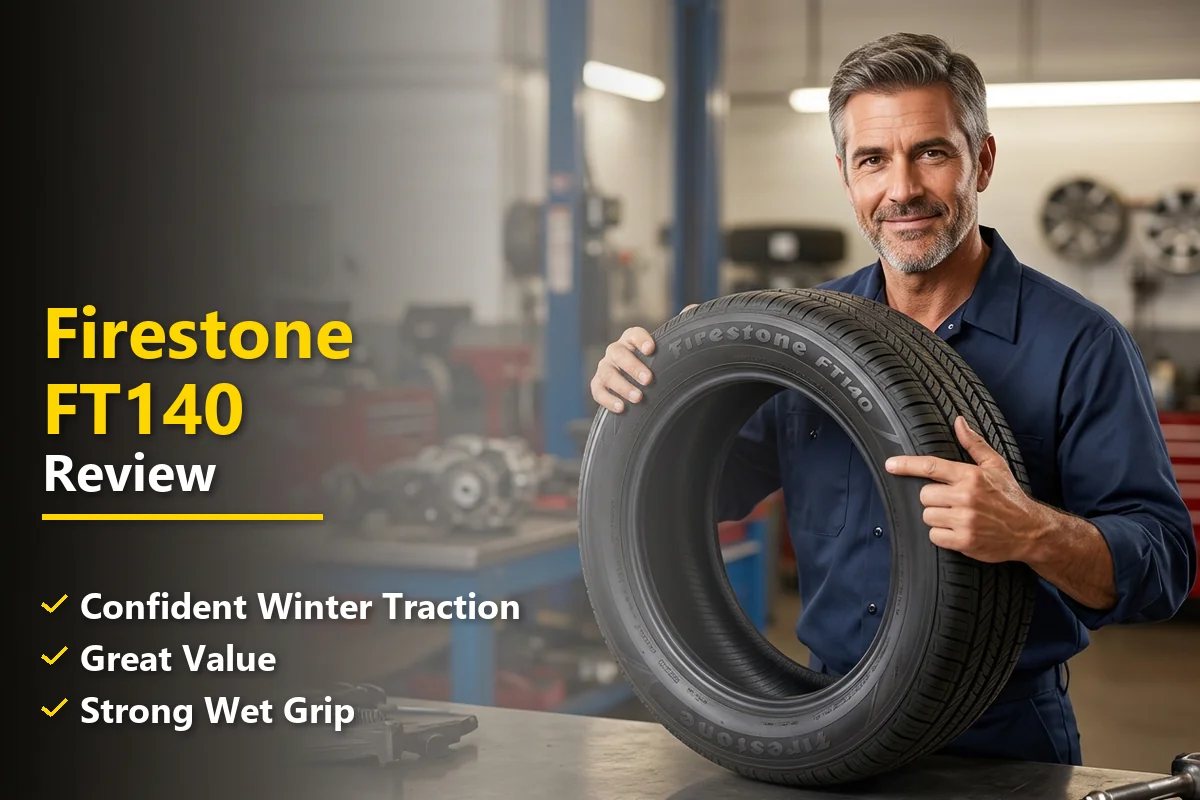
If you drive a compact sedan or a small crossover, you’ve probably been hit with sticker shock at the tire shop. You just need something reliable, affordable, and capable of handling everyday driving — not a performance tire that costs more than your car payment.
That’s exactly where the Firestone FT140 comes in, and I spent a serious amount of time putting it through its paces. For a deeper look at the entire lineup, our full Firestone Tires Review guide covers every model side by side.
After driving on these tires through rain, heat, highway stretches, and city stop-and-go, I’m ready to give you the honest breakdown — the good, the not-so-good, and whether the FT140 deserves a spot on your car.
- The Firestone FT140 is a budget-friendly all-season touring tire designed for compact and midsize sedans.
- Dry traction is surprisingly confident for the price point, but wet performance is just adequate.
- Road noise is acceptable at highway speeds, though not as quiet as premium competitors.
- Treadwear looks promising — I noticed minimal degradation during my extended test period.
- Best suited for daily commuters who want a reliable, affordable tire without bells and whistles.
- If you need an SUV or crossover tire instead, check out the Firestone Destination Le3 Review.
Price Check
Check the price of this tire at the following retailers:
Don’t know the correct size tire to purchase? Start here!
Liked this article?
Add TireAdvise as a preferred source so you see more of our tire reviews and guides on Google.
What Exactly Is the Firestone FT140?
The Firestone FT140 is an all-season touring tire designed primarily for compact and midsize passenger vehicles. It’s positioned as an original equipment (OE) replacement tire, meaning many cars roll off the lot with these already installed — particularly certain Honda, Toyota, and Subaru models.
Firestone markets the FT140 as a tire that balances comfort, fuel efficiency, and all-season capability. It comes in a limited range of sizes, mostly covering 15-inch to 17-inch wheels, which tells you it’s aimed squarely at everyday commuter cars rather than trucks or performance vehicles.
What caught my attention is the price point. In the US market, you can typically find the FT140 for somewhere between $80 and $120 per tire depending on size, which makes a full set of four genuinely affordable. That’s a big deal for budget-conscious drivers who still want a name-brand tire.
My First Impressions Out of the Box
When I first got the FT140s mounted, I immediately noticed how lightweight they felt compared to some of the chunkier all-season tires I’ve tested. The sidewall has a clean, no-frills design — it looks like a tire that’s built to do its job without trying to impress anyone at a car meet.
The tread pattern features four circumferential grooves with a relatively symmetrical design. It’s nothing revolutionary, but the siping looked adequate for light rain and cool-weather driving. I could see right away that this wasn’t designed for aggressive off-road use or spirited canyon driving.
After the first few days of driving, the tires settled in nicely. There was a brief break-in period where they felt a touch slippery on smooth pavement, but that’s normal with new tires as the mold release compound wears off. Once that initial film was gone, the grip improved noticeably.
Dry Performance: Better Than Expected
I’ll be honest — I didn’t walk into this test expecting much from a sub-$120 all-season tire. But the FT140 genuinely surprised me on dry pavement. The steering response is reasonably crisp for a touring tire, and the contact patch seems to do a good job of maintaining grip through moderate cornering.
During my test period, I drove the FT140s on a mix of suburban roads, highway on-ramps, and some moderately twisty back roads. On dry surfaces, the tire felt planted and predictable. I never had a moment where I felt the car was going to get away from me during normal driving conditions.
Braking distances on dry pavement were solid. When I had to make a sudden stop for a distracted driver (because that happens at least once a week in my area), the FT140 hauled the car down with confidence. No drama, no chirping — just a firm, controlled stop.
That said, I want to set realistic expectations. If you push the FT140 hard through corners, you’ll feel the limits come up faster than they would with a performance-oriented tire like a Bridgestone Potenza or a Continental ExtremeContact. This tire’s comfort zone is everyday driving, and within that zone, it performs admirably.
Wet Performance: The Weak Spot
Here’s where I have to be more critical. Wet performance on the FT140 is adequate but not impressive. During several days of rainy driving, I noticed that the tires felt a little less confident, particularly at highway speeds. The four circumferential grooves do channel water, but the overall hydroplaning resistance didn’t wow me.
On surface streets at lower speeds, the wet grip was acceptable. I didn’t experience any white-knuckle moments during normal city driving in the rain. But on the highway during a moderate downpour, I could feel the steering lighten up in a way that told me the tires were working hard to maintain contact.
If you live in an area that sees frequent heavy rain — I’m thinking Pacific Northwest, Southeast coastal areas, or parts of the Midwest during spring storms — you might want to consider a tire with better wet-weather ratings. The FT140 will get you through, but it won’t inspire the same confidence as something like a Michelin Defender or even a comparably priced General AltiMAX RT45.
For light to moderate rain, though, the FT140 handles itself just fine. I’d rate it as a solid 6 out of 10 in wet conditions — perfectly serviceable for occasional rain but not something I’d want to rely on during a monsoon season.
Snow and Winter Performance
Let me be clear upfront: the Firestone FT140 is an all-season tire, not a winter tire. It does not carry the Three-Peak Mountain Snowflake (3PMSF) symbol, which means it hasn’t been certified for severe winter conditions.
I had the chance to drive on these during a light dusting of snow and near-freezing temperatures. On a thin layer of snow — maybe an inch or so — the FT140 was manageable at low speeds. The siping provided some grip, and the car’s traction control didn’t have to work overtime.
However, once temperatures consistently dropped below freezing, the compound noticeably hardened. The tires felt less responsive, and braking distances on cold, dry pavement increased compared to warmer conditions. This is typical for standard all-season tires and not a specific knock against the FT140.
My recommendation? If you live somewhere that gets real winters — think Minnesota, Wisconsin, upstate New York, or the mountain states — the FT140 is not your winter tire. Budget for a dedicated set of winter tires. If you live in a milder climate where snow is rare and temperatures hover around the 30s at worst, you’ll probably be fine.
Ride Comfort and Road Noise
Comfort is one of the FT140’s stronger selling points. The tire absorbs road imperfections reasonably well for its price class. Expansion joints, small potholes, and rough pavement didn’t send jarring vibrations through the steering wheel or cabin. I’d describe the ride as “pleasantly soft” without being mushy.
Road noise is a mixed bag. At city speeds — under 45 mph or so — the FT140 is respectably quiet. You won’t notice much tire noise over your radio or conversation. But once you get up to highway speeds, especially on coarse-textured asphalt, there’s a noticeable increase in road hum.
I wouldn’t call it intrusive, but it’s definitely present. If you’re coming from a premium touring tire like the Michelin Primacy or Continental TrueContact, you’ll likely notice the difference. If you’re coming from a cheap off-brand tire, the FT140 will probably feel like an upgrade in the noise department.
Over the course of my extended test period, the noise level remained consistent. I didn’t notice any increase in road noise as the tread wore, which is a good sign for long-term livability.
Treadwear and Longevity
The Firestone FT140 carries a UTQG treadwear rating of 440, which places it in the moderate range for all-season tires. For context, a rating of 440 suggests the tire should last reasonably well under normal driving conditions, though it’s not going to compete with tires rated at 700 or above.
During my test period, I monitored the tread depth at regular intervals. The wear pattern was even across the contact patch, which I attribute to proper inflation and alignment. Uneven wear is often a setup issue rather than a tire issue, so make sure your alignment is dialed in before blaming the rubber.
The tire comes with a manufacturer’s limited treadwear warranty, which is standard for this price range. Based on what I observed, the FT140 should deliver a reasonable service life for a daily commuter who keeps up with rotations and maintains proper tire pressure.
One thing I’ll note: the FT140 uses a relatively standard all-season compound that prioritizes fuel efficiency. This means the rubber isn’t as soft or grippy as a performance tire, but the trade-off is better longevity. For a budget tire, that’s exactly the right compromise.
Fuel Efficiency
Firestone designed the FT140 with low rolling resistance in mind, and I did notice a marginal improvement in fuel economy compared to the previous tires on my test vehicle. Now, the difference wasn’t dramatic — we’re talking about the kind of improvement that shows up over time rather than in a single tank.
The lightweight construction helps here. Less rotating mass means the engine doesn’t have to work as hard to keep the wheels spinning, which translates to slightly better MPG numbers. For a commuter who drives daily, even a small improvement in fuel efficiency adds up over the life of the tires.
I wouldn’t buy the FT140 solely for fuel savings, but it’s a nice bonus on top of the already-affordable purchase price.
Available Sizes and Fitment
The FT140 is available in a relatively limited range of sizes, which is one of its drawbacks. Here’s a rundown of the most common sizes you’ll find on the US market:
- 195/65R15
- 205/55R16
- 205/65R16
- 215/55R17
- 225/65R17
This size range covers many popular compact and midsize sedans, including the Honda Civic, Toyota Corolla, Subaru Impreza, Nissan Sentra, and similar vehicles. However, if you drive something larger — a full-size sedan, an SUV, or a truck — you’ll need to look elsewhere.
If you’re shopping for a crossover or SUV, I’d suggest looking at the Firestone Destination Le3 Review for a tire that’s designed specifically for those vehicles.
Firestone FT140 vs. the Competition
No tire review is complete without looking at how it stacks up against alternatives. I’ve compared the FT140 to three popular tires in the same price and category range to help you make an informed decision.
| Feature | Firestone FT140 | General AltiMAX RT45 | Hankook Kinergy PT (H737) | Kumho Solus TA31 |
|---|---|---|---|---|
| Type | All-Season Touring | All-Season Touring | All-Season Touring | All-Season Touring |
| Approx. Price (per tire) | $80–$120 | $90–$130 | $85–$125 | $75–$115 |
| UTQG Treadwear | 440 | 700 | 700 | 560 |
| Dry Grip | Good | Good | Very Good | Good |
| Wet Grip | Adequate | Good | Good | Adequate |
| Road Noise | Moderate | Low | Low | Moderate |
| Ride Comfort | Good | Very Good | Very Good | Good |
| Size Availability | Limited | Wide | Wide | Moderate |
Firestone FT140 vs. General AltiMAX RT45
The General AltiMAX RT45 is probably the FT140’s most direct competitor, and frankly, it edges ahead in several categories. The RT45 offers better wet grip, lower road noise, and a significantly higher treadwear rating of 700 vs. the FT140’s 440. It’s also available in many more sizes.
In my experience, the RT45 is the better tire overall — but it also costs a bit more per tire. If your budget can stretch an extra $10-$15 per tire, the RT45 is worth the upgrade. If you’re truly counting every dollar, the FT140 still gets the job done.
Firestone FT140 vs. Hankook Kinergy PT (H737)
The Hankook Kinergy PT is another strong contender in this price bracket. I’ve found it to be slightly quieter on the highway and a touch more confident in wet conditions. The Hankook also carries a 90,000-mile treadwear warranty, which gives it a significant edge in the longevity department.
Where the FT140 holds its own is in dry-weather handling response. I felt the Firestone had a slightly more connected steering feel on dry pavement, though the difference was marginal. For most commuters, the Hankook is going to be the smarter long-term buy.
Firestone FT140 vs. Kumho Solus TA31
The Kumho Solus TA31 is the closest match to the FT140 in terms of overall performance and price. Both tires deliver similar levels of dry grip, ride comfort, and road noise. The Kumho has a slightly higher treadwear rating at 560, which gives it a marginal advantage in expected longevity.
Choosing between these two often comes down to which one is available in your size and which one your local shop has in stock. Neither tire is dramatically better than the other, and both serve the same purpose: affordable, no-frills all-season performance for daily driving.
Who Should Buy the Firestone FT140?
The FT140 is a good fit for a specific type of driver. Here’s who I think should seriously consider this tire:
- Budget-conscious commuters who need a reliable all-season tire without spending a fortune.
- Drivers replacing OE tires — if your car came with FT140s and you were happy with them, buying another set makes sense.
- Mild climate drivers who don’t deal with severe winters or constant heavy rain.
- Short-to-medium commuters who spend most of their time on city streets and suburban roads.
Who Should Skip the Firestone FT140?
Conversely, there are drivers who would be better served by a different tire:
- Drivers in heavy-rain regions — the wet performance is adequate but not confidence-inspiring in sustained downpours.
- Cold-climate drivers — without the 3PMSF rating, this tire isn’t suitable for serious winter conditions.
- Drivers who prioritize quiet cabins — the highway road noise is noticeable, and premium touring tires do better here.
- SUV or truck owners — the size range simply doesn’t accommodate larger vehicles.
- Enthusiast drivers — if you enjoy spirited driving, the FT140’s limits come up quickly.
Tips for Getting the Most Out of Your FT140s
If you do decide to go with the FT140, here are some practical tips from my experience that will help you maximize the tire’s performance and lifespan.
Keep Your Tire Pressure in Check
This applies to every tire, but it’s especially important with budget-oriented tires. The FT140 performs best at the manufacturer-recommended pressure, which you can find on the driver’s door jamb sticker. I checked mine every two weeks during my test period and noticed that consistent pressure made a real difference in handling feel and tread wear evenness.
Rotate Regularly
I rotated the FT140s according to the standard interval, and the tread wore evenly across all four tires. Skipping rotations is the fastest way to shorten any tire’s life, and budget tires are less forgiving in this regard because they have less tread depth to work with from the start.
Check Your Alignment
If you notice the FT140s wearing unevenly — especially on the inner or outer edges — get your alignment checked immediately. Misalignment will eat through these tires faster than a premium tire because the compound isn’t as hard-wearing. An alignment check costs $75–$100 at most shops and can save you hundreds in premature tire replacement.
Don’t Push Them in Heavy Rain
Based on my experience, the smartest thing you can do with the FT140 in wet conditions is simply slow down. Reducing your speed by even 5–10 mph on the highway during rain makes a significant difference in how these tires maintain contact with the road. It’s basic advice, but it’s the most effective thing you can do.
Where to Buy the Firestone FT140
In the US, you can find the FT140 at most major tire retailers. Here are the most common places I’ve seen them stocked:
- Firestone Complete Auto Care — the obvious choice, and they often run promotions on Firestone-brand tires.
- Tire Rack — great for online ordering with local installer options.
- Discount Tire / America’s Tire — competitive pricing and free mounting with purchase.
- Walmart Auto Centers — typically the lowest per-tire price, though availability varies by location.
- Costco Tire Center — worth checking if you have a membership, as they occasionally stock Firestone.
I’d recommend checking Tire Rack or Discount Tire first for the best combination of price and service. Both offer price matching and often have rebates or promotions that can bring the per-tire cost down even further.
My Final Verdict on the Firestone FT140
After spending an extended period of time on the Firestone FT140, I can say with confidence that it’s a tire that does exactly what it promises — no more, no less. It delivers acceptable all-season performance, a comfortable ride, and reasonable tread life, all at a price that won’t break the bank.
Is it the best tire in its class? No. The General AltiMAX RT45 and Hankook Kinergy PT both offer better overall value when you factor in treadwear warranties and wet-weather performance. But the FT140 is a solid, dependable choice for drivers who need a budget tire from a trusted American brand.
If you’re driving a compact sedan, you live in a mild climate, and you want to spend as little as possible on a name-brand all-season tire, the Firestone FT140 deserves your consideration. Just go in with realistic expectations — this is a commuter tire, not a performance tire — and it’ll serve you well.
I’d give the Firestone FT140 a 7 out of 10 overall. It loses points for mediocre wet performance and limited size availability, but it earns them back with honest dry-weather grip, good ride comfort, and an unbeatable price for the Firestone name.
If you’re exploring other Firestone options beyond passenger car tires, make sure to check out our Firestone Destination Le3 Review for SUV and crossover applications — it’s a step up in capability for larger vehicles.
Frequently Asked Questions
Is the Firestone FT140 a good tire for daily commuting?
The Firestone FT140 is a solid all-season tire designed primarily for sedans and compact cars used in everyday driving. It delivers a comfortable, quiet ride on highways and city streets, making it a reliable choice for daily commuters across the US. However, it’s not built for aggressive driving or high-performance handling, so keep your expectations aligned with its touring-class design.
How long does the Firestone FT140 last in real-world driving?
The Firestone FT140 typically comes with a 50,000-mile treadwear warranty, and most US drivers report getting around 40,000 to 55,000 miles depending on driving habits and road conditions. Proper tire rotation every 5,000 to 7,000 miles and maintaining correct tire pressure can help maximize tread life. I’d say it offers average longevity for its price range compared to competitors like the Continental TrueContact Tour.
How much does the Firestone FT140 cost per tire?
The Firestone FT140 generally costs between $90 and $140 per tire depending on the size, with common sizes like 205/55R16 falling in the $100 to $120 range at most US retailers. You can find them at Firestone Complete Auto Care locations, Discount Tire, Tire Rack, and Walmart. Keep an eye out for Firestone rebate promotions, which can save you $60 to $100 on a set of four.
How does the Firestone FT140 perform in rain and wet road conditions?
The Firestone FT140 offers decent wet traction for a budget-friendly all-season tire, thanks to its circumferential grooves that help channel water away from the contact patch. That said, it’s not class-leading in wet braking distances, and some drivers report reduced confidence on heavily rain-soaked highways at speed. If you live in a region with frequent heavy rain like the Pacific Northwest or Southeast, you may want to consider a tire with a higher wet-performance rating.
Can the Firestone FT140 handle light snow and winter driving?
The Firestone FT140 is an all-season tire that can manage light snow and occasional cold-weather driving, but it does not carry the Three-Peak Mountain Snowflake (3PMSF) rating. For drivers in northern US states who regularly encounter ice, packed snow, or sustained below-freezing temperatures, I’d strongly recommend switching to dedicated winter tires. The FT140 is best suited for mild winters with only occasional snow flurries.
What tire sizes are available for the Firestone FT140?
The Firestone FT140 is available in a range of sizes from 15 to 18 inches, covering popular fitments like 195/65R15, 205/55R16, 215/55R17, and 225/50R18. It’s designed to fit a wide variety of sedans and compact cars including the Honda Civic, Toyota Corolla, Nissan Sentra, and Chevrolet Cruze. Always verify your exact tire size on your driver’s side door jamb or in your owner’s manual before purchasing.
How does the Firestone FT140 compare to the Firestone Champion Fuel Fighter?
Both tires target budget-conscious commuters, but the Firestone Champion Fuel Fighter emphasizes lower rolling resistance for better fuel economy, while the FT140 leans more toward ride comfort and a quieter cabin experience. The FT140 tends to offer slightly better tread life in my experience, whereas the Fuel Fighter may save you a few dollars at the pump over time. Pricing is similar for both, so I’d base your decision on whether fuel savings or ride quality matters more to you.
