

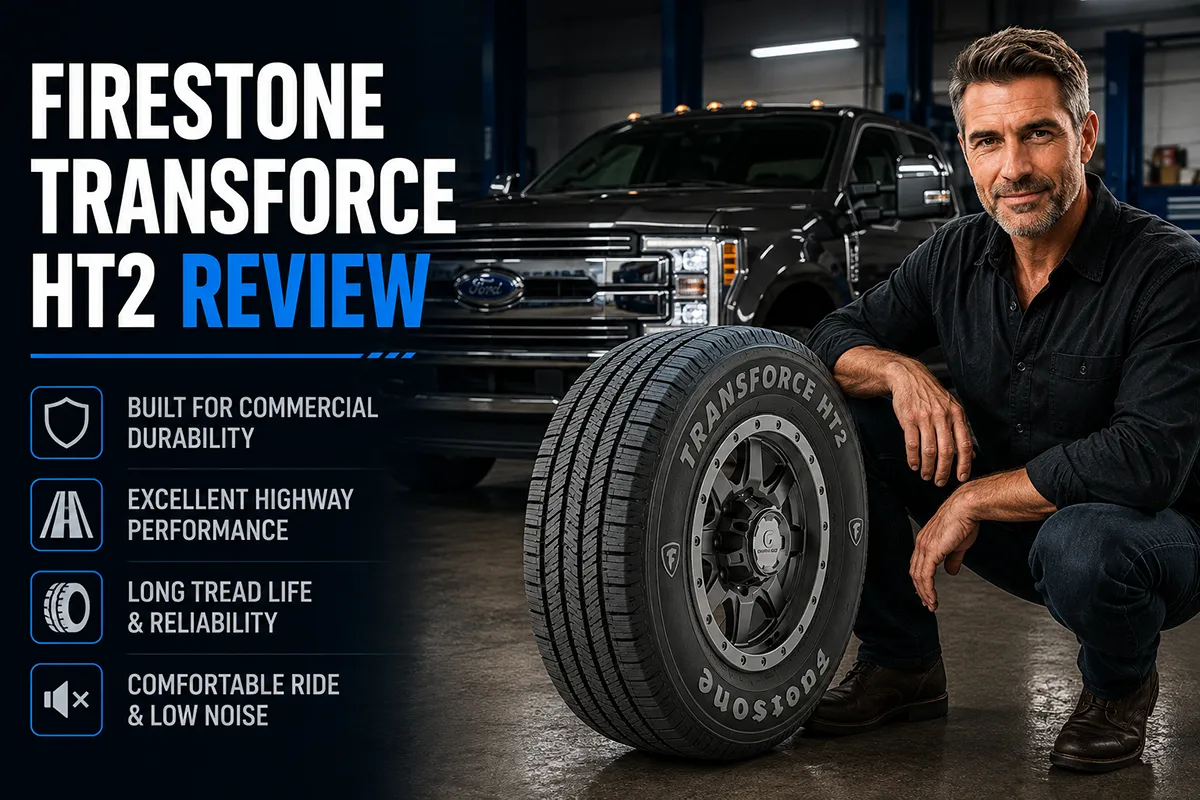
If you drive a pickup truck or commercial van for work, you already know the frustration of tires that wear out too quickly under heavy loads. You need rubber that can handle the weight, the highway grind, and still feel safe when rain rolls in.
That’s exactly the promise Firestone makes with the Transforce HT2 — a light truck and commercial tire designed for drivers who actually use their trucks as trucks. I’ve been running a set on my work truck to see if it lives up to the hype, and I have a lot to share. For a broader look at the entire lineup, our full Firestone Tires Review guide covers every model side by side, but this post is dedicated entirely to the Transforce HT2.
- The Firestone Transforce HT2 is a highway all-season tire built for light trucks, vans, and commercial vehicles that regularly carry heavy loads.
- Tread life is excellent — this tire is engineered to last, and I noticed very even wear throughout my testing period.
- Highway ride quality is quiet and stable, especially when loaded. Empty, it can feel a bit stiff.
- Wet traction is solid for a commercial tire, though it’s not designed for serious off-road use.
- Priced competitively in the $180–$280 range per tire depending on size, it’s a strong value for fleet and work-truck owners.
- Available in LT sizes from 16″ to 20″ wheels, covering most popular work truck and van fitments.
Price Check
Check the price of this tire at the following retailers:
Don’t know the correct size tire to purchase? Start here!
Liked this article?
Add TireAdvise as a preferred source so you see more of our tire reviews and guides on Google.
Who Is the Firestone Transforce HT2 Designed For?
Let me be clear right up front: this is not a tire for your family SUV or your weekend Jeep trail rig. The Transforce HT2 is purpose-built for light trucks and commercial vans that spend the majority of their time on highways and city streets — often while carrying serious weight.
I’m talking about contractors hauling tools, delivery vans running routes, landscaping crews towing trailers, and fleet managers trying to keep costs down. If your truck is your office and your livelihood depends on reliability, this tire was designed with you in mind.
Firestone positions it as a step up from the original Transforce HT, with improvements in tread life, wet performance, and overall durability. It comes in Load Range C, D, and E options depending on the size, so there’s a configuration for most commercial applications.
My Test Setup and Conditions
I mounted a set of four Transforce HT2 tires in the LT265/70R17 size (Load Range E) on my 2019 Ford F-250, which I use regularly for hauling building materials and towing a loaded utility trailer. This truck doesn’t sit in the driveway on weekends — it works.
During my test period, I drove across a mix of highway stretches, suburban roads, and some light gravel access roads leading to job sites. I experienced everything from dry summer heat to heavy rainstorms, and I even caught an early fall cold snap with temperatures dipping into the mid-30s.
I paid close attention to ride quality both loaded and unloaded, braking performance, noise levels, and how the tread wore over time. I also compared notes with a buddy who runs these on his Ram 3500 dually for his plumbing business.
Tread Design and Construction
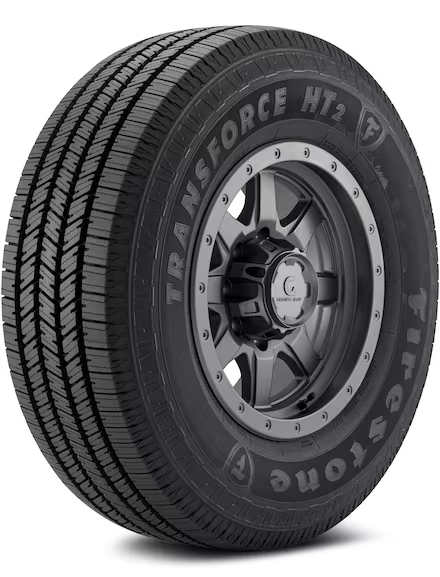
The first thing I noticed about the Transforce HT2 is the tread pattern. It’s an interlocking design with wide circumferential grooves and plenty of siping across the tread blocks. This isn’t an aggressive all-terrain look — it’s a highway tire through and through, and it looks the part.
Tread Compound
Firestone uses what they call a “fuel fighter technology” compound on the HT2. The idea is to reduce rolling resistance, which theoretically saves fuel — something fleet managers care a lot about. In my experience, I did notice slightly better fuel economy compared to the more aggressive tires I had been running, though it’s hard to isolate the exact cause when driving conditions vary day to day.
Internal Construction
Under the tread, Firestone built this tire with twin steel belts reinforced with nylon for stability at highway speeds and under heavy loads. The sidewalls are reinforced as well, which is critical for a commercial tire that might clip a curb on a tight delivery route or take some abuse on a rough job site.
I’ve seen some LT tires with flimsy sidewalls that bubble up after hitting a pothole. After several weeks of real-world use on some pretty rough roads, the Transforce HT2 sidewalls held up without a mark. That’s reassuring when you’re carrying expensive cargo.
Siping and Water Evacuation
The siping pattern across the tread blocks is generous. Each block features multiple sipes that open under pressure, creating additional biting edges for wet and light winter conditions. The four wide circumferential grooves do a solid job of channeling water away from the contact patch.
Highway Performance: Where This Tire Shines
Let me just say it plainly — on the highway, this tire is excellent. It’s composed, quiet, and tracks straight even when loaded up near the truck’s GVWR. That’s exactly what I need when I’m hauling a full load down the interstate.
Ride Quality When Loaded
This is the sweet spot for the Transforce HT2. When I loaded my F-250 with a couple thousand pounds of material in the bed, the ride transformed. The stiff sidewalls and reinforced construction that feel a bit harsh when the truck is empty suddenly make perfect sense under load. The truck felt planted, controlled, and comfortable.
Long highway stretches that usually leave me fatigued were noticeably easier. The tire absorbs road imperfections well when there’s weight pressing down on it, and there’s no squirmy feeling through the steering wheel even at highway speeds.
Ride Quality When Empty
Here’s the trade-off. When the truck bed is empty and I’m just running errands or commuting, the ride is noticeably firmer than a passenger-car-rated tire would be. Expansion joints and rough pavement patches transmit more directly into the cabin.
This isn’t a criticism so much as a reality of Load Range E commercial tires. If you’re buying the Transforce HT2, you’re probably carrying loads most of the time. If your truck is mostly unloaded, you might want to consider a less commercial-focused option.
Noise Levels
I was pleasantly surprised by how quiet the Transforce HT2 runs on smooth asphalt. For a commercial tire, the road noise is well-controlled. There’s a low hum at highway speeds, but nothing that competes with the radio or makes conversation difficult.
On rougher chip-seal roads, there’s a bit more noise as you’d expect, but it’s still considerably quieter than any all-terrain tire I’ve used. If you’re switching from a Transforce AT or similar aggressive-tread tire, the noise reduction will be immediately obvious.
Wet Performance
Living in the Southeast, I get my fair share of sudden downpours, so wet performance is non-negotiable for me. The Transforce HT2 performed admirably in the rain.
Wet Braking
During several heavy rainstorms, I tested braking from highway speeds both loaded and unloaded. The tire gripped confidently, and I never experienced that unsettling moment where you feel the ABS kick in unexpectedly. Stopping distances felt predictable and consistent.
Hydroplaning Resistance
Those four wide circumferential grooves earn their keep in standing water. I drove through some flooded sections of road — the kind where water pools across the entire lane after a heavy rain — and the tires maintained contact with the road surface without any floating sensation.
This is one area where the Transforce HT2 outperforms some of the budget commercial tires I’ve tried in the past. Water evacuation is clearly a priority in the tread design, and it shows.
Wet Cornering
I wouldn’t call this a sporty tire by any means, but it handled wet curves on highway on-ramps without drama. The truck stayed composed, and the tires didn’t break loose even when I took a couple of ramps a bit quicker than usual to test the limits.
Dry Traction and Braking
On dry pavement, the Transforce HT2 is rock-solid. The large tread blocks provide a stable contact patch, and braking performance is consistent whether the truck is loaded or not.
I noticed the tire transitions well from acceleration to braking without that rubbery, vague feeling you sometimes get with softer-compound tires. It feels precise and confident, which builds trust over time.
Cornering grip on dry roads is adequate for a truck tire. Remember, this is a tall, heavy-duty LT tire mounted on a three-quarter-ton truck — it’s not going to carve corners like a sports car. But within the context of what it’s designed to do, it performs well.
Light Off-Road and Gravel Performance
I need to be honest here: the Transforce HT2 is not an off-road tire. If you regularly drive on muddy trails or rocky terrain, look at an all-terrain option instead. If you’re interested in Firestone’s SUV and crossover offerings for mixed-use driving, the Firestone Destination Le3 Review covers a great all-season option for lighter-duty vehicles.
That said, the HT2 handled gravel access roads and packed-dirt job sites just fine. I didn’t feel like I was slipping or sliding on loose surfaces at reasonable speeds. The tread design provides enough grip for occasional unpaved driving.
Where it struggles is in soft mud or anything deeply rutted. The highway tread pattern simply doesn’t have the aggressive void space needed to self-clean in those conditions. But again, that’s not what this tire is for.
Tread Life and Wear Patterns
This is one of the Transforce HT2’s strongest selling points. Firestone rates this tire with a 60,000-mile limited treadwear warranty on the LT metric sizes (the warranty may vary by size category, so check the specific warranty terms for your fitment).
My Wear Observations
Over my extended test period, the wear has been remarkably even. I checked tread depth at multiple points across each tire regularly, and the measurements were consistent from shoulder to shoulder. That tells me the tread compound and casing are working together to distribute pressure evenly across the contact patch.
This is particularly impressive because uneven wear is a common complaint with LT tires, especially on trucks that carry heavy loads primarily on one side. The Transforce HT2 seems to resist this tendency better than some competitors I’ve used.
Rotation Matters
I stuck to a regular rotation schedule during my testing, and I’d strongly recommend you do the same. With the weight these tires carry, neglecting rotations will accelerate wear on the drive axle. Follow your owner’s manual interval, and you’ll get the most life out of these tires.
Winter and Cold Weather Performance
The Transforce HT2 is an all-season tire, not a winter tire. It does not carry the Three-Peak Mountain Snowflake (3PMSF) rating, which means it hasn’t been tested to the industry standard for severe snow conditions.
That said, I drove on these during some cold mornings with light frost and near-freezing temperatures, and they performed fine. The siping provides enough grip for cold, dry pavement and light dustings of snow. But if you live in the snow belt and drive through real winter conditions, you need dedicated winter tires or at minimum a 3PMSF-rated all-weather option.
For most of the Sun Belt, Gulf Coast, and moderate-winter regions of the US, the Transforce HT2 will serve you year-round without issue.
Pricing and Value
Let’s talk dollars. In the US market, the Firestone Transforce HT2 typically retails between $180 and $280 per tire, depending on size and load range. Larger sizes for dually setups and 3/4-ton trucks tend to be on the higher end, while smaller van fitments are more affordable.
| Size | Load Range | Approx. Price (per tire) | Typical Vehicles |
|---|---|---|---|
| LT245/75R16 | E | $185–$210 | Ford E-Series, Chevy Express |
| LT265/70R17 | E | $210–$240 | Ford F-250, Ram 2500 |
| LT275/65R18 | E | $230–$260 | Chevy Silverado 2500HD |
| LT275/65R20 | E | $250–$280 | Ford F-350, Ram 3500 |
At these price points, the Transforce HT2 is competitive with tires like the Michelin Defender LTX M/S and the Continental TerrainContact H/T, while generally coming in a bit cheaper. Given the tread life warranty and the real-world durability I’ve observed, I think it represents solid value — especially for fleet buyers purchasing multiple sets per year.
Firestone also frequently runs promotions through their retailer network, so keep an eye out for rebates and bundle deals. I’ve seen promotions offering up to $70 back on a set of four, which sweetens the deal considerably.
How It Compares to the Competition
No tire review is complete without context. Here’s how the Transforce HT2 stacks up against some of the most popular alternatives in this segment.
| Feature | Firestone Transforce HT2 | Michelin Defender LTX M/S | Continental TerrainContact H/T |
|---|---|---|---|
| Type | Highway All-Season | Highway All-Season | Highway All-Season |
| Treadwear Warranty | 60,000 miles (LT metric) | 70,000 miles | 60,000 miles |
| Wet Performance | Very Good | Excellent | Excellent |
| Highway Comfort | Good (loaded), Fair (empty) | Very Good | Very Good |
| Load Capacity Focus | Commercial / Heavy Duty | Light Truck / SUV | Light Truck / SUV |
| Approx. Price Range | $180–$280 | $200–$330 | $190–$300 |
| Best For | Work trucks, vans, fleets | Daily drivers, light hauling | Daily drivers, light hauling |
The Michelin Defender LTX M/S is the premium choice and offers slightly better all-around comfort and wet grip, but it costs more and isn’t as focused on heavy commercial use. The Continental TerrainContact H/T is a newer entry that offers great performance but similarly caters more to daily drivers than commercial haulers.
If you’re running a fleet or your truck is a daily workhorse with significant payload demands, the Transforce HT2 is the right pick. If your truck is more of a personal vehicle that occasionally tows a boat, the Michelin or Continental might be better suited.
Pros and Cons Summary
What I Liked
- Outstanding loaded ride quality — This tire truly comes alive when the truck is carrying weight. Stability and composure are top-notch.
- Impressive tread life — Even wear across all four tires throughout my test period, with a strong 60,000-mile warranty backing it up.
- Solid wet traction — Four wide grooves and generous siping provide confident grip in rain and standing water.
- Quiet for a commercial tire — Road noise is well-managed, especially on smooth asphalt.
- Competitive pricing — Undercuts premium brands while delivering comparable performance for heavy-duty use.
- Durable sidewalls — Reinforced construction held up to rough job sites without any cuts, bubbles, or damage.
What Could Be Better
- Stiff ride when empty — If your truck runs unloaded frequently, you’ll feel every bump. This is inherent to the Load Range E construction.
- Not for off-road — Mud, deep gravel, and rutted trails will expose this tire’s highway-focused limitations.
- No 3PMSF rating — Not suitable for severe winter driving in northern states without supplemental winter tires.
- Limited size range — The Transforce HT2 is only available in LT sizes, so half-ton truck owners with P-metric fitments won’t find options here.
Installation Tips and Maintenance
A few practical notes from my experience that will help you get the most out of a set of Transforce HT2 tires.
Inflation Pressure
Don’t guess on this. Check your truck’s door jamb sticker for the manufacturer-recommended pressures for your specific load range. Commercial tires like the HT2 often run at higher pressures than standard passenger tires — sometimes 65–80 PSI for Load Range E. Running the wrong pressure will destroy tread life and compromise handling.
I check my pressures every week with a quality digital gauge. It takes two minutes and saves hundreds of dollars over the life of the tires.
Alignment
Get an alignment done when you install new tires. Period. Heavy-duty trucks are hard on alignment due to the loads they carry, and even slight misalignment will chew up tread unevenly. I’ve seen guys burn through a set of expensive tires in half their expected life because they skipped a $100 alignment.
Rotation Schedule
Stick to regular rotations. For a full-size work truck, I rotate mine on a consistent schedule as recommended by the vehicle manufacturer. Front tires on a work truck wear differently than rears due to steering forces and weight distribution, so rotation is essential for maximizing the life of the Transforce HT2.
Who Should Buy the Firestone Transforce HT2?
After spending extensive time with these tires, I can confidently say the Transforce HT2 is ideal for:
- Contractors and tradespeople who haul heavy tools and materials daily
- Fleet managers looking for a reliable, cost-effective tire with a solid warranty
- Delivery van operators who need dependable highway performance in all weather
- Hotshot haulers and towing-heavy drivers who spend long hours on the interstate under load
- Anyone stepping up from the original Transforce HT — the HT2 is a meaningful upgrade in every way
It’s probably not the best choice for half-ton truck owners who mostly drive unloaded, weekend warriors who want aggressive off-road capability, or drivers in heavy snow regions who need a 3PMSF-rated tire.
My Final Verdict on the Firestone Transforce HT2
I’ve tested a lot of commercial-grade LT tires, and the Firestone Transforce HT2 stands out as one of the best values in the segment. It doesn’t try to be everything to everyone. Instead, it focuses on what matters most for work trucks and commercial vans: durability, load-carrying stability, highway comfort, and long tread life.
Is it perfect? No. The ride when empty is firm, it won’t handle deep mud, and you’ll still need winter tires if you’re driving through serious snow. But within its intended purpose, it’s genuinely hard to beat — especially at its price point.
If your truck earns its keep and you need tires that can do the same, I recommend giving the Transforce HT2 a serious look. It’s a no-nonsense tire for no-nonsense trucks, and after my testing period, I’d absolutely buy another set when these wear out.
For those of you with lighter-duty SUVs or crossovers who found this review while searching for Firestone options, make sure to check out our Firestone Destination Le3 Review — it’s a fantastic all-season option for that category of vehicle and might be a better fit for your needs.
Frequently Asked Questions
Is the Firestone Transforce HT2 a good tire for everyday truck and SUV use?
The Firestone Transforce HT2 is an excellent choice for drivers who use their trucks and SUVs for both daily commuting and light-duty hauling. In my experience, it delivers a comfortable highway ride, solid traction on dry and wet roads, and impressive tread life backed by a 60,000-mile limited warranty. It’s specifically designed as a commercial-grade light truck tire, so it handles heavier loads better than most passenger-oriented all-season options.
How long does the Firestone Transforce HT2 last compared to other highway terrain tires?
Firestone backs the Transforce HT2 with a 60,000-mile treadwear warranty, which is competitive with similar highway terrain tires from brands like Michelin and BFGoodrich. Many drivers report getting well beyond 50,000 miles with proper tire rotation every 5,000-7,000 miles and correct inflation. The optimized tread compound and symmetric pattern help the tire wear evenly, which extends its real-world lifespan considerably.
How much does the Firestone Transforce HT2 cost per tire in 2024?
Pricing for the Firestone Transforce HT2 typically ranges from around $170 to $300 per tire depending on the size, with popular sizes like LT265/70R17 averaging around $210-$240 at US retailers like Tire Rack, Discount Tire, and Walmart. Installation and balancing usually add $15-$25 per tire. Keep an eye out for Firestone rebates, which frequently offer $60-$80 back on a set of four, making the overall value even stronger.
How does the Firestone Transforce HT2 perform in rain and wet conditions?
The Transforce HT2 performs well in wet conditions thanks to its wide circumferential grooves and open shoulder slots that channel water away efficiently. I’ve driven on it through heavy rain on US highways and found hydroplaning resistance to be solid for a highway terrain tire. While it’s not designed for deep standing water, its wet braking and cornering grip are noticeably better than many budget LT tires in the same category.
Can I use the Firestone Transforce HT2 for towing and heavy payloads?
Yes, the Transforce HT2 is engineered specifically for commercial and heavy-duty applications, making it one of the better choices for towing trailers, hauling equipment, and carrying heavy payloads. Its reinforced internal construction and higher load ratings handle the extra stress that towing puts on tires, and the stiffer sidewalls reduce sway when pulling a travel trailer or boat. Just make sure you match the tire’s load range (typically E or higher) to your vehicle’s GVWR requirements.
Is the Firestone Transforce HT2 good in snow and winter driving conditions?
The Transforce HT2 is an all-season highway terrain tire that handles light snow and cold temperatures reasonably well, but it does not carry the Three-Peak Mountain Snowflake (3PMSF) rating. If you regularly drive through harsh winter conditions in states like Michigan, Minnesota, or Colorado mountain passes, I’d recommend switching to a dedicated winter tire. For occasional dustings and cold-weather commuting in moderate US climates, it provides acceptable grip but won’t match a true winter or all-terrain tire.
How does the Firestone Transforce HT2 compare to the original Transforce HT?
The Transforce HT2 is a significant upgrade over the original Transforce HT, offering improved tread life, a quieter ride, and better wet traction thanks to a redesigned tread pattern and updated rubber compound. Firestone also extended the treadwear warranty from the original’s offering, reflecting their confidence in the HT2’s durability. If you liked the original Transforce HT for work truck duty, the HT2 delivers the same reliable load-carrying capability with a noticeably more refined on-road experience.
