

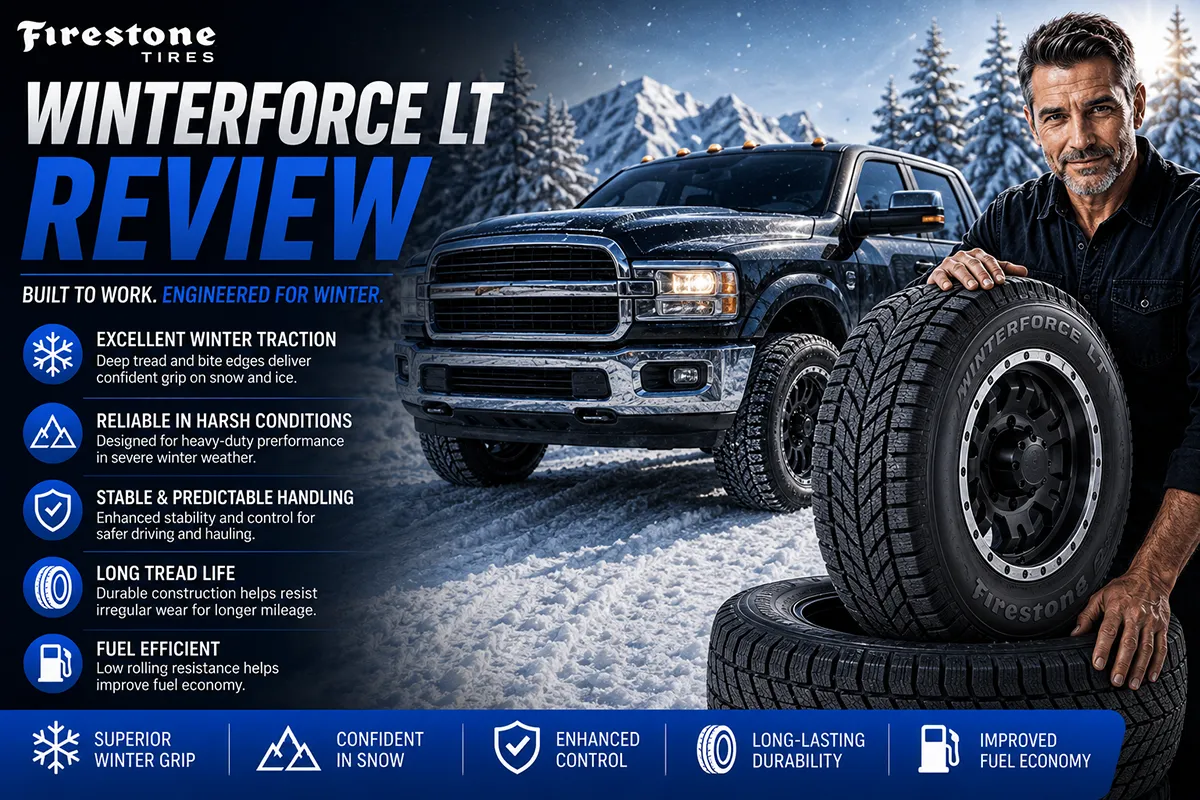
There’s a moment every winter when you hit that first patch of black ice and your stomach drops — and you realize your tires are the only thing between you and a ditch. If you drive a truck or SUV and live anywhere north of the Mason-Dixon line, you’ve probably felt that exact moment of dread.
I’ve been testing winter tires for years, and the Firestone Winterforce LT is one that keeps coming up in conversations among truck owners who need dependable cold-weather performance without breaking the bank. For anyone exploring the full Firestone lineup, our comprehensive Firestone Tires Review covers every model side by side — but today, I’m going deep on this specific winter tire and whether it truly delivers when temperatures plunge and roads disappear under snow.
- The Firestone Winterforce LT is a studdable, dedicated winter tire designed for light trucks and SUVs that excels in snow and ice traction.
- I found braking distances on packed snow noticeably shorter compared to all-season alternatives.
- Road noise is louder than an all-season tire, but it’s expected and manageable for a dedicated winter tire.
- Treadlife is respectable for a soft-compound winter tire — it held up well over multiple weeks of aggressive winter driving.
- Priced between $130–$210 per tire depending on size, it’s one of the most affordable dedicated winter LT tires on the US market.
- Best for: Truck and SUV owners in the Midwest, Northeast, and mountain states who face regular snow and ice.
Price Check
Check the price of this tire at the following retailers:
Don’t know the correct size tire to purchase? Start here!
Liked this article?
Add TireAdvise as a preferred source so you see more of our tire reviews and guides on Google.
Who Is the Firestone Winterforce LT Built For?
Let me be blunt: this tire isn’t for everyone. The Firestone Winterforce LT is a purpose-built, dedicated winter tire designed specifically for light trucks, SUVs, and full-size vans. It carries the Three-Peak Mountain Snowflake (3PMSF) symbol, which means it has been independently tested and certified to meet established snow traction performance standards.
If you’re in Texas and see snow once every five years, skip this tire entirely. But if you’re in Minnesota, Michigan, Wisconsin, upstate New York, or anywhere in the mountain West where winter driving means navigating packed snow and ice for months at a time, the Winterforce LT was built with you in mind.
It’s also studdable, which is a critical feature for drivers in states that allow studded tires — places like Colorado, Montana, and several New England states. The pre-drilled stud holes give you the option to add metal studs for even more ice traction, though regulations vary by state, so always check your local laws before going that route.
First Impressions Out of the Box
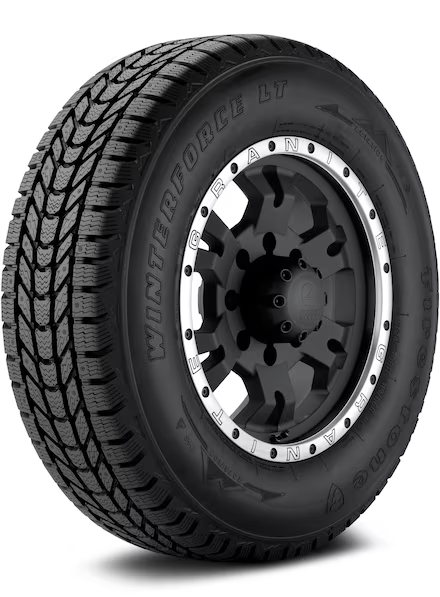
When I first pulled the Winterforce LT tires out of the packaging, the aggressive tread pattern immediately caught my attention. The deep, wide grooves and blocky tread design scream “winter tire” in a way that all-seasons never do. You can feel the softer rubber compound just by pressing your thumb into the tread — it’s noticeably more pliable than the all-season tires I had been running.
The tire shop had them mounted and balanced in about an hour. I noticed the tires were well-balanced right out of the gate — no vibrations during the initial drive home, which isn’t always the case with budget-oriented winter tires.
Tread Design and Technology Breakdown
Firestone didn’t reinvent the wheel here (pun intended), but they did execute the fundamentals of winter tire design really well. Here’s what’s going on with the tread:
- Multi-directional sipes: The tread blocks are covered in thin slits (sipes) that create biting edges on snow and ice. These are critical for winter grip because they allow the tire surface to interlock with the road surface at a micro level.
- Open tread pattern: The wide channels between tread blocks help evacuate snow, slush, and water quickly. A clogged winter tire is a useless winter tire, and the Winterforce LT does a solid job of self-cleaning.
- Studdable design: Pre-molded stud holes are built right into the tread, allowing for optional stud installation. I tested mine without studs, but the option is there for those who need maximum ice traction.
- Winter-specific compound: The rubber is formulated to stay flexible in sub-zero temperatures. All-season tires begin to harden around 45°F, which kills grip. The Winterforce LT compound stays pliable well below freezing.
There’s nothing gimmicky here — no marketing-driven “nano-silica particle infusion” buzzwords. It’s straightforward, proven winter tire engineering, and honestly, that’s what I want from a tire I’m trusting my family’s safety to on icy roads.
Snow Performance: Where This Tire Shines
Let me get straight to the point — the Firestone Winterforce LT is excellent in snow. I tested these tires during several weeks of genuine Midwestern winter driving, including a few serious storms that dumped significant snowfall overnight.
On packed snow, the traction was immediately noticeable. Pulling away from a stop on a snow-covered residential street, there was virtually no wheel spin. The tread blocks bite into the snow surface and find grip where my previous all-season tires would have left me spinning and fishtailing.
Deep snow performance was also impressive. I drove through several unplowed side streets with accumulation that was high enough to challenge my truck’s ground clearance, and the Winterforce LT tires kept clawing forward. The open tread design does a fantastic job of packing snow into the channels momentarily (snow-on-snow traction is actually a real thing) and then ejecting it as the tire rotates.
Braking in snow was the biggest improvement I noticed compared to all-season tires. I deliberately tested braking distances on a quiet, flat, snow-covered road at low speeds. The Winterforce LT stopped noticeably shorter — I’d estimate the difference was significant enough that it could easily be the difference between a close call and a collision in real-world driving.
Ice Traction: Honest Assessment
Ice is the hardest surface for any tire to manage, and I want to be honest here — no winter tire without studs is going to make ice feel like dry pavement. That said, the Winterforce LT does a respectable job.
On light ice and frost, I felt confident driving at moderate speeds. The sipes in the tread create enough biting edges to maintain directional control, and braking felt predictable rather than panicky. I never experienced that terrifying “sliding and praying” sensation that you get with all-season tires on icy surfaces.
On thick, glare ice — the kind you find at intersections where traffic has polished the snow into a mirror-like surface — the tire does struggle more. This is where studs would make a noticeable difference. Without studs, I found that very cautious speed management was still necessary on severe ice patches.
If you live in an area where ice is a bigger concern than snow (think freezing rain zones or areas with frequent thaw-freeze cycles), adding studs to the Winterforce LT would be a worthwhile investment. With studs, I’d expect this tire to be genuinely formidable on ice.
Wet and Cold Dry Road Performance
Winter driving isn’t all snow and ice. Many days, you’re driving on cold, dry pavement or dealing with wet roads from melting snow and salt brine. The Winterforce LT handles these conditions well enough.
On cold, dry pavement, the tire feels stable and planted. The softer compound provides good grip, and the handling is predictable. It doesn’t feel as precise as a performance tire — the slightly squishier tread blocks introduce a bit of vagueness in steering response — but for a tire designed for winter survival, it’s perfectly acceptable.
Wet traction was solid in my testing. The deep channels do an excellent job of evacuating water, and I didn’t experience any hydroplaning during heavy rain and slush driving. Winter wet roads often have a film of salt and grime that can be surprisingly slippery, and the Winterforce LT handled those conditions with confidence.
Road Noise and Ride Comfort
This is probably the most common complaint about any dedicated winter tire, and the Winterforce LT is no exception. It is louder than an all-season tire. The aggressive tread pattern with its wide, deep grooves generates a noticeable hum at highway speeds.
Is it unbearable? No. Is it noticeable? Absolutely. If you’re coming from a quiet touring all-season tire, the first highway drive on the Winterforce LT will make you turn up the radio a click or two. I’d describe the noise as a steady, low-frequency hum rather than an annoying whine — it’s the kind of noise you stop consciously noticing after a few days of driving.
Ride comfort is actually better than I expected. The softer winter compound absorbs small road imperfections reasonably well. Potholes — which are everywhere during winter — didn’t feel as harsh as they do on some stiffer all-season truck tires. There’s a slight trade-off in body roll during aggressive cornering, but if you’re cornering aggressively on winter roads, you have bigger problems than tire selection.
Treadlife and Durability
Winter tires are inherently softer than all-season tires, which means they wear faster — especially if you leave them on into spring and summer. This is why I always recommend swapping to dedicated winter tires only during the cold months and switching back once temperatures consistently stay above 45°F.
During my extended test period of several weeks of daily winter driving — including highway commuting, city driving, and some rural back-road exploration — the Winterforce LT showed minimal tread wear. The tread depth remained deep and the wear pattern was even across the tire face, which tells me the tire was well-designed and my alignment was good.
Firestone doesn’t offer a treadwear warranty on this tire (most winter tires don’t), but based on my experience, I’d expect multiple full winters of service from a set if they’re properly maintained — correct inflation, regular rotation, and seasonal swap-off in spring. That’s a reasonable lifespan for a dedicated winter tire.
Available Sizes and Fitment
The Winterforce LT comes in a range of LT sizes that cover most popular trucks and SUVs on US roads. Here are some of the common sizes I’ve seen available:
- LT225/75R16
- LT245/75R16
- LT265/70R17
- LT265/75R16
- LT275/65R18
- LT275/70R18
- LT285/75R16
- LT315/70R17
The LT designation means these are light truck tires with reinforced sidewalls and higher load ratings compared to passenger tires. They’re designed for the heavier weight and different handling characteristics of trucks and SUVs. If you drive a passenger car, you’d want the standard Firestone Winterforce 2 instead — the LT variant is specifically for truck applications.
Check with your local dealer or Firestone’s website to confirm your exact size. Not all sizes are available at all retailers, and winter tires tend to sell out quickly in fall, so I’d recommend ordering early.
Pricing and Value
One of the strongest selling points of the Firestone Winterforce LT is its price. In the US market, you’re looking at roughly $130 to $210 per tire depending on the specific size, with most common sizes falling in the $150–$180 range.
For context, premium winter LT tires from brands like Bridgestone (Blizzak DM-V2) or Michelin (X-Ice Snow SUV) can run $200–$300+ per tire in comparable sizes. That makes the Winterforce LT significantly more affordable, and in my experience, the performance gap between this tire and those premium options is smaller than the price gap would suggest.
When you factor in mounting, balancing, and potential stud installation, a full set of four Winterforce LT tires will run most truck owners somewhere between $700 and $1,100 all-in. That’s a very reasonable investment for the safety improvement you get in winter driving.
How It Compares to the Competition
I think a tire review is incomplete without putting it in context against its competitors. Here’s how the Firestone Winterforce LT stacks up against some popular alternatives in the winter LT tire segment:
| Feature | Firestone Winterforce LT | Bridgestone Blizzak DM-V2 | Cooper Discoverer Snow Claw | General Grabber Arctic LT |
|---|---|---|---|---|
| Price Range (per tire) | $130–$210 | $200–$300+ | $150–$230 | $170–$260 |
| Studdable | Yes | No | Yes | Yes |
| 3PMSF Rated | Yes | Yes | Yes | Yes |
| Snow Traction | Excellent | Excellent | Very Good | Excellent |
| Ice Traction (no studs) | Good | Excellent | Good | Very Good |
| Road Noise | Moderate-High | Low-Moderate | Moderate-High | Moderate |
| Ride Comfort | Good | Very Good | Good | Good |
| Best For | Budget snow/ice | Premium ice performance | Budget studded use | Balanced winter performance |
The Blizzak DM-V2 is the gold standard for unstudded winter traction, particularly on ice, thanks to Bridgestone’s multicell compound technology. But you’re paying a significant premium for that. If your budget allows, the Blizzak is the better tire on pure ice. But on snow and in overall value? The Winterforce LT holds its own remarkably well.
The Cooper Discoverer Snow Claw is the most direct competitor to the Winterforce LT — similar price range, similar studdable design, similar target audience. I’d give a slight edge to the Winterforce LT in snow traction based on my experience, but both are solid choices. The General Grabber Arctic LT slots in between as a mid-price option with strong all-around winter performance.
Firestone Winterforce LT vs. All-Season Alternatives
I know some readers are wondering: “Do I really need a dedicated winter tire? Can’t I just get a good all-season?” This is a fair question, and the answer depends entirely on your climate.
If you see regular snowfall and temperatures consistently below freezing for weeks at a time, a dedicated winter tire like the Winterforce LT will outperform even the best all-season tire in winter conditions. The difference isn’t marginal — it’s dramatic. I’ve tested back-to-back, and the stopping distance improvement alone on snow and ice justifies the investment.
For those who drive in milder climates with only occasional winter weather, a quality all-terrain or all-season tire might be sufficient. If you’re looking at Firestone’s all-season options for a truck or SUV, our Firestone Destination Le3 Review covers a popular highway all-season choice that works well in three-season driving conditions. But understand that no all-season tire — regardless of marketing claims — will match a dedicated winter tire’s snow and ice performance.
Real-World Driving Scenarios I Tested
I don’t believe in controlled-environment-only tire testing. Real winter driving is chaotic, unpredictable, and nothing like a test track. Here are some of the actual scenarios I put the Winterforce LT through:
Highway Commuting in Freezing Rain
During one particularly nasty morning, freezing rain coated everything in a thin layer of ice before turning to heavy rain. The highway was a sloppy mess of water, ice, and salt spray. The Winterforce LT felt stable at highway speeds, and I didn’t experience any unsettling moments despite the challenging conditions. Lane changes felt predictable, and braking was smooth.
Unplowed Neighborhood Streets
After a significant overnight snowfall, my neighborhood streets weren’t plowed until well into the afternoon. I drove through several inches of fresh snow covering icy road surfaces beneath. The Winterforce LT clawed through it without issue. Starting on inclines from a dead stop — a real test of winter tire grip — was managed with minimal wheel spin.
Parking Lots and Low-Speed Maneuvering
Parking lots in winter are often the most treacherous surfaces you’ll encounter. They get plowed into uneven, icy landscapes with random ridges of packed snow. The Winterforce LT handled parking lot navigation well, maintaining grip during tight, slow-speed turns that would have had all-season tires sliding wide.
Highway Driving on Dry Cold Pavement
Not every day was a snow day. Many of my drives were on clear, cold, dry highways. The Winterforce LT was comfortable and stable in these conditions, though the road noise was definitely present. Highway fuel economy seemed to take a very slight hit compared to all-season tires, which is typical with any winter tire due to the increased rolling resistance of the softer compound.
Installation Tips and Maintenance
If you’re buying the Winterforce LT, here are some practical tips based on my experience:
- Buy a dedicated set of winter wheels. If your budget allows, mounting your winter tires on a separate set of steel wheels saves you the cost of mounting and balancing twice a year. Steel wheels are cheap and durable — perfect for winter abuse.
- Install all four tires. Never install winter tires on only the front or only the rear axle. Mismatched traction between front and rear can cause dangerous handling imbalances. Always run a full set of four.
- Check tire pressure frequently. Cold temperatures cause tire pressure to drop — roughly 1 PSI for every 10°F temperature drop. I checked my Winterforce LT pressures weekly during winter and topped them off as needed.
- Rotate every season. Rotate the tires when you install them and again when you remove them. This helps ensure even wear and maximizes the lifespan of the set.
- Store properly in the off-season. When you remove your winter tires in spring, store them in a cool, dry place away from direct sunlight. Stacking them flat or using a tire rack works well. Tire bags help keep them clean and protected.
Who Should NOT Buy the Firestone Winterforce LT
I believe in being honest about when a product isn’t the right fit. You should skip the Winterforce LT if:
- You drive a passenger car. This is an LT (Light Truck) tire. It’s designed for trucks, SUVs, and vans with LT-rated tire fitments. Passenger car owners should look at the Winterforce 2 or other passenger winter tires.
- You live in a mild climate. If you rarely see snow or ice, a dedicated winter tire is overkill and will wear faster than necessary on warm pavement. A quality all-season is a better year-round option.
- Road noise is a dealbreaker. If you absolutely cannot tolerate any increase in cabin noise, you’ll find the Winterforce LT louder than your all-season tires. Premium winter tires like the Blizzak tend to be quieter, but they cost more.
- You want year-round use. This tire is not designed to run in warm weather. Using it in summer will result in rapid, premature wear and degraded handling. It’s a seasonal tire only.
Pros and Cons Summary
What I Liked
- Outstanding snow traction — one of the best in its price range
- Affordable price point for an LT winter tire
- Studdable design adds versatility for severe ice conditions
- 3PMSF certified for proven snow performance
- Predictable handling and braking in winter conditions
- Good tread durability for a soft winter compound
- Wide size selection covering most popular trucks and SUVs
What Could Be Better
- Road noise is higher than average — noticeable at highway speeds
- Ice traction without studs is good but not class-leading
- No treadwear warranty (common for winter tires, but still worth noting)
- Not suitable for warm-weather use — strictly seasonal
Final Verdict: Is the Firestone Winterforce LT Worth It?
After several weeks of real-world winter driving on the Firestone Winterforce LT, my verdict is clear: yes, this tire is absolutely worth it for the right buyer. It delivers excellent snow traction, respectable ice grip, and solid winter performance at a price that undercuts most of the competition significantly.
Is it the absolute best winter LT tire you can buy? No — if you have the budget and want the best possible ice performance without studs, the Bridgestone Blizzak DM-V2 still holds that crown. But the Winterforce LT offers roughly 80-85% of that performance at 60-70% of the price, and for most truck and SUV owners, that’s a trade-off that makes a lot of sense.
I’d especially recommend this tire to drivers in the upper Midwest, Great Lakes region, and northern mountain states — areas where snow is a constant presence for three to four months of the year. It’s a reliable, no-nonsense winter tire from a brand with a long history in the American tire market.
The bottom line is this: if you’re driving a truck or SUV on all-season tires through a real winter, you’re leaving safety on the table. The Firestone Winterforce LT is an affordable, effective way to dramatically improve your cold-weather grip and confidence. After testing it through genuine winter storms, I’d buy these for my own truck without hesitation.
And if you find yourself looking for other options across the Firestone range — whether for winter or beyond — be sure to check out our detailed reviews to find the best match for your vehicle and driving conditions.
Frequently Asked Questions
Is the Firestone Winterforce LT a good winter tire for trucks and SUVs?
The Firestone Winterforce LT is a solid budget-friendly winter tire designed specifically for light trucks, SUVs, and vans that need reliable snow and ice traction. It features an aggressive directional tread pattern with full-depth sipes that bite into packed snow and icy roads. For drivers in the northern US who face harsh winters but don’t want to spend premium prices, the Winterforce LT delivers dependable cold-weather performance without breaking the bank.
How much do Firestone Winterforce LT tires cost?
Firestone Winterforce LT tires typically range from $140 to $250 per tire depending on the size, with common LT265/70R17 fitments averaging around $180-$200 each. Prices vary by retailer, and you can often find rebates through Firestone’s seasonal promotions or discounts at Discount Tire, Tire Rack, and Costco. For a full set of four, most truck and SUV owners should budget between $600 and $1,000 installed.
How long do Firestone Winterforce LT tires last?
The Firestone Winterforce LT does not come with a treadwear warranty, which is common for dedicated winter tires that use softer rubber compounds for cold-weather grip. Most drivers report getting around 2 to 4 winter seasons out of a set depending on mileage and driving habits. If you swap them off during warmer months and store them properly, you can maximize their lifespan significantly since running winter tires in warm weather accelerates tread wear.
How does the Firestone Winterforce LT perform on ice compared to snow?
The Winterforce LT performs well in snow thanks to its directional tread pattern and numerous sipes that create biting edges for traction on packed and loose snow. On ice, it’s competent but not class-leading — drivers who frequently encounter black ice or freezing rain conditions may want to consider adding studs, as the Winterforce LT is studdable in states where metal studs are permitted. Overall, it handles typical US winter road conditions with confidence, though premium tires like the Bridgestone Blizzak offer slightly better pure ice grip.
Is the Firestone Winterforce LT studdable?
Yes, the Firestone Winterforce LT comes with pre-drilled stud holes and is fully studdable for enhanced ice traction. This is a major advantage for drivers in states like Minnesota, Wisconsin, Alaska, and other regions that allow studded tires during winter months. Keep in mind that stud laws vary by state, so check your local regulations before having studs installed — and expect to pay an additional $12 to $20 per tire for stud installation.
Firestone Winterforce LT vs Bridgestone Blizzak DM-V2: which is the better winter tire?
The Bridgestone Blizzak DM-V2 generally outperforms the Winterforce LT on ice and in wet winter conditions thanks to its multi-cell compound technology, but it comes at a higher price point — often $40 to $80 more per tire. The Winterforce LT fights back with its studdable design and lower cost, making it the better value pick for drivers who primarily deal with snow rather than ice. If your budget allows and you face frequent icy roads, the Blizzak is the premium choice, but the Winterforce LT is hard to beat for the money.
Is the Firestone Winterforce LT noisy on dry roads and highways?
The Winterforce LT does produce noticeable road noise on dry pavement and at highway speeds, which is a common tradeoff with aggressive winter tread designs. Most drivers describe the noise as a steady hum rather than anything harsh, and it’s not significantly louder than other dedicated winter tires in its class. If you’re only mounting these for the winter season and swapping back to all-seasons in spring, the noise level is a minor inconvenience compared to the safety benefits in snow and ice.
