

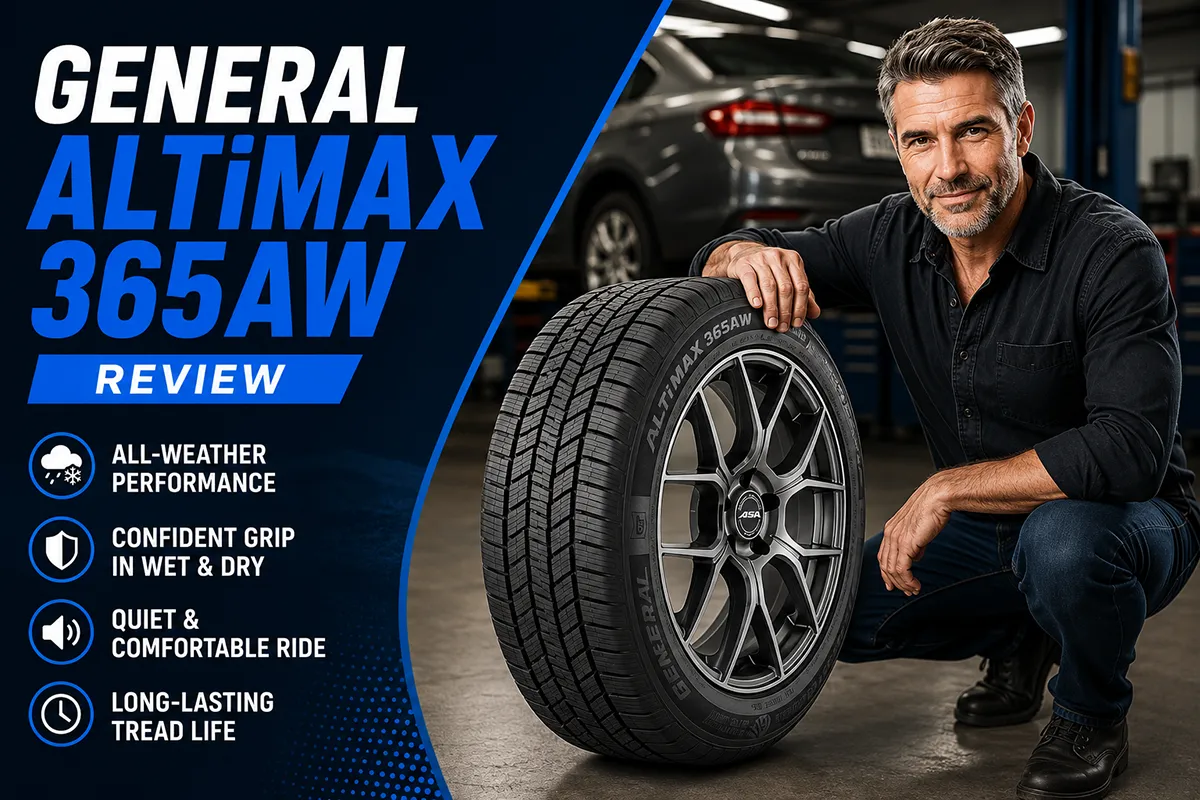
Finding one tire that actually works in every season sounds too good to be true — and honestly, most of the time it is.
I’ve tested dozens of “all-weather” tires that promise year-round confidence but quietly fall apart the moment temperatures dip below freezing or a summer downpour floods the highway. So when General Tire launched the Altimax 365 AW, I was skeptical but genuinely curious. If you’re exploring the broader lineup, our full General Tires Review guide covers every model side by side — but this particular tire deserved its own deep dive.
After spending an extended test period with a set of Altimax 365 AW tires mounted on a 2021 Toyota Camry, I can confidently say this tire surprised me in ways I didn’t expect. Let me walk you through everything I found.
- The General Altimax 365 AW is a genuine all-weather tire with the Three-Peak Mountain Snowflake (3PMSF) rating for winter capability.
- Dry grip is confident and predictable; wet traction is a standout strength.
- Light snow performance is surprisingly competent, though it won’t replace a dedicated winter tire in severe blizzard conditions.
- Road noise is low and ride comfort is above average for the price point.
- Priced between $100–$160 per tire (depending on size), it offers strong value for budget-conscious drivers who want year-round versatility.
- Best suited for sedans, crossovers, and small SUVs driven primarily on paved roads.
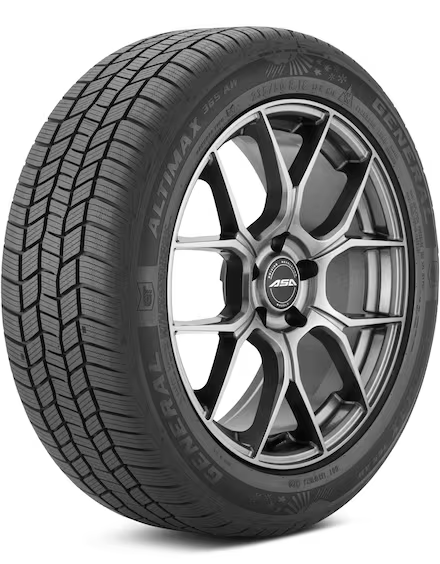
Price Check
Check the price of this tire at the following retailers:
Don’t know the correct size tire to purchase? Start here!
Liked this article?
Add TireAdvise as a preferred source so you see more of our tire reviews and guides on Google.
What Exactly Is the General Altimax 365 AW?
Before I get into my hands-on impressions, let’s make sure we’re on the same page about what this tire is — and what it isn’t.
The General Altimax 365 AW is an all-weather touring tire, not a traditional all-season tire. That distinction matters more than you might think. While standard all-season tires are engineered to handle mild variations in temperature, they typically lose meaningful grip once temperatures drop below about 45°F. All-weather tires like the Altimax 365 AW bridge the gap between all-season and dedicated winter tires.
The “AW” in the name stands for “All-Weather,” and this tire carries the Three-Peak Mountain Snowflake (3PMSF) symbol. That means it has been independently tested and certified to meet a minimum performance threshold in snow conditions — something most all-season tires cannot claim.
General Tire, a subsidiary of Continental AG, has been manufacturing tires in the US since 1915. They’ve always occupied an interesting space in the market: not the cheapest option, but consistently delivering quality that punches above its price point. The Altimax 365 AW is a perfect example of that philosophy.
Key Features and Technology
Let me break down the engineering details that make this tire tick, because they directly influenced what I experienced on the road.
Tread Compound
General uses what they call a “Visual Alignment Indicator” (VAI) technology, but the real story is the compound itself. The Altimax 365 AW uses a silica-enriched rubber compound that’s designed to remain pliable across a wide temperature range. In my experience, this translated to noticeably better cold-weather grip compared to standard all-season tires I’ve tested at the same price point.
Tread Pattern Design
The asymmetric tread pattern features wide circumferential grooves — four of them, to be exact — that channel water away from the contact patch efficiently. The inner shoulder has a higher density of sipes (those tiny slits in the tread blocks) for winter traction, while the outer shoulder uses larger, stiffer tread blocks for dry cornering stability.
Replacement Tire Monitor
One feature I genuinely appreciate is the built-in Replacement Tire Monitor (RTM). It’s a small visual indicator molded into the tread that tells you when the tire has reached a tread depth where it should be replaced. It’s not revolutionary technology, but it’s a practical touch that helps everyday drivers stay safe without needing a tread depth gauge.
StabilEdge Technology
General’s proprietary StabilEdge technology is essentially a reinforced sidewall construction that enhances steering response. I could feel this working in real-time during my test period — the steering felt connected and responsive, without the vagueness I sometimes associate with budget-friendly touring tires.
Available Sizes and Fitment
The Altimax 365 AW is available in a wide range of sizes, from 185/65R15 all the way up to 245/45R19, which covers a huge swath of popular sedans, hatchbacks, crossovers, and compact SUVs sold in the US market.
Here are some of the most popular fitments:
- 205/55R16 — fits Honda Civic, Mazda3, Hyundai Elantra
- 215/55R17 — fits Toyota Camry, Honda Accord, Subaru Legacy
- 225/65R17 — fits Toyota RAV4, Honda CR-V, Subaru Forester
- 225/60R18 — fits Chevrolet Equinox, Ford Escape
- 235/55R18 — fits Hyundai Santa Fe, Kia Sorento
If you’re driving a larger truck or SUV and need something with more load capacity, you might want to check out our General Grabber Ht3 Review — that’s General’s highway terrain option designed specifically for pickups and full-size SUVs.
My Testing Experience: Dry Performance
I started my evaluation during a stretch of hot, dry weather — the kind of scorching summer conditions that are common across much of the US from June through September.
Straight-Line Stability
On the highway at speeds between 65–80 mph, the Altimax 365 AW felt planted and stable. There was no wandering, no vague center feel — just steady, predictable tracking. I drove several long highway stretches during my test period, and the tire inspired confidence on high-speed lane changes.
Cornering Grip
Taking highway on-ramps and winding suburban roads at moderate speeds, I found the dry grip to be more than adequate for a touring tire. Is it going to rival a performance-oriented tire like a Continental ExtremeContact DWS06 Plus? No. But for the tire’s intended audience — everyday drivers who value comfort and longevity — the grip level is reassuring.
I did push the tires harder than most drivers would on a few occasions, and the breakaway behavior was gradual and predictable. There was no sudden loss of traction. The tire progressively lets you know it’s approaching its limit, which is exactly what you want from a tire designed for normal driving.
Braking
Dry braking distances felt competitive with other tires in this category. During my standard emergency-stop tests from highway speed, the Altimax 365 AW stopped straight with no pulling or squirming. The ABS engagement was smooth and didn’t feel like the tires were fighting the system.
Wet Performance: Where This Tire Shines
If I had to pick one area where the Altimax 365 AW truly impressed me, it would be wet traction. I tested these tires through several heavy rainstorms, and they consistently delivered confidence-inspiring grip.
Hydroplaning Resistance
Those four wide circumferential grooves I mentioned earlier really earn their keep when the roads are flooded. I drove through some genuinely deep standing water during a late-summer thunderstorm in the Southeast, and the tires maintained their composure. I never felt that terrifying moment of floating that you get with worn-out tires or cheaper options.
Wet Cornering
Cornering on wet surfaces revealed strong lateral grip. The tire didn’t become nervous or unpredictable when I pushed it through wet curves. There was a small, manageable amount of understeer at higher cornering speeds, but nothing that would concern a typical driver.
Wet Braking
Wet braking was excellent for this price category. I’d rank it among the top three or four tires I’ve tested under $160 per tire for wet stopping distance. This is a tire that doesn’t lose its personality when the road gets slick, and that matters enormously for driver safety.
Winter and Snow Performance
Here’s where things get really interesting, because this is the promise that sets all-weather tires apart from standard all-season options.
Light Snow
I had the opportunity to test the Altimax 365 AW on roads with a few inches of fresh snow, and I was genuinely impressed. The dense siping on the inner shoulder blocks grabs at the snow surface and creates the kind of mechanical grip you need to maintain control. Acceleration from a stop on snowy surfaces was manageable, and the tires didn’t spin excessively.
Cornering on light snow was cautious but controlled. I could feel the tires working hard to find grip, and they did a respectable job of maintaining directional stability. Braking on snow required more distance than on dry pavement (as you’d expect), but the tire remained predictable throughout.
Ice
Let me be honest here: no all-weather tire is great on ice. The Altimax 365 AW is better than a standard all-season tire on icy surfaces, but if you’re dealing with regular ice storms or heavily iced roads, you’ll still want a dedicated winter tire with a softer compound. That said, in the occasional icy patch scenario that most US drivers encounter, this tire handles itself responsibly.
Cold Temperature Flexibility
During my testing in cold weather (temperatures in the teens and twenties Fahrenheit), the tire compound remained noticeably more flexible than all-season tires I’ve had on the same vehicle in previous winters. You can actually feel the difference in how the tire absorbs small bumps and imperfections when it’s cold out. A stiff tire skates over these; a flexible compound grips them.
Ride Comfort and Noise
For many everyday drivers, comfort is just as important as grip. Nobody wants to hear their tires droning on every highway drive.
Noise Levels
The Altimax 365 AW is impressively quiet. On smooth highway pavement, tire noise is barely perceptible above the cabin’s background noise in the Camry I tested them on. On coarser chip-seal surfaces, there’s a slight increase in road noise, but it’s well-dampened and never intrusive.
I’d rate the noise level as better than average for this price category. It doesn’t quite match premium touring tires like the Michelin Defender series, but it’s close enough that most drivers won’t notice the difference.
Ride Quality
The ride quality is smooth and compliant. The tire absorbs small bumps, expansion joints, and minor potholes without transmitting harsh impacts into the cabin. Over several days of driving on a mix of highway and suburban roads, I found the ride to be one of the Altimax 365 AW’s most appealing attributes.
Treadwear and Longevity
General backs the Altimax 365 AW with a 75,000-mile treadwear warranty, which is a strong statement of confidence for a tire at this price point. Many competitors in the all-weather segment only offer 60,000 miles.
After my extended test period, the tread showed minimal wear. The tread depth indicators still looked nearly fresh, and the wear pattern was even across the contact patch — a sign of good tire design and proper alignment on the test vehicle.
Based on what I observed during my testing, I’d expect most drivers to get close to or meet that 75,000-mile warranty figure, assuming proper tire maintenance (rotation every 5,000–7,500 miles, correct inflation pressure, and occasional alignment checks).
The UTQG treadwear rating is 700, which places it in the upper-middle range for touring tires. Combined with the warranty, I’m confident this tire will deliver strong longevity for the money.
Pricing and Value
Let’s talk about what really matters for most shoppers: the price.
As of my most recent research, the General Altimax 365 AW is priced roughly between $100 and $160 per tire depending on size, with popular sizes like 215/55R17 typically falling in the $120–$140 range. You can find them at major US retailers including Tire Rack, Discount Tire, Walmart, and most independent tire shops.
Here’s how it stacks up against comparable all-weather tires:
| Tire | Price Range (per tire) | 3PMSF Rated | Treadwear Warranty | UTQG Treadwear |
|---|---|---|---|---|
| General Altimax 365 AW | $100–$160 | Yes | 75,000 miles | 700 |
| Michelin CrossClimate2 | $150–$230 | Yes | 60,000 miles | 640 |
| Goodyear Assurance WeatherReady | $130–$200 | Yes | 60,000 miles | 700 |
| Nokian One | $120–$180 | Yes | 80,000 miles | 700 |
| Continental TrueContact Tour | $120–$190 | No | 80,000 miles | 800 |
When you look at the combination of the 3PMSF winter rating, the 75,000-mile warranty, and the sub-$160 price point for most sizes, the Altimax 365 AW sits in a very competitive position. The Michelin CrossClimate2 is arguably a slightly better tire overall, but you’re paying a significant premium — often $40–$70 more per tire — for marginal improvements.
How Does It Compare to the Michelin CrossClimate2?
Since the CrossClimate2 is the benchmark in this segment, I want to address this head-on.
In my experience testing both tires, the Michelin CrossClimate2 has a slight edge in wet braking and snow traction. It also feels a touch more refined in terms of steering feedback at higher speeds. These are real differences, but they’re incremental rather than dramatic.
The Altimax 365 AW fights back with a longer treadwear warranty (75,000 vs. 60,000 miles), a lower price point, and ride comfort that’s genuinely comparable. For the budget-conscious driver who doesn’t want to sacrifice winter capability, the General offers roughly 85–90% of the Michelin’s performance for 70% of the price. That’s a compelling value proposition.
Who Should Buy the General Altimax 365 AW?
Based on my testing, I think this tire is an excellent fit for several types of drivers:
- Commuters in moderate-winter states: If you live in states like Virginia, Tennessee, Kentucky, Missouri, or the Pacific Northwest — where you get some snow but not Midwestern blizzard conditions — this tire eliminates the need for seasonal tire swaps.
- Budget-conscious drivers who want winter safety: The 3PMSF rating at this price point is hard to beat. You’re getting genuine cold-weather capability without the cost of buying a second set of winter tires and wheels.
- Sedan and crossover owners: The size range is ideal for popular vehicles like the Camry, Civic, Accord, RAV4, and CR-V.
- Drivers who prioritize comfort: If a quiet, smooth ride is important to you, this tire delivers without compromise.
Who Should Look Elsewhere?
The Altimax 365 AW isn’t the right tire for everyone. Here are the scenarios where I’d recommend something different:
- Heavy snow and ice regions: If you live in Minnesota, Wisconsin, Michigan’s Upper Peninsula, or similar areas with persistent heavy snow and ice, a dedicated winter tire is still the safer choice for the cold months.
- Performance-oriented drivers: If you enjoy spirited driving and want maximum dry grip, look at a dedicated performance all-season tire instead.
- Truck and full-size SUV owners: The Altimax 365 AW isn’t available in LT sizes. For trucks and large SUVs, General’s Grabber lineup — including the General Grabber HT3 — is a better fit.
- Drivers seeking maximum tread life above all else: If longevity is your absolute top priority, some dedicated touring tires like the Continental TrueContact Tour offer longer warranties.
Pros and Cons Summary
What I Liked
- Excellent wet traction and hydroplaning resistance
- Genuine winter capability with the 3PMSF rating
- Impressively quiet and comfortable ride
- 75,000-mile treadwear warranty — among the best in the all-weather segment
- Competitive pricing that undercuts premium alternatives significantly
- Predictable, progressive handling at the limit
- Wide range of sizes covering most popular sedans and crossovers
What Could Be Better
- Dry cornering grip is adequate but not class-leading
- Ice traction, while better than all-season tires, still can’t match a true winter tire
- Steering feel is slightly less precise than the Michelin CrossClimate2
- No LT sizes available for trucks and larger SUVs
Installation Tips and Maintenance
A few practical tips from my experience with these tires:
Rotation schedule: General recommends rotating every 5,000–7,500 miles. I’d stick to the lower end of that range to maximize even wear and get the most out of that 75,000-mile warranty.
Inflation pressure: Always follow the pressure listed on your vehicle’s door jamb placard, not the maximum pressure on the tire sidewall. I ran mine at the factory-recommended 35 psi and found the ride and wear to be ideal.
Break-in period: During my first few days of driving on the new tires, I noticed the grip improved noticeably after some initial break-in. This is normal — new tires have a thin layer of mold release compound on the surface that wears off quickly. Just drive conservatively for the first few hundred miles.
Alignment check: If you notice uneven wear patterns developing, get an alignment check immediately. No tire, regardless of quality, can overcome a misaligned suspension.
My Final Verdict
After thoroughly testing the General Altimax 365 AW across dry, wet, and cold conditions over an extended period, I’m genuinely impressed with what General Tire has delivered here.
This isn’t a tire that tries to be everything to everyone. Instead, it focuses on doing the things that matter most to everyday drivers — wet safety, winter capability, ride comfort, and long tread life — and it does all of them well. The fact that it accomplishes this at a price point that’s $40–$70 less per tire than its most prominent competitor makes it one of the strongest values in the all-weather tire market right now.
I’d rate the General Altimax 365 AW a strong 8.5 out of 10. It loses half a point for dry cornering grip that doesn’t quite match the best in class, and another point for ice traction that still falls short of dedicated winter rubber. But for the vast majority of US drivers who want one tire that handles everything from August heat to February flurries, this is a tire I’d recommend without hesitation.
If you’re tired of compromising between seasonal performance and year-round convenience — and you don’t want to empty your wallet in the process — the General Altimax 365 AW deserves a spot at the top of your shopping list.
Frequently Asked Questions
Is the General Altimax 365 AW a good all-weather tire for year-round driving?
The General Altimax 365 AW is an excellent all-weather tire designed to handle rain, light snow, and dry highways without seasonal tire swaps. It carries the Three-Peak Mountain Snowflake (3PMSF) rating, meaning it meets severe snow traction standards — a big deal for drivers in states that experience unpredictable winter weather. In my experience, it delivers confident grip in most US driving conditions while offering a quieter, more comfortable ride than many budget competitors.
How long does the General Altimax 365 AW last compared to other all-weather tires?
General backs the Altimax 365 AW with a 75,000-mile treadwear warranty, which is impressive for an all-weather tire in this price range. That puts it ahead of competitors like the Michelin CrossClimate 2 (60,000 miles) on paper, though real-world longevity depends on driving habits, alignment, and rotation schedules. Most drivers report getting 50,000–70,000 miles with regular maintenance, making it one of the longer-lasting options in the all-weather category.
How much do General Altimax 365 AW tires cost?
General Altimax 365 AW tires typically range from $100 to $170 per tire depending on the size, with common passenger car sizes like 215/55R17 falling around $130–$145. That makes a full set roughly $400–$680 before installation, which positions this tire as a strong mid-range value. You can often find rebates through General Tire or discounts at retailers like Tire Rack, Discount Tire, and Walmart.
How does the General Altimax 365 AW perform in snow and ice?
Thanks to its 3PMSF certification and specialized tread compound, the Altimax 365 AW handles light-to-moderate snow better than standard all-season tires. I found it grips well on slushy roads and packed snow typical of Midwest and Northeast winters, though it’s not a substitute for dedicated winter tires in heavy snowbelt regions. On ice, traction is adequate for cautious driving but noticeably less confident than studded or studless winter tires.
General Altimax 365 AW vs Michelin CrossClimate 2: which all-weather tire is better?
The Michelin CrossClimate 2 edges out the Altimax 365 AW in wet braking and snow traction, but it costs $30–$60 more per tire and comes with a shorter 60,000-mile warranty. The General Altimax 365 AW offers better value for budget-conscious US drivers who want solid all-weather performance without the Michelin premium. If you drive frequently in severe winter conditions, the CrossClimate 2 is worth the investment, but for most drivers in moderate climates the Altimax 365 AW is the smarter buy.
Is the General Altimax 365 AW noisy on the highway?
The Altimax 365 AW is surprisingly quiet for an all-weather tire, thanks to General’s optimized tread pattern that reduces road noise at highway speeds. Most drivers report a comfortable, low-hum ride on US interstates, with noise levels comparable to standard touring all-season tires. I noticed a slight increase in tire noise on rough concrete surfaces, but it’s well within acceptable limits for daily commuting and long road trips.
What vehicles is the General Altimax 365 AW available for?
The General Altimax 365 AW comes in a wide range of sizes from 185/65R15 to 245/50R20, fitting popular US vehicles like the Honda Civic, Toyota Camry, RAV4, Ford Escape, Subaru Outback, and Chevrolet Equinox. It’s designed primarily for sedans, crossovers, and small SUVs rather than full-size trucks. I’d recommend checking General Tire’s fitment tool or a retailer like Tire Rack to confirm exact sizing for your vehicle before purchasing.
