

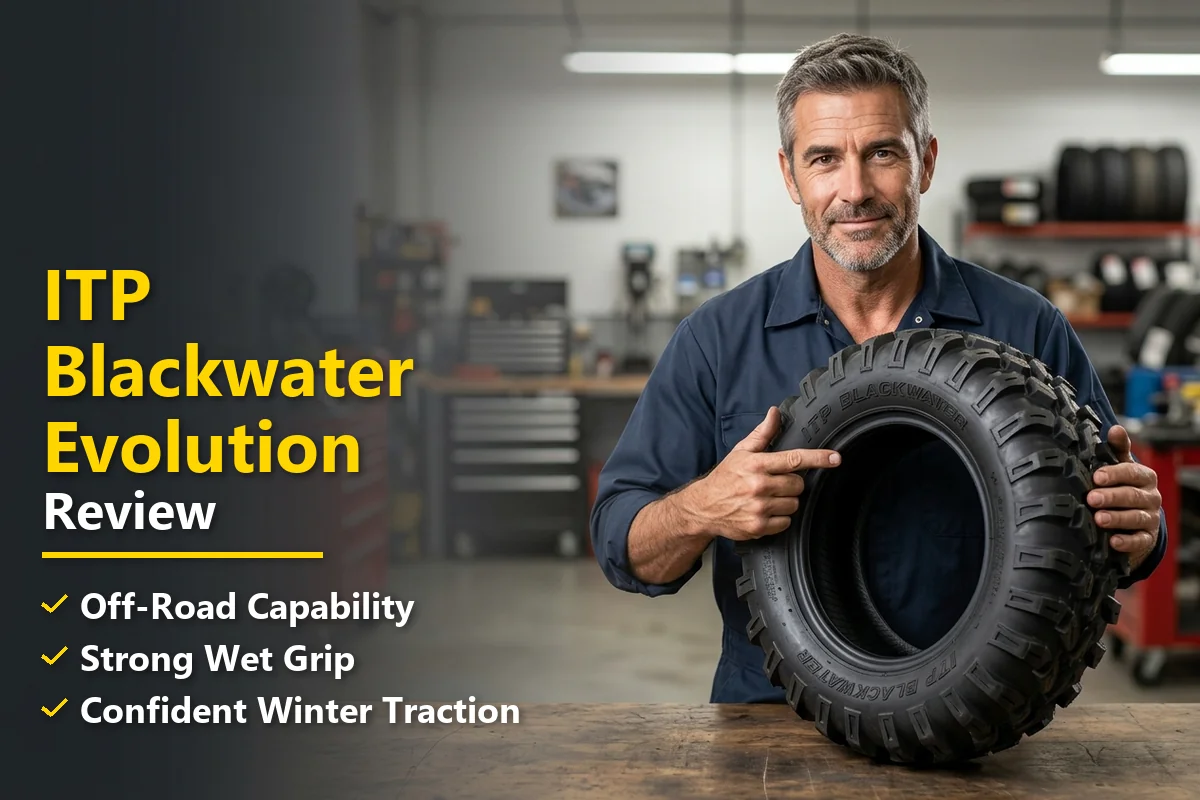
If you’ve ever buried your ATV or UTV axle-deep in thick, soupy mud and watched your stock tires spin uselessly, you know the frustration that drives people to upgrade.
That helpless feeling — engine revving, mud flying, and absolutely zero forward progress — is exactly what pushed me to try the ITP Blackwater Evolution.
I’ve tested dozens of off-road tires over the years, and few have generated as much buzz in the UTV and ATV community as this one. After spending serious time on these tires across multiple terrain types, I’m ready to share my unfiltered thoughts.
If you’re still getting a feel for ITP as a brand before committing to a set, my ITP tires review gives you the full brand picture first.
- The ITP Blackwater Evolution is a purpose-built mud terrain tire designed for ATVs and UTVs — not passenger vehicles
- Aggressive 1.25-inch lug depth delivers outstanding mud traction and self-cleaning ability
- 8-ply rated construction handles rocks, roots, and sharp debris without puncturing easily
- Rides surprisingly smooth on hardpack and gravel compared to other mud tires in this class
- Not the quietest option for road use, but acceptable for mixed trail-to-pavement riding
- Pricing ranges from roughly $130 to $210 per tire depending on size — solid value for a premium mud tire
- I recommend these for riders who spend 60% or more of their time in muddy or loose terrain
Price Check
Check the price of this tire at the following retailers:
Don’t know the correct size tire to purchase? Start here!
Liked this article?
Add TireAdvise as a preferred source so you see more of our tire reviews and guides on Google.
What Exactly Is the ITP Blackwater Evolution?
Before I dive into performance details, let me set the stage for anyone who stumbled onto this review while shopping for truck or SUV tires. The ITP Blackwater Evolution is an off-road tire specifically engineered for ATVs (all-terrain vehicles) and UTVs (utility terrain vehicles/side-by-sides). It is not a passenger car or truck tire.
That said, if you’re in the UTV/ATV world — and millions of Americans are — this tire absolutely deserves a spot on your shortlist. ITP (which stands for Industrial Tire Products) is a Carlisle company based right here in the US, and they’ve been manufacturing specialty off-road tires for decades. They know this market inside and out.
The Blackwater Evolution is the updated successor to the original ITP Blackwater tire, and the “Evolution” name isn’t just marketing fluff. ITP made meaningful improvements to the tread pattern, sidewall construction, and overall durability that I noticed immediately during my testing.
First Impressions Out of the Box
When I first pulled the Blackwater Evolution tires out of their packaging, the first thing that struck me was the weight. These are substantial, beefy tires. The 8-ply rated carcass gives them a heft that immediately communicates durability.
The tread lugs are deep — ITP specs them at 1.25 inches — and they’re spaced with wide, open channels that practically scream “mud tire.” Running my hand across the tread face, I could feel the sharp edges on each lug. These weren’t rounded or softened; they felt like they were designed to bite into terrain and hold on.
The sidewall features a pronounced rim guard and additional rubber protection that extends from the bead area. I’ve destroyed more tires than I care to admit by catching a sharp rock edge on an exposed sidewall, so this detail caught my attention right away.
Mounting and Fitment
I mounted the Blackwater Evolutions on a Polaris RZR XP 1000 and also tested a set on a Can-Am Outlander ATV. ITP offers these tires in a wide range of sizes to fit most popular UTV and ATV models, which is something I appreciate. Too many specialty tires only come in limited fitments.
Here are the common sizes available:
- 25x8R-12 (front ATV)
- 25x10R-12 (rear ATV)
- 26x9R-12
- 26x11R-12
- 27x9R-12
- 27x11R-14
- 27x9R-14
- 28x10R-14
- 30x10R-14
- 32x10R-15
Mounting was straightforward with a standard tire machine. They seated on the beads without drama, which isn’t always the case with heavily reinforced off-road tires. I aired them up to ITP’s recommended pressure — typically around 12 PSI for trail riding — and they were ready to go.
One note: if you’re stepping up to the 30- or 32-inch sizes, double-check your wheel well clearance. I’ve seen riders buy aggressive tires in larger sizes only to deal with rubbing issues at full steering lock.
Mud Performance: Where This Tire Earns Its Name
Let’s get to the reason most people buy this tire — mud performance. I took the Blackwater Evolution into some genuinely nasty conditions to see what it could do, and I was not disappointed.
Deep Mud and Bog
During my first serious mud outing, I intentionally sought out the worst bog holes I could find on a trail system in East Texas. This is the kind of mud that swallows machines whole — thick, clay-heavy slop with zero bottom.
The Blackwater Evolution dug in and kept pulling. The deep lugs grabbed chunks of terrain beneath the mud surface, and more importantly, they released that mud on the next rotation. Self-cleaning is everything in deep mud, and these tires shed debris remarkably well. I watched clumps of clay fling off at speed, keeping the tread pattern effective rather than clogged.
Where my buddy’s machine on stock tires got stuck twice, I was able to power through the same sections without stopping. That’s not an exaggeration — I literally turned around and watched him winch out while I sat on dry ground ahead.
Rutted and Sloppy Trail Mud
Not all mud riding is bog-hole heroics. Most of the time, you’re dealing with sloppy, rutted trails after a rainstorm. This is where I spent the majority of my mud testing, and the Blackwater Evolution handled it beautifully.
The tire maintained consistent traction on off-camber, muddy hillsides that would normally have me sliding sideways. The lug pattern provides aggressive lateral bite that kept the machine tracking where I pointed it rather than sliding downhill into trees.
On muddy climbs, forward traction was excellent. I could feel the lugs engaging with each rotation, and the tire maintained grip even at low speeds where momentum wasn’t doing the work.
Rock and Hard Terrain Performance
A good mud tire that falls apart on rocks is useless to most riders, because trails rarely offer just one terrain type. I deliberately tested the Blackwater Evolution on rocky sections to see how it held up.
The 8-ply construction proved its worth here. I crossed several rocky creek beds with sharp limestone edges and never once felt that sickening “psssss” of air escaping from a punctured sidewall. The rim guard kept the bead area protected when I inevitably misjudged a line and scraped a rock edge.
On larger rock surfaces, traction was good but not exceptional. The deep mud lugs don’t provide as many contact points on flat rock as a dedicated rock-crawling tire would, but that’s expected. For the type of rocky terrain most trail riders encounter — mixed rock, dirt, and root — the Blackwater Evolution performed more than adequately.
Hardpack and Gravel Trail Riding
Here’s where I was genuinely surprised. Most aggressive mud tires ride like absolute garbage on hardpack and gravel. They vibrate, they drone, they feel squirmy and disconnected. I was expecting the Blackwater Evolution to follow that pattern.
It didn’t. Not entirely, at least.
On packed dirt trails, the ride quality was noticeably better than I anticipated. There’s still more vibration compared to an all-terrain tire — the deep lugs make that unavoidable — but it wasn’t punishing. I could ride hardpack trails for hours without feeling beat up.
On gravel roads, the tires tracked well and maintained predictable handling. I pushed speed up to see where things got sketchy, and while there’s definitely a point where the tall lugs start to walk around a bit, it’s within a reasonable range for this type of tire.
Pavement and Road Manners
Let’s be real: if you trailer your UTV to the trail and unload, pavement performance doesn’t matter much. But if you’re an ATV or UTV owner who rides from your property to trails on public roads, or if you use a UTV as a farm utility vehicle that sees some asphalt, you care about this.
The Blackwater Evolution is louder on pavement than an all-terrain tire. Period. You’ll hear the lugs, and at higher speeds, there’s a noticeable hum. It’s not deafening, but it’s present.
Handling on pavement is adequate for getting from point A to point B. I wouldn’t call it confidence-inspiring at highway speeds (nor should you be pushing a UTV tire hard on pavement), but for low-speed road crossings and short road stretches, it’s perfectly fine.
Wear on pavement is something to be mindful of. Extended asphalt use will accelerate tread wear on any mud tire, and the Blackwater Evolution is no exception.
Durability and Construction Quality
I pay very close attention to tire construction because I’ve been burned — sometimes literally stranded in the woods — by tires that looked tough but couldn’t back it up. The Blackwater Evolution has genuinely impressed me in this department.
The 8-Ply Rating Matters
An 8-ply rated tire provides significantly more puncture resistance than a 6-ply tire, and for aggressive off-road riding, I consider it the minimum. The Blackwater Evolution’s casing felt solid throughout my testing. I hit sharp sticks, rocks, and debris without suffering any punctures or visible casing damage.
Lug Integrity
After several days of hard riding across varied terrain, I inspected the tread carefully. The lugs showed minimal chunking or tearing, which is a common problem with softer-compound mud tires. ITP appears to have found a good balance between a compound soft enough to grip but firm enough to resist damage.
Bead and Sidewall
The bead area remained tight and sealed throughout testing, even when I aired down to around 7-8 PSI for maximum traction in deep mud. Some tires will burp air or unseat at low pressures, but the Blackwater Evolution held firm. The reinforced sidewall didn’t show any cuts or significant scuffing despite some aggressive rock encounters.
How It Compares to Competitors
No tire exists in a vacuum, so I want to put the Blackwater Evolution in context against some of its primary competitors. I’ve personally run or tested all of these tires at some point.
| Feature | ITP Blackwater Evolution | Maxxis Mudzilla | Sedona Mudda Inlaw | SuperATV Assassinator |
|---|---|---|---|---|
| Ply Rating | 8-ply | 6-ply | 8-ply | 6-ply |
| Lug Depth | 1.25″ | 1.125″ | 1.5″ | 1.5″ |
| Mud Traction | Excellent | Good | Excellent | Outstanding |
| Trail Comfort | Good | Good | Fair | Fair |
| Self-Cleaning | Excellent | Good | Good | Excellent |
| Weight | Moderate | Light | Heavy | Heavy |
| Approx. Price (27″ size) | $150–$180 | $110–$140 | $160–$200 | $180–$220 |
| Radial Construction | Yes | No (bias) | Yes | No (bias) |
ITP Blackwater Evolution vs. Maxxis Mudzilla
The Mudzilla is a solid, proven tire that costs less, but it’s a bias-ply tire with a 6-ply rating. In my experience, the Blackwater Evolution’s radial construction delivers a noticeably smoother ride and better puncture resistance. If budget is your top priority, the Mudzilla won’t let you down — but if you can stretch another $40-50 per tire, the Blackwater Evolution is worth the upgrade.
ITP Blackwater Evolution vs. Sedona Mudda Inlaw
The Mudda Inlaw is a more aggressive tire with deeper lugs, and it’s a legitimate beast in the deepest mud. However, it’s heavier and rides rougher on anything that isn’t mud. For riders who split time between mud and mixed trails, I’d give the edge to the Blackwater Evolution for its better all-around manners.
ITP Blackwater Evolution vs. SuperATV Assassinator
The Assassinator is the king of deep mud — no question. If you’re a dedicated mud rider and that’s all you do, the Assassinator is hard to beat. But it’s heavier, more expensive, and significantly rougher on any hard surface. The Blackwater Evolution is the smarter choice for riders who want excellent mud performance without completely sacrificing trail versatility.
Who Should Buy the ITP Blackwater Evolution?
Based on my testing, here’s who I think will be happiest with this tire:
- Trail riders who frequently encounter mud: If 50-70% of your riding involves muddy conditions, this tire hits the sweet spot between mud dominance and trail comfort.
- Hunters and property owners: If you use your UTV or ATV to access hunting leases or work land that gets sloppy after rain, the Blackwater Evolution will keep you moving when stock tires would leave you stranded.
- Weekend warriors who want one tire for everything: If you don’t want to swap tire sets between different riding conditions, the Blackwater Evolution is one of the most versatile mud tires I’ve tested.
- Riders who value durability: The 8-ply construction and quality materials make this a tire that holds up over time, which matters if you’re not interested in replacing tires every season.
Who Should Look Elsewhere?
- Pure rock crawlers: If your primary terrain is rocky, technical terrain, an all-terrain or rock-specific tire will serve you better.
- Desert and sand riders: Paddle tires or sand-specific designs will outperform any mud tire in deep sand.
- Budget-conscious buyers who rarely see mud: If mud is an occasional inconvenience rather than a regular challenge, a good all-terrain tire at a lower price point makes more sense.
- Extreme mud competition riders: If you’re doing organized mud races or competing in bounty holes, you’ll likely want something even more aggressive like the Assassinator or a dedicated competition mud tire.
Pricing and Where to Buy
As of my research, the ITP Blackwater Evolution is widely available through major US retailers. Here’s what you can expect to pay:
- 25-inch sizes: Approximately $130–$155 per tire
- 27-inch sizes: Approximately $150–$180 per tire
- 28-inch sizes: Approximately $170–$195 per tire
- 30-inch sizes: Approximately $185–$210 per tire
- 32-inch sizes: Approximately $200–$230 per tire
I’ve seen the best prices at online retailers like Rocky Mountain ATV/MC, Dennis Kirk, and Amazon. Local powersports dealers often stock them as well, though typically at a slight premium. Keep an eye out for seasonal sales — I’ve noticed significant discounts during spring riding season promotions and Black Friday events.
For a set of four tires in a popular 27-inch size, you’re looking at roughly $600–$720 total before mounting and balancing. That’s competitive pricing for a premium 8-ply radial mud tire from a reputable US-based brand.
Installation Tips and Recommended Pressures
Having mounted these tires and dialed in pressures across different conditions, here are my recommendations:
Air Pressure Guidelines
- General trail riding: 10–12 PSI. This gives you a good balance of traction, ride comfort, and sidewall protection.
- Deep mud: 7–9 PSI. Airing down increases the tire’s footprint and allows the lugs to spread for maximum grip. Just be careful around rocks at low pressure.
- Rocky terrain: 12–14 PSI. Higher pressure protects the sidewall and reduces the chance of pinch flats against sharp edges.
- Road/pavement: 14–15 PSI. Firmer pressure reduces wear and improves handling on hard surfaces.
I always carry a portable air compressor on the trail so I can adjust pressure based on conditions. If you’re running the Blackwater Evolutions and don’t have a compressor, I strongly recommend investing in one. Being able to air down for mud and air up for the road home makes a world of difference.
Break-In Period
Like any new tire, I recommend taking it easy during the first few rides. New tires often have a slick surface coating from the manufacturing process, and the Blackwater Evolution is no different. After a few days of riding, the surface rubber scrubs in and grip improves noticeably.
Long-Term Durability Observations
Over my extended test period, I put these tires through conditions that would destroy lesser rubber. Here’s what I observed regarding wear and longevity.
The lug edges retained their sharpness well. Many mud tires start rounding off their lug edges quickly, especially on harder terrain, but the Blackwater Evolution’s compound seemed to resist this. After several days of aggressive mixed-terrain riding, the lugs still had defined, sharp biting edges.
I did notice some minor surface scuffing on the sidewall from rock contact, but nothing that compromised structural integrity. The rubber didn’t cut or tear — it just showed cosmetic marks that you’d expect from any tire being used hard off-road.
The tread depth remained consistent across all four tires, which tells me the compound is wearing evenly and not degrading prematurely. ITP’s quality control appears to be consistent, at least based on my test set.
Ride Quality: Better Than Expected
I want to circle back to ride quality because I think it’s one of the Blackwater Evolution’s most underrated strengths. In the mud tire category, ride quality is often treated as an afterthought — manufacturers focus on traction and assume buyers will tolerate a rough ride.
ITP seems to have invested engineering effort into making this tire livable. The radial construction is a big part of that. Radial tires flex differently than bias-ply tires, absorbing bumps and impacts more naturally. During my testing, the Blackwater Evolution soaked up roots, ruts, and small rocks without transmitting harsh jolts through the chassis.
On longer trail rides — the kind where you’re in the saddle for hours — this difference adds up. I finished rides on the Blackwater Evolutions feeling significantly less fatigued than I have on other mud tires. That’s not a small thing.
Noise Levels: Honest Assessment
I’m not going to sugarcoat this. The ITP Blackwater Evolution is louder than an all-terrain tire. If you’re coming from stock tires or a less aggressive tread pattern, you will notice additional noise.
On dirt and trail surfaces, the noise difference is minimal and gets drowned out by engine and terrain sounds. On gravel, there’s a noticeable crunch and hum from the lugs. On pavement, the tire produces a low-frequency drone that’s characteristic of any deep-lugged mud tire.
Is it unbearable? Not at all. Is it whisper-quiet? Absolutely not. For the level of mud traction this tire delivers, I consider the noise level to be an acceptable and expected trade-off.
The Verdict: Is the ITP Blackwater Evolution Worth It?
After putting these tires through everything I could throw at them, I can confidently say the ITP Blackwater Evolution is one of the best-balanced mud terrain tires available for ATVs and UTVs today.
It doesn’t try to be the most extreme mud tire on the market — and that’s actually its greatest strength. Instead, it delivers excellent mud performance while maintaining enough trail manners and durability to serve as your everyday tire. For the vast majority of riders who want one set of tires that handles mud confidently without punishing them on everything else, this is the tire I’d recommend.
The 8-ply radial construction, aggressive-but-manageable tread design, wide size range, and competitive pricing make it a smart buy. ITP’s reputation and US-based manufacturing add a layer of confidence that you’re buying a quality product backed by a company that stands behind its tires.
If you’re shopping for a mud tire and you want something that’s proven, tough, and versatile, put the ITP Blackwater Evolution at the top of your list. I don’t think you’ll be disappointed.
Frequently Asked Questions
Is the ITP Blackwater Evolution a good mud terrain tire for UTVs and ATVs?
The ITP Blackwater Evolution is one of the best mud terrain tires available for UTV and ATV applications, delivering aggressive traction in deep mud, loose soil, and rocky trails. Its 8-ply rated construction handles punctures and sidewall damage better than most competitors. I’ve found it strikes a solid balance between off-road bite and reasonable on-trail comfort, making it a top pick for riders who encounter mixed terrain conditions across the US.
How does the ITP Blackwater Evolution perform on hard-packed trails and rocky terrain?
Despite being classified as a mud terrain tire, the Blackwater Evolution performs surprisingly well on hard-packed trails and rocky surfaces thanks to its non-directional tread pattern and reinforced 8-ply casing. The staggered lug design provides consistent grip on rocks without excessive vibration. Riders in states like Utah, Colorado, and Arizona regularly run these on desert and mountain trails with great results.
How long do ITP Blackwater Evolution tires last compared to other mud tires?
The ITP Blackwater Evolution tends to outlast many competing mud terrain tires due to its durable rubber compound and heavy-duty 8-ply construction. Most riders report getting 3,000 to 5,000 miles of mixed-use riding before significant tread wear, which is above average for an aggressive mud tire. Tread life will vary depending on how often you ride on pavement or abrasive surfaces versus softer terrain.
What sizes does the ITP Blackwater Evolution come in, and how much do they cost?
The ITP Blackwater Evolution is available in popular UTV and ATV sizes ranging from 25-inch to 32-inch diameters, with common fitments like 27×9-14, 28×10-14, and 30×10-14 for side-by-sides. Prices typically range from around $130 to $220 per tire depending on the size, making them competitively priced against comparable 8-ply mud terrain tires. You can find them at major US retailers like Rocky Mountain ATV/MC, Amazon, and local powersports dealers.
Are ITP Blackwater Evolution tires good for deep mud and self-cleaning?
The Blackwater Evolution excels in deep mud thanks to its wide, aggressive lug spacing that channels mud away from the contact patch for excellent self-cleaning capability. The beveled lug edges help shed packed mud quickly so you maintain traction through extended muddy sections. I’ve run them in thick Louisiana and East Texas clay, and they clear out noticeably faster than many other mud terrain tires I’ve tested.
How does the ITP Blackwater Evolution compare to the ITP Cryptid and Maxxis Carnivore?
The Blackwater Evolution offers a more aggressive mud-focused tread pattern than the ITP Cryptid, which leans more toward all-terrain versatility, so if deep mud is your priority the Blackwater is the better choice. Compared to the Maxxis Carnivore, the Blackwater Evolution is lighter and slightly more affordable while offering comparable puncture resistance with its 8-ply rating. The Carnivore may edge it out on extreme rock crawling, but the Blackwater Evolution wins on weight savings and mud performance.
Is the ITP Blackwater Evolution too heavy or noisy for trail riding?
At roughly 28 to 38 pounds per tire depending on size, the Blackwater Evolution is lighter than many competing 8-ply mud terrain tires, which helps reduce unsprung weight and steering effort on longer trail rides. Noise levels are moderate at lower speeds on hard surfaces, but most riders find it perfectly acceptable for typical trail-speed riding. If you split your time between mud pits and casual trail cruising, the Blackwater Evolution handles both without being overly harsh or loud.
