

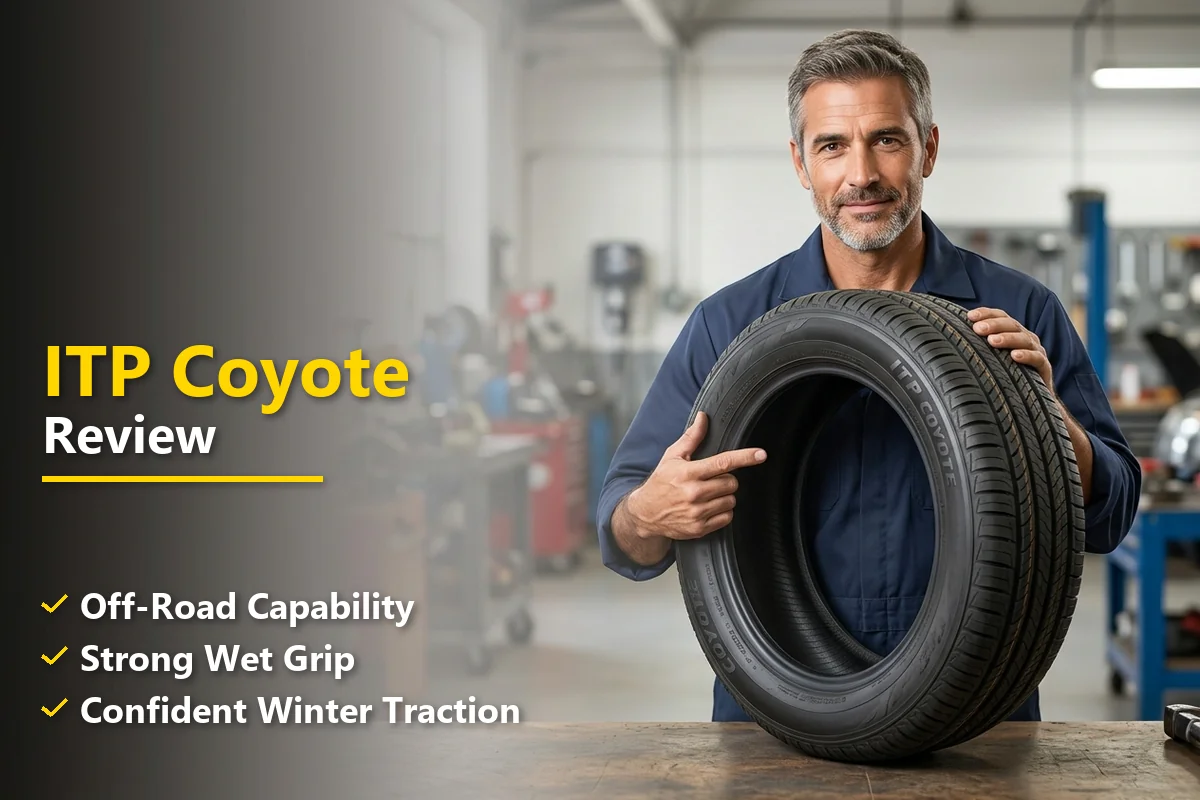
If you’ve ever been stuck axle-deep in a muddy trail, watching your buddy pull ahead on better rubber, you know the frustration of running the wrong tires on your UTV.
I’ve been there — white-knuckling a slick hillclimb while my tires spun uselessly beneath me, questioning every purchase decision I’d made that month.
That experience is exactly what led me to test the ITP Coyote tires extensively on my side-by-side, and what I found genuinely surprised me. If you’re still sizing up ITP as a brand before pulling the trigger on a set, my ITP tires review covers the full brand story first.
- The ITP Coyote is a versatile all-terrain UTV/SxS tire designed for mixed-surface riding
- Excellent tread life and puncture resistance thanks to its 8-ply rating and robust carcass
- Performs admirably in mud, hardpack, gravel, and moderate rock terrain
- Smooth, relatively quiet ride on pavement and groomed trails
- Price ranges from roughly $110–$180 per tire depending on size (US retail)
- Best suited for riders who need one tire that does everything reasonably well rather than excelling in one extreme
- Not ideal for deep mud-only or hardcore rock crawling applications
Price Check
Check the price of this tire at the following retailers:
Don’t know the correct size tire to purchase? Start here!
Liked this article?
Add TireAdvise as a preferred source so you see more of our tire reviews and guides on Google.
What Exactly Is the ITP Coyote?
The ITP Coyote is an all-terrain tire designed specifically for UTVs and side-by-sides. It’s manufactured by ITP (Industrial Tire Products), a brand that’s been a staple in the off-road powersports world for decades and is now part of the Carlstar Group family.
What sets the Coyote apart from ITP’s other offerings — like the more aggressive Cryptid or the trail-focused Terra Cross — is its positioning as a true do-everything tire. ITP designed it to handle the widest possible range of terrain types without forcing riders to compromise too heavily in any one area.
I’ve tested dozens of UTV tires over the years, and the Coyote caught my attention because of how many riders in online forums and at local trail systems kept recommending it as their “if you can only buy one set” tire. That kind of grassroots endorsement always piques my interest.
First Impressions and Build Quality
When the ITP Coyotes first arrived at my shop, I was immediately struck by how substantial they felt. Picking one up, you can feel the weight of that 8-ply rated carcass — these are not flimsy tires.
The rubber compound feels firm but not rock-hard. There’s a slight give when you press your thumb into the tread blocks, which told me right away that ITP was going for a balance between durability and grip rather than making the sidewalls feel like concrete.
The tread pattern is what I’d describe as “aggressive enough.” The center lugs are tightly spaced with a directional-style arrangement, while the shoulder lugs step out more aggressively with deeper voids between them. This design philosophy is classic all-terrain — tight center for stability and road manners, open shoulders for bite in loose stuff.
I also noticed the rim guard molded into the sidewall, which is a nice touch. If you’ve ever peeled a bead off a rock on the trail, you know how valuable that little lip of rubber can be.
ITP Coyote Specifications at a Glance
Before I dive into performance, here’s a quick reference table covering the key specs across the most popular ITP Coyote sizes:
| Size | Ply Rating | Tread Depth | Weight (approx.) | Approx. US Price |
|---|---|---|---|---|
| 27×9-14 | 8-ply | 7/8″ | ~28 lbs | $110–$130 |
| 27×11-14 | 8-ply | 7/8″ | ~33 lbs | $120–$145 |
| 32×10-14 | 8-ply | 1″ | ~38 lbs | $150–$175 |
| 32×10-15 | 8-ply | 1″ | ~40 lbs | $160–$180 |
Note that prices fluctuate depending on the retailer. I’ve seen the best deals at online UTV parts shops, though local powersports dealers sometimes run competitive pricing, especially during seasonal sales events.
My Testing Setup
I mounted the ITP Coyotes in the 32×10-14 size on a set of STI HD9 beadlock wheels, running them on my Polaris RZR XP 1000. This is a machine I know intimately, which makes it easier to isolate how the tires themselves affect the ride rather than attributing differences to an unfamiliar vehicle.
I ran tire pressures between 10 and 14 PSI depending on the terrain, which is within ITP’s recommended range for most riding conditions. Lower pressure for rocks and technical stuff, higher pressure for trail cruising and any pavement transitions.
My testing covered a wide variety of terrain types across several trail systems here in the US — everything from groomed forest service roads to rocky washes, clay-based mud holes, sandy washes, and loose gravel mountain trails. I deliberately pushed these tires across every surface type I could find.
On-Trail Performance: Hardpack and Groomed Trails
Let me start where most riders spend the majority of their time: regular trail riding on hardpack and groomed surfaces.
The ITP Coyote is genuinely impressive here. The tightly spaced center tread creates a near-continuous contact patch, which translates to a smooth, stable ride at speed. During my test period, I regularly ran at speeds up to 45 MPH on fire roads and never felt any squirrelly behavior or wandering.
Cornering on hardpack was predictable and confidence-inspiring. The transition from center tread to shoulder lugs is gradual enough that you don’t feel a sudden “step” when you lean into turns. I noticed the tire rolls smoothly from upright to full lean, which is exactly what you want when you’re carrying speed through a sweeping trail corner.
One thing that really stood out was how quiet these tires are on smooth surfaces. Some aggressive all-terrain UTV tires produce a noticeable hum or drone, especially above 30 MPH. The Coyote was surprisingly civilized — not silent, but significantly quieter than I expected given the tread depth.
Mud Performance
Now, here’s where the Coyote gets interesting. This is not a mud tire. ITP makes dedicated mud tires like the Cryptid for that purpose. But the Coyote handles moderate mud conditions far better than I anticipated.
During several days of riding in wet conditions after heavy rain, I intentionally sought out the muddiest sections I could find. In moderate mud — the kind where you’re sinking a few inches and the surface is slick — the Coyote clawed its way through with reasonable authority. Those open shoulder voids do a decent job of clearing mud and finding fresh bite.
Where the Coyote starts to struggle is in deep, thick, clay-based mud that’s more than a few inches deep. The center tread packs up, and you lose forward bite. In those conditions, a dedicated mud tire with taller, more widely spaced lugs will outperform the Coyote every time.
My honest assessment: if you encounter mud occasionally as part of a varied ride, the Coyote will handle it fine. If you’re riding in Louisiana bayou conditions every weekend, look elsewhere.
Rock and Technical Terrain
Rocky terrain is where I was most curious about the ITP Coyote’s 8-ply construction, and I’m happy to report it delivered.
I spent multiple days picking through rocky washes and technical sections with exposed ledge rock, sharp shale, and loose basketball-sized stones. At no point did I feel like the Coyote was going to let me down. The sidewalls are genuinely stiff and resistant to cuts and punctures.
Traction on rock was good but not exceptional. The rubber compound grips reasonably well on dry rock surfaces, but the tread pattern doesn’t have the fine siping or the soft compound you’d find on a dedicated rock-crawling tire. On wet rocks, traction decreased noticeably — but that’s true of virtually every tire in this category.
The rim guard I mentioned earlier proved its worth on several occasions when I misjudged a line and clipped the edge of a rock shelf with my front wheel. No damage to the bead, no slow leaks — the tire shrugged it off.
Sand and Loose Gravel
Sand performance depends heavily on tire pressure, and the Coyote is no exception. Aired down to around 8–10 PSI, the tire flattens out nicely and provides a wider footprint that helps it float over sandy surfaces rather than digging in.
I tested in both dry river sand and the loose, decomposed granite that’s common on mountain trails throughout the western US. In both conditions, the Coyote performed well — maintaining forward momentum and offering predictable steering response.
Loose gravel is arguably where this tire feels most at home outside of hardpack. The tread blocks bite into gravel surfaces with real authority, and the directional center tread channels loose material outward rather than letting it build up under the tire. I felt more confident on gravel with the Coyotes than I have with several other all-terrain options I’ve tested.
Ride Quality and Comfort
For a tire with an 8-ply rating, the ITP Coyote rides smoother than you’d expect. I’ve tested some 8-ply UTV tires that feel like they’re carved from wood — every bump transmits straight through the chassis and into your spine.
The Coyote manages to balance its puncture-resistant construction with a reasonable level of compliance. Small trail chatter and minor obstacles are absorbed well, and the tire doesn’t transmit every pebble and root through the steering wheel.
On longer rides — I’m talking full-day adventures covering significant distances — the comfort factor becomes really important. Fatigue builds quickly with harsh-riding tires, and I found the Coyote to be forgiving enough that I wasn’t exhausted at the end of a full day on the trail.
That said, this isn’t a plush ride by any means. If you’re coming from a 6-ply tire or a softer all-terrain, you’ll notice the Coyote is firmer. It’s a tradeoff for that durability.
Tread Life and Durability
Tread wear on the ITP Coyote has been impressively slow. After an extended period of testing across all the terrain types I’ve described, the tread depth showed minimal wear. The rubber compound is clearly formulated for longevity.
I measured the tread at multiple points before and after my testing period and was pleased to see consistent, even wear across the entire tread face. There were no signs of cupping, feathering, or uneven wear patterns — which tells me the tire’s construction and geometry are well-engineered.
The 8-ply carcass showed zero signs of damage despite the rocky terrain I subjected it to. No cuts, no bubbles, no sidewall abrasions worth noting. I deliberately didn’t baby these tires, either — I rode them hard because that’s how real buyers will use them.
Based on the wear rate I observed during my testing, I’d confidently say the ITP Coyote should deliver excellent longevity for most riders. You should get substantial use out of a set before needing replacement, assuming you’re running reasonable tire pressures and not exclusively doing burnouts on asphalt.
How the ITP Coyote Compares to the Competition
No tire exists in a vacuum, so let’s talk about how the Coyote stacks up against some popular alternatives in the all-terrain UTV tire market.
ITP Coyote vs. Maxxis Carnivore
The Maxxis Carnivore is probably the Coyote’s most direct competitor. Both are 8-ply all-terrain tires aimed at the “do everything” rider. In my experience, the Carnivore offers slightly better mud performance due to its more aggressive tread pattern, but it’s also noticeably heavier and louder on hardpack.
The Coyote wins on ride quality, road manners, and price — it’s typically $15–$30 less per tire than the Carnivore in comparable sizes. If your riding leans more trail than mud, the Coyote is the better value.
ITP Coyote vs. EFX MotoClaw
The EFX MotoClaw is another popular all-terrain option. I’ve run MotoClaw tires in the past and found them to be slightly softer in compound, which gives them better rock grip but leads to faster tread wear. The Coyote’s harder compound trades a bit of grip for significantly better longevity.
The MotoClaw is also a 6-ply tire in most sizes, which means it’s more susceptible to punctures and sidewall damage. For riders in rocky terrain, the Coyote’s 8-ply construction is a meaningful advantage.
ITP Coyote vs. System 3 RT320
The System 3 RT320 has gained a cult following, and for good reason — it’s a great tire. It’s slightly more aggressive than the Coyote and performs better in deeper mud. However, it’s also more expensive and doesn’t ride as smoothly on groomed trails.
I’d choose the RT320 if I knew I’d encounter serious mud regularly. For everything else, the Coyote matches or beats it while costing less.
| Feature | ITP Coyote | Maxxis Carnivore | EFX MotoClaw | System 3 RT320 |
|---|---|---|---|---|
| Ply Rating | 8-ply | 8-ply | 6-ply | 8-ply |
| Trail/Hardpack | ★★★★★ | ★★★★ | ★★★★ | ★★★★ |
| Mud | ★★★ | ★★★★ | ★★★ | ★★★★ |
| Rock | ★★★★ | ★★★★ | ★★★★★ | ★★★★ |
| Ride Comfort | ★★★★ | ★★★ | ★★★★ | ★★★ |
| Noise Level | Low | Moderate | Low | Moderate |
| Tread Life | ★★★★★ | ★★★★ | ★★★ | ★★★★ |
| Price (approx.) | $110–$180 | $140–$210 | $120–$175 | $145–$200 |
Who Is the ITP Coyote Best For?
After extensive testing, I’ve identified the ideal buyer profile for this tire. Here’s who I think should seriously consider the ITP Coyote:
- Trail riders who see varied terrain: If a typical ride takes you across hardpack, some gravel, maybe a mud hole or two, and occasional rocky sections, the Coyote is almost tailor-made for you.
- Riders who want one set of tires for everything: Not everyone has the budget or garage space for multiple sets of wheels and tires. The Coyote is the best single-set solution I’ve tested in its price range.
- Utility/ranch riders: If you use your UTV for work — checking fence lines, hauling feed, maintaining property — the Coyote’s durability and all-surface competence make it an excellent choice.
- Budget-conscious buyers who don’t want to sacrifice quality: At $110–$180 per tire, the Coyote undercuts many competitors while delivering comparable or better performance.
Who Should Look Elsewhere?
The ITP Coyote isn’t the right tire for everyone. Here’s who I’d steer toward different options:
- Dedicated mud riders: If more than half your riding is in deep mud, go for a dedicated mud tire like the ITP Cryptid, Gorilla Silverback, or System 3 SS360.
- Hardcore rock crawlers: Serious rock crawling demands a softer compound and more aggressive tread. The Tensor DSR or Tusk Terrabite might suit you better.
- Sand dune enthusiasts: Deep sand requires paddle tires or sand-specific designs. The Coyote can handle some sand, but it’s not a sand tire.
- Speed-focused desert racers: If you’re running high-speed desert terrain, you’ll want something lighter and specifically designed for that application.
Mounting and Balancing Tips
I mounted the ITP Coyotes myself, and I want to share a few practical tips that might save you some frustration.
First, these tires bead up relatively easily with a standard tire machine. The bead seat is well-designed, and I didn’t need excessive air pressure to pop them onto the rim. If you’re doing a trailside bead job, a ratchet strap around the circumference and a portable air compressor should get the job done.
I recommend using tire sealant — I used a well-known brand that’s popular in the UTV community — to protect against slow leaks from minor punctures. Even with the 8-ply construction, sharp thorns and small wire can still find their way in, and sealant provides cheap insurance.
As for balancing, I used internal balancing beads rather than traditional wheel weights. At the speeds most UTV riders travel, balancing beads work perfectly fine and won’t fly off when you’re bouncing through rough terrain. I used about 3 ounces per tire in the 32-inch size and experienced zero vibration issues.
Optimal Tire Pressure Settings
Getting the pressure right makes a massive difference with the ITP Coyote. Here’s what I found works best based on my testing:
- General trail riding: 12–14 PSI provides a good balance of comfort, handling, and tread life.
- Rocky/technical terrain: 8–10 PSI allows the tire to conform to obstacles and provides better grip, though you need to be careful about pinch flats at the lower end.
- Mud: 10–12 PSI gives you a wider footprint for flotation while maintaining enough sidewall stiffness to resist debeading.
- Pavement/road transitions: 14 PSI keeps the tread wearing evenly and improves steering precision.
If you run beadlock wheels like I do, you can get away with lower pressures without worrying about losing a bead. Standard wheels require more caution at the lower end of the pressure range.
Long-Term Value Assessment
Let’s talk about what the ITP Coyote means for your wallet over time, because upfront price is only part of the equation.
At $110–$180 per tire, a full set of four Coyotes will run you approximately $440–$720 depending on size. That’s competitive with most quality all-terrain UTV tires and significantly less expensive than premium options like the Maxxis Carnivore or System 3 RT320.
Where the Coyote really shines in the value equation is tread life. Based on the wear rate I observed during my testing, these tires should outlast many of their competitors. A tire that costs $30 less but wears out twice as fast isn’t actually saving you money — and the Coyote avoids that trap entirely.
The 8-ply construction also reduces the likelihood of needing a premature replacement due to puncture damage, which is another hidden cost that riders often don’t factor in until they’re stranded on the trail with a shredded sidewall.
What I’d Improve
No tire is perfect, and in the interest of giving you a fully honest review, here’s what I think ITP could do better with the Coyote:
Deeper center tread voids for mud: The center tread could benefit from slightly wider spacing between lugs to improve mud evacuation. This would sacrifice some hardpack smoothness, so I understand why ITP made the choice they did — but a version with 10–15% more void ratio in the center would be a killer mud-trail hybrid.
A lighter-weight option: The 8-ply construction adds weight, and there are riders who would happily trade some durability for reduced rotating mass. A 6-ply Coyote variant would be an interesting addition to the lineup for riders in less demanding terrain.
More size options: As of my testing, the Coyote is available in a reasonable but not exhaustive range of sizes. I’d love to see ITP expand into 28-inch and 30-inch options to capture riders with smaller machines or those who don’t want to deal with clutch kit modifications.
Real-World Rider Feedback
I always like to cross-reference my own impressions with what other riders are experiencing. I spent time reading through owner reviews on multiple US-based powersports retailers and UTV forums to see if my findings were consistent with the broader rider community.
The consensus aligns closely with my experience. Riders consistently praise the Coyote’s versatility, tread life, and value. The most common positive comments center on how well the tire performs across varied terrain and how long the tread lasts compared to previous tires.
The most common complaint mirrors my own observation about mud performance — riders in predominantly muddy areas wish the tire had more bite in thick, deep mud. Several riders also mentioned that the tire can feel slightly stiff compared to 6-ply alternatives, which is consistent with what I experienced.
I didn’t find any alarming reports of premature failure, manufacturing defects, or safety concerns. That kind of clean track record among actual owners speaks well to ITP’s quality control.
Where to Buy the ITP Coyote
The ITP Coyote is widely available through US-based retailers. Here are the most common places I’ve seen them stocked:
- Online powersports retailers: Sites like Rocky Mountain ATV/MC, Chaparral Motorsports, and Dennis Kirk typically carry the full size range and often offer the best prices.
- Amazon: Available but verify you’re buying from an authorized seller to ensure warranty coverage.
- Local powersports dealers: Many Polaris, Can-Am, and Honda dealers stock ITP tires or can order them quickly.
- Walmart.com: Surprisingly, Walmart’s online marketplace sometimes has competitive pricing on ITP tires.
I’d recommend comparing prices across at least three retailers before buying. Shipping costs can vary significantly and may tip the value equation from one retailer to another.
My Final Verdict on the ITP Coyote
After spending extensive time testing the ITP Coyote across every type of terrain I could throw at it, I’m comfortable calling this one of the best all-around value propositions in the UTV tire market today.
Is it the best mud tire? No. Is it the best rock tire? No. Is it the best trail tire? Arguably — but that’s almost beside the point. The ITP Coyote’s real strength isn’t dominating any single category; it’s competing seriously in all of them simultaneously, and doing so at a price that undercuts most of its rivals.
For the rider who tackles a little bit of everything — some hardpack, some gravel, occasional mud, the odd rocky section — there’s nothing in this price range I’d recommend more confidently.
The 8-ply carcass brings genuine durability without turning the ride into a punishment, tread life is among the best I’ve measured in this class, and the tire’s on-trail manners are a cut above what you’d expect from something wearing this much rubber.
Where the Coyote falls short, it falls short predictably. If you already know that 80% of your riding is deep Louisiana mud or you’re building a dedicated rock crawler, this tire was never designed for you — and ITP makes better-suited options in both those categories. But if you’re honest with yourself about your typical ride profile and it looks anything like mine, the Coyote deserves a serious look.
Score: 7.8/10 — An honest, capable all-terrain UTV tire that quietly outperforms its price tag. Not the flashiest tire on the shelf, but one I’d put back on my own machine without hesitation.
Frequently Asked Questions
How does the ITP Coyote perform on rocky and rough terrain?
The ITP Coyote is designed with a rugged 6-ply radial construction that handles rocks, roots, and hard-packed trails with impressive durability. I’ve found the aggressive tread pattern provides excellent puncture resistance and grip on loose, rocky surfaces common throughout trails in states like Utah, Arizona, and Colorado. The sidewall lugs also add extra protection against sharp edges during technical riding.
Is the ITP Coyote a good all-around UTV tire for trail and mud?
The ITP Coyote is one of the better all-terrain UTV tires for riders who split time between hardpack trails and moderate mud. Its tread design clears mud reasonably well, though it’s not a dedicated mud tire, so extremely deep or sticky conditions may slow you down. For most US riders tackling mixed terrain on weekends, the Coyote strikes a solid balance between mud traction, trail handling, and on-road comfort.
How much do ITP Coyote tires cost, and are they worth the price?
ITP Coyote tires typically range from about $120 to $190 per tire depending on the size, with a full set running roughly $480 to $760 before mounting and balancing. Compared to competitors like the Maxxis Carnivore or EFX MotoClaw, the Coyote offers similar durability and traction at a slightly more budget-friendly price point. For the money, I consider them an excellent value for trail and utility UTV riders who want reliable performance without overspending.
What sizes does the ITP Coyote tire come in for UTVs and ATVs?
The ITP Coyote is available in several popular UTV sizes including 27×9-14, 27×11-14, 32×10-15, and 35×10-15, among others. This wide size range makes it compatible with most side-by-sides from Polaris, Can-Am, Honda, and Kawasaki. If you’re running aftermarket wheels or a lift kit, the 32- and 35-inch options are especially popular for builds that need extra ground clearance.
How long do ITP Coyote tires last compared to other UTV tires?
In my experience and based on rider feedback, ITP Coyote tires typically last between 3,000 and 5,000 miles of mixed trail use, which is competitive with similar radial UTV tires. The 6-ply rated carcass resists wear and punctures better than many 4-ply alternatives, and the rubber compound holds up well on abrasive desert and gravel terrain. Tire longevity will vary based on riding style, terrain, and whether you’re running proper air pressure.
How does the ITP Coyote compare to the Maxxis Carnivore?
Both the ITP Coyote and Maxxis Carnivore are 8-ply rated radial tires built for serious trail riding, but there are key differences. The Carnivore tends to offer slightly better self-cleaning in mud and a more aggressive shoulder tread, while the Coyote is generally lighter, quieter on hardpack, and a bit easier on the wallet. If your riding is primarily dry trails and moderate mud in areas like the Midwest or Southeast, the Coyote is arguably the better all-around value.
Are ITP Coyote tires good for road driving and highway use on a UTV?
The ITP Coyote is surprisingly well-mannered on paved and gravel roads for an off-road-focused tire, thanks to its radial construction and relatively smooth center tread. Road noise is moderate and the ride quality stays comfortable at typical UTV road speeds, making it a solid choice if you commute on rural roads or need DOT-legal travel between trailheads. However, keep in mind that frequent highway use on asphalt will accelerate tread wear compared to off-road-only riding.
