

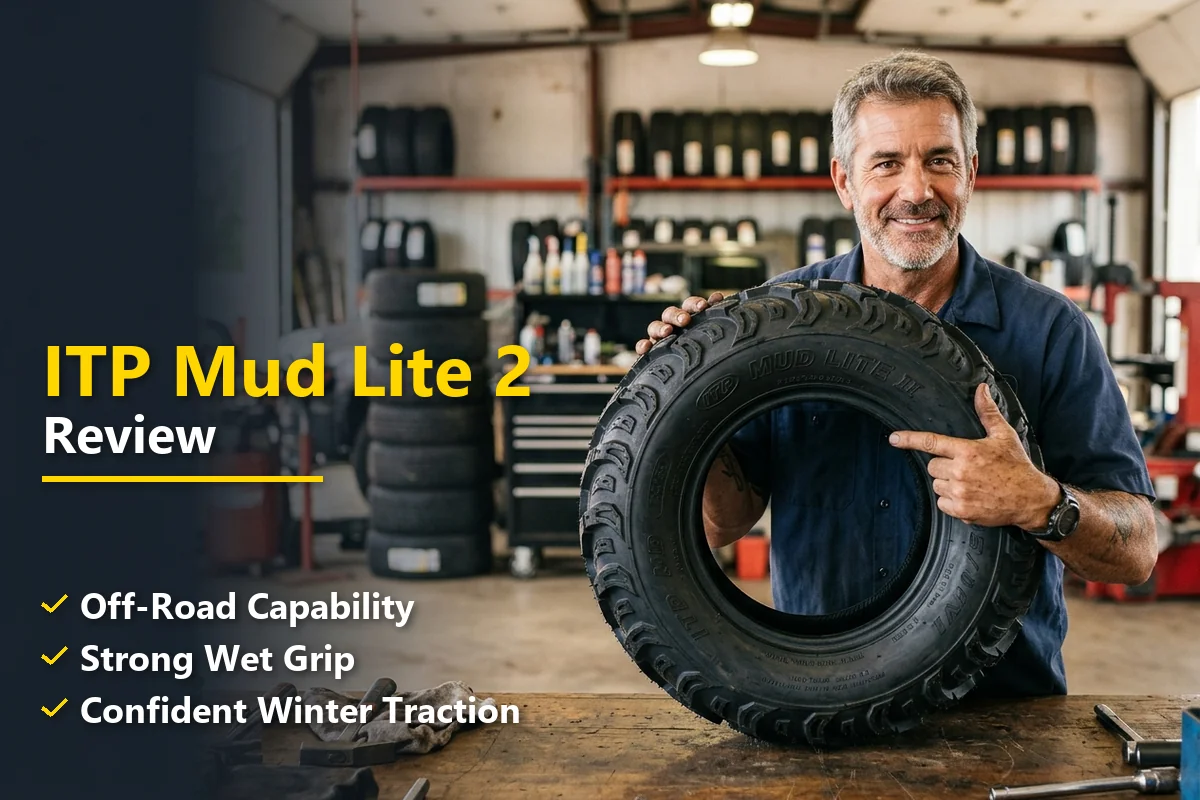
If you’ve ever been axle-deep in a mud hole, watching your buddy with better tires crawl out effortlessly while you sit there spinning, you know the frustration of running the wrong rubber on your ATV or UTV.
That sinking feeling — literally and figuratively — is what pushed me to try the ITP Mud Lite II. ITP has been a household name in the off-road world for decades, and their original Mud Lite was practically legendary among weekend warriors and serious trail riders alike.
So when I got a set of Mud Lite 2s mounted up for testing, I wanted to know one thing: does ITP’s second-generation mud tire live up to the hype, or is it riding on nostalgia? If you’re still getting a feel for the brand before committing to a set, my ITP tires review gives you the full brand picture first.
- The ITP Mud Lite 2 is a solid all-around mud tire for ATVs and UTVs at a very competitive price point
- Aggressive tread pattern delivers strong mud evacuation and decent traction on mixed terrain
- Lighter weight than many competitors, which reduces drivetrain strain and improves acceleration
- Rides surprisingly smooth on hard-packed trails and gravel roads
- Not the best choice for extreme rock crawling or deep clay-heavy mud — specialized tires outperform it in those niches
- Excellent value for recreational riders who encounter a mix of conditions
- Available in a wide range of sizes for both ATVs and UTVs, with US pricing typically between $80 and $160 per tire depending on size
Price Check
Check the price of this tire at the following retailers:
Don’t know the correct size tire to purchase? Start here!
Liked this article?
Add TireAdvise as a preferred source so you see more of our tire reviews and guides on Google.
What Exactly Is the ITP Mud Lite II?
The ITP Mud Lite 2 (sometimes written as Mud Lite II) is the second generation of ITP’s wildly popular Mud Lite tire line. It’s designed as a mud-terrain tire for ATVs and UTVs, built to handle soft, sloppy conditions while still being versatile enough for everyday trail riding.
ITP, which stands for Industrial Tire Products, is based in Clinton, Tennessee, and has been manufacturing off-road tires and wheels since 1982. They’re one of the most recognized names in the powersports tire market in the United States, and the Mud Lite series has been one of their flagship product lines for years.
The Mud Lite 2 was developed as a direct upgrade to the original, with a redesigned tread pattern, improved rubber compound, and updated construction. ITP markets it as a tire that bridges the gap between a dedicated mud tire and a versatile all-terrain option.
First Impressions Out of the Box
When I first unboxed the Mud Lite 2s, the first thing I noticed was the weight — or rather, the lack of it. These tires are noticeably lighter than many competing mud tires I’ve handled.
ITP uses a proprietary rubber compound that keeps the overall weight down without sacrificing durability. Holding one in each hand compared to a comparable Maxxis Zilla, the difference is tangible.
The tread pattern is immediately eye-catching. Deep, angled lugs with wide spacing dominate the center, and the sidewall lugs are prominent without being overly aggressive. The 6-ply rating on most sizes gives me confidence that these won’t puncture easily on rocky terrain.
Mounting and Fitment
I tested these on a Polaris RZR and separately on a Honda Rancher 420, so I got to experience the Mud Lite 2 on both a UTV and an ATV platform. Mounting was straightforward — they seated on the beads without any drama, which isn’t always the case with off-road tires.
The sizing options from ITP are generous. They offer the Mud Lite 2 in sizes ranging from 20 inches all the way up to 30 inches in overall diameter, with various width options. This means whether you’re running a smaller sport ATV or a full-size utility UTV, there’s likely a fitment that works.
I went with 27×9-12 fronts and 27×11-12 rears on the Rancher, and 30×9-14 fronts with 30×11-14 rears on the RZR. Both setups fit without any rubbing issues on stock suspension.
How I Tested the ITP Mud Lite II
I don’t believe in reviewing tires after one afternoon of riding. I ran these through several weeks of varied conditions before forming my opinion.
My testing grounds included muddy creek bottoms in East Tennessee, rocky forest service roads in the Smoky Mountains, hard-packed clay trails, loose gravel paths, and some sandy washes. I also did some basic pavement riding to and from trailheads, which I know many riders do as well.
I intentionally sought out the nastiest mud holes I could find, because that’s what these tires are named for — and that’s the promise ITP is making to buyers. I also paid attention to how they perform in conditions that aren’t ideal for a mud tire, since most riders don’t spend 100% of their time in the muck.
Mud Performance: Where These Tires Shine
Let’s start with the obvious — how do the Mud Lite 2s perform in actual mud?
In a word: impressively. The tread design does an excellent job of self-cleaning, which is critical in mud riding. I noticed that the wide channels between the lugs allow mud to evacuate quickly as the tire rotates, which means you’re constantly getting fresh biting edges into contact with whatever surface is underneath the slop.
In moderate mud — the kind of stuff you encounter on most trail rides after a good rain — these tires are outstanding. I was able to maintain forward momentum through sections that would have had me stuck on all-terrain tires.
The angled lug design creates a paddle-like effect that scoops and pushes, rather than just spinning in place. During one particularly sloppy section of trail, I watched my riding buddy on stock tires dig himself into a rut while I crawled through the same section with steady throttle and minimal wheelspin.
Deep Mud Limitations
Now, I want to be honest here — in truly deep, thick clay mud (the kind that’s over your axles), the Mud Lite 2 starts to show its limitations. Dedicated extreme mud tires like the ITP Cryptid or the Gorilla Silverback have deeper, more widely spaced lugs that perform better in those extreme conditions.
The Mud Lite 2 is a step below those tires in the deepest stuff. But here’s the thing — if you’re regularly riding in axle-deep mud, you probably already know you need an extreme mud tire. For the vast majority of riders who encounter mud as part of their trail riding rather than seeking out the worst possible conditions, the Mud Lite 2 is more than capable.
Trail and Hard-Pack Performance
This is where the Mud Lite 2 surprised me the most. Many mud tires are miserable on anything that isn’t soft terrain — they vibrate, they’re noisy, and they feel vague in corners on hard surfaces.
The Mud Lite 2, by contrast, rides remarkably well on hard-packed trails and gravel. I attribute this to the slightly closer lug spacing compared to extreme mud tires and the lighter weight construction. The tire doesn’t pound and vibrate the way some aggressive mud tires do.
On forest service roads covered in loose gravel, I had confidence in the front end. The tire provided predictable feedback through the handlebars, and I didn’t experience the “skating” sensation that some tall-lugged mud tires create on hard surfaces.
Rocky Terrain Performance
I spent a good amount of time on rocky trails to test the Mud Lite 2’s durability and grip on stone surfaces. The 6-ply construction held up well — I didn’t experience any punctures or visible damage even after riding over some sharp limestone ledges.
The rubber compound seems to have a good balance between being soft enough to grip on rocks and hard enough to resist cuts and abrasions. I did notice that on wet rocks, traction drops off somewhat — but that’s true of virtually every tire I’ve ever tested. The lugs don’t have the small siping that some all-terrain tires use to grip on wet stone.
For moderate rock crawling and typical rocky trail conditions, these tires are perfectly adequate. If you’re doing serious rock crawling where precise grip on stone faces is critical, you’d want a dedicated rock-terrain tire. But for the typical trail rider who encounters rocks as part of a varied ride, the Mud Lite 2 handles it well.
Sand Performance
Sand isn’t the Mud Lite 2’s strongest suit, but it’s passable. The aggressive tread pattern tends to dig in soft sand rather than float over it, which is typical of mud-oriented tires.
I tested them in some sandy washes in a dry creek bed, and by airing down slightly, I was able to maintain decent traction and forward progress. You won’t mistake these for paddle tires or dedicated sand tires, but occasional sandy sections on a trail won’t stop you.
Ride Comfort and Noise
For a mud tire, the Mud Lite 2 is genuinely comfortable. I was surprised by how smooth the ride felt on the Rancher, even on longer trail rides. The lightweight construction plays a big role here — less unsprung weight means the suspension can do its job more effectively.
Noise is moderate. On hard surfaces, you can hear the lugs making contact, but it’s not the aggressive hum that some deep-lug mud tires produce. On soft terrain, it’s essentially silent except for the satisfying sound of mud being flung off the tread.
My riding group includes a couple of guys with more aggressive mud tires, and they consistently comment on how rough their rides are on mixed terrain. I didn’t have that complaint with the Mud Lite 2.
Durability and Wear
After several weeks of hard riding across varied terrain, the Mud Lite 2s showed minimal visible wear. The lugs retained their sharp edges, and I didn’t find any chunks missing or significant cuts in the rubber.
The 6-ply casing provides genuine protection against trail hazards. I ran over a couple of sharp objects that I was sure would cause damage, and inspecting the tires afterward, I found superficial marks but nothing that compromised the integrity.
ITP doesn’t provide a specific treadwear rating or mileage warranty for these tires (which is standard in the ATV/UTV tire market), but based on the wear I observed during my testing period, I expect these to last well through multiple riding seasons for a typical weekend warrior.
Weight Comparison: Why It Matters
One of the biggest selling points of the Mud Lite 2 is its light weight. Let me explain why this matters more than many riders realize.
Every pound of rotating mass on your ATV or UTV requires energy to spin. Heavier tires sap power from your engine, reduce acceleration, increase braking distances, and put additional strain on your drivetrain — including CV joints, which are expensive to replace.
The ITP Mud Lite 2 in a 27×9-12 size weighs approximately 21 pounds. For comparison, many competing mud tires in the same size weigh 25-30+ pounds. That’s a potential savings of 16 or more pounds across all four corners. On a smaller ATV, that difference in rotational mass is significant.
I noticed the difference most during acceleration and when navigating technical sections that required quick direction changes. The machine felt more responsive and nimble on the Mud Lite 2s than it does on heavier tire options.
ITP Mud Lite 2 vs. The Competition
No tire review is complete without context. Here’s how the Mud Lite 2 stacks up against some of the most popular alternatives in the US market.
| Feature | ITP Mud Lite 2 | Maxxis Zilla | Sedona Mud Rebel RT | ITP Cryptid |
|---|---|---|---|---|
| Tire Type | Mud Terrain | Mud/All-Terrain | Mud Terrain | Extreme Mud |
| Ply Rating | 6-ply | 6-ply | 6-ply | 6-ply |
| Weight (27×9-12) | ~21 lbs | ~24 lbs | ~26 lbs | ~28 lbs |
| Approximate Price (per tire) | $85–$150 | $80–$140 | $100–$170 | $120–$200 |
| Deep Mud Performance | Very Good | Good | Very Good | Excellent |
| Hard-Pack/Trail Comfort | Very Good | Very Good | Good | Fair |
| Versatility | Excellent | Excellent | Good | Fair |
| Best For | All-around mud/trail | Mixed terrain riding | Serious mud with some trail | Dedicated mud riding |
ITP Mud Lite 2 vs. Maxxis Zilla
The Maxxis Zilla is probably the closest competitor to the Mud Lite 2, and it’s the comparison I get asked about the most. Both tires occupy a similar niche — mud-capable but versatile enough for everyday trail riding.
In my experience, the Mud Lite 2 has a slight edge in pure mud traction due to its more aggressive lug design. The Zilla, on the other hand, tends to be marginally smoother on hard surfaces. The weight difference favors the ITP, which gives it better throttle response.
Pricing is very similar between the two, so it often comes down to personal preference and brand loyalty. If I had to choose between them for a machine that sees 60% trails and 40% mud, I’d give the edge to the Mud Lite 2 for its weight advantage and strong mud performance.
ITP Mud Lite 2 vs. Sedona Mud Rebel RT
The Sedona Mud Rebel RT is a more aggressive tire than the Mud Lite 2. It has deeper lugs and a more open tread pattern, which gives it superior performance in deep mud.
However, that aggressiveness comes at a cost — it’s heavier, rougher on hard surfaces, and more expensive. For riders who spend a lot of time in serious mud but still want some trail versatility, the Mud Rebel RT is worth considering. But for the average rider, I think the Mud Lite 2 offers a better overall package.
ITP Mud Lite 2 vs. ITP Cryptid
This is an interesting comparison because both tires come from the same manufacturer. The Cryptid is ITP’s more extreme mud offering, and it’s significantly more aggressive than the Mud Lite 2.
I’d recommend the Cryptid only if you spend the majority of your riding time in deep, nasty mud. It’s heavier, rougher on trails, and more expensive. The Mud Lite 2 is the better choice for riders who want strong mud performance without sacrificing everyday rideability.
Sizing Options and Pricing
The ITP Mud Lite 2 is available in a comprehensive range of sizes that covers most ATV and UTV applications:
- 20×11-9 — Ideal for smaller sport ATVs
- 25×8-12 / 25×10-12 — Popular for mid-size ATVs
- 26×9-12 / 26×11-12 — Common utility ATV sizes
- 27×9-12 / 27×11-12 — Popular for larger ATVs and smaller UTVs
- 27×9-14 / 27×11-14 — UTV 14-inch wheel fitments
- 28×9-14 / 28×11-14 — Mid-size UTV fitments
- 30×9-14 / 30×11-14 — Full-size UTV fitments
Pricing in the US market typically ranges from about $80 for the smallest sizes up to approximately $160 for the largest. A full set of four tires will generally run between $350 and $600 depending on size, which positions the Mud Lite 2 firmly in the mid-range price category.
I’ve seen them available at major US retailers including Rocky Mountain ATV/MC, Dennis Kirk, Amazon, Tire Rack’s powersports section, and various local powersports dealers. Prices can vary by $10-20 between retailers, so I recommend shopping around before purchasing.
Who Should Buy the ITP Mud Lite 2?
Based on my testing, here’s who I think the Mud Lite 2 is ideal for:
The Weekend Trail Rider
If you ride your ATV or UTV on weekends across a mix of terrain — some mud, some trails, some gravel roads — the Mud Lite 2 is an outstanding choice. It gives you the mud capability you need without punishing you on non-muddy surfaces.
The Budget-Conscious Rider
At its price point, the Mud Lite 2 delivers excellent value. You’re getting a well-engineered tire from a reputable American brand without breaking the bank. For riders who don’t want to spend $200+ per tire on premium options, this is a smart buy.
Riders Who Want to Protect Their Drivetrain
The light weight of these tires means less stress on your CVT belt, CV joints, wheel bearings, and brakes. If you’ve ever had to replace CV joints on a UTV, you know that’s a repair bill you want to avoid. Running lighter tires is one of the best preventive measures you can take.
Who Should Look Elsewhere
If you’re a dedicated mudder who seeks out the deepest, nastiest holes possible, you’ll want something more aggressive like the ITP Cryptid, SuperATV Assassinator, or Gorilla Silverback. The Mud Lite 2 is very capable in mud, but it’s not an extreme mud tire.
If you rarely encounter mud and primarily ride rocky, hard-packed trails, you might be better served by an all-terrain tire like the ITP Terra Cross or Maxxis Bighorn that’s optimized for those conditions.
Installation Tips and Recommendations
A few practical tips from my experience with the Mud Lite 2:
- Run appropriate air pressure. I found that 7-8 PSI provided the best balance of traction, comfort, and sidewall protection for trail riding. In deep mud, airing down to 4-5 PSI can significantly improve the contact patch and floatation.
- Directional tread pattern matters. The Mud Lite 2 has a directional tread that needs to be mounted correctly for optimal mud evacuation. The tread should form a V-shape pointing forward at the top of the tire. Double-check that your installer gets this right.
- Break them in gently. Like any new tire, give the Mud Lite 2 a few easy rides before pushing hard. New rubber has a slick surface film from the manufacturing process that needs to wear off for maximum grip.
- Consider tire sealant. While the 6-ply construction is robust, I always recommend running a tire sealant like Slime or TireJect in off-road tires as an extra layer of protection against punctures from thorns and sharp debris.
The Bottom Line: My Honest Verdict on the ITP Mud Lite 2
After putting the ITP Mud Lite 2 through its paces over several weeks of varied riding conditions, I’m genuinely impressed by what this tire delivers for its price.
Is it the ultimate mud tire? No, and it doesn’t claim to be. What it is, however, is one of the best all-around mud-capable tires you can buy for an ATV or UTV in the US market right now. It handles mud with authority, behaves well on trails and hard-pack, weighs less than most of its competition, and won’t drain your bank account.
The combination of strong mud performance, trail versatility, light weight, and reasonable pricing makes the Mud Lite 2 a tire I would — and do — recommend to fellow riders. It occupies that sweet spot where most recreational riders actually spend their time: mixed conditions with varying amounts of mud.
If ITP’s goal with the Mud Lite 2 was to create a worthy successor to the original Mud Lite while broadening its appeal to riders who want mud capability without compromise, I’d say they succeeded. This tire earned a permanent spot in my recommendation list, and it’s the tire I suggest most often when riding buddies ask me what to run on their machines.
For the average ATV or UTV owner in the United States who rides a mix of terrain and encounters mud regularly but not exclusively, the ITP Mud Lite 2 is a smart, reliable, and affordable choice. I recommend it with confidence.
Frequently Asked Questions
How does the ITP Mud Lite 2 perform in deep mud compared to the original Mud Lite?
The ITP Mud Lite 2 is a significant upgrade over the original, featuring a more aggressive tread pattern with deeper lugs that bite harder in thick mud and release debris more efficiently. I noticed much better self-cleaning ability and forward traction in soupy conditions. The redesigned shoulder lugs also give you better side-hill grip, which the original Mud Lite struggled with in heavy terrain.
Are ITP Mud Lite 2 tires good for trail riding and hard-packed surfaces?
While the ITP Mud Lite 2 is primarily a mud tire, it handles hard-packed trails surprisingly well thanks to its balanced tread design that doesn’t feel overly chunky on firm ground. You will notice slightly more vibration on pavement or packed gravel compared to an all-terrain tire, but for mixed riding that includes mud, trails, and light hard-pack, it’s a solid all-around choice. Most riders find the ride comfortable enough for full-day trail sessions.
How much do ITP Mud Lite 2 tires cost, and where can I buy them in the US?
ITP Mud Lite 2 tires typically range from $90 to $160 per tire depending on size, with popular sizes like the 25×8-12 and 25×10-12 usually falling around $100 to $130 each. You can find them at US retailers like Rocky Mountain ATV/MC, Dennis Kirk, Amazon, and Tire Rack. I recommend comparing prices across multiple sellers since seasonal sales can save you $15 to $30 per tire.
What sizes does the ITP Mud Lite 2 come in, and will it fit my ATV or UTV?
The ITP Mud Lite 2 is available in a wide range of sizes from 25-inch to 30-inch diameters, covering 12-inch and 14-inch wheel fitments common on most popular ATVs and UTVs. Common fitments include 25×8-12, 25×10-12, 26×9-12, 27×9-14, and 30×9-14, among others. Always check your machine’s fender clearance and factory recommended tire size before upgrading, especially if you’re jumping up more than one inch in overall diameter.
How long do ITP Mud Lite 2 tires last, and are they durable enough for rocky terrain?
Most riders report getting 2,000 to 4,000 miles out of a set of ITP Mud Lite 2 tires depending on riding conditions and terrain mix. The 6-ply rated construction holds up reasonably well against rocks and roots, though they’re not as puncture-resistant as a dedicated hard-terrain tire. I’d say they’re best suited for mud-heavy riding with occasional rocky sections rather than constant sharp-rock abuse.
Is the ITP Mud Lite 2 a heavy tire, and does it affect acceleration or steering?
The ITP Mud Lite 2 is designed to be lighter than many competing mud tires, which is one of its biggest selling points. Compared to aggressive mud tires like the ITP Cryptid or Gorilla Silverback, you’ll notice less rotational weight, meaning better throttle response and less strain on your belt and drivetrain. Steering remains relatively light, making it a great option for smaller displacement ATVs that struggle with heavier mud tires.
How does the ITP Mud Lite 2 compare to the ITP Cryptid and Sedona Mud Rebel for mud riding?
The ITP Mud Lite 2 sits between the Cryptid and Sedona Mud Rebel in terms of aggressiveness—it’s less extreme than the Cryptid but more capable in deep mud than the Mud Rebel. If you ride 60% mud and 40% trails, the Mud Lite 2 hits a sweet spot with better trail manners than the Cryptid and stronger mud performance than the Rebel. Price-wise, the Mud Lite 2 is also more budget-friendly than the Cryptid, making it a popular mid-range choice for riders across the US who want versatility without breaking the bank.
