

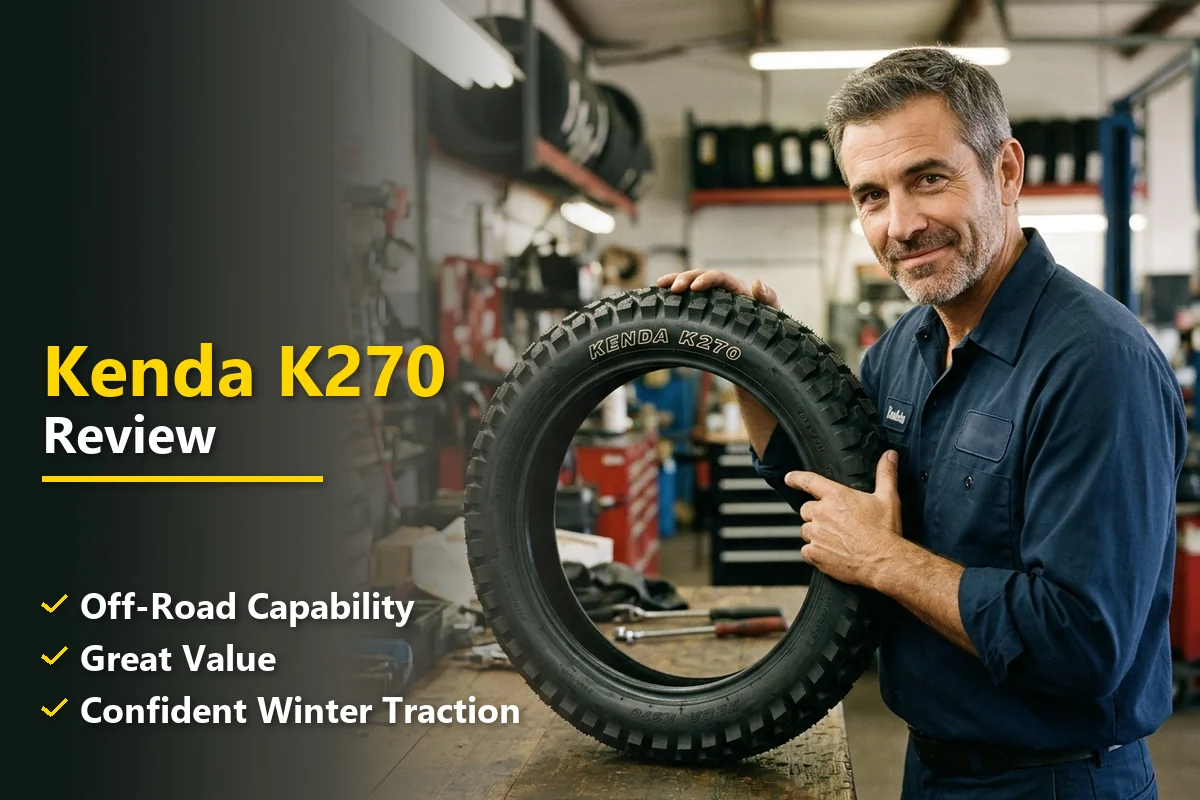
If you’ve ever tried to find a single tire that works on both cracked asphalt and loose gravel trails, you know the frustration. Most tires that claim “dual sport” capability end up being mediocre at both — or they cost as much as a weekend getaway.
The Kenda K270 caught my attention because riders keep recommending it in forums as “the budget dual sport tire that actually works.”
I wanted to see if that reputation holds up, so I mounted a set and put them through real conditions — highway commuting, backroads, gravel paths, and even some light mud. For a broader look at the brand’s full lineup, our complete Kenda Tires Review guide covers every model side by side.
- The Kenda K270 is a DOT-approved dual sport tire designed for riders who split time between pavement and off-road trails
- Excellent value — typically priced between $30 and $70 depending on size, well below premium competitors
- Surprisingly capable on loose surfaces like gravel, hardpack dirt, and light mud
- On-road performance is adequate but noticeably louder and less planted than street-focused tires
- Tread life is reasonable for the price, especially if you’re primarily riding off-road
- Best suited for adventure riders, commuters on rough rural roads, and anyone who needs a versatile tire on a budget
Price Check
Check the price of this tire at the following retailers:
Don’t know the correct size tire to purchase? Start here!
Liked this article?
Add TireAdvise as a preferred source so you see more of our tire reviews and guides on Google.
What Exactly Is the Kenda K270?
The Kenda K270 is a dual sport tire designed for motorcycles and small displacement vehicles that need DOT-approved rubber capable of handling both paved roads and off-road terrain. It’s part of Kenda’s extensive off-road and dual sport lineup, and it’s been around for years — which usually means the design is either proven or outdated. In this case, I’d argue it’s proven.
The tire features a classic block-pattern tread with wide channels between the knobs. This design gives it solid self-cleaning capability in mud and soft terrain while still providing enough contact patch for reasonable on-road handling.
Kenda positions this as a 50/50 tire, meaning it’s theoretically designed for equal parts street and dirt. In practice, I’d call it more of a 40/60 — it leans slightly toward off-road capability, which is actually a good thing for riders who need it.
First Impressions and Mounting
When the K270s arrived, the first thing I noticed was how lightweight they felt compared to other dual sport tires I’ve handled. The rubber compound feels firm but not overly stiff, and the knobs have clean edges right out of the box with no visible manufacturing defects.
Mounting was straightforward. I’ve dealt with some budget tires that have incredibly stiff beads, making them a nightmare to seat, but the K270 went on without a fight. The bead seated cleanly on the first attempt with a standard compressor, and I had no issues with air leaks during the initial inflation.
The sidewall markings are clear and easy to read — tire size, load index, speed rating, DOT approval, and directional arrow are all plainly visible. One thing I appreciated: the directional arrow is large and obvious, so there’s no second-guessing which way the tire should rotate during installation.
On-Road Performance
Let’s address the elephant in the room first. This is a knobby dual sport tire. If you’re expecting it to carve corners like a sport touring tire, you’re going to be disappointed. But within the context of what it is, the K270 does a respectable job on pavement.
Straight-Line Stability
During my first few days of highway riding, the K270 felt stable at legal speeds. There was no wandering or vague feeling through the handlebars that I sometimes get with aggressive off-road tires on pavement. It tracks straight and doesn’t get pushed around by road grooves as badly as I expected.
At sustained highway speeds, I could feel the tire working harder than a pure street tire would. There’s a subtle vibration that comes through — not alarming, but present. It’s the kind of thing you stop noticing after a while, but it’s there.
Cornering and Lean Confidence
Cornering is where the K270’s dual sport nature becomes most apparent. The transition from the center knobs to the edge knobs happens with a noticeable step, and you can feel the contact patch change as you lean in. It’s predictable once you get used to it, but riders coming from street tires will need an adjustment period.
I found that keeping my speed reasonable through corners — nothing aggressive, just sensible riding — the K270 provided adequate grip. The rear felt planted during moderate lean angles, and I never had a moment where the tire broke loose unexpectedly on dry pavement.
Wet Road Performance
Here’s where things get interesting. The wide channels between the knobs actually do a decent job of channeling water away from the contact patch. During several days of riding in steady rain, I felt more confident on the K270 than I’ve felt on some budget street tires in similar conditions.
That said, painted road lines and metal surfaces (manhole covers, bridge expansion joints) are still slippery — more so than with a softer street compound. I learned quickly to be deliberate about avoiding those surfaces when wet, which is honestly good practice regardless of what tire you’re running.
Road Noise
This is the K270’s most obvious weakness on pavement. The block tread pattern generates a constant hum at speed that’s noticeably louder than a street tire. If you’re riding a faired bike with wind protection, it’s tolerable. On a naked bike where you’re already dealing with wind noise, you barely notice it over the ambient sound.
But if you value a quiet ride and spend 90% of your time on pavement, this tire will annoy you. It’s an inherent trade-off of the knobby design.
Off-Road Performance
This is where the Kenda K270 truly earns its keep, and frankly, this is why most people buy it.
Gravel and Hardpack Dirt
On gravel roads, the K270 is confidence-inspiring. The knobs dig in and provide genuinely good traction, and the tire gives you clear feedback about what the surface is doing underneath you. I spent an entire afternoon on unmaintained county roads in rural terrain, and the K270 handled everything from packed gravel to loose shale without drama.
Hardpack dirt is probably the K270’s sweet spot. The knobs are spaced well enough to find grip but close enough together that the tire doesn’t feel vague or squishy. Acceleration traction is strong, and braking distances felt comparable to what I’d expect from a mid-range dual sport tire.
Mud and Soft Terrain
In light to moderate mud, the K270 performs better than I anticipated. The wide channels between the tread blocks allow mud to clear reasonably well, preventing the tire from turning into a slick cylinder. I rode through several muddy stretches after rain and maintained forward progress without excessive wheel spin.
However, in deep, sticky clay mud, the K270 reaches its limits. The knobs aren’t tall enough or aggressive enough to truly claw through thick muck the way a dedicated enduro tire would. But that’s expected for a DOT-legal dual sport tire, and anyone expecting otherwise is being unrealistic.
Sand and Loose Surfaces
Sandy conditions were hit or miss. In firm, wet sand, the K270 provided decent traction. In deep, dry sand, it struggled — the knobs aren’t wide enough to float on top of the surface, and the tire tends to dig in rather than glide. If you regularly ride in sandy terrain, you’ll want something with a wider, paddled tread design.
Rocky Terrain
I tested the K270 on some moderately rocky trails, and the tire held up well. The sidewalls are reasonably sturdy for the price point, and I didn’t experience any punctures or cuts during my test period. The knobs showed some wear on the edges after navigating rocky sections, but nothing alarming.
One thing I’ll note: the tire’s carcass is not as robust as premium dual sport options from Dunlop or Pirelli. If you’re regularly riding over sharp, jagged rocks at speed, you might want to consider a tire with more sidewall protection. For casual trail riding and fire roads, though, the K270 is perfectly adequate.
Tread Life and Durability
Tread life on dual sport tires is always a balancing act. Softer compounds grip better but wear faster. Harder compounds last longer but sacrifice traction. The K270 uses a relatively hard compound, which favors longevity over maximum grip.
After several weeks of mixed riding — a combination of daily commuting on pavement and weekend dirt rides — the K270 showed moderate and even wear. The center knobs wore slightly faster than the edges, which is typical for any tire that sees significant highway use.
Compared to other dual sport tires in this price range, the K270’s tread life is competitive. It won’t outlast a Shinko 705 on pure pavement, but it holds up better off-road and provides more consistent performance as it wears down. The knobs maintain their shape well rather than rounding off quickly, which means the tire stays useful in dirt even as it ages.
Kenda K270 vs. the Competition
No tire review is complete without context. Here’s how the K270 stacks up against the dual sport tires you’re most likely comparing it to:
| Feature | Kenda K270 | Shinko 244 | Dunlop D606 | Pirelli MT 21 |
|---|---|---|---|---|
| Price (avg. rear) | $40–$70 | $35–$65 | $90–$130 | $110–$160 |
| On-Road Performance | Adequate | Good | Fair | Good |
| Off-Road Performance | Good | Adequate | Excellent | Excellent |
| Tread Life | Good | Good | Fair | Fair |
| Wet Grip | Adequate | Adequate | Good | Good |
| Road Noise | Noticeable | Moderate | Loud | Moderate |
| DOT Approved | Yes | Yes | Yes | Yes |
| Best For | Budget mixed use | Budget street-biased | Aggressive off-road | Premium all-around |
Kenda K270 vs. Shinko 244
The Shinko 244 is probably the K270’s closest competitor in terms of price. In my experience, the Shinko is slightly better on pavement — it’s quieter and feels more stable at higher speeds. But the K270 clearly outperforms it in dirt and gravel. If your riding is 70% or more pavement, go with the Shinko. If you’re 50/50 or more off-road, the K270 is the better choice.
Kenda K270 vs. Dunlop D606
The D606 is in a completely different league off-road. It’s more aggressive, grips harder in every off-road condition, and has a more robust construction. But it also costs roughly twice as much, wears faster on pavement, and generates significantly more road noise. If money is no object and you ride mostly off-road, the D606 is superior. For budget-conscious riders who need a versatile tire, the K270 offers 70% of the D606’s off-road capability at half the price.
Kenda K270 vs. Pirelli MT 21
The MT 21 is a premium option that does almost everything well. It corners better on pavement, wears more evenly, and provides excellent off-road grip. But at $110-$160 per tire, it’s a hard pill to swallow if you’re on a budget. I’d recommend the MT 21 for riders who put serious hours on their bikes and need top-tier performance. The K270 is for riders who want capable rubber without the premium price tag.
Size Availability
One area where the K270 shines is size selection. Kenda offers this tire in a wide range of sizes that cover most popular dual sport motorcycles. Common sizes include:
- 2.75-21 (front)
- 3.00-21 (front)
- 4.10-18 (rear)
- 4.60-18 (rear)
- 5.10-17 (rear)
- 3.25-21 (front)
- 4.60-17 (rear)
This covers bikes like the Honda CRF250L, Kawasaki KLR650, Suzuki DR650, Yamaha XT250, and many others in the dual sport category. Check Kenda’s fitment guide for your specific bike to confirm compatibility, as tube-type and tubeless applications vary by size.
Who Should Buy the Kenda K270?
After spending significant time on these tires, I’ve developed a clear picture of who this tire is made for — and who should look elsewhere.
The K270 Is Ideal For:
- Budget-conscious dual sport riders who need a capable tire without spending $100+ per wheel
- Riders who split time between pavement and dirt — especially if dirt makes up 50% or more of your riding
- Rural commuters who deal with gravel roads, unpaved shoulders, and deteriorating pavement regularly
- Adventure riders on smaller displacement bikes who want to explore fire roads and trails on weekends
- Riders who go through tires quickly and need affordable replacements that don’t sacrifice too much performance
The K270 Is NOT Ideal For:
- Primarily highway riders — the noise and reduced cornering confidence aren’t worth the off-road capability you’ll never use
- Aggressive trail riders who need maximum traction in challenging single-track or deep mud
- Riders who prioritize on-road refinement — there are better options for pure street performance
- Heavy bikes over 650cc — the tire’s construction may not hold up well under the additional weight and power of larger machines
Installation Tips and Recommendations
Based on my experience with the K270, here are a few tips that will help you get the most out of these tires:
Break them in gradually. Like any new tire, the K270 has a slick release agent on the surface from manufacturing. I recommend riding conservatively for the first few days, avoiding aggressive lean angles or hard braking until the tire is properly scuffed in.
Run the right pressure. For mixed riding, I found the best balance at around 28-30 PSI in the rear and 25-28 PSI in the front for on-road use. When heading off-road, I’d drop to 20-22 PSI for noticeably better traction and a more compliant ride. Just remember to air back up before hitting pavement again.
Use quality tubes. The K270 is a tube-type tire in most sizes. Don’t cheap out on the inner tubes — a good heavy-duty tube from a brand like Kenda’s own Thorn Proof or a Bridgestone HD tube will save you from flats and headaches down the road.
Inspect regularly. The knob design can trap small stones and debris. After off-road rides, take a minute to inspect the tread and pick out any embedded rocks. This prevents uneven wear and reduces the chance of a stone working its way through the rubber.
What I Liked Most About the Kenda K270
If I had to pick the three things that impressed me most, they’d be:
1. The price-to-performance ratio is outstanding. At $40-$70 per tire, you’re getting dual sport capability that honestly rivals tires costing twice as much in most real-world conditions. For riders who can’t justify dropping $250+ on a set of premium rubber, the K270 removes the financial barrier to adventure.
2. Off-road confidence on gravel and hardpack. This is the tire’s home turf, and it performs beautifully. The grip is predictable, the feedback is clear, and the tire inspires confidence on surfaces that would have me white-knuckling a street tire.
3. Even wear pattern. Budget tires sometimes wear unevenly, developing flat spots or cupping that ruins handling before the tread is actually gone. The K270 wore down evenly and consistently throughout my testing, which means you’ll get the full useful life out of the rubber.
What I Liked Least About the Kenda K270
In the interest of being completely transparent, here are the areas where the K270 fell short:
1. Road noise is significant. I mentioned this earlier, but it bears repeating. If you do a lot of highway riding, the constant hum from the knobby tread will become the soundtrack of your commute. Some riders don’t mind; others find it grating.
2. Cornering transitions are abrupt. The step between the center and edge knobs creates a noticeable shift in feel during lean. It’s predictable once you’re used to it, but it never becomes invisible. Riders who enjoy spirited canyon riding on pavement will find this frustrating.
3. Limited performance in deep mud and sand. While the K270 handles light mud fine, it reaches its limits faster than more aggressive tires in truly sloppy conditions. If your trails regularly feature deep mud holes or sand washes, you’ll want something more purpose-built.
Value Assessment: Is the Kenda K270 Worth It?
This is the question that matters most, and my answer is a qualified yes. The Kenda K270 is worth every penny for the right rider.
At its price point, there simply isn’t a dual sport tire that offers a better combination of off-road capability, tread life, and on-road adequacy. You’d have to spend nearly double to get a meaningful performance upgrade, and even then, the gains are incremental for casual to moderate dual sport riding.
I think of the K270 as the “Honda Civic” of dual sport tires — it’s not flashy, it won’t win awards for excitement, but it does exactly what it promises at a price that makes sense. For riders who want to explore dirt roads and trails without a major investment, this tire removes the excuse to stay on pavement.
However, if you’re a serious off-road rider who regularly tackles technical terrain, or if you spend 80%+ of your time on highways, the K270 is a compromise that may not serve you well. In those cases, investing in a purpose-specific tire will pay dividends in performance and safety.
Final Verdict on the Kenda K270
After extensive testing across varied conditions, I can confidently say the Kenda K270 is one of the best values in the dual sport tire market. It excels on gravel and hardpack dirt, provides acceptable on-road manners for commuting and light highway use, and does it all at a price that won’t make your wallet weep.
It’s not perfect — no tire is, especially one trying to serve two masters. The road noise, abrupt cornering transitions, and limited deep-mud capability are real drawbacks that you should weigh against your specific riding habits. But for the vast majority of dual sport riders who want affordable versatility, the K270 delivers.
I’d give the Kenda K270 a solid 4 out of 5 for its intended purpose. It loses a point for on-road refinement, but the combination of off-road performance, durability, and price makes it an easy recommendation for budget-conscious adventure riders across the US.
If you’re on the fence, consider how much of your riding is off-road. If it’s 40% or more, the K270 is a smart buy. If it’s less than that, you might be happier with something street-biased. Either way, Kenda has proven with the K270 that great off-road traction doesn’t have to come with a premium price tag.
Frequently Asked Questions
Is the Kenda K270 a good dual-sport tire for highway and off-road riding?
The Kenda K270 is a solid budget-friendly dual-sport tire that performs well on dirt roads, gravel, and light trails, but it’s not designed for aggressive off-road use. On pavement, it offers acceptable grip and stability at highway speeds, though it wears faster than dedicated street tires. I’d recommend it for riders who split their time between paved roads and unpaved surfaces without pushing extreme limits in either environment.
How long does the Kenda K270 tire last on average?
Most riders report getting between 5,000 and 8,000 miles out of a set of Kenda K270 tires, depending on riding style and terrain mix. If you ride primarily on pavement, the knobby tread pattern tends to wear down faster compared to off-road use. Regular tire pressure checks and avoiding prolonged highway riding at high speeds can help extend the tread life.
What bikes are compatible with the Kenda K270 dual-sport tire?
The Kenda K270 is available in a wide range of sizes that fit popular dual-sport and adventure bikes like the Suzuki DR650, Kawasaki KLR650, Honda XR650L, and Yamaha XT250. It also fits smaller enduro-style bikes and vintage dual-sports. Always check the specific tire size stamped on your current sidewall to confirm fitment before ordering.
How much does the Kenda K270 cost compared to other dual-sport tires?
The Kenda K270 typically costs between $35 and $75 per tire depending on size, making it one of the most affordable dual-sport tire options on the US market. By comparison, premium alternatives like the Shinko 705 or Dunlop D606 can run $70 to $130 per tire. For budget-conscious riders who need a reliable replacement tire, the K270 delivers strong value without a major compromise in performance.
How does the Kenda K270 perform in rain and wet road conditions?
The Kenda K270’s knobby tread pattern channels water reasonably well, giving it decent wet traction on paved roads for a dual-sport tire. However, it’s not as confidence-inspiring in heavy rain as a dedicated street tire with wider siping. I’d recommend reducing speed in wet conditions and making sure your tire pressure is within the manufacturer’s recommended range for the best grip.
Is the Kenda K270 DOT approved for street use in the United States?
Yes, the Kenda K270 is DOT approved and fully street legal in all US states, so you can ride it on public roads without any issues. It carries the DOT marking on the sidewall, confirming it meets federal safety standards for highway use. This makes it a practical choice for riders who need a single tire that works on both pavement and unpaved trails.
Kenda K270 vs Shinko 244: which dual-sport tire is better for mixed terrain?
Both the Kenda K270 and Shinko 244 are popular budget dual-sport tires, but they have different strengths. The K270 tends to offer slightly better off-road traction thanks to its more aggressive knob pattern, while the Shinko 244 provides a smoother, quieter ride on pavement. If your riding leans more toward dirt and gravel, the K270 is the better pick; if you spend most of your time on paved roads with occasional off-road detours, the Shinko 244 may feel more comfortable.
