

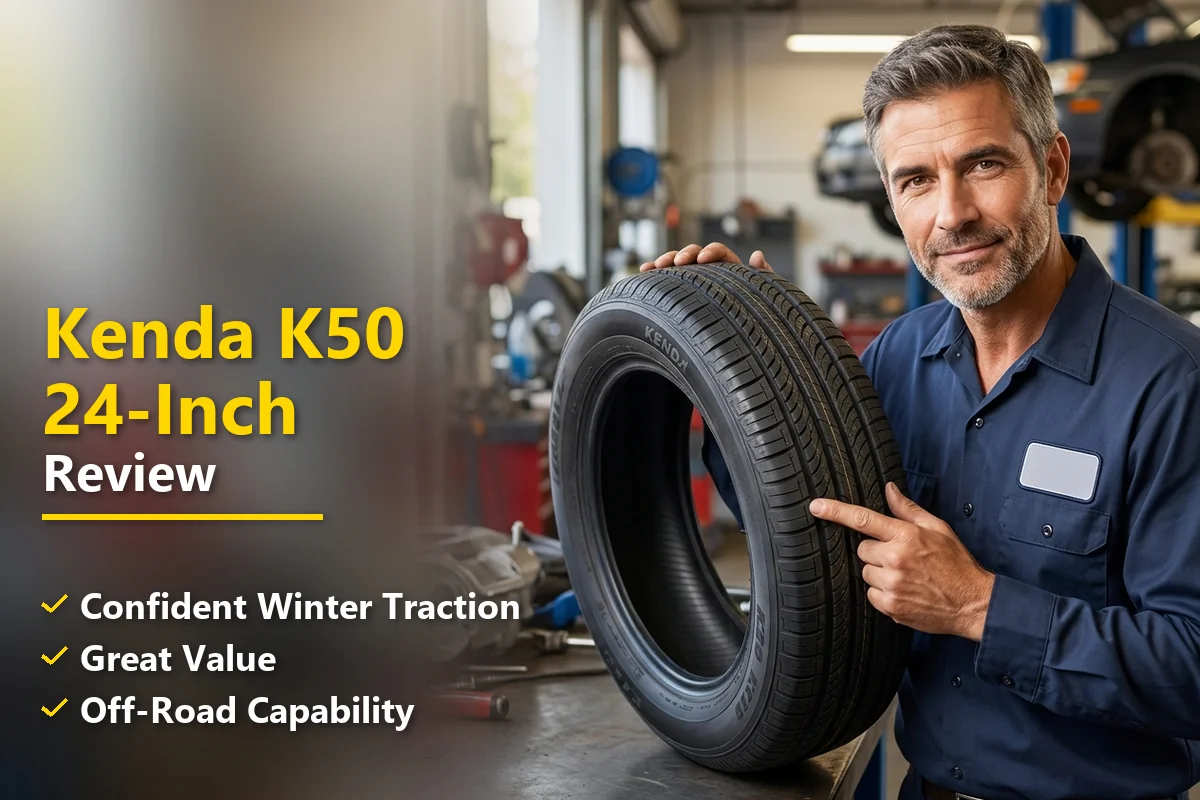
If you’ve ever searched for a reliable 24-inch tire that won’t drain your wallet, you’ve probably stumbled across the Kenda K50. It’s one of those tires that has been around seemingly forever, and for good reason — it quietly does its job without demanding attention or a premium price tag.
But here’s the thing: just because a tire is affordable and well-known doesn’t automatically mean it’s the right fit for your specific riding needs.
I wanted to find out for myself whether the Kenda K50 in the 24-inch size lives up to its long-standing reputation, so I put it through real-world testing on actual streets, sidewalks, and mixed-surface paths.
For a broader look at how this model stacks up within the brand’s lineup, our full Kenda Tires Review guide covers every model side by side.
- The Kenda K50 24-inch is a budget-friendly knobby tire ideal for cruiser bikes, BMX-style rides, and casual urban cycling.
- Grip on dry pavement is solid; wet performance is acceptable but not exceptional.
- Ride comfort is surprisingly good for a knobby tire thanks to its flexible sidewall construction.
- Rolling resistance is higher than slick tires, but that’s expected with this tread pattern.
- At roughly $15–$25 per tire in the US market, it’s one of the best value options in its category.
- Best suited for casual riders, commuters on mixed surfaces, and anyone restoring a classic cruiser or BMX bike.
Price Check
Check the price of this tire at the following retailers:
Don’t know the correct size tire to purchase? Start here!
Liked this article?
Add TireAdvise as a preferred source so you see more of our tire reviews and guides on Google.
What Exactly Is the Kenda K50 24-Inch?
Before I dive into my hands-on experience, let me set the stage for anyone unfamiliar with this tire. The Kenda K50 is a classic knobby-tread tire that has roots in the BMX world. It’s been a staple since the 1980s when BMX culture was exploding across the United States, and it’s remained in production because — frankly — it works.
The 24-inch version is designed for cruiser-style bikes, larger BMX frames (sometimes called “BMX cruisers”), and various utility or commuter bikes that use the 24-inch wheel size. It’s a wire-bead clincher tire, which means it’s straightforward to mount and doesn’t require any special tools or expertise.
Kenda offers the K50 24-inch in a common width of 2.125 inches, though availability can vary slightly depending on the retailer. The tire features a symmetrical knobby tread pattern with raised diamond-shaped lugs arranged in rows — a design that’s become iconic in cycling circles.
My Testing Setup and Conditions
I mounted the Kenda K50 24-inch tires on a steel-frame cruiser bike that I use for neighborhood errands, short commutes, and weekend rides with my family. The wheels are standard 24-inch aluminum rims with a width that falls comfortably within the tire’s recommended range.
During my test period, I rode across a variety of surfaces that most casual US riders would encounter: smooth asphalt, cracked and patched city streets, concrete sidewalks, packed gravel paths, and some loose dirt trails in a local park. I also deliberately rode in the rain on several occasions to evaluate wet traction.
I inflated the tires to the middle of Kenda’s recommended PSI range, which I found offered the best balance between comfort and rolling efficiency. I’ll talk more about inflation strategy later in this review.
First Impressions: Mounting and Build Quality
Right out of the packaging, the Kenda K50 felt solid in my hands. The rubber compound has a firm but slightly flexible feel — not the rock-hard budget rubber you sometimes encounter with cheap no-name tires, and not the buttery-soft compound of a premium racing tire either. It sits comfortably in the middle.
Mounting was effortless. I used basic tire levers and had both tires seated on the rims in under ten minutes. The wire bead snapped into place cleanly, and I didn’t experience any of the frustrating bead-seating issues that can plague lower-quality tires. If you’ve mounted a bicycle tire before, you’ll have zero problems here.
I did notice that the tire had a mild rubber smell fresh out of the box, which is completely normal and faded after a few days of riding. The sidewall markings are clear and legible, with the Kenda branding and size information printed in a clean white-on-black format.
Build Quality Score: 7.5/10
For the price point, the build quality is genuinely impressive. The knobs are evenly formed with no visible mold defects, and the sidewall feels durable without being excessively stiff. I’ve seen tires at twice the price with worse quality control.
Tread Pattern and Design Analysis
The K50’s tread pattern is its most distinctive feature. Those raised knobby lugs are arranged in a repeating diamond pattern across the entire contact surface. Each knob is roughly the same height, creating a uniform profile that distributes pressure evenly.
This design serves multiple purposes. On hard surfaces like pavement, the flat tops of the knobs provide grip. On loose surfaces like gravel or dirt, the gaps between the knobs allow the tire to dig in slightly for traction. It’s a versatile compromise — not optimized for either extreme, but competent in both.
The center row of knobs is slightly more prominent than the shoulder knobs, which helps with straight-line tracking on pavement. When you lean into turns, the shoulder knobs engage and provide lateral grip. I found this transition to be smooth and predictable during my testing.
How the Tread Compares to Modern Alternatives
Compared to more modern semi-slick or inverted-tread designs, the K50’s knobby pattern does create more rolling resistance on smooth pavement. You can actually hear a faint hum from the tread at speed. However, this is a conscious trade-off — you’re gaining versatility and off-road capability that a slick tire simply can’t match.
If your riding is 100% on smooth pavement and speed is your priority, the K50 probably isn’t the ideal choice. But if you ride on a mix of surfaces — which most casual US riders do — this tread pattern makes a lot of practical sense.
Dry Performance: Grip and Handling
On dry pavement, the Kenda K50 performs admirably. Straight-line grip is reliable, and I never once felt the tire slip or lose traction during normal riding conditions. Accelerating from stops, climbing gentle hills, and cruising at steady speeds all felt confident and secure.
Cornering grip on dry surfaces was good but not exceptional. The knobby tread pattern means there’s less rubber in constant contact with the road compared to a slick tire, so you do feel a slight reduction in cornering confidence at higher lean angles. For casual riding and moderate cornering, though, it’s perfectly adequate.
Braking performance on dry pavement was solid. The knobs seem to grip well under braking forces, and I experienced consistent, predictable stopping power throughout my test period. No surprises, no drama — exactly what you want from a tire.
Wet Performance: Where Things Get Interesting
Wet performance is where the K50’s knobby design actually pays dividends compared to some slicker alternatives. The channels between the knobs help evacuate water from the contact patch, reducing the risk of hydroplaning. During several rainy rides, I found the K50 to be noticeably more confident in wet conditions than I expected.
That said, it’s not a rain tire. On painted road markings, metal manhole covers, and wet leaves — the usual hazards for US cyclists — the K50 still requires caution. The rubber compound doesn’t seem to have any special wet-weather formulation, so while the tread pattern helps, the actual grip level on wet surfaces is merely acceptable rather than outstanding.
My recommendation for wet riding on the K50: reduce your speed, avoid aggressive cornering, and give yourself extra braking distance. Standard advice for any tire, but especially important here.
Off-Road and Mixed Surface Performance
This is where the Kenda K50 really earns its keep. On packed gravel paths, the tire felt planted and controllable. The knobs dig into loose material just enough to provide traction without making the ride feel unstable or squirrely.
On loose dirt trails in my local park, the K50 performed better than I anticipated. While it’s no substitute for a dedicated mountain bike tire with aggressive lugs, the knobby pattern provides enough bite to handle gentle off-road terrain confidently. I rode through some sandy patches, light mud, and root-covered sections without any alarming loss of traction.
For riders who use their 24-inch cruiser or BMX bike to cut through parks, ride on unpaved paths, or navigate the occasional construction zone detour, the K50 is an excellent choice. It bridges the gap between pure pavement tires and aggressive off-road rubber.
Ride Comfort and Noise
I was pleasantly surprised by the ride comfort the Kenda K50 delivers. Despite the knobby tread — which can sometimes translate to a harsh, buzzy ride — the K50 manages to absorb small bumps and road imperfections reasonably well. I attribute this to the moderately flexible sidewall and the 2.125-inch width, which allows for a decent air volume cushion.
Running the tire at the lower end of the recommended pressure range makes a noticeable difference in comfort. During my test period, I experimented with different pressures and found that dropping 5–10 PSI below the maximum made the ride noticeably smoother on rough pavement without significantly increasing rolling resistance or risking pinch flats.
Noise is present but not obnoxious. On smooth asphalt, you’ll hear a gentle hum from the knobs. On concrete sidewalks with expansion joints, there’s a rhythmic thump. Neither sound is loud enough to be annoying, and both fade into the background once you’re focused on riding.
Durability and Wear
After several weeks of consistent riding, the Kenda K50 showed minimal signs of wear. The knobs retained their shape and height, and I didn’t notice any cracking, chunking, or unusual wear patterns developing. The sidewalls remained intact with no cuts or abrasions despite occasionally rubbing against curbs during parking.
The wire bead held its shape perfectly throughout testing, maintaining a secure seat on the rim without any need for readjustment. This is important for a budget tire — bead failure is one of the most common issues with cheap tires, and the K50 avoids that pitfall entirely.
Based on the wear rate I observed during my test period, I’d estimate this tire will deliver a very respectable service life for casual riders. Heavy riders or those who ride aggressively on abrasive surfaces may see faster wear, but that’s true of any tire in this price range.
Puncture Resistance
The K50 does not feature any dedicated puncture protection belt or reinforced casing. This is a basic, no-frills tire construction. During my testing, I didn’t experience any flats, but I also wasn’t riding through debris-strewn urban environments on a daily basis.
If punctures are a concern for your riding conditions — and they should be for many US urban cyclists — I’d recommend pairing the K50 with thorn-resistant inner tubes or tire liners. This small additional investment can dramatically extend the tire’s practical usability.
Inflation Recommendations
Kenda specifies a pressure range for the K50, and where you set your pressure within that range significantly impacts performance. Here’s what I found during my testing:
- Higher pressure (near maximum): Lower rolling resistance, faster on smooth pavement, but harsher ride quality and reduced grip on loose surfaces.
- Mid-range pressure: Best all-around compromise. Good rolling speed, comfortable ride, and reliable traction on mixed surfaces. This is where I kept my tires for most of my testing.
- Lower pressure (near minimum): Maximum comfort and off-road grip, but noticeably slower on pavement and increased risk of pinch flats if you hit sharp edges.
I recommend starting at mid-range and adjusting based on your primary riding surface. Check your pressure before every ride — these tires, like all clinchers with tubes, will lose a few PSI over the course of a week.
Kenda K50 24-Inch vs. Competing Tires
To put the K50 in context, let me compare it against a few other popular 24-inch tire options available in the US market:
| Feature | Kenda K50 24″ | Kenda Kontact 24″ | Bell Freestyle 24″ | Sunlite Cruiser 24″ |
|---|---|---|---|---|
| Tread Type | Knobby | Semi-slick | Knobby | Smooth/Slick |
| Width | 2.125″ | 1.75″ | 2.125″ | 2.125″ |
| Price (US) | $15–$25 | $18–$28 | $12–$20 | $15–$22 |
| Dry Grip | Good | Very Good | Good | Very Good |
| Wet Grip | Acceptable | Good | Acceptable | Fair |
| Off-Road Capability | Good | Fair | Good | Poor |
| Rolling Resistance | Moderate-High | Low-Moderate | Moderate-High | Low |
| Ride Comfort | Good | Good | Fair | Good |
| Puncture Protection | None | None | None | None |
| Best For | Mixed-surface riding | Urban commuting | Budget replacement | Smooth pavement only |
As you can see, the Kenda K50 occupies a sweet spot for riders who need versatility. If you ride exclusively on smooth pavement, the Sunlite Cruiser or Kenda Kontact would be faster and more efficient. But if your rides include any amount of unpaved terrain, the K50’s knobby tread gives it a clear advantage.
The Bell Freestyle is the K50’s closest competitor in terms of design philosophy, but in my experience, the Kenda’s rubber compound and build quality feel a step above. The small price premium for the K50 is well justified.
Who Should Buy the Kenda K50 24-Inch?
Based on my testing, I recommend the Kenda K50 24-inch for the following riders:
- Cruiser bike owners who ride a mix of paved roads and light off-road paths.
- BMX cruiser riders who want that classic knobby look and feel on a 24-inch frame.
- Parents buying for teens who need a reliable, affordable tire for a 24-inch youth bike.
- Bike restorers looking for an authentic-style knobby tire to complete a retro build.
- Casual commuters who occasionally detour through parks or unpaved shortcuts.
- Budget-conscious riders who want maximum value without sacrificing basic quality.
Who Should Look Elsewhere?
The K50 isn’t the right tire for everyone. I’d suggest exploring other options if:
- You ride exclusively on smooth pavement and want maximum speed and efficiency — a slick or semi-slick tire will serve you better.
- You need serious off-road capability for mountain biking — the K50’s knobs are not aggressive enough for technical trails.
- Puncture protection is a top priority — you’ll want a tire with a built-in Kevlar belt or similar technology.
- You’re a heavy rider (over 250 lbs) who puts extreme stress on tires — a heavier-duty tire with a reinforced casing would be more appropriate.
Where to Buy in the US
The Kenda K50 24-inch is widely available through US retailers. Here are the most common sources I’ve found:
- Amazon: Typically the most convenient option with Prime shipping. Prices generally range from $15–$22 per tire depending on the seller.
- Walmart: Available both in-store and online, often at competitive prices around $14–$18.
- Local bike shops: Many independent bike shops carry Kenda tires or can order them. Prices may be slightly higher but you get the benefit of expert advice and support.
- Online cycling retailers: Sites like JensonUSA, Nashbar (if available), and BikeNashbar sometimes carry the K50 at good prices, especially during sales.
I always recommend buying from a reputable seller to ensure you’re getting genuine Kenda product and not a counterfeit. Stick to well-known retailers and check reviews before purchasing from unfamiliar third-party sellers.
Installation Tips From My Experience
While mounting the K50 is straightforward, here are a few tips that made my experience even smoother:
- Check the rotation direction: The K50 is non-directional, meaning it can be mounted in either direction. However, I found that orienting the tread pattern consistently on both wheels gives a cleaner look.
- Dust the tube with talcum powder: Before inserting your inner tube, a light dusting of talcum powder helps prevent the tube from sticking to the inside of the tire. This reduces the chance of pinch flats during installation.
- Inflate slowly and check bead seating: After mounting, inflate the tire slowly to about half pressure, then visually inspect the bead line around the entire circumference. The bead line should be evenly spaced from the rim on both sides. If it’s uneven, deflate, massage the tire, and try again.
- Break them in gently: For the first few rides, take it easy — especially in corners. New tires sometimes have a release agent residue from manufacturing that can make them slightly slippery until it wears off.
Long-Term Ownership Considerations
If you decide to go with the Kenda K50 24-inch, here are some things to keep in mind for the long haul:
Storage matters. If you store your bike in a garage or shed where it’s exposed to temperature extremes, the rubber compound will degrade faster. UV exposure is also a concern. I recommend storing the bike out of direct sunlight when possible, or using a bike cover.
Inspect regularly. Every couple of weeks, give the tires a quick visual inspection. Look for embedded glass, staples, thorns, or any cuts in the rubber. Catching a slow leak early is much better than dealing with a flat on the road.
Replace in pairs. When the time comes to replace the K50, I recommend replacing both tires simultaneously. Mismatched tires — even if they’re the same model — can have different grip levels due to wear differences, which can make handling less predictable.
My Final Verdict on the Kenda K50 24-Inch
After spending extensive time riding on the Kenda K50 24-inch tires across a wide variety of surfaces and conditions, I can confidently say this tire delivers exactly what it promises: reliable, versatile performance at a price that’s hard to beat.
Is it the fastest tire? No. Is it the grippiest in wet conditions? No. Is it the most technologically advanced? Absolutely not. But it doesn’t pretend to be any of those things. The K50 is an honest, well-built, knobby-tread tire that excels at being a dependable all-rounder for casual and recreational riders.
The classic tread pattern still works beautifully in 2024. It provides enough grip for pavement, enough bite for light off-road, and enough durability to inspire confidence that your investment won’t fall apart after a few weeks. At $15–$25 per tire, the value proposition is outstanding.
I’m giving the Kenda K50 24-inch a solid 8 out of 10 for its intended purpose. It loses points for the lack of puncture protection and higher rolling resistance compared to slick alternatives, but it gains them back with versatility, build quality, and sheer value for money.
If you ride a 24-inch wheel bike and you need a tire that can handle the unpredictable mix of surfaces that define American neighborhoods — cracked pavement, gravel shoulders, park paths, and the occasional shortcut through a dirt lot — the Kenda K50 is a fantastic choice. I recommend it without hesitation for the casual rider who wants to spend their money wisely and get back to enjoying the ride.
Frequently Asked Questions
Is the Kenda K50 24-inch tire good for everyday riding on US streets and sidewalks?
The Kenda K50 24-inch tire is a solid choice for casual riding on paved streets, sidewalks, and light trails commonly found across US neighborhoods and parks. Its classic knobby tread pattern provides decent grip on both dry and slightly wet pavement without feeling sluggish. I’ve found it reliable for daily commutes and recreational rides, though it’s not designed for aggressive off-road or mountain biking terrain.
How much does the Kenda K50 24-inch tire cost, and where can I buy it in the US?
The Kenda K50 24-inch tire typically costs between $12 and $22 per tire depending on the retailer and specific width. You can find it at major US retailers like Amazon, Walmart, and local bike shops, as well as online cycling stores like Jenson USA and Dan’s Comp. At this price point, it’s one of the most affordable and widely available 24-inch replacement tires on the market.
What bike wheel sizes and widths does the Kenda K50 24-inch tire fit?
The Kenda K50 in the 24-inch size is designed to fit standard 24-inch bicycle rims and is commonly available in widths like 2.125 inches and 1.75 inches. The 2.125-inch version fits most cruiser-style and BMX-type 24-inch wheels, while the 1.75-inch option works well on lighter kids’ mountain bikes and hybrid frames. Always double-check your current rim width and tire clearance before ordering to ensure a proper fit.
How long does the Kenda K50 24-inch tire last before needing replacement?
In my experience, the Kenda K50 24-inch tire can last anywhere from one to three years depending on riding frequency, rider weight, and road conditions. The rubber compound is durable enough for regular neighborhood riding but will wear faster if you frequently ride on rough asphalt or gravel. You’ll know it’s time to replace when the center knobs start looking flat and smooth or you notice increased punctures.
Is the Kenda K50 24-inch tire a good replacement for kids’ mountain bikes and BMX bikes?
The Kenda K50 24-inch tire is one of the most popular replacement tires for kids’ mountain bikes, cruisers, and 24-inch BMX bikes in the US market. Its knobby tread gives young riders confidence on grass, dirt paths, and pavement, and the affordable price makes it easy to replace both tires without breaking the bank. It’s an especially smart choice if you’re upgrading from worn-out stock tires on brands like Huffy, Schwinn, or Mongoose.
How does the Kenda K50 24-inch tire perform in wet conditions and on loose gravel?
The Kenda K50’s raised knob tread pattern channels water reasonably well on wet pavement, giving you better traction than a slick tire in light rain conditions. On loose gravel and packed dirt trails, the knobs dig in enough to maintain decent control at moderate speeds. However, it’s not a true off-road tire, so I’d recommend slowing down on muddy trails or heavily loose surfaces where a more aggressive tread would perform better.
Kenda K50 vs. Kenda K831 24-inch tire — which one should I choose?
The Kenda K50 features a classic BMX-style knobby tread that works well on mixed surfaces and casual riding, while the Kenda K831 has a more aggressive, directional mountain bike tread designed for better off-road grip. If your riding is mostly on streets and light trails, the K50 is the better all-around value at a slightly lower price point. Choose the K831 if you regularly ride on dirt trails, gravel paths, or rougher terrain where extra traction matters more than rolling efficiency.
