

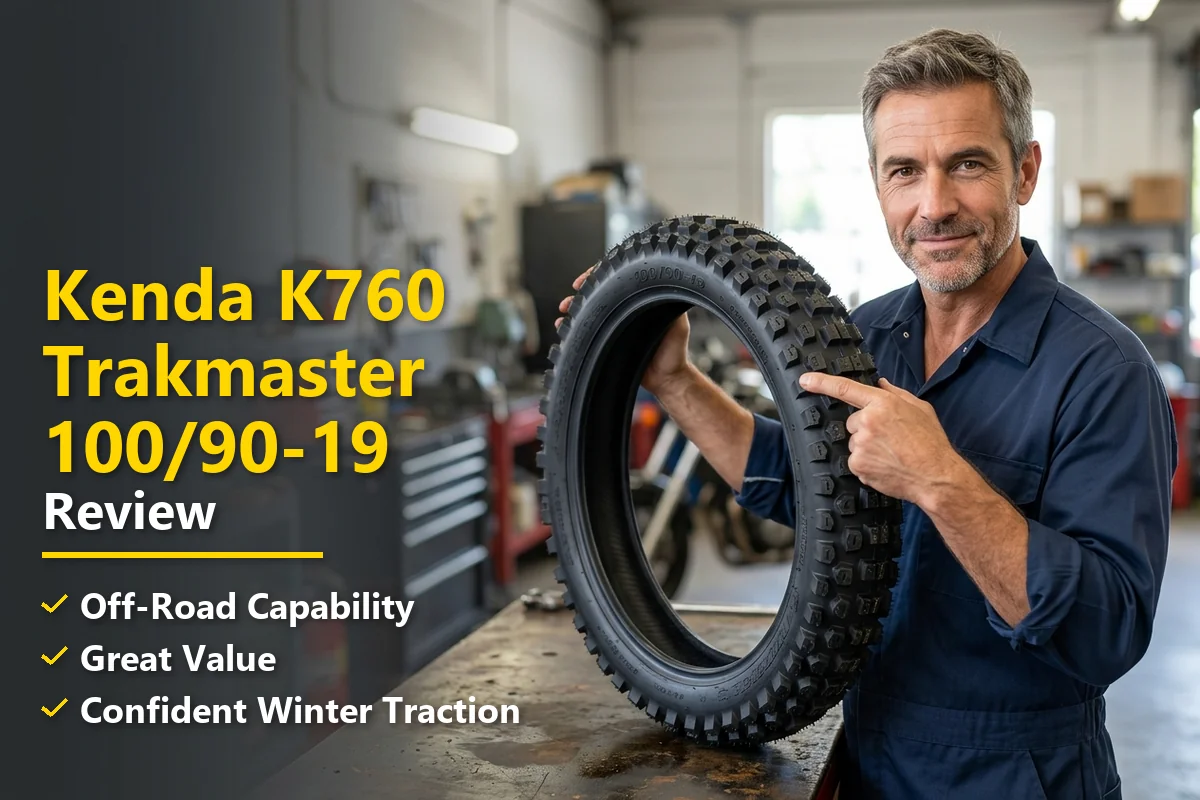
If you’ve ever found yourself spinning your rear wheel in a muddy rut or losing confidence on a rocky downhill, you know how much your tire choice matters. The wrong tire can turn a fun weekend ride into a white-knuckle survival exercise.
I recently spent an extended period putting the Kenda K760 Trakmaster II in the 100/90-19 size through its paces across a range of off-road conditions, and I want to share exactly what I found — the good, the bad, and everything in between.
If you’re exploring the broader Kenda lineup, our full Kenda Tires Review guide covers every model side by side and can help you compare this tire against other options in their catalog.
- The Kenda K760 Trakmaster II 100/90-19 is a DOT-legal dual-sport/off-road tire that excels in soft-to-intermediate terrain at an excellent price point.
- Aggressive knob pattern delivers impressive traction in mud, sand, and loose dirt.
- On-road comfort is limited — expect vibration and faster wear on pavement.
- Priced around $45–$65 USD depending on retailer, it’s one of the most affordable options in its class.
- Best suited for riders who spend 60% or more of their time off-road.
- Mounting and break-in are straightforward with no unusual issues.
Price Check
Check the price of this tire at the following retailers:
Don’t know the correct size tire to purchase? Start here!
Liked this article?
Add TireAdvise as a preferred source so you see more of our tire reviews and guides on Google.
What Exactly Is the Kenda K760 Trakmaster II?
Before I dive into my hands-on experience, let me lay some groundwork. The Kenda K760 Trakmaster II is a dual-sport and off-road tire designed primarily for dirt bikes and adventure motorcycles. It carries a DOT rating, which means it’s street-legal in all 50 US states, but make no mistake — this tire was built with dirt in mind.
The 100/90-19 size is the front tire fitment most commonly used on mid-size to full-size dirt bikes and dual-sport machines. Think Honda CRF450L, Kawasaki KLX300, Yamaha WR250R, and similar bikes that straddle the line between trail weapon and street commuter.
Kenda, a Taiwanese tire manufacturer with a significant presence in the US market, has been producing the Trakmaster line for years. It’s become something of a cult favorite among budget-conscious off-road riders, and after testing it extensively, I understand why.
First Impressions Out of the Box
When the tire arrived, the first thing I noticed was the sheer aggressiveness of the tread pattern. The tall, widely spaced knobs immediately communicate that this tire means business in the dirt. They’re noticeably taller and more pronounced than what you’d find on a 50/50 dual-sport tire.
The rubber compound felt firm but not rock-hard to the touch. I gave the knobs a squeeze and a flex — they had a slight give that suggested decent conformity over obstacles without being so soft that they’d tear off quickly.
Build quality appeared solid throughout. I inspected the bead area, the sidewall construction, and the knob bases carefully. No flash, no irregularities, no cosmetic issues. For a tire at this price point, the manufacturing quality impressed me right out of the gate.
Weight-wise, it felt comparable to other tires in this category — neither noticeably heavy nor suspiciously light. The 4-ply nylon carcass construction is standard for off-road tires in this class and provides a good balance between flexibility and puncture resistance.
Mounting and Setup
I mounted the Kenda K760 Trakmaster II on a standard 19-inch spoked rim using tire irons. If you’ve mounted off-road tires before, you’ll find this one cooperative. The beads seated without drama using a standard floor pump — no compressor needed, no bead blaster tricks required.
I used rim locks as I always do with tube-type off-road tires, and I’d strongly recommend you do the same. This tire is designed to run with inner tubes, and at lower off-road pressures, a rim lock is essential to prevent the tire from spinning on the rim and tearing the valve stem.
After mounting, I set my initial street pressure at 30 PSI for the break-in period and planned to experiment with lower pressures off-road. The tire balanced well with minimal weight needed.
On-Road Performance: Honest Assessment
Let’s address the elephant in the room first. If you’re buying the Kenda K760 Trakmaster II expecting a smooth, quiet highway tire, you’re going to be disappointed. This is fundamentally an off-road tire that happens to be street-legal.
Road Noise and Vibration
On pavement, the tire produces a noticeable hum that increases with speed. At highway speeds around 55-65 mph, the drone is clearly audible even through a full-face helmet. It’s not unbearable, but it’s ever-present.
I also felt a mild vibration through the handlebars that wasn’t there with my previous more street-oriented tire. The tall, aggressive knobs create an inherently uneven contact patch on smooth pavement, and you can feel it.
Pavement Grip
Dry pavement grip was adequate for normal riding. I could brake, accelerate, and navigate turns with reasonable confidence at moderate speeds. The DOT-rated compound provides enough stick for everyday street duties.
Wet pavement, however, is where I exercised extra caution. The widely spaced knob design means there’s less rubber actually touching the road surface compared to a street or 50/50 tire. During a rainy commute, I noticed the front end felt vaguely uncertain in corners. I wouldn’t call it dangerous, but it demanded more attention and smoother inputs.
Pavement Wear Rate
After several days of mixed street and dirt riding, I could already see the leading edges of the center knobs starting to round off from pavement contact. If you’re logging significant street time, expect the knobs to wear down relatively quickly compared to a dedicated street or 50/50 tire.
This is perfectly normal for an aggressive off-road tread pattern. It’s physics, not a defect. The knobs are designed to dig into dirt, not slide across asphalt.
Off-Road Performance: Where This Tire Shines
Now we’re talking. The Kenda K760 Trakmaster II’s natural habitat is dirt, and it performs with genuine enthusiasm once you leave the pavement behind.
Loose Dirt and Gravel
On dry, loose dirt trails, this tire hooks up remarkably well. The tall knobs dig past the loose surface layer and find purchase in the harder-packed soil beneath. I felt confident pushing through corners on fire roads and flowing singletrack, and the tire tracked predictably without sudden breakaway.
Gravel roads, which can feel treacherous on street-biased tires, became far less intimidating. The knobs bite into the gravel bed and provide a much more connected feeling than any 50/50 tire I’ve used in similar conditions.
Mud Performance
Mud is where the K760 Trakmaster’s tread design really earns its keep. The wide spacing between knobs allows mud to evacuate from the tread quickly, maintaining a relatively clean contact patch rotation after rotation. I’ve ridden through everything from thin, slippery clay to thick, boot-sucking gumbo, and the Trakmaster clawed through impressively.
During one particularly sloppy trail session after heavy rain, I was amazed at how well the tire self-cleaned. Where a tighter tread pattern would pack up and become a mud-caked slick, the K760’s open design shed mud almost continuously. It wasn’t magic — deep enough mud will overwhelm any tire — but it was noticeably better than several more expensive tires I’ve used in similar conditions.
Sand
In sandy washes and desert terrain, the Trakmaster performed well. The front tire floated over soft sand better than I expected, and the aggressive knob edges provided enough directional control to maintain a chosen line. I dropped pressure to around 15 PSI for deep sand sections, which widened the footprint and improved flotation significantly.
Rocky Terrain
On rocky trails, I had mixed feelings. The tire’s compliance over sharp rocks was decent, and the knobs gripped well on dry rock faces. However, on wet rocks, I experienced some slippage that required careful throttle and body position management.
The 4-ply carcass provides reasonable puncture protection, but I wouldn’t call it bombproof. I didn’t suffer any flats during my test period, but I could feel the tire deflecting around sharper rocks in a way that made me glad I wasn’t running ultra-low pressures over truly gnarly terrain.
Hard-Pack
Hard-packed dirt was the one off-road surface where I felt the K760 was slightly outclassed by some competitors. On bone-dry, hardpan trails, the tall knobs don’t have enough soft material to dig into, and the tire relies more on its rubber compound for grip. It worked, but it didn’t provide the same confidence-inspiring bite as it did in softer terrain.
Durability and Longevity
Over my extended test period, which included a mix of street commuting, fire road exploration, and dedicated trail riding, the Kenda K760 Trakmaster II held up well. No knobs tore off, no sidewall damage, and no unusual wear patterns developed.
The knob edges did round slightly from street use, as I mentioned, but the overall tread depth remained healthy. Based on my experience, riders who keep this tire primarily on dirt should see respectable longevity. Those who ride mostly on pavement will burn through the tread significantly faster.
I should note that longevity on any aggressive knobby tire is heavily influenced by riding style, terrain, tire pressure, and the ratio of street-to-dirt riding. Aggressive riders on hard terrain will wear any tire faster than conservative riders on softer surfaces.
How It Compares to the Competition
No tire review is complete without context. Here’s how the Kenda K760 Trakmaster II 100/90-19 stacks up against some of its most common competitors in the US market:
| Feature | Kenda K760 Trakmaster II | Dunlop D606 | Shinko 244 | Pirelli MT21 |
|---|---|---|---|---|
| Approximate Price (USD) | $45–$65 | $80–$100 | $40–$55 | $90–$120 |
| DOT Legal | Yes | Yes | Yes | Yes |
| Off-Road Bias (%) | 80/20 | 90/10 | 50/50 | 80/20 |
| Mud Performance | Excellent | Excellent | Fair | Very Good |
| Street Comfort | Fair | Poor | Good | Fair |
| Durability | Good | Very Good | Good | Very Good |
| Value for Money | ⭐⭐⭐⭐⭐ | ⭐⭐⭐⭐ | ⭐⭐⭐⭐⭐ | ⭐⭐⭐ |
Kenda K760 vs. Dunlop D606
The Dunlop D606 is arguably the gold standard in the DOT knobby category, and I’ve run D606s on multiple bikes over the years. In a head-to-head comparison, the D606 edges out the K760 in overall off-road grip, especially on hard-pack, and its knobs seem to last slightly longer in abrasive conditions.
However, the D606 costs roughly $30–$50 more depending on the retailer. For riders who want “good enough” off-road performance at a substantially lower price, the Kenda K760 delivers about 85-90% of the D606’s capability for 50-60% of the cost. That math makes a lot of sense, especially if you go through tires frequently.
Kenda K760 vs. Shinko 244
The Shinko 244 is another budget-friendly option that I’ve tested, but it’s a true 50/50 tire. It’s significantly more comfortable on the street and wears slower on pavement. However, the moment you hit real dirt — especially mud or soft terrain — the K760 leaves the Shinko 244 in the dust (literally). If your riding is predominantly off-road, the K760 is the better choice. If it’s mostly street with occasional dirt roads, the Shinko 244 might serve you better.
Kenda K760 vs. Pirelli MT21
The Pirelli MT21 is a premium tire with a premium price tag. It offers slightly better all-around performance and arguably superior carcass construction, but at nearly double the price of the K760 Trakmaster. I consider the MT21 the better tire in absolute terms, but the K760 offers far better value per dollar. For most recreational riders, the performance difference won’t justify the price gap.
Who Should Buy the Kenda K760 Trakmaster II 100/90-19?
Based on my testing, here’s who I think will be happiest with this tire:
- Budget-conscious dual-sport riders who want genuine off-road capability without breaking the bank.
- Trail riders who need a DOT stamp for highway transit to trailheads but spend most of their time in the dirt.
- Riders in soft terrain areas — if you frequently encounter mud, sand, or loose soil in your region, this tire will serve you well.
- Beginners and intermediate riders who are still developing their off-road skills and don’t want to invest in premium rubber while they’re still learning and potentially going through tires faster.
- Riders who change tires frequently — if you burn through knobbies every season anyway, why not save money on each replacement?
Who Should Look Elsewhere?
The K760 Trakmaster II is not for everyone. I’d steer you toward other options if:
- You ride primarily on pavement — a 50/50 tire like the Shinko 244 or Continental TKC80 will be more comfortable and last longer on the street.
- You’re a competitive enduro or hare scramble racer — you’ll want a dedicated off-road tire without DOT constraints, and you’ll likely need a softer compound for maximum grip.
- You ride mostly on hard-pack or rocky terrain — the K760’s strength is in softer terrain, and there are better options for hard-pack-dominant conditions.
- Road noise is a deal-breaker for you — this tire is noticeably louder than street-oriented or 50/50 dual-sport tires.
Tire Pressure Recommendations
Finding the right pressure made a significant difference in how this tire performed across different surfaces. Here’s what worked best for me during my testing:
- Street riding: 28–32 PSI. This provided the best balance of wear resistance, stability, and comfort on pavement.
- Fire roads and gravel: 22–25 PSI. Dropping pressure slightly improved comfort and traction on unpaved roads.
- Trail riding (moderate terrain): 16–20 PSI. This range gave me excellent grip and compliance over roots, rocks, and uneven surfaces.
- Deep sand or mud: 12–15 PSI. Going low increased the footprint dramatically and improved flotation. Always use a rim lock at these pressures.
These are starting points based on my experience with my specific bike and weight. Your ideal pressures may vary depending on your motorcycle, your weight with gear, and the specific terrain conditions. I always recommend carrying a small tire pressure gauge and experimenting to find your sweet spot.
Installation Tips
If you’re mounting this tire yourself (which I highly encourage — it’s a valuable skill), here are a few tips from my experience:
- Use quality tire irons. Cheap irons flex and make the job harder. I use Motion Pro irons and they’ve never let me down.
- Lubricate the beads generously. Dish soap and water works fine, but dedicated tire mounting lubricant is even better.
- Pay attention to the rotation arrow. The K760 has a directional tread pattern. Mount it backward and you’ll lose significant mud-clearing capability. The rotation arrow is clearly marked on the sidewall.
- Don’t forget your rim lock. At off-road pressures, the tire can spin on the rim without one, shearing your valve stem.
- Break in the tire gently. New tires have a mold release agent on the surface that reduces grip until it wears off. I spent my first ride at moderate speeds and avoided aggressive cornering for the initial outing.
Where to Buy in the US
The Kenda K760 Trakmaster II 100/90-19 is widely available through US retailers. Here are the most common sources where I’ve seen competitive pricing:
- RevZilla — Typically competitive pricing with excellent customer service and free shipping thresholds.
- Rocky Mountain ATV/MC — Often has the best prices, especially during sales events.
- Amazon — Convenient and frequently price-competitive, though verify the seller is reputable.
- Cycle Gear — Good if you want to buy in person and inspect before purchasing.
- Dennis Kirk — Another solid online option with regular promotions.
At the time of my testing, prices ranged from approximately $45 to $65 depending on the retailer and any active promotions. That’s a genuine bargain for a DOT-rated aggressive knobby tire.
Key Specifications at a Glance
- Tire Size: 100/90-19
- Position: Front
- Construction: Bias-ply, 4-ply nylon
- Tube Type: Yes (requires inner tube)
- DOT Rated: Yes — street legal in all US states
- Load Rating: 57M
- Tread Pattern: Aggressive knobby, directional
- Rim Diameter: 19 inches
- Recommended Use: Off-road/dual-sport (80/20 dirt/street)
Final Verdict: My Honest Take
After spending considerable time with the Kenda K760 Trakmaster II in the 100/90-19 size, I can confidently say it’s one of the best values in the DOT knobby tire market today. It won’t dethrone the Dunlop D606 as the off-road king, and it’s not going to win any awards for highway comfort. But that’s not what it’s trying to be.
What it is — and what it does exceptionally well — is deliver aggressive off-road traction at a price that makes it almost a no-brainer for budget-conscious riders. The mud performance alone justifies the purchase for riders in wetter climates, and the overall versatility across soft-to-intermediate terrain is impressive.
I’d give the Kenda K760 Trakmaster II 100/90-19 a solid 4 out of 5 stars. It loses a point for limited hard-pack grip and the expected street compromises, but it earns top marks for value, mud performance, and overall off-road capability at its price point.
If you’re a dual-sport rider who spends more time on dirt than pavement and you don’t want to spend premium-tire money every time you need fresh rubber, the K760 Trakmaster II deserves a spot at the top of your shortlist. I plan to buy another one when this one wears out — and that’s the most honest endorsement I can give any tire.
Frequently Asked Questions
How does the Kenda K760 Trakmaster 100/90-19 perform in off-road conditions?
The Kenda K760 Trakmaster 100/90-19 is designed as an aggressive dual-sport and off-road tire, and it delivers excellent traction in dirt, mud, sand, and loose gravel. The widely spaced knob pattern sheds mud quickly, which keeps you gripping through soft terrain common across US trails and desert riding areas. In my experience, it handles technical single-track and hard-pack surprisingly well for its price point, making it a go-to for budget-conscious off-road riders.
Is the Kenda K760 Trakmaster 100/90-19 DOT approved for street use in the US?
Yes, the Kenda K760 Trakmaster 100/90-19 is DOT approved, which means it is fully legal for highway and street use across all US states. That said, it is primarily an off-road-oriented tire, so on-road performance—especially on wet pavement—is noticeably limited compared to a dedicated street tire. If your riding split is mostly off-road with occasional road transitions, it works well, but I would not recommend it as a primary street tire.
How much does the Kenda K760 Trakmaster 100/90-19 cost compared to other dual-sport tires?
The Kenda K760 Trakmaster 100/90-19 typically retails between $45 and $65 in the US, making it one of the most affordable off-road and dual-sport tires in its size. Comparable tires like the Dunlop D606 or Pirelli MT21 often cost $80 to $110 or more, so the Kenda offers significant savings. For riders who go through rear tires quickly on trails, this lower price point makes it easy to replace without hesitation.
What bikes does the Kenda K760 Trakmaster 100/90-19 fit?
The Kenda K760 Trakmaster 100/90-19 is a front tire size that fits a wide range of popular dual-sport and enduro motorcycles, including the Kawasaki KLR650, Honda XR650L, Suzuki DR650, and many KTM adventure models. Always verify your specific bike’s recommended tire size in the owner’s manual before purchasing. It mounts on standard 19-inch front rims using a tube, as this is a tube-type tire.
How long does the Kenda K760 Trakmaster 100/90-19 last on mixed terrain?
Tread life on the Kenda K760 Trakmaster 100/90-19 varies based on riding conditions, but most US riders report getting between 2,000 and 4,000 miles on mixed dirt and pavement use. Aggressive knobby tires like this naturally wear faster on asphalt, so if you ride significant highway miles, expect the lower end of that range. For purely off-road use the tire holds up well, and at its price point the tread life is considered very reasonable.
How does the Kenda K760 Trakmaster compare to the Dunlop D606 for off-road riding?
The Kenda K760 Trakmaster and the Dunlop D606 are frequently compared among US dual-sport riders, and each has strengths. The D606 tends to offer slightly better tread durability and marginally more confidence on wet pavement, but the K760 provides comparable off-road grip in dirt and mud at nearly half the price. If you prioritize value and ride mostly off-road, the Kenda K760 is hard to beat, while the D606 may edge it out for riders who log more street miles.
Is the Kenda K760 Trakmaster 100/90-19 a tube-type or tubeless tire?
The Kenda K760 Trakmaster 100/90-19 is a tube-type tire, so you will need to run an inner tube with it. Most dual-sport and enduro bikes that take this size use spoked rims, which require tubes anyway. Make sure you purchase the correct size heavy-duty inner tube—a 100/90-19 or 110/90-19 tube works well—and consider carrying a patch kit if you ride remote US trails where help is far away.
