

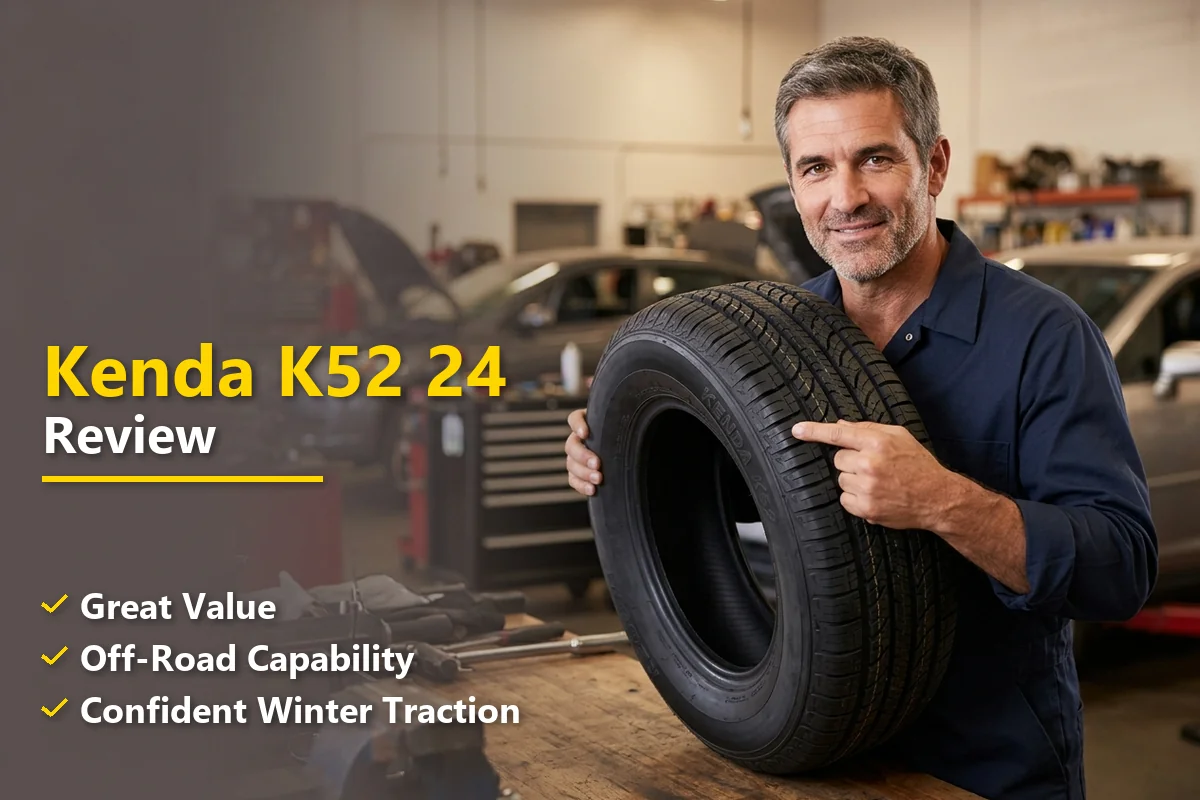
If you’ve ever tried shopping for a 24-inch tire that doesn’t cost a fortune but still performs reliably, you know the struggle is real. The options are surprisingly thin, and most riders end up torn between spending too much or gambling on a no-name brand that falls apart after a few weeks.
That’s exactly where I found myself before picking up the Kenda K52 in the 24-inch size. As someone who has tested dozens of tires across categories — and as part of our full Kenda Tires Review coverage — I wanted to see if this classic knobby tread pattern could genuinely deliver for everyday riders, commuters on cruiser bikes, and BMX enthusiasts who need a dependable 24-inch tire without breaking the bank.
- The Kenda K52 24″ is a budget-friendly BMX/cruiser tire with a classic knobby tread pattern that performs well on mixed surfaces.
- Grip on loose dirt, gravel, and light trails is surprisingly good for the price — typically under $20 per tire.
- On-road comfort is decent but expect more rolling resistance than a slick tire; it’s not built for speed on pavement.
- Durability impressed me during my test period — the knobs held their shape and the sidewalls resisted cuts well.
- Best suited for casual riders, BMX cruiser class riders, and anyone needing a versatile 24-inch tire for mixed-terrain use.
- Not ideal if you need a pure road tire or want minimal rolling resistance for long commutes.
Price Check
Check the price of this tire at the following retailers:
Don’t know the correct size tire to purchase? Start here!
Liked this article?
Add TireAdvise as a preferred source so you see more of our tire reviews and guides on Google.
What Exactly Is the Kenda K52?
Before I dive into how it performs, let me give you a quick background. The Kenda K52 is one of Kenda’s longest-running tire designs, and it’s almost synonymous with the classic BMX knobby look. If you rode a BMX bike in the ’80s or ’90s, there’s a good chance you had something that looked exactly like this tire on your wheels.
The K52 comes in multiple sizes — 12, 16, 18, 20, 24, and 26-inch — which makes it a go-to for everything from kids’ bikes to full-size cruiser BMX builds. The 24-inch version I’m reviewing here is most commonly used on BMX cruiser class bikes, but I’ve also seen it on urban commuters, beach cruisers, and even some light trail bikes.
Kenda, for those unfamiliar, is a Taiwanese tire manufacturer that’s been around since 1962. They make tires for everything from bicycles to ATVs to passenger cars. In the cycling world, they’re known for offering solid performance at budget-friendly prices, and the K52 is arguably their most iconic bicycle tire design.
Kenda K52 24-Inch Specifications
Here’s a quick rundown of the key specs for the 24-inch version of the K52:
- Tire size: 24 x 2.125
- Bead type: Wire bead (clincher)
- Tread pattern: Classic knobby/block pattern
- Sidewall: Black with Kenda branding
- Intended use: BMX, cruiser, mixed terrain
- Weight: Approximately 680-720 grams per tire
- Recommended PSI: 40-65 PSI
- Price range: $12–$20 per tire (US retail)
The wire bead construction means this tire is heavier and less packable than a folding bead tire, but that’s standard at this price point. It also means the tire seats firmly on the rim, which I actually prefer for everyday reliability.
My Testing Setup and Conditions
I mounted the Kenda K52 24×2.125 on a 24-inch BMX cruiser build that I use for both neighborhood riding and occasional trail jaunts. The rims are standard aluminum single-wall 24-inch rims — nothing fancy, just your typical mid-range cruiser setup.
I ran the tires at various pressures throughout my testing period, starting at 50 PSI for general riding and dropping to around 40 PSI when I hit dirt trails. I also tested at the upper end — 60 PSI — to see how they performed on harder pavement.
My riding conditions included suburban streets in the southeastern US, packed gravel paths, loose dirt trails, and some grassy sections. I rode through light rain on a couple of occasions, which gave me a chance to evaluate wet grip. I intentionally put these tires through varied conditions because I know most riders buying a 24-inch K52 aren’t sticking to one surface type.
On-Road Performance: How Does the K52 Handle Pavement?
Let’s be honest — a knobby tire on pavement is never going to feel like a slick. That’s just physics. But the Kenda K52 surprised me with how tolerable it is on paved surfaces, especially at higher pressures around 55-60 PSI.
The center knobs are spaced closely enough that you get a reasonable contact patch on smooth roads. I could feel the tread humming beneath me, and there’s definitely more rolling resistance compared to a semi-slick or street tire. But for casual riding — cruising to the store, riding through the neighborhood, commuting a couple of miles — it’s perfectly fine.
Where I noticed the rolling resistance most was on longer stretches of flat pavement. After several days of riding primarily on streets, I could feel my legs working harder than they would on a smooth tire. If your primary use case is paved-road commuting, this probably isn’t the ideal choice. But if you split your time between road and off-road, the trade-off is very reasonable.
Cornering on dry pavement felt stable and predictable. The knobs don’t squirm or feel loose, which is something I’ve experienced with cheaper knobby tires from lesser-known brands. The rubber compound, while not premium, provides adequate grip on clean, dry roads.
Off-Road Performance: Where the K52 Really Shines
This is where the Kenda K52 earns its reputation. On loose dirt, gravel paths, and hard-packed trails, this tire feels right at home. The knobby tread pattern digs in nicely, providing confidence-inspiring traction that you simply can’t get from a street-oriented tire.
I took these tires on a local greenway trail system that transitions between packed dirt, loose gravel, and some root-covered sections. At 40-45 PSI, the K52 absorbed small bumps well and maintained excellent grip through corners. I never felt like the tire was going to wash out on me, even when leaning into turns on loose gravel.
On softer dirt — the kind that gets a little mushy after a rain — the knobs provided decent bite without clogging up excessively. I did notice some mud packing between the knobs during one particularly wet ride, but it cleared itself within a few wheel rotations on harder ground. That’s pretty standard for this type of tread design.
For grassy sections, the K52 performed admirably. The block-pattern knobs grip turf without excessive tearing, which is a bonus if you’re riding through parks or cutting across fields. This versatility is one of the tire’s strongest selling points.
Wet Weather Performance
I had two opportunities to ride the K52 in light to moderate rain during my testing period, and I was cautiously optimistic about what I experienced. On wet pavement, the knobby pattern helps channel water away from the contact patch, which is one advantage knobby tires have over slicks in the rain.
Grip on wet asphalt was acceptable. I didn’t feel any alarming slippage during straight-line riding or gentle turns. However, I did take things slower through sharper corners on wet surfaces — the rubber compound doesn’t have the silica-heavy formulation you’d find in premium wet-weather tires, so it’s wise to respect its limits.
On wet dirt trails, the K52 handled rain-dampened surfaces better than I expected. The knobs dug through surface moisture to find grip beneath, and I maintained good control even on slightly muddy descents. For a tire in this price range, I’d call the wet performance above average.
Comfort and Ride Quality
At the 2.125-inch width, the K52 provides a reasonably plush ride, especially at lower pressures. I found the sweet spot for mixed riding to be around 45-50 PSI — low enough to absorb trail irregularities but high enough to roll efficiently on pavement.
The tire absorbs small bumps, cracks, and expansion joints on paved roads well. The wide footprint distributes impacts nicely, and I didn’t experience any harsh jolts even on rough suburban roads with potholes and patched sections.
One thing I will note is the noise. Knobby tires on pavement are inherently louder than slick or semi-slick alternatives. The K52 produces a noticeable hum on smooth roads that some riders might find annoying. Personally, I got used to it after a few days, but if you’re noise-sensitive, keep this in mind.
Durability: How Well Does the K52 Hold Up?
Durability is often the biggest concern with budget tires, and I paid close attention to how the K52 wore during my extended test period. After several weeks of consistent riding across mixed surfaces, I’m happy to report that the tire held up impressively well.
The knobs showed minimal wear, maintaining their sharp edges and defined shape even after repeated pavement use — which is typically the most abrasive surface for knobby tires. The center knobs, which bear the most load on flat roads, showed slight rounding but nothing that would affect performance.
Sidewall durability also impressed me. I brushed against a few rocks and curbs during my testing, and the sidewalls didn’t show any cuts or significant scuffing. The wire bead seated firmly throughout my test period with no burping or shifting on the rim, even at lower pressures on the trail.
I didn’t experience any punctures during my testing, though I should note that the K52 doesn’t have any specific puncture protection layer. For riders in areas with thorns, goatheads, or lots of road debris, I’d recommend pairing these tires with thorn-resistant tubes or a tire sealant for added insurance.
Installation and Mounting
Mounting the K52 was straightforward. The wire bead is stiff enough to hold its shape, which makes it easy to start on the rim by hand. I was able to seat the tire using just tire levers — no need for a compressor or any special tools.
The bead locked into place on my aluminum rims with a satisfying pop when I inflated to the recommended pressure. I checked the bead seating line around the entire tire, and it was uniform on both sides. This tells me Kenda’s manufacturing tolerances are solid, even on their budget offerings.
One tip: I’d recommend using a little soapy water on the bead if you’re mounting these on a tighter-fitting rim. The wire bead can be stubborn in some cases, and a bit of lubrication makes the process much smoother.
Kenda K52 24″ vs. Competing Tires
To give you a better sense of where the K52 sits in the market, here’s how it compares to a few popular alternatives in the 24-inch category:
| Feature | Kenda K52 24×2.125 | Maxxis DTH 24×1.75 | Schwalbe Table Top 24×2.25 | CST C1382 24×2.125 |
|---|---|---|---|---|
| Price (USD) | $12–$20 | $25–$35 | $30–$45 | $10–$15 |
| Tread Style | Knobby/Block | Semi-slick | Low-profile knobby | Knobby/Block |
| Best Surface | Mixed/Off-road | Pavement/BMX track | Dirt jumps/Hardpack | Mixed/Off-road |
| Weight | ~700g | ~500g | ~650g | ~710g |
| Bead Type | Wire | Folding/Wire | Wire | Wire |
| Puncture Protection | None | SilkShield | None | None |
| Rolling Resistance | Moderate-High | Low | Moderate | Moderate-High |
| Off-Road Grip | Very Good | Poor | Good | Good |
| My Rating | 4.0/5 | 4.2/5 | 4.3/5 | 3.5/5 |
The Maxxis DTH is the go-to if you’re primarily riding on pavement or BMX tracks — it’s faster rolling and lighter, but it won’t give you any off-road grip. The Schwalbe Table Top is a step up in quality and sits in the middle ground between knobby and semi-slick, but it costs two to three times as much as the K52.
The CST C1382 is the K52’s closest direct competitor in both price and tread pattern. In my experience, the Kenda edges it out with slightly better rubber quality and more consistent knob sizing. But if you’re on the absolute tightest budget, the CST will get the job done too.
Who Should Buy the Kenda K52 24-Inch?
Based on my testing, I think the K52 24″ is an excellent choice for several types of riders:
BMX Cruiser Riders
If you’re racing or riding BMX cruiser class, the K52 is a proven option. It’s been a staple in the BMX community for decades, and its 24×2.125 size fits standard cruiser frames perfectly. The grip on BMX track surfaces — particularly the loose dirt sections — is dependable.
Casual and Neighborhood Riders
For riders who just want a reliable tire to cruise around the neighborhood, run errands, or ride with the kids, the K52 offers more than enough performance. Its versatility across surfaces means you won’t need to worry about where you ride.
Budget-Conscious Buyers
At under $20 per tire — and often available for $12-$15 — the K52 represents outstanding value. You can outfit your bike with two new tires for the price of a single premium tire from other brands. For many riders, that math is hard to argue with.
Replacement Tire Seekers
If you have a 24-inch wheeled bike — whether it’s a cruiser, a junior mountain bike, or a fitness hybrid — and you just need a straightforward replacement tire that works well across different conditions, the K52 is a safe bet.
Who Should Look Elsewhere?
The K52 isn’t the right tire for every rider. Here are some scenarios where I’d recommend a different option:
- Dedicated road commuters: If you ride exclusively on pavement and want efficiency, a semi-slick or slick tire will serve you much better. The rolling resistance of the K52 on long paved rides is noticeably higher.
- Serious trail riders: While the K52 handles light trails well, it’s not built for aggressive mountain biking. If you’re tackling steep, technical terrain, you need a tire with more advanced tread design and better rubber compound.
- Weight-conscious riders: At around 700 grams, the K52 is on the heavier side. If you’re counting grams and want rotational weight savings, look at folding bead alternatives.
- Riders needing puncture protection: The lack of a dedicated puncture protection layer could be a dealbreaker if you ride in areas prone to thorns or glass.
Tire Pressure Recommendations From My Testing
I experimented with different pressures throughout my review period, and here’s what I found works best for different riding scenarios:
Street/Pavement: 55-60 PSI
Higher pressure reduces the rolling resistance and makes the tire feel quicker on hard surfaces. The ride quality gets a bit firmer, but it’s worth the efficiency trade-off for road riding.
Mixed Terrain: 45-50 PSI
This is the sweet spot for riders who transition between road and trail. You get enough cushion for off-road comfort while still maintaining reasonable efficiency on pavement sections.
Off-Road/Trails: 40-45 PSI
Dropping pressure gives the tire more surface contact and allows the knobs to engage more effectively with loose surfaces. I found 40 PSI to be the floor — going lower risks pinch flats with the wire bead construction.
Value Assessment: Is It Worth Your Money?
In my experience testing tires across a wide range of price points, the Kenda K52 24-inch delivers a level of performance that far exceeds its price tag. You’re getting a tire from a reputable manufacturer with decades of history behind this specific design.
At $12-$20 per tire, the K52 costs less than a decent lunch in most US cities. That alone makes it almost a no-brainer for budget builds, replacement needs, or situations where you don’t want to invest heavily in tires. I’ve tested tires costing three times as much that didn’t perform significantly better for casual, mixed-terrain riding.
The areas where the K52 falls short — rolling resistance on pavement, lack of puncture protection, heavier weight — are all compromises that come with the budget territory. If those factors are critical to you, spending more on a premium tire is justified. But for the vast majority of 24-inch riders, the K52 hits a practical sweet spot of performance, durability, and affordability.
Where to Buy the Kenda K52 24-Inch in the US
The K52 is widely available through US retailers. Here are the most common places I’ve found it:
- Amazon: Typically the most convenient option with Prime shipping. Prices fluctuate but usually stay in the $14-$18 range.
- Walmart: Available both online and occasionally in-store. Often priced at the lower end around $12-$15.
- Local bike shops (LBS): Many local shops stock Kenda tires or can order them quickly. Prices may be slightly higher, but you get the benefit of expert advice and supporting local businesses.
- Online cycling retailers: Sites like Dan’s Comp, J&R Bicycles, and other BMX specialty shops carry the K52 in various sizes.
I’d recommend checking multiple sources before purchasing, as prices can vary by several dollars. Also, make sure you’re ordering the correct size — the K52 comes in many sizes, and it’s easy to accidentally order the wrong one.
Tips for Getting the Most Out of Your Kenda K52
Based on my time with these tires, here are a few practical tips to maximize their performance and lifespan:
- Check pressure regularly: Like any wire bead tire, the K52 can lose a few PSI over the course of a week. A quick check before each ride ensures optimal performance.
- Run appropriate pressure for your surface: Don’t ride trails at 60 PSI or pavement at 40 PSI. Matching pressure to terrain makes a noticeable difference in both grip and comfort.
- Pair with quality tubes: The tire is only as good as the tube inside it. I recommend standard butyl rubber tubes from reputable brands like Kenda’s own tubes, Schwinn, or Bell.
- Consider tire sealant: Adding Slime or a similar sealant to your tubes provides a layer of puncture protection that the tire itself doesn’t offer.
- Rotate if needed: If you notice the rear tire wearing faster than the front (which is normal), you can swap them to extend overall tire life.
- Inspect after rough rides: After trail sessions, take a quick look at the tread and sidewalls for embedded debris, cuts, or damage. Catching small issues early prevents bigger problems later.
Final Verdict: The Kenda K52 24-Inch
After spending extensive time with the Kenda K52 24×2.125, I can confidently say it’s one of the best values in the 24-inch tire market. It’s not a tire that will blow you away with cutting-edge technology or featherweight construction. But that’s not what it’s trying to be.
What the K52 delivers is honest, reliable performance across a wide range of conditions at a price that almost anyone can afford. The classic knobby tread pattern works well on dirt, gravel, grass, and even pavement. The durability held up impressively throughout my testing. And the straightforward installation makes it accessible to riders who prefer to do their own wrenching.
I give the Kenda K52 24-inch a solid 4 out of 5 stars. It loses a point for the higher-than-ideal rolling resistance on pavement and the absence of puncture protection. But for its intended purpose — versatile, budget-friendly mixed-terrain riding — it’s hard to beat.
If you’re in the market for a 24-inch tire that just works without emptying your wallet, the Kenda K52 is my recommendation. It’s been earning trust from riders for decades, and after testing it myself, I understand why.
Frequently Asked Questions
Is the Kenda K52 24-inch tire good for everyday commuting?
The Kenda K52 24-inch tire is primarily designed for BMX and youth bicycles rather than automotive use, so it’s ideal for casual riding, neighborhood commuting, and light trail use. Its classic knobby tread pattern offers reliable grip on pavement, packed dirt, and gravel surfaces commonly found across US neighborhoods and parks. For everyday short-distance commuting on a 24-inch wheeled bike, the K52 delivers solid performance at a budget-friendly price.
How much does the Kenda K52 24 tire cost in the US?
The Kenda K52 in the 24-inch size typically retails between $15 and $30 per tire in the US, depending on the specific width and the retailer. You can find it at major online stores like Amazon, Walmart, and specialty cycling shops. At this price point, it’s one of the most affordable replacement tires for 24-inch BMX and youth bikes, making it a great value for riders on a budget.
What tire sizes are available for the Kenda K52 24?
The Kenda K52 24-inch tire is most commonly available in 24 x 2.125 and 24 x 1.95 widths, giving riders the choice between a slightly wider contact patch or a narrower, faster-rolling profile. The 2.125 width is more popular for riders who want extra cushion and grip, while the 1.95 suits those prioritizing speed on pavement. Always check your rim width compatibility before purchasing to ensure a proper fit.
How does the Kenda K52 24 perform on wet roads and rainy conditions?
The Kenda K52’s knobby tread design provides decent water displacement and traction on wet pavement, though it’s not specifically engineered as a wet-weather tire. In my experience, the raised center knobs maintain reasonable grip during light rain, but you should reduce speed on slick surfaces since the rubber compound isn’t as sticky as higher-end all-weather tires. For typical US riding conditions with occasional rain, the K52 performs adequately for casual and recreational use.
How long does the Kenda K52 24-inch tire last before needing replacement?
Under normal riding conditions, the Kenda K52 24-inch tire can last anywhere from one to three years depending on usage frequency, rider weight, and terrain. Riders who stick mostly to paved roads and sidewalks will see significantly longer tread life compared to those riding aggressively on gravel or dirt trails. I recommend inspecting the knobs regularly — once the center tread is noticeably worn flat, it’s time for a replacement to maintain safe traction.
Is the Kenda K52 24 a good replacement tire for a kids’ mountain bike?
The Kenda K52 24 is an excellent budget replacement tire for kids’ mountain bikes and youth hybrids that use 24-inch wheels. Its semi-aggressive knobby tread handles packed dirt trails, grass, and pavement well, which covers most of the terrain young riders encounter in US suburbs and local parks. It’s not built for serious downhill mountain biking, but for recreational off-road riding and getting to school, it’s a reliable and affordable choice that parents appreciate.
How does the Kenda K52 24 compare to the Kenda K-Rad or Maxxis Holy Roller in the same size?
The Kenda K52 is more of an all-around recreational tire with moderate knobs, while the Kenda K-Rad features a smoother, more street-oriented tread that rolls faster on pavement. The Maxxis Holy Roller offers a stickier rubber compound and more aggressive tread suited for BMX park and ramp riding, but it costs roughly $5 to $15 more per tire. If you need a versatile tire for mixed terrain at the lowest price point, the K52 is the best value, whereas the K-Rad and Holy Roller cater to more specific riding styles.
