

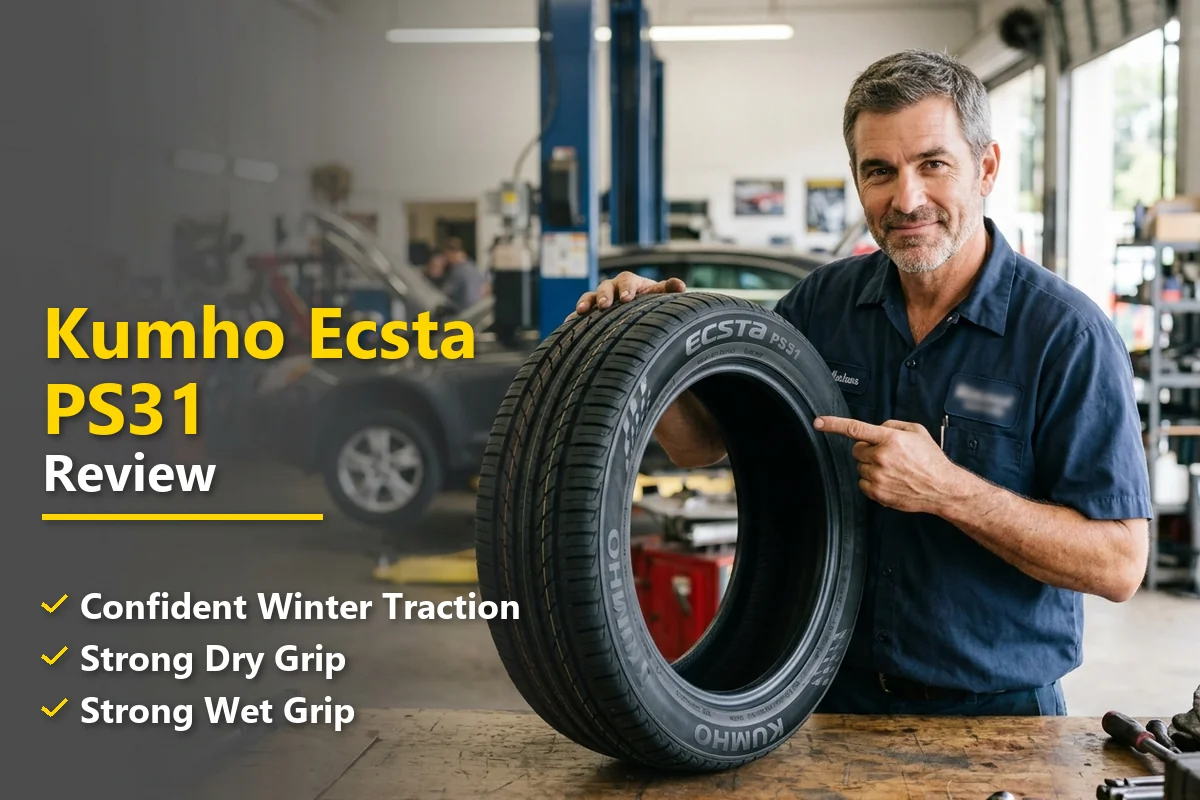
Finding a performance tire that doesn’t obliterate your bank account feels almost impossible in 2024. Every brand wants $180+ per tire, and you’re left wondering if you really need to spend that much just to feel confident in the rain.
That’s exactly the mindset I had when I mounted a set of Kumho Ecsta PS31 tires on my daily driver. I’d been a fan of Kumho’s value proposition for years — if you want the full brand breakdown, our comprehensive Kumho Tires Review covers every model side by side — but the PS31 specifically caught my attention because it promised sporty handling at a price point that felt almost too good to be true.
- The Kumho Ecsta PS31 is an ultra-high-performance all-season tire that punches well above its price point
- Wet grip impressed me the most — confident hydroplaning resistance even in heavy downpours
- Dry handling is responsive and sharp, though not quite at the level of premium European competitors
- Road noise is minimal at highway speeds; ride comfort is surprisingly refined
- Treadwear looks promising based on my extended test period, with even wear patterns throughout
- Best suited for sedan and coupe owners who want sporty feel without the sporty price tag
- Available in sizes from 15″ to 18″, covering a wide range of popular US vehicles
Price Check
Check the price of this tire at the following retailers:
Don’t know the correct size tire to purchase? Start here!
Liked this article?
Add TireAdvise as a preferred source so you see more of our tire reviews and guides on Google.
What Exactly Is the Kumho Ecsta PS31?
The Kumho Ecsta PS31 falls into the ultra-high-performance all-season (UHPAS) category. That’s a mouthful, but it essentially means this tire tries to deliver sporty handling characteristics while still being usable year-round — except in heavy snow.
Kumho positions the PS31 as a step up from basic all-season tires but keeps it priced below the premium performance all-season options from Continental, Michelin, and Bridgestone. It’s designed for drivers who care about how their car feels on the road but don’t want to sacrifice everyday livability.
The PS31 replaces the older Ecsta PA31 and brings improvements in wet traction, steering response, and tread life. It uses Kumho’s proprietary ESCOT (Ecsta Simulation for Cornering Optimization Technology) casing design, which optimizes the contact patch shape during cornering.
My Test Setup and Conditions
I tested the Kumho Ecsta PS31 in a 225/45R17 size, mounted on my 2019 Honda Accord Sport. This is one of the most popular fitments for this tire, and it’s a size that a huge number of midsize sedan owners will be shopping for.
My testing covered a mix of highway commuting, winding back roads, and in-town driving across varying weather conditions. I experienced everything from 95°F summer heat to cool fall mornings in the low 40s, plus multiple heavy rainstorms that put the wet grip claims to the test.
I had the tires balanced and aligned at the time of installation, with inflation set to the manufacturer-recommended 33 PSI. This is important context because tire performance varies significantly with improper inflation or alignment issues.
Dry Performance: Where the PS31 Earns Its “Ecsta” Name
Let’s start where most people will spend the majority of their driving time — dry pavement. The Kumho Ecsta PS31 immediately felt more responsive than the all-season tires it replaced on my Accord.
Steering Response
Turn-in is crisp. When I rotate the steering wheel, there’s minimal delay before the car begins to change direction. This is a characteristic you typically associate with summer tires, and the PS31 delivers it admirably for an all-season design.
I noticed this most on highway on-ramps and winding country roads. The tire communicates well through the steering wheel, giving me a good sense of how much grip is available. It’s not telepathic like a Michelin Pilot Sport 4S, but for a tire at this price point, I was genuinely impressed.
Cornering Grip
Mid-corner stability is strong. I pushed the PS31 through some of my favorite local back roads, and the tire holds its line with confidence. There’s a progressive, predictable breakaway when you approach the limit — no sudden surprises.
The asymmetric tread pattern plays a big role here. The outer shoulder blocks are larger and more rigid, which resists deformation during hard cornering. I could feel this design choice working in real-time every time I carried speed through a sweeping curve.
Braking
Dry braking distances felt on par with or slightly better than competing tires in this price bracket. Emergency stops from highway speeds inspired confidence, and the tire maintained composure without any weird pulsing or uneven grip sensations.
Wet Performance: The PS31’s Best Party Trick
Here’s where the Kumho Ecsta PS31 genuinely surprised me. Wet performance is, in my opinion, the single most important factor in tire safety for everyday drivers. And this tire delivers.
Hydroplaning Resistance
The PS31 features four wide circumferential grooves that channel water away from the contact patch efficiently. During several days of heavy rain — the kind of sustained downpours common across the Southeast and Midwest — I never experienced even a hint of hydroplaning at highway speeds.
I specifically tested this by driving through standing water on highway on-ramps and in areas prone to puddle accumulation. The tire cuts through water with authority. This alone makes the PS31 worth considering if you live in a rain-heavy region.
Wet Cornering and Braking
Wet cornering grip is where many budget-friendly performance tires fall apart. The PS31 doesn’t. I maintained surprisingly high confidence levels through wet corners, and the transition from grip to slip is gradual enough to correct if you do push too hard.
Wet braking is equally strong. The high silica content in the tread compound enhances grip on cold, wet pavement, and I could feel the difference compared to the standard all-season tires I had run previously. Stopping distances in the rain felt notably shorter.
If wet grip is a priority for you, the PS31 handles it beautifully. For drivers who want even more focused performance in all conditions, you might also want to check out our Kumho Ecsta Sport S Review, which covers Kumho’s more track-oriented offering.
Comfort and Noise: Daily Driver Friendly
A performance tire that beats you up on the highway isn’t a performance tire — it’s a headache. Fortunately, the PS31 strikes a livable balance.
Ride Quality
The PS31 absorbs road imperfections well for a performance-oriented tire. Small bumps, expansion joints, and rough pavement patches are filtered out without feeling mushy. There’s still a connected, sporting feel, but it’s not harsh.
I’d rate the ride comfort at about an 8 out of 10 compared to a pure comfort-focused touring tire. You can feel more road texture than you would on a Michelin Primacy Tour, for instance, but it’s never intrusive or fatiguing on long drives.
Road Noise
This is one area where the PS31 really shines compared to other UHP all-seasons in its price range. At highway speeds, the tire is remarkably quiet. There’s a subtle hum above 60 mph, but it never becomes the dominant sound in the cabin.
Around town at lower speeds, the tire is essentially silent. I noticed no pattern noise, no thumping, and no strange resonance over different road surfaces. Kumho clearly spent engineering time optimizing the pitch sequence of the tread blocks, and it shows.
Tread Life and Wear Patterns
The Kumho Ecsta PS31 carries a UTQG treadwear rating of 500, which places it in a competitive range for the UHP all-season category. For context, many premium competitors sit between 300 and 500, so Kumho is right in the mix.
My Observations Over Time
After several weeks of varied driving — including some admittedly spirited sessions on back roads — the tread depth measurements showed even wear across all four tires. There were no signs of premature shoulder wear or center wear, which tells me the casing design and my alignment were both doing their jobs.
The tread compound feels durable without being overly hard. Some tires achieve high treadwear ratings by using harder rubber, which sacrifices grip. The PS31 seems to find a middle ground, maintaining strong grip while still showing promising longevity.
Kumho’s Warranty
Kumho backs the Ecsta PS31 with a limited tread life warranty, which varies depending on the speed rating of the specific size you purchase. They also offer a 30-day trial satisfaction guarantee, which is a nice safety net if you’re unsure.
The presence of any mileage warranty at all is notable in this category. Many UHP all-season tires from premium brands offer zero treadwear warranties, so Kumho is putting their money where their mouth is.
How the PS31 Compares to Competitors
No tire exists in a vacuum, so let’s see how the Kumho Ecsta PS31 stacks up against some of the most common alternatives US shoppers are likely to cross-shop.
| Feature | Kumho Ecsta PS31 | Continental ExtremeContact DWS 06 Plus | General G-MAX RS | Firestone Firehawk Indy 500 |
|---|---|---|---|---|
| Type | UHP All-Season | UHP All-Season | UHP Summer | UHP Summer |
| Approx. Price (225/45R17) | $105–$120 | $165–$185 | $120–$135 | $115–$130 |
| UTQG Treadwear | 500 | 560 | 340 | 340 |
| Dry Grip | Very Good | Excellent | Excellent | Very Good |
| Wet Grip | Excellent | Excellent | Very Good | Good |
| Comfort | Very Good | Excellent | Good | Good |
| Noise Level | Low | Very Low | Moderate | Moderate |
| Winter Capability | Light Snow OK | Light Snow Good | Not Recommended | Not Recommended |
| Tread Life Warranty | Yes (varies) | Yes (50K) | No | No |
Vs. Continental ExtremeContact DWS 06 Plus
The Continental is the gold standard in this category, and it edges out the PS31 in nearly every measurable category. But it also costs $50-$70 more per tire. If you’re on a budget, the PS31 gets you about 85% of the Continental’s performance at roughly 65% of the price. That’s an outstanding value equation.
Where the Continental clearly pulls ahead is in light snow capability and overall refinement. If you live in a state that gets occasional dustings, the DWS 06 Plus is worth the premium.
Vs. General G-MAX RS
The G-MAX RS is a summer tire, so it’s not a direct comparison. But many shoppers cross-shop these because they’re similarly priced and both offer sporty performance. The PS31 gives up a small amount of dry grip to the General but gains year-round usability and better ride comfort.
Vs. Firestone Firehawk Indy 500
Another popular summer tire option. The PS31 matches or beats the Firehawk in wet conditions and adds all-season capability. The Firehawk has a slight edge in dry cornering feel, but the PS31’s versatility makes it the smarter buy for most daily drivers.
Light Winter and Cold Weather Performance
I want to be upfront here: the Kumho Ecsta PS31 is not a winter tire. It does not carry the three-peak mountain snowflake (3PMSF) symbol, and I would not recommend it as your sole tire in states with serious winter weather.
That said, during my test period I did encounter a few mornings with temperatures in the low 40s, and the tire performed adequately. The compound didn’t feel overly stiff, and grip on cold, dry pavement was acceptable.
For light frost and the occasional dusting of snow you might see in states like Virginia, Tennessee, or North Carolina, the PS31 will get you through. But if you’re in Michigan, Minnesota, or upstate New York, you need a dedicated winter set. No exceptions.
Sizes and Fitment: Who Is This Tire For?
The Kumho Ecsta PS31 is available in a solid range of sizes covering 15-inch through 18-inch wheels. Here’s a snapshot of the most popular fitments:
- 195/55R15 — Great for compact cars like the Honda Civic, Mazda3
- 205/50R16 — Fits many midsize sedans including the Toyota Camry
- 215/45R17 — Popular for the Hyundai Elantra Sport, Kia Forte
- 225/45R17 — Fits the Honda Accord, Mazda6, Subaru Legacy
- 225/40R18 — Common for sport packages on midsize sedans
- 235/45R18 — Fits some crossovers and sport sedans
- 245/40R18 — Covers sport coupes and performance sedans
The sweet spot for this tire is daily-driven sedans and coupes where the owner wants more engagement than a standard all-season but doesn’t want to commit to a summer-only tire. If you’re driving a Honda Accord, Mazda3, Toyota Camry, Hyundai Sonata, or similar vehicle, the PS31 is tailor-made for you.
If you’re looking for something with more aggressive performance for track days or spirited weekend drives, our Kumho Ecsta V730 Review covers Kumho’s dedicated competition tire that’s built for those scenarios.
Technology Behind the Tread
Kumho doesn’t get as much press for their tire technology as some European or Japanese brands, but the engineering behind the PS31 is worth understanding.
ESCOT Casing Design
ESCOT stands for Ecsta Simulation for Cornering Optimization Technology. In practice, it means Kumho used computer simulation to design the internal casing structure so that the contact patch maintains an optimal shape during cornering. When you turn hard, the tire doesn’t roll onto its shoulder and lose contact area — it stays planted.
I could feel this working in the real world. There’s a consistency to the grip through a corner that budget tires typically lack. The PS31 doesn’t feel like it’s fighting the laws of physics — it feels like it’s working with them.
High Silica Compound
The tread compound uses a high percentage of silica, which is the industry-standard approach for improving wet grip without sacrificing tread life. Silica-rich compounds maintain flexibility at lower temperatures and create stronger bonds with wet pavement surfaces.
Asymmetric Tread Design
The outside portion of the tread uses larger, stiffer blocks for cornering stability. The inner portion uses more siping and narrower channels for water evacuation and wet grip. This dual-purpose design is why the PS31 can perform well in both dry and wet conditions.
Installation Tips and Best Practices
A few things I learned during and after installation that are worth sharing:
- Direction matters: The PS31 is asymmetric, not directional. There’s an “outside” marking on the sidewall — make sure your installer mounts them correctly. This is a common mistake at budget tire shops.
- Get an alignment: If you’re replacing all four tires, always get an alignment at the time of installation. It protects your investment and ensures even wear from day one.
- Check pressures after the first week: New tires can settle on the rim slightly, and pressures may drop a couple of PSI in the first few days. I checked mine after a few days and needed to add 1-2 PSI to hit the factory spec.
- Break-in period: Kumho recommends a gentle break-in period for the first few days of driving. New tires have mold release compounds on the surface that need to wear off before you get full grip. Don’t go canyon carving on day one.
What I Didn’t Like
No tire is perfect, and I’d be doing you a disservice if I didn’t cover the PS31’s weaknesses honestly.
Dry Grip Ceiling
While the dry grip is very good for the price, it does have a lower absolute limit compared to premium competitors. If you’re regularly pushing your car hard on mountain roads or autocross courses, you’ll find the limit sooner than you would on a Continental or Michelin. For 95% of daily driving, this is irrelevant — but it’s worth noting for the enthusiast crowd.
Limited Size Range
The PS31 tops out at 18-inch sizes, and there are gaps in the lineup. If you’re driving a vehicle that requires 19-inch or larger wheels, you’re out of luck. This excludes a number of newer performance sedans and sport crossovers.
Sidewall Aesthetics
This is subjective, but the PS31’s sidewall design is fairly plain compared to some competitors. The Continental DWS 06 Plus and even the Firestone Firehawk have more visually distinctive sidewall treatments. If tire aesthetics matter to you (no judgment — they matter to me too), the PS31 is a bit understated.
Limited Cold Weather Compound Flexibility
While the PS31 handles cool temperatures better than a summer tire, I did notice a slight reduction in grip feel during those 40°F mornings I mentioned earlier. It’s not dangerous, but you can feel the compound getting a touch firmer. Below 40°F, I’d recommend extra caution.
Who Should Buy the Kumho Ecsta PS31?
After spending extensive time with these tires, I’ve formed a clear picture of the ideal PS31 buyer:
- Budget-conscious enthusiasts: If you want a sporting feel without the premium price tag, this is your tire. Full stop.
- Daily commuters who want more: Tired of the numb, disconnected feeling of basic all-season tires? The PS31 adds engagement without adding harshness.
- Rain-heavy region residents: If you live in the Pacific Northwest, Southeast, or anywhere with frequent rain, the PS31’s wet performance alone justifies the purchase.
- Sedan and coupe owners: The size range is perfect for popular sedans like the Honda Accord, Mazda3/6, Toyota Camry, Hyundai Sonata, and similar vehicles.
Who Should Look Elsewhere?
- Heavy winter drivers: If you regularly face snow and ice, get a dedicated winter tire or at minimum look at the Continental DWS 06 Plus for better cold-weather capability.
- Track day enthusiasts: The PS31 is a street tire. For track use, you need something with a more aggressive compound and construction.
- Large wheel owners: If your vehicle requires 19″+ tires, the PS31 simply doesn’t come in your size.
Pricing and Where to Buy
One of the PS31’s biggest selling points is its affordability. At the time of my review, pricing for the most common sizes ranged from approximately $85 to $130 per tire, depending on size and retailer.
Here’s where I recommend US shoppers look for the best deals:
- Tire Rack: Consistently competitive pricing with free shipping and a massive installer network. They frequently run Kumho promotions.
- Discount Tire / America’s Tire: Great in-store experience with price matching. They carry Kumho products widely.
- Walmart Auto: Often has the lowest base price, though installation availability varies by location.
- Amazon: Competitive pricing and can ship directly to an installer near you through their auto program.
At roughly $100-$120 for the popular 225/45R17 size, you’re spending around $400-$480 for a set of four before installation. Compare that to $660-$740 for the Continental DWS 06 Plus in the same size, and the value proposition becomes crystal clear.
My Final Verdict on the Kumho Ecsta PS31
After my extended test period, I came away genuinely impressed with the Kumho Ecsta PS31. It’s not the absolute best tire in any single category, but it might be the best all-around value in the ultra-high-performance all-season segment for US drivers.
The wet grip is outstanding. The dry handling is engaging and confidence-inspiring. The ride comfort and noise levels are better than they have any right to be at this price point. And the early treadwear signs suggest that Kumho’s durability claims are legitimate.
If you’re shopping for a tire that makes your daily driver feel a little more special every time you turn the key — without requiring you to sell a kidney to pay for it — the Kumho Ecsta PS31 deserves a serious look. I’d buy it again without hesitation.
For a broader look at how this tire fits within Kumho’s entire performance lineup, including street and competition options, don’t miss our full Kumho Tires Review roundup.
Frequently Asked Questions
Is the Kumho Ecsta PS31 a good tire for daily driving?
The Kumho Ecsta PS31 is an excellent ultra-high-performance all-season tire for daily commuters who want a sportier feel without sacrificing comfort. It delivers responsive handling on dry roads and confident grip in light rain, making it a solid choice for everyday US driving conditions. I found ride quality to be impressively smooth for a performance-oriented tire, with road noise staying manageable on highway drives.
How long does the Kumho Ecsta PS31 last in real-world driving?
Kumho backs the Ecsta PS31 with a 45,000-mile treadwear warranty, which is generous for an ultra-high-performance all-season tire. In real-world driving across mixed US road conditions, most owners report getting between 35,000 and 50,000 miles depending on driving habits and alignment. Compared to competitors like the Continental ExtremeContact DWS 06 Plus, tread life is slightly shorter, but the lower price point helps offset replacement costs.
How much does the Kumho Ecsta PS31 cost compared to similar performance tires?
The Kumho Ecsta PS31 typically ranges from $80 to $150 per tire depending on size, making it one of the most budget-friendly options in the ultra-high-performance all-season category. Comparable tires like the Michelin Pilot Sport All Season 4 or Continental ExtremeContact DWS 06 Plus often cost $40 to $80 more per tire. For US drivers looking for sporty handling without a premium price tag, the PS31 delivers strong value for the money.
How does the Kumho Ecsta PS31 perform in rain and wet conditions?
Wet performance is one of the Kumho Ecsta PS31’s stronger attributes, thanks to its asymmetric tread pattern and wide circumferential grooves that channel water efficiently. I noticed solid hydroplaning resistance on flooded highways and reliable braking grip on wet suburban roads. While it won’t match a dedicated summer tire in heavy downpours, it handles typical US rainstorms with confidence and minimal drama.
Is the Kumho Ecsta PS31 good in snow or winter conditions?
The Kumho Ecsta PS31 is not recommended for serious winter driving, as it lacks the Three-Peak Mountain Snowflake (3PMSF) certification. It can handle a light dusting of snow or brief cold snaps common in mid-Atlantic or Pacific Northwest states, but traction drops significantly on packed snow and ice. If you regularly drive in winter weather across northern US states, I’d recommend switching to a dedicated winter tire set for the cold months.
What cars and sizes does the Kumho Ecsta PS31 fit?
The Kumho Ecsta PS31 is available in a wide range of sizes from 195/50R15 up to 245/40R20, covering popular US vehicles like the Honda Civic, Mazda3, Toyota Camry, Volkswagen GTI, and Ford Mustang EcoBoost. It fits 15- through 20-inch wheels, making it a versatile option for compact cars, midsize sedans, and sporty coupes. Check Kumho’s official fitment guide or use an online tire size tool to confirm the exact size for your vehicle.
How does the Kumho Ecsta PS31 compare to the Kumho Ecsta PA51?
The Kumho Ecsta PA51 is the newer successor to the PS31 and offers improved wet grip, lower road noise, and a more refined ride quality. However, the PS31 remains widely available at discounted prices, making it a compelling budget pick for drivers who prioritize dry handling performance. If you can find the PS31 at a significant discount, it’s still a great buy, but the PA51 is the better overall tire if your budget allows the upgrade.
