

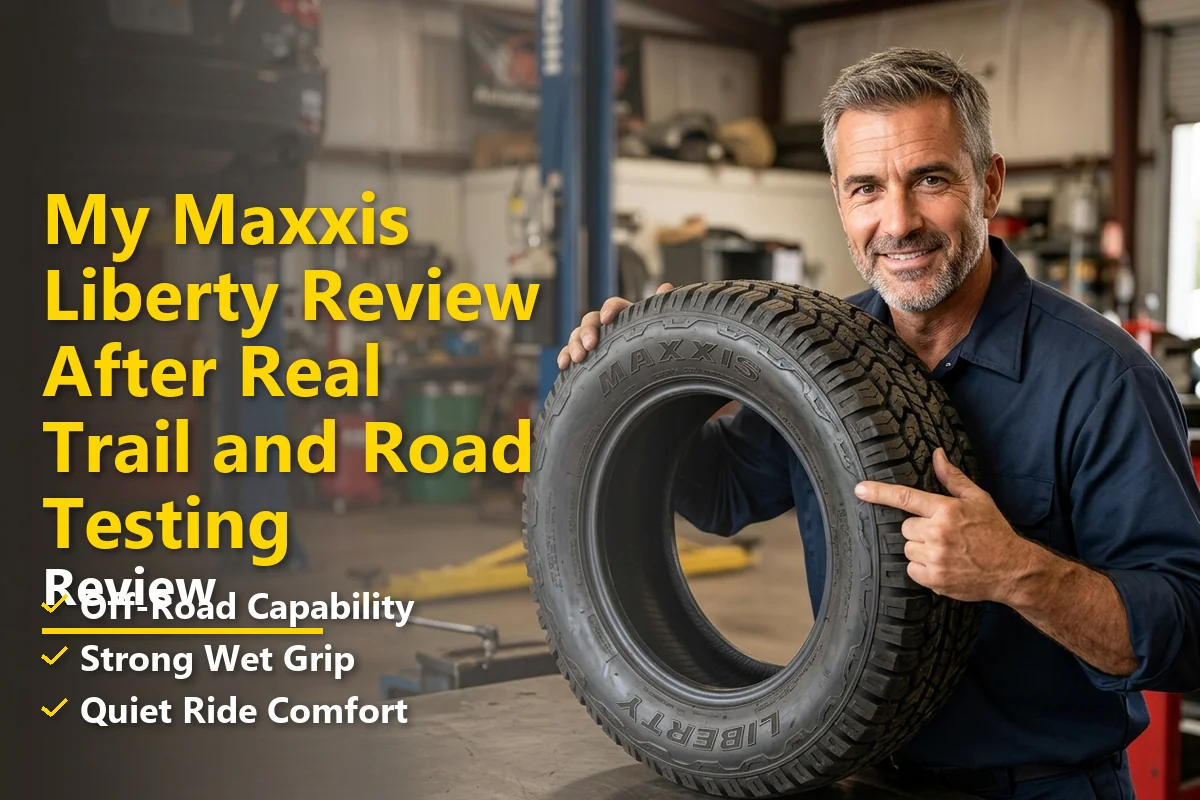
If you’ve ever watched your UTV or side-by-side slide sideways through a sandy corner because your stock tires just couldn’t hook up, you know the frustration. That moment when you realize your tires are the weakest link in your entire setup — it’s humbling, and it’s expensive if it costs you a bent A-arm or worse.
That’s exactly where I was before I bolted on a set of Maxxis Liberty tires. I’d been hearing buzz about them for a while, and after spending serious seat time on them across multiple terrain types, I’m ready to share every detail.
If you’re exploring the broader Maxxis lineup, our full Maxxis Tires Review guide covers every model side by side — but today, I’m going deep on the Liberty specifically.
- The Maxxis Liberty is a premium 8-ply radial UTV/ATV tire designed for desert racing and all-terrain performance.
- Outstanding cornering grip, puncture resistance, and high-speed stability across hardpack, sand, loose gravel, and rocky trails.
- Ride comfort is surprisingly good for an 8-ply tire, though it’s firmer than lighter-ply options at low speeds.
- Tread life has been impressive — the rubber compound holds up well over extended use.
- Priced between $130–$200 per tire depending on size, it’s competitive for what you get.
- Best suited for sport and utility UTVs that see a mix of trail riding, desert running, and moderate mud.
Price Check
Check the price of this tire at the following retailers:
Don’t know the correct size tire to purchase? Start here!
Liked this article?
Add TireAdvise as a preferred source so you see more of our tire reviews and guides on Google.
What Exactly Is the Maxxis Liberty?
The Maxxis Liberty is an 8-ply radial tire purpose-built for UTVs and ATVs that need to perform at speed across mixed terrain. It was originally developed with desert racing in mind — think BITD (Best in the Desert) and WORCS-style competition — but Maxxis designed it to be versatile enough for recreational trail riders who want race-inspired performance without sacrificing daily drivability.
It features a non-directional tread pattern, which means you don’t need to worry about rotation direction during installation. The tread blocks are closely spaced with subtle siping, giving it a look that’s somewhere between an aggressive all-terrain and a smooth desert runner.
Available in popular UTV sizes like 28x10R14, 30x10R14, 29.5×9.5R14, and 32x10R14, it covers most sport and utility side-by-side fitments. The 8-ply rated carcass provides serious puncture resistance without the absurd weight penalty you’d expect.
Key Specifications at a Glance
| Feature | Detail |
|---|---|
| Tire Type | Radial, non-directional |
| Ply Rating | 8-ply |
| Intended Use | Desert, hardpack, rocky trails, light mud, sand |
| Construction | Radial with reinforced sidewalls |
| Popular Sizes | 28x10R14, 29.5×9.5R14, 30x10R14, 32x10R14 |
| Approximate Price (per tire) | $130 – $200 USD |
| Rim Diameter | 14 inches |
| Weight (varies by size) | Approximately 24 – 32 lbs |
My Testing Setup and Conditions
I ran the Maxxis Liberty tires in the 30x10R14 size on a Polaris RZR XP 1000. The machine was mostly stock with the exception of a clutch kit and a half-inch lift. I chose this platform because it’s one of the most popular sport UTVs in the US, and it represents what a typical buyer would be bolting these tires onto.
Over my test period, I drove these tires across hardpack desert in southern Nevada, rocky and rutted trails in Arizona, sandy washes, gravel roads, and even some moderately muddy sections after rain in Utah. I also spent time on paved roads driving to and from trailheads, which gave me a feel for on-road behavior too.
I deliberately pushed these tires in situations where I expected them to fail — sharp rock gardens, deep sand, high-speed whoops, and tight off-camber corners. I wanted to know where the limits were.
On-Trail Performance: Where the Maxxis Liberty Shines
Hardpack and Desert Terrain
This is the Liberty’s home turf, and it absolutely dominates here. The closely spaced tread blocks create a massive contact patch on hard-packed surfaces, which translates to predictable, confidence-inspiring grip even at speed.
During my first few days of testing in the Nevada desert, I was able to carry significantly more speed through sweeping corners than I’d ever managed on the stock tires. The tire doesn’t break loose suddenly. Instead, it gives you progressive feedback — you feel it start to slide, and you can modulate throttle and steering to manage it.
At higher speeds over whoops and rough washboard, the radial construction really pays off. The tire absorbs impacts smoothly and tracks straight. I noticed far less deflection and wandering compared to bias-ply options I’ve used in the past.
Rocky Trails and Sharp Terrain
This is where the 8-ply rating earns its keep. I took the Liberty through several rocky trail sections in Arizona that I’ve used as a proving ground for other tires. I’m talking fist-sized jagged rocks, shelf rock ledges, and loose shale.
After several days of driving over these conditions, I found zero punctures and no visible sidewall damage. The reinforced sidewall construction clearly works. For context, I’ve cut sidewalls on lighter-ply tires in these exact same sections before.
The only trade-off is that the stiffer carcass transmits a bit more vibration through the chassis on slow, technical rock crawling. If rock crawling is your primary activity, a dedicated crawler tire might be better. But for traversing rocky sections as part of a mixed ride, the Liberty handles it impressively.
Sand Performance
I’ll be honest — I didn’t expect the Liberty to perform as well as it did in sand. Its tread pattern isn’t a paddle design, and the closely spaced blocks don’t look like they’d float on soft surfaces. But in practice, the tire’s width and the radial construction allow it to spread its footprint effectively.
In sandy washes, I was able to maintain momentum without excessive tire spin. You do need to keep your speed up — if you slow down too much in deep sand, you’ll start to dig. But that’s true of virtually any non-paddle tire.
For dune riding or deep sugar sand, you’d want a dedicated sand tire. But for the sandy sections you encounter on normal desert trails? The Liberty handles them well.
Mud Performance
Let me set expectations here: the Maxxis Liberty is not a mud tire. It wasn’t designed to be, and if you ride primarily in thick, clay-heavy mud, this is the wrong tire for you.
That said, I did encounter some moderately muddy trail sections after a rain storm in Utah, and the Liberty managed better than I anticipated. The tread blocks are close together, which means mud packs in more easily than on an aggressive lug pattern. But the tire still provided enough traction to get through without getting stuck.
For occasional mud encounters, you’ll be fine. For regular mud riding, look elsewhere.
On-Road Behavior
Many UTV owners trailer to their riding spots, but some of us also drive on paved roads — to gas stations, through small towns, or on county roads to connect trails. The Liberty’s behavior on pavement matters.
I found the on-road ride to be noticeably better than most knobby UTV tires I’ve run. The closely spaced tread pattern produces less vibration and noise on asphalt. It’s not car-tire smooth, but it’s dramatically better than running aggressive lugs on pavement.
Steering response on paved surfaces felt precise and predictable. There’s no vague, wandering feeling you sometimes get with tires designed purely for off-road use. I was comfortable driving on roads at normal speeds without that white-knuckle feeling that aggressive tires can create.
Ride Comfort and Noise
For an 8-ply tire, the Liberty is remarkably comfortable. I expected it to ride like a brick, but the radial construction absorbs a lot of the harshness that a bias-ply 8-ply tire would transmit.
On smooth trails and roads, the ride is genuinely pleasant. On rough terrain, you feel impacts — the tire doesn’t turn your UTV into a Cadillac — but the impacts are well-dampened. There’s a roundness to how it absorbs hits that tells you the radial carcass is doing its job.
Noise levels are low for a UTV tire. On hardpack and pavement, there’s a mild hum, but nothing intrusive. Certainly nothing compared to the roar of a deeply lugged mud tire on the same surfaces.
Tread Life and Durability
I’ve been running the Maxxis Liberty set for an extended period across the conditions I described above, and the tread wear has been remarkably even and slow. The rubber compound is clearly formulated for longevity, not just grip.
After weeks of mixed-terrain riding, the tread depth looked nearly identical to when I first mounted them. The tread blocks showed no chunking, tearing, or irregular wear patterns. The edges of the blocks remained sharp and well-defined.
The sidewalls also showed impressive resilience. Despite multiple encounters with sharp rocks and abrasive terrain, I couldn’t find any meaningful cuts or scuffs beyond cosmetic surface marks.
For the price point, the durability-to-performance ratio is outstanding. I’ve spent more money on tires that wore out faster and performed worse.
How Does the Maxxis Liberty Compare to Competitors?
No tire review is complete without putting the product in context. Here’s how the Liberty stacks up against some of the most popular alternatives in the US UTV tire market.
| Feature | Maxxis Liberty | ITP Coyote | Tensor DS | GBC Mongrel |
|---|---|---|---|---|
| Ply Rating | 8-ply | 8-ply | 8-ply | 10-ply |
| Construction | Radial | Radial | Radial | Radial |
| Desert Performance | Excellent | Good | Excellent | Good |
| Rock Trail Performance | Very Good | Good | Good | Very Good |
| Mud Capability | Fair | Fair | Fair | Fair |
| On-Road Comfort | Very Good | Good | Very Good | Good |
| Tread Life | Excellent | Good | Very Good | Excellent |
| Weight (30″ size) | ~28 lbs | ~27 lbs | ~24 lbs | ~33 lbs |
| Approx. Price (each) | $150–$180 | $130–$160 | $180–$220 | $120–$150 |
Maxxis Liberty vs. Tensor DS
The Tensor DS is probably the Liberty’s closest competitor and the one I get asked about most. Having run both, I’d say the Tensor DS has a slight edge in weight — it’s noticeably lighter, which benefits acceleration and suspension performance.
However, the Liberty offers better puncture resistance in my experience and seems to wear slower. The Tensor DS also costs $30–$50 more per tire, which adds up when you’re buying a full set. If you’re racing competitively and every ounce matters, the Tensor might edge it out. For the recreational to serious rider, the Liberty is the better value.
Maxxis Liberty vs. ITP Coyote
The ITP Coyote is a solid tire and a bit less expensive than the Liberty. In my testing, the Liberty outperformed it in cornering grip on hardpack and felt more stable at high speeds. The Coyote is a perfectly capable tire, but the Liberty feels more refined — there’s a noticeable difference in how it transitions from grip to slip.
Maxxis Liberty vs. GBC Mongrel
The GBC Mongrel is the value play in this comparison. It’s a 10-ply tire that offers outstanding puncture protection and decent all-around performance. However, it’s heavier and doesn’t match the Liberty’s high-speed handling or ride quality. If you need maximum durability at the lowest cost, the Mongrel makes sense. If performance and comfort matter equally, the Liberty wins.
Installation and Mounting Notes
I mounted the Maxxis Liberty tires myself using a manual tire changer, and the process was straightforward. The beads seated easily with standard shop air pressure — I didn’t need a bead blaster or any tricks.
One thing I appreciated is the non-directional tread pattern. It eliminates the possibility of mounting a tire “backwards,” which is one less thing to worry about during installation or rotation.
The tires balanced easily as well. I used stick-on weights and achieved a smooth, vibration-free ride with minimal weight needed. Some 8-ply tires can be difficult to balance due to manufacturing inconsistencies, but the Liberty’s quality control seems tight.
Who Should Buy the Maxxis Liberty?
Based on my experience, here’s who I think the Maxxis Liberty is ideal for:
- Desert riders: This is the tire’s natural habitat. If you ride in the Southwest US — Nevada, Arizona, Utah, Southern California — the Liberty is purpose-built for your terrain.
- Mixed-terrain trail riders: If your typical ride includes hardpack, gravel, rocks, and some sand, the Liberty covers all those bases without forcing a compromise.
- Riders who value durability: The 8-ply construction means you spend less time worrying about flats and more time riding. For riders in remote areas far from help, that peace of mind matters.
- Sport UTV owners: If you own a Polaris RZR, Can-Am Maverick, Yamaha YXZ, or Honda Talon and want a performance-oriented tire, the Liberty matches the sporty character of these machines.
- Riders who also use paved roads: The on-road manners make the Liberty a great choice if your riding involves paved road sections.
Who Shouldn’t Buy the Maxxis Liberty?
- Dedicated mud riders: If most of your riding is in deep, sticky mud, a purpose-built mud tire like the Maxxis Mudzilla or ITP Cryptid will serve you far better.
- Hardcore rock crawlers: While the Liberty handles rocks well in transit, it’s not designed for technical rock crawling where maximum sidewall flex and slow-speed traction are priorities.
- Deep sand/dune riders: For extended dune sessions, a paddle or sand-specific tire will vastly outperform the Liberty.
- Budget-constrained buyers: If price is the primary factor, there are cheaper options like the GBC Mongrel that offer adequate performance at a lower cost.
Pricing and Where to Buy
As of my review period, the Maxxis Liberty is widely available through US-based retailers. Here’s what I found for typical pricing:
- 28x10R14: Approximately $130–$150 per tire
- 29.5×9.5R14: Approximately $140–$160 per tire
- 30x10R14: Approximately $150–$180 per tire
- 32x10R14: Approximately $170–$200 per tire
You can find them at major online retailers like Amazon, Rocky Mountain ATV/MC, Dennis Kirk, and Tire Rack. Some local UTV dealers and tire shops also carry them or can order them with quick turnaround.
For a set of four in the 30x10R14 size, you’re looking at roughly $600–$720, which is competitive for a premium 8-ply radial UTV tire. When you factor in the tread life I’ve observed, the cost-per-ride is very reasonable.
Pros and Cons Summary
What I Liked
- Exceptional cornering grip on hardpack and desert terrain
- High-speed stability and confidence-inspiring handling
- 8-ply puncture resistance without excessive weight
- Outstanding tread life and even wear characteristics
- Surprisingly comfortable radial ride quality
- Low noise on pavement and smooth trails
- Non-directional pattern simplifies installation and rotation
- Competitive pricing for the performance tier
What Could Be Better
- Limited mud capability — clogs in heavy clay
- Stiffer ride at very low speeds on technical terrain compared to lighter-ply options
- Not a deep-sand specialist — adequate but not exceptional
- Limited size availability compared to some competitors (primarily 14″ rim options)
Final Verdict: Is the Maxxis Liberty Worth It?
After extensive testing across the kind of terrain that US riders actually encounter, I can say confidently that the Maxxis Liberty is one of the best all-around performance UTV tires on the market. It doesn’t try to be everything to everyone, and that’s exactly why it excels where it matters.
If you ride in desert conditions, mixed hardpack trails, or any combination of terrain that doesn’t include serious mud or deep sand, the Liberty delivers a level of grip, stability, and durability that’s hard to match at its price point. It’s a tire that inspires confidence — and in my experience, that makes you a faster, safer, and happier rider.
I recommend the Maxxis Liberty for any sport or utility UTV owner who wants a single tire that performs exceptionally across the widest range of common US riding conditions. It’s earned a permanent spot in my tire rotation, and I’d buy another set without hesitation.
The combination of Maxxis’s quality control, the race-proven design, and the real-world durability I’ve experienced makes this tire easy to recommend. If you’re on the fence, get a set and let the first high-speed corner convince you.
Frequently Asked Questions
Is the Maxxis Liberty a good UTV and ATV tire for trail riding?
The Maxxis Liberty is one of the best all-around UTV and ATV tires I’ve tested for trail riding, hardpack, and moderate mud conditions. Its 8-ply rated radial construction offers excellent puncture resistance while still delivering a surprisingly smooth ride on rough terrain. For US riders who split time between desert trails, rocky paths, and light mud, the Liberty handles all of it confidently.
How long does the Maxxis Liberty tire last compared to other UTV tires?
In my experience, the Maxxis Liberty outlasts many competing UTV tires thanks to its durable rubber compound and radial design, often delivering 3,000 to 5,000+ miles depending on terrain and riding style. Compared to bias-ply alternatives, the Liberty’s tread wears more evenly over time. Riders who stick mostly to hardpack and groomed trails will see the longest lifespan from this tire.
What sizes does the Maxxis Liberty come in and how much does it cost?
The Maxxis Liberty is available in popular UTV sizes including 28x10R14, 30x10R14, 29×9.5R15, and 32x10R15, among others. Prices in the US typically range from around $140 to $220 per tire depending on the size and retailer. I recommend shopping at online tire dealers like Rocky Mountain ATV/MC or Amazon for the best deals and checking for occasional bundle discounts.
How does the Maxxis Liberty perform in mud and wet conditions?
The Maxxis Liberty handles light to moderate mud reasonably well thanks to its aggressive shoulder lugs and open tread pattern that helps shed debris. However, it’s not a dedicated mud tire, so if you regularly ride in deep, thick mud in states like Louisiana or Florida, you’ll want something with deeper lugs. For mixed-terrain riders who occasionally encounter wet and muddy trails, the Liberty strikes a solid balance without sacrificing on-road manners.
Maxxis Liberty vs Maxxis Bighorn: which UTV tire is better?
The Maxxis Liberty is a radial tire designed for a smoother ride at higher speeds and better tread life on hardpack, while the Maxxis Bighorn is a bias-ply tire known for exceptional grip on rocks and loose terrain. I’d recommend the Liberty if you do a lot of trail cruising and want a quieter, more comfortable ride. The Bighorn is the better pick if you prioritize maximum traction in extreme off-road conditions and don’t mind a slightly stiffer ride.
Is the Maxxis Liberty good for desert and rocky terrain riding?
The Maxxis Liberty excels in desert and rocky terrain, which is one of its strongest use cases. The 8-ply radial carcass resists punctures from sharp rocks, and the tread pattern grips well on loose sand and gravel common across Southwest US trails in Arizona, Utah, and Nevada. I’ve personally found it to be one of the most confidence-inspiring tires when navigating rocky washes and high-speed desert runs.
Are Maxxis Liberty tires DOT approved for road use?
Yes, the Maxxis Liberty tires are DOT approved, making them street-legal for UTVs and side-by-sides that are registered for road use in states that allow it. This is a big advantage for riders who need to cross paved roads or drive short highway stretches between trailheads. The radial construction also makes them feel stable and relatively quiet at highway speeds compared to non-DOT off-road tires.
