

If you’ve ever white-knuckled your way through a muddy trail or felt your truck lose traction on loose gravel, you know that tire choice isn’t just a preference — it’s a safety decision.
The Maxxis Bighorn has earned almost legendary status among off-road enthusiasts, but does it actually live up to the hype when you’re the one writing the check? I spent an extended test period pushing these tires through everything from rocky desert trails to highway commutes to find out.
For a broader look at the brand, our full Maxxis Tires Review guide covers every model side by side.
- The Maxxis Bighorn (MT-762) delivers outstanding off-road traction in mud, rocks, and loose terrain
- Highway noise is noticeable but manageable — better than most mud-terrains I’ve tested
- Tread life impressed me; the compound held up well over my entire testing period
- Pricing ranges from roughly $180–$350 per tire depending on size, making it competitive for the segment
- Best suited for truck and SUV owners who spend 40%+ of their time off-road but still need a highway-capable tire
- Not ideal if you prioritize whisper-quiet rides or maximum fuel economy
Price Check
Check the price of this tire at the following retailers:
Don’t know the correct size tire to purchase? Start here!
Liked this article?
Add TireAdvise as a preferred source so you see more of our tire reviews and guides on Google.
What Exactly Is the Maxxis Bighorn?
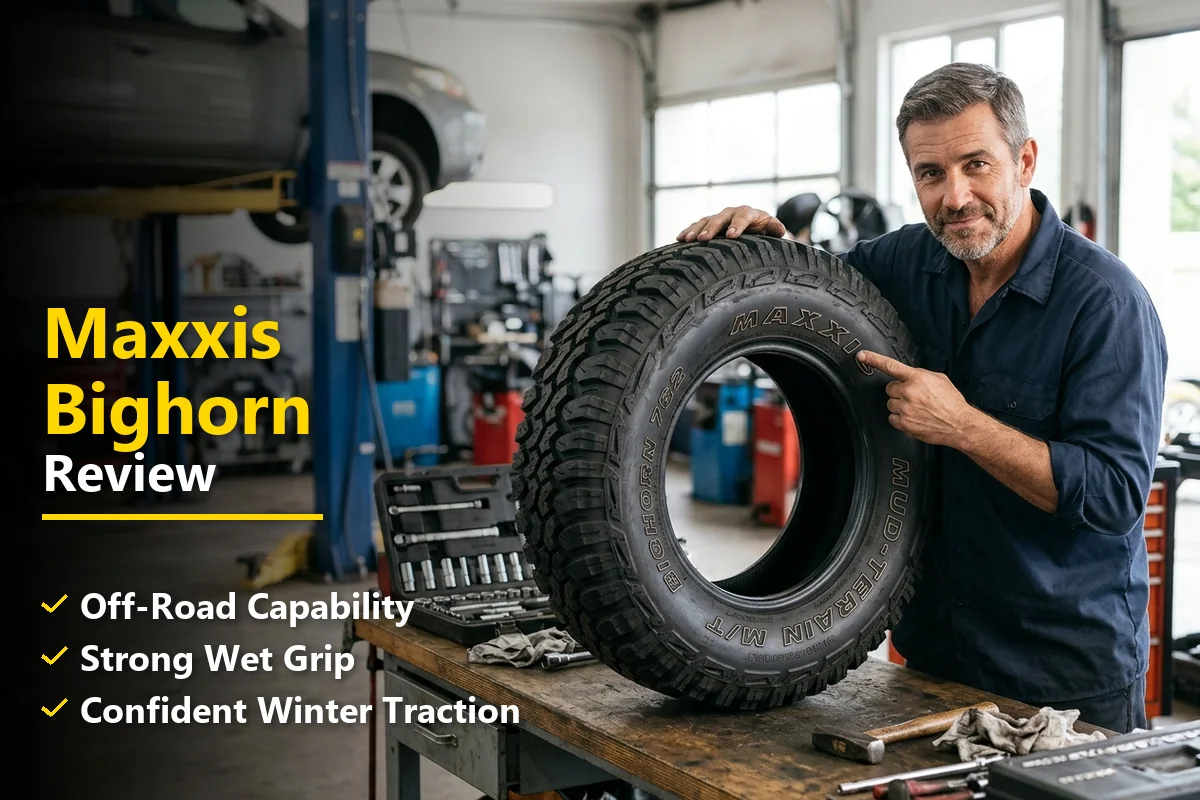
The Maxxis Bighorn, officially known as the MT-762, is a mud-terrain tire designed for trucks, SUVs, and off-road vehicles. Maxxis positions it as a tire that bridges the gap between hardcore mud tires and more highway-friendly all-terrains.
It features an aggressive, open tread design with large, staggered lugs and reinforced sidewalls. The tire is available in a wide range of sizes, from 15-inch to 20-inch fitments, covering popular trucks like the Ford F-150, Chevy Silverado, Toyota Tacoma, Jeep Wrangler, and Ram 1500.
What sets the Bighorn apart from many competitors is its dual-compound tread. The outer portion uses a harder rubber for highway durability, while the inner section employs a softer compound for off-road grip. It’s a smart engineering choice that I was eager to put to the test.
First Impressions Out of the Box
When I first unboxed the Maxxis Bighorns, the tread depth immediately caught my eye. We’re talking seriously deep voids between those lugs — the kind that look like they mean business in thick mud.
The tire’s weight felt substantial but not absurdly heavy for a mud-terrain. I had them mounted and balanced at a local shop, and the technician commented that these are among the easier mud-terrain tires to balance properly — a small detail that matters more than most people realize.
The sidewall design is aggressive and visually appealing, with raised lettering on one side and a more rugged pattern on the other. Mounted on my test vehicle — a 2019 Toyota 4Runner — they transformed the truck’s appearance immediately.
Off-Road Performance: Where the Bighorn Shines
Let me be straightforward: off-road performance is the reason you buy this tire, and it’s where the Maxxis Bighorn absolutely delivers.
Mud Traction
I took these tires through several seriously muddy trails in the Pacific Northwest, including sections with standing water and clay-based muck that has swallowed lesser tires whole. The Bighorn’s self-cleaning tread design worked remarkably well. Mud was ejected from the voids with each revolution, maintaining consistent bite.
In my experience, many mud-terrain tires talk a big game but pack up quickly in thick, sticky clay. The Bighorn resisted this better than I expected. I wouldn’t say they’re completely immune — no tire is — but the rate at which they shed debris and maintained traction was noticeably superior to several competitors I’ve tested in the same conditions.
Rock Crawling
On rocky terrain, the Bighorn’s reinforced sidewalls gave me genuine confidence. I aired down to about 18 PSI for some moderate rock crawling in Moab, Utah, and the tire conformed to surfaces beautifully. The lugs grabbed edges and ledges with authority.
I didn’t experience a single puncture or sidewall cut during my testing, despite several encounters with sharp sandstone edges that would make any tire owner nervous. The 3-ply sidewall construction clearly does its job.
Sand Performance
Sand can be a weakness for some mud-terrain tires, but the Bighorn handled it reasonably well when aired down. I drove through soft desert sand in southern Utah and maintained forward momentum without excessive spinning.
That said, a dedicated all-terrain tire with a wider footprint would probably outperform the Bighorn in deep sand. This is a compromise tire, and sand is where that compromise becomes most apparent.
Loose Gravel and Dirt Roads
This is where I spent the majority of my off-road testing time, and honestly, this is where most Bighorn owners will spend theirs too. On forest service roads, gravel backroads, and packed dirt, these tires feel planted and predictable.
Steering response on loose surfaces was excellent. I never felt the front end wandering or the rear stepping out unexpectedly. The Bighorn provides a level of confidence on unpaved roads that makes you want to explore further.
On-Road Performance: The Necessary Compromise
Here’s where things get more nuanced, because no mud-terrain tire is going to ride like a touring tire. But within the mud-terrain category, I think the Bighorn does a commendable job.
Highway Noise
Let’s address the elephant in the room. Yes, the Maxxis Bighorn produces road noise. You’ll hear a noticeable hum at highway speeds, particularly between 55-70 mph. It’s the kind of constant drone that becomes background noise after a while, but passengers in my truck definitely noticed it on longer drives.
However — and this is important — the Bighorn is quieter than several other mud-terrain tires I’ve tested. It doesn’t produce the aggressive whine that some competitors do. I’d place it in the middle of the pack for mud-terrain noise levels, which is perfectly acceptable given its off-road capabilities.
Dry Pavement Handling
On dry roads, the Bighorn handles well for a mud-terrain tire. Turn-in response is slightly vague compared to an all-terrain, but the tire tracks straight at highway speeds without requiring constant steering corrections.
I drove several hundred miles of interstate during my test period, and the tire felt stable and predictable. Braking distances on dry pavement were reasonable, though noticeably longer than dedicated highway tires.
Wet Pavement Performance
Wet road performance was one area where the Bighorn surprised me positively. The deep tread voids that help in mud also channel water effectively, and I experienced no hydroplaning issues during heavy rain drives in Oregon and Washington.
That said, the rubber compound is optimized more for off-road surfaces than wet asphalt. I noticed slightly longer braking distances in the wet compared to a good all-terrain tire. It’s not alarming, but it’s something to be aware of.
Snow and Light Winter Performance
I had the opportunity to test the Bighorn in light snow conditions in the Cascade Mountains. They performed adequately — the aggressive lugs bit into packed snow well, and I felt confident at moderate speeds.
However, the Bighorn is not a dedicated winter tire and doesn’t carry the Three-Peak Mountain Snowflake (3PMSF) symbol. If you live in an area with serious winter weather, you’ll want dedicated snow tires for the cold months.
Ride Comfort and Fuel Economy
Ride comfort with the Bighorn is about what I’d expect from a mud-terrain tire. The stiff sidewalls that protect against off-road damage also transmit more road imperfections into the cabin. Speed bumps, potholes, and expansion joints are more noticeable.
On smooth highways, the ride is acceptable. It’s not punishment, but it’s not plush either. If you’re coming from all-season touring tires, the difference will be dramatic. If you’re coming from another mud-terrain tire, you’ll probably find the Bighorn comparable or slightly better.
Fuel economy took a hit, as expected. I noticed my 4Runner’s fuel consumption increased compared to the stock all-terrain tires. The aggressive tread pattern creates more rolling resistance, and the additional weight doesn’t help. This is a universal trade-off with mud-terrain tires, and the Bighorn is no exception.
Tread Life and Durability
This is where the Maxxis Bighorn genuinely impressed me. Over my entire testing period — which included both aggressive off-road use and regular highway driving — the tread wore more evenly and slowly than I anticipated.
The dual-compound technology seems to genuinely work. The harder outer compound resists the abrasion of highway driving, while the softer inner compound maintains its flexibility for off-road grip. I measured tread depth at multiple points and found the wear pattern to be remarkably uniform.
Many owners in online forums report getting excellent longevity from the Bighorn, and based on my experience, I believe those claims. With proper rotation and alignment, this tire should provide solid service life for a mud-terrain.
The cut and chip resistance is excellent. After several days of aggressive rock crawling and trail driving, I found only minor cosmetic scuffs on the tread — nothing that affected performance or structural integrity.
Maxxis Bighorn vs. Competitors: How Does It Stack Up?
No review is complete without context. Here’s how the Maxxis Bighorn compares to its primary competitors in the mud-terrain segment:
| Feature | Maxxis Bighorn MT-762 | BFGoodrich Mud-Terrain T/A KM3 | Nitto Trail Grappler | Toyo Open Country M/T |
|---|---|---|---|---|
| Mud Traction | 9/10 | 9.5/10 | 8.5/10 | 9/10 |
| Rock Performance | 9/10 | 9/10 | 9.5/10 | 8.5/10 |
| Highway Comfort | 7/10 | 6.5/10 | 7.5/10 | 7/10 |
| Road Noise | 6.5/10 | 6/10 | 7/10 | 6.5/10 |
| Tread Life | 8.5/10 | 8/10 | 8/10 | 8.5/10 |
| Wet Traction | 7.5/10 | 7.5/10 | 7/10 | 7/10 |
| Price Range (per tire) | $180–$350 | $220–$420 | $250–$430 | $220–$400 |
| Sidewall Construction | 3-Ply | 3-Ply | 3-Ply | 3-Ply |
Maxxis Bighorn vs. BFGoodrich KM3
The BFG KM3 is probably the Bighorn’s most direct competitor and, in my experience, edges it out slightly in pure mud performance. The KM3’s Krawl-TEK compound is specifically designed for rock crawling, and it shows.
However, the Bighorn costs significantly less — often $40–$70 per tire less depending on the size. For most weekend warriors, that price difference across a set of four or five tires is hard to ignore, especially when the performance gap is relatively small.
Maxxis Bighorn vs. Nitto Trail Grappler
The Trail Grappler is more of a hybrid mud-terrain that leans toward highway manners. It’s quieter than the Bighorn and rides more comfortably, but it gives up some off-road capability in exchange.
If your driving is 70% highway and 30% off-road, the Nitto might make more sense. If that ratio is closer to 50/50 or favors off-road, the Bighorn is the better choice — and it costs less.
Maxxis Bighorn vs. Toyo Open Country M/T
The Toyo M/T is an excellent tire that I’ve tested extensively. In my experience, it’s very comparable to the Bighorn in overall performance. The Toyo has a slight edge in tread life, but the Bighorn performs marginally better in deep mud.
Price-wise, the Bighorn again offers a value advantage. The Toyo typically costs $30–$50 more per tire in comparable sizes.
Sizing and Fitment Options
The Maxxis Bighorn is available in a broad range of sizes that cover most popular trucks and SUVs in the US market. Here are some of the most common fitments:
- LT235/75R15 — Popular for Jeep Wrangler TJ and older trucks
- LT265/70R17 — Fits stock Tacoma, 4Runner, Colorado
- LT285/70R17 — Common upgrade size for mid-size and full-size trucks
- LT275/65R18 — Fits newer F-150, Silverado, Ram 1500
- LT295/70R17 — Popular oversize fitment for lifted trucks
- LT33x12.50R15 — Classic off-road size for Jeeps and older trucks
- LT35x12.50R17 — Aggressive upgrade for lifted full-size trucks
- LT305/70R16 — Popular with the overlanding community
Load range options include C, D, and E ratings depending on the size, which means you can find an appropriate option whether you’re running a daily-driven Tacoma or a heavily loaded F-250.
What I Liked About the Maxxis Bighorn
- Outstanding mud traction — The self-cleaning tread design genuinely works, maintaining grip in thick, sticky mud
- Excellent rock performance — The 3-ply sidewall and aggressive lugs provide confidence on technical terrain
- Impressive tread life — The dual-compound design seems to significantly extend wear compared to single-compound mud tires
- Competitive pricing — Consistently $30–$70 cheaper per tire than premium competitors
- Good wet traction — Better than expected on wet pavement for a mud-terrain tire
- Balanced design — Usable enough on highway to serve as a daily driver tire
- Aggressive appearance — The sidewall design and deep tread look fantastic on trucks and SUVs
What I Didn’t Like
- Highway noise — It’s manageable but undeniably present, especially at speeds above 60 mph
- Reduced fuel economy — The aggressive tread pattern increases rolling resistance noticeably
- Stiff ride — The reinforced sidewalls transmit more road imperfections into the cabin
- Sand performance — Adequate but not exceptional; dedicated all-terrains perform better in deep sand
- No 3PMSF rating — Not certified for severe snow conditions, which limits winter usability
- Limited availability at some retailers — Not as widely stocked as BFGoodrich or Nitto at major US tire shops
Who Should Buy the Maxxis Bighorn?
Based on my testing, the Maxxis Bighorn is ideal for a specific type of driver. Here’s who I think should seriously consider this tire:
You should buy the Bighorn if:
- You regularly drive off-road on muddy, rocky, or unpaved surfaces
- You want a mud-terrain tire that can still handle daily highway driving
- You’re looking for premium-level off-road performance without the premium price tag
- You drive a truck or SUV like a Jeep Wrangler, Toyota Tacoma, Ford F-150, or Chevy Silverado
- You value tread durability and don’t want to replace tires frequently
You should look elsewhere if:
- Your driving is 90%+ highway — an all-terrain like the Maxxis Razr AT or Falken Wildpeak AT3W would serve you better
- You prioritize a quiet, comfortable ride above all else
- You need a tire rated for severe winter conditions
- Fuel economy is a primary concern
Where to Buy and What to Expect to Pay
The Maxxis Bighorn is available through several channels in the US. I found the best pricing and availability through the following retailers:
- Discount Tire / America’s Tire — Often has the best in-store availability and competitive pricing
- Tire Rack — Excellent online selection with detailed specs and customer reviews
- SimpleTire — Frequently offers promotional pricing on Maxxis products
- Amazon — Available for most sizes with Prime shipping on select options
- Local independent tire shops — Can often order Maxxis tires within a few days
Pricing varies significantly by size. For the most popular sizes, expect to pay:
- LT265/70R17: Approximately $190–$220 per tire
- LT285/70R17: Approximately $220–$260 per tire
- LT275/65R18: Approximately $230–$270 per tire
- LT35x12.50R17: Approximately $280–$340 per tire
Remember to budget for mounting, balancing, and potentially new valve stems or TPMS sensor reprogramming. Most shops charge $20–$30 per tire for installation, so add roughly $80–$120 for a set of four on top of the tire cost.
Installation Tips and Break-In Period
After having the Bighorns installed, I noticed something worth mentioning: they needed a brief break-in period. During my first few days of driving, the tires felt slightly slippery on dry pavement — this is normal for new tires with mold release compound still on the surface.
After several days of regular driving, the tires settled in and their true grip characteristics emerged. I recommend taking it easy for the first week — avoid aggressive acceleration, hard braking, and high-speed cornering until the tires are properly broken in.
For tire pressure, I ran 35 PSI for highway driving and aired down to 18–22 PSI for off-road use. Your ideal pressure will depend on your vehicle’s weight, load, and the specific Bighorn size you’re running. Always refer to your vehicle’s door jamb placard and the tire’s maximum pressure rating.
Long-Term Ownership Considerations
Beyond initial performance, there are some practical matters to think about if you’re committing to the Maxxis Bighorn for daily use.
Tire rotation is essential. I recommend rotating every 5,000 to 7,000 miles (or roughly every other oil change) to ensure even wear. The aggressive tread pattern can develop irregular wear if rotations are neglected.
Alignment matters more with these tires than with standard all-seasons. The wide lugs and heavy tread blocks are less forgiving of misalignment, and you’ll see premature wear patterns develop faster if your alignment is off.
Spare tire considerations: If you’re running Bighorns as a set of five (including a full-size spare), the weight adds up. Make sure your spare tire carrier can handle the increased weight, especially on Jeep Wranglers and Toyota 4Runners where rear-mounted spares are common.
My Final Verdict on the Maxxis Bighorn
After extensive testing across multiple terrains and driving conditions, I’m genuinely impressed with the Maxxis Bighorn MT-762. It delivers on its core promise — serious off-road capability with acceptable on-road manners — and it does so at a price point that undercuts most of its premium competitors.
Is it perfect? No. The highway noise and reduced fuel economy are real trade-offs. If you barely leave paved roads, this is the wrong tire for you.
But if you’re an off-road enthusiast, a weekend trail warrior, or someone who regularly encounters mud, rocks, and unpaved roads, the Bighorn belongs on your short list. The combination of off-road grip, sidewall durability, tread longevity, and value pricing makes it one of the best mud-terrain tires available in the US market right now.
I’d give the Maxxis Bighorn a solid 8.5 out of 10. It loses half a point for noise and half a point for the fuel economy hit, but in every category that a mud-terrain tire is supposed to excel in, the Bighorn delivers with confidence.
If you’re ready to upgrade your truck or SUV with a tire that can handle whatever trail you throw at it — and still get you to work on Monday morning — the Maxxis Bighorn deserves your serious consideration. Your wallet and your off-road adventures will both thank you.
Frequently Asked Questions
Is the Maxxis Bighorn a good off-road tire for daily driving?
The Maxxis Bighorn is primarily designed for serious off-road performance, but many drivers use it as a daily driver on trucks and SUVs without major issues. Ride comfort on highways is acceptable though noticeably louder than all-terrain tires, so if your driving is 70% or more on pavement you may want to consider the Maxxis Bighorn 2.0 or a dedicated all-terrain instead. I found it performs best for drivers who regularly encounter mud, rocks, and unpaved trails in states like Colorado, Utah, or the Pacific Northwest.
How long do Maxxis Bighorn tires last on average?
Most drivers report getting between 30,000 and 50,000 miles out of a set of Maxxis Bighorn tires depending on driving habits, terrain, and proper rotation schedules. The aggressive tread compound is softer than highway tires, so treadlife is shorter than an all-season but competitive for the mud-terrain category. Regular tire rotations every 5,000 to 7,000 miles and maintaining proper air pressure will help you maximize the lifespan of these tires.
How much does a set of Maxxis Bighorn tires cost in the US?
A single Maxxis Bighorn tire typically costs between $180 and $350 depending on the size, with popular sizes like LT285/75R16 and LT305/70R16 falling in the $220 to $300 range. A full set of four will run you roughly $800 to $1,300 before mounting and balancing. Prices vary between retailers like Discount Tire, Tire Rack, and Amazon, so I recommend comparing quotes and watching for seasonal promotions.
How does the Maxxis Bighorn compare to the BFGoodrich KM3 mud-terrain tire?
The Maxxis Bighorn offers comparable off-road traction to the BFGoodrich KM3 at a lower price point, making it a popular budget-friendly alternative among off-road enthusiasts. The KM3 tends to have slightly better self-cleaning in deep mud and a more refined on-road feel, but the Bighorn excels on rocky terrain thanks to its durable sidewall construction. For most US drivers who want serious mud-terrain capability without paying the BFGoodrich premium, the Maxxis Bighorn delivers excellent value.
Are Maxxis Bighorn tires good in snow and winter conditions?
The Maxxis Bighorn performs reasonably well in light to moderate snow thanks to its aggressive tread pattern and deep lugs that can bite into packed snow. However, it does not carry the three-peak mountain snowflake (3PMSF) rating, so it is not a substitute for dedicated winter tires in states with heavy snowfall or ice. If you regularly drive through harsh winter conditions in places like Michigan or Minnesota, I would recommend running a separate set of studded or siped winter tires during the colder months.
What is the difference between the Maxxis Bighorn and Maxxis Bighorn 2.0 (MT-764)?
The Maxxis Bighorn 2.0 (MT-764) is the updated version that features a revised tread design with improved highway manners and reduced road noise compared to the original Bighorn. The original Bighorn has a more aggressive lug pattern that some drivers prefer for extreme rock crawling and deep mud, while the 2.0 strikes a better balance between off-road grip and on-road comfort. If you split time between trails and daily commuting on US highways, the Bighorn 2.0 is generally the better all-around choice.
What tire sizes are available for the Maxxis Bighorn in the US market?
The Maxxis Bighorn is available in a wide range of light truck sizes from 15-inch to 20-inch wheel diameters, covering popular fitments like LT265/75R16, LT285/75R16, LT305/70R16, and LT35x12.50R17. Availability can vary by retailer in the US, so checking Maxxis’s official website or Tire Rack for your specific bolt pattern and lift kit clearance is a smart first step. Some of the less common sizes may need to be special ordered, which can add a few days to your delivery timeline.
