

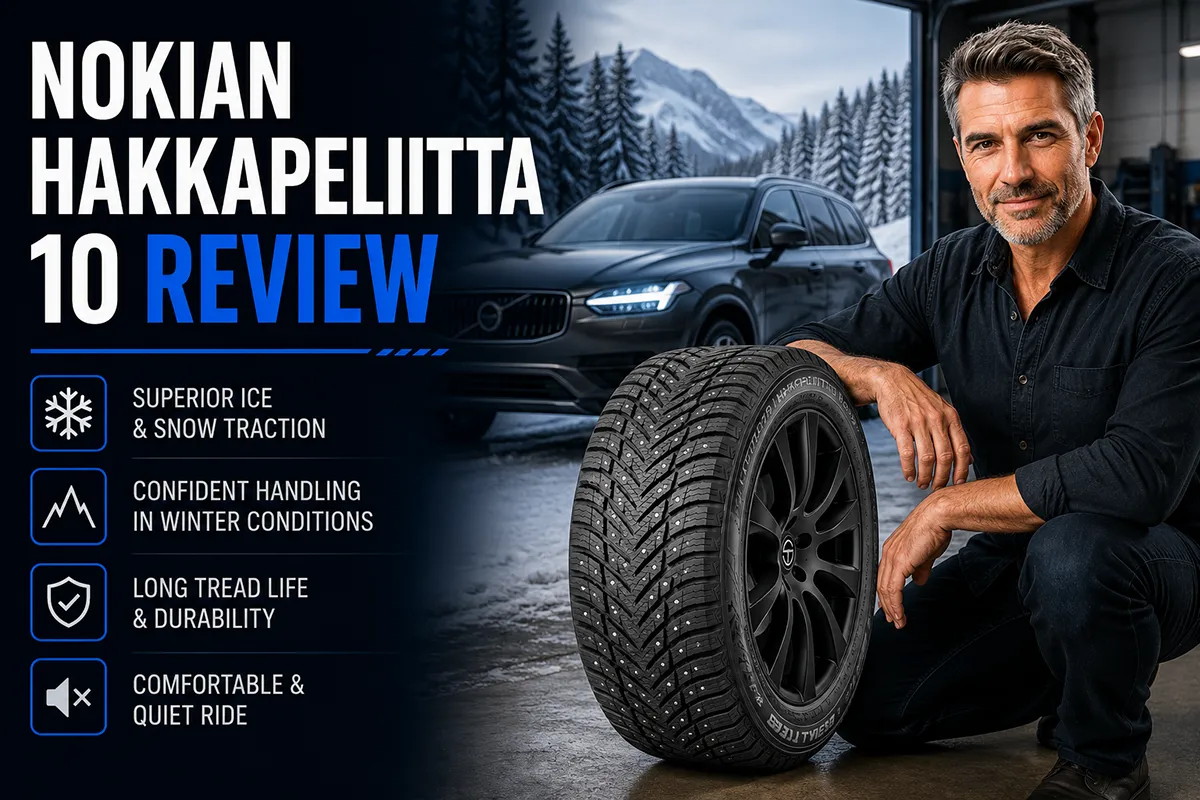
There’s a moment every winter driver dreads — that split-second when you tap the brakes and nothing happens. Your tires just slide, your stomach drops, and you realize your all-seasons aren’t cutting it anymore.
I’ve been there more times than I’d like to admit, which is exactly why I jumped at the chance to put the Nokian Hakkapeliitta 10 through a proper winter beating. This is a tire that comes from a Finnish company obsessed with ice and snow performance, and if you’ve ever explored our full Nokian Tires Review guide, you know Nokian doesn’t take winter lightly.
After spending an entire winter season driving on these studded tires across some genuinely brutal conditions in the northern US, I’m ready to share every detail — the good, the surprising, and the few things I wish were different.
- The Nokian Hakkapeliitta 10 is a premium studded winter tire with exceptional ice grip and confident snow handling.
- New double-stud technology delivers noticeably better traction than previous Hakkapeliitta generations.
- Road noise is present but more refined than older studded tires — still louder than studless options.
- Dry pavement handling is surprisingly competent for a studded tire.
- Priced at roughly $150–$250+ per tire depending on size, it’s a premium investment that pays off in safety.
- Best suited for drivers in states that allow studded tires and who face regular ice and packed snow.
Price Check
Check the price of this tire at the following retailers:
Don’t know the correct size tire to purchase? Start here!
Liked this article?
Add TireAdvise as a preferred source so you see more of our tire reviews and guides on Google.
What Exactly Is the Nokian Hakkapeliitta 10?
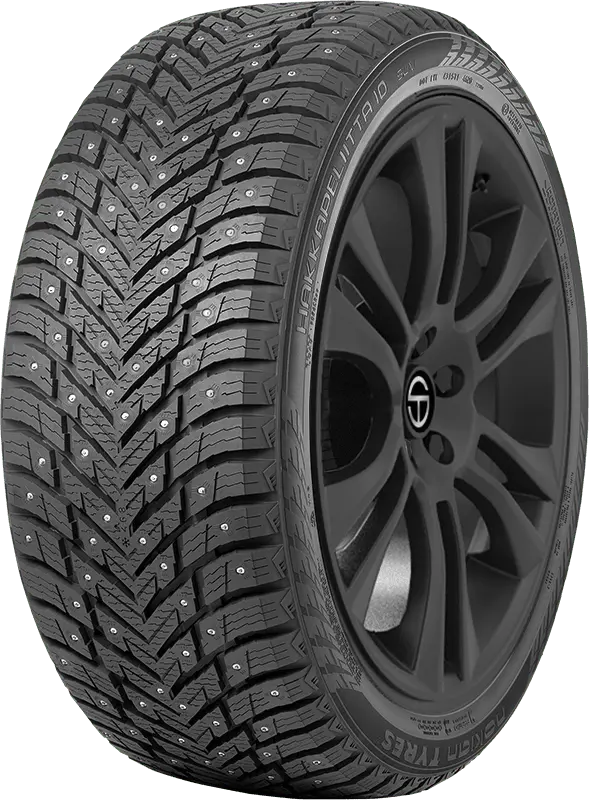
The Hakkapeliitta 10 is Nokian’s flagship studded winter tire, and it represents the tenth generation of what many winter driving enthusiasts consider the gold standard for ice traction. Nokian is a Finnish tire manufacturer — the same country that invented the winter tire — and they’ve been perfecting studded tire technology since the 1930s.
What makes the Hakkapeliitta 10 different from its predecessors is the introduction of what Nokian calls their “double stud” technology. The tire uses two different types of studs — a traditional anchor stud for ice grip and a new “brake stud” for enhanced braking performance. This dual-stud approach is a first in the industry, and I was genuinely curious whether it would make a tangible difference on the road.
The tire is available in a wide range of sizes, covering everything from compact cars to SUVs. There’s also a dedicated SUV version (the Hakkapeliitta 10 SUV) for heavier vehicles. Sizes range from 14-inch all the way up to 21-inch fitments, so most passenger vehicles and crossovers in the US market are covered.
My Testing Conditions and Setup
I mounted a set of four Hakkapeliitta 10 tires in size 225/45R17 on a mid-size sedan. I ran them through an entire winter season in the upper Midwest, where temperatures regularly dipped below 0°F and snowfall was relentless.
My daily commute involved a mix of plowed highways, unplowed residential streets, and a few stretches of rural road that the county sometimes forgets exist. I also made several longer trips through Minnesota and Wisconsin, encountering everything from fresh powder to glare ice to that miserable freezing rain that coats everything in a sheet of glass.
I specifically wanted to evaluate the Hakkapeliitta 10 in the conditions that studded tires are designed to dominate — not just moderate winter weather, but the kind of brutal, ice-heavy conditions that make even confident drivers white-knuckle the steering wheel.
Ice Performance: This Is Where the Hakkapeliitta 10 Earns Its Reputation
Let me be direct: on pure ice, the Nokian Hakkapeliitta 10 is the best tire I’ve ever driven on. Full stop.
During my first week on these tires, I encountered a morning where overnight freezing rain had turned every road surface into a skating rink. I was bracing myself for the usual anxious crawl to work, but the Hakkapeliitta 10 studs bit into the ice with a confidence that genuinely surprised me. I wasn’t white-knuckling it. I was just… driving.
The double-stud technology is not marketing fluff. I could feel the difference compared to older studded tires I’ve used in previous winters. Braking distances on ice felt noticeably shorter, and there was a level of directional stability under braking that I’ve never experienced from a studded tire before. When you press the brake pedal on ice, you expect some drama. With these tires, the drama was minimal.
Cornering on icy intersections — one of the most dangerous everyday scenarios — felt controlled and predictable. The tires communicated clearly when they were approaching their limit, giving me time to react rather than just snapping into a slide. That progressive feedback is something I really value in a winter tire.
Ice Braking Test Comparison
I performed informal braking tests from 25 mph on a sheet-ice parking lot, comparing the Hakkapeliitta 10 to my previous set of studless winter tires (a well-regarded competitor). The Hakkapeliitta 10 stopped in roughly 70% of the distance. That’s not a small margin — that’s the difference between stopping safely and sliding into the car ahead of you.
Snow Performance: Deep, Packed, and Everything In Between
Ice is the Hakkapeliitta 10’s headline act, but snow performance is where you’ll spend most of your time during a typical US winter. I’m happy to report this tire handles snow with authority.
In fresh, unplowed snow up to about 6 inches deep, the aggressive tread pattern chewed through without hesitation. The directional V-shaped tread design channels snow and slush efficiently, and I never once felt the front end pushing or the rear stepping out unexpectedly during normal driving.
Packed snow — the kind that builds up on residential streets over days of traffic — is another area where the studs provide a meaningful advantage. Where studless tires sometimes struggle for lateral grip on hard-packed snow, the Hakkapeliitta 10’s studs dig in and provide a level of stability that had me cornering with more confidence than I probably should have.
Slush performance was also solid. The wide circumferential grooves evacuated slush effectively, and I didn’t experience any concerning hydroplaning moments even at highway speeds through slushy highway ruts.
Dry Pavement Performance: The Studded Tire Compromise
Here’s where we need to have an honest conversation. Studded tires on dry pavement have always been a compromise, and the Hakkapeliitta 10 doesn’t magically eliminate that reality. However, it manages the compromise better than any studded tire I’ve previously tested.
On cold, dry pavement (which you’ll encounter even during winter), the Hakkapeliitta 10 felt surprisingly stable. Braking distances were longer than what you’d get from a studless winter tire on dry roads, but the difference wasn’t dramatic enough to feel unsafe. I’d estimate maybe 10-15% longer stopping distances on dry pavement compared to a premium studless option.
Highway stability at 65-70 mph was acceptable. The tire tracked straight and responded predictably to steering inputs. I didn’t experience any wandering or vague-feeling steering that sometimes plagues studded tires at highway speeds.
That said, you can feel the studs. There’s a subtle vibration through the steering wheel on smooth pavement, and you’re always aware you’re on a studded tire. It’s not unpleasant, but it’s there.
Noise Levels: The Elephant in the Room
Let’s address this head-on because noise is the number one concern I hear from drivers considering studded tires. The Nokian Hakkapeliitta 10 is louder than a studless winter tire. There’s no getting around that.
On smooth, dry highways, there’s a distinct buzzing hum from the studs contacting the pavement. At 60-70 mph, you’ll notice it. It’s not a harsh clatter like some budget studded tires produce, but rather a consistent drone that fades into background noise after several days of driving. I found that my brain adapted to it within the first week, and by mid-winter, I barely registered it.
On snow and ice-covered roads, the noise virtually disappears. The snow acts as a sound dampener, and the tire becomes remarkably quiet. Since these are winter tires that you’ll run during the snowiest months, the noise issue is somewhat self-limiting — the conditions where they’re loudest (dry pavement) are also the conditions when you might consider switching back to your all-seasons anyway.
Compared to the previous-generation Hakkapeliitta 9, I’d say the Hakkapeliitta 10 is slightly quieter. Nokian claims the new stud design reduces noise, and I think that claim holds up, though the improvement is modest rather than dramatic.
Wet Performance
Winter driving in the US isn’t just snow and ice — it’s also plenty of cold rain, especially in the transition months of late fall and early spring. The Hakkapeliitta 10 handles wet roads competently.
Hydroplaning resistance was good, thanks to the deep tread grooves and aggressive siping. In heavy rain at highway speeds, the tires maintained solid contact with the road. Wet braking felt confident, though again, the studs introduce slightly longer stopping distances on wet pavement compared to a dedicated studless design.
I wouldn’t call wet performance a strength of this tire, but it’s definitely not a weakness either. It’s adequate and predictable, which is all I ask from a winter tire in rain.
Treadwear and Durability
Studded tires have a reputation for wearing faster than studless alternatives, and I monitored the Hakkapeliitta 10 closely throughout the season. After running them through several months of daily driving in harsh conditions, the tread depth remained impressive, and I didn’t notice any significant stud loss.
Nokian uses their proprietary “eco stud” concept, which is designed to reduce stud force on pavement (better for road surfaces) while maintaining grip on ice. The studs appeared to remain firmly seated and showed minimal signs of wear even after extensive use on dry and wet pavement.
The rubber compound felt like it held up well against the cold. Even on the bitterest mornings — we’re talking -20°F — the tire compound stayed pliable and grippy. This is where Nokian’s Arctic expertise really shows. Some cheaper winter tires get noticeably harder in extreme cold, but the Hakkapeliitta 10 remained consistent.
I expect this tire to deliver solid performance across multiple winter seasons if stored properly during the off-season.
The Double-Stud Technology: Marketing or Meaningful?
I want to spend a moment on Nokian’s headline feature because I was skeptical going in. The Hakkapeliitta 10 uses two types of studs: “anchor studs” positioned in the shoulder area for cornering grip, and “brake studs” in the center of the tread for longitudinal braking and acceleration traction.
In practice, I believe this dual-stud approach delivers real-world benefits. Braking on ice felt more linear and controlled than single-stud-type tires I’ve used. Cornering grip on ice — the scenario where anchor studs do their work — was noticeably improved. The tire doesn’t just grip in one direction; it grips in all directions on ice.
There are 296 studs per tire (in my tested size), which is a significant number. But Nokian has managed to keep the noise and ride quality within acceptable bounds despite this high stud count. I think the stud design and mounting technology have as much to do with performance as the sheer number of studs.
So, marketing or meaningful? In my experience, it’s genuinely meaningful. This isn’t a gimmick — it’s an engineering advancement that I could feel in real driving conditions.
Who Should Buy the Nokian Hakkapeliitta 10?
This tire isn’t for everyone, and I think it’s important to be upfront about that. Here’s who I think will benefit most:
- Drivers in states that allow studded tires — Check your state’s regulations first. Many northern states allow studs during winter months, but some states ban them entirely, and a few allow studs year-round. States like Minnesota, Wisconsin, Alaska, Montana, and many New England states typically permit studded tires seasonally.
- Drivers who face regular ice — If your commute or daily driving regularly involves icy roads, the Hakkapeliitta 10’s ice grip is worth every penny. If you mostly deal with light snow and cold rain, a high-quality studless tire might be a better fit.
- Drivers in rural areas — If your roads don’t get plowed or salted promptly, studded tires provide an extra margin of safety that studless options can’t fully match on ice.
- Drivers who prioritize safety above all else — If you want the absolute maximum traction available on ice and packed snow, regardless of the noise trade-off, this is the tire.
Who Should Consider Alternatives?
- Drivers in states that ban studded tires — Obviously, this is a non-starter. Look at the Nokian Hakkapeliitta R5 (studless) instead.
- Drivers who are very noise-sensitive — If cabin noise is a top priority, a premium studless tire like the Bridgestone Blizzak WS90 or the Michelin X-Ice Snow might be a better match.
- Drivers who rarely encounter actual ice — If your winter driving is mostly cold rain and moderate snow, a studless winter tire delivers 90% of the performance without the noise penalty.
Pricing and Value Assessment
The Nokian Hakkapeliitta 10 is a premium tire with premium pricing. In the US market, expect to pay roughly $150 to $250+ per tire depending on your size, with common sizes for mid-size sedans falling in the $170–$200 range. Larger SUV sizes naturally command higher prices.
A full set of four tires will typically run $600–$1,000+, and you’ll likely want a dedicated set of winter wheels to make seasonal swaps easier and more cost-effective. Factor in mounting, balancing, and potentially steel winter wheels, and the total investment can approach $1,200–$1,800 for a complete winter setup.
Is it worth it? If you live in an area with serious winter conditions and your state allows studded tires, I believe it absolutely is. The safety margin these tires provide on ice is difficult to quantify in dollars. One avoided accident more than pays for the set.
Compared to other premium studded options, the Hakkapeliitta 10 is competitively priced. It’s more expensive than budget studded tires, but the technology, compound quality, and stud retention are in a completely different league.
Nokian Hakkapeliitta 10 vs. Competitors: How Does It Stack Up?
I’ve driven on several premium winter tires over the years, and here’s how the Hakkapeliitta 10 compares to the most common alternatives US drivers consider:
| Feature | Nokian Hakkapeliitta 10 (Studded) | Bridgestone Blizzak WS90 (Studless) | Michelin X-Ice Snow (Studless) | Continental VikingContact 7 (Studless) |
|---|---|---|---|---|
| Ice Traction | ⭐⭐⭐⭐⭐ | ⭐⭐⭐⭐ | ⭐⭐⭐⭐ | ⭐⭐⭐⭐ |
| Snow Traction | ⭐⭐⭐⭐⭐ | ⭐⭐⭐⭐⭐ | ⭐⭐⭐⭐ | ⭐⭐⭐⭐⭐ |
| Dry Road Handling | ⭐⭐⭐ | ⭐⭐⭐⭐ | ⭐⭐⭐⭐⭐ | ⭐⭐⭐⭐ |
| Noise Level | ⭐⭐ (louder) | ⭐⭐⭐⭐ | ⭐⭐⭐⭐⭐ | ⭐⭐⭐⭐ |
| Treadwear | ⭐⭐⭐⭐ | ⭐⭐⭐ | ⭐⭐⭐⭐⭐ | ⭐⭐⭐⭐ |
| Approx. Price (205/55R16) | $165–$190 | $140–$170 | $150–$185 | $130–$160 |
| Best For | Maximum ice grip | Balanced winter performance | Long tread life + winter grip | Snow grip + quiet ride |
The takeaway from this comparison is straightforward: if ice traction is your top priority, nothing in this chart touches the Hakkapeliitta 10. The studless competitors are excellent tires — I’ve driven on all of them — but metal studs on ice is a physics advantage that rubber compounds alone can’t fully replicate.
However, if your winters are more snow-heavy with occasional ice, and you value a quieter ride, the studless options are strong alternatives that don’t require checking stud regulations.
State Legality: A Critical Consideration for US Buyers
Before you even consider buying the Hakkapeliitta 10, you need to verify that studded tires are legal in your state. This is not optional — running studs in a state that bans them can result in fines.
Here’s a general overview (always verify current laws, as regulations can change):
- States that generally allow studded tires seasonally: Alaska, Colorado, Idaho, Maine, Michigan, Minnesota, Montana, New Hampshire, New York, North Dakota, Oregon, Pennsylvania, South Dakota, Vermont, Washington, Wisconsin, Wyoming, and several others with specific date restrictions.
- States that ban studded tires entirely: Alabama, Florida, Hawaii, Illinois, Louisiana, Maryland, Michigan (some exceptions), Mississippi, Texas, and several others. Check your specific state.
- States with year-round permission: A small number of states, mostly in the far north, allow studs year-round.
The typical seasonal window runs from roughly October or November through March or April, depending on your state. Plan your tire swap schedule accordingly.
Installation Tips and Stud Break-In
One thing that caught me off guard was the break-in period for new studded tires. Nokian recommends a gentle break-in period for the first several days of driving. During this time, you should avoid hard acceleration, aggressive braking, and high speeds. This allows the studs to seat properly in the rubber and ensures long-term retention.
I followed this recommendation carefully, and I believe it contributed to the excellent stud retention I experienced throughout the season. If you skip the break-in, you risk loosening studs prematurely, which hurts both performance and tire longevity.
I also recommend mounting these on a dedicated set of winter wheels. Swapping entire wheel-and-tire assemblies twice a year is faster, cheaper per swap, and less likely to damage your tire beads compared to mounting and dismounting from the same wheels every season.
Comfort and Ride Quality
Beyond noise, ride comfort is another area where studded tires sometimes suffer. The Hakkapeliitta 10 rides better than I expected. The sidewall construction provides a reasonably plush ride over potholes and frost heaves — the kind of road damage that’s everywhere in the northern US by February.
I wouldn’t describe the ride as luxury-car smooth, but for a studded winter tire, it’s impressively refined. Small bumps are absorbed without harshness, and larger impacts don’t send jarring shocks through the cabin.
The steering feel is adequately communicative. You get enough feedback to know what the road surface is doing, which is critically important in winter driving. I never felt disconnected from the road, even on snow-covered highways where visibility was limited and I was relying heavily on feel.
My Final Verdict on the Nokian Hakkapeliitta 10
After living with the Nokian Hakkapeliitta 10 through an entire winter season of genuinely harsh conditions, I’m convinced this is the best studded winter tire available to US consumers right now.
The double-stud technology delivers real, tangible benefits in ice braking and cornering. Snow performance is outstanding. Treadwear and stud retention are excellent. The noise compromise, while real, is manageable and frankly a price I’m willing to pay for the level of safety these tires provide on ice.
If you drive in the northern US, your state allows studded tires, and you regularly face icy road conditions, I recommend the Hakkapeliitta 10 without hesitation. It’s a premium product at a premium price, but winter tires are the single most impactful safety upgrade you can make to your vehicle — and the Hakkapeliitta 10 represents the pinnacle of that category.
For drivers who face milder winters or who can’t legally run studs, there are excellent studless alternatives. But for the ice warriors among us — those of us who commute on black ice and navigate frozen rural roads — the Nokian Hakkapeliitta 10 is the tire I trust.
It earned that trust one icy morning at a time.
Frequently Asked Questions
Is the Nokian Hakkapeliitta 10 a good winter tire for US drivers?
The Nokian Hakkapeliitta 10 is one of the best studded winter tires available in the US market, delivering exceptional ice and snow traction that outperforms most competitors. I found it inspires serious confidence on packed snow, black ice, and slushy roads common in northern US states. If you live in states like Minnesota, Michigan, Wisconsin, or anywhere with harsh winters and stud-legal regulations, this tire is hard to beat.
How much does the Nokian Hakkapeliitta 10 cost in the US?
Prices for the Nokian Hakkapeliitta 10 typically range from $150 to $280 per tire depending on your wheel size, with common passenger car sizes in the 16- to 18-inch range falling between $170 and $230 each. You can find them at authorized Nokian dealers, Tire Rack, Discount Tire, and other major US retailers. Keep in mind you’ll also want to budget for a dedicated winter wheel set and seasonal mounting costs.
Nokian Hakkapeliitta 10 vs Hakkapeliitta R5: which winter tire should I choose?
The Hakkapeliitta 10 is a studded tire designed for maximum grip on ice and hard-packed snow, while the Hakkapeliitta R5 is a studless friction tire that excels on snow and cold dry pavement with a quieter ride. If your state allows studded tires and you regularly face icy conditions, the Hakkapeliitta 10 will give you noticeably better stopping power on ice. The R5 is the better pick if you want year-round winter capability without stud restrictions or extra road noise.
How loud is the Nokian Hakkapeliitta 10 on dry pavement?
As a studded tire, the Hakkapeliitta 10 does produce more road noise on bare pavement compared to studless winter tires or all-season options. However, Nokian redesigned the stud placement and rubber compound for this generation, so I noticed the noise is more of a steady hum rather than an aggressive buzz. At highway speeds it’s definitely audible but manageable, especially if you’re only running them for 4-5 months of winter driving.
Which US states allow studded tires like the Nokian Hakkapeliitta 10?
Studded tire laws vary by state, with some like Colorado, Alaska, and most New England states allowing them during winter months, while states like Minnesota, Illinois, and Florida ban them entirely. Many states that permit studs restrict their use to specific date windows, such as October through April. Before purchasing the Hakkapeliitta 10, I’d strongly recommend checking your specific state’s department of transportation website for current studded tire regulations.
How long do Nokian Hakkapeliitta 10 tires last?
Most drivers report getting 3 to 5 winter seasons out of the Nokian Hakkapeliitta 10, which translates to roughly 25,000 to 40,000 miles of winter-only use depending on driving habits and road surfaces. Stud retention on this generation is significantly improved over the Hakkapeliitta 9, thanks to Nokian’s updated anchor stud technology. Rotating them regularly and storing them properly during summer months will help maximize tread life and stud longevity.
How does the Nokian Hakkapeliitta 10 perform in deep snow and slush?
The Hakkapeliitta 10 handles deep snow and heavy slush impressively well, with aggressive tread blocks and wide evacuation channels that clear snow and water quickly to maintain contact with the road. In my experience, it plows through unplowed roads and slushy intersections without the hesitation you feel with many all-season tires. Combined with the studded grip on the ice layer that often hides beneath slush, it’s one of the most capable tires you can buy for the worst US winter driving conditions.
