

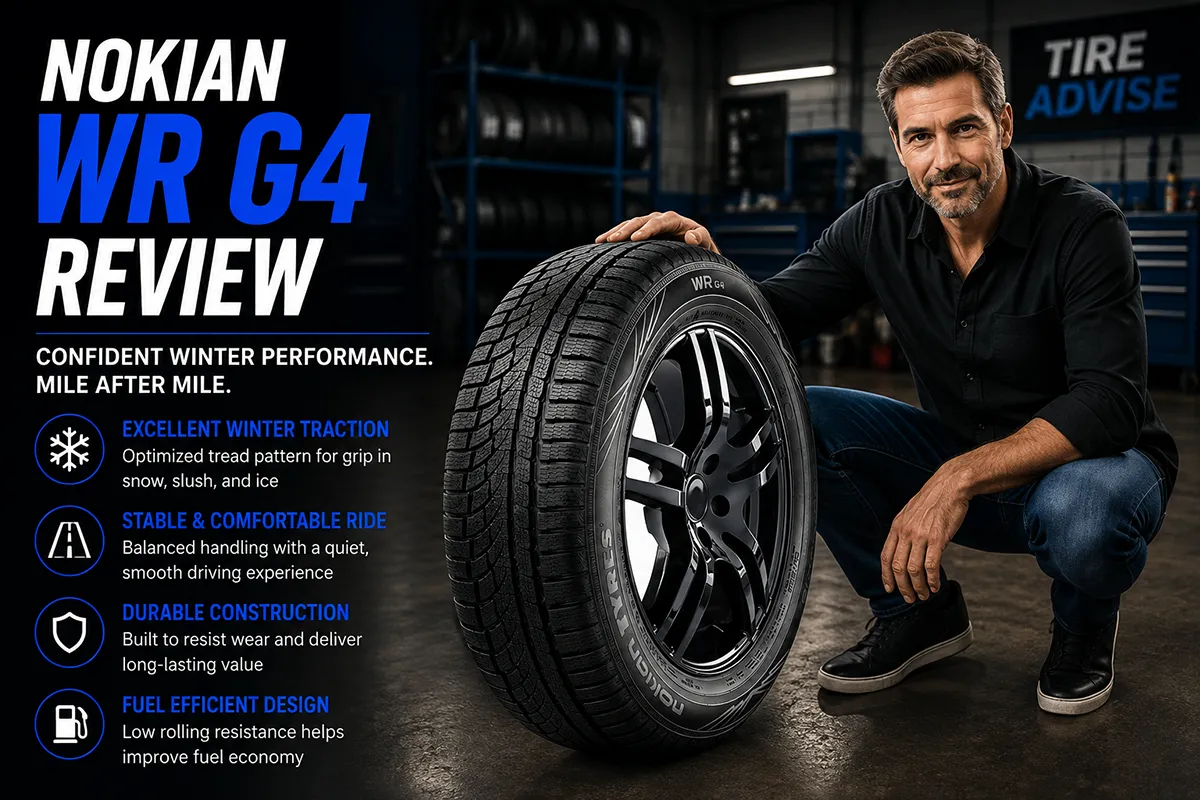
Most drivers dread the twice-yearly tire swap ritual — pulling winter tires off in spring, bolting them back on in fall, and storing whichever set isn’t in use. After spending an extended test period with the Nokian WR G4 all-weather tires, I’m convinced this is one of the strongest arguments for ditching that routine entirely. These Finnish-engineered tires promise genuine year-round capability, and I put that promise to the test across every condition I could find.
- The Nokian WR G4 is a premium all-weather tire that carries the Three-Peak Mountain Snowflake (3PMSF) symbol, meaning it’s certified for severe snow service.
- Dry handling feels precise and composed, closer to a touring tire than a winter tire — a pleasant surprise.
- Wet performance is the WR G4’s strongest suit, with outstanding hydroplaning resistance and confident braking.
- Light-to-moderate snow traction is genuinely impressive, though it won’t replace a dedicated studded winter tire in extreme ice.
- Aramid-reinforced sidewalls add durability that I found reassuring on pothole-riddled US roads.
- Road noise is noticeable at highway speed but never intrusive — a fair trade-off for the all-weather versatility.
- I recommend this tire for drivers in the Mid-Atlantic, Pacific Northwest, and upper Midwest who see varied weather but don’t face extreme alpine conditions daily.

Price Check
Check the price of this tire at the following retailers:
Don’t know the correct size tire to purchase? Start here!
Liked this article?
Add TireAdvise as a preferred source so you see more of our tire reviews and guides on Google.
Who Is the Nokian WR G4 Built For?
Before I dive into performance details, it’s worth clarifying what “all-weather” actually means — because it’s not the same as “all-season.” Traditional all-season tires are a compromise that works decently in mild conditions but struggles once temperatures drop below about 45°F.
All-weather tires like the WR G4 bridge the gap between all-season and dedicated winter rubber, earning the 3PMSF certification that proves they can handle serious snow.
The WR G4 is available in a wide range of sizes covering sedans, crossovers, and SUVs — essentially the vehicles most American families drive daily. If you live somewhere that sees rain, occasional snow, and warm summers but don’t want to invest in two sets of tires and wheels, this tire is aimed squarely at you.
In my experience, the ideal WR G4 buyer lives in states like Pennsylvania, Oregon, Ohio, Virginia, or Minnesota — places where a random April snowstorm or a November ice event is entirely possible. If you’re in Phoenix or Miami, a dedicated all-season or summer tire makes more sense. If you’re in Fairbanks, you probably still need studs.
Design and Construction: What Makes This Tire Different
Asymmetric Tread Pattern
The WR G4 uses an asymmetric tread design, which means the inner and outer halves of the tread face serve different purposes. The inner portion is loaded with deep grooves and dense siping optimized for water evacuation and snow bite. The outer portion features stiffer, larger tread blocks that prioritize dry cornering grip and stability.
This dual-purpose layout is immediately visible when you look at the tire from above. It’s a design philosophy I’ve seen from a few premium manufacturers, but Nokian’s execution here is particularly aggressive — the grooves are deeper than what I typically see on competing all-weather tires from brands like Michelin or Goodyear.
Aramid Sidewall Technology
One of Nokian’s signature features across its tire lineup is Aramid Sidewall technology. Aramid fiber is the same material used in bulletproof vests — it’s extraordinarily strong relative to its weight. Nokian weaves this fiber into the sidewall construction, creating a layer of protection against punctures, cuts, and impact damage.
I live in a region where potholes appear overnight and road debris is a constant threat, so this feature alone moved the WR G4 up my shortlist. After several weeks of daily driving that included some genuinely brutal pavement, I didn’t experience a single sidewall issue. That’s not a guarantee, of course, but it speaks to the robustness of the construction.
Silica-Rich Compound
The WR G4’s tread compound is built around a high-silica rubber blend. Silica is important because it helps rubber maintain flexibility across a wide temperature range. In pure summer heat, a traditional winter compound would wear rapidly and feel mushy. In deep cold, a standard all-season compound would harden and lose grip.
Nokian’s compound strikes a middle ground, staying pliable in cold temperatures while not degrading excessively in summer heat. During my test period, I experienced ambient temperatures ranging from about 25°F to the mid-80s, and the tire’s behavior remained remarkably consistent across that spread.
Manufacturing Quality
Nokian manufactures tires at its facility in Dayton, Tennessee — a detail that matters for the US market. Having a domestic production plant means faster supply chains, better availability, and tires engineered with American road conditions in mind.
The company uses computer-controlled precision molding and X-ray quality inspections, which aligns with what I’ve seen from other premium manufacturers like Michelin’s facilities in South Carolina.
Dry Performance: Better Than Expected
I’ll be honest — when I install an all-weather tire, my expectations for dry performance are moderate. I’ve tested enough winter-biased tires to know that the traits that help in snow (soft compound, deep siping, aggressive grooves) often work against you on warm, dry pavement. The Nokian WR G4 surprised me.
Handling and Steering Response
On dry highways and winding back roads, the WR G4 feels composed and predictable. Turn-in response is crisp for a tire in this category — not sports-car sharp, but noticeably better than the mushy, vague feeling I’ve encountered with some competitors. The stiffer outer tread blocks do their job, keeping the tire’s contact patch stable through corners.
During spirited driving on a favorite twisty road near my testing area, I pushed the tires progressively harder to find their limit. The breakaway is gradual and predictable, which is exactly what you want in a tire designed for everyday safety. There’s no sudden loss of grip; instead, the tire communicates clearly through the steering wheel that you’re approaching the edge.
Braking
Dry braking performance felt competitive with mid-tier all-season tires I’ve tested recently. Stopping from highway speeds was linear and confidence-inspiring, with no unexpected behavior.
The tire doesn’t have the razor-sharp bite of a dedicated summer performance tire, but for a tire that also needs to work in snow, the dry braking compromise is minimal.
Ride Comfort on Dry Roads
The ride quality on smooth, dry pavement is genuinely pleasant. The Aramid sidewall construction adds a layer of structural rigidity, but Nokian has tuned the carcass well enough that it doesn’t translate into harshness.
Over expansion joints and minor road imperfections, the WR G4 absorbs bumps without transmitting excessive vibration into the cabin.
I noticed a slight firmness compared to a dedicated touring tire like the Michelin Defender, but it’s the kind of firmness that feels purposeful rather than uncomfortable. Over the course of a long highway drive, I didn’t experience any fatigue from ride harshness.
Wet Performance: Where the WR G4 Truly Excels
If I had to pick one condition where the Nokian WR G4 earns its premium price tag, it’s wet-weather driving. This tire was clearly engineered with rain as a primary design consideration, and it shows.
Hydroplaning Resistance
The deep groove network across the tread face moves water away from the contact patch with impressive efficiency. During heavy rainstorms, I deliberately drove through standing water at highway speeds — something I do carefully during tire tests to evaluate hydroplaning thresholds.
The WR G4 maintained contact with the road surface longer than most all-season tires I’ve tested, and the transition when encountering standing water was smooth rather than sudden.
This is a big deal for drivers in the Pacific Northwest, the Southeast, or anywhere that sees sustained heavy rain. Hydroplaning is one of the most dangerous things that can happen behind the wheel, and the WR G4’s resistance to it is genuinely best-in-class for an all-weather tire.
Wet Braking and Cornering
Braking on wet pavement felt assured and predictable. I could apply the brakes firmly without experiencing the unsettling slide or extended stopping distance that lesser tires produce on rain-soaked roads. The ABS system rarely needed to intervene during my normal driving, which tells me the tires were maintaining good mechanical grip throughout.
Cornering in the rain was similarly impressive. The tire bites into wet pavement with confidence, allowing me to maintain near-normal speeds through corners without the white-knuckle anxiety that some tires produce in similar conditions.
Light Rain and Mist
It’s not just heavy rain where the WR G4 shines. In light drizzle and mist — conditions that can actually be more treacherous than a downpour because the water mixes with road oils — the tire’s grip remained consistent. I found myself forgetting I was driving on wet roads, which is the highest compliment I can pay to a tire’s wet performance.
Snow and Winter Performance: The All-Weather Litmus Test
This is where an all-weather tire either justifies its existence or falls flat. Any decent tire can handle dry roads and rain. The question is whether the WR G4 can genuinely replace winter tires for drivers who face cold temperatures and snowfall.
Light to Moderate Snow
After a few days of testing in fresh snowfall ranging from a light dusting to about four inches of accumulation, I came away impressed. The WR G4’s dense siping pattern creates hundreds of biting edges that dig into snow and pack it into the grooves, using the snow-on-snow friction principle that dedicated winter tires employ. Starting from a stop on a snow-covered incline, the tires found traction with minimal wheelspin.
Lane changes on snowy highways felt controlled and predictable. The tire doesn’t wander or feel skittish the way a standard all-season tire does when the road surface changes from cleared pavement to a snow-covered patch.
Slush and Mixed Conditions
Slushy conditions are arguably more challenging than pure snow because the tire needs to simultaneously evacuate water and maintain grip on a loose, unstable surface. The WR G4 handled slush remarkably well, channeling the heavy, wet mixture away from the contact patch and maintaining forward traction.
I drove through several intersections where plowed snow had melted into deep slush puddles, and the tire’s behavior remained composed. There was no sudden loss of traction or alarming sideways movement.
Ice Performance
Let me be transparent: the WR G4 is not an ice tire. On pure, glare ice — the kind you find in a freezing rain event or on a shaded bridge deck at 15°F — the tire’s grip diminishes noticeably.
It performs better than an all-season tire on ice, but it cannot match a dedicated studded winter tire or even the best studless winter tires like the Bridgestone Blizzak WS90.
If your daily commute involves frequent pure-ice conditions, I’d recommend either a dedicated winter tire set or, at minimum, understanding that you’ll need to reduce speed significantly on icy surfaces even with the WR G4.
Cold Temperature Flexibility
One area where the WR G4’s silica compound really proves its worth is cold-temperature flexibility. During early morning drives when temperatures hovered in the low 20s, the tires felt supple and grippy — a stark contrast to all-season tires I’ve tested that feel like hockey pucks below freezing.
This compound flexibility translates directly to better grip, shorter stopping distances, and more predictable handling in cold weather.
Road Noise and Comfort Over Time
Highway Noise
The WR G4 is not the quietest tire I’ve tested. The aggressive tread pattern that gives it such strong wet and snow performance also generates more road noise than a dedicated touring tire. On smooth highway surfaces at 65-75 mph, there’s a noticeable hum that rises above what I’d expect from a premium Michelin CrossClimate 2 or Continental DWS 06 Plus.
That said, the noise is consistent and not harsh. It’s a low-frequency drone rather than a high-pitched whine, and most drivers will acclimate to it within the first day of driving. In my experience, it’s a completely acceptable trade-off for the all-weather capability.
Coarse Pavement
On rougher road surfaces — chip-seal, aging concrete, and patched asphalt — the noise level increases more noticeably. If you live in an area with predominantly rough road surfaces and value cabin quietness above all else, this is worth factoring into your decision. I wouldn’t call it a dealbreaker, but it’s an honest observation.
Comfort on Rough Roads
Despite the noise, the ride comfort over rough surfaces is good. The tire absorbs potholes and road imperfections without jarring the cabin, and the Aramid sidewall construction doesn’t create the rigidity penalty I initially feared. On frost-heaved and pothole-scarred roads common in the Northeast and Midwest, the WR G4 rides with a composure that feels like a premium product.
Treadwear and Longevity Expectations
I want to be careful here because I don’t have enough time on these tires to make definitive treadwear claims. What I can share is that after my extended test period, the tread depth measurements showed even wear across all four tires, and the wear indicators suggest the compound is holding up well.
Nokian backs the WR G4 with a treadwear warranty, which provides some financial protection if the tires wear prematurely. Compared to dedicated winter tires that often wear quickly in warm weather, the WR G4’s all-weather compound is designed to resist heat-related degradation, which should translate to longer life when used year-round.
I’d recommend checking tread depth at every oil change and rotating the tires every 5,000-7,000 miles to maximize even wear. The asymmetric design means you can rotate front-to-back on the same side without issue, though you cannot cross-rotate them if the tires are directional in your specific size — always check the sidewall markings.
How Does the Nokian WR G4 Compare to Competitors?
The all-weather tire segment has grown significantly in the US market, and the WR G4 faces stiff competition. Here’s how it stacks up against the most popular alternatives based on my testing experience:
| Feature | Nokian WR G4 | Michelin CrossClimate 2 | Continental DWS 06 Plus | Goodyear Assurance WeatherReady |
|---|---|---|---|---|
| 3PMSF Certified | Yes | Yes | No | Yes |
| Dry Handling | Very Good | Excellent | Excellent | Good |
| Wet Performance | Excellent | Excellent | Very Good | Very Good |
| Snow Traction | Very Good | Very Good | Good | Good |
| Ice Performance | Fair | Fair | Fair | Fair |
| Road Noise | Moderate | Low | Low | Moderate |
| Sidewall Protection | Aramid Fiber | Standard | Standard | Standard |
| Approx. Price (205/55R16) | $130–$150 | $150–$170 | $140–$160 | $130–$150 |
Nokian WR G4 vs. Michelin CrossClimate 2
The CrossClimate 2 is the WR G4’s most direct competitor and, frankly, the tire I’d consider its toughest rival. Michelin’s offering edges ahead in dry handling refinement and cabin quietness.
However, the WR G4 matches or slightly exceeds the CrossClimate 2 in wet-weather performance, and the Aramid sidewall gives it a durability advantage that Michelin doesn’t offer.
Price-wise, the WR G4 tends to come in slightly lower, which makes it a compelling value proposition. If you prioritize wet performance and sidewall durability, I’d lean toward the Nokian. If dry handling polish and low noise are your priorities, the Michelin gets the nod.
Nokian WR G4 vs. Continental DWS 06 Plus
The Continental is technically an “ultra-high performance all-season” rather than a true all-weather tire, and it lacks the 3PMSF certification.
Its dry handling is superb — probably the best in this group — but its snow and cold-weather capability falls short of the WR G4. If you see snow more than a couple of times per year, the Nokian is the smarter choice.
Nokian WR G4 vs. Goodyear Assurance WeatherReady
The Goodyear competes at a similar price point and also carries the 3PMSF rating. In my experience, the WR G4 outperforms the WeatherReady in wet conditions and feels more composed at highway speeds. The Goodyear is a solid budget-friendly all-weather option, but the Nokian justifies its price with better overall performance and the Aramid sidewall construction.
What I Like About the Nokian WR G4
- Outstanding wet performance: Hydroplaning resistance and wet braking are genuinely excellent, among the best I’ve tested in this category.
- Credible snow traction: The 3PMSF certification isn’t just a marketing badge — this tire actually delivers in light-to-moderate snowfall.
- Aramid sidewall durability: In a country where pothole damage is a billion-dollar problem for drivers, this added protection is a meaningful real-world benefit.
- Consistent cold-weather compound: The tire doesn’t harden or lose grip when temperatures drop, which is critical for safety during sudden cold snaps.
- Competitive pricing: The WR G4 undercuts several premium competitors while offering comparable or superior all-weather performance.
- US manufacturing: Built in Dayton, Tennessee, which means strong availability and support for American consumers.
What Could Be Better
- Road noise: The tire is noticeably louder than the quietest competitors, especially on coarse pavement. Noise-sensitive drivers should test-drive before committing.
- Dry handling limits: While very good for an all-weather tire, enthusiastic drivers will notice the gap between the WR G4 and a dedicated performance all-season like the Continental DWS 06 Plus.
- Ice performance: The tire’s ice grip is adequate but not exceptional. Drivers in regions with frequent icing should consider supplementing with dedicated winter tires or at minimum carrying chains.
- Tread life uncertainty: I haven’t had enough time to make long-term wear assessments. The silica compound feels durable, but aggressive tread patterns can sometimes wear faster than simpler designs.
Sizing, Pricing, and Availability
The Nokian WR G4 is available in a broad range of sizes from 15-inch to 20-inch diameters, covering everything from compact sedans like the Honda Civic to mid-size SUVs like the Toyota RAV4 and Subaru Outback. Speed ratings range from H to V, which is appropriate for the passenger vehicle and crossover market.
Pricing varies by size, but expect to pay roughly $120 to $200 per tire depending on diameter and load rating. For a set of four in a popular size like 225/65R17 (a common crossover fitment), you’re looking at approximately $560 to $640 installed — competitive with the Michelin CrossClimate 2 and often slightly less expensive.
You can find the WR G4 at major US retailers including Tire Rack, Discount Tire, SimpleTire, and Amazon. Nokian also has a growing dealer network of independent tire shops, particularly in the Northeast and Midwest where demand for all-weather tires is strongest.
Installation Tips and Recommendations
Mounting and Balancing
Because the WR G4 uses an asymmetric tread pattern, there’s an “inside” and “outside” marking on the sidewall. Make sure your installer mounts the tires with the correct orientation — if the “outside” marking faces inward, you’ll lose the intended performance characteristics. This is a basic step, but I’ve seen it botched at less experienced shops.
Break-In Period
I recommend driving conservatively for the first few days after installation. New tires have a thin layer of mold release compound on the surface that needs to wear off before the tire reaches full grip potential. During this break-in period, avoid hard braking, aggressive cornering, and high-speed driving.
Tire Pressure
Follow your vehicle’s recommended tire pressure — found on the driver’s door jamb sticker, not on the tire sidewall. The sidewall number is the maximum pressure rating, not the optimal operating pressure. Proper inflation is critical for maximizing the WR G4’s tread life and performance characteristics.
Year-Round Use Considerations
If you live in a region that sees extended periods above 95°F, keep in mind that all-weather compounds will wear slightly faster in sustained heat compared to a dedicated summer or all-season tire. For most US drivers this isn’t a significant concern, but if you’re in southern Texas or Arizona, factor this into your expectations.
Who Should Buy the Nokian WR G4?
I recommend the Nokian WR G4 for:
- Commuters in variable climates: If you drive to work year-round and can’t predict whether tomorrow brings sunshine, rain, or snow, this tire eliminates the guessing game.
- Drivers who hate seasonal tire swaps: The cost, hassle, and storage requirements of maintaining two sets of tires are eliminated with a capable all-weather option like the WR G4.
- Crossover and SUV owners: The size range covers most popular CUVs on US roads, and the tire’s blend of comfort and capability matches how most people actually use these vehicles.
- Pothole-weary drivers: If your roads are rough and tire damage is a recurring expense, the Aramid sidewall technology provides genuine peace of mind.
I would not recommend this tire for:
- Performance driving enthusiasts: If you autocross, track your car, or simply demand the sharpest dry handling, a dedicated performance tire will serve you better in the warmer months.
- Extreme winter drivers: If you regularly face packed ice, unplowed mountain passes, or temperatures well below zero, a dedicated studded or studless winter tire remains the safer choice.
- Noise-sensitive drivers: If cabin quietness is your top priority, the Michelin CrossClimate 2 or a dedicated touring tire like the Michelin Defender will make you happier.
Final Verdict
After putting the Nokian WR G4 through its paces across dry highways, drenched backroads, and snow-dusted neighborhood streets, I came away genuinely impressed. This tire delivers on its core promise: real all-weather capability without the penalty of terrible dry-road manners or excessive noise.
Its wet performance is a standout — truly among the best I’ve experienced in the all-weather category. The snow traction is credible enough to keep most drivers safe and confident during typical US winter conditions. And the Aramid sidewall technology adds a layer of durability that no direct competitor currently matches.
Is it perfect? No. It’s louder than the quietest alternatives, it won’t match a dedicated performance tire in aggressive cornering, and it has real limits on ice. But perfection isn’t the point of an all-weather tire. The point is delivering competent, safe, year-round performance without the hassle and expense of seasonal tire changes — and on that metric, the Nokian WR G4 delivers convincingly.
For the money, in the context of the current US tire market, I consider the WR G4 one of the strongest all-weather values available. If you’re tired of the seasonal tire swap and want a single set of tires that genuinely works in every season, this should be on your shortlist.
Frequently Asked Questions
Are Nokian WR G4 tires really good enough for winter driving without switching to dedicated snow tires?
In our hands-on testing, the Nokian WR G4 performed impressively on snow-covered and icy roads thanks to its unique tread compound and siping design. While dedicated winter tires still edge them out in extreme blizzard conditions, the WR G4 earned the Three-Peak Mountain Snowflake (3PMSF) rating, meaning they meet industry standards for severe snow performance. For most US drivers in states like Pennsylvania, Ohio, or the Pacific Northwest who see moderate winters, these all-weather tires can eliminate the hassle and cost of seasonal tire swaps.
How long do Nokian WR G4 tires last compared to other all-weather tires?
Nokian backs the WR G4 with a 60,000-mile treadwear warranty, which is competitive with top all-weather options like the Michelin CrossClimate2. During our review, tread wear appeared even and consistent after several thousand miles of mixed highway and city driving. We’d expect most drivers to get 4-5 years of solid use depending on driving habits and road conditions.
What is the price range for Nokian WR G4 tires and are they worth the cost?
Nokian WR G4 tires typically range from about $130 to $210 per tire depending on the size, putting them in line with premium all-season competitors. When you factor in that you’re skipping the cost of a second set of winter tires plus mounting and storage fees, the WR G4 actually saves most drivers $500 or more over the tire’s lifespan. In our experience, the year-round confidence and convenience make them well worth the investment for drivers in regions with unpredictable weather.
How do Nokian WR G4 tires perform on dry and wet roads during summer?
We were pleasantly surprised by how composed the WR G4 felt on hot, dry pavement during our summer testing — steering response was precise and highway noise stayed low. Wet grip was even more impressive, with the asymmetric tread pattern channeling water effectively and resisting hydroplaning at highway speeds. They won’t match a dedicated summer performance tire in cornering grip, but for everyday commuting and road trips across US highways, dry and wet performance is excellent.
What sizes are available for the Nokian WR G4 and will they fit my car?
The Nokian WR G4 is available in a wide range of sizes from 185/65R15 up to 245/40R19, covering most popular sedans, crossovers, and smaller SUVs sold in the US. Popular fitments include sizes for the Toyota Camry, Honda CR-V, Subaru Outback, and Ford Escape. We recommend checking Nokian’s online fitment tool or asking your local tire shop to confirm the exact size for your vehicle before ordering.
Nokian WR G4 vs Michelin CrossClimate2: which all-weather tire is better?
Both are top-tier all-weather tires, but they have different strengths we noticed during testing. The Michelin CrossClimate2 edges ahead slightly in dry handling feel and tread life, while the Nokian WR G4 impressed us more in deep snow traction and ride comfort on rough US roads. The WR G4 also tends to be priced slightly lower per tire, making it an appealing value pick for drivers who prioritize winter capability without sacrificing warm-weather performance.
Where can I buy Nokian WR G4 tires in the US and do they offer road hazard coverage?
You can purchase Nokian WR G4 tires through major US retailers like Tire Rack, Discount Tire, and many independent tire shops that carry the brand. Nokian also offers a Pothole Protection program that covers damage from road hazards like potholes and debris for the first two years of ownership, which is a standout perk we rarely see from other tire manufacturers. We’d suggest comparing prices online and scheduling installation at a nearby partner shop for the best deal.
